
How not to listen to Lemonade: music criticism and epistemic violence

With the premier last month of Lemonade, her second visual album, Beyoncé didn’t make the world stop so much as she make it revolve: around her, around her work, around black women. For all of the limitations of pop music as a medium (it’s inherently capitalist, for one) and Lemonade’s various feminist strategies (“Formation,” with its “Black Bill Gates” language, can be heard as a black parallel public to white corporate feminism), the album nevertheless re-centered mainstream media attention on black women’s cultural and creative work.
As the conversation about Lemonade revolved around black women and black feminism, two white men pop critics writing for major publications responded with “So What About The Music?” articles. The description to Carl Wilson’s Slate piece asks “But how is it as strictly music?,” and Kevin Fallon’s Daily Beast piece asks both “But is the music any good?” in the title and “But is the music worth listening to?” in the dec. Each time, the “but” sounds like the antecedent to its implied mansplainy consequent “actually…” And just as “but actually” recenters men as authorities and experts, these three questions decenter features prioritized in black women’s pop performance traditions, and in Lemonade itself. As posed in these two articles, the “so what about the music?” question frames “music” so narrowly that it both obscures or at best trivializes what the album does musically. Wilson and Fallon’s essays are good examples of how not to listen to Lemonade.

Borrowed from “Let’s Talk About Sex(ism)” from Twin Geeks
I want to read Wilson and Fallon carefully so we can think about when this question makes for both technically correct and ethically/politically responsible theory and criticism, and when it makes for technically incorrect and ethically/politically irresponsible theory and criticism. My aim here isn’t to argue that Wilson and Fallon are bad people. My focus is the definition or concept of “music” that’s at the heart of the method they use in these two articles (and methods are bigger than individual writers). In more academic terms, I’m asking about research ethics. If, as Wilson’s and Fallon’s articles prove, the “so what about the music?” question can be a power move that establishes the critic’s or theorist’s authority, how can we–especially the mainstream we–ask about the music parts of pop music without making that power move?
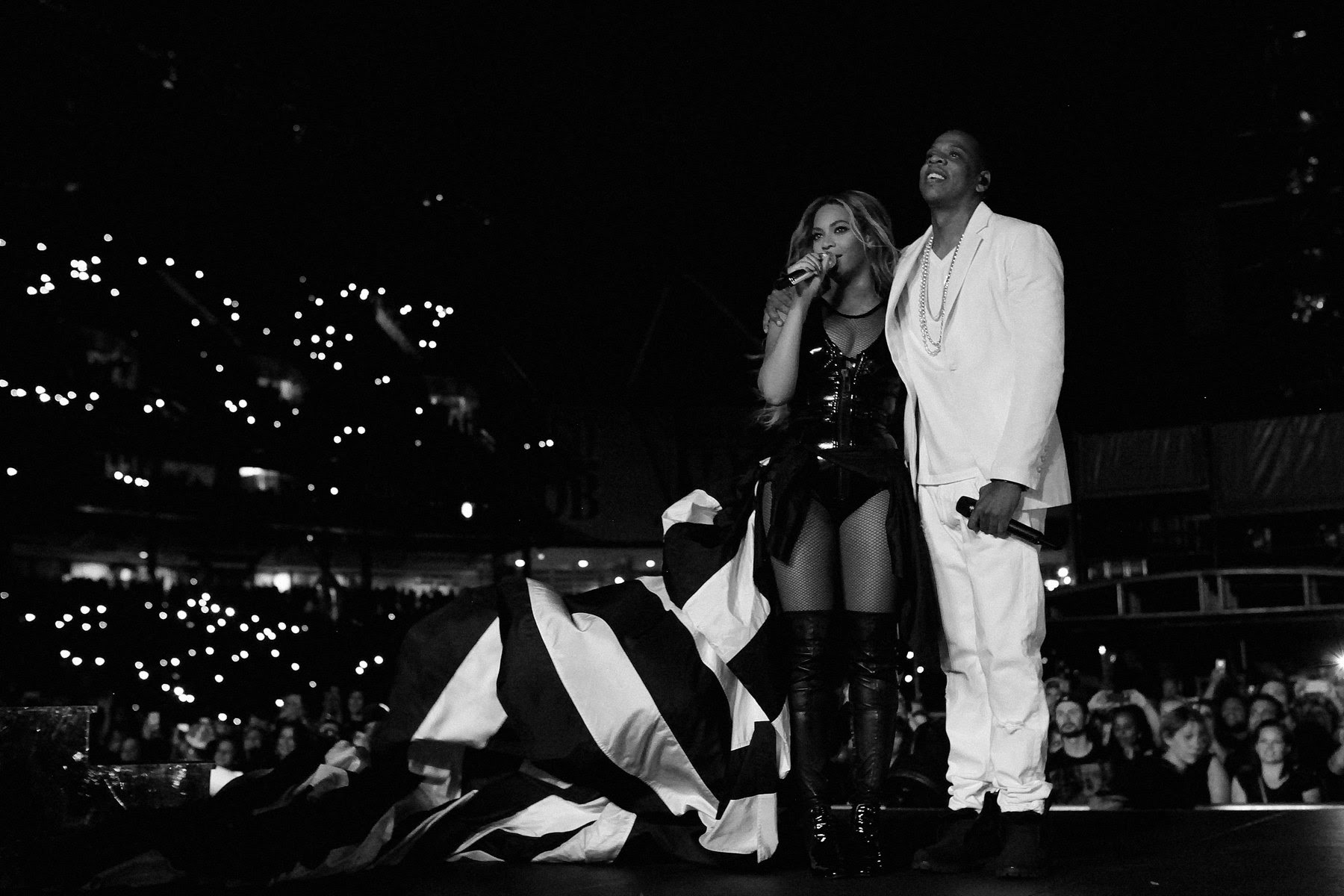 Firstly, both articles apply fairly conventional European fine art aesthetics to the album. Wilson invokes pre-Enlightenment European aesthetics to argue that the “reality show aspect” of the album is somehow aesthetically inconsistent with great pop music. Prior to the 17th century, it was commonly thought that the status of a work’s form or medium ought to correspond to the status of its representational content: painting, the most highly regarded art form, should have subject matter of equal stature–gods and royalty. Wilson’s claim that “the other distraction is the way that the album’s central suite of music interacts with tabloid-style gossip (and a certain elevator video clip) about Beyoncé and her husband Jay Z” echoes that centuries-old sentiment, a sentiment which is about as alien to Lemonade’s aesthetic as, well, Boethius is.
Fallon begins his article with a genuflection to Prince (as does Wilson), scrunches its nose at the gossipy lyrical and narrative content, and then twice scoffs at the very idea of a visual album, “whatever that is,” as though we in the West don’t have precedents for this sort of Gesamtkunstwerky (the total artwork combining music, visuals, and lyrics) thing going back to Wagner and the Florentine Camerata (the collective attributed with inventing opera in the 17th century). He does talk more extensively about the sounds and music than Wilson does, but given the rapid turnaround he also faced, there’s not a lot of close listening to specific musical figures, performances, or compositional techniques, mostly just a survey of the different genres on the album.
Wilson says that the cheating story detracts from the album’s musical quality because it’s an unoriginal narrative:
a drama of jealousy, betrayal, and reconciliation, one of the most ancient and common of human experiences, and of songwriting fodder…that issue of thematic freshness may render some of the songs here less distinctive and invigorating than Beyoncé was.
I find this an odd criticism to level at a pop album, or even an artwork. Nobody would say that West Side Story or Romeo & Juliet were aesthetically diminished because they recycled that tired old theme of jealousy, betrayal, and (failed) reconciliation. Moreover, as Angela Davis argued in Blues Legacies and Black Feminism, these themes of jealousy, betrayal, and reconciliation are the foundation of black feminist pop music aesthetics in a personal-is-political kind of way. Both articles force a contextually incorrect definition of “politics” onto the album, one which sees the most intimate details of relationships, sex, and kinship as merely personal and apolitical. Fallon, for example, says “there’s no doubt that the music on the album is far more personal than it is political.” Both critics fail to consider it in terms established in black women’s pop performance traditions.
Even in Wilson’s attempt to focus strictly on the music, he spends most of the time talking about visuals and lyrics. He hears a wide range of sonic references in Lemonade, from Dolly Parton to Donna Summer to the Lomax recordings to calypso. But he thinks this makes it sound derivative: “as an aural album, Lemonade is a little less fascinatingly singular and eccentric than Beyoncé” (Wilson). Fallon makes an almost identical remark in his article: “Lemonade doesn’t hurl itself toward any genre in a statement of artistry. Instead it masters… um, all of them, but in turn doesn’t make the same powerful statement of Beyoncé’s artistic mission, like her last album did.” Contrast this with the way Jonathan Shecter talks about Diplo’s post-genre eclecticism as “fresh and cutting-edge,” part of an “ongoing artistic evolution.” As philosopher Christine Battersby has argued, the habit of thinking that flexibility is a sign of innovation when attributed to white men, but a sign of regression when attributed to anyone else, is a habit that goes back to the 19th century. It’s not surprising that Beyoncé gets dinged for the same thing that garners Diplo praise: in her case, what Fallon calls “the most daringly genre-hopping music she’s ever produced” is evidence of unoriginality, whereas in Diplo’s case post-genre eclecticism is evidence of his ability to distinctively transcend provincialism. Even when Wilson’s article does manage to talk about sounds and music, it trivializes Beyoncé’s other artistic achievements on the album.
Both articles rely on some gendered and racialized interpretive habits to address the song’s aesthetic value, lyrical content, and Beyoncé’s artistry. But what about their discussion of the music?

“listen” by Flickr user Robyn Jay, CC BY-SA 2.0
These same racialized, gendered habits tune Wilson and Fallon’s listening and mask the sonic dimensions of Lemonade that don’t fit their narrow concept of music. Both critics make a conceptual move that separates musical practice from black feminist practice. Fallon uses some parentheses and a “but…?” question to put rhetorical and grammatical space between Lemonade’s black femininity and its musical and sonic features: “(By the way, it’s powerful, and feminist, and unapologetically black, and transfixing, and gorgeous, and assured, and weird, and confusing, and dumb, and groundbreaking.) But hey: Is the music any good?” This framing defines “the music” as something distinct and independent of the album’s black femininity, as though black women’s and black feminist musical traditions didn’t infuse the album’s music…or, to the extent they do, they don’t count as “music.”

“Listening” by Jens Schott Knudsen, CC BY-NC 2.0
Wilson makes an identical move. Following the white liberal feminist aesthetics that influence lots of contemporary post-feminist pop, Wilson’s piece locates treats the black feminist message primarily in the video. “In video form…it’s more evident that [Lemonade] is equally the cyclical story of generations of black women dealing with men and balancing their struggle for R-E-S-P-E-C-T (as well as S-E-X) against the violations and injustices of race and gender.” He sees the politics in the visuals, but doesn’t consider the sounds as having anything to say or do about that story and that struggle.
This approach isn’t limited to well-meaning but ignorant white men pop critics: even bell hooks’ now (in)famous essay on Lemonade looks at but doesn’t listen for its politics. She argues that it is a “visual extravaganza” whose “radical repositioning of black female images does not truly overshadow or change conventional sexist constructions of black female identity.” Locating the politics entirely in Lemonade’s visuals, hooks’s essay treats black feminism as something contested solely in terms of images. (And divorcing the images from the sounds fails to consider the fact that the sounds impact how viewers interpret what they see.)

Screenshot from Lemonade
This is the wrong method to use for thinking about Lemonade and Beyoncé’s work as a whole (and pop music in general). Sounds on this album don’t operate independently of black femininity, black women’s performance traditions, or individual artists’ black feminist politics. On the one hand, thinking with Daphne Brooks and Regina Bradley, it’s more accurate to say that Beyoncé’s sound game has generally led the way and been more politically cutting-edge than her visual game. On the other hand, sound can also be what does the heavy lifting for patriarchy and other systems of domination, as I argue here. Separating the music itself out from the political content misrepresents what music is and how it works. And it is a particularly gendered misrepresentation: critics are not so eager to separate Kendrick’s sounds from his politics. In both white and black philosophical traditions, dominant concepts of politics and the political are normatively masculine (just think about the gendered public/private distinction, for example), so from these perspectives feminine and feminized sounds don’t feel or seem “political.”
But in these two cases the divorce between music and politics is also what lets white men pop critics have authority over black feminist music. If they can distill Lemonade down to its “solely musical” aspects, then they can plausibly present themselves as experts over generic, depoliticized sound, sounds disconnected from knowledges and values tied to particular lived experiences and performance traditions. Problem is, in the same way that there is no generic ‘person’ without a race or a gender, there is no generic, depoliticized sound. As Jennifer Stoever has argued, even though Western modernity’s occularcentric epistemology obscures the sonic dimensions of white supremacist patriarchy and the subaltern knowledges developed under it, sounds nevertheless work politically. Digging deep into the music on Lemonade or any other pop song does not involve abstracting the music away from every other aspect of the work and its conditions of production. Digging deep into the music part of pop music means digging deeper into these factors, too.
When Regina Bradley, Dream Hampton, Laur M. Jackson, Zandria Robinson, and Joan Morgan talk about how Lemonade makes them feel, what affects and knowledges and emotions it communicates, they are talking about the music–they just work in a tradition that understands music as something other than ‘the music itself’ (that is, they don’t think music is abstracted away from visual and cultural elements, from structures of feeling common to black women with shared histories and phenomenological life-worlds). As I have tried to show in my own work, the sounds and musical performance are central to Beyoncé and Rihanna’s work because they engage traditions of black women’s and black feminist knowledges. Aesthetic practices develop and emerge as types of implicit (i.e., non-propositional or non-verbal) knowledge, knowledge created in response to lived experiences in a particular social location. Aesthetic practices can communicate and perform knowledges that reinforce systems of domination, and they can also communicate and perform subordinate knowledges that map out strategies for survival amid domination. Dominant institutions (like the music industry) and people from dominant groups (like Iggy Azalea or Eric Clapton) separate the aesthetic practice from the implicit knowledges that make it meaningful, and thus neutralize those knowledges and make the aesthetic practice fungible and co-optable. Talking about “the music itself” or “solely music” does the same thing: it is a form of what philosophers call epistemic violence.

Screenshot from Lemonade
So, asking “but what about the music?” is a way to dig into those implicit knowledges to show where much of this epistemic work is happening. And that’s good analysis that isn’t (necessarily) epistemically violent. It demonstrates what Stoever calls “an ethical responsibility to hear African American cultural production with…assumptions about value, agency and meaning” (31) that are appropriate to them. But you can also ask “but what about the music?” in a way that abstracts away from these implicit knowledges. That’s what Wilson’s and Fallon’s pieces do, and that’s why they’re both epistemically violent and objectively poor methods of musical interpretation. But we can and do better when we write about and theorize the music part of pop music. And, to riff on Mariana Ortega’s argument in her article on the type of epistemic violence she calls “loving, knowing ignorance,” doing better means listening to and with black women, black women’s music, and black feminist aesthetics. You can’t divorce music or listening from politics; listening better can and will follow from practicing more just politics.
—
Robin James is Associate Professor of Philosophy at UNC Charlotte. She is author of two books: Resilience & Melancholy: pop music, feminism, and neoliberalism, published by Zer0 books last year, and The Conjectural Body: gender, race and the philosophy of music was published by Lexington Books in 2010. Her work on feminism, race, contemporary continental philosophy, pop music, and sound studies has appeared in The New Inquiry, Hypatia, differences, Contemporary Aesthetics, and the Journal of Popular Music Studies. She is also a digital sound artist and musician. She blogs at its-her-factory.com and is a regular contributor to Cyborgology.
—
 REWIND!…If you liked this post, you may also dig:
I Been On: BaddieBey and Beyoncé’s Sonic Masculinity-Regina Bradley
Listening to Sounds in Post-Feminist Pop Music-Robin James
Of Resilience and Men: How Bieber, Skrillex, and Diplo Play with Gender in “Where Are Ü Now”-Justin Burton
Share this:

Desiring Medieval Sound

 Each of the essays in this month’s “Medieval Sound” forum focuses on sound as it, according to Steve Goodman’s essay “The Ontology of Vibrational Force,” in The Sound Studies Reader, “comes to the rescue of thought rather than the inverse, forcing it to vibrate, loosening up its organized or petrified body (70). These investigations into medieval sound lend themselves to a variety of presentation methods loosening up the “petrified body” of academic presentation. Each essay challenges concepts of how to hear the Middle Ages and how the sounds of the Middle Ages continue to echo in our own soundscapes.
The posts in this series begins an ongoing conversation about medieval sound in Sounding Out!. Our opening gambit in April 2016, “Multimodality and Lyric Sound,” reframes how we consider the lyric from England to Spain, from the twelfth through the sixteenth centuries, pushing ideas of openness, flexibility, and productive creativity. We will post several follow-ups throughout the rest of 2016 focusing on “Remediating Medieval Sound.” And, HEAR YE!, in April 2017, look for a second series on Aural Ecologies of noise! –Guest Editors Dorothy Kim and Christopher Roman
—
In fall 2013, The Cloisters’ Fuentidueña Chapel was brimming with bodies in motion, in relation, in sound and in silence, attracting ear and eye away from the hall’s sparse collection of medieval sculpture and fresco to a performance unfolding in its midst. For the first time in its seventy-five year history, The Cloisters presented a work of contemporary art: Janet Cardiff’s Forty-Part Motet (2001), a site-specific virtual performance of Thomas Tallis’s famous sixteenth-century, forty-part motet Spem in alium, played on a continuous fourteen-minute loop through an array of forty high-fidelity speakers.
It was, by all accounts, a resounding success. Reviews in the The Wall Street Journal, The New York Times, The New Yorker, and NPR’s Soundcheck were rhapsodic. The volume of visitors to The Cloisters, which houses most of the Metropolitan Museum of Art’s medieval collection, tripled. On the day I visited, I found myself deeply moved—in part by the music, yes, but also by my weird intimacy with each speaker’s singular human voice, and by the unguarded auditions unfolding all around me. One couple chatted cheerily over the music; a white-haired matron sharply shushed them quiet. Some sat on benches or the apse steps, eyes closed; many travelled from speaker to speaker, lingering. One visitor openly wept. I learned from a museum attendant this was a near daily occurrence.
How could a looped recording of Renaissance polyphony generate such outpourings of enthusiasm and emotion?
By multiplying auditions. By putting bodies in relation. By sculpting space. By dislocating time. By sounding in The Cloisters. By irrupting the Middle Ages. By desiring medieval sound.
Sculpting

John Speed, Nonesuch Palace, 1610
Cardiff’s installation arranges forty high-fidelity speakers on stands at roughly head height in a large, inwards-facing oval array. Each speaker emits one of the motet’s forty distinct voice parts, individually recorded by singers from the Salisbury Cathedral Choir. Historical evidence suggests that Tallis composed Spem in alium to be performed this way, in the round, high in one of the royal Nonsuch Palace’s octagonal towers, where the work’s eight vocal quintets could imitatively pass musical material around the tower’s circumference, respond antiphonally across its diameter, and bombard the center with forty-voice polyphonic counterpoint. “It was like the composer was a sculptor,” Cardiff explains, “and I wanted to show how sculptural the piece of music was.”
Spem in alium chimes with the whole of Cardiff’s body of artistic work in its abiding interest in the physicality of sound, “in how sound may physically construct a space in a sculptural way and how a viewer may choose a path through this physical yet virtual space.” The language she uses to describe her work here links sound and motion in the sculpting of space: as the sound moves between choirs, variably filling acoustic space with voice, so audiences move among speakers, plotting itineraries according to the physical, visual, and aural push and pull of bodies in relation to other bodies. Moving and being moved are the hammer and chisel Cardiff use to give sounding space its shape.

Inhabitation
Cardiff describes the genesis of Forty-Part Motet in an interview: “When you listen on your stereo it’s so frustrating because you know all these people are there, but you can’t hear them. I just wanted to climb inside and hear them individually.”
Syntactically, what does Cardiff want to climb inside of, so that she might hear voices individually?
The radio—but that would merely eliminate a mediating technology, putting her in the concert hall or cathedral, no closer to the individual voice. The performance—but that would render her a singer, her own voice filling her hearing so she’s unable to attend to the voices of others. No—Cardiff seems to wish to climb inside each singer to hear their voice individually, intimately, as if her own. The motivation driving Forty-Part Motet amounts to a fantasy of transpersonality.
Cardiff employs these same transpersonal tropes to describe her audio walks: dream-like, site-specific, binaural soundworks narrated on a Walkman which seek to create
a surrogate relationship with a viewer… People could get this intimate connection with this virtual person in the audio walks, in the same way they can with Motet…. They hear the sound of my breathing; it’s right at the back of their necks, but not in a creepy way. It’s almost in a natural way; it’s almost in their head.
In Forty-Part Motet, though, this intimacy is in reverse. It’s not another’s voice in our head. It’s us visiting voices in the heads of forty others.
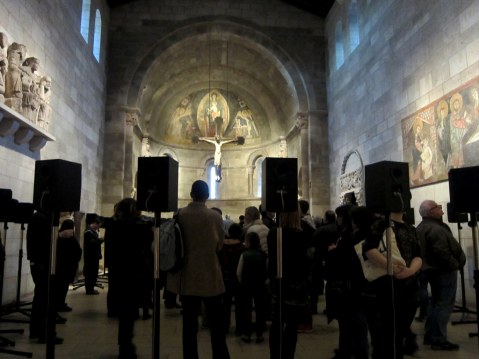
Cardiff, “Forty Part Motet” at the Cloisters in NYC, Image by Flickr User Allison Meier
Motet
Latin for “Hope in another,” the incipit of a medieval Sarum rite responsory from the Vulgate Book of Judith, Spem in alium is widely considered Tallis’s greatest work. The motet is experimentally syncretic in structure and style. It opens with elaborate polyphony frowned upon as too Catholic in the Protestant England of the mid-sixteenth century, when the work was composed and premiered. A point of imitation percolates through four quintets of soprano, alto, tenor, baritone, and bass, until twenty singers voice twenty distinct lines, obscuring any sense of rhythmic pulse and textual intelligibility. This mass of vocal sound passes through the eight total quintets until it completes a full rotation through the choir.
All forty voices enter at once for the first time at the fortieth breve [3:08 in video above]. The quintets then rotate back to where they began, and the mass of forty contrapuntal voices resurges [5:20], made all the more massive by slow harmonic movement between tonic and dominant. We are hit with a sonic welter, nimble and static all at once.
Suddenly, all voices fall silent [5:40]. This is the first of three caesuras in the piece, all of them crucially important: they articulate the motet into distinctly characterized segments, they offer aural contrast to the work’s welters of sound, and they create opportunities for forty-strong choral entries, rare moments where all voices coordinate, where the horizontality of the vocal line temporarily vanishes before vertical harmonic coordination.
Following this first hiatus, Spem in alium adopts a distinctly homophonic and antiphonal style: the text is clear, rhythms readily discerned, as English sacred music responsive to Reformation ideals aspired to be. A transparent voicing on tonic C major precedes the second caesura, whose yawning gap gives onto alien sonority: A major [8:06]. Non-functional, unresolved, otherworldly, the chord hangs across all voices for the span of a breve before shifting mode, C-sharp giving way to C-natural, the motet resuming diatonicity and building momentum towards its final seventeen breves’ worth of full-throated, forty-voice polyphony [9:08].
For a moment, though, Spem in alium cracks open, slowing time, reconfiguring voice. Something utterly other irrupts into audibility, arresting, ephemeral, ravishing—and then is smoothed away.
Temporalities
Carolyn Dinshaw opens her love letter to the amateur medievalist, How Soon is Now?, with an anecdote about a bespectacled young man in a dark blue bathrobe at the fall 2008 Medieval Festival at The Cloisters. “[H]e had glanced around his house and grabbed something that looked like a monk’s robe or that otherwise signified ‘medieval’,” she writes. “The past is present in this intimate, mundane element of undressed everyday life” (2). Dinshaw gives a name to the nonce infolding of past and present that captured her fascination in the figure of this young man: “asynchrony: different time frames or temporal systems colliding in a single moment of now” (5).
It’s no accident that Dinshaw launches her study of medieval and medievalist asynchrony at The Cloisters: the museum building is a patchwork of medieval architectural elements spanning the eleventh- through sixteenth-centuries, lifted wholesale from their European sites and mortared together with modern materials and techniques in a medieval style. In the Fuentidueña Chapel where Forty-Part Motet was installed, for example, a twelfth-century Spanish apse’s mottled limestone abuts neat grids of hewn block and smooth tile that forms the modern nave; the modern structure’s recessed clerestorial apertures emulate the apse’s Romanesque slit windows, permitting only the skinniest vertical bars of light.
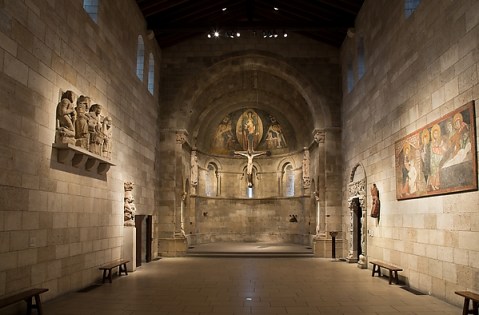
The Fuentidueña Chapel, The Cloisters, New York City
Thomas Hoving, former curator of the medieval department and director of the Met, describes two attitudes towards The Cloisters’ amalgamative architecture: critical disdain towards a “hodgepodge of ancient European architectural history, ripped out of context, pasted together to form a dreamlike but haphazard ensemble” (56); and affectionate reverie: “If you dream a little, you can float through time to the eleventh… through [the] twelfth… all the way to the beginning of the sixteenth century” (58).
In many ways, dream is the mental site of asynchrony where memory and vicissitude, anxiety and hope promiscuously mingle. The museum, that consummate heterotopia assembling traces of the past in a single moment of now, likewise manifests asynchrony in physical space. The Cloisters, then, is a dream of the Middle Ages, a locus of temporal heterogeneity we enter after crossing the greenwood of Fort Tryon Park, as if on pilgrimage into the past, still clothed in our everyday life.

The Cloisters, NYC, 2014, Image by Flickr User Alex.Palmer
Ghosts
I.
Shortly before Forty-Part Motet was installed at The Cloisters, Janet Cardiff Googled one of her favorite singers from the recording, to see how he was getting on. She found a funeral announcement. “He’s still singing in the choir,” she remarks.
II.
Asynchrony takes “the form of restless ghosts haunting the present” (34).
III.
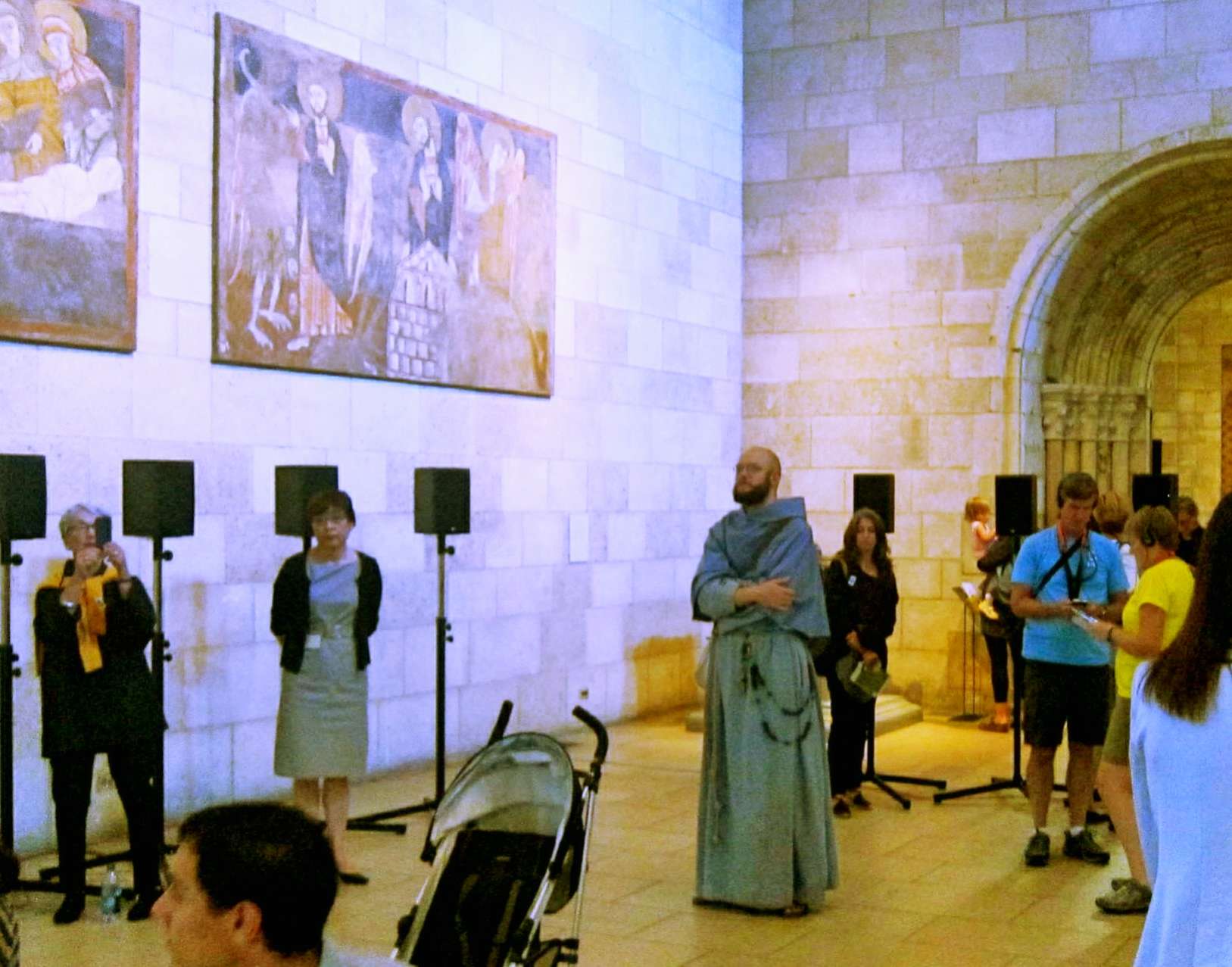
The press opening for Forty-Part Motet was visited with an apparition:
The Brother entered, listened to the nine-minute motet, and his face glowed… When it was finished, he glided out. Perhaps (Videte miraculum!) he has lived in the Funtedueña Chapel for its thousand-odd years, and appears only for special celebrations.
A photo taken at the event shows a man in a monk’s habit, glasses perched on his nose, his robes a faded shade of blue.
IV.
Cardiff relates the moment she discovered sound as her medium:
I was recording with the tape recorder out in the cemetery. I had a headset on and I was walking around doing research, just recording the names of the people on the headstones… Then I pressed stop and… I hit rewind by mistake, so I had to press play to find out where I was. All of a sudden I heard my voice describing what was in front of me and my footsteps walking… I was electrified. It was really, really incredible.
V.
1557. Spem in alium was probably commissioned by Henry Fitzalan, 12th Earl of Arundel. Alexander Blachly argues for a 1556 premiere, but “that premiere seems not to have occurred—most likely because of the death of Fitzalan’s son and daughter in 1556, and of his wife in 1557.” The motet was probably premiered under Queen Elizabeth in 1559, one year after the death of Queen Mary, its likely original dedicatee, for “a select seated audience of perhaps thirty or forty people”, in an octagonal tower chamber “roughly 25 feet in diameter (almost identical to the 27-foot width of the Fuentidueña Chapel at The Cloisters).”
VI.
“[T]he speakers are a little like the tomb effigies of knights and ladies held in another chapel space of The Cloisters, containing something of the person who lived… [while] an object that also has nothing to do with that person except in memory.” That something is, of course, their voice.
VII.
The performance of Spem in alium runs to about ten minutes. Cardiff’s looped recording runs to fourteen. In those four extra minutes, the singers clear their throat, mutter to themselves, chat idly, moan about last night’s bender, excuse themselves to the loo. In a hall full of murmuring visitors, it’s difficult to tell which voices come from which bodies, or whether voices still come from bodies to begin with. This is the acousmatic situation, as Brian Kane describes it, a phantasmagoria that “[posits a] sphere outside the bounds of the mundane world… manifested in this world only at special or singular moments” (108).
VIII.
Cardiff explains to WNYC’s Studio 360 that “each individual speaker is an individual singer… You realize that, yeah, these are real people” [1:30 in the audio clip below]. Reporter Jamie York goes on to remark that “in some ways, the speakers are more like people than people are” [4:06]: unguarded, approachable, vulnerable, obverses of the brusque, hardened urbanites attending the installation. One visitor draws the obvious conclusion: “What the work does, the position that it puts you in, is really one of a ghost” [6:31].
Studio 360 – Show 1443 Janet Cardiff
.
Desiring
Dinshaw aligns asynchrony with the loving labors of the amateur, reminding us of the word’s etymology, and with amateur forms of knowledge “derived not only from positions of detachment but also… from positions of affect and attachment, from desires to build another kind of world” (6). Cardiff’s work is similarly about affect and attachment, about “space impregnated with memory and desire, expectation” (32), about the active construction of worlds between persons, in that word’s etymological sense. Her soundwork blurs boundaries between presence and absence, inside and outside, the living and the dead, the aesthetic and the everyday; it performs the world’s “slippage between the recording and the recorded, the past and the present, and the confusion of what is memory and what is our present” (35).
What memory does Forty-Part Motet slip us into?
Surely, a fraught one: we take a seat in the towers of Nonsuch Chapel, we exchange pleasantries with that select audience, we hobnob with the Queen. This is the false memory of cultural fantasy, and we do well to interrogate it for what, and who, it includes and excludes.
Yet, we don’t remember, exactly. We did not, cannot perceive the soundwaves that filled the upper room in 1559. We do not sit with that aristocratic audience, stationary at the center of a compass of eight quintets. Rather, we circulate in space and in time, seen and unseen. We are ghosts who enter into relation, body to body, with persons not there, whom we cannot know, and with persons there, whom we come to know in a bed of sound. We oscillate between self and other, a hopeful vibration; we traverse and, in traversing, sculpt the space between singular voice and multiple chorus with our desire-moved bodies. We temporarily become the owners of voices not ours; we are undone and made intimate, in a visible and invisible community of intimates.

“At the cloisters for Janet Cardiff’s 40 part motet,” Image by Flickr User V
Another way of saying this is that Forty-Part Motet slips us into the structure of memory, a structure that resonates in and with the physical structure of The Cloisters, multiplying asynchronies and blurring our quotidian orientations more powerfully than either could manage alone. “We need a non-modern temporal orientation to perceive [temporal] heterogeneity,” to resist modernity’s “subject-object split,” “to explore subjective attachment rather than objective detachment” (183n129). More attachment, Dinshaw implores, and indeed, how else could a looped recording move so many? How else to open the narrow aperture through which a medieval past momentarily irrupts into the present—non-functional, unresolved, otherworldly, in the space of sound?
—
Featured Image: “Janet Cardiff’s installation ‘The Forty Part Motet’ in the Fuentidueña Chapel” by Flickr User Joe Schultz
—
Andrew Albin is assistant professor of English at Fordham University at Lincoln Center. He facilitates the Fordham Medieval Dramatists in their biennial performance of early English drama for public audiences at Fordham and in NYC. Publications include articles on the Chester shepherd’s play in Early Theatre and on Chaucer’s Prioress’s Tale in The Chaucer Review, and a chapter in the edited collection Voice and Voicelessness in Medieval Europe on Richard Rolle’s Melos amoris; Prof. Albin is also currently preparing a multimedia, alliterative English translation of the Melos amoris for publication under the PIMS Mediaeval Sources in Translation series. He has also collaborated in the creation of musical works that have been performed across the United States and in Europe.
—
REWIND! . . .If you liked this post, you may also dig:
Sounding Out! Podcast #13: Sounding Shakespeare in S(e)oul— Brooke Carlson
Maile Colbert, Rui Costa, and Jeff Cain’s “Radio Terramoto” — Maile Colbert
Queer Timbres, Queered Elegy: Diamanda Galás’s The Plague Mass and the First Wave of the AIDS Crisis–Airek Beauchamp
Share this:


Current Top Posts





April 2021

January 2020

November 2019

October 2019

August 2019

April 2014

November 2017

March 2015

December 2017

October 2015
 Sounding Out!
Recent Comments