
“HOW YOU SOUND??”: The Poet’s Voice, Aura, and the Challenge of Listening to Poetry
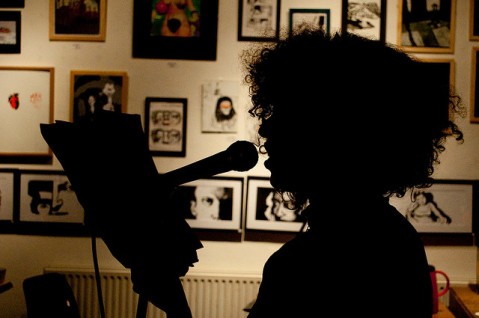
This post is dedicated to the memory of Amiri Baraka, who passed away on January 9, 2014 in Newark, New Jersey.
I began writing this post while my wife, Sarah, was at a conference on writing curriculum for high school literature. Over the phone one night she asked how to help students better understand the language of Shakespeare, and at a loss for suggestions (not only because I don’t study early modern drama), I recalled my own adolescent struggles with Macbeth, Hamlet, and Julius Caesar. I recalled well-intentioned teachers who gave me recordings, telling me that they would help me get an “ear” for Shakespeare’s language—yet all I remember, maybe all I learned, while listening to the Caedmon recording of Macbeth on vinyl, was that, to my mid-1990s ear, Shakespeare (anachronistically) sounded like Star Wars (which appeared 15 years after the 1960 Caedmon album).
My high school confusion has not completely faded when it comes to the sound of recorded poetic language, even more so when the notion of the poet’s voice is thrown into the mix. As opposed to verse recited by actors (the Caedmon Macbeth featured Anthony Quayle), or the sound of the syllables when we read a poem silently to ourselves, I find it tough to parse the idea of the sound of the poem in terms of the poet’s voice because “voice” is a slippery category—a constructed one, contingent upon the given historical moment of inscription and reception. It is tough because this idea of the sound of the poem, located in the voice of the poet, gets complicated with sonic technologies where voice is subject to the shifting conditions of fidelity.
“Record Player” by DeviantArt user SomeAreLove, CC-BY-NC-ND-3.0
The act of listening to recorded poetry thus poses particular analytic challenges, which become more complex when the politics of identity are brought to bear on these questions of voice and poetry. As a site for identity production, the recorded poetry performance projects a mediated voice that is a potential self. The “sound” of this poetic subjectivity is different from recording to recording, even of the same poem. In an effort to work through these complexities, this post takes up three different recordings of Amiri Baraka’s poem “Black Dada Nihilismus,” which offer variations in delivery and performance that each depend upon the social, political, and aesthetic dimensions of the soundscape that each recording is embedded within.
“Black Dada Nihilismus” is an excellent opportunity to consider the overlapping challenges of voice, performance and the politics of identity in recorded poetry. Published in the early 1960s, this poem was written before Baraka’s shift in politics, which was precipitated by the assassination of Malcolm X in 1965, yet the poem anticipates the intersection of aesthetics and politics during the Black Arts Movement in the late 1960s into the 70s. This shift can be tracked in the sonic details of the first two recordings, made in 1964 and 1965. In the third version, a 1993 remix by DJ Spooky, we can hear how this shift reverberates beyond its historical moment.
In a statement of poetics included in Donald Allen’s classic 1959 anthology The New American Poetry, Baraka (then Leroi Jones) asked: “HOW YOU SOUND??” How a poet’s poem sounded mattered most for him: “you have to start and finish there … your own voice … how you sound” (425). Primarily referencing the poem on the page, he wasn’t whistling in the dark: often thought of as a vocal performance of language, poetry has a long history with sound. One thread of this history is the Homeric tradition of an “oral poetics,” a tradition where, as Albert Lord notes in The Singer of Tales, socialized performances of poetry were simultaneously modes of composition. The feel of language in the body remained inseparable from the poetry that relayed the heroic tales of the ancient world. In The Sounds of Poetry, Robert Pinsky offers a similar account of sound and voice, suggesting that the “sound” of language, the sensuous play of speech, is the material for poetic composition. Or as Charles Bernstein has it in Close Listening, “poetry needs to be sounded” because it is a way to understand it better (7).
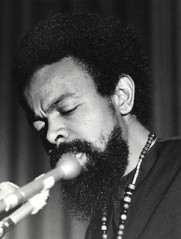
“Le Roi Jones” by Flickr user UIC Digital Collections, CC BY-NC-ND 2.0
Poetry is often said to be difficult—but how would a poet’s “sounding” of a poem help a listener better understand it, as Bernstein suggests? How is the recorded voice resonating in air different from inert marks on a page? What is the status of that difference? Why or how would the sound recording signify differently than the poem on the silent page? In short, is listening easier than reading? My answer to the final question is a resounding “no.” For me, the challenge is how to consider the recorded poetry performance in both formal and aural terms so as to remain tuned in to the aesthetic and the poetic as well as the social and historical dimensions of a particular poet’s work. This is not easily done.
“Black Dada Nihilismus” was first published in The Dead Lecturer (1964) and later included in Transbluesency (1995). Written in two parts, it asserts a black aesthetic by critiquing the dominance of (white) light in Western art and suggesting a connection between this light, ethnic violence, and religious ideology. This is how the poem opens:
.Against what light
is false what breath
sucked, for deadness.
Murder, the cleansed
purpose, frail, against
God, if they bring him
Bleeding, I would not
forgive, or even call him
black dada nihilismus.
The protestant love, wide windows,
color blocked to Modrian, and the
ugly silent deaths of jews […]
(Transbluesency 97)
Through critique the poem develops the connections between aesthetics and racial dominance and violence. These connections take on different inflections in each recorded version of the poem, and with each inflection another aspect of them is amplified.
The first version is a bootleg of a reading at the Asilomar Negro Writers Conference that was held in Pacific Grove, California, in early August, 1964.
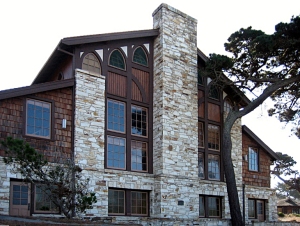
Asilomar Conference Grounds, site of 1964 Negro Writers Conference
In addition to the preamble, where Baraka explains some of the poem’s key terms such as Dada, which he describes as a movement in France (rather than Germany or Switzerland), another sonic detail that marks this as “live” is at the 2:59 minute mark when we hear the flap of a turning page, reminding us that Baraka is treating the poem as a script in these recordings. In this version, the opening lines are sharply delivered, the voice fully pausing at the linebreaks and acutely pronouncing the hard vowels (e.g. “sucked”). Against the continuous background hush of the original reel-to-reel recording, Baraka punches his words into the air, as if trying to find a rhythm between these harder vowels and the softer ones that often denote the poem’s object of critique (e.g. “light”).
The next version is off the A side of New York Art Quartet and Imamu Amiri Baraka (ESP Disk 1965), where the poem’s rhythm is immediately established by the musical accompaniment.
Between the first recording and this one a shift began in Baraka’s development as a poet. The assassination of Malcolm X pushed him to think even more about race, politics, and art. In this version the opening lines, delivered with punch and pause in the bootleg, take on a different register when juxtaposed with the smooth coolness of the quartet. Overall, though, the poem is delivered more militantly here. In the first version the opening lines are delivered forcefully, but ultimately this forcefulness subsides over the course of the reading. The opposite is the case in this studio version that slowly builds to the apex of the poem, the point of most force, this stanza:
Black scream
and chant, scream,
and dull, un
earthly
hollering.
(Transbluesency 99)
In the bootleg, the turn of the page—between “earthly” and “hollering”—interrupts this stanza, and Baraka hesitates and slowly finds his way toward the poem’s close, while in the studio version, the musical accompaniment reaches a fevered pitch here, making it feel as if it is at the edge of the scream that it names. This prepares us for the closing litany of names of black figures of “black dada nihilismus,” which goes like this:
For tambo, willie best, dubois, patrice, mantan, the
bronze buckaroos.
For Jack Johnson, asbestos, tonto, buckwheat,
billie holiday.
(Ibid.)
In the final version, which is DJ Spooky’s remix of the second one, included on the CD Offbeat: A Red Hot Soundtrip (TVT Records 1996), this litany feels more like the outro (that is meant as) against Spooky’s beats and moody reverb.
An aspect of the poem amplified in the remix is the stanzas leading up to the apex stanza of the “black scream.” In a series of tercets that open the second section, the speaker addresses the experience of racial oppression and a growing need to strike back:
The razor. Our flail against them, why
you carry knives? Or brutaled lumps of
heart? Why you stay, where they can
reach? Why you sit, or stand, or walk
in this place, a window on a dark
warehouse […]
(Transbluesency 98)
The “why” is significantly amplified in the remix, forcing us to hear the ironic indictment of the oppressive “light,” not as audible in the other two tracks, explicit in Baraka’s tercets.
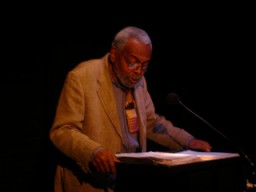
“IMG_0433″ by Flickr user Beyond Baroque, CC-BY-NC-SA-2.0
The original recordings of these versions of “Black Dada Nihilismus” are each in a different format: vinyl LP, tape-to-tape reel, and CD. I have been working with digitized versions, so the way I am hearing these recordings—through a smooth digitized MP3 file or Youtube clip—is not the same as the crackle of a needle running an LP’s groove or a nearly noiseless laser tracing a CD. These variations in format mean that the different ways these versions individual signify—their respective “sounds”—are flattened out by compression. Despite this loss of material context, Baraka still sounds different in each of these tracks. Each version of Baraka’s poem offers us another iteration of his “voice,” and the poem, but listening to each of them does not necessarily provide a better understanding of it. We are, though, given different sonic experiences that depend upon the purpose of Baraka’s performance, the listener imagined during the reading, and the voice enunciated through the mediated environment.
Some of the voice details do remain consistent across these recordings. For example, the delivery of one of the poem’s most memorable phrase—“Hermes, the/the blacker art”—that occurs toward the close of the poem’s first section is steadily delivered in a lower register, in the hush of an aside, and might be taken as the motif of each of these variations.
“Stage Microphone TTV” by Flickr user Keith Bloomfield, CC-BY-NC-ND-2.0
A vast archive of recorded poetry exists. Mid-century recording projects by Caedmon and Folkways made “voices” of well-known poets, such as Robert Frost and Dylan Thomas, available for mainstream consumption. More recent anthologies and series like Poetry Speaks and The Voice of the Poet suggest that the “voice of the poet” still holds appeal. The proliferation of online sound archives such as Penn Sound and From the Fishouse further attest to an ongoing investment in recording, storing, and making available sound files of poets reading their work. And this fascination with the “sound” of poetry is not limited to mainstream cultural spheres or web-based archives. Several scholarly collections on this convergence of sound, voice, and poetry such as Bernstein’s already-mentioned Close Listening, Adelaide Morris’s Sound States, and Marjorie Perloff’s and Craig Dworkin’s The Sound of Poetry/The Poetry of Sound have appeared over the last decade.
The idea of the sound of the poem, located in the mediated voice of the poet, therefore remains relevant today. In many of these instances, however, the poet’s voice falsely takes on an authoritative “aura,” as Walter Benjamin used that word in his (recently re-translated) “The Work of Art in the Age of Its Technological Reproducibility.” Benjamin uses “aura” to talk about authenticity in art and how that is lost when images (or sounds) can be reproduced and widely distributed, and this is not a bad thing: “technological reproducibility emancipates the work of art from its parasitic subservience to ritual. To an ever-increasing degree, the work produced becomes the reproduction of work designed to be reproduced” (24). When Benjamin’s concept is applied to recorded poetry, two key points emerge. First, the “sound” of a poet’s voice is the product of technological conditions. Second, just as a book editor makes aesthetic judgments based on a perceived audience, a listener is imagined when a poetry performance is recorded. Too bad I didn’t know this in high school.
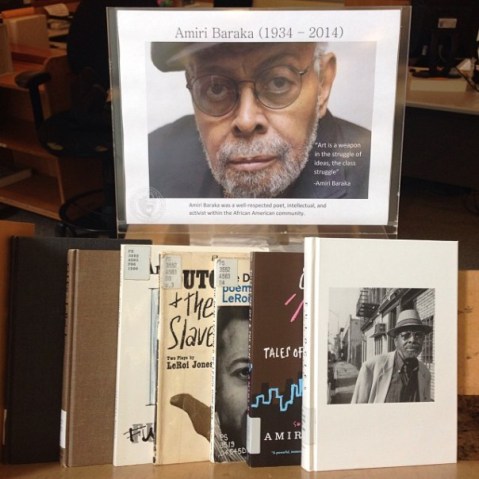
“A Poem for Speculative Hipsters by Amiri Baraka” by Flickr user Shawn Calhoun, CC-BY-NC-2.0
—
Featured image: “Paula Varjack” by Flickr user Very Quiet, CC-BY-SA-2.0
—
John Hyland recently completed his dissertation on sound, poetics, and the black diaspora, titled “Atlantic Reverberations: The Sonic Performances of Black Diasporic Poetries,” at the University at Buffalo, SUNY. His poems, essays, and reviews have appeared (or are forthcoming) in a range of journals, such as The Journal of Postcolonial Writing, College Literature, and Borderlands. Recently, he has enjoyed performing with the Buffalo Poets Theater and co-edited a special issue of the poetry journal kadar koli on the relationship between violence and the expressive arts.
—
 REWIND! . . .If you liked this post, you may also dig:
Hearing the Tenor of the Vendler/Dove Conversation: Race, Listening, and the “Noise” of Texts-Christina Sharpe
Pretty, Fast, and Loud: The Audible Ali–Tara Betts
The Sounds of Anti-Anti-Essentialism: Listening to Black Consciousness in the Classroom-Carter Mathes
Share this:

Musical Encounters and Acts of Audiencing: Listening Cultures in the American Antebellum

 Editor’s Note: Sound Studies is often accused of being a presentist enterprise, too fascinated with digital technologies and altogether too wed to the history of sound recording. Sounding Out!‘s last forum of 2013, “Sound in the Nineteenth Century,” addresses this critique by showcasing the cutting edge work of three scholars whose diverse, interdisciplinary research is located soundly in the era just before the advent of sound recording: Mary Caton Lingold (Duke), Caitlin Marshall (Berkeley), and Daniel Cavicchi (Rhode Island School of Design). In examining nineteenth century America’s musical practices, listening habits, and auditory desires through SO!‘s digital platform, Lingold, Marshall, and Cavicchi perform the rare task of showcasing how history’s sonics had a striking resonance long past their contemporary vibrations while performing the power of the digital medium as a tool through which to, as Early Modern scholar Bruce R. Smith dubs it, “unair” past auditory phenomena –all the while sharing unique methodologies that neither rely on recording nor bemoan their lack. The series began with Mary Caton Lingold‘s exploration of the materialities of Solomon Northup’s fiddling as self-represented in 12 Years a Slave. Last week, Caitlin Marshall treated us to a fascinating new take on Harriet Beecher Stowe’s listening practice and dubious rhetorical remixing of black sonic resistance with white conceptions of revolutionary independence. Daniel Cavicchi closes out “Sound in the Nineteenth Century” and 2013 with an excellent meditation on listening as vibrant and shifting historical entity. Enjoy! —Jennifer Stoever-Ackerman, Editor-in-Chief
—
“To listen” is straightforward enough verb, signifying a kind of hearing that is directed or attentive. Add an “er” suffix, however, and “listen” moves into a whole new realm: it is no longer something one does, an attentive response to stimuli, but rather something one is, a sustained role or occupation, even an identity. Everybody listens from time to time, but only some people adopt the distinct social category of “listener.”
And yet listeners have emerged in diverse historical and social contexts. Arnold Hunt, in his recent book The Art of Hearing, for example, points to the congregants of the Church of England in the late sixteenth and early seventeenth centuries, whose sermon-gadding and intense repetitive listening to preachers became a form of popular culture. Shane White and Graham White, in The Sounds of Slavery, argue that early nineteenth-century black slaves adopted listening, or “acting soundly,” as a way of being that gave everyday sounds—conversation, cries of exertion, hymns—multiple layers of meaning and a power unknown to white overseers. Jonathan Sterne, in The Audible Past, describes the post-Civil War culture of sound telegraphy, in which young working class men trained themselves to employ “audile technique” for bureaucratic purposes, rendering their hearing objective, standardized, and networked.

Physical manifestations of the growing standardization of listening, Dodge’s Institute of Telegraphy, circa 1910 – Valparaiso, Indiana, Image by Flickr User Mr. Shook
We might add our own contemporary iPod era to these examples. We live in a time, after all, when it entirely acceptable to appear alone in public, ears connected to an iPod, head bobbing to the grooves of a vast archive of recorded music. Sampling, playlists, streaming–thanks to playback technologies, the U.S. has become a nation of obsessive listeners, and the power to “capture” a sound and re-hear it, something that began with the phonograph, remains a time-bending drama that can awaken people to their own aurality. Technologized listening, in fact, has spawned many of the icons of music discourse in the past 100 years: Edison’s tone testers in 1910s, record-collecting jitterbugs in the 1930s, audiophiles of the Hi-Fidelity era in the 1950s, Beatles fans with their bedroom record players in the 1960s, the “chair guy” in Memorex’s famous ad campaign of 1980, dancing listeners silhouetted in iPod posters since 2003.
But I think also that phonograph-centric narratives have obscured earlier, equally powerful cultures of listeners. The focus of my recent research, for example, has been the world of antebellum concert audiences. Between 1830 and 1860, the United States developed concentrated population centers filled with boosters and recent migrants eager to embrace a life based on new kinds of economic opportunity. Shaping much of the urban experience was a growing commercialization of culture that generated new and multiple means of musical performance, including parades, museum exhibitions, pleasure gardens, band performances, and concerts. Together, these performances significantly enhanced the act of listening: for people used to having to make music for themselves in order to hear it, a condition common to most Americans before 1830, access to public performances by others provided an opportunity for working and middle-class whites (women, African Americans, and the poor were another matter) to stop worrying about making music and, with the purchase of a ticket, to solely, and at length, assume an audience role.
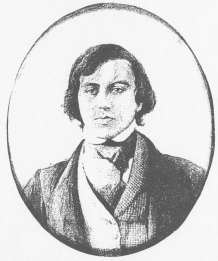
A young George Templeton Strong, Image from CUNY Baruch
The odd circumstance of purchasing the experience of listening provided class-striving urbanites with new possibilities for self-transformation. For many young, rural, white men, for example, arriving to the city for the first time to take clerking jobs in burgeoning merchant houses, being able to hear diverse performances of music was associated with a cosmopolitanism that brimmed with social possibility. Thus, for instance, Nathan Beekley, a young clerk, recently arrived in Philadelphia in 1849, found himself attending multiple performances of music several nights a week, including more and more appearances at the opera as a way to avoid “rowdies.” In New York City during the 1840s, George Templeton Strong, a young lawyer in Manhattan, derided his own musical abilities and instead attended every public musical event he could find, carefully chronicling his listening experiences and analyzing his reactions in a multi-volume journal. Walt Whitman, a young man on the make in Brooklyn and New York between 1838 and 1853, regularly attended every sound amusement he could, including the Bowery Theatre, dime museums, temperance lectures, political rallies, and opera, writing in Leaves of Grass, “I think I will do nothing for a long time but listen/And accrue what I hear into myself.”
This culture of listening was, in many ways, very much unlike ours. Despite an expanded access to performance, for instance, professional concerts before the mid-1850s were often understood as part of a wider ecology of sound. Very few listened to music in ways that we might expect today–focused on a “work,” in a concert hall, without distraction. Listening, in fact, was as much a matter of local happenstance as personal selection—a passing marching band, echoes of evening choir practice at a nearby church, an impromptu singing performance at a party. Such experiences were marked by the momentary thrill of spontaneity and discovery rather than the studied appreciation of familiarity; in any moment of hearing, it was difficult to know how long the encounter might be, or even what sounds, exactly, were being heard. Cities like Boston and New York were especially rich with such surprise encounters.
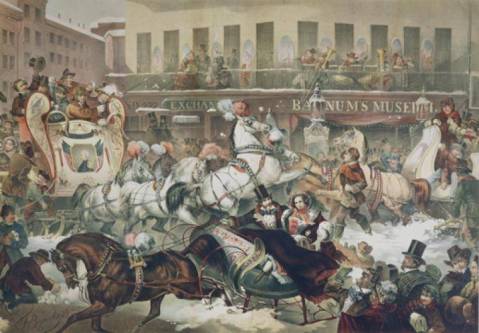
Thomas Benecke’s lithograph “Sleighing in New York” from 1855, which, among many other sounds, depicts musicians performing on the balcony of Barnum’s Museum on the corner of Broadway and Ann Street.
Francis Bennett, a young arrival to Boston in 1854, for example, encountered, in his first night in the city, a band concert and the “cries” from a “Negro meeting house,” and within weeks became enamored of fife and drum bands, often leaving work to follow one and then another as far as he dared. Young writer J. T. Trowbridge was more stationary but equally enthusiastic about what he heard from his New York rooming house in 1847: “The throngs of pedestrians mingled below, moving (marvelous to conceive) each to his or her ‘separate business and desire;’ the omnibuses and carriages rumbled and rattled past; while, over all, those strains of sonorous brass built their bridge of music, from the high café balcony to my still higher window ledge, spanning joy and woe, sin and sorrow, past and future….”
Music listeners were also often listeners of other forms of commercial sound, especially theater, oratory, and church services, which, together, comprised a complex sonic culture. This was especially reinforced by the physical spaces in which they shared such diverse aural experiences. In a rapidly-growing society, there often was not time or immediate resources to construct buildings dedicated to specific uses; instead, existing structures–typically a “hall” or “opera house”–served mixed uses.

Metropolitan Hall in New York City, where concert singer Elizabeth Taylor Greenfield debuted in 1853. It also hosted abolitionist meetings, talks on women’s rights, and various other activities.
As historian Jean Kilde noted in When Church Became Theater, evangelists in the Second Great Awakening often rented urban theaters for services; and congregations, in turn, rented churches to drama troupes, ventriloquists, and musicians to raise money. This “mixed-use” of buildings was reinforced by hearers, who often engaged in their own “mixed-use” understandings of what they heard. They evaluated sermons as they would a theatrical performance or found church choirs thrillingly entertaining rather than piously inspirational. Conversely, they listened to symphonic concerts with a religious solemnity.
This culture of antebellum, middle-class urban listeners didn’t last long, succumbing to the class sorting by post-Civil War social reformers, who mocked the indiscriminate over-exuberance of antebellum listeners as a kind of “mania” and a form of social disorder. As Lawrence Levine explains in Highbrow Lowbrow, over the course of the nineteenth century, developing a “musical ear” became increasingly paramount, reverence for great works of art shaped audience response, and listening became a specific skill to be learned. Music became something to appreciate not simply hear. By the 1890s, a true listener was someone who, in the words of critic Henry Edward Krehbiel (in his enormously popular How to Listen to Music, from 1897), “will bring his fancy into union with that of the composer” (51).

“Man With the Musical Ear.” Arthur’s Home Magazine (September 1853): 167.
In many ways, the controlled silent listening favored by reformers directly paved the way for music technologies, like the phonograph, that similarly sought to control and manipulate listening. But it was the urban music listeners of the 1840s and 1850s who were responsible, in the first place, for identifying and accentuating the joys and possibilities of “just listening.”
—
Featured Image: Etching of Jenny Lind Singing at Castle Garden in New York City, 1851
—
Daniel Cavicchi is Dean of Liberal Arts and Professor of History, Philosophy, and the Social Sciences at Rhode Island School of Design. He is author of Listening and Longing: Music Lovers in the Age of Barnum and Tramps Like Us: Music and Meaning Among Springsteen Fans, and co-editor of My Music: Explorations of Music in Daily Life. His public work has included Songs of Conscience, Sounds of Freedom, an inaugural exhibit for the Grammy Museum in Los Angeles; the curriculum accompanying Martin Scorcese’s The Blues film series; and other projects with the Public Broadcasting System and the National Park Service. He is currently the editor of the Music/Interview series from Wesleyan University Press and serves on the editorial boards of American Music and Participations: the Journal of Audience Research.
—
REWIND! . . .If you liked this post, you may also dig:
“Como Now?: Marketing ‘Authentic’ Black Music,” –J. Stoever-Ackerman
Hearing the Tenor of the Vendler/Dove Conversation: Race, Listening, and the “Noise” of Texts –Christina Sharpe
How Svengali Lost His Jewish Accent––Gayle Wald
Share this:


Current Top Posts





April 2021

January 2020

November 2019

October 2019

August 2019

April 2014

November 2017

March 2015

December 2017

October 2015
 Sounding Out!
Recent Comments