
To Sir, With Ratchety Love: Listening to the (Dis)Respectability Politics of Rachel Jeantel

 Editor’s Note: July 18th, 2013 has been designated as World Listening Day by the World Listening Project, a nonprofit organization founded in 2008 “devoted to understanding the world and its natural environment, societies and cultures through the practices of listening and field recording.” World Listening Day is a time to think about the impacts we have on our auditory environments and, in turn, its affects on us. Once again, Sounding Out! has decided to observe World Listening Day by planning a month-long special forum of posts exploring several different facets of listening such today’s offering by SO! regular Regina Bradley, questioning how American racial ideologies impact listening as a cultural, embodied act. Listen carefully, because we will be following Regina’s post with a special Sounding Out! Comment Klatsch on Wednesday, July 3rd that considers the consequences of racialized refusals to listen. What are the consequences of a listening that is interrupted? distorted? denied? perpetually deferred?—Editor-in-Chief, Jennifer Stoever-Ackerman
—
Rachel Jeantel gave me life with a curt “that’s real retarded, sir.” Responding to George Zimmerman’s attorney Don West’s suggestion that Trayvon Martin pursued and wanted to hurt Zimmerman, Jeantel undoubtedly lifted many eyebrows and possibly a few “hell naws” under the breaths of those watching her testify. Her response to West regarding his lack of understanding can be extended to assess the firestorm of controversy surrounding her testimony: questions of her literacy as oppositional to the prosecution’s hopes of conviction, surprise at her brashness and demonstrative gestures of irritation, and, worst of all, judgments about the literal and figurative fullness of her girlhood/womanhood and chocolate skin as signs to ring the alarm as grounds for dismissing justice for Trayvon Martin. Because her testimony operated outside of normal constructs of witness etiquette and respectability, it was greeted with a hailstorm of controversy paralleling the rawness of responses to scripted reality shows. The shallowness of “critique” of Jeantel—whom, it must be continually repeated, is not on trial—was disgusting.
But you don’t need me to tell you that, because if you were really listening to Rachel Jeantel, SHE told you. Jeantel’s delivery was particularly striking, offering her audience low timbred and often emphatic quips of “what?!” and “you ain’t get that from me” to indicate her irritation and frustration with West. Jeantel’s refusal and inability to conform to expected cultural and aural scripts of black womanhood within the confines of the courtroom – the epitome of a hyper-respectable space – destabilizes not only racial paradigms of black (southern) respectability but Americanized expectations of black women’s scripts of respectability. As Brittney Cooper points out, “Rachel Jeantel has her own particular, idiosyncratic black girl idiom, a mashup of her Haitian and Dominican working-class background, her U.S. Southern upbringing, and the three languages – Haitian Kreyol (or Creole), Spanish and English – that she speaks.” Her people ain’t from hea and because of her upbringing can’t be categorized like other black girls from hea. In this sense, Rachel Jeantel is ratchet.
As I previously define in an analysis of Beyonce’s “Bow Down,” [sonic] ratchetness is a means of navigating sliding representations of respectability within American popular culture. Jeantel’s testimony, however, thinly treads between ratchetness as performative discourse and lived experience. Her reference to the television show The First 48, during a line of questioning regarding how she knew the police would contact her, for example, signified to some that Jeantel was oblivious to the judicial process.
Upon closer examination, however, The First 48 is a touchstone in understanding her negotiation of the criminal justice system as a series of steps/performances surrounding the policing of black bodies from her native Miami (which, it seems, is always on the show). It provides a widely acknowledged– and commodified – representation of black trauma in relation to the U.S. justice system. Jeantel’s ratchetness, then, is a tragicomedic site of cultural and gendered trauma accessible to the national public. Her personal loss of a close friend is overshadowed by her performance of that grief in a space of hyper-respectability. Her emotionally charged question “are you listening?” jolted not only West but those watching the trial. Were we listening? What were we listening for?
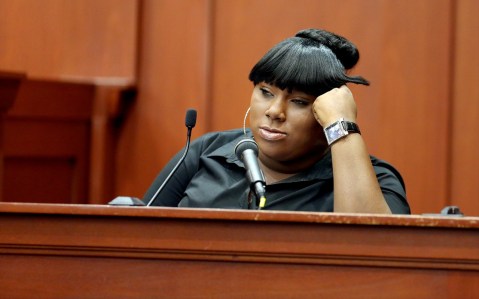
Jeantel’s performance of ratchetness both pointed out and disrupted America’s racialized and gendered listening practices. I’d like to suggest her two-fold performance of ratchetness – sonic and cultural, imposed and embodied –presented ratchetness outside of a strictly pop culture lens. Instead, Jeantel’s performance and lived experiences present ratchetness as an antithetical response to (hetero)normative politics of respectability currently in place in the black (diasporic) community.
The lightning-speed meme-ification of Jeantel invoked flatter, more familiarized representations of ratchet. Because of our inability to translate Jeantel’s grief as “respectable,” she bore the brunt of public scorn and attempts of humiliation. The idea that Jeantel signifies a real life Precious, for example—the main character of Lee Daniel’s Oscar-nominated 2009 film adaptation of Sapphire’s novel Push, played by Gabourey Sidibe—demonstrates increasingly blurred lines between black women’s performative and lived experiences. It should be noted that Sidibe herself was frequently attacked in the press and on the Internet, to the point where she told her co-star Mo’nique in Interview Magazine, “I try to stay off the Internet. Just because people hurt my feelings sometimes. . .a lot of people commented that I’m an incredible actress. But other opinions weren’t so nice, physically or whatever.” Jeantel-as-Precious inadvertently suggests Jeantel’s ratchetness is grounded in the sense that she is plus-sized, dark, “illiterate,” and from a working class background. Precious-as-Sidibe becomes the medium through which Jeantel’s (il)legible womanhood is comprehensive.
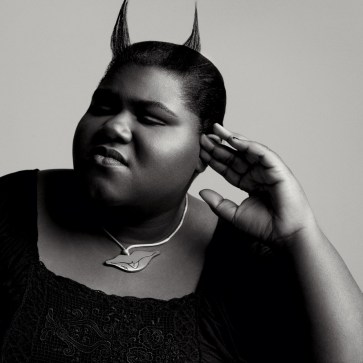
Gabourey Sidibe, from Interview Magazine, Photography by Vinoodh Matadin and Inez Van Lamsweerde
Further, meme-ing Jeantel as Precious solidifies her working class background and ultimately her testimony as a threat to Trayvon Martin’s (re)deemed middle class respectability as a portal of victimization. Returning to Cooper’s observations of Jeantel’s use of hybrid-linguistics, it is Jeantel’s sonic delivery that most threatens Martin’s perceived and scripted middle class respectability. Jeantel’s use of so-called “broken” English has overwhelmingly been heard by what Jennifer Stoever-Ackerman calls America’s dominant “listening ear” in “Reproducing U.S. Citizenship in Blackboard Jungle” as a marker of her working class background – not her trilingual background – and thus, it sonically aligns Martin with the black working class and voids prospects of him being considered a victim of violence rather than its perpetrator. Don West’s treatment of Jeantel on the witness stand attempted to impose a parallel between Jeantel’s alleged “illiteracy” and Martin’s criminality. The “crime” of illiteracy within the courtroom and supposed “crime” of Martin beating Zimmerman into shooting him co-exist within a policed space of (white) respectability that black bodies are frequently forced to adhere.

Jeantel retaliated against West’s attempts to back her into this tight space, however, with her emphatic use of “sir.” Jeantel’s brilliantly subversive tactic demonstrates ratchety resistance because it provides a subtle inversion of the white supremacist discourse directed towards her. Her use of “sir” reminded me of the unnamed protagonist’s grandfather at the beginning of Ralph Ellison’s Invisible Man, who on his deathbed commanded his family to “live with your head in the lion’s mouth:” “I want you to overcome ‘em with yeses, undermine ‘em with grins, agree ‘em to death and destruction, let ‘em swoller you till they vomit or bust wide open” (16). Indeed, Jeantel busted “the lion’s mouth” wide open vis-à-vis a hybridized slang and an emphatic “yes sir” or “no sir.” Most importantly, Jeantel sustained her dignity and self-respect in the process. Jeantel’s mastery of a low, monotone “sir” signifies her existence outside of the politics of respectability that frame not only black women’s experiences but blacks’ submission to white supremacy.
Where West and others focused on her facial features or even her delivery of “sir” as a sign of (dis)respect, what was lost upon many was how her aurally subversive delivery of arguably the most hyper-respectable word in (American) English kept her in command of her testimony.
 Rachel Jeantel is ratchety brilliance. She witnessed, performed, and sounded her truths in ways that complicated if not contradicted the normative discourse policing black women’s bodies. Although much of her cunning was shortsightedly heard as uncouth and aural evidence of a lack of (middle class) home training, Jeantel signifies the usefulness of ratchet as a form of resistance to the white privilege that dictates respectable spaces like the U.S. courtroom. Sir.
—
R.N. Bradley recently graduated with a PhD in African American Literature at Florida State University and is a regular writer for Sounding Out!
—
 REWIND! . . .If you liked this post, you may also dig:
Death Wish Mixtape: Sounding Trayvon Martin’s Death–Regina Bradley
Hearing the Tenor of the Vendler/Dove Conversation: Race, Listening, and the “Noise” of Texts–Christina Sharpe
The Noise of SB 1070: or Do I Sound Illegal to You?–Jennifer Stoever-Ackerman
Share this:

Pretty, Fast, and Loud: The Audible Ali

 Aaaaaaaaaaaaand NOW. . .in SO!‘s corner. . .writing for this month’s “Sound and Sport,” we have the scholar. . .the poet . . .the “Wordsmith of the Web” Taaaaaaaaaara Betts! In today’s post, she shares how listening influences her creative process AND knocks us out with an analysis of the importance of Muhammad Ali’s voice to his sports career and historical legacy. For an instant replay of last month’s post, click Melissa Helquist‘s “Goalball: Sport, Silence, and Spectatorship.” Next month’s rematch will feature Josh Ottum‘s research on sound and skateparks. But now, let’s get ready to ruuuuuuuummmbbble! —J. Stoever-Ackerman, Editor-in-Chief
Plap of glove against glove
Shush of scuffle and slide.
Rebuildin’, repeatin’, rebuildin’
All this repeatin’, getting’ up again & again
Discipline, routine and I keep
doing new things to prepare
my mind, my body, so my pretty
mouth keeps up with all my rhymes.
–Tara Betts, from “Repeatin’” (scene 8, The GREATEST!)
The recent Peggy Choy Dance Company production of “The GREATEST!: A Hip Dance Homage to Muhammad Ali” in April 2013 gave me cause to rethink the key events in Muhammad Ali’s life, particularly his burgeoning political awareness in the 1960s. As I wrote the libretto for the performance—which combined athletic dance performance with images, poems, and quotes from Ali—I kept thinking about how Ali had one of the most recognized, quoted, and distinct voices ever heard in the boxing world.
 In the libretto, I tried to capture the nuances of black vernacular and the southern hallmark of Ali’s hometown, Louisville, Kentucky (he was sometimes referred to as the “Louisville Lip”), vocal sounds that signify an African American experience. Is there a southern drawl? A bass-filled bravado? There are certain words that sound fuller and cut short based on the vernacular that was spoken during the time period of Cassius Clay and well into his evolution as Muhammad Ali. While many of the materials that I visited for inspiration and historical context were books, to capture the look, feel, and speech of the 1960s and 1970s, I had to crate-dig for some vinyl.
A copy of a 1963 spoken word album I Am The Greatest!: Cassius Clay and the 1997 documentary film When We Were Kings served as two such sources. Both recordings represent an audible Ali, at once a man whose iconic voice sounded as familiar to me as people who I’ve known personally and a historical figure whose vocal grain content embodied his shifts in political consciousness. The difference between Clay’s 1964 recording and the samples woven into the When We Were Kings soundtrack is more than the changes that gradually developed over time. These recordings reveal how Ali’s confidence is constructed around creating an affirming, critical identity, rather than merely promoting his athletic prowess. At first, he merely sounds cocky; later he sounds as if he is fighting for a group of people that he wants to inform, serve, celebrate, protect, and uphold. My libretto was deeply impacted both by the sonic continuities in Ali’s voice across time and space, as well as its audible shifts.
The champ ain’t nobody but me!
Pretty, fast & loud, I’ll shake the world,
with a lion’s might.
My children will lift
their fists and fight
–Tara Betts, from “‘By Any Means necessary: If they met in Harlem’’” (transition from scene 14, The GREATEST!)
Before Cassius Clay joined the Nation of Islam and changed his name to Muhammad Ali, he recorded a spoken word album on the Sony label in 1963. I Am The Greatest! was released in 1964 before Clay’s two key fights with Sonny Liston and Ali’s eventual victory for the heavyweight crown. The album included original liner notes from modernist poet Marianne Moore and New York Post sports journalist Milton Gross, but it was telling that comedy writer Gary Belkin and Cassius Clay were the co-authors of the spoken word material—which is more comedy than poetry or interviews. Belkin was a comedy writer for well-known comedians such as Carol Burnett and Sid Caesar, and the comedy show Car 54, Where Are You? So, Belkin was clearly accustomed to writing sketch comedy, but Clay was used to being humorous outside of a recording studio with a staged audience.

Overall, Clay’s delivery seems to be slower–both less fluid and more staged– than his impromptu recitations at boxing-related events outside the recording studio. Clay seems to anticipate that sound effects such as roaring crowds and clanging bells will be inserted into the tracks, so he over-enunciates and pauses. Each track begins with a bell ringing as if boxing round is about to begin, and there are eight “rounds,” probably because Clay insisted that any fight with Liston would be shorter than eight rounds. As I listened, I wondered if Ali was comfortable recording this album or if he considered it simply another way to promote and market one of the world’s best known boxers? To my ear, it lacked some of the speed and ease I associate with Clay’s speech in other settings. In the boxing world, his speeches mentally challenged his opponents and entertained crowds. The recording studio left less room for spontaneity, fluidity, and even the visual interplay of sound with his quick motion.

Cassius Clay in the studio recording I Am the Greatest! with Sam Cooke, Image from newblackman.blogspot, courtesy of Michael Ochs Archives/Getty Images
The eight rounds/comedic sketches lean heavily on Ali’s signature boisterous braggadocio in his loud, deliberate voice, using canned laughter and other voices setting up Clay to talk about his excellence. Otherwise, they are a grab bag of influences and sound effects. These other voices and sounds create an artificial environment that is not the same as being surrounded by boxers, trainers, and others in the athletic arena. In fact, these sounds and the sources sound quite different from Clay himself. “Round 1: I Am The Greatest” and “Round 2: I Am The Double Greatest” are accompanied by violins that sound more like a serenade than a classical composition. In “Round 4: ‘I Have Written A Drama,’ He Said Playfully,” a lute plays in the beginning that hints at a spoof of a Shakespearean-style drama about defeating dragons complete with affected British accents, including one actor speaking with the theatrical lisp. The knight “Cassius of Clay” enters with the audible clanking of armor.
Clay reveals a shift in tone when he sings on the last two tracks. He begins with “Stand By Me”–a cover of Ben E. King’s classic song/then recent hit–with fervor. In the last song, “The Gang’s All Here,” Clay follows some of the words of Tin Pan Alley lyricist Theodora Morse set to Sullivan’s tune from Pirates of Penzance.
Clay tries to pick up the energy lost by his less-than-enthusiastic singing. “Is Memphis with me? Is Louisville with me? Is Houston with me. Ain’t I purty?” Each question is answered with a crowd enthusiastically shouting a “Yeah!” Here Ali relies on his enthusiastic, improvised rhymes, departing from the song’s traditional lyrics to include himself in a song that does not come from an African American writer or the Black experience.
The same country that refuses to let people eat
or use the bathroom in the same places
wants ME to go and get killed?
What does THAT sound like?
—-Tara Betts, from “The Same Country” (scene 15, The GREATEST!)
Almost 35 years later, there are clear sonic differences between Cassius Clay’s debut on Sony and the soundtrack to When We Were Kings, the 1997 documentary of the 1974 heavyweight championship between George Foreman and Muhammad Ali. This retrospective record is decidedly more centered on black experiences and black voices that speak musically, politically, and spiritually, particularly about the Black presence in Islam. There are no comedic monologues, sketches or Greek choruses; it sonically represents Ali after his conversion to orthodox Islam, after his friendship with and separation from Malcolm X, and after his opposition to Vietnam. Every spoken part on this album affirms the multiplicities of a Black presence in blues, R&B, and songs recorded live on the African continent; the huffs and rhymes are cheered for by a live African audience. As I listened to When We Were Kings, I could hear Ali’s comfort and his freedom of movement, audibly in contrast with his other album.

When We Were Kings records his time in Kinshasa, Zaire where he trains and eventually fights George Foreman. It does not simply focus on Ali’s voice, but is sonically rich with music, interviews with people who witnessed that fight and those who knew Ali personally; the soundtrack reflects these interconnections in its continuous uninterrupted flow. The role of these sounds endeavors to document what was heard in Zaire in 1974, but it also includes Ali in the surrounding sonic environment as one person who becomes a focal point for the musicians and speakers who also articulate black identity on the record.
The first thing I heard was Ali’s voice:
I’m gonna fight for the prestige, not for me, but to uplift my little brothers who are sleeping on concrete floors today in America, black people who are living on welfare, black people who can’t eat, black people who don’t know no knowledge of themselves, black people who don’t have no future. I want win my title and walk down the alleys and sit on the garbage cans with the wineheads…
This opening sample of Ali sets the soundtrack’s tone, and kicks off the only hip hop song on the album, a sonic shift that signals a new generation/genre in black music in 1997, more than 30 years after Ali’s spoken word album as Cassius Clay. Ali’s quote also informs listeners that the emphasis of this album has little do with comedy, especially since the soundtrack draws from nonfiction, rather than setting Clay/Ali in fictionalized sketches. The focus is on black people and their struggles.
In the first song, emcees look back and tell the story of “The Rumble in the Jungle” but the verses also hail Ali as a hero. When The Fugees, A Tribe Called Quest, and Busta Rhymes rap over a fairly standard bassline, their presence on this soundtrack is an important signal of Ali’s influence and the recurring engagement between artists and Ali during his athletic heyday such as James Brown. In Jeff Chang’s Can’t Stop, Won’t Stop (2005), Afrika Bambaataa points out repeatedly how Brown became a consistent presence in hip hop when New York radio stations simply refused to play his music, particularly in the 1970s. After decades of infusing a variety of soul singers and Brown’s stylistic turns on “the one” and messages of black pride into the genre of hip hop, the presence of “The Rumble in the Jungle” on this soundtrack completely makes sense. As more than a wellspring for samples throughout the large, growing body of hip hop music, Brown was also embodying and representing black consciousness in music with a Black voice, much in the same way that Ali utilized Black speech. In some ways, Ali’s couplets predate rap lyrics and perform in a similar manner; Bambaattaa cites him as an influence, along with Malcolm X.
James Brown and many others flow seamlessly into the event and its soundtrack in a way that reflects the immediacy and proximity of these events. The “Black Woodstock” of the Zaire 1974 music festival that accompanied Ali and Foreman’s fight set the tone and soundtrack in real life, not just in the documentary. In fact, the festival itself was documented in the 2008 release Soul Power directed by Jeff Levy-Hinte. At this point, it’s clear that there is a continuum for hearing the connections between black voices across oceans and continents.
Following “Rumble in the Jungle,” the record samples Ali and Drew “Bundini” Brown (Ali’s assistant trainer and cornerman), snippets taken directly from the documentary footage. Brown is a slower, more deliberate speaker; he uses rhyme like Ali. He talks about the fruit returning to the root and Ali claiming his crown back home. For African Americans to return to Africa post-slavery, this trip and clip sonically reinforce the cultural significance of Ali’s trip. Such pilgrimages fortify the idea that black people have a homeland, a continent, and a cultural continuum, much in the same way that this soundtrack constructs.
“Ali, Bombaye!” in a sea of faces just like mine,
my brothers, my parents, my cousins.
I want to go home and tell the people
in the streets this is what we come from,
what we could be.
—-Tara Betts, from “The Hard Road to Zaire’” (scene 21, The GREATEST!)
When African girls chant to celebrate Ali’s arrival, they reassert how this is a homecoming for Ali, a welcome and a reconnection that fuels Ali’s determination. The chants seem to encourage the first sample of Ali when he issues his threat: “When I get to Africa we gon’ get it on cause we don’t get along. I’m gonna eat him up…” This sample segues into James Brown’s “The Payback” as it was performed before the fight, then another chant performed by Mobütu, named after Zaire’s controversial leader, Mobutu Sese Seko.
When Ali concludes the soundtrack, he interrupts chants of “Ali, Bombaye!” with huffs and a brief exhortation of knocking you out, “sucker.” These last words fade into a snippet of African chant. This constructs a very different narrative that looks back at Ali’s career, long after the younger Clay established part of his image with hyperbolic bravado. Ali has cultivated a Pan African, global, political awareness that includes black people in America from his hometown in Louisville, KY to across the globe.
Hearing Clay and Ali–their continuities and their differences–gave me an insight into the familiar voices of some of my older relatives (and their blues records), and it also helped me channel that voice in poems of my own. It allowed me to imagine how hyperbole helped encourage Ali to energize and cheer himself on, so much that others began rooting for him as well. It did not matter what arena he was in, Ali would use his voice, his fists, and his will to conquer it. As I wrote the libretto, I thought about how I might unearth that determination in a way that respectfully embodied his tone, cadence, vocabulary, and ebullience. One of the definitions of greatness relates to the defeat of time and distance, and in the words that I wrote about Ali, I found that listening to him, and hearing his significance grew over time, helped him transcend both.
Every mile, every turn of the rope brings
me closer to telling him he’s nothing.
I hate every minute of training,
but I say
Don’t quit.
Suffer now
and live your life
as a champion.
I am a myth, and a man,
of my own making.
–Tara Betts, from “The Hard Road to Zaire” (scene 21, The GREATEST!)
—
Tara Betts is the author of the poetry collection Arc and Hue, a Ph.D. candidate at Binghamton University, and a Cave Canem fellow. Tara’s poetry also appeared in Essence, Bum Rush the Page, Saul Williams’ CHORUS: A Literary Mixtape, VILLANELLES, both Spoken Word Revolution anthologies, and A Face to Meet the Faces: An Anthology of Contemporary Persona Poetry. Her research interests include African American literature, poetry, creative writing pedagogy, and most recently sound studies. In the 1990s, she co-founded and co-hosted WLUW 88.7FM’s “The Hip Hop Project” at Loyola University while writing for underground hip hop magazines, Black Radio Exclusive, The Source, and XXL. She is co-editor of Bop, Strut, and Dance, an anthology of Bop poems with Afaa M. Weaver. In April 2013, she published the libretto “THE GREATEST!: An Homage to Muhammad Ali” (Winged City Press) written for the live performance directed by Peggy Choy.
—
REWIND! . . .If you liked this post, you may also dig:
They Do Not All Sound Alike: Sampling Kathleen Cleaver, Assata Shakur, and Angela Davis–Tara Betts
SO! LA: Sounding the California Story–Bridget Hoida
Freedom Back: Sounding Black Feminist History, Courtesy the Artists—Tavia Nyong’o
Share this:


Current Top Posts





April 2021

January 2020

November 2019

October 2019

August 2019

April 2014

November 2017

March 2015

December 2017

October 2015
 Sounding Out!
Recent Comments