
SO! Amplifies: Radio Coyote’s #DIASPORADICAL Sound

 SO! Amplifies. . .a highly-curated, rolling mini-post series by which we editors hip you to cultural makers and organizations doing work we really really dig. You’re welcome!
—
This whole world’s wild at heart and weird on top —Wild at Heart
Por tu amor. . . — Buyepongo
Radio Coyote is a San Francisco-based web radio program & podcast I co-host with my friend Jesus Varela, aka Sweet Jesus. Radio Coyote is our effort at amplifying expression which is #DIASPORADICAL – acknowledging movement and humanity in a world alive with ART; most especially of those on the margins who in the current structure, have become the invisible inspiration for the priviliged, hardly benefiting from the soul they emit.
Recently, Jesus and I recorded with Los Angeles’s own future-rooted band of immigrant brothers – Buyepongo – live from the scrappy but charming Radio Valencia studios in the Mission District. Some topics we talked about included connections between the Bay Area and Los Angeles, the hip-hop influence of Wu-tang Clan & Madlib on the group, and, importantly, the burgeoning yet connected #DIASPORADICAL network building alternatives and manifesting the visceral spirit of our ancestors through drumming.
This particular episode’s conversation is emblematic of how we use sound and voice on Radio Coyote to bring energies together to counter the hegemonic corporate $tandard currently funding the arts and culture industries—live music and entertainment but also tech and media, not to mention the spaces where they intersect—all reflective of a standard which is essentially: THE STRIVE FOR MONETARY SUCCESS MARKED AS WHITE ACHIEVEMENT A/K/A the land of the “Free” where the inspired benefit from those on the margins.
Nahhhhh, FUCK THAT. – emcee Nani Castle in To The People
The type of capitalist cultural extraction we challenge on Radio Coyote can be heard and seen everywhere. Justin Bieber, for example, has a #1 record right now (produced by Skrillex) that is clearly influenced by Caribbean dembow. I’m still waking up from that dream where Macklemore wins a Grammy award over the 2014 jazz griot giant that is Kendrick Lamar. The FADER, like so many media outlets, assigns white writers to cover emerging Latin culture in the US: Exhibit A on contemporary cuban music & Exhibit B on J. Balvin and reggaton. And, I could go on. But because it is so pervasive, we need to keep asking, “Who benefits?”
It don’t make you right cause you majority.- Bree Newsome, South Carolina-based activist & artist who removed the Confederate Flag earlier this past Summer from SC’s capital
Mamacita, pass me a beer-a – Will Smith on Bomba Estereo’s “Fiesta” (Remix) for SONY
Because all around the world – or the worldwild, I like to say, people are waking up and acknowledging themselves, their neighbors, and the stories of their movement, exploring what those moves truly meant and what they will mean for a humanity needing to be increasingly inter-reliant in our crumbling late-Capitalist era. Radio Coyote is a product, a revelation, and a confluence of these worldwild movements, amplifying the true vibration and rhythms of a very specific history and examining how they will mutate in the future.

Our voices and spirits have always been dangerous. During the conquest in what is now Mexico, for example, the Spansh conquistadors killed the ceremonial drummers first. In Chile, when Augosto Pinochet seized power in 1973, he ordered revolutionary singer Victor Jara executed, and his soldiers kidnapped Jara, smashed his hands and wrists and shot him 44 times. But what was once dangerous has been disempowered and I predict, increasingly exploited. Now Canadian DJ A-Trak calls himself “Plantain Papi,” Roots drummer Questlove goes by “Questlove Gomez,” and Kendrick raps in Spanish. Bieber just dropped that dembow-influenced pop record while dembow legacy artists, Los Rakas (via Panama & Oakland) switched to Latin pop.
Cause I just need one more shot at second chances – Justin Bieber in “Sorry”
I get a lot of success because I’m white. – Diplo in YourEDM.com
Radio Coyote is our chance to explore these ideas and who benefits from the global flows of culture . To empower me. To empower us. To get back to the place where this expression was dangerous . We are smuggling these sounds to you over what was once pirate radio – now, online – because the boundaries between u$ are quite pronounced. Radio Coyote is my moment of love in a land$cape of domination and hate. We are powerful. It’s clarity through the confusion. Radio Coyote simply must be. It’s an effort at radically witnessing the expressions all over the world of people who’ve had access to Internet these last 10 – 15 years, but who also seek to honor, understand & feel a past which we are indisputably products of!
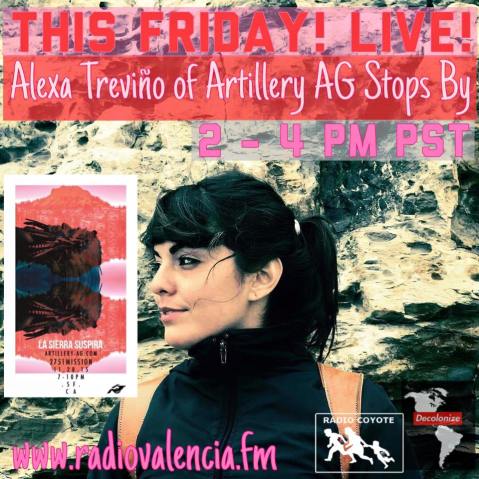
Though I am fiercely frightened to get on the mic every Friday from 2 – 4 PM PST, I like to think I’m reversing the common programming Latinas go through, constantly told to shush in this world. I also feel a true duty. We simply need to step up and be ourselves! We need to acknowledge and be proud of our own particular story of being human in a world with the same level of equality as the other, together, with immense respect for the planet we live on and all the resources she provides (another topic I like to think about, but more on #PACHAMAMAISM at another time…).
There is nothing else we should be doing but seeing ourselves in each other and being very adamant about that. So this is my love force to you and I hope you continue to enjoy/share it. Lift your voice in love, too, in any way you feel is important out in the worldwild! And, then, tell me about it so we can have you call in and talk to us on Radio Coyote: radiocoyotesf@gmail.com! 😀
Tune-in to #RadioCoyote: Smuggling #DIASPORADICAL Sounds Across Borders Every Friday From 2 – 4 Pm PST With DJ Nipslip aka Naticonrazon and Jesucio aka Sweet Jesus: www.radiovalencia.fm. Archives:www.soundcloud.com/radiocoyote
—
all images courtesy of the author
—
Nati Linares aka Nati Conrazon is an artist advocate and cultural lobbyist rebalancing the world who was raised in New York City, but is currently living a #Bicoastalidad lifestyle which is rooted in Oakland, California. Her womanagement clients include Brazil-via-Brooklyn’s Vocalista Making Interracial Music Babies, Zuzuka Poderosa & Powerfully Raw Chilean/Irish Emcee, Nani Castle. Check out all her current projects: www.conrazon.me/projects/current-projects and follow her on Twitter: @conrazon, Instagram: naticonrazon and beyond! Embrace the hybrid!
—
—
 REWIND!…If you liked this post, you may also dig:
SO! Amplifies: Sounding Board Curated by Leonardo Cardoso–Jay Loomis
SO! Amplifies: Shizu Saldamando’s OUROBOROS–J.L. Stoever
Share this:

SO! Reads: Norma Mendoza-Denton’s Homegirls

“When I wear my eyeliner, me siento más macha (I feel more macha) I’m ready to fight” (54)
 Makeup has long been an intentional part of a chola aesthetic: in particular, the skillful sign of bold black eyeliner or a carefully arched, thin, brow. The quote above by Norteña Xótchil, one of author Norma Mendoza-Denton’s interviewees, reminds us that make-up not only creates a sense of empowerment but also evokes the idea of physical strength (“feeling macha”). Norma Mendoza-Denton’s ethnographic study Homegirls: Language and Cultural Practice among Latina Youth Gangs (Wiley-Blackwell, 2008) presents a project of high ambition, and even higher execution, in its carefully crafted discussion of the linguistic and cultural practices of Latina youth gangs at Sor Juana High School in northern California. Homegirls offers much needed insight into the relationship between language style and the cultural, lived experiences of Latina youth gangs. She centers her analysis on the linguistic, the cultural, and the phonetic, and in this way she pushes students of ethnic studies and sound studies to consider how young Latinas craft and articulate their own identity through meaning-making practices that challenge tropes of deviancy that are often unfairly cast on young women of color.
Throughout the book, speaking chola – an urban, gendered variation of Chicana English – becomes an audible badge, a marker of experience rather than a punch line, a culturally appropriated costume, a music video fad, or linguistic variety in need of policing. Recently, celebrity white or non-Latina women, such as Gwen Stefani and Lana Del Rey, have adopted telltale signs of a chola aesthetic – the crisp centered hair part, baggy pants, big hoops and/or only-the-top-buttoned plaid shirt. By focusing on the language styles of cholas, Mendoza-Denton encourages readers to think beyond the stereotypical images and sounds that so often circulate in mainstream media about cholas. Homegirls offers Sound Studies and Chicana/o Studies scholars a notable addition to the growing literature on the intersections of language, race, and sound.

Image by Illusive Photography @Flickr CC BY-NC-ND
“You gotta take pride to do your clothes
you know I have to iron,
when I go out I have to iron my shirt for half an hour
or forty-five minutes, you know,
my pants, you know
they gotta be
cre::ased
you know they gotta-” (56)
 Homegirls joins conversations on Latinas and gang culture (Fregoso 2003; Miranda 2003; Ramírez 2009), which have historically been male-centered. Thelma, one of the Norteña girls, demonstrates in the quotation above her engagement with an aesthetic practice often linked with Latino gang members. Although the topic of language and linguistic identities, specifically bilingualism and translating, are emerging topics within Chicana/o Studies, Mendoza-Denton’s work joins that of a small number of scholars who take on Latina/o language practices and identities as the central focus of their work. She observes, in fact, how identity and meaning-making processes are intertwined to language, as are other social markers of identity such as race, class, gender, ethnicity, and accent. Homegirls joins recent discussions that demonstrate specifically how accents are vocal stand-ins for a person’s racialized, classed, and gendered experience. Where Fregoso and Miranda center their discussion on the cinematic representations of cholas and a historical account of pachucas respectively, Mendoza-Denton’s work is more in line with Miranda’s ethnographic approach to Latina youth gangs. Homegirls listens to the women’s voices and allows them to speak for themselves. This approach yields a work that reminds us how language identities are racialized when conflated with other racial markers, how they negotiate power relations (in/out group dynamics), and how they can also function as political forms of resistance.
“My dad dice que me miro como lesbian (says I look like a lesbian), my mom dice que qué guangajona (complains that it’s baggy). How much you wanna bet that I can go outside like this y no me dicen nada (they won’t say anything)” (151)
Maureen, a 14-year-old participant, speaks above to the code switching that many of the young women in this study practice. Mendoza-Denton re-imagines the chola as an innovator, highlighting the role of language and the body in creating new cultural practices. For example, in Chapter 5, the author heralds an exciting discussion on play and applying makeup as forms of gendered performances expanding on notions of beauty and grooming amongst Latina youth. She writes, “The symbolic and unconventional use of makeup among the girls claiming Norte and Sur at Sor Juana High School literally painted gender and ethnicity on their bodies,” marking a critical intervention in how the chola aesthetic racializes and genders bodies, yet also functions as a self-directed performance (152). In paying close attention to the symbolic meaning of makeup and its application, the ritual of carefully drawing the brow dismantles the mainstream appropriation of this often-criminalized look.
Mendoza-Denton’s close phonetic analysis demonstrates how the visual aesthetic coupled with a sonic aesthetic speaks to the political implications of embodied linguistic and cultural practices. The chola vocal aesthetic challenges traditional notions of femininity, closely associated with politics of respectability through Spanish honorifics like “usted,” within the Chicano family. This idea echoes other studies that show how pachucas, precursors to contemporary homegirls, with their extravagant attire and deviant behavior embody an adolescent rebellion against the patriarchal Chicano family and how pachuquismos forged a stylized linguistic resistance. Such stylized linguistic and embodied resistance can be seen in the excerpt below from T-Rex, one of Mendoza-Denton’s most candid participants in her study.
T-Rex: A girl could be more macha than some guys. For example me.
Norma: You think you’re more macha than guys?
T-Rex: I am more macha.
Norma: What makes you macha?
T-Rex: The way I act. The way I don’t let them step on me. (164)
In this brief excerpt, T-Rex articulates her notions of being ‘macha,’ a prime example of a discursive and material Latina youth practice that transcends the boundaries of normative gendered expressions for Latina youth. We are accustomed to seeing urban cholas with curiosity, envy, or both. Mendoza-Denton allows us to hear them and gain a deeper understanding of their social practices.
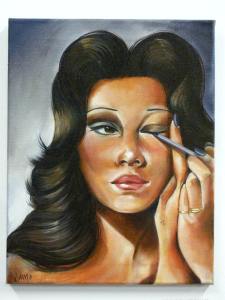
Image by Amor Eterno Arte @Flickr CC BY-NC-ND
In framing the chola aesthetic as a transgressive type of beauty, Mendoza-Denton poses that the cholas in this study act as cultural producers who assign alternative meanings to femininity through their body and speech. Recalling Xóchitl’s remarks about mascara, the eyeliner serves in one form as a tool for a racialized feminine ideal of beauty, while simultaneously a sign for “willingness to fight” for other girls (154). Eyeliner, in this example, very visibly displays the complex interactions and negotiations of gender norms and agency. In this sense, Mendoza-Denton grants the reader a primary example of how cholas participate in a type of feminine gender expression that challenges expected ways of acting, which includes speech.
From Mendoza-Denton’s conversation with T-Rex, we see that speech and accent are just as meaningful in the construction of this alternative aesthetic. T-Rex, explains how the eyeliner is a “power-based interpretation” that when correlated with a tough, or even threatening, manner of walking—the use of the body—cholas command power and respect. Here, her intervention serves not only to gain a deeper understanding of Latina youth practices but also frames the chola as an empowered, vocal (what some would consider, mouthy) woman. Too often cholas receive harsh criticism or complete disregard for their assumed subversive behavior, criminality, and social deviance. In Homegirls, Mendoza-Denton challenges those notions by finding the symbolic capital in how these young women employ discursive, material, and phonetic practices.
The final two chapters of the book focus on the specific linguistic features relevant to studies of language and sound. Mendoza-Denton highlights phonetic variation among the girls speech in how their realization of /I/ demarcates core speakers from members of the group in the periphery yet points to similar speaking characteristics for girls of both gangs. The author’s focus on the stigmatized Th-Pro set (i.e. something, nothing) in the speech of Latina girls demonstrates how it discursively positions theses young women’s interactions and group affiliation due to its frequency and saliency. These later chapters demonstrate one of the author’s most significant contributions: projecting a specific accent is often linked to the creation of an identity. As Mendoza-Denton writes, “How speakers pronounce their words says a lot not only about the identities that they wish to project, but also about the history of the language(s) that they speak” (231). These linguistic variations give readers insight on the importance of how distinctive discourse markers are vital in the creation of stylized identities for young women of color.
Norma Mendoza-Denton has produced a rich account of a community largely ignored and misinterpreted in the conversations on Latina youth culture in the United States. As she reminds readers in her conclusion, Homegirls is one of the only studies of its kind that documents gang dynamics outside of discussions regarding violence, control over territory, or drug trafficking. While this approach provides a much-needed focus on the self-making and cultural processes amongst youth of color, I wonder if some significant discussions might be left out with this approach. Although there is large need for research on this topic that deviates from traditional approaches (such as criminality, violence, drug trafficking) when working with youth, particularly women of color, in her effort to subvert these sociological mainstays Mendoza-Denton avoids certain experiences that leave out pertinent context.

Image by Joey Ortega @Flickr CC BY-ND
For example, in her discussion of the young women’s makeup practices, Mendoza Denton mentions the perceived threat they pose to teachers and police at school but does not go into more detail. These questions are not to discount the contributions of the book but rather to introduce future considerations for work surrounding Latina youth gangs. However, for Mendoza-Denton, the focus on the creativity and agency these young women embody is never lacking:
“So when you walk down the street,
you got the special walk, [begins to walk deliberately, swinging her upper body]
you walk like this,
you walk all slow,
just checking it out.
I look like a dude, ¿que no?
I walk, and then I stop.
I go like this [tilts head back – this is called looking “in”]
I always look in, I always look in,
I never look down.
It’s all about power
You never fucking smile.
Fucking never smile” (155-6)

Image by Amor Eterno Arte @Flickr CC BY-ND
Homegirls is at its finest when the reader is presented with excerpts like the quote above where T-Rex’s assertive physical and mental stance illustrates the linguistic and cultural practices that Mendoza-Denton seeks to highlight in her work. Mendoza-Denton’s contribution to this topic privileges the symbolic capital in linguistic, embodied, and cultural practices which sets up a platform for future work on Latina identities. When we read cholas in popular culture we might think of the aesthetic, the stereotypes, the big hoops, the dark lips, and the mascara. When we read Homegirls, Norma Mendoza-Denton compels us to consider the complex web of how linguistic and cultural practices (through material and vocal embodiments) speaks to the intersections of race, gender, and class amongst Latina youth gangs.
–
Featured image is of Yasmin Ferrada (the author’s sister) as photographed by King Kast. It is used with permission by the author.
–
Juan Sebastian Ferrada is a doctoral candidate in the Department of Chicana and Chicano Studies at the University of California, Santa Barbara. His work investigates the intersections of language and sexuality among LGBTQ Latina/o communities. Specifically, Sebastian explores the politics of Spanglish as a method for articulating ideas of sexuality and family acceptance within an LGBTQ Latina/o community organization. Sebastian earned a B.A. in Global Studies, in addition to a B.A. and M.A. in Chicana and Chicano Studies from the University of California, Santa Barbara.
–
 REWIND! . . .If you liked this post, you may also dig:
“Óyeme Voz: U.S. Latin@ & Immigrant Communities Re-Sound Citizenship and Belonging” – Nancy Morales
Listening to the Border: “’2487’: Giving Voice in Diaspora” and the Sound Art of Luz María Sánchez – Dolores Inés Casillas
Deaf Latin@ Performance: Listening with the Third Ear — Trevor Boffone
Share this:


Current Top Posts





April 2021

January 2020

November 2019

October 2019

August 2019

April 2014

November 2017

March 2015

December 2017

October 2015
 Sounding Out!
Recent Comments