
Speaking “Mexican” and the use of “Mock Spanish” in Children’s Books (or Do Not Read Skippyjon Jones)

Cinco de Mayo. ‘Tis the season when many Americans don sombreros, order their frozen margaritas, and, God help us, speak “Spanish.” We are well used to hyper Anglicized renditions of “amigo,” “adios,” and happy hour specials brought on by the commercialization of Cinco de Mayo. The holiday celebrates a significant event in Mexico’s history – the battle of Puebla and victory over France in 1862 – through narrowing ideas about language, culture, and tequila. That said, let’s not just blame Cinco de Mayo for the disconcerting use of Spanish. Unfortunately, the incessant use of phrases such as “ay caramba” and “no problemo” are heard much, much earlier in contemporary children’s books.
The New York Times recently published the startling figure that just 93 of the 3,200 children’s books published in 2013 were about African American children. Within these few 93 texts, African American children all-too-often read about themselves within the past tense, in reference to slavery and civil rights legacies. Children of color are left to identify with the adventures and imaginative stories of white characters amid white settings. Aptly characterized as an, “apartheid of children’s literature,” two moving first-person accounts from Walter Dean Myers and Christopher Myers detail the significance of incorporating more characters of color for all readers. One major effect of this dearth of representation, according to Christopher Myers,
…is a gap in the much-written-about sense of self-love that comes from recognizing oneself in a text, from the understanding that your life and lives of people like you are worthy of being told, thought about, discussed and even celebrated.
Just as significant, is the number of children’s books about Latino children from the 2013’s trove of 3,200 books: 53. That’s 5-3. As a reminder, the United States Census tallied 53 million Latinos in the United States, representing the nation’s youngest demographic (children!).
However, perhaps worse than the actual lack is the rise of stereotypic in-your-face representations of race within children’s books – award-winning ones, actually – and their role in teaching children troubling ideas about race, language, and “difference.”
My name is Skippito Friskito. (clap-clap)
I fear not a single bandito. (clap-clap)
My manners are mellow,
I’m sweet like the Jell-O,
I get the job done, yes indeed-o.
Case in point: Skippyjon Jones, a Siamese cat that pretends to be a Chihuahua superhero. Skippyjon speaks English, but his super hero alter ego speaks in Mock Spanish in his recurring and imaginative quests. Speaking “Spanish” in hyperanglized fashion recasts Skippyjon from an English-speaking (white) cat to a Spanish-accented (brown) dog. His auditory performance of Mexicanness, what Reina Prado considers “sonic brownface,” reeks of white privilege as he code-switches from cat/white/English to dog/brown/”Spanish.” What’s worse, as a children’s book, directed at those between the impressionable ages of 4-8, Skippyjon encourages both adult readers and young readers to read out loud and perform sonic brownface. Listening to the book’s trite word choice (amigos, adios, frijoles), fake Spanish (indeed-o, mask-ito) and embellished accents (“ees” for is) trains the ear on how to speak “Mexican,” presumably, of course, for the listening amusement of non-Mexicans.

Image by Flickr user Howard Lewis Ship
“I am El Skippito, the great sword fighter,” said Skippyjon Jones.
Apparently, these tried and true tactics sell quite well. This award-winning children’s book character, by Judy Schachner, has spawned into a lucrative empire that includes fourteen books, a coordinating plush toy figure, online webisodes of the books’ stories, CDs of Schachner reading out loud, the obligatory Ipad app, a starring role in the department store Kohl’s “We Care” charity campaign in 2012, and get this, a children’s musical. Of course, Skippyjon is not really recognized as a book series about Latinos (like fellow television darlings, Dora the Explorer, Handy Manny, or Dragon Tales) yet it taps into every flinching stereotype we know of, and should avoid, about Mexicans. Equating Mexicans and Mexican tales to the canine of a Chihuahua is hardly new but it does not make it less problematic.
For instance, in the inaugural self-titled Skippyjon Jones book, the cat’s adventures take place “far, far away in old Mexico.” Much like the perpetual placement of African Americans in the past tense within children’s books, situating Mexico in the imaginative past reinforces perceptions of all-things-Mexican as distant, foreign, and old. Skippyjon and his chimichangos – his sidekicks (good guys) –set out to save their rice and beans from Alfredo Buzzito and Bumblebeeto Bandito (bad guys). Zorro-esque masks, swords, fiestas followed by siestas, fellow Chihuahuas, piñatas, plenty of cacti, and lots of clap-clap cues frame the rice-and-bean rescue. His adventures, book after book, via a Skippito brown identity sends a disquieting message about power and privilege. Skippito, even when masked, still plays the role of Great White Hero to the masses of “Mexican” dogs.
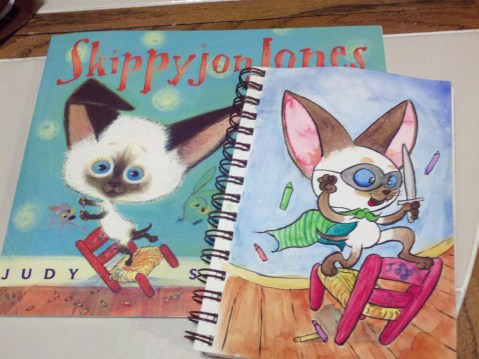
Image by Flickr user Tomas Quinones
Then all of the Chimichangos went crazy loco.
Several of Schachner’s Skippyjon books have received notable accolades including, for instance, the 2004 E.B. White Read Aloud Award and a spot on the coveted “Teachers’ Top 100 Books for Children” by the National Education Association in 2007. The former comes with an adorning gold seal on future editions of honored books. A sampling of the series’ laudatory press, from the E.B White Read Aloud press release, “Peppered with Spanish expressions and full of energized fun, SkippyJon Jones is not only entertaining for the listener, it’s also enjoyable for the reader.” And from the author’s webpage: “Each of my adventures are ay caramba, mucho fun but they’re educational too!” The insinuation that the Skippyjon Empire teaches Spanish not only ignores the richness of Spanish but it also feeds popular ideals that Spanish is an “easy” and “fun” language to learn.
Schachner’s recurrent use of “Spanish,” in particular, not only structures the silly narrative adventures of Skippyjon as he imagines himself to be Skippito but the racialized language play has also become the hallmark element of Skippyjon. Written and read out loud by parents and teachers, some of Skippyjon’s signature phrases include “Holy Guacamole!” and “Holy Frijoles!” – textbook examples of Jane Hill’s renowned writings on Mock Spanish (or fake, incoherent Spanish uttered and deemed “funny” by non-native Spanish speakers). Because we already hold native Spanish-speakers (U.S. Latinos) with such little regard in the first place, Mock Spanish done for laughs, as argued by Hill, comes quite easily. Carmen Martínez-Roldán takes the Skippyjon Jones series to task in necessary detail; see her analysis of Mock Spanish in the equally troubling, Skippyjon Jones in the Doghouse. Her emphasis on the cultural representations of Mexicans vis-a-vis language in children’s books supports my tirade against this cat/dog. Martínez-Roldán found that several teachers, particularly those from the Southwest, expressed a sense of inexplicable uneasiness to these books. Amazon ratings are (painfully) positive for Skippyjon, yet, according to Martínez-Roldán, those who expressed low ratings were “accompanied by lengthy explanations, mostly related to misrepresentations of Mexicans and the poor use of Spanish.” Her research calls for more diversity within children’s literature but, central to this essay, reminds us that U.S. Latinos hold both a personal and political relationship to Spanish.
Image by Flickr User John Graham
Anthropologist Bonnie Urciuoli explains how Spanish, when overheard in designated public spaces (think: Cinco de Mayo or Mexican restaurants) is safely “ethnified,” yet Spanish is regarded as out of place or “racialized” when heard as bilingual announcements at local grocery stores or school sites. When heard by monolingual English speakers outside of its designated spaces in the U.S., Spanish carries “racialized” connotations such as “impoliteness” and “danger.” The insistence many American employers place on speaking English and prohibiting non-English language conversations at workplaces, for instance, speaks to the public boundaries imposed on Spanish and Spanish-speakers. (Yes, Whole Foods. I am looking at you.)
Jane Hill’s provocative argument, built from Uricuolli’s writings, examines Whites’ use of Spanish (Mock Spanish). Unlike Latinos, who learn early on to self-monitor where and how they speak English and Spanish, non-native speakers of Spanish do not carry this same burden, according to Hill. In fact, they have the privilege of speaking grammatically incorrect Spanish, in hyper Anglicized Spanish, or mockingly (by adding a stupid “o” or prefacing a phrasing with “el”) without surveillance.
Then, using his very best Spanish accent, he said, “My ears are too beeg for my head.
My head ees too beeg for my body. I am not a Siamese cat… I AM A CHIHUAHUA!”
In addition to overplayed colloquial expressions, Schachner demarcates a racial line with “visual accents” (“beeg” for big) (see Jennifer Stoever-Ackerman, Priscilla Peña Ovalle and Sara V. Hinojos). In line with Uricuolli’s ideas, even Skippito’s English is accented and marked while in “Mexican” character. Readers stammer through “ees” and “beeg” in an effort, as prepped, to use their “very best Spanish accent.” The practice teaches children that accents are performative and easy to take on and off rather than hear accents as indicative of someone’s larger family histories of migration and culture.

The Frito Bandito, Image by Flickr user Bill Futreal
For children unfamiliar with Mexicans and Latinos, these books cast Spanish with archaic imageries of Mexican bandits and modern-day Frito Banditos. Spanish is not used as a language to communicate given its incoherence. Instead, Schachner uses Spanish to laugh at Skippito and by extension, Mexicans and Latinos in the U.S.; its runaway success is indicative of how “funny” Spanish and Mexicans continue to be to White and/or monolingual English speakers.
For Latinos, these books plant early attitudes about their own language differences. For children positioned as the family translator or struggling to maintain a bilingual, bicultural existence, these books teach children to shun their accent and those of their families. These books are clearly not for my two kids, whose young ears are already familiar with their grandmother’s Spanish-accented English and their own mother’s English-accented Spanish.
“Vamos, Skippito- or it is you the Bandito will eato!”
Reading children’s books out loud and listening to race through scripted accents sends troubling messages about “difference” at an early age. Educators have long argued that children’s books serve as both mirrors and maps to affirm and inspire readers’ identities, experiences, and future motivations. True. But I would also argue that the woeful absence of more diverse children’s tales mirrors a number of campaigns directed at working-class, communities of color; namely, our nation’s shaky commitment to universal preschool, lack of public support for Women Infant and Children (WIC) and Food Stamp programs, and outdated approaches to parental leaves (six measly weeks). In particular, Skippyjon Jones is a kid’s rendition of grownup racial and language politics, a pint-size version of NAFTA and English-only propositions presented for five-year old audiences. These policies, like the woeful crop of contemporary books, do little to provide a map for the livelihoods of children of color. Instead, Skippyjon’s use of language, a reincarnation of Speedy Gonzalez normalizes English, white characters (even in brown drag), and helps keep Cinco de Mayo antics alive.

Image by Flickr user Manchester City Library
—
NOTE: On 5-8-14, the author added a passage to this article to reflect the relationship of her work to Carmen M. Martínez-Roldán’s “The Representation of Latinos and the Use of Spanish: A Critical Content Analysis of Skippyjon Jones” published in The Journal of Children’s Literature (2013).
Featured Image by Flickr user The Long Beach Public Library, CC BY-NC-ND 2.0
—
Dolores Inés Casillas is an assistant professor in the Department of Chicana and Chicano Studies and a faculty affiliate of Film & Media Studies at the University of California, Santa Barbara. She writes and teaches courses on Latina/o sound practices, popular culture, and the politics of language. Her book, Sounds of Belonging: U.S. Spanish-language Radio and Public Advocacy will be published this fall by New York University Press as part of their Critical Cultural Communication series.
—
 REWIND!…If you liked this post, you may also dig:
This Is How You Listen: Reading Critically Junot Díaz’s Audiobook-Liana Silva
Óyeme Voz: U.S. Latin@ & Immigrant Communities Re-Sound Citizenship and Belonging -Nancy Morales
Sonic Brownface: Representations of Mexicanness in an Era of Discontent–reina alejandra prado saldivar
Share this:

This Is How You Listen: Reading Critically Junot Díaz’s Audiobook

Last month, T.M. Luhrmann compared the experience of reading a written book versus listening to books in the New York Times article “Audiobooks and the Return of Storytelling.” Lurhmann points out how audiobook sales jumped 20% in 2012, whereas total industry book sales went down 1%. From the looks of it, books have benefited from audiobook sales, but in literary studies, print remains the primary vehicle for analysis. Might listening to an audiobook actually change how we critically read a text?
As I listened to Junot Díaz narrate This Is How You Lose Her (2012), the first book Díaz has read as an audiobook and the first book of short stories the author has published since 1996’s Drown, I wondered how his reading influenced how I interpreted the text. Díaz’s reading sounds less like regular speech and more like a performance, with its own cadence and rhythm:
This post approaches the audiobook as a text in itself, coming from a sound studies perspective. I attempt to conceptualize the idea of “close listening” as a methodology akin to “close reading” in literary studies. I listen for how Diaz reads the text but more specifically how the reading itself becomes a way of authoring the text. Ultimately, I argue that Díaz’s reading becomes a re-authoring the text—re-writing the text sonically. On a broader level, I hope to add to the conversation of what it means to read an audiobook, as Birgitte Stougaard Pederson and Ibsen Have brought up in “Conceptualising the Audiobook Experience.” Using This Is How You Lose Her, I show that reading an audiobook means engaging with the text from the angle of the ear, and that close listening can become an aural reading practice that relies not so much on the visual texts, but on aural cues from the narrator.
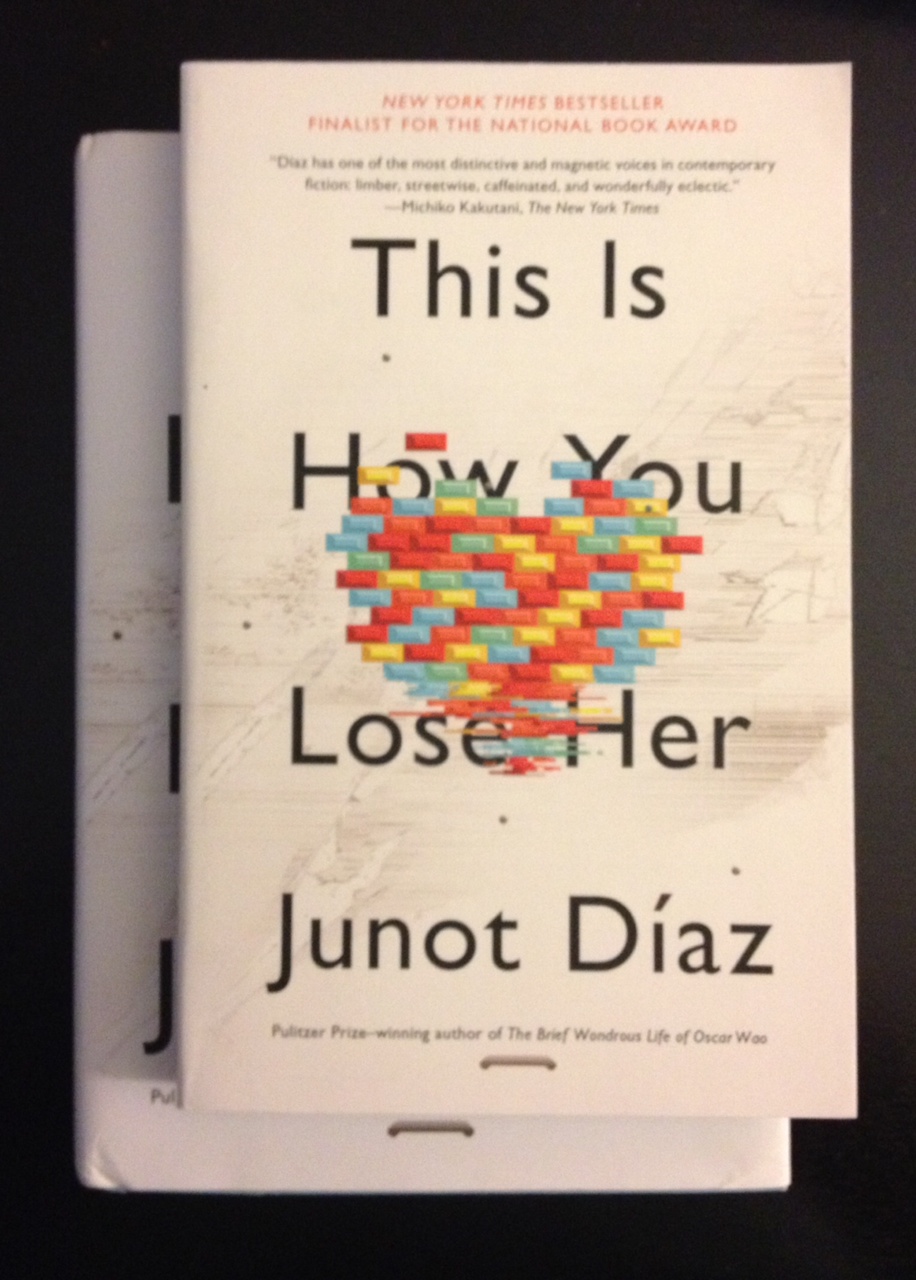
Not one but two (!) copies of This Is How You Lose Her
This Is How You Lose Her revolves around Yunior, a young Dominican immigrant who grows up in New Jersey and who ends up as a professor in Boston, and the many loves he has had or that he has encountered growing up. The stories trace his progress from a young, recently arrived Yunior, to a tenured, mature Yunior, showcasing certain relationships that influence how he relates to women—in sum, illustrating how he loses the women he loves. Throughout the short story collection, Díaz also calls attention to other relationships that may influence Yunior’s perspective, for example, his brother’s attachments with women, especially toward the end of his young life as he battled cancer, and his father’s relationship with his mistress, a Dominican woman who lived in New Jersey. At the end, Díaz illuminates how a mujeriego (womanizer) like Yunior comes to be; the short stories indicate that Yunior is as much a product of his environment as he is a seller of the merchandise.
Díaz is not a professional audiobook narrator. Although Díaz has done live readings, reading the full-length version of a book one has written is a different exercise. The Penguin Audio version of the collection is based on the actual short story collection (in other words, unabridged), so it does not contain additional stories or behind the scenes interviews. Technically, it is no different than the print version.
Listening to authors read their own work has value beyond the pleasure of hearing them read their text. Scholarly writing on audiobooks has emphasized the experience of listening to an audiobook for pleasure (like Deborah Phillips’ “Talking Books: The Encounter of Literature and Technology in the Audiobook” and James Shokoff’s “What Is An Audiobook?”), but it wasn’t until the 2011 edited collection Audiobooks, Literature, and Sound Studies that audiobooks were considered on their own instead of as extensions of the literature they were based on. The allure of doing this scholarly exercise with the audiobook version of This Is How You Lose Her is that Díaz’s delivery of the text is uncommon at the least.

“Junot Diaz at the Southern Festival of Books” by Flickr user Stacey Kizer, CC BY-NC 2.0
Talking about Junot Díaz’s readerly voice requires to tune into conversations about his writerly voice. In many reviews of Díaz’s books, writers discuss how Díaz deftly conveys a writer’s voice in his text, indicating that his success is that his characters have a very clear voice—or at least Yunior does. Michiko Kakutani, for example, points out how “Junot Díaz has one of the most distinctive and magnetic voices in contemporary fiction: limber, streetwise, caffeinated and wonderfully eclectic, capable of conjuring for the reader everything from the sorrows of Dominican history to the banalities of life in New Jersey.” Although this quotation is in reference to Díaz’s second book, The Brief Wondrous Life of Oscar Wao, it describes Díaz’s writing in terms of his voice instead of, for instance, in terms of his use of metaphors or choice of subject.
Richard Wolinsky, in his Guernica interview with Díaz, sees an overlap between Yunior and Díaz: “He’s [Yunior] got a very distinct voice, and it’s a voice that’s informed by [Diaz’s] own reading, particularly science fiction and fantasy.” Although Díaz has pointed out that Yunior is loosely based on events that have happened to him, Wolinsky “hears” Díaz in his main character. The tone and the language Yunior uses is read as a reflection of Díaz.
Conversations about the voice of the writer point to a sensibility about sound, but are often limited to a written text. Anna Barnet, in an interview with Junot Díaz, states “His two principal linguistic registers (‘this kind of crazy Caribbean language and music’ and ‘this sort of African-American-infused American vernacular’) grind against each other along with the many other voices he ventriloquizes in his writing.” Barnet reminds readers that Díaz’s writing style is based in spoken language—particularly Díaz’s spoken language. This language of “voice” to describe a writer’s style (or, specifically, a writer’s ability to convey a clear sense of who the character is and/or their views) is commonplace but gives the impression that there is a sonic aspect to an author’s work, when in reality it is but a metaphor for something that occurs at the level of text.
A critical reading of a text that includes the audiobook rendition allows critics to add substance to those references to “voice.” In Junot Díaz’s case, it is possible that readers encounter him first through written text, and so have an expectation of what Díaz (or Yunior) would sound like live. In my textual analysis of eight audiobook reviews (and one book review that included a mention of the narration in the audiobook) most listeners showed some sort of discomfort with Díaz’s narration. One reviewer, for example, had issue with the “smoothness” of Díaz’s narration: “At times the reading was a little shaky and uneven”. Another reviewer stated “at times his cadence is choppy, with odd pauses and emphasis on strange words that detract from the overall experience.” Reviewers also had an issue with Díaz’s pace, which is characterized by pauses in places that many not seem normal in casual American speech. These statements hint at a “weird” quality in Díaz’s speech, something that does not come through when Díaz has a casual conversation. (Listen to this podcast episode of NPR’s Alt. Latino guest-starring Díaz and compare with this video of him reading part of This Is How You Lose Her.) Although one blogger pointed out that Díaz sounded “professorial” in the reading, others used the words “native,” “authenticity,” “Dominican” and even “Jersey accent” to describe how Díaz sounded. It is unclear how these reviewers define “native” or “authentic.”

“Junot Diaz” by Flickr user ALA The American Library Association, CC BY-NC-SA 2.0
Connecting sound to authenticity implies that Dominicans can only sound a certain way, or that the audio narration is lacking when it does not represent a “typical” Dominican voice. To the extent that Díaz is Dominican, his voice is of a Dominican male who has grown up in the Northeastern United States. His uneven audio narration creates a feeling of sonic unintelligibility in the listener, similar to the effect of including Spanish words in the written text. Díaz-as-narrator can make a listener uncomfortable, and by extension forces that reader to listen.
The sonic unintelligibility also relies on the text, on how Díaz plays with language by switching back and forth from English to Spanish. Díaz mentions in an interview with Marva Hinton that some readers are not happy with his choice of Spanglish in his writing: “There [are] folks who hear one Spanish word, and they’re convinced this is some sort of immigrant conspiracy” Farther down, in the same article, Díaz refers to his mix of Spanish and English (and a particular kind of Spanish and English at that, since he moves among Standard American English, African American Vernacular English, and Dominican Spanish) as “opaque language.” There’s a connection between the kind of “opaqueness” that Spanish gives and the unintelligible effect of Díaz read his work.
An example of how sonic unintelligibility operates in the audiobook is the first story, “The Sun, The Moon, The Stars.” This opener, told in first person, revolves about one of Yunior’s break-ups; Yunior and his girlfriend Magdalena, on whom he cheated, go to the Dominican Republic on a trip they had planned before she found out about the affair. It frames the book as being an in-depth analysis of loves lost, from the man who keeps losing them. It also sets the tone sonically for the audiobook reading: after the introduction of the book, a snippet of bachata music comes on, and then makes way for Díaz, who reads the title of the story. This is the pattern of the book: slices of bachata, followed by Díaz’s narration.
His voice is characterized by a slight sing-song cadence that is reminiscent of Dominican Spanish accent. If this were in Spanish, it might be easier to lose track of the cadence, but in English it sounds like a disembodied accent. I showcase the swing in Díaz’s narration by alternating capital letters and lower-case letters: “Her FAther, who usually would treat me like his HIjo, CALLS me an ASShole on the PHONE, SOUNDS like he’s STRANgling himself with the cord.” The voice seems to float for a while until Díaz arrives to the end of a paragraph or a series of sentences, and then it sinks. Moreover, this pattern does not change when Díaz switches characters: it’s hard to tell Yunior apart from Magdalena unless the reader pays close attention to when the narrator is switching characters and/or when the narrator uses a pronoun. The same effect comes from the odd pauses in the author’s narration: “Oh God, she wailed. Oh. My God.”
The choppiness and the emphasis in the reading are a way to dislocate the listener, in a similar way that Spanish phrases or lack of quotation marks in the text dislocate a reader who does not understand Spanish or who depends on the quotation marks to make sense of the prose. Also, this story focuses on Magdalena withdrawing from Yunior and not communicating with him. The tone, cadence, and sound of Díaz’s voice can be read to mirror the relationship between Yunior and Magdalena (and the other women in the text): the sonic unintelligibility is manifest at the level of plot through Yunior’s relationships.
Although many audiobook reviewers may consider the plot in their reviews, part of what makes an audiobook stand out is the performance of the text. I take my cues from audiobook reviewers and consider critically my listening experience of This Is How You Lose Her and how this can become the basis for a critical interpretation of the text. My analysis underscores that having an author read a text can provide a different way into analyzing the text and prompts readers to pay attention to sound. If, like Shokoff asserts, most audiobook readers listen to an audiobook while doing something else, Díaz shows that listening closely to the audio text can be as rewarding as reading a book.
—
Featured Image: “Junot Diaz” by WBUR Boston’s NPR News Station, Attribution-NonCommercial-NoDerivs License
—
Liana Silva-Ford is co-founder and Managing Editor of Sounding Out!.
—
 REWIND! . . .If you liked this post, you may also dig:
“‘Or Does It Explode?’ Sounding Out the U.S. Metropolis in Hansberry’s A Raisin in the Sun“-Liana Silva-Ford
“‘HOW YOU SOUND??’: The Poet’s Voice, Aura, and the Challenge of Listening to Poetry”-John Hyland
“Fade to Black, Old Sport: How Hip-Hop Amplifies Baz Luhrmann’s The Great Gatsby“-Regina Bradley
Share this:


Current Top Posts





April 2021

January 2020

November 2019

October 2019

August 2019

April 2014

November 2017

March 2015

December 2017

October 2015
 Sounding Out!
Recent Comments