
Kawa: Rediscovering Indigeneity in China via Reggae
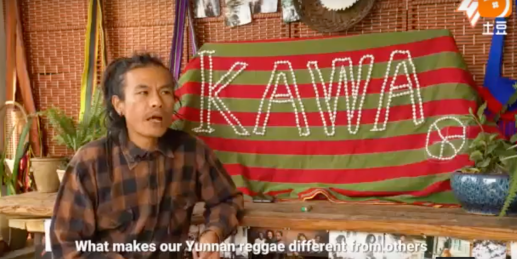
Kawa is a reggae group from Yunnan’s Ximeng, an autonomous county for the Wa people in the southwest of China, bordering Myanmar. When I learned about Kawa’s story in 2016, I was first intrigued by the geographical similarities between Yunnan and Jamaica: both regions are characterized by tropical climates, lush vegetations, and perhaps most prominently, proximities to marijuana plantations. Outsiders often associate the musical style of reggae with a stereotypical “laidback” lifestyle projected onto these locales. Known as “Yunnan Reggae,” Kawa’s music indeed exhibits some of the most characteristic elements of reggae music—slower tempos, remixed vocals, and repetitive chords falling on the offbeat.
“Yunnan Reggae”–Kawa
Recently I realized this climate connection was simplistic and reductive, and what I failed to grasp in Kawa’s music was far more important—a notion of indigeneity manifested through reggae’s generic elements. In Steven Feld’s “From Schizophonia to Schismogenesis: The Discourses and Practices of World Music and World Beat” in 1995, he noted the affinity of many indigenous cultures for reggae music. “Its [reggae] perception by indigenous peoples outside the Caribbean as an oppositional roots ethnopop form has led to its local adoption by migrants and indigenes in places as diverse as Europe, Hawaii, Native North America, Aboriginal Australia, Papua New Guinea, South Africa, and Southeast Asia” (110). In the 1970s, “roots” reggae translated the everyday lives of Jamaicans as well as their Rastafarian spirituality into a stark resistance to racial oppression, economic inequality, and colonial capitalism that they had experienced in history. The music was deeply embedded in the Jamaican culture. Around the same time, however, engineers and producers in Jamaica–many of them Chinese and Chinese-Jamaican–began to experiment with remixing reggae songs, contributing to an adaptive style of pop music as well as its international popularity. Therefore, against the global market force for “a world music,” reggae was quickly adopted to preserve indigenous cultures, remixing a wide range of ethnomusical elements.
But note that Feld’s list did not include East Asia. In fact, indigeneity as a discourse has been largely absent in this region. Taiwan is perhaps the only exception, where the Austronesian peoples have claimed their indigenous status and political rights. Japan and the Koreas are often considered as the most ethnically homogeneous countries in the world. And China, while officially acknowledging its ethnic diversity, never thought its internal migration of the Han majority as a potential threat to its ethnic minorities and indigenous cultures. I grew up in the southwest of China in the 1990s, when the internal migration of ethnic groups was already a norm. I could not remember if “indigeneity” meant anything even remotely political. I could not remember if the cultural traditions of ethnic minorities were meant to be tied up to the land on which they are/were practiced. What I do remember is that there are regions where the ethnic minorities concentrate and in which they integrate.
This post examines how the Chinese reggae group Kawa introduces an indigenous discourse through the sonic elements of reggae. In their performances, Lao Han often opens with a statement about being an indigenous ethnic minority. Most members of the group have non-Han Chinese backgrounds—Wa, Hani, Aini, and Hui. And even the name Kawa refers to the Wa people in their own language.
Kawa always find the most innovative ways to incorporate ethnic elements into their interpretations of the genre. In “Yunnan Reggae,” for example, sampled vocals from Wa people, lyrics written in Wa language, and traditional Wa instrumentation all work together to portray living cultural traditions closely associated with the Wa ethnic identity. However, it is the intimacy with the land Kawa expresses in their music that foregrounds their indigenous sentiments.
Although the entirety of the lyrics consists of two lines, the song “Red Hair Tree” reveals an indigenous life dwelling on the land—in its neighborhood, locality, and proximity.
Such a huge red hair tree
Hitting the wooden drum sounding dong dong
“Red Hair Tree” resembles a labor song narrating the mundane activities of logging and drum crafting. The first line describes the tree’s size, invoking a reverence for its sublimity. The glistening red color contributes to the plant’s vibrant animacies. As Ai Yong explains, “If you have chatted with the elders on the A Wa Mountains about this land, you will see an extraordinary beam of light glistening in their eyes, carrying endless assurance and reverence” (translated by Meng Ren). The second line translates that reverence into a more intimate whispering. Due to the Wa people’s animist beliefs, the red hair tree’s spirit is reincarnated in the wooden drum. The “dong dong” sound then embodies an invocation of the natural spirits. “The Wa ancestors believe, where there is the red hair tree, there is god’s blessing. In the past, the tall and robust red hair trees surrounded all Wa villages.” As Ai Yong continues to explain, the natural spirits are called for protection in exchange for the people’s worship.
“Red Hair Tree” is not the first time when reggae prompted the Han Chinese to confront questions about migration and indigeneity, however. It is often forgotten that the Chinese diaspora in Jamaica contributed to the development of reggae. Stephen Cheng’s “Always Together (A Chinese Love Song)” in 1967 is a rare yet symptomatic example of how the Chinese imagined indigeneity through remixing reggae.
Despite its obvious rocksteady overtone, the song combines a wide range of Chinese elements. It opens with a pronounced bass line coupled by the guitar and then the accented drum beat. Although this rhythmic beat is reminiscent of typical reggae songs, the music flow is somehow disrupted by the sudden appearance of the male vocal. Stephen Cheng sings in Mandarin. His chest voice meanders across a wide range, registering a sonority that is more often heard in Chinese opera than in reggae songs (or pop music in general). His delivery accentuates on the extended vowels, exaggerating the dramatic ups and downs of the tonal language—Mandarin Chinese. In fact, the music is adapted from a well-known Taiwanese folk song “Green is the Mountain (Gao Shan Qing).” On the surface, it is a romantic love story. It depicts the scenic landscape of the mountains and waters of Alishan, which the Taiwanese indigenous Tsou people traditionally inhabit. Through a metaphorical parallel, the romantic love between a young Tsou couple is embodied in the companionship between the mountain and the water, which resonates with its English title “Always Together.”
Indeed, “Green is the Mountain” was written by the Han Chinese who fled to Taiwan during the Chinese Civil War, and it is often criticized for romanticizing the experience of the indigenous peoples who were forced to move into the mountain. When the song is rendered into reggae by Cheng, however, it re-contextualizes this imagined indigeneity as a diasporic yearning to restore the lost connections between land and culture. “Always Together” was produced by Byron Lee, a Chinese-Jamaican who founded the renowned ska band Byron Lee and the Dragonaires. As record producers, sound system owners, or band managers, numerous Chinese-Jamaicans like Lee contributed “Chinese elements” to reggae during its formative years. In return, reggae carries on the tradition of cultural remix, always opening itself up to local adaptions.
Reggae has always been an eclectic music form. As we have seen, both examples combine a wide range of musical elements from different cultures—from ethnic minorities in China to Chinese and African diaspora in Jamaica. Despite almost a half century apart, the two reggae songs foreground a discourse on indigeneity that is shaped by the migration of people and the mixing of culture. Despite the most generic “pop” elements, the local adoption of reggae reveals an attempt to comprehend the relationship between ethnic identity, cultural practice, and the land. Understood in this way, Kawa’s reggae music becomes an important voice in understanding ethnic differences and indigeneity in today’s China.
—
Featured Image: Screen Shot from “Kawa: Chinese Yunnan Reggae Band”
—
Junting Huang is a Ph.D. Candidate in the Department of Comparative Literature at Cornell University. His research areas include literary studies, film/media studies, and sound studies. His dissertation project “The Noise Decade: Intermedial Impulse in Chinese Sound Recording” examines the figure of noise in contemporary Chinese literature and new media art. It analyzes how noise is conceptualized through the recorded sound as a materializing force that indexes the shifting social relations in the 1990s.
—
 REWIND! . . .If you liked this post, you may also dig:
Decolonizing the Radio: Africa Abroad in the Age of Independence– Samantha Pinto
“Everyone I listen to, fake patois…”– Osvaldo Oyola
Radio de Acción: Violent Circuits, Contentious Voices: Caribbean Radio Histories–Alejandra Bronfman
Share this:

SO! Reads: Rebecca Tuhus-Dubrow’s Personal Stereo

 In Personal Stereo, Rebecca Tuhus-Dubrow’s eminently readable history of the Walkman and its kind, it is telling to learn that Sony founders Masaru Ibuka and Akio Morita were prone to conversing in ‘something akin to a private shared language’ or idioglossia. “They would sit there,” recounts Morita’s eldest son, “and we would listen but we had no idea what they were saying” (21). In later life, following strokes, both lost the ability to speak; Ibuka’s son characterises their subsequent relationship as “communicating without words’.” Even the name Sony itself, notes Tuhus-Dubrow, with its origins in the Latin sonus and the English slang “sonny,” was ultimately “a word in no language’” (13). It is as though aural perception, delivered on an intimate scale, is somehow revelatory in a way that transcends the typical organising principles of language. The incorporation of the sonic into everyday life forever approaches a kind of affective intensity.
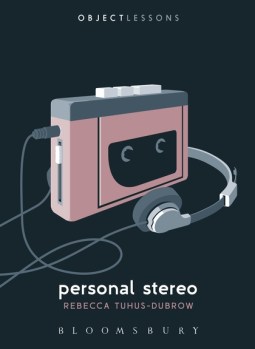 Personal Stereo tunes into this frequency and – by virtue of its array of research and skilful marshalling of social and cultural history – offers a compelling map of its coordinates. If, as part of Bloomsbury’s Object Lessons series, one of its central tasks is to apprehend the affective resonance of the inanimate, it is testament to Tuhus-Dubrow’s work that she is able to manage the breadth of her material into an adroit and concise narrative while at the same time allowing space for her writing to approach these contained moments of intensity. “When I think of [the Walkman] now, I think of joy,” she writes in the introduction (1). While acknowledging that undue celebration of the past can stymie the present, she offers a quietly persuasive case for an examination of nostalgia amid the anxiety of contemporary life, which almost serves as a rallying cry for a generation pinioned between the two: ‘The past, whatever its shortcomings, has the virtue of having already happened. And we survived it.’
As iTunes – like the glory of the world – passes into epilogue, it is again time to consider how we might frame obsolete technologies as echoes of a particular moment in our lives, anchored between progress and decay. As texts, they harbour a kind of degraded cartography: a summation of meaning and collapse.
The story of the Walkman begins in the bombed-out ruins of 1940s Tokyo, as Ibuka and Morita establish the foundations of the company that would become a consumer electronics giant as part of Japan’s ill-fated post-war boom. It is striking how much of the Walkman’s development was shaped by the ravages of warfare: Tuhus-Dubrow notes how its antecedent, the tape recorder, was first used in the German military, and early headphones were issued to fighter pilots. It is possible to read the subsequent commercial adoption of personal listening devices as an attempted refashioning of the domestic interior, transgressed so violently in acts of conflict. One of Ibuka’s founding principles for Sony was to “apply highly advanced technologies…developed in various sectors during the war to common households” (12). Tuhus-Dubrow also recounts the case of Andreas Pavel, a native of post-war Berlin, who emigrated with his family to São Paulo and developed what we might term a “counter-prototype” to the Walkman, partly inspired by the internal acoustics of his mother’s home – “a mecca of sound” – in Cidade Jardim. Object lessons are formed through disintegration and salvaged materials. Morita compares his formative partnership with the older Ibuka to a newly-established familial unit: “It was almost as though an adoption were taking place” (13).

Akio Morita (left) and Masaru Ibuka (right), 1961. Courtesy of Sony
This elides neatly with Tuhus-Dubrow’s central chapter, which is also the strongest. Here, she discusses the reception of private listening within the public domain, and how existing societal norms apprehended this new sonic phenomenon. It is intriguing, and at times hilarious, how much of the reaction operates as moral critique: from a 1923 article comparing the very act of solo listening to alcohol abuse or a drug habit, to rather more recent takes that foreshadow the current intergenerational culture wars. “The personal stereo,” harrumphs A.N. Wilson, ‘became the archetypal accessory of the me-generation” (68).
Tuhus-Dubrow’s research is smart and on point, not least because it leads to a productive consideration of how the cathartic element of the private soundtrack becomes something that society struggles to assimilate. She takes to time to weave in personal testimonies and reminiscences that are effective and somehow touching: “the Walkman,” she admits, “was a source of elation and comfort” (85). A friend recalls how “[my] inner world was enriched by the freedom to explore music on my own” (84). Pavel describes how the first use of his prototype, in the snows of St Moritz, evoked “a state of ecstasy,” in which life temporarily assumed a cinematic quality. “Suddenly,” he remembers, curiously switching to the present tense, “I’m inside a film” (27).

Darryl with a new Walkman, December 25, 1982, Image by Flickr User Kent Kanouse
Others speak of how musical accompaniment aids a more immersive interaction with the world around them, and it is here that perhaps the real strength of Tuhus-Dubrow’s work emerges: the generosity of an approach that permits mutual recognition; the summoning of an experiential quality that is elusive in its definition but vivid and immediate in its resonance. It is a mode of writing – and indeed a mode of listening – that is resolutely contemporary, formed in a firestorm of technological innovation that was both oppressive and liberatory, attuning us to new ways of being at the same time as it degrades and erodes old certainties.
It bears resemblance to what Tuhus-Dubrow recognises as “the logic of our own bodies, with organs and limbs whose motions are connected to their functions, and which are susceptible to injury and gradual breakdown” (102). Earlier she writes, “as one song neared its end, I would begin to hear the opening chords of the next in my head.”
What is it, this sense of auditory anticipation?
It is the forming of new waves. We have blood in our ears.
—
Featured Image: “Walkman through the cassette” by Flicker User Narisa (CC BY-NC-ND 2.0)
—
Lewis Jones is a writer and itinerant based in Brighton, UK. He received an MA in Literature, Culture and Theory from the University of Sussex, having previously graduated in English Literature from the University of Winchester. He is interested in how artistic and aesthetic mediums might be used to develop new theoretical approaches to culture and society. He particularly likes urban spaces, as visual and auditory environments, and the intersections between music, movement and the body. He thinks that dancing about architecture is a perfectly valid exercise.
—
 REWIND! . . .If you liked this post, you may also dig:
SO! Reads: Hiromu Nagahara’s Tokyo Boogie-Woogie: Japan’s Pop Era and Its Discontents–Shawn Higgins
SO! Reads: Janet Borgerson and Jonathan Schroeder’s Designed For Hi Fi Living–Gina Arnold
SO! Reads: Susan Schmidt Horning’s Chasing Sound: Technology, Culture and the Art of Studio Recording from Edison to the LP— Enongo Lumumba-Kasongo
SO! Reads: Steph Ceraso’s Sounding Composition: Multimodal Pedagogies for Embodied Listening–Airek Beauchamp
Share this:


Current Top Posts





April 2021

January 2020

November 2019

October 2019

August 2019

April 2014

November 2017

March 2015

December 2017

October 2015
 Sounding Out!
Recent Comments