
Sounding Visibility in Anglo-Latin Prose

series co-editors Dorothy Kim and Christopher Roman
Here is a distilled introduction to the latest installment of Medieval Sound, Aural Ecology, by series co-editors Dorothy Kim and Christopher Roman. To read their previous introduction, click here. To read the first run of the series in 2016, click here. To read the full introduction to “Aural Ecology” and to read last week’s post by Thomas Blake, click here.
Aural Ecology
What is considered music, noise, or harmony is historically and culturally contingent. [. . .] The essays in “Aural Ecologies” address the issue of unharmonious sounds, sounds that often mark dissonant critical identities—related to race, religion, material—that reverberate across different soundscapes/landscapes. In this way, this group of essays begins to open up the stakes of Medieval Sound in relation to what contemporary sound studies has begun to address in relation to cultural studies, architectural and environmental soundscapes, and the marking of race through the vibrations of the body. —Dorothy Kim and Christopher Roman
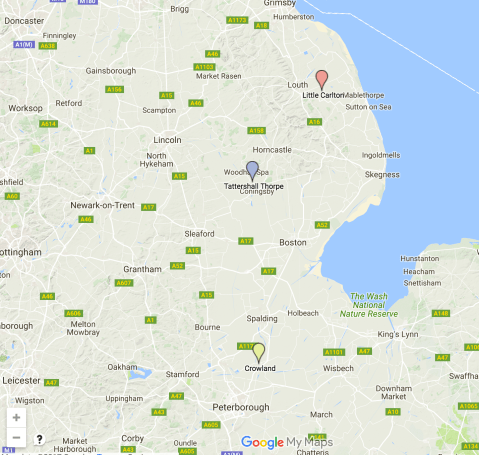
While the raucous rancor of last year’s Super Tuesday was dominating network news and social networks—which, sadly, seems so long ago now—a quieter news story emerged from the tranquil fields of Lincolnshire: an Anglo-Saxon island has been discovered. Its artifacts are some of the most remarkable to have been found in recent decades; among these finds are writing utensils, game pieces, butchered animal bones, and other indicators of a sustained trading community.
The Guardian reported that surveys and software enabled the archaeologists to model the island in its contemporary landscape and seascape, revealing that it had once rested “between a basin and a ditch.”
This placement, the lead archaeologist continued, suggests that the site “was a focal point in the Lincolnshire area, connected to the outside world through water courses.” So if these reimagined waterways can show us how people saw the site, can they tell us how people heard it, as well?
I think so, especially because of the recent work on ancient acoustics in early churches. In February, The Atlantic published an article on the recent scholarly collaboration among an art historian-archaeologist, a music producer-engineer, and the founder of the USC Immersive Audio Laboratory (yes, it’s a real thing). This super-interdisciplinary team was able to “map the acoustic fingerprint of several [Byzantine] churches,” which were shown to have been deliberately “designed to shift a person’s sensory experience.” Now, the USC member explains, they can record a chant, “process it … and all of the sudden we have performances happening in medieval structures.” They can actually rebuild the sounds of our ancient past. [By the way, Allison Meier of hyperallergic reported on this story as well; her article provides links to the Escape Velocity podcast on Acoustic Museums, which is well worth a listen].
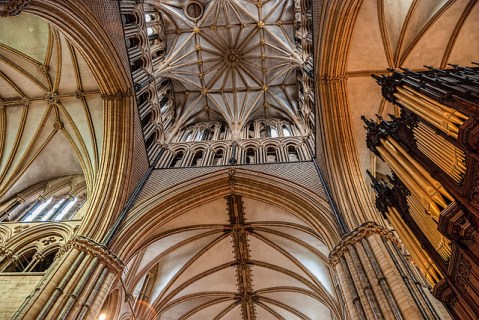
Interior of Lincoln Cathedral, Image by Flickr User Gary Ullah, (CC BY 2.0)
If they can recreate the lost sounds of ancient structures, and archaeologists can recreate early medieval topographies, then it stands to reason that the recreation of past landscapes, and even seascapes, might not be far behind.
But was sound different across the cooler, wetter climate of the early Middle Ages? Were the hearers’ auditory contexts drastically different in a pre-modern world? To what effect?
To me, what’s tantalizing about the Lincolnshire island is that it was on the border of the early medieval fenland—an area described by the 8th-century monk Felix as dense and undulating, “now consisting of marshes, now of bogs, sometimes of black waters overhung by fog, sometimes studded with wooded islands and traversed by the windings of tortuous streams” (Ch XXIV, trans Colgrave p 87). In such an aqueous environment, sound would have travelled well, staying close to the cool, dense air hovering over the waters.
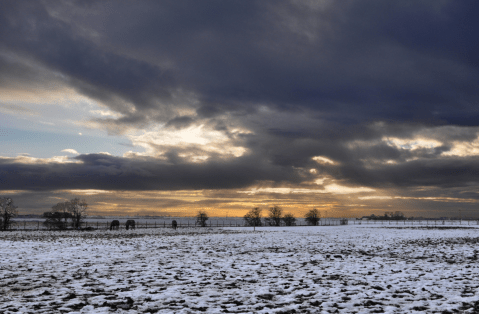
Dark skies over fenlands, near Spilsby, Lincolnshire. Taken by Lutmans on Flickr, (CC BY 2.0).
In his prose hagiography, the Life of St Guthlac, Felix enshrines certain sounds in the wetland ecology of Guthlac’s surroundings. He does so most explicitly at the landing-place, where visitors must “sound a signal” to alert the hermit that they’ve arrived. But what was this signal, and why would Felix bother to emphasize such a mundane practice of alerting your host when you’ve arrived?
In monastic communities bells were used to sound the Daily Office to calling each member together in prayer. As moderns, we should remember that these bells—frequent, sonic interventions of everyday life—were rung on the shore, or in a church, or on monastic grounds rather than from the larger towers of later belfries (an exception to this is the early Irish Round Tower). These small hand-held bells “of hammered sheets or cast metal” which “would presumably have clanged or tinkled, rather than tolled sonorously across a distance” (Resounding Community, 103).
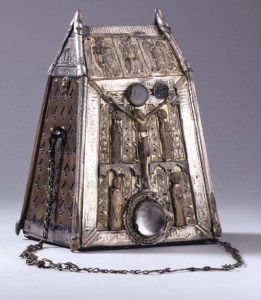
Bell-shrine; bronze and silver parcel-gilt; made for the bell of St Conall Cael.
Bells were spiritual and supernatural; they could cleanse or curse, and were kept by clerics and lay people alike. They were sometimes sworn on, as if they were relics. Sometimes, they were made into relics. For more about early Irish bell traditions, click here and or/ here.
In Northwest Europe in the Early Middle Ages, Christopher Loveluck describes David Hinton’s work on a seventh-century smith found buried alone, “next to the marshland and waterways to the sea, with his tools, a bell, a fine seax and a silk-wrapped amulet” and therefore “emblematic of the transition from such ‘outsider’ itinerant artisan/merchants to the vibrant artisan and trading communities of the emporia ports.” Still, the“[p]erception of threat from itinerant ‘outsiders’ is emphasized in the late seventh-century Anglo-Saxon law code of Wihtred, by the obligation on non-local travellers and foreigners to announce themselves with bells or horns, prior to leaving principal roads or trackways to approach settlements.”
For seventh-and eighth century people, then, bells sounded time, community, and stillness as well as place, strangeness, and travel. In either instance, the aural intrusion always betokened a human presence. And of course, these were some of the only sounds that weren’t naturally occurring; this might have been as close as they got to manmade sound pollution.
For Guthlac, sound was especially important because he could not see far from his earthen hermitage. Not having any need for a bell to sound the Daily Office, he nevertheless depended on some kind of signal for approaching visitors.
In one episode, distraught parents bring their once-possessed, now very ill son to Crowland in the hope that he might be cured. This is quite different from an earlier visitation from Wilfrid and Æthelbald, whom Guthlac knew personally, and with whom he might have traded correspondence. To me, this is the real test of Guthlac’s grace: will he help the neediest? The stranger? The tired, desperate parents? Does the bell, or whatever the signal is, proclaim their sameness or difference?
We can sense the tension in the passage, during their sounding of the signal and speaking to Guthlac:
Then when the sun rose in its splendour, they approached the landing place of this said island, and having struck the signal they begged for a talk with the great man. But he, as was his custom, burning with the flame of most excellent charity, presented himself before them…[and after hearing their story] immediately seized the hand of the tormented boy and led him into his oratory, and there prayed on bended knees, fasting continually for three days…(XLI, Colgrave 131).
The parents had expected to wait; they expected to plead on their son’s behalf. They expected a struggle to be heard. But—and I do think that’s a rather crucial autem in the Latin—Guthlac is eager to listen; the sound on the shore was enough.
What’s more, his cure is a series of utterances. He prays (aloud) for three days straight, without pausing to eat. And after ritually rinsing and breathing the “breath of healing” on the boy, the child, “like one who is brought into port out of the billows and the boiling waves, heaved some deep sighs from the depth of his bosom and realized that he had been restored to health”(XLI, Colgrave 131).
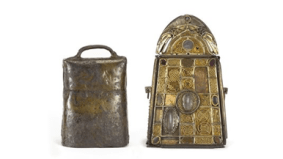
Image from National Museum of Ireland
I’m a mom to an asthmatic toddler, so I find myself quite moved by this scene. I can imagine ringing the bell—the thing I might have heard in church, or had in my home; the signal by which monks were called to prayer and children inside for curfew—to make a sound for myself. I can imagine traveling with my husband to a strange place far from home, not knowing what would happen. I can imagine using something everyday for something extraordinary, and having the sound of my arrival echo with anticipation. If I were this mother, I would hear it bounce off the marshes and off the low-lying islands. The dawn would be warming the air above us, amplifying our sound. And I would be standing there, with my child wrapped in my arms, hoping to see someone emerge from a barrow; a man of God whose isolation and entrenchment was supposed to be part of his holiness.
The sound travels outwards to the hermitage and back with the hermit—the echo of her hope, meeting them at the shore. This is a soundscape and a landscape in which time seems still on the shore, but sped through in the oratory. Felix joins both sites, and both temporalities, with the simile of the boy as one rescued from shipwreck catching his breath as he washes ashore. The image recalls the sound of their arrival, and that first bell still seems to ring through this narrative of hope against all odds.
Wouldn’t it be great to hear that again?
—
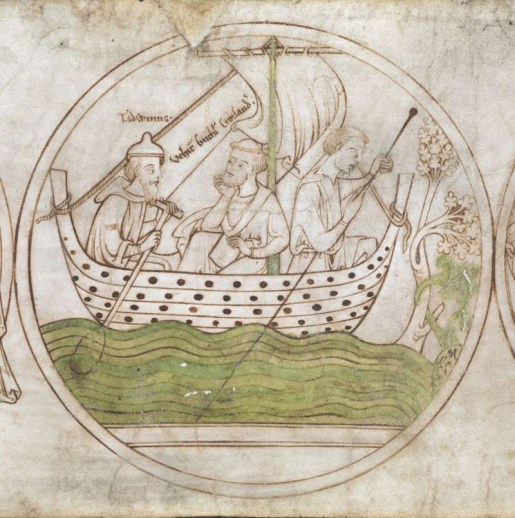
Featured Image: Guthlac sailing to Crowland with Tatwin. © British Library, Harley Roll, Y 6, roundel 4, from Medieval Histories.com
—
Rebecca Shores is a Ph.D. candidate in English Literature at the University of North Carolina at Chapel Hill. Her Dissertation is entitled “Bringing Saints to the Sea: Ships in Old English and Anglo-Latin Hagiography.”
—
REWIND!…If you liked this post, you may also dig:
(Sound)Walking Through Smithfield Square in Dublin–Linda O’Keeffe
Wayback Sound Machine: Sound Through Time, Space, and Place–Maile Colbert
Audiotactility & the Medieval Soundscape of Parchment–Michelle M. Sauer
Share this:

Spaces of Sounds: The Peoples of the African Diaspora and Protest in the United States

The slaves who were ourselves had known terror intimately, confused sunrise with pain, & accepted indifference as kindness. – Ntozake Shange, Sassafrass, Cypress & Indigo
Sanford. Baltimore. Chicago. Staten Island. Charlotte. Cleveland. Oakland. Austin. Los Angeles. The Bronx.
Despair in the United States is nothing new. It is neither an emotion confined to the neatly-drawn borders of this land nor is it experienced more acutely by any one group of people. The vast discrepancy between the results of the popular vote and the electoral college’s selection of Donald Trump as forty-fifth president of the United States amply reveals despair to be an sentiment viscerally experienced by a wide swath of people in this country, irrespective of race, ethnicity, gender, class, or sexuality.
Such despair has been ignored, however, by those who have caused and who continue causing the suffering of peoples of both indigenous and, later, African descent. We are taught that men from what we now recognize as Europe arrived in this hemisphere in the late fifteenth century, settling initially on a strip of earth in the Caribbean Sea that would become the first site of massacre and genocide, acts which unleashed, if one lends credence to the narrator of Junot Díaz’s The Brief Wondrous Life of Oscar Wao, the fukú, the “Curse and the Doom of the New World.” The narrating voice himself characterizes the curse not in the actions of death, but in the “screams of the enslaved, [..] the death bane of the Tainos, uttered just as one world perished and another began […]” (1). The fukú resonated through the sounds that these human beings made.

Image of the People’s History of Telegraph Avenue mural, designed by Osha Neumann, painted in 1976, restored and enlarged in 1999, at the corner of Haste and Telegraph in Berkeley. Image by Flickr user nursenicole329 (CC BY-NC-ND 2.0).
.
Not a house in the country ain’t packed to its rafters with some dead Negro’s grief. – Toni Morrison, Beloved
The State’s unwillingness to hold George Zimmerman responsible for the murder of Trayvon Martin–and its subsequent refusal to hold any police officer accountable for the hundreds of deaths they have caused–has galvanized the United States in the last four years. Hundreds of thousands of men, women, and children alike have taken to the streets, as #BlackLivesMatter, a true and succinct sentence, has roused ghosts of the past who have never left us, who have always been present, accompanying us on this journey.
This post is not a reflection of the music that has served as a soundtrack to these protests, though there are articles that have done so, such as this one, this one, and this one. These pieces do not include the extensive list of articles that address perhaps the most widely-viewed piece of protest music thus far, Beyoncé’s “Formation” video, a scarce offering of which can be found here, here, and here. Instead, it is an essay inspired by the sounds of the protesters themselves, the noises made by the minds, bodies, and spirits of the men, women and children who have taken to public spaces and sometimes commercial zones in order to confront and object to the protections applied to those who kill men, women, and children, often of African descent.
Listen to Los Angeles in 2013. . .
. . .to Houston in 2014. . .
. . .to New York City in 2014. . .
. . .and to Charleston in 2015. . .
. . .
 In his pivotal Cities of the Dead: Circum-Atlantic Performance (1996), Joseph Roach characterized New Orleans and London as urban centers marked by two simultaneous, consistent acts: appropriation by white people and white power structures of the cultures of the peoples they have violently marginalized, and then, at the same time, a clear distancing from those very cultures and peoples. Although now in its twentieth year of publication, Roach’s theorization of the circum-Atlantic world remains vastly underutilized in scholarly circles—particularly in sound studies, where it should have special resonance– and has become increasingly critical to our understanding of this historical moment, as it “insists on the centrality of the diasporic and genocidal histories of Africa and the Americas, North and South, in the creation of the culture of modernity” (4). With this configuration, Roach accomplishes two feats simultaneously: first, he decentralizes the United States as the focal point of studies about the so-called New World, instead, placing on equal footing all of the histories and cultures of the Americas. For this scholar of the literatures of the Americas, particularly those written by men and women of African descent, Roach’s is a critical gesture that facilitates comparative work across national boundaries.
Second, and most importantly, Roach emphasizes the role of murder, rape and the destruction of whole cultures indigenous to the American and African continents in the foundation of the nations of this hemisphere. Ta-Nehisi Coates is perhaps the most recent writer to remind us that the most potent legacy of such modernity, racism, “is a visceral experience, that is dislodges brains, blocks airways, rips muscle, extracts organs, cracks bones, breaks teeth” (Between the World and Me, 10). That which we know as “modernity,” itself a deeply flawed construct that remains in need of serious revision, was born of broken backs, mutilated limbs, hushed middle-of-the-night tears of indigenous and African peoples. Moans and sighs, whispers and wails, cries and screams, they are the musical score of this hemisphere’s American experiment.
The slaves who were ourselves aided Indigo’s mission, connecting soul & song, experience & unremembered rhythms –Ntozake Shange

Harriet Tubman Memorial Monument, Harlem, Image by Flickr User John Mannion (CC BY-NC-ND 2.0).
In the face of a populace accustomed to ignoring the wailing of mothers who have buried their children, who have disregarded their dignity and the weight and shape and taste of their loss, men, women, and children have mobilized. They have made manifest that which communities of peoples of African descent have spoken of and have documented since the founding of this nation. As Roach has utilized the term performance, the literal rituals of mourning by communities of African heritage not only commemorate those who have recently passed but they also invoke the spirits of those who have long borne witness to such violence. Throughout his study, Roach distinguishes between a European heritage that begins to segregate the living from the dead during the Enlightenment (50), and more traditional cultures, particularly African ones, where spirits mingle with their human counterparts. While written texts may not, and often do not, adequately commemorate the loss of lives deemed marginal to the larger society, performance itself – chants, wails, songs – serve not only to memorialize but also as gestures of restoration.
Protesters and activists are no longer satisfied with the well-established decree that we should wait for a distant moment for a more perfect realization of the United States’s many promises. No, instead, they have identified this as the historical moment in which those oaths are to be fulfilled. They have walked, marched, and stomped through streets, on sidewalks, parks, churches, filling malls and transportation hubs with their bodies as testimony. They have repossessed and redefined spaces once thought of as simply neutral, transparent space as Katherine McKittrick refers to it in Demonic Grounds, revealing the fault-lines of difference based on class, race, gender, and sexuality in this society (xv). They have done so manipulating sound, both recycling chants used through the decades to protest injustice and, at times, simply occupying space, without a word uttered.
The silence waged in the 2014 protest in Grand Central Terminal after the non-indictment of Daniel Pantaleo in the murder of Eric Garner does not represent erasure, but rather a purposeful demonstration of the willful humanity of those unwilling to forget.
They quiet themselves. They replace the sounds of unfettered pain and grief with its absence, until all that you hear is the mechanized announcement of train schedules. The contrast is stark: the moment highlights what Claudia Rankine has identified as the condition of black life in Citizen, that of mourning (145), against a backdrop of technological advancement, that which has been built on the backs of and through the physical, emotional, and intellectual labor of black life. Here, the members of this community enact what has been called a “die-in”: simulating the physical positioning of bodies in caskets, they force onlookers to confront an uncomfortable truth about the history of this country and of the nations of this hemisphere.
All of us walk on land soaked in the blood of those who have made our lives easier and more convenient. The men and women at Grand Central make manifest what Roach terms surrogation: in the chasm left by death, they offer a replacement, one that both evokes those who have died and disturbs the complacency of survivors themselves (2). The performance serves to confront those who dare say that the violence of genocide and enslavement of past generations should remain in the past; no, these men and women and the spirits they invoke respond. Time is not linear, as we have been taught. For past, present, and future are temporal constructs used to service oppression and domination; this will no longer do.

From Kara Walker’s 2014 exhibit, “A Subtlety,” at the Domino Sugar Factory in Brooklyn (CC BY-NC 2.0)
Here, in this here place, we flesh; flesh that weeps, laughs; flesh that dances on bare feet in grass. Love it. Love it hard. – Toni Morrison
We bear witness to the reclamation of grief, of lives cut short at the hand of a government charged with protecting those human beings who inhabit its borders, at least theoretically. While, as Roach surmises, “memory [may be] a process that depends crucially on forgetting” (2), we hold space to those dedicated to not forget, to instead excavate the silences, breathe life into those histories, remembering that the stories we have heard, the pages we have read, were once human beings. We create “counter-memories” as challenge and testimony, as a sacred pledge to those who are no longer present physically in this realm (Roach 26). We recall the cultures and practices of those who lived before the written form was a tool of exclusion, when remembrance was a practice of community.
American culture, in the hemispheric sense, incorporates all such rituals, across generations; as Roach notes, it is performance that “works on behalf of living memory, by bringing the parties together as often as necessary” (138). No longer consigned to the past, the spirits of those killed by the state are revived, their existences in the human plain celebrated. They are not defined by how they died but instead by how they lived. While literacy of the written form can separate, sound and gesture more effectively bypass the fictions of difference based on race, ethnicity, gender, class, and sexuality. Cities of the Dead amplifies how “performance can articulate what otherwise may not be properly communicated” (161).
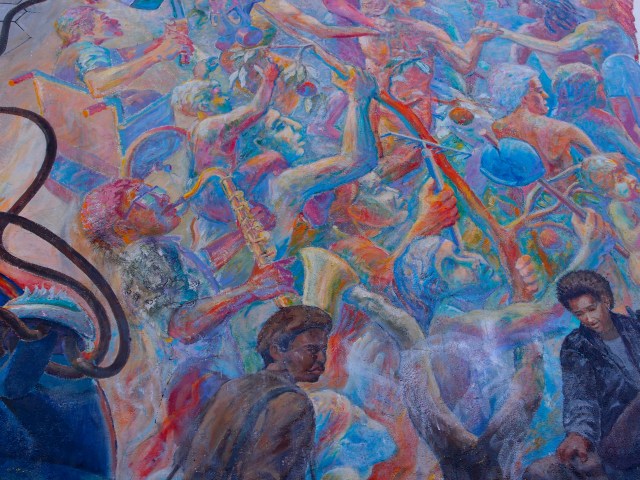
Image of the People’s History of Telegraph Avenue mural, designed by Osha Neumann, painted in 1976, restored and enlarged in 1999, at the corner of Haste and Telegraph in Berkeley. Image by Flickr user nursenicole329 (CC BY-NC-ND 2.0).
It’s so magic folks feel their own ancestors coming up out of the earth to be in the realms of their descendants – Ntozake Shange
We say their names. We say their names: Eleanor Bumpers. Anthony Báez. Sean Bell. Aiyana Stanley-Jones. Tyisha Miller. Oscar Grant. Rekia Boyd. Trayvon Martin. Tanisha Anderson. Renisha McBride. Eric Garner. Yvette Smith. Tamir Rice. Sandra Bland. Freddie Gray. Korryn Gaines. Akia Gurley. Alton Sterling. Philando Castile. Micah Jester. Deborah Danner. Walter Scott. Michelle Lee Shirley.
The list, tragically, grows, and still we say their names. We do so as an act of remembrance. As an offering. As peoples of African descent around the world do in times of ceremony, in the name of ritual. We remember those who have come before us, who have birthed this current historical moment of awakening here in the United States. We say their names.
And, as the sounds of their names said aloud echoes, we pray. Ashé.
—
Vanessa K. Valdés is associate professor of Spanish and Portuguese at The City College of New York; she is the editor of Let Spirit Speak! Cultural Journeys through the African Diaspora (2012) and The Future Is Now: A New Look at African Diaspora Studies (2012) and the book review editor of sx salon. She is the author of Oshun’s Daughters: The Search for Womanhood in the Americas (2014). The title of this essay is inspired by Josh Kun’s Audiotopia: Music, Race, and America, where he writes that his book is “focusing on the spaces of music, the spaces of songs, and the spaces of sounds” (25).
—
Featured Image “Freedom Marchers” by Flickr User Keoni Cabral, Photoshop processed digital image from the Martin Luther King Center in Atlanta, Georgia (CC BY 2.0).
—
 REWIND! . . .If you liked this post, you may also dig:
SO! Reads: Shana Redmond’s Anthem: Social Movements and the Sound of Solidarity in the African Diaspora—Ashon Crawley
Music Meant to Make You Move: Considering the Aural Kinesthetic–Imani Kai Johnson
Black Mourning, Black Movement(s): Savion Glover’s Dance for Amiri Baraka–Kristin Moriah
Something’s Got a Hold on Me: ‘Lingering Whispers’ of the Atlantic Slave Trade in Ghana–Sionne Neely
Share this:


Current Top Posts





April 2021

January 2020

November 2019

October 2019

August 2019

April 2014

November 2017

March 2015

December 2017

October 2015
 Sounding Out!
Recent Comments