
The Amplification of Muted Voices: Notes on a Recitation of the Adhan

Where do we begin?
On Tuesday January 13th, 2015, my first-year students and I gathered for the second meeting of our seminar, “Soundscapes: Artistic, Social, and Biological Approaches to Acoustic Environments.” We were just a few steps away from the iconic Duke chapel, almost in its shadow.
The chapel is an example of a revivalist architectural style known as “Collegiate Gothic.” Its steps were constructed with soft stone, intended to wear down quickly and provide an accelerated impression of age and prestige. The chapel’s cruciform blueprint is an unambiguous symbol of its Methodist Christian roots, as is the university’s motto: “eruditio et religio” (“erudition and religion”). In true Gothic revivalist style, the phrase is a Latin translation of a line from an 18th-century, English-language Methodist hymn titled “Sanctified Knowledge.”
.


On Tuesday, January 13th—the second day of my Soundscapes seminar—Duke’s Office of Communications announced that the Islamic call to prayer, the adhan, would sound from a bell tower of its iconic chapel in Durham, North Carolina. According to a press release, Duke’s chapel administrators and Muslim Students Association felt the three-minute long, “moderately amplified” recitation “represents a larger commitment to religious pluralism” on campus and that the sound of the adhan “connects the university to national trends in religious accommodation.”
The story was picked up by WRAL, the television news outlet based in nearby Raleigh. The web-based stories included a photo of the student slated to be the muezzin, the person appointed to recite the call to prayer. In the photo, the student was shown rehearsing from the bell tower. I read the announcement just before walking to class and thought the event would be a historic opportunity for my students and I to make field recordings of their university soundscape.
Where do we begin?
The adhan was scheduled to take place on the afternoon of Friday, January 16th. On Wednesday, January 7th—a week before the announcement of the adhan at Duke—twelve people were murdered during an attack on the Paris offices of the satirical newspaper Charlie Hebdo. Ostensibly, the murders were committed on behalf of Al-Qaeda in the Arabian Peninsula as a retaliation for the newspaper’s cartoon depiction of the prophet Mohammed.

Image of “Je Suis Charlie” solidarity demonstrations in Hamburg, Germany, by Flickr user Konrad Lembcke
Where do we begin?
Islamic theology posits that the adhan is not music. It is recited, not sung. Likewise, the text of the Qu’ran is not poetry. These sacred texts are certainly musical and poetic, but they are neither music nor poetry. These theoretical distinctions have complex and profound implications: more than soundscapes or sound art or acoustemology, the Islamic premise underlying recitations of the adhan and Qu’ran provoked my students to reconsider entire constellations of historical, cultural, linguistic, political, and—indeed—spiritual phenomena.
My students and I conducted a survey in which they asked classmates to identify a recording of the adhan. Only 2 out of 48 students recognized it as a recitation of the Islamic call to prayer; most guessed it was “Arab” or “Middle Eastern” music, but it seemed universally familiar as a “soundtrack” for a film sequence. One student who had lived in Morocco recognized the adhan immediately; another recognized it as the sound of his Lebanese grandmother’s alarm clock, automated to remind her to pray. We became acquainted with Cairo in One Breath, a documentary film project about post-revolutionary Egypt’s 2010 Adhan Unification Project, an effort to “replace individual muezzins with a single voice, broadcast to Cairo’s [thousands of] mosques from a radio station.”
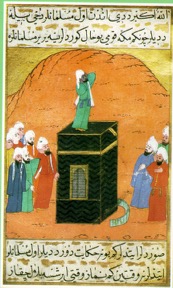 We also became familiar with the mythology of the first muezzin: Bilal, who was born in Mecca to Abyssinian slaves—in other words, a black man who was freed from slavery.
Where do we begin?
On Wednesday January 14th, the Reverend Franklin Graham posted a reaction to Duke’s announcement on his Facebook account. Franklin is the son of evangelical Baptist preacher Billy Graham, close friend and advisor to American presidents from Dwight D. Eisenhower to George W. Bush and known as “America’s pastor.” Franklin Graham is a resident of High Point, North Carolina (an hour’s drive from Duke) whose salary from tax-exempt, non-profit religious organizations is reported to be $880,000 per year.

Graham’s post “went viral,” and his threat of financial sanctions—aimed squarely at donors and alumni—seemed to land on its mark. Within hours, Duke’s proposed adhan recitation became the subject of a flood of media coverage, and the university received “credible threats” of violence; public relations and financial concerns were quickly compounded by “safety concerns.” My students and I—whose safety was being threatened—wondered whether the phrase “safety concerns” was a euphemism for terrorism, or vice versa.
On Thursday January 15, the university’s administration announced that they were canceling the planned recitation from the chapel bell tower. Instead, the adhan would be recited just outside the chapel, at the top of the steps leading to the chapel’s front doors. Franklin Graham celebrated the decision—again, on Facebook.

Later in the day, Richard Hays, the dean of the Duke Divinity School, released a letter outlining his objections to the proposed recitation. Hays’ letter revealed a somewhat obscure but significant division between the Divinity School and the chapel administration, each of which see themselves—in their own ways—as custodians of Duke’s Christian image. For the Divinity School administration, the chapel is a symbol of the university’s Christian identity. For the chapel administration, its Christian heritage is an aspect of a fundamentally pluralistic identity.
It is worth pausing here to emphasize that the controversy—now national in scope—was provoked by the mere prospect of sound. More specifically, a sound amplified at “moderate volume.”
By this point, the student muezzin and his family requested that his photo and name be removed; like the university, the young man and his family expressed “safety concerns.” Duke removed his image and name from the official online version of the announcement immediately. WRAL, the Raleigh television station, have still not removed the student’s image or name from their website.

Screen Capture of WRAL’s website by author
Where do we begin?
On the morning of Friday, January 16th?
The adhan was scheduled to take place at 1PM. At 12:30, I met two of my students—Tanner Waters and Jee Yoon—near the chapel. A large crowd was already gathering. Tanner, Jee, and I equipped ourselves with identical digital audio recorders so we could make a trio of stereo recordings, each from a distinct position; later, we would synchronize the recordings, mixing them in different ways to experiment with sonic “versions” of the event.
A half-dozen news vans were parked around the circular driveway leading to the chapel, their satellite antennas projecting into the clear blue sky. This was news. The news’ cameras were arranged on tripods in a straight line at the rear of the crowd; university security were maintaining a perimeter around the chapel that kept broadcast media at a distance. As I approached with my headphones on and my audio recorder in my hand, a chapel staff member asked mildly, “Excuse me, sir. Are you with the media?” I smiled and shook my head. No.
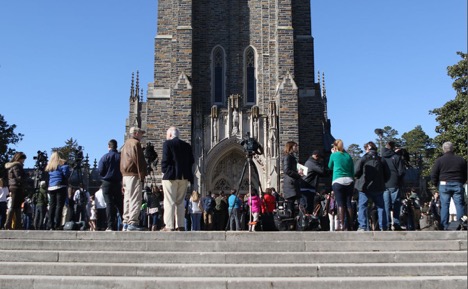
Photo by Elysia Su, The Duke Chronicle
A small PA sat at the top of the steps. Very small. There were no cables attached to it, and a small radio antenna extended from the top. It took me a few minutes to realize that this was the amplification, the moderate “loudspeaker” for the adhan. It took me another moment to realize the student muezzin would not appear: instead, he would transmit his recitation remotely. I was told later that he was just behind the closed doors of the chapel. Like so many recitations of the adhan, the transmission, amplification, and conceptual layers of it seemed uncannily like a sound art installation.
We all faced the loudspeaker, waiting for sounds to happen. The crowd went from murmurs to whispers, then silent. After a few seconds, the voices of members of the Muslim Students Association began to broadcast from the loudspeaker.
A young man’s voice introduced the adhan—a brief, prosaic context for what we would hear. Then a woman’s voice (also young) offered a literal English translation of the the adhan’s Arabic text. She spoke plainly, without the melodic contours of a recitation.
Now, before sharing recording of the Duke student muezzin’s recitation, I offer a bit of context—not an explanation or translation, but a comparative musical example. First, let’s listen to an iconic recitation style—albeit with a bit of YouTube-style hyperbole—recorded in Medina, Saudi Arabia. This recitation lasts four minutes—a fairly typical length of time for a complete recitation.
Now, let’s listen to the entire recitation of the adhan at the Duke chapel.
.
The prevailing quality of the Duke recitation is extraordinarily subdued. It is a vocal expression of the “moderate” sound and Muslim identity at the center of the controversy. At one minute and thirty seconds, it is less than half as long as most recitations.
Where do we begin?
Perhaps we might analyze this adhan as a peculiar instance of acousmatic sound: the student muezzin, like Pythagoras or the Wizard of Oz behind a curtain, was separated or dissociated from a discernible source by a curious bit of technology. When I asked Omid Safi, the director of Duke’s Islamic Studies Center, about this aspect of the story—the unseen and moderate voice of the student—he responded that for Muslims at Duke, the entire episode was about “safety and inclusion.”

Author’s screencapture of comments underneath a CBS.com broadcast about the Duke adhan.
Safi is a Duke alum. He studied there as undergraduate, co-founding the Muslim Students Association as a freshman, and went on to earn his Masters and PhD degrees at Duke. Since returning as director of the Islamic Studies Center two and a half years ago, he has been vocal and visible in the mass media. Safi himself has been labeled a “radical Muslim professor” by white conservatives and subjected to online “takedown articles,” particularly surrounding this event. Safi told me,
Part of the reason why … there was amplification but no person in sight [was] that people were scared. And it sounds hysterical … In retrospect, knowing what took place in Chapel Hill a few weeks later, [it was] not so unreasonable.
On Tuesday February 10, 2015, three Muslim college students—Deah Barakat, Yusor Abu-Salha, and Razan Abu-Salah—were murdered in their Chapel Hill home, just a twenty-minute drive from Duke. Less than a year earlier, Yusor Abu-Salha had been interviewed by her third-grade teacher for the StoryCorps oral history project.

Click on image to hear Story Corps interview
.
At horrifying moments like these, I think to myself, “This is why people pray.”
I was deeply ambivalent about discussing the murders with my students. After speaking to a handful of students individually and discreetly, I found most of them were completely unaware of the murders. I wondered—mostly silently, to myself—what impact the news might have on them, then decided to share the story obliquely: I discussed StoryCorps (“listening is an act of love”) in class, an important resource for those of us interested in oral history and I concluded by mentioning the recording of Yusor Abu-Salha. I never asked if they listened to Yusor’s voice, and I cannot know how they might have been affected. I simply did not know what to ask, nor what to say.
Less than one year later, in September, I surveyed my next cohort of incoming freshman. Less than half of them knew anything about the adhan controversy. Among the few who had heard something about it, the event had already acquired dubious mythological qualities: in one account, Muslim students were forced to move their call to prayer from the chapel tower to the nearby Sara Duke Gardens.
Analyses of the event varied considerably. In an op-ed for Duke’s student newspaper titled “Deconstructing the National Fear of Duke’s Adhan,” freshman Eidan Jacob—an Israeli Jew—offered a brilliant context and synthesis, expressing “surprise and disappointment” that the adhan was “so poorly received.” He observed that in his hometown of Haifa, “recitations of the adhan are simply part of the soundscape.”
A broad cultural and political context reveals that xenophobia and—more specifically—Islamophobia, remain cultural common sense in the post-9/11 United States. Both supporters and opponents of the adhan at Duke were disappointed by the controversy, and I do not discern a tidy moral to the story.
The sounds and discourse of the adhan at Duke suggest a narrative preoccupied with “decibels and debate,” but the subtle dynamics and textures of thoughtful, moderate conversation suggest an audible alternative to the loudness and noise of mass media discourse. The diverse qualities of the voices in this story—musical and otherwise—are more than poetic metaphors: the “voices of moderates” and “moderate-sounding voices” deserve close attention; regardless of the causes or motives underlying their subdued tones, their very quietness demands nuanced, high-fidelity listening. The literal and metaphorical amplification of voices might be a distraction from more important matters of range and intimacy.
Where do we begin?
—
In May 2015, the Duke chapel was closed for restoration. It is scheduled to reopen in May 2016.
Plans for a weekly adhan recitation elsewhere on the Duke campus are under consideration.
—
Featured Image by Elysia Su, The Duke Chronicle
—
David Font-Navarrete is an artist, musician, and ethnomusicologist. He is currently a Lecturing Fellow at Duke University’s Thompson Writing Program.
—
 REWIND!…If you liked this post, check out:
“Beat-ification: British Muslim Hip Hop and Ethical Listening Practices” –Jeanette Jouili
“Rallying Cries as Suffering Sounds: “Allah-O-Akbar” and the Aurality of Feminized Iranian Suffering–Roshanak Kheshti
“An Ear-splitting Cry: Gender, Performance, and Representations of Zaghareet in the U.S.“-Meghan Drury
Share this:

Radio Preservation Task Force Conference: Sound History and the Logistics of Social Recognition

Click to download PDF of Program!
Radio Preservation Task Force Conference Information
Friday: Library of Congress, Washington, DC 9-5pm
Saturday: University of Maryland- College Park, 9-5pm
Schedule at: www.radiopreservation.org,
RPTF Federal Page (associate list linked at the left tab): https://www.loc.gov/programs/national-recording-preservation-plan/about-this-program/radio-preservation-task-force/
Hashtag: #RTPF (@soundingoutblog will livetweet the conference)
This conference is free and open to those in the academic/archival/curatorial/preservation community who would like to attend.
—
On Feb. 26 and 27, the Radio Preservation Task Force (RPTF) of the National Recording Preservation Board (NRPB) will hold the first national digital humanities media history conference at the Library of Congress on Friday and the University of Maryland on Saturday. The schedule can be found here. Eminent sound historian Michele Hilmes (Wisconsin) directs the conference program with Christopher Sterling (GWU), Chair of the National Recording Preservation Board. Distinguished historian of British broadcasting Paddy Scannell (Michigan) commences the conference as academic keynote. I write this update as national research director for the project.
The RPTF is tasked with preserving local, noncommercial, and otherwise unprocessed recordings stored at local radio stations, libraries, archives, and garages, and identifying strategies to process and facilitate engagement with these materials. Scholars, curators, sound preservationists, and archivists from more than 100 universities, museums and libraries will converge on Capitol Hill to discuss steps toward preserving radio’s aural history, including the many historical events captured by nontheatrical broadcasts such as news, town hall meetings, public forums, sporting events, and community outreach programs.
The conference is a culmination of roughly 18 months of initial work (largely built out of service labor by academic media historians), and contributes a new dimension to the emergent discipline of sound studies with its focus on the history of mass media storytelling, sound art, and for the first time, the nontheatrical sounds of radio history. Participants have been confirmed from NPR, the Smithsonian, Pacifica, the Library of Congress, and multiple academic research groups. National presses, blogs, and magazines will also be present to cover the RPTF. Our conference Twitter hashtag is #RPTF. Presenters will discuss the common goal of how to best assess, protect, preserve, and implement current and future findings, with reference to conventional history work, museum curation, classroom pedagogy, and material preservation actions. Tours for scholars and archivists began yesterday at NPR and the Library of Congress’s Packard Campus.
Radio nerd nirvana at Library of Congress Packard campus #RPTF #loc #radiohistory pic.twitter.com/ObmX8NjDy2
— Jennifer Waits (@SpinningIndie) February 25, 2016
The RPTF was formed thanks to a mandate by sound preservation pioneer and former NRPB Chair Sam Brylawski, practitioner keynote for the conference. The mandate was issued to identify what, where, and how many recordings might still be extant from radio history. Our early findings have been both compelling and disappointing. Over the RPTF’s first two aggregation cycles, the consortium turned up 350,000 recordings spread over roughly 350 participating archives. We expect that number to reach well over one million after our next search cycle, and for our affiliate archive list to increase to over 1000 with the inclusion of radio stations. Enormous numbers to be sure.
NPR’s Research, Archives, Data Strategy team is working to ensure that historic radio stories are accessible in perpetuity #RPTF #nprchives
— nprchives (@nprchives) February 26, 2016
However, if one conducts a thought experiment about how many recordings might have aired between the mid-1920s and the mid-1980s, the number seems meager at best. I’m terrible at math, but if one begins with a low-ball assumption (very low for some markets) that there have been 25 stations per median market, producing daily content between 1925 and 1985, it’s not hyperbole to speculate that our findings, while not total or comprehensive, reveal that only a fraction of content has survived. Most materials have been incinerated or trashed thanks to “consolidation” of the media market after the Telecommunications Act of 1996. As stations changed hands, moved sites, and reorganized spaces, station archives were the first to go. Protecting and storing records, DATs, reel-to-reels, and internal documents, simply haven’t made sense for bottom lines. It’s safe to anecdotally contend that we’ve certainly already lost over 75% of radio history, and perhaps as high as 90%.
Most radio recordings are stored on fragile formats #AVpreservation #AVarchives #RPTF https://t.co/zTIbP1Kg9c
— NPR RAD (@npr_rad) February 25, 2016
Why is this important? The short answer is that radio has held a unique and important position in U.S. cultural history. Radio has been a media industry that developed a mature art form through storytelling and entertainment, while acting as a communications technology that has been utilized for community building and public discourse. After print media, the history of radio provides an unmatched reflection of the historical development, experience, and reception of cultural and political events. And as I’ve written previously at FlowTV, radio sometimes contains the only remaining historical expression of specific moments and social movements.
Seeing some of the earliest radio recordings at Library of Congress’ Packard campus #RPTF pic.twitter.com/vtODDZULEG
— Jennifer Waits (@SpinningIndie) February 25, 2016
As the task force has progressed since late 2014, it’s become conspicuously apparent to our consortium that a core goal of cultural research – increasing the visibility of marginalized histories – is well served by exhuming and studying the artifacts of radio history. By increasing the nontheatrical radio archive in particular, we increase and build continuity lines for histories that simply haven’t been told due to lack of primary sources. It’s very much a nuts and bolts, trial and error process. A lot of the project will culminate around a sprawling big data interface in 2017 – a collaboration between the RPTF, ARSC, and Indiana University. This potentially makes the RPTF the largest digital humanities project in Film and Media. And we plan for the interface to feature syllabi, lesson plans for all educational ages, and recordings that fall under the domain of “fair use.”
To make invisible histories audible turns out to consist of quite a few steps, and a careful study of the conditions necessary to conduct preservation work, which requires an understanding of the regulatory, historical, and organizational precedents and restrictions by which materials can be shared. In this way, the RPTF also represents an emergent research path for media and sound studies – dedication to the study and implementation of logistics for social recognition. Actively studying the contemporary political economy of how hidden information might come to be circulated, and devising strategies to protect and circulate voices for the first time, makes a strong contribution to social justice work.
Packed house! @RadioTaskForce #rptf pic.twitter.com/8p9RIKnn6q
— Monica De La Torre (@digitalxicanafm) February 26, 2016
There’s still much to learn about these processes, and that’s the purpose of the conference. We’re putting together experts in multiple spheres for the first time to begin a conversation about how a national infrastructure might be organized to address the mechanics that comprise the ethics we associate with the study of sound history. Participants will present historical research, while panels and workshops discuss everything from material sound preservation methods, to educational approaches to teaching sound in film and media classrooms, to contemporary curatorial methods regarding presentation of media art.
[Ed note: SO! Ed. in Chief J. Stoever will be speaking in as part of a Radio Pedagogy Workshop this afternoon at 1:30 (along with Special Ed. Neil Verma and SO! writers Amanda Keeler and Kathy Battles; other SO! fam in the house include Inés Casillas, Monica de la Torre, Alex Russo, Shawn VanCour, Suzanne Smith, Alejandra Bronfman, Christine Ehrick, Bill Kirkpatrick, Josh Sheppherd and Andrew Bottomley. It’s an SO! fam reunion over here!]
Among projects commencing immediately after the conference, the RPTF will be applying for preservation and curation grants with our partners at multiple universities, as well as with Pacifica Radio Archives, considered by many to be the great collection of postwar local and community radio history in the U.S. Since there are so many recordings to process, the RPTF has organized eight content-based caucuses in which faculty experts will be working with archivists to unite split collections, and determine which recordings are most in need of research and circulation. Caucuses will meet for the first time at the conference, as horizontally organized research units that will act as grant-writing bodies. The results of their preservation actions will be linked or shared at the RPTF big data site. Here is a list of the caucus chairs and their themes:
- Kathleen Battles, Oakland University – LGBT Radio
- Mary Beth Haralovich, University of Arizona – Gender and Feminist Radio
- Laura Schnitker, University of Maryland and Jennifer Waits, Radio Survivor – College, Community, and Educational Radio
- Sonja Williams, Howard University – African American and Civil Rights Radio
- Jon Nathan Anderson, CUNY-Brooklyn – Labor Radio
- Michael Stamm, Michigan State – Radio Journalism
- Inés Casillas, UC-Santa Barbara – Spanish Language and Bilingual Radio
- David Jenemann, University of Vermont – Sports Radio
In collaboration with the National Recording Preservation Foundation, the RPTF has already distributed its first grant: to the Lily Library at Indiana University to digitally process, preserve, and distribute the complete Orson Welles radio broadcasts. This will be the first time these recordings — which are all now in the public domain — have been made available in completion. We expect to build a special website with these materials sometime in 2017.
And it begins! #RPTF excited to present this morning with @npr_rad coworker @AydaPour pic.twitter.com/JCt7HVIXMa
— Jane Gilvin (@jg88354) February 26, 2016
—
Josh Shepperd is Assistant Professor of Media Studies at Catholic University in Washington D.C. He teaches courses related to critical, conceptual, and methodological approaches to media studies. He is also actively involved in digital humanities media preservation, and currently serve as the National Research Director of the Radio Preservation Task Force for theNational Recording Preservation Board of the Library of Congress.
—
REWIND!…If you liked this post, you may also dig:
The New Wave: On Radio Arts in the UK–Magz Hall
SO! Amplifies: Ian Rawes and the London Sound Survey–Ian Rawes
SO! Amplifies: Carleton Gholz and the Detroit Sound Conservancy–Carleton Gholz
Share this:


Current Top Posts





April 2021

January 2020

November 2019

October 2019

August 2019

April 2014

November 2017

March 2015

December 2017

October 2015
 Sounding Out!
Recent Comments