
SO! Reads: Norma Mendoza-Denton’s Homegirls

“When I wear my eyeliner, me siento más macha (I feel more macha) I’m ready to fight” (54)
 Makeup has long been an intentional part of a chola aesthetic: in particular, the skillful sign of bold black eyeliner or a carefully arched, thin, brow. The quote above by Norteña Xótchil, one of author Norma Mendoza-Denton’s interviewees, reminds us that make-up not only creates a sense of empowerment but also evokes the idea of physical strength (“feeling macha”). Norma Mendoza-Denton’s ethnographic study Homegirls: Language and Cultural Practice among Latina Youth Gangs (Wiley-Blackwell, 2008) presents a project of high ambition, and even higher execution, in its carefully crafted discussion of the linguistic and cultural practices of Latina youth gangs at Sor Juana High School in northern California. Homegirls offers much needed insight into the relationship between language style and the cultural, lived experiences of Latina youth gangs. She centers her analysis on the linguistic, the cultural, and the phonetic, and in this way she pushes students of ethnic studies and sound studies to consider how young Latinas craft and articulate their own identity through meaning-making practices that challenge tropes of deviancy that are often unfairly cast on young women of color.
Throughout the book, speaking chola – an urban, gendered variation of Chicana English – becomes an audible badge, a marker of experience rather than a punch line, a culturally appropriated costume, a music video fad, or linguistic variety in need of policing. Recently, celebrity white or non-Latina women, such as Gwen Stefani and Lana Del Rey, have adopted telltale signs of a chola aesthetic – the crisp centered hair part, baggy pants, big hoops and/or only-the-top-buttoned plaid shirt. By focusing on the language styles of cholas, Mendoza-Denton encourages readers to think beyond the stereotypical images and sounds that so often circulate in mainstream media about cholas. Homegirls offers Sound Studies and Chicana/o Studies scholars a notable addition to the growing literature on the intersections of language, race, and sound.

Image by Illusive Photography @Flickr CC BY-NC-ND
“You gotta take pride to do your clothes
you know I have to iron,
when I go out I have to iron my shirt for half an hour
or forty-five minutes, you know,
my pants, you know
they gotta be
cre::ased
you know they gotta-” (56)
 Homegirls joins conversations on Latinas and gang culture (Fregoso 2003; Miranda 2003; Ramírez 2009), which have historically been male-centered. Thelma, one of the Norteña girls, demonstrates in the quotation above her engagement with an aesthetic practice often linked with Latino gang members. Although the topic of language and linguistic identities, specifically bilingualism and translating, are emerging topics within Chicana/o Studies, Mendoza-Denton’s work joins that of a small number of scholars who take on Latina/o language practices and identities as the central focus of their work. She observes, in fact, how identity and meaning-making processes are intertwined to language, as are other social markers of identity such as race, class, gender, ethnicity, and accent. Homegirls joins recent discussions that demonstrate specifically how accents are vocal stand-ins for a person’s racialized, classed, and gendered experience. Where Fregoso and Miranda center their discussion on the cinematic representations of cholas and a historical account of pachucas respectively, Mendoza-Denton’s work is more in line with Miranda’s ethnographic approach to Latina youth gangs. Homegirls listens to the women’s voices and allows them to speak for themselves. This approach yields a work that reminds us how language identities are racialized when conflated with other racial markers, how they negotiate power relations (in/out group dynamics), and how they can also function as political forms of resistance.
“My dad dice que me miro como lesbian (says I look like a lesbian), my mom dice que qué guangajona (complains that it’s baggy). How much you wanna bet that I can go outside like this y no me dicen nada (they won’t say anything)” (151)
Maureen, a 14-year-old participant, speaks above to the code switching that many of the young women in this study practice. Mendoza-Denton re-imagines the chola as an innovator, highlighting the role of language and the body in creating new cultural practices. For example, in Chapter 5, the author heralds an exciting discussion on play and applying makeup as forms of gendered performances expanding on notions of beauty and grooming amongst Latina youth. She writes, “The symbolic and unconventional use of makeup among the girls claiming Norte and Sur at Sor Juana High School literally painted gender and ethnicity on their bodies,” marking a critical intervention in how the chola aesthetic racializes and genders bodies, yet also functions as a self-directed performance (152). In paying close attention to the symbolic meaning of makeup and its application, the ritual of carefully drawing the brow dismantles the mainstream appropriation of this often-criminalized look.
Mendoza-Denton’s close phonetic analysis demonstrates how the visual aesthetic coupled with a sonic aesthetic speaks to the political implications of embodied linguistic and cultural practices. The chola vocal aesthetic challenges traditional notions of femininity, closely associated with politics of respectability through Spanish honorifics like “usted,” within the Chicano family. This idea echoes other studies that show how pachucas, precursors to contemporary homegirls, with their extravagant attire and deviant behavior embody an adolescent rebellion against the patriarchal Chicano family and how pachuquismos forged a stylized linguistic resistance. Such stylized linguistic and embodied resistance can be seen in the excerpt below from T-Rex, one of Mendoza-Denton’s most candid participants in her study.
T-Rex: A girl could be more macha than some guys. For example me.
Norma: You think you’re more macha than guys?
T-Rex: I am more macha.
Norma: What makes you macha?
T-Rex: The way I act. The way I don’t let them step on me. (164)
In this brief excerpt, T-Rex articulates her notions of being ‘macha,’ a prime example of a discursive and material Latina youth practice that transcends the boundaries of normative gendered expressions for Latina youth. We are accustomed to seeing urban cholas with curiosity, envy, or both. Mendoza-Denton allows us to hear them and gain a deeper understanding of their social practices.
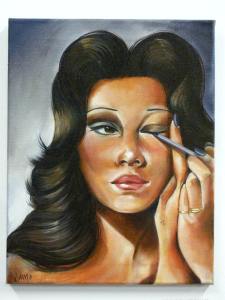
Image by Amor Eterno Arte @Flickr CC BY-NC-ND
In framing the chola aesthetic as a transgressive type of beauty, Mendoza-Denton poses that the cholas in this study act as cultural producers who assign alternative meanings to femininity through their body and speech. Recalling Xóchitl’s remarks about mascara, the eyeliner serves in one form as a tool for a racialized feminine ideal of beauty, while simultaneously a sign for “willingness to fight” for other girls (154). Eyeliner, in this example, very visibly displays the complex interactions and negotiations of gender norms and agency. In this sense, Mendoza-Denton grants the reader a primary example of how cholas participate in a type of feminine gender expression that challenges expected ways of acting, which includes speech.
From Mendoza-Denton’s conversation with T-Rex, we see that speech and accent are just as meaningful in the construction of this alternative aesthetic. T-Rex, explains how the eyeliner is a “power-based interpretation” that when correlated with a tough, or even threatening, manner of walking—the use of the body—cholas command power and respect. Here, her intervention serves not only to gain a deeper understanding of Latina youth practices but also frames the chola as an empowered, vocal (what some would consider, mouthy) woman. Too often cholas receive harsh criticism or complete disregard for their assumed subversive behavior, criminality, and social deviance. In Homegirls, Mendoza-Denton challenges those notions by finding the symbolic capital in how these young women employ discursive, material, and phonetic practices.
The final two chapters of the book focus on the specific linguistic features relevant to studies of language and sound. Mendoza-Denton highlights phonetic variation among the girls speech in how their realization of /I/ demarcates core speakers from members of the group in the periphery yet points to similar speaking characteristics for girls of both gangs. The author’s focus on the stigmatized Th-Pro set (i.e. something, nothing) in the speech of Latina girls demonstrates how it discursively positions theses young women’s interactions and group affiliation due to its frequency and saliency. These later chapters demonstrate one of the author’s most significant contributions: projecting a specific accent is often linked to the creation of an identity. As Mendoza-Denton writes, “How speakers pronounce their words says a lot not only about the identities that they wish to project, but also about the history of the language(s) that they speak” (231). These linguistic variations give readers insight on the importance of how distinctive discourse markers are vital in the creation of stylized identities for young women of color.
Norma Mendoza-Denton has produced a rich account of a community largely ignored and misinterpreted in the conversations on Latina youth culture in the United States. As she reminds readers in her conclusion, Homegirls is one of the only studies of its kind that documents gang dynamics outside of discussions regarding violence, control over territory, or drug trafficking. While this approach provides a much-needed focus on the self-making and cultural processes amongst youth of color, I wonder if some significant discussions might be left out with this approach. Although there is large need for research on this topic that deviates from traditional approaches (such as criminality, violence, drug trafficking) when working with youth, particularly women of color, in her effort to subvert these sociological mainstays Mendoza-Denton avoids certain experiences that leave out pertinent context.

Image by Joey Ortega @Flickr CC BY-ND
For example, in her discussion of the young women’s makeup practices, Mendoza Denton mentions the perceived threat they pose to teachers and police at school but does not go into more detail. These questions are not to discount the contributions of the book but rather to introduce future considerations for work surrounding Latina youth gangs. However, for Mendoza-Denton, the focus on the creativity and agency these young women embody is never lacking:
“So when you walk down the street,
you got the special walk, [begins to walk deliberately, swinging her upper body]
you walk like this,
you walk all slow,
just checking it out.
I look like a dude, ¿que no?
I walk, and then I stop.
I go like this [tilts head back – this is called looking “in”]
I always look in, I always look in,
I never look down.
It’s all about power
You never fucking smile.
Fucking never smile” (155-6)

Image by Amor Eterno Arte @Flickr CC BY-ND
Homegirls is at its finest when the reader is presented with excerpts like the quote above where T-Rex’s assertive physical and mental stance illustrates the linguistic and cultural practices that Mendoza-Denton seeks to highlight in her work. Mendoza-Denton’s contribution to this topic privileges the symbolic capital in linguistic, embodied, and cultural practices which sets up a platform for future work on Latina identities. When we read cholas in popular culture we might think of the aesthetic, the stereotypes, the big hoops, the dark lips, and the mascara. When we read Homegirls, Norma Mendoza-Denton compels us to consider the complex web of how linguistic and cultural practices (through material and vocal embodiments) speaks to the intersections of race, gender, and class amongst Latina youth gangs.
–
Featured image is of Yasmin Ferrada (the author’s sister) as photographed by King Kast. It is used with permission by the author.
–
Juan Sebastian Ferrada is a doctoral candidate in the Department of Chicana and Chicano Studies at the University of California, Santa Barbara. His work investigates the intersections of language and sexuality among LGBTQ Latina/o communities. Specifically, Sebastian explores the politics of Spanglish as a method for articulating ideas of sexuality and family acceptance within an LGBTQ Latina/o community organization. Sebastian earned a B.A. in Global Studies, in addition to a B.A. and M.A. in Chicana and Chicano Studies from the University of California, Santa Barbara.
–
 REWIND! . . .If you liked this post, you may also dig:
“Óyeme Voz: U.S. Latin@ & Immigrant Communities Re-Sound Citizenship and Belonging” – Nancy Morales
Listening to the Border: “’2487’: Giving Voice in Diaspora” and the Sound Art of Luz María Sánchez – Dolores Inés Casillas
Deaf Latin@ Performance: Listening with the Third Ear — Trevor Boffone
Share this:

A Conversation With Themselves: On Clayton Cubitt’s Hysterical Literature
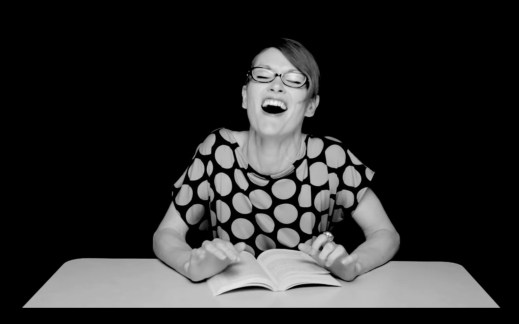
 Welcome to our second installment of Hysterical Sound. Last week I discussed silence and hysteria in relation to Sam Taylor-Johnson’s silent film Hysteria, suggesting that the hysteric’s vocalizations go unheard because we have tuned them out. In upcoming weeks Veronica Fitzpatrick will explore how the soundtrack of The Texas Chainsaw Massacre can be considered hysterical in its rejection of language and meaning and John Corbett, Terri Kapsalis and Danny Thompson share an excerpt from their performance of The Hysterical Alphabet.
Today, Gordon Sullivan, considers the video art series Hysterical Literature in relation to a long history of women’s vocalizations serving as aural fetishes for the pleasure of male listeners. In doing so he troubles the dichotomies raised by the project, dichotomies between masculine visual pleasure and feminine aurality, between language and bliss.
— Guest Editor Karly-Lynne Scott
—
Each video in filmmaker and photographer Clayton Cubitt’s Hysterical Literature series (2012-) – which consists of 11 “sessions” so far – appears deceptively simple. We see a black and white frame with a clothed woman seated at a table, visible from the sternum up, holding a book of her choosing. She announces her name and the title of the book before beginning to read. While reading, the subject generally begins to stumble, the speeding of reading slowing down or speeding up, changes in pitch and emphasis growing more pronounced. Eventually, she is able to read no more and gives in to sighs, groans, or silent, eye-closing paroxysms. When she returns to herself, she announces again her name and the title of the book before the “session” ends.
Despite the consistency of the concept, the 11 “sessions” have been viewed a combined 45 million times, and perhaps much of the appeal of the series is in what it doesn’t show. What we do not see – and indeed do not hear – is the “assistant” beneath the table with an Hitachi Magic Wand physically stimulating the subject. What might have been errors or difficulties in the reading are retroactively understood as evidence of the difficulty of “performing” under the attention of the vibrator.
According to Cubitt, the series’ title and conceit nod at the Victorian-era propensity for naming “unruly” female behavior as “hysterical,” where the cure was often the application of a vibrating device to produce “release.” Female sexuality is therefore the absent center of Hysterical Literature – it is there, but can be disavowed (at least visually), a trend that places it firmly in a culture that has an ambiguous relationship to female pleasure and its sounds.
As John Corbett and Terri Kapsalis note in “Aural Pleasure: The Female Orgasm in Popular Sound,” the sounds of female pleasure are “more viable, less prohibited, and therefore more publically available form of representation than, for instance, the less ambiguous, more easily recognized money shot” that characterizes “hard core” pornography (104). Certainly Hysterical Literature’s home on YouTube would seem to confirm Corbett and Kapsalis’ claim that sounds of female pleasure “occur in places…that would otherwise ban visual pornography” (104).
Indeed, the question of pornography looms over Hysterical Literature, as Cubitt seeks to push on YouTube’s “Community Guidelines” by exhibiting female pleasure sonically (See also Joshua Hudelson for a discussion of sexual fetish and the ASMR community on Youtube). Here the sound of the subject’s voice echoes Linda Williams’s description in Hard Core: Power, Pleasure, and “The Frenzy of the Visible,” where the female voice “may stand as the most prominent signifier of female pleasure” that can stand in for the pleasure we are denied access to visually (123). In this way, the sound of female pleasure is, as Corbett and Kapsalis suggest, always evidentiary (104). For them, a woman’s pleasure may/must be corroborated by her sounds (For an alternative view of gender and sound as it relates to women, see Robin James’ “Gendered Voice and Social Harmony”).
This pleasure calls to mind Roland Barthes, who saw the possibility of bliss and representation as fundamentally incompatible. For Barthes, the “grain” of the voice is a bodily phenomenon, not one of language and signification. For him, “the cinema capture[s] the sound of speech close up…and make[s] us here in their materiality, their sensuality, the breath, the gutturals, the fleshiness of the lips, a whole presence of the human muzzle” (67). This “materiality” has a single purpose: bliss. This bliss doesn’t reside in language, with its representational aims, but in those aspects of the voice that are not ruled the signifier/signified dynamic.
What draws me to these discussions – and their relation to Hysterical Literature – is the almost overwhelming insistence on dichotomy. The visual “evidence” of hard core pornography is juxtaposed to the aural “evidence” of female pleasure. Male pleasure (on the side of the visible) is opposed to female pleasure (on the side of the invisible). Representation is incompatible with “bliss.”
This logic is not confined to discussions of sound, but is echoed in some of the writing on Hysterical Literature as well. In her profile (which included her own “session”), dancer and writer Toni Bentley argues that the series “juxtaposes the realm of words literally atop the realm of the erotic.” In her view, this immediately becomes a conflict: “Who would win the inevitable war? Upper body or lower? Logic or lust? Prefrontal cortex or hypothalamus?” Though her list of oppositions may seem idiosyncratic, she still insists on division before suggesting that what might emerge instead is that they “meld together.”
Bentley is not alone in understanding the videos this way, as other subjects find a clean break between “I am reading” and “I am orgasming” that would suggest a strict dichotomy between, as Barthes would put it, representation and bliss. For Bentley, this is a “literate, and literal, clitoral monologue that renders the Vagina Monologues merely aspirational.” I’m not sure that “monologue” captures the depth of what is happening in each Hysterical Literature session. Cubitt’s goal is to reveal something about his subjects, to use “distraction” as a means for revelation that ultimately removes him from the scene. Indeed, the participation of the vibrator-wielding “assistant” and Cubitt’s status as filmmaker argue that instead of a monologue, the series facilitates what Cubitt calls “a conversation with themselves.”
Though Cubitt and his subjects seek to maintain the division between the subject and her distraction, the series is far more interesting than that dichotomy would suggest. Hysterical Literature is interesting not because it juxtaposes “reading” and “orgasm,” but rather because of the rigor with which it is willing to dwell in between these two (apparently) opposed states. There is no cut, no switch in which a subject goes from reading to not-reading. Every video begins and ends the same way – we open on a woman telling us her name and her book, and end the same way, orgasm over with. In between, however, we have a combination of the book chosen by the subject and her augmented reading. Rather than the sighs and groans that supposedly evidence the subject’s pleasure, the more interesting elements are the sounds of the book transformed. The cadence that slows down, speeds up, gets lost, and must repeat. The drawn out vowels that teeter between a gracefully pronounced word and the abyss of unintelligibility. That the “struggle” will end in orgasms and the loss of speech is less significant than the attempt to maintain a voice in the face of what cannot be denied.
If we grant a gulf between “representation” and “bliss,” Hysterical Literature suggests that such a gulf is a productive place to be.
—
Gordon Sullivan is a PhD candidate at the University of Pittsburgh, currently writing a dissertation on questions of sensation and the political in exploitation films.
—
Featured image taken from “Hysterical Literature: Session Four: Stormy“.
—
REWIND! . . .If you liked this post, you may also dig:
Echo and the Chorus of Female Machines — AO Roberts
This Is How You Listen: Reading Critically Junot Díaz’s Audiobook — Liana M. Silva
Standing Up, For Jose — Mandie O’Connell
Share this:


Current Top Posts





April 2021

January 2020

November 2019

October 2019

August 2019

April 2014

November 2017

March 2015

December 2017

October 2015
 Sounding Out!
Recent Comments