
The Noisiest City on Earth? or, What Can the 2012 Manhattan Noise Complaint Maps Really Tell Us?

“It’s a city, not a cemetery. You can’t tell everybody to go around wearing earplugs.”
Ex-New York City Parks Commissioner Henry J. Stern, quoted in “Many Pleas for Quiet, but City Still Thunders”
In 1905, a New York Times article declared New York City “the noisiest city on Earth.” More than a century later—this summer, to be exact—The New York Times ran a series on noise in New York City titled “What? The Long War on Loud” that proved that this city is still trying to figure out its relationship to sound. (One of the gems of that series? “New York’s War on Noise” timeline.) As a displaced New Yorker, some of my most vivid memories of the city are aural. Although New York City isn’t the only loud city out there, there are many reasons it’s called “The City That Never Sleeps”—and sound has a lot to do with it, depending on which neighborhood you call home.
Now you can see what neighborhoods are allegedly noisiest, and where all that noise comes from. Brooklyn designer Karl Sluis created the 2012 Manhattan Noise Complaints maps (click for full image), in which Sluis correlated the data on 311 noise complaints made during the year 2012 (40, 412 complaints, to be exact) that he obtained from the NYC Open Source site with Manhattan’s geographical coordinates. He used circles of various sizes to a) create an aural tracing of the island of Manhattan, sitting in a sea of turquoise blue b) showcase the number of complaints in an area. The bigger the circle, the larger the number of complaints.

Screen Capture of Karl Sluis’s 2012 Manhattan Noise Complaints maps (click for interactive image)
The maps Sluis has created are helpful for visualizing the complaints on a broad scale, but they paint an incomplete picture of what noise means in New York City. The demographics of each neighborhood are absent from each map, a slight that can perhaps be traced to the 311 data available, but in order to better understand how New Yorkers define “noise” those stats must be included. Both Sluis and John Metcalfe from The Atlantic Cities discuss notable findings, but neither takes into account the fact that some of the areas with a higher concentration of noise complaints are not just densely populated but densely populated with racial and ethnic minorities. Indeed, comparing the maps’ noisy hotspots to a map of Manhattan racial demographics reveal how urban racial dynamics intersect with ideas about sound and power: who can make sound, who must be chastised for making noise, who can complain and whose complaints are actually being heard.

“Unnecessary noise prohibited” by Flickr user Ricky Leong, CC BY-NC-SA 2.0
Mapping noise complaints gives a spatial dimension to noise, and it renders noise palpable, in a way. Sluis points out, “Noise complaints reveal the concentration of activity in the city as well as many smaller stories, such as the construction of the Second Avenue subway line, idling buses on the Upper East Side, and the homes of the loudest dogs (or the least patient neighbors).” He reminds us that the data comes from complaints and not necessarily decibels; in other words, it represents local ideas of what counts as sound and what counts as noise.
While Metcalfe correctly describes the thousands of 311 complaints about noise from 2012 as “the entire year’s expression of mass annoyance,” Sluis’s map does not go far enough toward figuring out whose annoyance, exactly. We must remember that annoyance oftentimes stems not just from physical reactions to noise but rather one’s perceptions about noise, what Jennifer Stoever-Ackerman deems “the listening ear.” How we hear others, Stoever-Ackerman argues, is not as natural as it seems. For example, whom we deem as noisy may stem from our community, our parents, and/or social conditioning. Accounting for race/ethnicity in noise maps will show how the listening ear conditions neighbors to categorize and react to certain sounds.
For the purpose of this analytic exercise, I compared Sluis’s maps and the Center for Urban Research, CUNY Graduate Center’s 2010 map of block-by-block demographic changes in New York City, in order to illustrate how population density and racial/ethnic demographics play a role in concentrated pockets of noise complaints. Drawn from 2010 census data, the CUNY map clearly delineates neighborhoods and color-codes the groups in each neighborhood per block: blue for whites, green for Latino, orange for black, purple for Asian, and grey for “Other.” Although the Center for Urban Research, CUNY Graduate Center’s maps cannot be superimposed on Sluis’s maps, they help give a general idea as to where neighborhoods are located in addition to racial demographics.
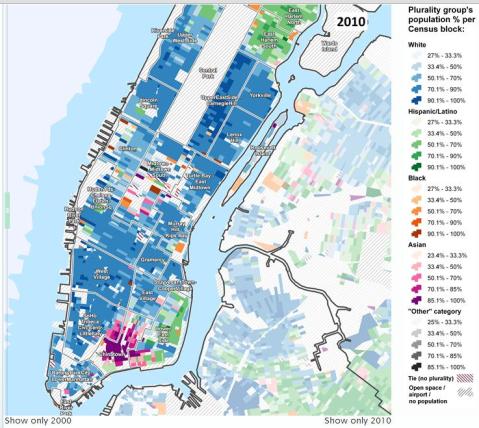
Manhattan below 110th Street in 2010, courtesy of the Center for Urban Research, CUNY Graduate Center

Manhattan above 110th Street 2010. Courtesy of the Center for Urban Research, CUNY Graduate Center
From the maps illustrating changing race/ethnicity patterns, I gathered what neighborhoods were predominantly white (West Village, Lincoln Square, Yorkville, Upper West Side), predominantly Latino (Washington Heights, East Harlem) predominantly black (Central Harlem, parts of Hamilton Heights), and predominantly Asian (Chinatown, blocks of the Lower East Side). When one compares Sluis’s overall noise map of Manhattan to the racial demographic maps of Manhattan, what stands out is that the major circles of noise complaints are also places where there are different racial and ethnic groups mingling (for example, Times Square) or places that are populated by mostly minorities (Hamilton Heights). Whereas Sluis flattens out the noise complaints, demographic stats point to the racial/ethnic contours of each neighborhood. Sluis’s maps focus on number of complaints; unfortunately this assumes everyone complaining is the same and that everyone making the noise is the same—a level aural playing field if you will. Bringing demographics into the equation underscores how not all complainers are equal and how not all complaints carry the same heft.
The city may be noisy, but “noisy” is relative. Sluis’s map shows some predictably noisy areas for those of us familiar with Manhattan’s soundscape (Union Square, Times Square) but it also draws attention to other areas not as predictable in the mainstream imagination (East Harlem South, Hamilton Heights). However, the maps by the Center for Urban Research, CUNY Graduate Center help us better understand the context for the high or low number of complaints in certain areas. For example, one of the biggest circles on Sluis’s general map of Manhattan is located in the Hamilton Heights/Washington Heights area; the Center for Urban Research, CUNY Graduate Center’s map of Manhattan above 110th Street show that these areas are densely populated by blacks and Latinos/as. This is key information because it reminds viewers that this neighborhood is a lot more ethnically diverse than other neighborhoods with a smaller number of complaints. It brings to mind: what role does race play in these complaints, in terms of those who complain and those who are the focus of the complaints? Although more people might mean more complaints, the prevalence of complaints like “loud talk” in East Harlem (Spanish Harlem) are nevertheless connected racialized ideas about people of color being “loud.” This doesn’t assume that the people complaining are white, but that they are complaining about groups that are characterized as loud, noisy, rowdy.

“Classic New York: noise, smoke” by Flickr user Will, CC BY-NC-ND 2.0
These noise maps, when put into conversation with demographic data, also indicate what areas are priorities in urban planning—the sounds of gentrification. The visualizations of the complaints by section (under the main map), combined with CUNY’s maps, are even more telling because they break down the number of complaints by category. The aforementioned northern tip of Manhattan, for example, is also where many of the complaints are concentrated. At a glance, loud parties, loud people, and loud car stereos seem to be the major complaints in those areas, according to Sluis’s visualizations. Meanwhile, noises of “urban growth,” such as construction and jackhammers, are less prevalent in these areas, whereas they are more prevalent below Central Park North, in now mostly-white neighborhoods.
Sluis’s maps of the 311 noise complaints data allow readers to see differences in terms of neighborhoods: who complains the most? what do they complain about? However, one thing to keep in mind is that first question: who makes the complaints. This is where the data falls short. Can it be assumed that those who are calling about the noise are mostly people who live in the neighborhood? Are Upper Manhattan neighbors less or more tolerant of noise? The answers to these questions, although they’re not found in Sluis’s map, point to how ideas of who is noisy or who can make noise are at play here.
I do not mean to downplay the usefulness of Sluis’s map. I instead call for the necessary addition of key missing factors to future noise maps in order to give us a more complex picture of noise complaints in Manhattan and elsewhere. Although it may not be possible to gather who the 311 callers are, including factors such as race and class may lead to very different noise maps. For example, what would a noise map of Manhattan look like if researchers brought income into the equation? Income inequality, especially in Manhattan where that imbalance is starkly on display, matters for the purpose of sound mapping. The more affluent neighborhoods are also the ones with less complaints and are the ones that are mostly inhabited by whites. Wealthier communities are more spread out and have more ability to couch themselves from noise, not to mention that it probably takes fewer complaints to get a response.

“Marcus Garvey Park Drum Circle, Harlem, NYC” by Flickr user j-No, CC BY-NC-ND 2.0
Gentrification is another factor: what kind of analysis could we do if we considered what neighborhoods have been gentrified in the past ten years? It is possible that as whites move into neighborhoods where people of color have historically lived, suddenly they find them noisy—hence, complaints. It is fitting to consider, for example, the tension between an established group of drummers in Marcus Garvey Park in Harlem and the inhabitants of a new highrise (characterized as “young white professionals”) who wanted the 30-years and running drum circle shut down, as reported in The New York Times in 2008. Moreover, if we accounted for the history of zoning in the neighborhoods that have the most or the least complaints it would add another layer of analysis to the data. Are some of these neighborhoods used as entertainment zones, for example? Is it easier to open up bars there than elsewhere in the city?
With these questions in mind, the maps go from beautiful renditions of data, to opening up a bigger conversation about the arbitrariness of noise. The demographical and sociological context of these noise complaints must accompany the raw data, especially when it comes to sound. The analysis also points to the source of the data: 311 calls. I wonder if this is the only way that people in Manhattan (and New York City at large) are dealing with noise. I’m sure that after a century of being “the noisiest city on Earth,” folks have gotten creative about it.
—
Featured image: ” Stranger 10/100 Johano” by Flickr user MichaelTapp, CC BY-ND 2.0
—
Liana M. Silva-Ford is co-founder and Managing Editor of Sounding Out! She is also known professionally as the Writer Whisperer.
—
 REWIND! . . .If you liked this post, you may also dig:
“I’m on my New York s**t”: Jean Grae’s Sonic Claims on the City -Liana Silva
The Noise You Make Should Be Your Own–Scott Poulson-Bryant
Sounding Out! Podcast Mini-Series (#16): Listening to The Tuned City of Brussels, Day 1: “Noise”
Share this:

Cauldrons of Noise: Stadium Cheers and Boos at the 2012 London Olympics
 Welcome to the extra innings of our summer series on “Sound and Sport”! In today’s bonus post, David Hendy discusses his recent Noise broadcast for BBC Radio 4 on the sounds of Olympic crowds. For an instant replay of our summer series click Kariann Goldschmitt’s “The Sounds of Selling Out?: Tom Zé, Coca-Cola, and the Soundtrack to FIFA Brazil 2014” (August), Josh Ottum‘s “Sounding Boards and Sonic Styles: The Music of the Skatepark” (July), Tara Betts‘s “Pretty, Fast, and Loud: The Audible Ali” (June), and Melissa Helquist‘s “Goalball: Sport, Silence, and Spectatorship” (May). Following Hendy’s post on Olympics past, give Andrea Medrado’s podcast a spin for a listen into its future: “The Sounds of Rio’s Favelas: Echoes of Social Inequality in an Olympic City.” And now, David Hendy. Of course, the crowd goes WILD. —J. Stoever-Ackerman, Editor-in-Chief
—
I didn’t get to go to the London 2012 Olympics or Paralympics. Alas, my number didn’t come up in the lottery for seats. So, like millions of others, my family and I watched – and heard – the sporting action on television or, occasionally, on our smart phones. A pretty good experience it was, too: the BBC for instance gave British viewers 24 live streams of high-definition coverage for the Olympics; Channel 4’s approach to the Paralympics was smaller-scale but packed a similar punch in terms of imagery. A key part of the “enhanced experience,” however, was the acoustic quality of the broadcasts. When the Olympics had last been staged in London, during the post-war austerity of 1948, television footage sounded like this:
“1948 Olympics Clip” courtesy of Peregrine Andrews and Alan Hall, Falling Tree Productions Limited
Just about the only things viewers would’ve heard were the voices of the commentators and the distant, muted sounds of the crowd.
That evocative archive recording was used in a recent radio documentary by the British sound designer Peregrine Andrews. The programme explored just how much had changed in location recording techniques by 2012. This time around, Peregrine pointed out, some 4,000 microphones were in position at the various venues: not just suspended in the air above or placed on the trackside, but bonded directly onto the beams in the gymnastic hall, say, or attached to the targets used in archery. Competitors everywhere were heard in extreme close-up – every shift of a hand or foot, every creak of wood, every grunt or groan made audible to the viewer at home.
This wasn’t just hyperbole. Newspapers quickly latched on to the phenomenon, dispatching reporters to measure decibel levels and offer their readers guides to the “best” venues for hearing the sound of the crowd. They pointed out that an airplane taking off produces about “140 decibels of noise”– and that the cheers echoing around the soaring curves and low ceilings of the Olympic Velodrome reached very nearly the same level.

Panorama of the London Olympic Velodrome, Image courtesy of Flickr User Jack999

Olympic Velodrome Image courtesy of Flickr User adambowie
“The roar was thrilling, to the point of pain,” claimed one reporter from the Toronto Globe and Mail. “If I had endured another minute, I am sure we’d all have gone deaf.” Zaha Hadid’s gloriously sweeping Aquatics Centre provided perhaps the most intense acoustics of all. Whenever the 17,500 fans inside cheered, the “guttural roar” was simply “ear-drum shattering,” declared the London Evening Standard. The main Olympic stadium was open air, of course, making the sound less intense. But even here the Globe and Mail journalist wrote of a “tsunami of noise” building in waves; another of the stadium’s “sonic boom”; yet another of how Usain Bolt’s 100 metres final produced a roar from the crowd which, measured at 107 decibels, beat that of your average pneumatic drill.

Olympic Stadium 2012, Image by Flickr User tom_bennett
Perhaps it wasn’t surprising that London 2012 was dubbed the loudest ever Olympics. For the main stadium’s designer Rod Sheard had always conceived it with acoustics firmly in mind. He’s quoted in a piece in It’s Nice That: “The athletes are so focused, it’s very easy for them not to hear the crowd. . .we’ve got to make it really loud for them to get any benefit from it.” And so the 80,000 people inside were packed as closely together as possible with the roof shaped to rebound their roar back into the heart of the space, generating maximum volume.
As my producer Matt Thompson and I discovered when making our recent BBC radio series Noise: a Human History (available on iTunes), this contemporary attempt to revel in the roar of the spectators throws up some striking – and very ancient – parallels. The most obvious is that of the Colosseum in Rome, which, some 2000 years ago, provided what Keith Hopkins and Mary Beard have described as “a brilliantly constructed and enclosed world, which packed emperor, elite and subjects together, like sardines in a tin.”
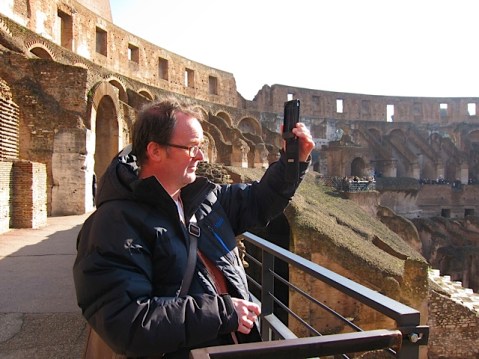
David Hendy at Colosseum, Image by MattThompson/Rockethouse Productions
The acoustic qualities of ancient amphitheaters like this – their ability to amplify the slightest sounds – is still pretty unnerving if you get the chance to witness it for yourself, as Matt and I did when recording, at the Colosseum and at the ancient Greek theatre of Epidaurus:
In these cauldrons of concentrated sound, the roar of the spectators took on a collective force of its own – a volatile quality rich with cultural and political repercussions. During plays in Greek theatres, audiences were rarely hushed and reverential. They were talkative and unruly, sometimes showing their disapproval by drumming their heels against the benches, sometimes disrupting the action by shouting and jeering. The chorus below would address spectators directly, as if facing a jury. Audience participation was as much a part of a performance as were the actors in the orchestra or on the stage. And when it came to the Roman Games later held at the Colosseum or in even larger venues such as the nearby Circus Maximus, the barrage of sound could reach intimidating levels of ferocity.

David Hendy Recording at Epidaurus, Image by Matt Thompson/Rockethouse Productions, taken on location
Roman arenas were not just sporting venues, of course. They were designed for political theatre. Vespasian had ordered the Colosseum to be built to help wipe away the memory of his predecessor Nero and his notorious private pleasure palace the Golden House. Now Roman citizens had a pleasure palace all of their own. The ruling elite had also created a place for the ostentatious display of imperial power and generosity, a bribe for the people’s continuing loyalty. Which is why, if the crowds were sometimes a little slow in showing their appreciation, paid stooges dotted about the arena would start applauding – or booing – at all the right moments, while soldiers would strike down any member of the audience who lagged in their cheering. But, as in the Greek theatres, Rome’s audiences were never entirely under the cosh; they could occasionally give voice to underlying discontentment. And when so many people were so tightly packed together, sheer proximity and the contagious quality of sound meant any turn in the mood would have been quick to make itself felt.
One startling example of this came in 55BC when Julius Caesar’s powerful rival Pompey put on a show in the Circus Maximus that featured the slaughter of elephants – something the crowd lapped up until the very moment they heard the poor creatures’ death throes. In episode 9 of Noise: a Human History, I speculated on what it might’ve been like – and recalled the unsettling outcome:
In London in 2012, we had our very own Pompey, in the form of the British Chancellor of the Exchequer, George Osborne. He’d turned up to the Paralympics to award some medals. And as his name was announced the stadium resounded with loud booing for the first time all summer:
Why did 80,000 people all suddenly decide to boo as one? Because, one commentator quipped, there were only 80,000 people in the stadium.
Politicians as a class are inevitably unwelcome in a place of entertainment, their presence too obviously betraying an attempt to siphon off a little of the goodwill. Osborne’s particular problem, though, was that he wasn’t just any old politician. He was from the ruling Conservative party, which, true to its ungenerous instincts, had just cut welfare benefits for Britain’s disabled people. In the circumstances, turning up to the Paralympics seemed an entirely predictable affront to most of those in the stadium – one that Osborne was thick-skinned and numb-skulled enough not to have predicted for himself.
All this might seem, well, unsporting. But booing is part of the civic dialogue. It brings politicians face-to-face with their electorate. It forces them to feel the scorn and anger of those they’ve let down. The moment passes, of course. Clips briefly went viral on YouTube, and were soon forgotten. Osborne himself is still in office, overseeing the ruination of the British economy through his programme of austerity. But for a delicious few seconds we were reminded of the inherently public nature of sound. We heard – we felt – the role of listening to one another, not as a passive thing but as a powerfully collective, inter-subjective, electrifying, communicative act.
—
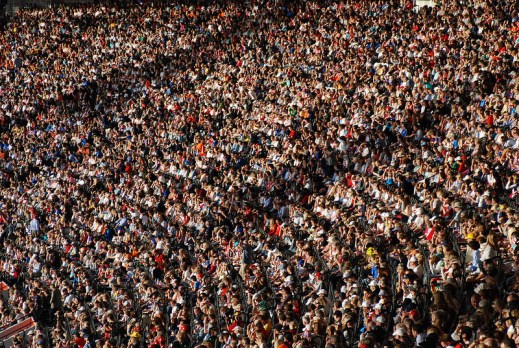
Featured Image: Crowd: London 2012 Olympic Stadium, Image by Flickr User Flickmor
—
David Hendy is Professor of Media and Communication at the University of Sussex, England. He wrote and presented the recent 30-part BBC radio series Noise: a Human History, which remains available to download on ITunes. The accompanying book, Noise: a Human History of Sound and Listening, will be published in the US in October 2013 by Harper Collins. He’s the author of Radio in the Global Age (2000), Life on Air: a History of Radio Four (2007), and Public Service Broadcasting (2013), and contributes regularly to radio programmes.
—
 REWIND! . . .If you liked this post, you may also dig:
“We wanted to tell stories about sound”: Opening Ears Through the “Everything Sounds” Podcast–Craig Shank and George Drake Jr.
Quebec’s #casseroles: on participation, percussion and protest–Jonathan Sterne
Goalball: Sport, Silence, and Spectatorship— Melissa Helquist
Share this:


Current Top Posts





April 2021

January 2020

November 2019

October 2019

August 2019

April 2014

November 2017

March 2015

December 2017

October 2015
 Sounding Out!
Recent Comments