
A Brief Review of Australian Radio Art

Welcome to the second part of Radio Art Reflections, a series on radio art that brings together the thoughts of three practitioners who have been researching the field from Canada, Australia and the UK.
In the first part Canadian sound and radio artist Anna Friz discussed how transmission art has shaped her practice and how it has become an important current within the expanded territory of radio art. Following this, musician and sound artist Colin Black reflects on the particularities of Australia’s radio art history, analyzing the effects of ongoing cutbacks at the Australian Broadcasting Corporation. Black fears a distinctive Australian soundscape-based radio art is in danger of being lost, while identifying a current renaissance in narrative based radio features which currently shape ABC radio output, and considers the potential of ABC’s new Creative Audio Unit.
– Guest Editor Magz Hall
—
As an artist growing up in rural Australia, I was hugely influenced by how state-owned radio engaged with sound-based practitioners. For decades, radio not only gave voice to some of the more exploratory artists and their works, it allowed artists and audiences from all over this vast continent to find a space in which experimental works could, with financial support, gestate, be realized and propelled onto a world stage, often receiving international acclaim for their distinctive perspective.
In recent years I have come back to those works as a PhD researcher, interviewing thirty five international practitioners, theorists and producers on Australian radio art thereby gaining a new appreciation of its particular aesthetic practices and approaches. This article draws on some of these interviews to highlight national and international perceptions about where Australian radio art has been, while also demonstrating its potential to influence a new generation of artists to explore beyond mainstream media formats.

Murray Higgins, ABC Adelaide Drama supervising engineer recording various armaments on the deck of a Royal Australian Navy ship. This actuality was used for a live broadcast of a radio play scheduled for broadcast on the same day of recording. (Photo taken April 8, 1945 by an unknown photographer)
THE LISTENING ROOM
While there are a few early examples of Australian radio art, consistant programming and commissioning of radio art effectively commenced in the 1980s with the formation of the ABC Arts Unit during 1984-85 and the acoustic arts programme The Listening Room, which aired from 1988 to 2003. Although long-decommissioned, The Listening Room was still one of a very few signposts that my interviewees cited when trying to understand the properties of Australian radio art. The Listening Room’s founding executive producer Andrew McLennan, who expanded the boundaries of ABC radio from 1976 onwards, had a clear take on the aesthetic framework of the show, stating in one internal ABC report (c1990) that the programme was a:
… venue for the exploration, the cross-pollination of radio forms. … you can hear new radio plays, audio essays, acoustic features, sound documentaries, new music, sound-scapes and sculptures, audio installations, acoustic art forms …
This approach was broader than that of other international radio art programs. Here is a quote from the formative executive producer of Deutschlandradio Kultur, Götz Naleppa, who took a much more “aesthetic” approach for his well-known Klangkunst programmes in Germany:
The difference to other radio-art-forms like radio-play is simple: sound-composition [a term Naleppa prefers to radio art] shares with them the same elements: sound, text (voice) and music. But in radio-play text (dialogue) is in the foreground and the other elements SERVE it (often in an illustrative way). And in (radio)sound-composition we have the same elements – but they are EQUAL, they are simply MATERIAL in the hands of the composer [Götz Naleppa, e-mail message to author July 28, 2005].
Of the two, The Listening Room clearly had a wider scope. Thus a number of ABC works, like On the Raft, All at Sea (by Robyn Ravlich and Russell Stapleton), placed the text in the foreground as the narrative is primarily driven by the use of spoken dialogue and the other elements are used to serve the text in a chiefly illustrative fashion. By definition Naleppa would call this a “radio-play” and not necessarily neues hörspiel or radio art, and definitely not a radio “sound-composition.”
.
Extract from On the Raft, All at Sea (2002) by Robyn Ravlich and Russell Stapleton (courtesy Robyn Ravlich and ABC Radio)

Figure Two: The Listening Room, program logo postcard designed by Antart (c 1990).
“AUSTRALIAN” RADIO ART
Alongside this inclusiveness of a wide scope of work, my research uncovered a range of other ideas about the identifiable properties of Australian radio art. Austrian Elisabeth Zimmerman claims that with Australian work there is “a certain tradition” that favours the “use of environmental sounds … but in a very composed way.” Andrew McLennan supports Zimmerman’s viewpoint and states: “it’s always hard to say and it is probably a bit of a cliché … [however he] often think[s] of it as quite environmentally driven.” Douglas Kahn, an American, is more skeptical, observing that “The Australian stuff was much broader range … I don’t think you can say that there was an Australian aesthetic because there were so many different artists that were brought in to do things.” Although later Kahn does state that a common thread heard in Australian work was its “really high quality production values … really nice complex mixes … people playing the mixing board like it was a piano in a really sophisticated way.” Kaye Mortley from her Australian French background describes Australian work as “radiophonic art, of various sorts, more experimental in nature, some produced by composers.” While not a composer, Australian Virginia Madsen supports Mortley’s viewpoint when she describes her own work as “experimental … it combines music, theatre performance, and documentary really.” The common theme that emerges from my research is the openness and commitment to experimentation that exists alongside a highly professional approach to the art form within Australian radio art culture.
My interviews also indicated that radio art plays a role in the perceived amorphous and multi-faceted notion of national identity, while confirming Kahn and Nicholas Zurbrugg’s earlier observations that radio art has critically contributed to the overall arts ecology in Australia. As a practitioner, I would also describe my own work as having an experimental approach that is influenced by the high quality production levels of programs like The Listening Room. While much of my work is environmentally driven, my artistic focus is to create multi-faceted, intimate aural geographies in which human imprint is present.
.
Extract from Alien In The Landscape (2007) by Colin Black (courtesy DeutschlandRadio Kultur). This extract features synchronous field recordings made by a Rodes NT4, X-Y configured stereo microphone and Fender Stratocaster with additional strings attached as pictured below.

Figure Three: The author conducting field recordings at the edge of the Great Sandy Desert in Australia, 2006.
THE CREATIVE AUDIO UNIT AND AUSTRALIAN RADIO TODAY
When The Listening Room was decommissioned in 2003, explorative radio was forced in two directions: ABC Radio National programmed some word-based works, while ABC Classic FM aired another set of works that Kate Dundas (Director of ABC Radio) has called “Shorter-form pieces, maybe perhaps down the sound-based acoustic end or radiophonic end of the spectrum.”Budgets were dramatically reduced and diverted, resulting in the effective abandonment of regular commissions and airtime for long-form sound-based works. In 2012 ABC management decommissioned book readings and Creative Instinct (a “feature program that reflects and explores the creative world”) and The Night Air (described as “aural equivalents of the avant-garde cut-up: a montage of interviews, location sound, music and found audio”). Moreover management oversaw the dismantling of the Airplay programme, which included “hour-long dramatic fictions [sic] experiment with form” effectively ending an 80-year tradition of Australian radio drama. In replacing these programmes, the Creative Audio Unit (CAU) was planned and American-style low budget radio production techniques for dramatic short stories (as championed at the 2012 ABC run Radio Beyond Radio conference) were put on the table as the future of radio.
In 2013 the ABC recruited a whole new team (who collectively had very little direct engagement with prior radio drama and The Listening Room production budgets and procedures), to setup, oversee and run the CAU. This transition was so atypical of past ABC changes that it raises questions as to whether this was an orchestrated act of cultural amnesia. It is perhaps not surprising that one of the major challenges this new team faces is the lack of resources, which impedes the magnitude of new works commissioned. This also raises questions as to how the previous budgets from Airplay, The Night Air and Creative Instinct have been reassigned. Another challenge is this unit’s extremely wide area of responsibility (that was previously spread across a number of ABC Units) ranging from radio drama and essays on the Radiotonic programme (effectively replacing the entire radio drama department) to what it claims to be a “portal into radio art, performance, soundscapes and composed audio features” on its Soundproof programme.
While Soundproof makes gestures to re-stimulate radio art activities in Australia, in sampling its first twenty episodes it becomes apparent that a very large percentage of airtime is heavily driven by the spoken dialogue narrative, more in line with radio drama or documentary. Furthermore, the episodes that contain the more interesting sound works seem to be frequently interrupted by extended contextual dialogue and therefore, for the most part, present only extracts or shorter form radio art works. Therefore, as a practitioner who runs the risk of being excluded from future CAU activities, I would nevertheless argue that for the most part, the CAU is doubling up on its focus on radio drama and documentary style productions and has not to date reached its goal of fully exploring and presenting sound rich radio art features, as it claims (please see Soundproof episode mp3 downloads dated between 11 May to 21 September 2014). Moreover, Soundproof is much more constrained, even backward-looking, when compared to its predecessors and is therefore aiming to attract a much less adventurous radio audience. More glaringly, the first twenty episodes lack a strong presence for new Australian works when compared to The Listening Room that broadcast sixty-four Australian works with a total duration of fifty hours in its first year of operation. As an inquisitive listener it seems that, to date, Soundproof has forgotten its own lineage without offering anything new or innovative and in doing so, has also forgotten audience members like myself in Australia and throughout the world.
I sometimes wonder what the conclusions from my research study would be if it were only focused on current practice. Would today’s Australian radio art still play a role in the perceived multi-faceted notion of Australian national identity? Would it still be perceived to have an experimental approach with high quality production levels that favour the use of environmental sounds? Is it still a critical contributor to the overall arts ecology in Australia? Audience members who have little prior knowledge of Australian radio art, may think so or may not conceive of its potential to do so. However, given sustained support, the space for experimentation and a clear inventive vision for the future, building on the legacy of past achievements, Australian radio art clearly has the potential to regain its status on a world stage.
—
Featured Image: Beastman mural on Brisbane Radio by Flickr User JAM Project
—
Dr Colin Black is an internationally acclaimed composer/sound artist having won the 2003 Prix Italia Award and achieving the final round selection in the 2010 and 2011 Prix Phonurgia Nova for his creative feature length works. As a result of this acclaim, Black has received multiple national and international commissions to create innovative long-form works for broadcast across major Australian and European networks. Black’s curator credits include, international festival/showcases of award winning Australian acoustic art and radio art at London’s Resonance104.4fm, Kunstradio (ÖRF, Austria) and Toronto’s New Adventures In Sound Art. In 2013 he also curated the Australian Broadcasting Corporation’s Sound Fix: Your Weekly Dose of Transmitted Audible Art series. He is a PhD graduate of the Sydney Conservatorium of Music where he was a recipient of the University of Sydney Postgraduate Awards Scholarship. More recently Black has been engaged as an academic lecturing at the University Technology, Sydney; moreover he has authored a number of conference papers and peer reviewed journal articles including “An Overview of Spatialised Broadcasting Experiments With a Focus on Radio Art Practices” in Organised Sound. Black is also the founding member of The International Radio Art (and Creative Audio for Trans-media) Research Group. For more information see: www.colinblack.com.au
—

REWIND! . . .If you liked this post, you may also dig:
Unsettled Listening — Randolph Jordan
Radio Ambulante: A Radio that Listens — Carolina Guerrero
Everything Sounds Podcast — Craig Shank
Share this:

Sound at SEM 2014

Hot on the heels of the American Musicological Society and Society for Music Theory’s joint annual meeting in Milwaukee, the Society for Ethnomusicology will hold its 59th Annual Meeting in Pittsburgh, November 13-16, 2014, hosted by the University of Pittsburgh. SEM is arguably one of the conferences most hospitable to sound studies, and several panels feature strong papers.
On Wednesday, Nov. 12, the “Music and Labor” pre-conference symposium features some fascinating papers of interest to sound scholars and includes a keynote address by Dr. Marcus Rediker, Distinguished Professor of Atlantic History at the University of Pittsburgh. With panels titled “(Re) Conceptualizing Music and Labor,” “The Labor of Music in Transitioning Economies,” “Art as Work: Defying Capitalist Hegemony and National Narrative through Musical Activism and Creative Adaptation,” and “Transformation of Music Labor Regimes in Socialist and Post-Socialist Southeastern Europe,” even the papers that aren’t especially sound studies-related have the potential to demonstrate deft interdisciplinary approaches that would be applicable (and fruitful) in sound studies research.
One of the first sound studies events of the conference program is the annual meeting of the Sound Studies Special Interest Group. Dr. Allen Roda, Jane and Morgan Whitney Research Fellow at the Metropolitan Museum of Art in New York City, and I are currently co-chairs of the SIG; anyone interested in sound studies will not want to miss our meeting on Thursday, November 13 at 12:30-1:30 PM in the Duquesne Room. This year’s meeting will mark the SIG’s 6th anniversary since it was formed in 2009. The group now has over 100 members and is represented on several panels at the 2014 conference in Pittsburgh. One co-chair seat will become vacant this year, and the group will hold elections to fill this position at the meeting; we also plan to discuss plans for more visibility online and among the academic community.
Before the meeting, come early to the 8:00-10:30 AM session in that same room to catch Molly McBride’s paper, “The Sounds of Humor: Listening to Gender in Early Barn Dance Radio,” or see a whole sound studies panel titled “Auditory Histories of the Indian Ocean: Hearing the Soundworlds of the Past” in the Alleghany Room.
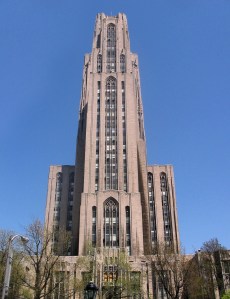
“The Cathedral of Learning at UPitt” by Flickr user Carlos Hernandez, CC BY-NC-SA 2.0
If you can’t make those early panels on the first day, the convention boasts numerous, high-quality sound studies sessions, many of which convene simultaneously. There have been several sound studies-related panels and individual papers at past meetings, but the number of high-quality papers is certainly trending in favor of more sound studies.
Also, the last several annual meetings have featured a soundwalk hosted by the Sound Studies SIG. This year is no different; however, rather than having a guided walk around the host city, this year’s soundwalk will be self-guided. Using the Twitter hashtag #semsoundwalk, participants will listen to Pittsburgh, the acoustic environment of the conference itself, the coffee shop where they stop for refreshment, or wherever they happen to find themselves between 1:15 – 6:00PM on Friday, Nov. 14. Be sure to follow the hashtag – even if you’re not in Pittsburgh – to “listen” along with conference participants.
I am delighted to see that this year’s conference unites the SEM’s commitment to the study of world musics and cultures and sound studies, particularly in panels such as “Auditory Histories of the Indian Ocean: Hearing the Soundworlds of the Past,” “Contemplating Voice in Cross-Cultural Perspective,” and “Regulating Space, Regulating Sound: Musical Practice and Institutional Mediation in São Paulo, Brazil.” This year also highlights the SEM’s strong interdisciplinary bent and makes even more room at the epistemological table for the examination of technoculture and its implications for sound studies and the larger ethnomusicological community.
Because of the sheer volume of sound studies activities, rather than listing my “picks” for the conference, I’ve listed most of the relevant papers and sessions, leaving the hard decision up to you. In fact, there are so many genuine sound studies panels and papers (or papers on closely related topics) its easy to see why the blurry line that demarcates “sound studies” from “music studies” seems blurriest at SEM. For those who cannot attend the conference, some of this year’s panels will be live-streamed. The Special Interest Groups for Sound Studies and Ecomusicology are also co-hosting a roundtable on Saturday morning. For more information about the conference and to catch the live-streamed sessions, visit the conference website at http://www.indiana.edu/~semhome/2014/.
—
Michael Austin is Assistant Professor of Media, Journalism, and Film and coordinator of the Interdisciplinary Studies Program in the School of Communications at Howard University where he teaches courses in music production, sound design for film and audio production. He holds a Ph.D. in Humanities – Aesthetic Studies (with a specialization in Arts and Technology) from the University of Texas at Dallas and music degrees from UT-San Antonio and UT-Austin. He is also affiliated with the Laboratoire Musique et Informatique de Marseille, an audio/music technology and informatics lab in Marseille, France, and is co-chair of the Society for Ethnomusiciology’s Special Interest Group for Sound Studies.
—
Featured image: “Musician” by Flickr user Joanna, CC BY-NC 2.0
—

“Cathedral of learning/Stephen Foster Memorial – Painted by Light” by Flickr user Sriram Bala, CC BY-NC 2.0
WEDNESDAY, November 12
8:00 am – 8:00 pm
Ballroom 3, Wyndham Grand Pittsburgh Downtown Hotel
Pre-Conference Symposium: “Music and Labor”
THURSDAY, November 13
8:30 – 10:30 am
Duquesne Room
“The Sounds of Humor: Listening to Gender on Early Barn Dance Radio,” Molly McBride, Memorial University of Newfoundland
Alleghany Room
Session: Auditory Histories of the Indian Ocean: Hearing the Soundworlds of the Past
“Wonders and Strange Things: Practices of Auditory History before Recorded Sound,” Katherine Butler Schofield, King’s College London
“Notes in the Margins: Sumatran Religious Hybridity and the Efficacy of Sound, “ Julia Byl, King’s College London
“Contact, Contestation and Compromise: Sound and Space in 19th-Century Singapore,” Jenny McCallum, King’s College London
“A ‘Wayang of the Orang Puteh’?: Theatres, Music Halls and Audiences in High-Imperial, Calcutta, Madras, Penang and Singapore,” David Lunn, King’s College London
10:45am -12:15 pm
Sterling 3 Room
“Sounding Neoliberalism in the Richmond City Jail,” Andrew C. McGraw, University of Richmond
Heinz Room
“The Color of Sound: Timbre in Ralph Ellison’s Invisible Man,” Sydney A. Boyd, Rice University
12:30 – 1:30 pm
Duquesne Room
Special Interest Group for Sound Studies
1:45 – 3:45 pm
Sterlings 1 Room
“Radio Archives and the Art of Persuasion: Preserving Social Hierarchies in the Airwaves of Lima” Carlos Odria, Florida State University
Ft. Pitt Room
Session: Mediated Musics, Mediated Lives
“Uploading Matepe: The Role of Online Learning Communities and the Desire to Connect to Northeastern Zimbabwe,” Jocelyn A. Moon, University of Washington; Zachary Moon, Independent Scholar
“Staging Overcoming: Disability, Meritocracy, and the Envoicing of Dreams,” William Cheng, Dartmouth University
“As Time Goes By: Car Radio and Spatiotemporal Manipulations of the Travel Experience in 20th-Century America,” Sarah Messbauer, University of California, Davis
“’How Can We Live in a Country Like This?’ Music, Talk Radio, and Moral Anxiety,” Karl Haas, Boston University
Sterling 3 Room
Session: Oxide and Memory: Tape Culture and the Communal Archive
Oxide and Memory: Tape Culture and the Communal Archive
“Magnetic Tape, Materiality, and the Interpretation of Non-Commercial Cassette and Reel-to-Reel Recordings from Quebec’s Gaspé Peninsula,” Laura Risk, McGill University
“Family Sense and Family Sound: Home Recordings and Greek-American Identity,” Panayotis League, Harvard University
“The Memory of Media: Autoarchivization and Empowerment in 1970s Jazz,” Michael C. Heller, University of Massachusetts, Boston
“Reimagining the Community Sound Archive: Cultural Memory and the Case for ‘Slow’ Archiving in a Gaspesian Village,” Glenn Patterson, Memorial University of Newfoundland
4:00 – 5:30 pm
Sterlings 1 Room
Panel: Contemplating Voice in Cross-Cultural Perspective
“The Gravest of Female Voices: Women and the Alto in Sacred Harp,” Sarah E. Kahre, Florida State University
“Re-sounding Waljinah: Aging and the Voice in Indonesia,” Russ P. Skelchy, University of California, Riverside
“Katajjaq: Between Vocal Games, Place and Identity,” Raj S. Singh, York University
Sterlings 3 Room
Session: Rumors, Sound Leakages and Individual Tales: Disruptive Listening in Zones of Conflict
“From the Struggle for Citizenship to the Fragmentation of Justice: Reflections on the Place of Dinka Songs in South Sudan’s Transitional Justice Process,” Angela Impey, School of Oriental and African Studies (SOAS), University of London
“Internet Rumors and the Changing Sounds of Uyghur Religiosity: The Case of the Snake Monkey Woman,” Rachel Harris, School of Oriental and African Studies (SOAS), University of London
“The Cantor and the Muezzin’s Duet at the Western Wall: Contesting Sound Spaces on the Frayed Seams of the Israel-Palestine Conflict,” Abigail Wood, University of Haifa
Heinz Room
Session: Historiography, Historicity, and Biography
“A Sonic Historiography of Early Sample-Based Hip-Hop Recordings,” Patrick Rivers, University of New Haven
“Biography as Methodology in the Study of Okinawan Folk Song,” Kirk A. King, University of British Columbia
“Sounding the Silent Image: Uilleann Piper as Ethnographic Object in Early Hollywood Film,” Ivan Goff, New York University
Untitled by Flickr user David Kent, CC BY-NC-ND 2.0
FRIDAY, November 14
7:00 – 8:00 am
Special Interest Group for Voice Studies
8:30 – 10:30 am
Commonwealth 1-2 Room, live streaming
Session: Sound Networks: Socio-Political Identity, Engagement, and Mobilization through Music in Cyberspace and Independent Media
*Sponsored by the Popular Music Section and Special Interest Group for Sound Studies
“Technological Factors Conditioning the Socio-Political Power of Music in Cyberspace,” Michael Frishkopf, University of Alberta
“Cyber-Mobilization, Informational Intimacy, and Musical Frames in Ukraine’s EuroMaidan Protests,” Adriana Helbig, University of Pittsburgh
“Countering Spirals of Silence: Protest Music and the Anonymity of Cyberspace in the Japanese Antinuclear Movement,” Noriko Manabe, Princeton University
“Living (and Dying) the Rock and Roll Dream: Alternative Media and the Politics of ‘Making It’ as an Iranian Underground Musician,” Farzaneh Hemmasi, University of Toronto
Sterling 1 Room
Session: Affective Environments and the Bioregional Soundscape
*Sponsored by the Special Interest Group for Ecomusicology
“’Landscape is Not Just What Your Eyes See’: Battery Radio, the Technological Soundscape, and Sonically Knowing the Battery, Kate Galloway, Memorial University of Newfoundland
“Re-sounding Caribou: Musical Posthumanism in Being Caribou,” Erin Scheffer, University of Toronto
“Cold, Crisp, and Dry: Inuit and Southern Concepts of the Northern Soundscape,” Jeffrey van den Scott, Northwestern University
Discussant, Nancy Guy, University of California, San Diego
Duquesne Room
“The Sound of Affective Fact,” Matthew Sumera, University of Minnesota
1:15 – 6:30 pm
Soundwalk: A Sonic Environmental Survey of the SEM Annual Meeting
*Sponsored by the Special Interest Groups for Sound Studies and Ecomusicology. Follow the walk on Twitter: #semsoundwalk
(Meet in Wyndham Grand main lobby at 1:15pm. Reconvene in lobby at 6:00)
1:45 – 3:45 pm
Smithfield Room
Session: Strident Voices: Material and Political Alignments
*Sponsored by the Special Interest Group for Voice Studies
“Registering Protest: Voice, Precarity, and Assertion in Crisis Portugal,”Lila Ellen Gray, University of Amsterdam
“Quiet, Racialized Vocality at Fisk University,” Marti Newland, Columbia University
“’The Rough Voice of Tenderness’: Chavela Vargas and Mexican Song,” Kelley Tatro, North Central College
Discussant: Amanda Weidman, Bryn Mawr College
4:00 – 5:30 pm
Heinz Room
Session: Celebratory Sounds and the Politics of Engagement
“Creating Zakopower in Postsocialist Poland,” Louise J. Wrazen, York University
“Merry-Making and Loyalty to the Movement: Conviviality as a Core Parameter of Traditionalism in Aysén, Chile,” Gregory J. Robinson, George Mason University
“Sounding the Carnivalesque: Changing Identities for a Sonic Icon of the Popular,” Michael S. O’Brien, College of Charleston

“Musical Mystery” by Flickr user Robert Wilhoit, CC BY-NC-SA 2.0
SATURDAY, November 15
8:30 – 10:30 am
Sterlings 1 Room
Roundtable: Sound Studies, Ecomusicology, and Post-Humanism In/For/With Ethnomusicology
*Sponsored by the Special Interests Groups for Ecomusicology and for Sound Studies
P. Allen Roda, The Metropolitan Museum of Art
Jennifer Post, University of Arizona
Mark Pedelty, University of Minnesota
Michael Silvers, University of Illinois at Urbana-Champaign
Ben Tausig, Stony Brook University
Zeynep Bulut, King’s College London
10:45 am – 12:15 pm
Benedum Room, live streaming
Musical Instruments, Material Cultures, and Sound Ecologies
“Bulgarian Acoustemological Tales: Narrativity, Agrarian Ecology, and the Kaval’s Voice,” Donna A. Buchanan, University of Illinois at Urbana-Champaign
Sterling 1 Room
Session: Theorizing Sound
“Water Sounds: Distance Swimmers and Ecomusicology,” Niko Higgins, Columbia University
“Telephone, Vacuum Cleaner, Couch: Senses and Sounds of the Everyday in Postwar Japan,” Miki Kaneda, Boston University
Discussant: Benjamin Tausig, Stony Brook University
SUNDAY, November 16
8:30 – 10:30 am
Birmingham Room
Session: Regulating Space, Regulating Sound: Musical Practice and Institutional Mediation in São Paulo, Brazil
*Sponsored by the Latin American and Caribbean Section
“Music under Control? São Paulo’s Anti-Noise Agency in Action,” Leonardo Cardoso, University of Texas at Austin
“Music Producers in São Paulo’s Cultural Policy Worlds,” Daniel Gough, University of Chicago
“’Small Universes’: The Creation of Social Intimacy through Aesthetic Infrastructures in São Paulo’s Underground,” Shannon Garland, Columbia University
Discussant, Morgan Lurker, Reed College
Heinz Room
“Hear What You Want: Sonic Politics, Blackness, and Racism-Canceling Headphones,” Alex Blue, University of California, Santa Barbara
Alleghany Room
“Sound and Silence in Festivals of the French Revolution: Sonic Analysis in History,” Rebecca D. Geoffroy-Schwinden, Duke University
10:45 am – 12:15 pm
Liberty Room
Session: Sounding Nations
“Building the Future through the Past: The Revival Movement in Iranian Classical Music and the Reconstruction of National Identity in the 1960s and the 1970s,” Hadi Milanloo, Memorial University of Newfoundland
“Sounding Citizenship in Southern Africa: Malawian Musicians and the Social Worlds of Recording Studios and Music Education Centers,” Richard M. Deja, University of Illinois
“Unity in (Spite of) Diversity: Tensions and Contradictions in Performing Surinamese National Identity,” Corinna S. Campbell, Williams College

“Music” by Flickr user Rich McPeek, CC BY-NC 2.0
Share this:


Current Top Posts





April 2021

January 2020

November 2019

October 2019

August 2019

April 2014

November 2017

March 2015

December 2017

October 2015
 Sounding Out!
Recent Comments