
Listening to the Beautiful Game: The Sounds of the 2018 World Cup

DOI: https://doi.org/10.59350/d1hab-pjx27
I heard them before I saw them. Walking to my apartment in Moscow’s Tverskoy District, I noticed a pulsating mass of sound in the distance. Turning the corner, I found a huge swath of light blue and white and—no longer separated by tall Stalinist architecture—was able to clearly make out the sounds of Spanish. Flanked by the Izvestiia building (the former mouthpiece for the Soviet government), Argentinian soccer fans had taken over nearly an entire city block with their revelry. The police, who have thus far during the tournament been noticeably lax in enforcing traffic and pedestrian laws, formed a boundary to keep fans from spilling out into the street. Policing the urban space, the bodies of officers were able to contain the bodies of reveling fans, but the sounds and voices spread freely throughout the neighborhood.
Moscow is one of eleven host cities throughout Russia for the 2018 FIFA World Cup, which runs from June 14 to July 15. Over one million foreign fans are expected to enter the country over the course of the tournament, and it is an important moment in Vladimir Putin’s attempt to reassert Russia’s power on the global stage. Already, it has been called “the most political tournament ever,” and discussions of hooliganism, safety concerns, and corruption have occupied many foreign journalists in the months leading up to the start. So gloomy have these preambles been that writers are now releasing opinion pieces expressing their surprise at Moscow’s jubilant and exciting atmosphere. Indeed, it seems as though the whole world is not only watching the games, but also listening attentively to try to discern Russia’s place in the world.

Thus it comes as no surprise that the politics of sound surrounding the tournament have the potential to highlight the successes, pitfalls, and contradictions of the “beautiful game.” Be it vuvuzelas or corporate advertising, sound and music has shaped the lived experience of the World Cup in recent years. And this tournament is no exception: after their team’s 2-1 win over Tunisia on June 18, three England fans were filmed singing anti-semitic songs and making Nazi salutes in a bar in Volgograd. That their racist celebrations took place in Volgograd, formerly known as Stalingrad and the site of one of the bloodiest battles of World War II, added historical insult and even more political significance. The incident has shaped reception of England’s fans and their sounds across the country. As journalist Alec Luhn recently tweeted, police cordoned off singing England supporters in Nizhny Novgorod after their victory over Panama, ostensibly keeping the risk of hooliganism at bay. The incident stands in stark contrast with the police barrier around the Argentina fans, who were being protected not from supporters of other nationalities, but rather from oncoming traffic.
England fans in Russia sing songs…behind a line of police. Part of the reason there hasn’t been any hooligan violence pic.twitter.com/RwXz8XtLHf
— Alec Luhn (@ASLuhn) June 23, 2018
More than anything, however, sound has facilitated cultural exchange between fans and spectators. In recent years, historians and musicologists have paid more attention to the multivalent ways musical exchanges produce meaningful political and social understandings. Be it through festivals, diplomatic programs, or compositional techniques, music plays a powerful role in the soft power of nations and can cultivate relationships between individuals around the globe. More broadly, sound—be it organized or not—shapes our identity and is one of the ways by which we make meaning in the world. Sound, then, has the potential to vividly structure the experience of the World Cup—a moment at which sound, bodies, individuals, and symbolic nations collide.
At the epicenter of all of this has been Red Square, Moscow’s—and perhaps Russia’s—most iconic urban space. The site of many fan celebrations throughout the World Cup, Red Square’s soundscape brings together a wide variety of national identities, socio-economic considerations, and historical moments. To walk through Red Square in June 2018 is to walk through over five-hundred years of Russian history, emblematized by the ringing bells and rust-colored walls of the Kremlin; through nearly eighty years of Soviet rule, with the bustle and chatter of curious tourists waiting to enter Lenin’s tomb; and through Russia’s (at times precarious) global present, where fans from Poland join with those from Mexico in chants of “olé” and Moroccan supporters dance and sing with their South Korean counterparts. The past, present, and an uncertain future merge on Red Square, and the sonic community formed in this public space becomes a site for the negotiation of all three.

In the afternoon of June 19, I walked through Red Square to listen to the sounds of the World Cup outside the stadium. At the entrance to Red Square stands a monument to Grigory Zhukov, the Soviet General widely credited with victory over the Nazis in World War II. Mounted upon a rearing horse, Zhukov’s guise looms large over the square. In anticipation of that evening’s match between Poland and Senegal at Moscow’s Spartak Stadium, Polish fans were gathered at the base of Zhukov’s monument and tried to summon victory through chants and songs (Poland would end up losing the match 2-1.) Extolling the virtues of their star player, Robert Lewandowski, the fans played with dynamics and vocal timbres to assert their dominance. Led by a shirtless man wearing a police peaked cap, the group’s spirit juxtaposed with Zhukov’s figure reiterated the combative military symbolism of sporting events. Their performance also spoke to the highly gendered elements of World Cup spectatorship: male voices far outnumbered female, and the deeper frequencies traveled farther across space and architectural barriers. The chants and songs, especially those that were more militaristic like this one, reasserted the perception of soccer as a “man’s sport.” Their voices resonated with much broader social inequalities and organizational biases between the Women’s and Men’s World Cups.
From there, I walked through the gates onto Red Square and was greeted by a sea of colors and hundreds of bustling fans. Flanked by the tall walls of the Kremlin on one side and the imposing façade of GUM (a department store) on the other, the open square quickly became cacophonous. Traversing the crowds, however, the “white noise” of chatter ceded to pockets of organized sound and groups of fans. Making a lap of the square, I walked from the iconic onion domes of St. Basil’s cathedral past a group of chanting fans from Poland, who brought a man wearing a Brazil jersey and woman with a South Korean barrette into the fold. Unable to understand Polish, the newcomers were able to join in on the chant’s onomatopoeic chorus. Continuing on, I encountered a group of Morocco supporters who, armed with a hand drum, sang together in Arabic. Eventually, their song morphed into the quintessential cheer of “olé,” at which point the entire crowd joined in. I went from there past a group of Mexico fans, who were posing for an interview while nearby stragglers sang. The pattern continued for much of my journey, as white noise and chatter ceded to music and chants, which in turn dissipated either as I continued onward or fans became tired.
Despite their upcoming match, Senegalese fans were surprisingly absent. Compared to 2014 statistics, Poland had seen a modest growth of 1.5% in fans attending the 2018 World Cup—unsurprising, given the country’s proximity to Russia and shared (sometimes begrudgingly) history. Meanwhile, Senegal was not among the top fifty countries in spectator increases. That’s not to say, of course, that Senegalese supporters were not there; they were praised after the match for cleaning up garbage from the stands. Rather, geography and, perhaps, socio-economic barriers delimited the access fans have to attending matches live as opposed to watching them from home. With the day’s match looming large, their sounds were noticeably missing from the soundscape of Red Square.
Later that evening, I stopped to watch a trio of Mexico fans dancing to some inaudible music coming from an iPhone. Standing next to me was a man in a Poland jersey. I started chatting with him in (my admittedly not great) Polish to ask where he was from, if he was enjoying the World Cup so far, and so on. Curious, I asked what he thought of all the music and songs that fans were using in celebrations. “I don’t know,” he demurred. “They’re soccer songs. They’re good to sing together, good for the spirit.”
Nodding, I turned back toward the dancing trio.
“You are Russian, yes?” The man’s question surprised me.
“No,” I responded. “I’m from America.”
“Oh,” he paused. “You sound Russian. You don’t look Russian, but you sound Russian.”
I’d been told before that I speak Polish with a thick Russian accent, and it was not the first time I’d heard that I did not look Russian. In that moment, the visual and sonic elements of my identity, at least in the eyes and ears of this Polish man, collided with one another. At the World Cup, jerseys could be taken off and traded, sombreros and ushankas passed around, and flags draped around the shoulders of groups of people. Sounds—and voices in particular—however, seemed equal parts universal and unique. Emanating from the individual and resonating throughout the collective, voices bridged a sort of epistemological divide between truth and fiction, authenticity and cultural voyeurism. In that moment, as jubilant soccer fans and busy pedestrians mingled, sonic markers of identity fluctuated with every passerby.
I nodded a silent goodbye to my Polish acquaintance and, joining the crowd, set off into the Moscow evening.
—
Featured Image: “World Cup 2018” Taken by Flickr User Ded Pihto, taken on June 13, 2018.
—
Gabrielle Cornish is a PhD candidate in Musicology at the Eastman School of Music. Her research broadly considers music, sound, and everyday life in the Soviet Union. In particular, her dissertation traces the intersections between music, technology, and the politics of “socialist modernity” after Stalinism. Her research in Russia has been supported by the Fulbright Program, the Glenn Watkins Traveling Fellowship, and the Cohen-Tucker Dissertation Research Fellowship from the Association for Slavic, East European, and Eurasian Studies. Other projects include Russian-to-English translation as well as a digital project that maps the sounds and music of the Space Race.
—

REWIND! . . .If you liked this post, you may also dig:
Cauldrons of Noise: Stadium Cheers and Boos at the 2012 London Olympics–David Hendy
Goalball: Sport, Silence, and Spectatorship— Melissa Helquist
Sounding Out! Podcast #20: The Sound of Rio’s Favelas: Echoes of Social Inequality in an Olympic City–Andrea Medrado
—
Share this:

becoming a sound artist: analytic and creative perspectives

Recently, in a Harvard graduate seminar with visiting composer-scholar George Lewis, the eminent professor asked me pointedly if I considered myself a “sound artist.” Finding myself put on the spot in a room mostly populated with white male colleagues who were New Music composers, I paused and wondered whether I had the right to identify that way. Despite having exploded many conventions through my precarious membership in New York’s improvised/creative music scene, and through my shift from identifying as a “mrudangam artist” to calling myself an “improviser,” and even, begrudgingly, a “composer” — somehow “sound artist” seemed a bit far-fetched. As I sat in the seminar, buckling under the pressure of how my colleagues probably defined sound art, Prof. Lewis gently urged me to ask: How would it change things if I did call myself a sound artist? Rather than imposing the limitations of sound art as a genre, he was inviting me to reframe my existing aesthetic intentions, assumptions, and practices by focusing on sound.
Sound art and its offshoots have their own unspoken codes and politics of membership, which is partly what Prof. Lewis was trying to expose in that teaching moment. However, for now I’ll leave aside these pragmatic obstacles — while remaining keenly aware that the question of who gets to be a sound artist is not too distant from the question of who gets to be an artist, and what counts as art. For my own analytic and creative curiosity, I would like to strip sound art down to its fundamentals: an offering of resonance or vibration, in the context of a community that might find something familiar, of aesthetic value, or socially cohesive, in the gestures and sonorities presented.
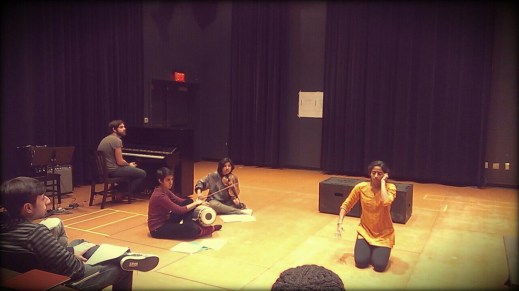
Rehearsing for “Meena’s Dream” (2013) by playwright Anu Yadav – original score by Rajna and Anjna Swaminathan and Sam McCormally.
I have spent most of my musical life wondering how the sounds I produce intersect with specific vectors of social belonging. The sounds emanating from my primary instrument — the mrudangam, a South Indian drum — are situated within a complex lattice of social difference, resonating within and across communities as disparate as the predominantly privileged-caste audiences of Chennai’s elite Karnatik sabha-s and the cosmopolitan connoisseurs who show up to find a home in New York City’s myriad intercultural and experimental music spaces. The sounds I produce are also inflected by the multivalent referentiality of my own socially situated body — as a queer, privileged-caste, Indian-American woman — simultaneously slicing through and answering to sonic environments organized around particular notions of rigor, virtuosity, and beauty.
For me, what began as a creative path rooted in the mimesis of an artistic lineage eventually settled in a versatile expressive voice, shaped by a decade of aesthetic (and ethical) nomadism. From my vantage point as a female percussionist in the South Asian diaspora, I have always been aware of the cracks in the veneer of tradition and other normative structures, and perhaps this fueled my musical vagrancy. Over time, my sound has accumulated the resonances of Karnatik music, ‘jazz’ drumming, bharatanatyam footwork, and Afro-Cuban rhythms, among others.
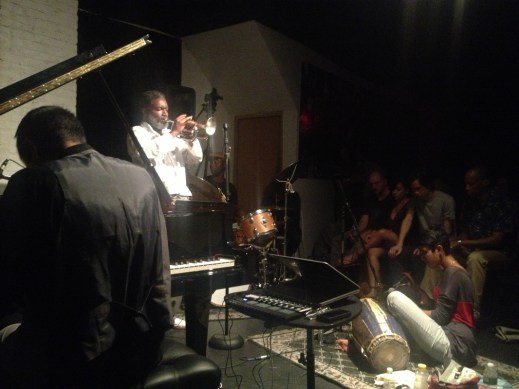
The author performing with Vijay Iyer, Graham Haynes, and Marcus Gilmore. The Stone, NYC. July 2013.
Certainly, this convergence of sonic layers is mediated by the rich specificity of interpersonal relationships and positionalities within larger networks. Power and positionality mediate the shape, audibility, and versatility of sounds as they become coupled with the implied (or actual) encounter of socially situated bodies. Yet, sounds somehow continue to exist in excess of the mechanisms and bodies that attempt to explain, produce, and contain them: idiom, tradition, space, culture, nation, race, gender, and sexuality. Therein lies their potency and mystery, and I intend to briefly explore the sensation of sonic excess in the hopes of honing a more sensitive analytic and creative perspective.
I am yet to become comfortable thinking in terms of sound, due to the longtime privileging of structure and technique in my musical upbringing. However, this is beginning to unravel as I am forced to deal with sound, particularly the sound of what Patrice Pavis and Jason Stanyek have called the “intercorporeal” aspect of intercultural performance. The predominantly improvised sounds that resonate through my mrudangam often emerge on the edge of my dynamic embodied consciousness, arranging themselves chaotically in real-time, interacting with others’ emergent soundings and sensory yearnings. Some of it may be mediated by parallel perceptual and idiomatic forms, but achieving a core interactive flow involves a fundamental immersion in sound.
Mat Maneri, feat. Rajna and Anjna Swaminathan
Tongues Series, curated by Amirtha Kidambi
ISSUE Project Room — June 18, 2016
For instance, take this impromptu piece presented by violist Mat Maneri, violinist Anjna Swaminathan (my sister), and me in 2016. It took place in the wonderfully resonant vaulted space of ISSUE Project Room, in front of an unsuspecting audience that had convened to hear the back-to-back juxtaposition of two improvisational “tongues” — a set of Maneri’s rich microtonal experiments, followed by a Karnatik concert of voice, violin, and mrudangam. However, this impromptu ludic exchange of sonic offerings — particularly Maneri’s incredible, chameleon-like ability to confound the sounds of Karnatik ornamentations with his own microtonal reflections — guided attention away from comparison and toward the sounds as they bounced eerily around the resonant architecture. Faced with the technically daunting Karnatik repertoire that Anjna and I were to play subsequently with vocalist Ashvin Bhogendra, the echoes of our interstitial collaboration allowed us to reorient ourselves and breathe a little easier.
From an analytic perspective, it is irresponsible to distill these sounds, to capture and conceptualize them as distinct from the bodies, histories, and discourses that participate in their co-creation and interpretation. Yet, riddled as they are with generations of power asymmetries and complex emotions, it is clear that these resonances have a secret life of their own. As musicians, we are not often given the opportunity to explore these clandestine, almost Baudelairean, correspondences, except perhaps when we discover them by accident. For instance, sonic ambiguities like those spun during the trio encounter play on sonic excess to spur new ways of listening and relating, with a direct ethical impact on the ensuing music.
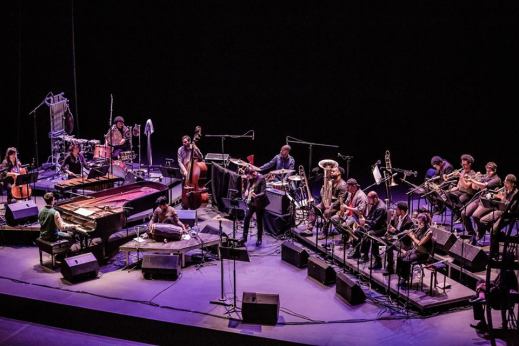
Performing in Vijay Iyer’s large ensemble project, “Open City,” named after Teju Cole’s award-winning novel. October 2013.
John Blacking’s definition of all music as “humanly organized sound” is perhaps an early articulation of this idea, although the word ‘organized’ contains a bias toward formal structure and stability. To be sure, organizing principles always exist at the local level of socially situated perception and expression, which Nina Sun Eidsheim calls the ‘figure of sound.’ However, the kind of sound art I’m proposing revels in excess, or as Eidsheim puts it — “not only aurality, but also tactile, spatial, physical, material, and vibrational sensations [that] are at the core of all music” (5). We can even turn to how Jacques Attali poetically describes composition — as “a labor on sounds, without a grammar, without a directing thought, a pretext for festival, in search of thoughts,” a practice wherein “rhythms and sounds are the supreme mode of relation between bodies once the screens of the symbolic, usage and exchange are shattered,” one that neither marks nor produces the body, but allows for “taking pleasure in it” (143). By focusing on the multi-sensory, pleasurable valences of sound, and on the ways in which sonic excess allows for new patterns of coexistence, we can outline a ‘sound art’ practice and analytic that aren’t circumscribed by Western institutional definitions and technological/perceptual biases.
Thinking in this way about sound and vibration helps to eradicate the mind-body problem that continues to plague certain areas of music studies and music making. Sound forms an elusive common denominator that doesn’t rely heavily on colonial taxonomies of form or hierarchical theories of art. It even accounts for the subversive or incommensurable resonances that tend to emerge at the unstable threshold between so-called ‘producers’ and ‘receivers’ of music. After all, sound is in the ear of the beholder, and social asymmetries are embedded in the way we hear and listen. Through the notion of vibration, we are further attuned to the visceral space in which it reverberates, and the ways in which its echoes live on in the bodies of those who experience it.
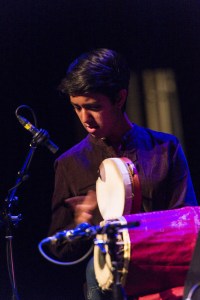
performing at the Banff International Workshop for Jazz and Creative Music. June 2013. Photo credit: Don Lee, Image courtesy of author
Finally, there is the other definition of sound in English, which indicates a level of trust and holism. Taking this path to becoming ‘sound artist’ focuses attention on the artist. I don’t intend to focus on the ‘chops’ conventional to a field of aesthetic practice. Rather, I am interested in the more obscure meaning: a ‘sound artist’ as one that ethically occupies space as an artist.
How might this emerging sound art, as analytic and creative practice, work to interrogate the very ethics and politics of art, while succumbing to the contingency and volatile excess of sound? I don’t claim to hold the answers, but if we are in any way sounding out against the grain of dominant modalities, then at some level we must attend seriously to sound: in its excess, as it overwhelms bodies and spaces, and as it stretches the realm of the known.
—
Featured Image: “The great Rajna Swaminathan,” from Teju Cole tweet, 5 October 2013.
—
Rajna Swaminathan is an accomplished mrudangam (South Indian percussion) artist, a protégé of mrudangam legend Umayalpuram K. Sivaraman. She has performed with several renowned Indian classical musicians, most notably mentor and vocalist T.M. Krishna. Since 2011, she has been studying and collaborating with eminent musicians in New York’s jazz and creative music scene, including Vijay Iyer, Steve Coleman, Miles Okazaki, and Amir ElSaffar. Since 2013, Swaminathan has led the ensemble RAJAS, which explores new textural and improvisational horizons at the nexus of multiple musical perspectives. Swaminathan is active as a composer-performer for dance and theatre works, most notably touring with the acclaimed company Ragamala Dance and collaborating with playwright/actress Anu Yadav. Swaminathan holds degrees in anthropology and French from the University of Maryland, College Park, and is currently pursuing a PhD in cross-disciplinary music studies at Harvard University.
—
 REWIND! . . .If you liked this post, you may also dig:
Sounding Out Tarima Temporalities: Decolonial Feminista Dance Disruption–Iris C. Viveros Avendaño
Gendered Soundscapes of India, an Introduction –Praseeda Gopinath and Monika Mehta
Tape Hiss, Compression, and the Stubborn Materiality of Sonic Diaspora–Chris Chien
“This Liquid Dream”: An Interview with Aquaphoneia Composer Navid Navab–Eshter Bourdages
Share this:




Current Top Posts





April 2021

January 2020

November 2019

October 2019

August 2019

April 2014

November 2017

March 2015

December 2017

October 2015


Recent Comments