
“All their ioynts & properties”: Orthography and Sound in Early English Poetry

 Each of the essays in this month’s “Medieval Sound” forum focuses on sound as it, according to Steve Goodman’s essay “The Ontology of Vibrational Force,” in The Sound Studies Reader, “comes to the rescue of thought rather than the inverse, forcing it to vibrate, loosening up its organized or petrified body (70). These investigations into medieval sound lend themselves to a variety of presentation methods loosening up the “petrified body” of academic presentation. Each essay challenges concepts of how to hear the Middle Ages and how the sounds of the Middle Ages continue to echo in our own soundscapes.
The posts in this series begins an ongoing conversation about medieval sound in Sounding Out!. Our opening gambit in April 2016, “Multimodality and Lyric Sound,” reframes how we consider the lyric from England to Spain, from the twelfth through the sixteenth centuries, pushing ideas of openness, flexibility, and productive creativity. We will post several follow-ups throughout the rest of 2016 focusing on “Remediating Medieval Sound.” And, HEAR YE!, in April 2017, look for a second series on Aural Ecologies of noise! –Guest Editors Dorothy Kim and Christopher Roman
–
During the “grammar wars” of the sixteenth century, when some scholars sought to restrict English letters to an “isomorphic” (or phonemic) relationship between sound and spelling, Richard Mulcaster emerged as a champion of a more broad and complex vernacular orthography in his 1582 Elementarie, with profound implications for the growing English language. In particular, Mulcaster’s insight that language is shaped by “custom” bolsters the argument for variety over phonemic standardization; as he writes (in the 1925 Oxford University Press reprint):
letters ca[n] expresse sou[n]ds withall their ioynts & properties, no fuller than the pencill can the form and lineaments of the face, whose praise is not life but likeness: as the letters yeld not alwaie the same, which sound exactlie requireth, but allwaie the nearest, wherwith custom is content (99).
Mulcaster seems to strongly indicate here that we should not expect vernacular orthography to capture sound in any reliable way. Custom – meaning actual usage, etymological roots, and so on, muddies the waters of spelling-based sound. Anyone familiar with Modern English, given its complex conventions and silent, or variably pronounced letters, might agree. Yet as John Wesley notes in “Mulcaster’s Tyrant Sound,” “Mulcaster’s orthography continually oscillates … between a conception of letters as completely divorced from sound, and one that finds sound and sight interacting (not always in conflict)” (349).
Indeed, looking more closely at Mulcaster’s statement, it is possible to discern the specter of a scribe, pencil in hand, attempting to capture the “joints and properties” of a poet’s sound in letters – using different letters depending on the dialectal orthography of the compositional time and space: a listening body making a visual representation of sound.
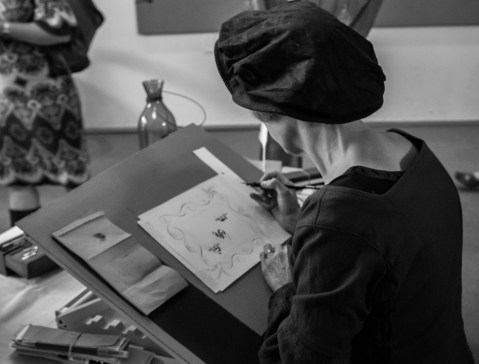
Image of a scribe by Nathan Adams @Flickr CC BY-NC-ND
Certainly, we encounter instances of orthographical representations of distinctive sounds in more recent and deliberate dialect poetry. John Hyland, writing on sound and African diasporic poetry in his unpublished dissertation Atlantic Reverberations, notes of late nineteenth- / early twentieth-century black dialect poems that “in a certain way, they are meant to be read and heard as talking machines. The sound technology, in this case, is the poem; it is a construction and a recording of a ‘black’ voice that socially and culturally functions in a manner analogous to the gramophone” (31). [Ed. Note: you can also read his work on Sounding Out! here]. Following this, it is interesting to try to figure out how the text of a poem can gesture toward and suggest a “sound” that belongs to a localized (even stereotyped) body, despite the text’s being mute on the page. New computational linguistic programs can help play back these ancient sound files, but based on my experience in using them with Middle English texts, there is a ways to go in matching their analytic capabilities with idiosyncratic early English spelling to produce satisfying results.
While late medieval English poems cannot be thought of as deliberate “constructions” of a voice in quite the same way as some contemporary forms of black poetry—although portions of Chaucer’s The Reeve’s Tale, in which “northern speech” is represented through alternate spellings and diction, might be an exception—I propose that we imagine orthography (and by extension, the scribes who implemented it) as a kind of “sound technology” analogous to early sound reproduction devices such as the phonograph. The analogy will break down at certain points, but in suggesting it I hope to answer two related questions: First, to what extent can orthography reliably encode sound (or, to put it another way, offer a score for “decoding” sound)? Second, can we extend back in time the critique of sound technology made by recent “sound theorists,” who tend to focus on texts and technologies from the modern period – and, if so, what can be gained thereby?
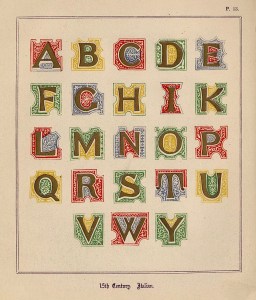
A medieval alphabet. Image by Cesar Ojeda @Flickr CC BY-NC-ND
The answer to the first question is, I believe, a very qualified “yes.” Yes, English orthography can and does encode sound, but like so many things about the English language and its highly idiosyncratic spelling conventions, it’s complicated. The second question leads to an elusive, but promising, framework in which to consider the role of orthography in shaping English poetic sound. In short, I will argue that orthographic profiles act as a sort of “performance” in which spelling collaborates with the sound of language to offer a socio-linguistic context within which to experience a given poem.s
I used SPARSAR, “an expressive poetry reader” developed by computational linguists Rodolfo Delmonte and Anton Maria Prati, to produce audio recordings of three poetic specimens from Middle English: The specimens are: Osbern Bokenham’s “Life of St. Anne,” (ll. 41-64); Geoffrey Chaucer’s The Franklin’s Prologue, (V.709-28); and John Audelay’s “Conclusion,” (ll.1-13). The specimens were chosen with the idea of dialectal variety in mind: Bokenham is associated with Suffolk, Chaucer with London, and Audelay with the West Midlands. According to its creators, SPARSAR uses “prosodic durational parameters” for English syllables developed by the authors with the aim of “evaluat[ing] objective presumed syllable and feet prosodic distribution at line level,” producing a version of a poem that can be read by Text to Speech (TTS) software with “an appropriate expressivity” (73).
The problem with TTS software is that it produces monotone outputs that fail to account for prosody, let alone expressivity. SPARSAR, I hoped, would “level the playing field” between differing orthographies in the poems, from an analytic standpoint: “the poem is translated into a phonetic form preserving its visual structure and its subdivision into lines and stanzas. Phonetically translated words are associated to mean duration values taking into account position in the word and stress” (Delmonte and Prati 74). Yet textual analysis of poems in Middle English is challenging precisely because of orthographical variation, and this holds true for SPARSAR as well. Before SPARSAR could recognize the speech of the poems, I had to run them through a “normalizing” program—VARD, although Morphadorner offers a similar service—thus in some ways defeating the purpose of testing orthography’s ability to encode sound, as well as muddling SPARSAR’s fine-grained prosodic analysis.
Audelay first with and then without SPARSER.
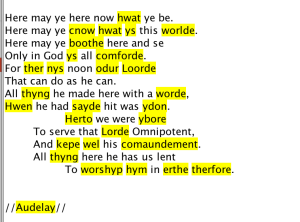
Audelay for VARD. Image used with permission by the author.
Thus, for example, in the second line of my selection from John Audelay, “Here may ye cnow hwat ys this worlde,” I replaced “cnow” with the modern “know” (thus losing the /k/ sound), “hwat” with “what,” “ys” with “is,” and “worlde” with “world.” One easily discerns the loss of information with respect to not only sound, but also scansion (the inflectional “e” ending). SPARSAR also does not account for the Great Vowel Shift in reproducing Middle English pronunciations. For how this would change the pronunciation of some words, see Simon Horobin, Does Spelling Matter? (2013).
The recordings produced by the resulting SPARSAR files are, then, a record of failure with respect to my project. But they are instructive failures, nonetheless, and I include them here alongside the “raw” TTS recordings of the poems to illustrate my point: orthography is a key way of encoding sound, yielding both geographic and temporal sonic data. Moreover, such failures – and they are inevitable to a certain extent in any digital analysis of pre-modern English – point out the urgent need to work ever backwards and include ever more variant spellings in software databases. I am reminded of the comical difficulties that iPhone’s Siri software has in deciphering Scots English, though in that scenario the trouble is not necessarily with orthography, but accent.
Imagine, however, Siri attempting to decipher an accurately voiced reading of a Robert Burns poem based on its textual appearance.
Echoing Mulcaster’s statement on orthography, Ralph H. Emerson writes in “English Spelling and Its Relation to Sound” that “alphabetic spelling … [can] be a kind of backbone that supports the flesh and muscle of all the phonetic and phonemic variants in different dialects and idiolects” (260). The problem, as Mulcaster would point out, is the matter of those phonemic variants, a point Emerson concedes: “Western orthography … is largely a tale of how people have squeezed as many values as possible out of the very short Roman alphabet” (262). As Simon Horobin writes, the phoneme /r/ is pronounced differently in England even among different speakers of Northern dialect; the various realizations of /r/ that do not alter meaning require the designation of an “allophone”: [r] (21). In order to encode all the various pronunciations, we would need further phonemic symbols. At the risk of oversimplifying several hundred years of the development of spelling conventions in English, the desire for a less arbitrary connection between letter and sound is at the heart of the debates and attempted reforms in which grammarians like Mulcaster were involved.
Bokenham first with and then without SPARSER.
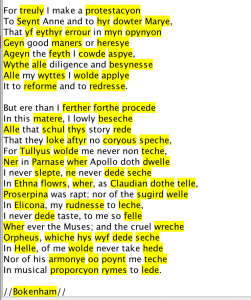
Bokenham for VARD. Image used with permission by the author.
Yet as much as Mulcaster argues for an orthography freed from “tyrant sound,” as Wesley notes, his arguments keep circling back to sound’s importance. Wesley writes, “Despite his claims regarding the ‘heard’ Z and its subjugation to the ‘sene’ S, the sound of Z creates a variety of problems for Mulcaster; in fact, its sound means Mulcaster must adjust the appearance and frequency of various other letters” (348). The reason for this is the complex set of rules in English regarding how letters interact with and influence each other in shaping the sound of a word. A more systematic analysis of these rules is precisely what allows Emerson to argue that orthography can, in fact, encode sound in English. He writes, “almost any dialect can be described as a plausible and usually predictable realization of the spelling, one word at a time” (265). Emerson describes a “four-step process” for this spelling-based description, which begins with “segment[ing] the spelling into elemental graphemes”; then “assign[ing] the segments their proper graphophonemes, that is, their abstract but systematically universal protovalues.” The next step “shows how the graphophonemes are phonemically realized in particular circumstances within individual dialects.” The example Emerson gives is “hair,” which segments into “H + AI + R, or //her//” (265). From this, he argues, we can reliably derive all the variant pronunciations of “hair.” To complete the process, a litereme is needed; e.g., the litereme <<s>> matches the phoneme //s// but also provides the “natural characteristic spelling” that expresses the “s” and “soft c” in English (266). Emerson concludes,
To describe how spelling encodes sound in a particular language is simply to chart the relationships between segments on these different levels … the litereme is the key: THAT is what everything else is really standing for, spellings and sounds and graphophonemes alike. (The letters themselves can be thought of as archiliteremes, with <<C>>having the reflexes <<k>> and <<s>>, <<A>> having <<ā>> and <<ă>>, etc.) … The simple universal phonology of written English gives birth to the infinite particularities of spoken English. (267)
Fortunately – for the purposes of looking at orthographically expressed Middle English variants, “present orthography still represents the pronunciation of Middle English” (Emerson 267). Unfortunately, though the letter-to-sound relationship in Middle English is much closer, we cannot be sure what those pronunciations were. But we can guess, and orthography is our best (perhaps only) clue.

From letters to sounds. Image by Michael Summers @Flickr CC BY-NC-ND.
The notion of “suggested” pronunciation is indeed where sound studies offers a compelling model for considering the relationship between poem and scribe, and how the former is recorded orthographically by the latter. Jonathan Sterne’s The Audible Past proposes to construct a “history of sound” that troubles the notion of “face to face” communication as being more “authentic” than sound reproduction technologies, adding, “This history of sound begins by positing sound, hearing, and listening as historical problems rather than as constants on which to build a history” (22). As medievalists know all too well, scribes and scribal variation in the copying of texts constitute a rich field of study when it comes to the question of textual “authenticity.”
Intriguing in light of such variation is Sterne’s idea of “transducers, which turn sound into something else and that something else back into sound” (22) – for which we might read orthography as a kind of technology with “moving parts” that work in concert to reproduce sound, as outlined above. More intriguing, perhaps, is Sterne’s description of the development of “audile technique,” a “practice of listening” that he bases on a study of “virtuosic and highly technical listening skills” during the nineteenth century and the advent of the telegraph, phonograph, and telephone. Sterne writes that with audile technique:
listening became more directional and directed, more oriented toward constructs of private space and private property. The construct of acoustic space as private space in turn made it possible for sound to become a commodity. Audile technique did not occur in the collective, communal space of oral discourse and tradition (if such a space ever existed); it happened in a highly segmented, isolated, individuated acoustic space (24).
In this context, Chaucer’s famous admonition to his scribe “Adam” becomes all the more charged and suggestive (650 in The Riverside Chaucer). We must certainly think of medieval scribes as early practitioners of “audile technique,” taking advantage of orthography as a tool by which to turn sound into a commodity in the form of manuscripts for various occasions and audiences.
Chaucer first with and then without SPARSER.
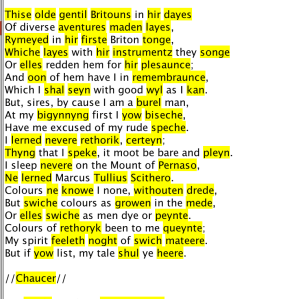
Chaucer for VARD. Image used with permission by the author.
Rethinking medieval texts in this way leaves us with a collaborative sonic performance in which the particular orthographies of the scribes help to pull an author’s text into a certain sound-space, even if it is inexact and in some sense inauthentic. Our ability to “hear” that space, to share it, is limited by our limited mapping of the incredibly multiform ways that English was uttered, and how those utterances were scored on the page by poets and scribes. Wesley notes the importance of discipline to Mulcaster’s educational-grammatical program as set forth in the Elementarie; discipline also hovers over the listening bodies performing audile technique for the sake of increasingly commodified sound spaces described by Sterne. English letters resist such discipline, sliding around various orthographies depending on time, place, poet, and scribe. In order to begin to use programs like SPARSAR to recreate, however tentatively, the sound they encode, we must loosen the standardizing discipline of our technology in parsing letters of the past.
—
Featured image “Mixed Media Painting” by See-ming Lee @Flickr CC BY-SA
—
David Hadbawnik is a poet, translator, and medieval scholar. His Aeneid Books 1-6 were published by Shearsman Books in 2015. He is the editor and publisher of Habenicht Press and the journal kadar koli, a co-editor of eth press, which focuses on creative interactions with medieval texts, and associate director of punctum books. Currently, he is an Assistant Professor of English at the American University of Kuwait.
—
 REWIND! . . .If you liked this post, you may also dig:
The Hysterical Alphabet–John Corbett, Terri Kapsalis, and Danny Thompson
The Eldrich Voice: H.P. Lovecraft’s Weird Phonography–James A. Steintrager
Mouthing the Passion: Richard Rolle’s Soundscapes–Christopher Roman
Share this:

Introduction: Medieval Sound

A text arrives and the buzz of a cell phone jolts you from your idle thoughts. The sound–like an alarm, another kind of bell to mark out the day–shifts you from one audition to another. The spatiality of competing sounds fills our consciousness and shapes our attitudes towards music and noise, privacy and pollution. These themes surround the issue of sound and articulate a variety of questions and problems. How does one delineate between noise and sound? How does sound individualize us within the community? How does sound create space? Why is the scopic the privileged sense?
Sound studies is the name for an interdisciplinary field encompassing the study of noise, music, vibrations, and what T.S. Eliot called “auditory imagination” in The Use of Poetry and The Use of Criticism (111). It is a capacious field, encompassing examinations of the individual sonic space of iPod use and the historical sound of rural and urban life. Sound (or the lack thereof) immerses a subject in worlds that may not be, or can distance the listener from the world that is. To put on headphones, to lose oneself in chant, to be awakened by an alarm, to lose the sound of voices in the crashing waves, transfers us, immerses us, and connects us in a variety of sonic worlds.

Medieval musician reinactment. Image borrowed from Byronv2 @Flickr CC BY-NC.
Each of the essays in this month’s “Medieval Sound” forum focuses on sound as it, according to Steve Goodman’s essay “The Ontology of Vibrational Force,” in The Sound Studies Reader, “comes to the rescue of thought rather than the inverse, forcing it to vibrate, loosening up its organized or petrified body (70). These investigations into medieval sound lend themselves to a variety of presentation methods loosening up the “petrified body” of academic presentation. Each essay challenges concepts of how to hear the Middle Ages and how the sounds of the Middle Ages continue to echo in our own soundscapes.
The posts in this series begins an ongoing conversation about medieval sound in Sounding Out!. Our opening gambit in April 2016, “Multimodality and Lyric Sound,” reframes how we consider the lyric from England to Spain, from the twelfth through the sixteenth centuries, pushing ideas of openness, flexibility, and productive creativity. We will post several follow-ups throughout the rest of 2016 focusing on “Remediating Medieval Sound.” And, HEAR YE!, in April 2017, look for a second series on Aural Ecologies of noise!
Multimodality and Lyric Sound
The essays clustered in the group “Lyric Sound” re-center lyric soundscapes—onomatopoeia, mashups, music box, witnesses to queer temporalities—in order to reorient the critical terrain of our understanding of the medieval lyric. Recent criticism on digital rhetoric has defined multimodality as the process of creating, rather than the product. In Daniel Anderson et al’s “Integrating Multimodality into Composition Curricula: Survey Methodolgy and Results from a CCCC Research Grant” (2006), multimodality, “acknowledges the practices of human sign-makers, who select from a number of modalities for expression (including sound, image, and animation, for example), depending on the rhetorical and material contexts within which the communication is being designed and distributed.” In this body of criticism, the term “multimedia” becomes condensed to the “integration of multiple forms of media” (59-84).
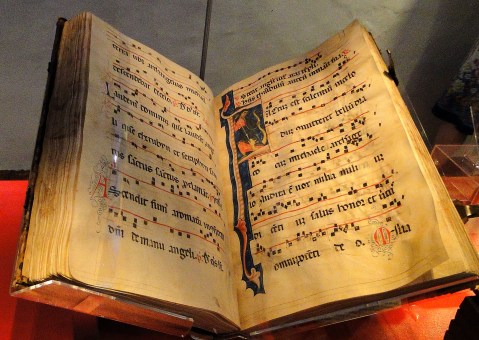
An illuminated music manuscript. Image by Richard White @Flickr CC BY-NC-SA.
This interest in semiotics is, however, not a new one; rather, it is one that has deep roots in medieval rhetoric, especially with regard to music. The two medieval writers most important to the discussion of rhetoric and music in the thirteenth century are John of Salisbury, particularly his twelfth-century work Metalogicon, and Gilbert of Crispin’s well-known debate Disputatio Iudei et Christiani from the late eleventh century. John of Salisbury’s Metalogicon, lays out the relation between symbols, sounds, and notation, writing:
Letters, that is, written symbols, in the first place represent sounds (voce). And secondly they stand for things, which they conduct into the mind through the windows of the eyes. Frequently, they even communicate, without emitting a sound, the utterances of those who are absent (Book 1, Chapter 3, 59).
John of Salisbury also links the notation of music with the notation of writing under the rubric of grammar, noting:
That such great import has existed in such tiny notations should not seem strange, for singers of music likewise indicate by a few graphic symbols numerous variations in the acuteness and gravity of tones. For which reason such characters are appropriately known as “the keys of music” (Book 1, Chapter 13, 59).
Gilbert of Crispin also considers the semiotics of visual notes. In the Disputatio Iudei et Christiani, he writes:
Just as letters stand in one way as images and notations of words, so also pictures exist as likenesses and notation of things written (qtd. in Michael Clanchy’s From Memory to Written Record 290).
Therefore what Isaiah saw, said and wrote, what Ezechiel saw, said and wrote, may after them be said and written and signified by some pictorial notation (290).
Both of these writers rework material from Isidore of Seville, and both describe correlations between reading “nota” in relation to music and images in post-Conquest Britain.
The elision between writing down letters and writing down musical notes is furthered by the slippery quality of the Latin from which the term “note” is derived. The Latin word “notare” means “to record writing,” while the second most common meaning of the noun “nota” [noter] means “to sing, to interpret musically.” The resulting duality of the term “note” survives today in both English and French, as Ardis Butterfield has pointed out in a November 2009 conference paper “A Note on a Note,” writing that “a note is both a sound and a sign.” The ambiguity of the term in Latin also indicates that the distinctions between the two meanings—“to record in writing” and “to interpret musically”—are constantly in flux.
The issues of the development of musical notation—a recording technology of sound—and the interface issues at stake in medieval manuscripts mean that our view of the medieval lyric comes primarily through the eyes. In other words, the medium—the manuscript page—in which the medieval lyric is recorded explains how our interpretations are deeply ocularcentric. However, we believe that we can think of the medieval manuscript as a flexible recording medium that allows for a “mise-en-système,” what Joanna Drucker describes as “an environment for action” in Graphesis: Visual Forms of Knowledge Production (139). A digital mise-en-système is a digital ecology in which the main question posed is how the interface can create the subject/user/reader. Interface then becomes a “border zone between cultural systems and human subjects;” it is the co-dependent space where “speaker and spoken are created. (148, 158-59).

“The Story of the Written Word” from the NY Public Library McGraw Rotunda. Photo by Wally Gobetz @Flickr CC BY-NC-SA.
Drucker tackles the theoretical stakes of digital visuality by explaining that “all images are encoded by their technologies of production and embody the qualities of the media in which they exist. These qualities are part of an image’s informations” whether this be illuminated manuscript, daguerreotype, painting, photograph, or digital image (21). The issues of layout, marginalia, paratext, columns, table of contents, indexes, chapter headings, are as Malcolm Parkes discusses in Scribes, Scripts, and Readers, a development of the medieval scholarly book (121-142). These experimental page structures became standard in printed books and eventually in digital texts.
In this series, we push back a bit on Drucker’s idea that the manuscript page is actually just a static mise-en-page. If the codex (as it developed in the Middle Ages) is one of the earlier kinds of informational “interfaces” then we should consider it as a mediating apparatus: one in which the mise-en-page and material features, its myriad graphic cues explain how to read, use, navigate, and access information in the codex book. We argue today with the example of the medieval English lyric as it emerges, that manuscripts are functionally an interactive media ecosystem, a mise-en-système where subject/user/reader can pull different threads and create and recreate meaning.
Over the next six weeks, the writers featured in our forum on Lyric Sound–Christopher Roman, Dorothy Kim, David Hadbawnik, Marla Pagán-Mattos, Katherine Jager--examine the different forms that medieval lyrics take and how the lyric is ensounded in terms of the mouth, recording medium, as well as the performance. Historical sound is always about negotiating the past through the present. Silence in the Middle Ages would not be our silence, just as music or noise today may not be defined as such then. These essays ask us to listen, create, make noise, open our senses in multimodal and multitudinous ways. We close with Andrew Albin‘s meditation on what it means to remediate medieval sounds in our contemporary moment, an intellectual call to the present as well as the future, as we will return with more on “Remediating Medieval Sounds” in April 2017. –Forum Guest Co-Editors Dorothy Kim and Christopher Roman
—
Dorothy Kim is an Assistant Professor of English at Vassar College. She is a medievalist, digital humanist, and feminist. She has been a Fulbright Fellow, a Ford Foundation Fellow, a Frankel Fellow at the University of Michigan. She has been awarded grants from the National Endowment for the Humanities, Social Science and Humanities Research Council of Canada, and the Mellon Foundation. She is a Korean American who grew up in Los Angeles in and around Koreatown.
Christopher Roman is Associate Professor of English at Kent State University His first book Domestic Mysticism in Julian of Norwich and Margery Kempe deals with the creation of queer families within mystical theology. His forthcoming book Queering Richard Rolle deals with the intersection of queer theory and theology in the work of the hermit, Richard Rolle. His research also deal with quantum theory and Bede, ecocritical theory, and medieval soundscapes. He has published on medieval anchorites, ethics in Games of Thrones, and death and the animal in the works of Geoffrey Chaucer.
—
REWIND! . . .If you liked this post, you may also dig:
Musical Encounters and Acts of Audiencing: Listening Cultures in the American Antebellum–Daniel Cavicchi
Sounds Difficult: James Joyce and Modernism’s Recorded Legacy–Damien Keane
The Amplification of Muted Voices: Notes on a Recitation of the Adhan––David Font-Navarrete
Share this:


Current Top Posts





April 2021

January 2020

November 2019

October 2019

August 2019

April 2014

November 2017

March 2015

December 2017

October 2015
 Sounding Out!
Recent Comments