
Reflective Sound Gathering via the New England Soundscape Project

Beyond the confines of recording studios, stages, and music classrooms, a vast and shifting sonic canvas exists for field recorders. This personal essay explores my awakening to a new creative recording process through the New England Soundscape Project , an ongoing sound-gathering mission whereupon I use small digital recorders—paired with various microphones, an iPhone, and a genuine sonic curiosity—to record brief moments throughout New England’s rich coastal, urban, and rural landscapes across six U.S. states. I received a modest seed grant from my University to pursue some creative work in field recording and sound studies. Over the next year, my travels will take me to the National Parks, cities, and historic landmarks in Connecticut, Vermont, Rhode Island, Maine, New Hampshire, and Massachusetts.
While near limitless possibilities on where and how to produce sonic and electroacoustic musical compositions endure, starting theNew England Soundscape Project challenged me to hone my listening skills while simultaneously dealing with nature’s unpredictability. Moreover, as a budding sound artist, I had to contend with the cognitive and emotional issues affecting a brand-new and unexplored creative practice. I came to believe that a holistic method of field recording offered me certain advantages—enabling an emerging sound artist to detach from rigidly defined agendas and instead focus on reflection, deep breathing, environmental awareness, gratitude, and an observational spirit. The listening exercises I detail in this post made me a newly introspective practitioner—one capable of a heightened sensitivity that improved my production and composition skills across multiple media.
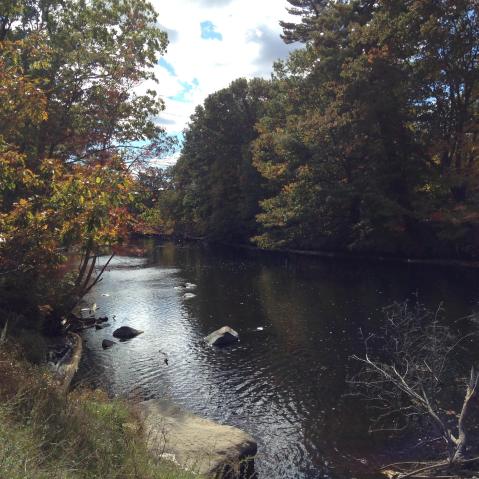
Merrimack River, New Hampshire, USA. All images by author.
Field Recording: An End Goal in Mind?
Field recording involves a delicate balance of technical skill, careful planning, and patience. Stepping away from a controlled environment, capturing audio on location presents many random and often erratic trials. From wind noise and poor site accessibility to recording malfunctions and user error—a host of issues arise once the recordist enters unfamiliar territory. Here, unfamiliar territory includes both new places and nascent approaches to research-based production and artistic data collection. Where do I situate a project like the New England Soundscape Project among new media production, sound studies, and music composition? Does that issue even matter?

Otter Brook Dam/Edward MacDowell Lake, Keene, New Hampshire, USA. All images by author.
The notion of practice-based work usually implies an end goal in mind. What if there is not an end goal in sight? What happens then? Would the New England Soundscape Project be “enough” of a contribution to creative scholarship when approached as a type of audio ethnography—much like the immersive storytelling recently curated by Leonardo Cardoso? The New England region is lush and robust, with many diverse landscapes. I hoped to document these in some way, but wondered how to continue. Truthfully, I had some hesitation on where to start.
Media artists and music composers learn the mechanics of their craft in colleges, universities, conservatories, at home, and on the job. Some of these techniques include audiovisual production, computer programming, coding, editing, and arranging using digital software. I am both self-taught and a product of an academic and Eurocentric, conservatory training system. This presents some tension, as I discuss below. Although traditional audio engineers and music composers often work towards completing a project without a predefined trajectory, how can budding sound artists develop and hone an inner acuity to find the “right” material during their creative processes?
While the process remains largely subjective, I found it helpful to begin by answering the following questions:
- What kind of project is this?
- How is the sound to be used?
- Where and how will the project be displayed?
- Who is the intended audience?
- What are the sound artist’s intentions?
- What tools are needed?
I draw inspiration from the Sound Studies Lab’s position that this type of work is diverse, fluid, and balances technical, artistic, and theoretical aims. The challenge is that the answers to the questions above are not immediately clear and require me to look inward at who I really am.

Boot Mill Threading Machine, Lowell, Massachusetts, USA. All images by author.
Following the Sonic Muse
Beyond the obvious technical and aesthetic factors affecting an expansive multisite recording project, we know little about how a nascent sound artist begins. Whom do they emulate? Should they take notes? pictures? What should they pay attention to onsite?
If the project is exploratory, the recordist may experience hesitation—as I did— and frustration that can block their creative process, especially because the pathways toward a finished sound project aren’t as established as those of a sound engineer, for example, or a songwriter. Nevertheless, my experiences have shown me that a nascent sound artist/recordist can also find intrinsic meaning and realize their mission—particularly by establishing a detached yet perceptive listening ethos, as I did to begin my work on the New England Soundscape Project.
For me, framing a detached and perceptive mindset involved:
- Remaining sensitive to my surroundings at each location;
- Focusing on stillness, deep breathing, and a quiet mind while recording;
- Adopting a respectful, unobtrusive manner at each site—taking care not to disrupt or distract others;
- Calmly monitoring my technology and its use;
- Trusting that I am intended to be in that exact moment at that exact time;
- Avoiding being overly concerned with the “end game” of their practice;
- Embracing the role of a sound gatherer and observer;
It is perhaps the final objective—adopting the philosophy of sound gatherer and observer—where truly sensitive listening begins. Here, the recordist aims to remove their personal goals and agenda from the field recording process. Before proceeding, the attentive recordist looks around them, focuses on quiet breathing, and views their microphones as lenses and without fear of what the result should be. To what or whom am I observing?
Here’s the problem. It dawned on me that I know little about who I am as a sound artist, and how my voice positively contributes to the world, if at all. I need to learn to listen—not just to the sounds in nature, but also to the sounds of the voices of the persons with whom I interact. Could solitude and introspective listening lead me to listen through a newly formed self, capable of deeper connections with my peers and environment? I found that my detachment involved investigating, acknowledging, and, whenever possible, setting aside my own biases, fears, and, importantly, my own agendas. By removing my ego and cluttered mind from the process, I could start to be an inclusive practitioner—one whom cultivates positive relationships daily and is capable of crafting a deeper sonic art that embraces rather than one that marginalizes.

Merrimack River, Lowell Massachusetts, USA. All images by author.
The Art of Meditative Listening
Rather than taking on a stringent approach with little flexibility, I practice observational recording by gathering audio as my muse and as environmental conditions dictate. By remaining attentive to my recording levels, I gather source materials up close, from afar, and for any length of time. Meanwhile, as this creative progression unfolds, I stay quiet—bringing almost meditative quality to my practice. Moreover, concentrating on deep breathing and stillness allows me to adopt a grateful mindset—one that is appreciative of my surroundings and for being present at that precise moment. It is then that the environment becomes the focus of sound gathering and not notions of a “final product.”

Scarborough State Beach, Newport, Rhode Island, USA. All images by author.
I found an artistic renewal—even healing—by adopting this meditative practice. As the New England Soundscape Project takes shape over the coming months and years, I hope to document the beauty of the Northeast through music, sound, and images. Yet, it is enough simply to be present in each location while aspiring to produce thoughtful and reflective sound art. Although there is no overarching method that best describes every aspect of a multisite field recording process, the “art” in the sound can truly emerge by striving to banish fear and doubt from the recording process. Addressing the “why” during each moment is just as important as addressing the “how” and the “why” in pre- and post-production. The recordist’s humanity plays a key role in determining how creative decisions are made, and the ability to remove the need for control determines how free—and freeing—the process can be.
This Thursday, SO! will feature my podcast on reflective listening with audio examples from the New England Soundscape Project thus far. I look forward to producing future episodes (and essays) on this project in the coming months. I hope you can tune in on Thursday and thank you for listening!
—
Featured Image: Scarborough State Beach, Newport, Rhode Island, USA. All images by author.
—
Acknowledgements
An Internal Seed Grant from the University of Massachusetts Lowell supports the New England Soundscape Project.
—
Daniel A. Walzer is an Assistant Professor of Composition for New Media at the University of Massachusetts Lowell. Walzer’s research and reviews appear in the Leonardo Music Journal, the Journal of Music, Technology & Education, the Journal of Radio & Audio Media and forthcoming articles in TOPICS for Music Education Praxis, and the Music Educators Journal. Walzer received his MFA in Music Production and Sound Design for Visual Media from Academy of Art University, his MM in Jazz Studies from the University of Cincinnati and his BM in Jazz Studies from Bowling Green State University. Walzer is currently pursuing doctoral studies in education at the University of the Cumberlands. Read more at http://www.danielwalzer.com
—
REWIND!…If you liked this post, you may also dig:
SO! Amplifies: Ian Rawes and the London Sound Survey–Ian Rawes
SO! L.A.: Sounding the California Story–Bridget Hoida
Sound-politics in São Paulo, Brazil–Leonardo Cardoso
Share this:

Radio Preservation Task Force Conference: Sound History and the Logistics of Social Recognition

Click to download PDF of Program!
Radio Preservation Task Force Conference Information
Friday: Library of Congress, Washington, DC 9-5pm
Saturday: University of Maryland- College Park, 9-5pm
Schedule at: www.radiopreservation.org,
RPTF Federal Page (associate list linked at the left tab): https://www.loc.gov/programs/national-recording-preservation-plan/about-this-program/radio-preservation-task-force/
Hashtag: #RTPF (@soundingoutblog will livetweet the conference)
This conference is free and open to those in the academic/archival/curatorial/preservation community who would like to attend.
—
On Feb. 26 and 27, the Radio Preservation Task Force (RPTF) of the National Recording Preservation Board (NRPB) will hold the first national digital humanities media history conference at the Library of Congress on Friday and the University of Maryland on Saturday. The schedule can be found here. Eminent sound historian Michele Hilmes (Wisconsin) directs the conference program with Christopher Sterling (GWU), Chair of the National Recording Preservation Board. Distinguished historian of British broadcasting Paddy Scannell (Michigan) commences the conference as academic keynote. I write this update as national research director for the project.
The RPTF is tasked with preserving local, noncommercial, and otherwise unprocessed recordings stored at local radio stations, libraries, archives, and garages, and identifying strategies to process and facilitate engagement with these materials. Scholars, curators, sound preservationists, and archivists from more than 100 universities, museums and libraries will converge on Capitol Hill to discuss steps toward preserving radio’s aural history, including the many historical events captured by nontheatrical broadcasts such as news, town hall meetings, public forums, sporting events, and community outreach programs.
The conference is a culmination of roughly 18 months of initial work (largely built out of service labor by academic media historians), and contributes a new dimension to the emergent discipline of sound studies with its focus on the history of mass media storytelling, sound art, and for the first time, the nontheatrical sounds of radio history. Participants have been confirmed from NPR, the Smithsonian, Pacifica, the Library of Congress, and multiple academic research groups. National presses, blogs, and magazines will also be present to cover the RPTF. Our conference Twitter hashtag is #RPTF. Presenters will discuss the common goal of how to best assess, protect, preserve, and implement current and future findings, with reference to conventional history work, museum curation, classroom pedagogy, and material preservation actions. Tours for scholars and archivists began yesterday at NPR and the Library of Congress’s Packard Campus.
Radio nerd nirvana at Library of Congress Packard campus #RPTF #loc #radiohistory pic.twitter.com/ObmX8NjDy2
— Jennifer Waits (@SpinningIndie) February 25, 2016
The RPTF was formed thanks to a mandate by sound preservation pioneer and former NRPB Chair Sam Brylawski, practitioner keynote for the conference. The mandate was issued to identify what, where, and how many recordings might still be extant from radio history. Our early findings have been both compelling and disappointing. Over the RPTF’s first two aggregation cycles, the consortium turned up 350,000 recordings spread over roughly 350 participating archives. We expect that number to reach well over one million after our next search cycle, and for our affiliate archive list to increase to over 1000 with the inclusion of radio stations. Enormous numbers to be sure.
NPR’s Research, Archives, Data Strategy team is working to ensure that historic radio stories are accessible in perpetuity #RPTF #nprchives
— nprchives (@nprchives) February 26, 2016
However, if one conducts a thought experiment about how many recordings might have aired between the mid-1920s and the mid-1980s, the number seems meager at best. I’m terrible at math, but if one begins with a low-ball assumption (very low for some markets) that there have been 25 stations per median market, producing daily content between 1925 and 1985, it’s not hyperbole to speculate that our findings, while not total or comprehensive, reveal that only a fraction of content has survived. Most materials have been incinerated or trashed thanks to “consolidation” of the media market after the Telecommunications Act of 1996. As stations changed hands, moved sites, and reorganized spaces, station archives were the first to go. Protecting and storing records, DATs, reel-to-reels, and internal documents, simply haven’t made sense for bottom lines. It’s safe to anecdotally contend that we’ve certainly already lost over 75% of radio history, and perhaps as high as 90%.
Most radio recordings are stored on fragile formats #AVpreservation #AVarchives #RPTF https://t.co/zTIbP1Kg9c
— NPR RAD (@npr_rad) February 25, 2016
Why is this important? The short answer is that radio has held a unique and important position in U.S. cultural history. Radio has been a media industry that developed a mature art form through storytelling and entertainment, while acting as a communications technology that has been utilized for community building and public discourse. After print media, the history of radio provides an unmatched reflection of the historical development, experience, and reception of cultural and political events. And as I’ve written previously at FlowTV, radio sometimes contains the only remaining historical expression of specific moments and social movements.
Seeing some of the earliest radio recordings at Library of Congress’ Packard campus #RPTF pic.twitter.com/vtODDZULEG
— Jennifer Waits (@SpinningIndie) February 25, 2016
As the task force has progressed since late 2014, it’s become conspicuously apparent to our consortium that a core goal of cultural research – increasing the visibility of marginalized histories – is well served by exhuming and studying the artifacts of radio history. By increasing the nontheatrical radio archive in particular, we increase and build continuity lines for histories that simply haven’t been told due to lack of primary sources. It’s very much a nuts and bolts, trial and error process. A lot of the project will culminate around a sprawling big data interface in 2017 – a collaboration between the RPTF, ARSC, and Indiana University. This potentially makes the RPTF the largest digital humanities project in Film and Media. And we plan for the interface to feature syllabi, lesson plans for all educational ages, and recordings that fall under the domain of “fair use.”
To make invisible histories audible turns out to consist of quite a few steps, and a careful study of the conditions necessary to conduct preservation work, which requires an understanding of the regulatory, historical, and organizational precedents and restrictions by which materials can be shared. In this way, the RPTF also represents an emergent research path for media and sound studies – dedication to the study and implementation of logistics for social recognition. Actively studying the contemporary political economy of how hidden information might come to be circulated, and devising strategies to protect and circulate voices for the first time, makes a strong contribution to social justice work.
Packed house! @RadioTaskForce #rptf pic.twitter.com/8p9RIKnn6q
— Monica De La Torre (@digitalxicanafm) February 26, 2016
There’s still much to learn about these processes, and that’s the purpose of the conference. We’re putting together experts in multiple spheres for the first time to begin a conversation about how a national infrastructure might be organized to address the mechanics that comprise the ethics we associate with the study of sound history. Participants will present historical research, while panels and workshops discuss everything from material sound preservation methods, to educational approaches to teaching sound in film and media classrooms, to contemporary curatorial methods regarding presentation of media art.
[Ed note: SO! Ed. in Chief J. Stoever will be speaking in as part of a Radio Pedagogy Workshop this afternoon at 1:30 (along with Special Ed. Neil Verma and SO! writers Amanda Keeler and Kathy Battles; other SO! fam in the house include Inés Casillas, Monica de la Torre, Alex Russo, Shawn VanCour, Suzanne Smith, Alejandra Bronfman, Christine Ehrick, Bill Kirkpatrick, Josh Sheppherd and Andrew Bottomley. It’s an SO! fam reunion over here!]
Among projects commencing immediately after the conference, the RPTF will be applying for preservation and curation grants with our partners at multiple universities, as well as with Pacifica Radio Archives, considered by many to be the great collection of postwar local and community radio history in the U.S. Since there are so many recordings to process, the RPTF has organized eight content-based caucuses in which faculty experts will be working with archivists to unite split collections, and determine which recordings are most in need of research and circulation. Caucuses will meet for the first time at the conference, as horizontally organized research units that will act as grant-writing bodies. The results of their preservation actions will be linked or shared at the RPTF big data site. Here is a list of the caucus chairs and their themes:
- Kathleen Battles, Oakland University – LGBT Radio
- Mary Beth Haralovich, University of Arizona – Gender and Feminist Radio
- Laura Schnitker, University of Maryland and Jennifer Waits, Radio Survivor – College, Community, and Educational Radio
- Sonja Williams, Howard University – African American and Civil Rights Radio
- Jon Nathan Anderson, CUNY-Brooklyn – Labor Radio
- Michael Stamm, Michigan State – Radio Journalism
- Inés Casillas, UC-Santa Barbara – Spanish Language and Bilingual Radio
- David Jenemann, University of Vermont – Sports Radio
In collaboration with the National Recording Preservation Foundation, the RPTF has already distributed its first grant: to the Lily Library at Indiana University to digitally process, preserve, and distribute the complete Orson Welles radio broadcasts. This will be the first time these recordings — which are all now in the public domain — have been made available in completion. We expect to build a special website with these materials sometime in 2017.
And it begins! #RPTF excited to present this morning with @npr_rad coworker @AydaPour pic.twitter.com/JCt7HVIXMa
— Jane Gilvin (@jg88354) February 26, 2016
—
Josh Shepperd is Assistant Professor of Media Studies at Catholic University in Washington D.C. He teaches courses related to critical, conceptual, and methodological approaches to media studies. He is also actively involved in digital humanities media preservation, and currently serve as the National Research Director of the Radio Preservation Task Force for theNational Recording Preservation Board of the Library of Congress.
—
REWIND!…If you liked this post, you may also dig:
The New Wave: On Radio Arts in the UK–Magz Hall
SO! Amplifies: Ian Rawes and the London Sound Survey–Ian Rawes
SO! Amplifies: Carleton Gholz and the Detroit Sound Conservancy–Carleton Gholz
Share this:


Current Top Posts





April 2021

January 2020

November 2019

October 2019

August 2019

April 2014

November 2017

March 2015

December 2017

October 2015
 Sounding Out!
Recent Comments