
Of Sound Machines and Recording, Sharing that Transcends Time and Space

This is the conclusion to a two-part post by SO! regular writer Maile Colbert. Read Part One from Monday, January 12th here.
—
As we are primarily a visual culture, no longer connected to what environments can tell us through sound, we’ve lost aural acuity once central to the dynamic of our lives.
From what we have just begun to see, it appears that ancient human beings had learned well the lessons imparted by natural sounds. Their lives depended as much (if not more) on their ability to hear and understand the audio information imparted by their surroundings as those given by visual cues. –Bernard Krause, Ph.D The Soundscape Newsletter 06, June, 1993
Birth
All newborns emerge with the same cry, it is near impossible to distinguish one from another, even as a mother. This could be for many reasons and serve many purposes. Should something happen to a birth mother, the indistinguishable cry may help draw attention from another. It could be that, considering niche effect (in which animals adapt their calls to a frequency less populated by other environmental sounds), aside from biological reasons, a newborn’s cry is shaped by the wombscape from whence it came, and I speculate that generally speaking one wombscape is similar to another. Primarily what a fetus is hearing is low frequency. So it would serve that they would have an instinct to initially call out in a high frequency range. The baby then develops its cry according to its surrounding, such as a household in the city versus a country, a household with other children or not, a household with constant media sound.
My daughter has the most incredible earsplitting high frequency bark when she wants attention. If this doesn’t work (such as when “Baby, Mama has to wash the garden manure from her hands before she picks you up”), she’ll roll into a gritty horrific low growl that sounds like she’s being strangled. One of these always works, and I often wonder about these sounds’ relationship to the white noise (her specific mix in a more mid-range involving pink noise and a “rain on roof” recording) that has been a constant since her birth, and is still used for naps, some feedings, and bedtime.
Sound Machines and Noise
From my late pregnancy insomnia, to creating a calming environment in the labor room at the hospital, to keeping a consistent calming environment in the recovery room, to using that sound as a signal that it is time to calm, time to sleep…a sound machine has been a constant already in my daughter’s new world. It started with an app in Paris, at a festival during my third trimester, my waddling condition wouldn’t allow me to walk around much nor meet friends for drinks, etc. So I choose to stay in the hotel room and read. The fetal babe wasn’t in the mood to read, kicking and dancing, perhaps excited from the music at the festival. For a little while I played with her, her kicking in response to my pokes and prods. But soon I knew we both needed to both settle down. I was always fascinated by my parents’ sound machine as a child, it seemed something magical. I found and downloaded an app that allowed you to create your own mix, and so it began.
But recent research poses the question of whether a sound machine can actually affect hearing development. Some researchers have questioned if prolonged exposure to consistent sound could affect auditory pathways to the brain. I wonder what then of infants who grow up near, say, the ocean…or like my mother near a stream and small waterfall, a constant sound in her childhood and soundtrack to her memories from then. Or near a busy road or even walkway. Of course I want the babe to grow up to enjoy and focus on a varied soundscape. But at certain points, the noise has been a lifesaver! It’s been especially useful now combatting construction sounds, as babies tend to focus on background sounds, most likely for survival:
.
Of course it is very important to be aware of the strength of the sound a baby is exposed to, all too easy for our very visual culture to ignore. Even a sound machine with the volume too high, or the proximity too close, could reach decibels over 80, a threshold that could cause the tiny hair cells in the ear needed for hearing to die. As we lose these, we start to lose our hearing. The amount of energy in a sound doubles with even just a three decibel climb. If any sound makes it difficult to hold a regular conversation, chances are it’s past this threshold and could be doing damage. Our world is in many ways getting increasingly louder. As our cities grow, its sounds grow, and we are exposed to more constant and louder soundscapes. Will an accidental evolution be for us to adapt to losing our hearing? For me of course, this is a very bleak thought.
Death
Your words are preserved in the tin foil and will come back upon the application of the instrument years after you are dead in exactly the same tone of voice you spoke in then. . . . This tongueless, toothless instrument, without larynx or pharynx, dumb, voiceless matter, nevertheless mimics your tones, speaks with your voice, speaks with your words, and centuries after you have crumbled into dust will repeat again and again, to a generation that could never know you, every idle thought, every fond fancy, every vain word that you chose to whisper against this thin iron diaphragm.
-Edison’s Ars Memoria, concept for the phonograph

Kaua’i `O’o, extinct since 1987
A recorded sound transcends time. It allows a listener to share a space and perspective with the recordist. It allows a future people to hear the songs of people passed, and of their shared past. It allows for an extinct bird to call into the future, for a child to hear that bird and wonder, and question, and to have that question affect her future and therefore perhaps the future of others. I often think about what soundscapes or sound I have experienced that my daughter might not have the opportunity to experience when she’s older. Already since my childhood growing up in part in Hawaii, three birds I knew, I had heard, that my mother grew up with, that her father grew up with, that his parents grew up with (and so on)…are no longer calling in the wild. But what the world and I can share with her and her generation, can give her, can leave her, are recordings.
Kaua’i `O’o: http://macaulaylibrary.org/audio/6031
Po’ouli: http://macaulaylibrary.org/audio/5125
Hawaiian Crow: http://macaulaylibrary.org/audio/13434
The library I am constantly creating, shaped by my choice and perspective…where to hit start, when to stop, where to point the mic, what equipment to use, how to frame this aural moment that captured me and invoked the desire to save and to share.
I think of this very often these days, as a friend and great soundscape ecologist and composer has passed. Steve Miller (www.stevemiller.net ) left a wealth of music, sound, and writing that his daughter and family can share. His daughter will be able to put on headphones and share a space her father formed with his perspective, his choices, his interests. A sharing active with him.
A sharing that transcends time and space.

The artist and her daughter in the studio, Image by JS
.
Future Memory, for Odette
Sound has a hold over my daughter in a way I wasn’t quite expecting. It’s almost a punch line that the daughter of two parents that work with and study sound would have such sensitivity. The smallest sounds can pull her from sleep, can pull her from eating. They can be a character for her, making her laugh, cry, yawn, widen her eyes in amazement.
It was only natural my partner and I decided to make an album as a gift to our daughter. We had wanted to do the same marking our history together years back, and had various sound recordings and unfinished ditties in a library marked “Future Memory.” The idea behind it was an aural coming together of our history and feelings expressed and translated through sound and song. We realized, of course, in many ways this was Odette’s history as well, and she our future.
The album became Future Memory, for Odette, a lullaby album in dedication and celebration to her, and including sounds from her growing in the womb, soundscapes we hope will be a part of her life, and in recording them in some way ensuring that, a score written for her while I was in labor from a friend, songs her father and I began and finished together during the stages of pregnancy, birth, and her first year, and collaborations and contributions in sound and music from family and friends would be her legacy.
This is her first song:
—
Dedicated to Odette Helen, and to the family, daughter, and memory of Steve Miller
“Future Memory, for Odette” to be released in 2015 through Wild Silence (www.wild-silence.com ). A dedication album to a new born daughter…a mix of her parents’ recorded and shared sounds, memories, hopes, and dreams towards a future with her. Sounds of her womb-scape, birth, and first year…music in collaboration with friends and family across oceans and land…an album of lullabies for Odette.
—
Maile Colbert is a multi-media artist with a concentration on sound and video who relocated from Los Angeles, US to Lisbon, Portugal. She is a regular writer for Sounding Out!
—
 REWIND! . . .If you liked this post, you may also dig:
On Sound and Pleasure: Meditations on the Human Voice– Yvon Bonenfant
This Is Your Body on the Velvet Underground– Jacob Smith
Sound Designing Motherhood: Irene Lusztig & Maile Colbert Open The Motherhood Archives– Maile Colbert
Share this:

The New Wave: On Radio Arts in the UK

 In the UK there has never been much scope for radio art within the realm of public service broadcasting, leading artists to seek funding for their own independent projects, predominantly from the Arts Council of England (ACE) and other state funding bodies and charitable trusts. In this article, the final in Sounding Out!‘s series Radio Art Reflections, I will consider this recent avenue of practice, because its results – in terms of audience composition, artistic output and the wider cultural context of the form – shed light on both the particular context of radio art practice in the UK, and also have implications for the wider struggle for sustainable independent media networks against the diminished imaginative horizons of a public broadcast culture endlessly inured to ‘unavoidable’ cuts and the free market enclosure of the digital commons.
In the name of ‘austerity’ such cuts have been inflicted upon broadcasters worldwide. The loss of key radio arts programmes like Australia’s Listening Room, as discussed in the last post by Colin Black, is by no means the exception, even in an age of expansion in digital spaces. As De Lys stated way back in 2006 it may be considered “[i]ronic that the ‘rationalization’ of radio arts by public broadcasters occurs at the same time that audio arts activity and the creative use of sound are expanding exponentially in community spaces, in galleries, games, and online.” (De Lys, S and Foley, M; 2006, “The Exchange: A Radio-Web Project for Creative Practitioners and Researchers” Convergence; The International Journal of Research into New Media Technologies, 12; 129, Sage)
Elsewhere, institutional affirmation through public broadcasting connects local, national and international art radio broadcasters, as it also empowers two long running international radio art competitions that continue today: the Prix Italia set up by RAI, in 1948, to engage creatives to work with radio and create new works for the medium; and the The Karl Sczuka Prize for Radio Art, established by SWR in Germany in 1955, notable (sadly) for how so few women artists have ever won the awards. For Kersten Glandien, contributing to the Reinventing The Dial symposium back in 2009, the availability of public radio funding in the 80s and 90s enabled a heyday of commissions and festivals, events and prizes (Glandien, K; 2009. Keynote Paper given at Reinventing the Dial Symposium. Canterbury Christ Church University).

No such radio art competition or open call for new radio art work has ever been run by the BBC, highlighting its resistance to the form. At present the BBC runs just one experimental programme that has been on air for 20 years: Between The Ears on BBC Radio 3, which leans towards more narrative-centered features reflecting Black’s issues with ABC’s Soundproof discussed in the last article.
ART STATIONS AND COMMUNITY RADIO IN THE UK
The first experimental art radio station in the UK went on air in Liverpool for a week in 1995, Hearing is Believing on 105.8FM. As Scanner wrote at the time it offered the chance for listeners to hear “sound works, performance and innovative documentaries that would never receive airplay on even the most ‘progressive’ FM bands. Remember, BBC Radio still has problems playing certain works of Stockhausen because they contain randomly-culled shortwave radio signals.”(The Wire, 1995). That inspired the London Musicians Collective to run its own month long arts station in Resonance 107.3FM in 1998. I was part of its action group and then its steering group as the station went full time in 2002.
Tight regulation across public and commercial radio in the UK also meant that artists were late to explore the medium. Trevor Wishart reminisced with me at Radio Without Boundaries about a radio piece he made with the BBC in mind that took over 28 years to be played on the radio in the UK, being not sufficiently ‘musical’ for a music station and not ‘dramatic’ enough to fulfill the conventions of drama.
In this context, community radio has been an important if limited platform and nurturing site for new radio art. There are now over 200 such stations in the U.K. but only two dedicated to the arts community: Resonance FM and Soundart Radio at 102.5 FM, the latter based in Devon since 2006. Soundart Radio exists on a hand-to-mouth basis via small grants to provide training for disadvantaged groups. Resonance FM, by contrast, has achieved regular funding by walking a line between its community status and its avant garde roots. Its success is due largely to its location and the exceptional work of volunteer artists and musicians who have developed innovative programming without budgets.
Arts Council England increased Resonance’s funding as it became a ‘national portfolio organisation’ in 2012. The station may tower over other most community stations, but its yearly funding is still only comparable with that of many regional arts festivals. Moreover, radio art is only a small part of what Resonance broadcasts, and is mostly scheduled as discrete programmes such as Radia, and as less frequent one-off programming such as Remote Performances a collaboration between London Fieldworks, the Live Art Development Agency and ACE, broadcasting 20 live mostly music based performances for a week from Glen Nevis, Lochaber, Scotland.
FUNDING RADIO ARTISTS
Open funding for artists directly from community radio stations is very limited and ad hoc. The Community Media Association was able to offer small commissions for Modulate, an open call to encourage artists to team up with community stations to encourage more arts diversity and address the fact that around “70 per cent of the community radio sector’s programming is music-based” (CapeUK, 2008, p.08). Meanwhile, Art Transmission was a welcome one-off project early this year run by Francis Knight who commissioned three sound artists including Jane Pitt and Xentos Jones to work with young boxers and steam railway enthusiasts to make radio works for the small community station BRFM on the Isle of Sheppey. A recent CapeUK report concluded that Community radio “offers creative and artistic freedom to their contributors unmediated by the editorial control exercised in commercial or public service broadcasting.” (CapeUK, 2008, p.20).

It would be naive to imagine editorial constraints do not exist in the community radio sector. This is perhaps why several British artists have gone it alone to retain autonomy by running their own short durational arts stations as Restricted Service Licenses for projects which run for up to 28 days and can broadcast up to 25 watts, such as Kaffe Matthews Radio Cycle (2003) and Tom McCarthy and INS Calling All Agents (2004), Celestial Radio (2008), Boat Radio (2012), Writtle Calling (2012), Radio Boredcast (2012) and The Dark Outside (2012-14) all funded by The Arts Council. This marks an increasing trend in the UK of artists-curated FM stations.
Grants for the Arts from ACE offers a way for artists to receive funding to make new work. My own group Radio Arts has, through funding from ACE and Kent County Council, been able to recently commission new radio art works for broadcast from Colin Black (AU), Arturas Bumsteinas (LITH), Iris Garelfs (GER), Anna Friz (CAN), Louise Harris (UK),Olivia Humphreys (UK),Langham Research Centre (UK), GX Jupitter- Larsen (US), Carlo Patrao (PORT), Mikey Weinkove (UK),Joaquim Cofreces (Argentina), Esther Johnson (UK), Michael McHugh (UK), Gregory Whitehead (USA), as well as Radio Arts members Genetic Moo, myself and James Backhouse (UK). Radio Arts ran a series of workshops, a radio art showcase exhibition and will be running a forthcoming live event and online gallery and further workshops next year alongside broadcasts of the new works to be heard on eight partner stations in four countries.
However, such work can only continue with further funding. For me it is important to move away from the current creative commons ethos, where no one is ever paid to participate. We should allow sound and radio artists to gain a fee to produce new radio work, particularly as the Artist Network in the UK is campaigning for artists to be paid in galleries.
MICROBROADCSTING AND ARTS SPACES
Another interesting area which has taken off from Japanese radio artist Tetsuo Kogowa is micro broadcasting, the use of small range transmitters allowing artists to broadcast in a localized space of up to one watt, without the need for a license, either by building the transmitters or buying them readymade. These work well for radio installation and have allowed me to continuously play works as discrete stations and produce surround works allowing a different voice or sound to emanate from each radio in the installation. For eight years, mostly unfunded, I worked on Switch Off a PhD radio art project documented on my blog creating eight different fictional stations as micro broadcast installations each imaging a future use for FM when it has been abandoned in the UK these works explored radio art practice from a post digital perspective.
.
Micro broadcasting these works proved to be a very liberating way of sharing radio art work in galleries and outside of conventional radio broadcasts and allowed me to really experiment without constraint, whilst the web has brought me closer with other international artists and communities to share practice and projects. Having used radios as a readymades for multiple and surround installations my experience has led me to new ways of thinking about installation work such as a bespoke transmitting book Spiritual Radio 2014, which broadcasts itself and awaits the listener to find its frequency.
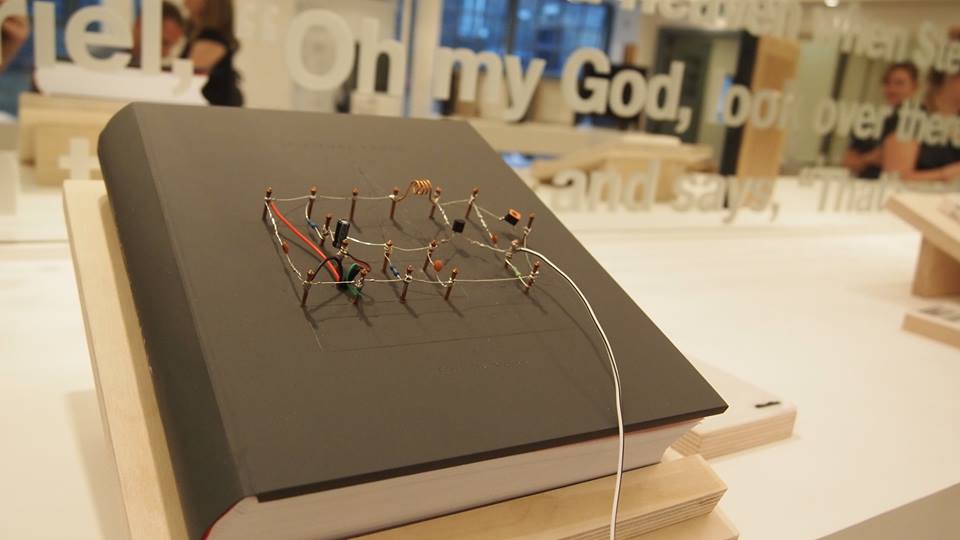
Magz Hall Spiritual Radio (2014) Whitechapel Gallery London
Following this line, many online arts stations have been set up by galleries and arts spaces, often as temporary projects. Online arts station Basic FM started in 2011, and was a project of Newcastle independent cinema Pixel Palace having hosted Vicki Bennett’s Radio Boredcast at the AV Festival (2012). It “presented an audio gallery that exhibited the work of those making interesting noise: sound collage, found sound, spoken word, discourse, dialogue and discussion, musique concrète or original, remixed and detourned musics” (Basic FM, 2014, website). Run by one part-time member of staff and funded by the Arts Council to run for thirty months until 30th Sept 2014 Basic FM did not carry on due to lack of further funding, a real loss after it steadily building up its reputation as the third full time arts station in the UK.
It seems that in the UK the lack of artistic airspace on public and community radio has been sidestepped by radio artists who have forged their own stations to redefine public space in myriad forms. And there are possibilities in the future. The latest temporary UK arts station call comes from the well regarded CCA Gallery Glasgow Radiophrenia next year, while London’s Tate Britain is currently running a family programme Radiocity and its community programmes have commissioned myself and Jim Backhouse from Radio Arts to run a series of workshops called Reclaim the Waves from the end of February, working with the local Westminster community to document the changing city and produce a participatory radio installation for exhibition.

—
Magz Hall is a sound, radio artist and founder of Radio Arts an artist led group who promote radio art. Her work has been exhibited in the British Museum, the Sainsbury Centre, MACBA Barcelona, Denmark, Italy, Germany, Norway, Morocco, Canada and the USA and broadcast internationally. Her ambisonic soundtrack of Hong Kong Airport at the British Museum was described as “extraordinary and rich.” Radio Mind (2012) an “intriguing and beautiful work” was commissioned by the Lightworks Festival. Her most recent work Spiritual Radio (2014) “looks like a hardback on life support” (TLS) was commissioned for ‘Unbinding the Book’a touring exhibition. A senior lecturer at Canterbury Christ Church University and a founder of London’s arts station Resonance FM, she has just completed a practice based PhD on radio art at CRISAP, LCC, University of the Arts London entitled Radio After Radio: Redefiningradioart in the light of new media technology through expanded practice.
—
Images courtesy of the artist.
—

REWIND! . . .If you liked this post, you may also dig:
Sound and Curation — Santaperversa
From Kitschy to Classy: Reviving the TR-808 — Ian Dunham
Revising the Future of Music Technology — Aaron Trammell
Share this:




Current Top Posts





April 2021

January 2020

November 2019

October 2019

August 2019

April 2014

November 2017

March 2015

December 2017

October 2015
 Sounding Out!
Recent Comments