
Wayback Sound Machine: Sound Through Time, Space, and Place
 This is the second post in Sounding Out!’s July forum on listening in observation of World Listening Day on July 18th, 2013. World Listening Day is a time to think about the impacts we have on our auditory environments and, in turn, its affects on us. To read last week’s post by Regina Bradley (and to read more about World Listening Day) click here.
—
When I travel to somewhere I’m unfamiliar with to create a work, I’ve become in the habit of bringing my VLF receiver, hydrophones, and underwater camera in order to explore. Whether what comes out ultimately becomes part of the work or not, my interest in these particular tools stems from a fascination with obscure events around me, real and happening, that I cannot perceive. But it also marks my wonder at events and elements in our world that have been, while changing, continuous in a time line extending much further than my own. Similar to the sense one may get when experiencing a desert, or an ocean, with time and patience, what might at first seem bleak, barren, or monotonous, begins to give hint to a rich world hidden from our day to day.
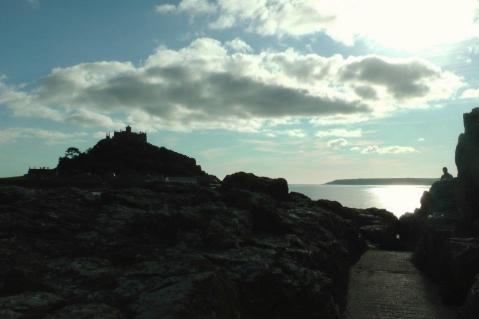
Photo by the author, Saint Michael’s Mound, Marazion, Cornwall
Two autumns ago, finding myself with a day off from a project I was working on near Penzance in Cornwall, I decided to take the day to hike the lesser known British arm of the Santiago Pilgrim Route: the St. Michael’s Way. Dating back tens of thousands of years, St. Michael’s Way enabled pilgrims and missionaries traveling from Ireland or Wales to choose to abandon their ships and walk across the peninsula, rather than navigating the treacherous waters around Land’s End. In the days of such pilgrimmages, the way was fraught with all sorts of dangers, and the path itself splits a few times, veering off towards a church near the harbor where they would get the boat to cross them. There they would meet a guide who would offer safe passage from the many thieves and pirates along the way. Still marked with the iconic scallop shell symbol of the pilgrim route, the path was nevertheless neglected, and overrun with all sorts of modern obstacles such as busy roads and farm irrigation systems.
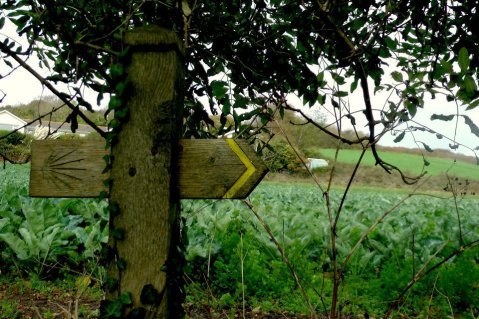
Photo by the author, Gulval, Cornwall
As I got lost time and time again making my way towards Saint Ives, I found myself marveling at all sorts of new and heretofore unknown sensations. My ears tuned from the project I was there working on, I was especially taken by the sound. Toward the middle of the path–located at the top of the hills inland of the peninsula –the wind from both sides carried over pieces of the day to day from the villages; a tractor, grazing animals, bits of conversation in Cornish, and church bells wisping by as quickly as they came, like ghosts. It is fitting that St Michael, after whom the route was named, is the patron saint of high places.
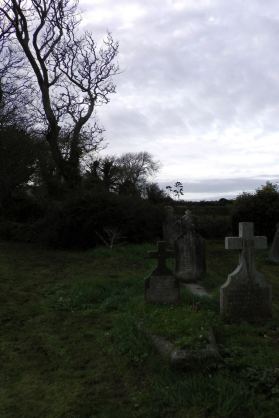
Photo by the author, Ludgvan, Cornwall
I began to wonder what this path may have sounded like back in the time of thieves and pirates, back when the occasion to use it was a shared occasion celebrated with the voices of people, priests, prayers, and the markets and fairs along the way to fuel all this activity. As I continued walking, I began to wonder how it may have sounded even before then, before the hills were blanketed with crops and cattle, before the many battles that must have been waged, and villages built and grazed. . .were there more birds then? Were there more trees? Were there more boar and foxes? What about even before these hills were hills, could there be a way to sonify these hills forming? I started to dream of a “wayback machine” for sound. What if as you walked this path, you could listen to time spinning back, listen to how it might have sounded, listen to its history? And what could you take from that experience? Could something be taken from this? In the two years since that happenstance, this idea has since stuck with me. Beginning tentative research and practice to apply these thoughts, I continue to unearth more questions than answers, so I began to seek others experimenting in a similar vein. While acoustic ecology is a growing field, I still have not found many researchers working with sound in/as time.
One person who has come close to this idea is acoustic ecologist, musician, and sound recordist Bernie Krause, whom last year I interviewed in an article on the sound of disaster about disappearing sounds as a signal of impending crises. The prelude of Krause’s book The Great Animal Orchestra: Finding the Origins of Music in the World’s Wild Places, is the beautifully written, “Echoes of the Past,” which takes a meandering listen to how the world might have sounded sixteen thousand years ago. With that trip in mind, perhaps something could come from working with people in various fields of statistical analysis to see what sounds are projected to go extinct from a soundscape with time, and what this could mean in terms of how the sound line will be extended into the future. In the section “First Notes,” Krause describes working with a graduate student, Kristin Junette, who reasoned that based on fossil records and the known sounds of insect species today, we might be able to re-create the insect ambience of about sixty-five million years ago. Then, based on acoustic physiology of the skull of a Hadrosaur, a dinosaur of the time, Krause and Junette were able to re-create a representative vocalization of its call to place in this early soundscape (for the Discovery Channel’s vision of how the hadrosaur might have sounded click here).
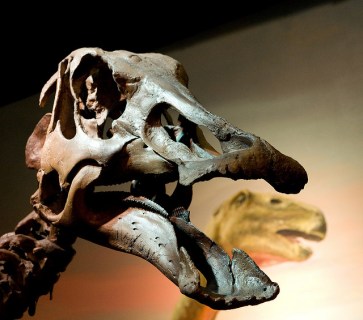
Hadrosaur skull, Image by Flickr user e_monk
I was also excited to learn of the research of Miriam Kolar, who has been working with various techniques and with people in various disciplines on a team studying and “recreating” the acoustic architecture of the Chavín de Huántar, a 3,000 year old ceremonial center, predating the Inca in the Peruvian Andes. Chavín de Huántar is a complex underground maze of rooms and twisting corridors connected by air-ducts. When they were being excavated, archeologists noticed the rooms played strange acoustic tricks on them. “This environment is not only a physical maze, but it’s a sound maze,” says Kolar. For one example, some rooms have interconnected spaces that multiply echoes and bounce them back to the ear so rapidly that the sounds appear to emanate from all directions at once, while other areas seem designed for absorption. The team has been using 3-D computer modeling and specialized recording equipment to try and recreate the auditory effect. “If you have archaeology and no acoustics, you’re deaf,” says archaeoacoustician David Lubman. “And if you have acoustics and not the other, you’re blind. You need both” to understand ancient places like Chavín.

Chavín De Huántar
Inspired in part by the research of Krause and Kolar, “Passageira em Casa/The Traveller at Home,” one of my projects from the two years since my walk in Cornwall, begins to explore the notion of the wayback machine with sound in geography. Passageira em Casa is an intermedia and interdisciplinary performance inspired by the journey to define the concept of home. The narrative is a partially fictionalized and personalized account of the Maritime history of Portugal, enacted by a dancer, vocal performer, live video, and live electronic sound composition that creates a geography through the narrative and space of the project. From a dawn chorus in Lisbon to underwater earthquakes in the Pacific, field recordings along a maritime navigation route flow throughout the performance, giving a soundscape to the narrative’s location.
.
The recent Australian version “Passageira australis” begings to explore sound in time. Recently developed at the iAir residency at RMIT, holds a focus on the debate behind whether the Portuguese were the first Europeans to arrive in Australia, based on the 16th century Dieppe maps of Jave la Grande and the myth/history of the Mahogany Ship. The soundtrack reveals a soundline based on the impact on flora, fauna, and overall soundscape on both countries.
.
A two channel composition, different then stereo, one speaker represents Europe, the other Australia. As the dancer, our sailor, moves from one end of the space to the other, the sound in each channel is changed based on her approximate location to each “country”. With this experience, my hope is the audience comes away thinking about interconnectivity of the world, and how we impact the places we touch. Although I will continue to research when I return to Australia, already the project had me working with a map historian at the Victoria State Library, as well as consulting the thesis of geologist Andrew Pickering on using GIS technology to search for the location and story behind the presumed mythological Mahogany Ship.
Based on hearing, listening (from an anthropological point of view) is the very sense of space and of time. . .By her noises, Nature shudders with meaning: at least this is how, according to Hegel, the ancient Greeks listened to her. The oaks of Dodona, by the murmur of their boughs, uttered prophecies, and in other civilizations as well. . .noises have been the immediate raw materials of a divination, cledonomancy: to listen is, in an institutional manner, to try to find out what is happening. –Roland Bathes, “Listening”
Sound has a special importance to emotion, instinct, and memory, both individual and historical.. Hitting the oldest part of our brain, sound provides immediate information telling us where we are, whether it is safe, and how we should feel about it. The wayback machine would function as a sonic database that would not only help us to remember and learn about the past, but also to create new experiences within the complexity of changing soundscapes over a period that usually defies our human comprehension. I see this tool being helpful to researchers in many disciplines as a new kind of living archive, but also having a place in libraries, museums, centers, and perhaps “in the field” along paths such as the Santiago’s Way, where one could download an audio file from the map online, then listen with wonder and unique sensation as they walk back through history.
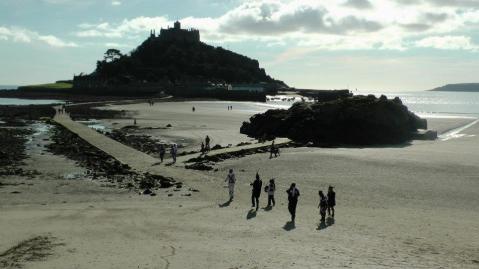
Photo by the author, Saint Michael’s Mound, Marazion, Cornwall
—
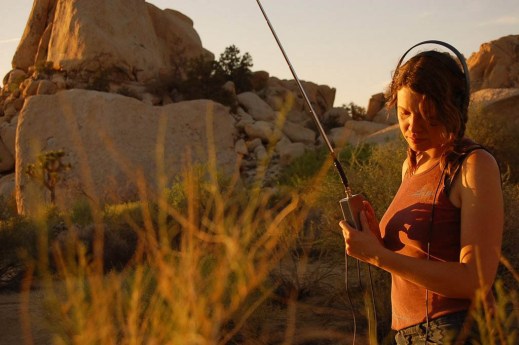
Featured Image photo credit: Vahid Sadjadi, Joshua Tree State Park, California
—
Author’s Note: A version of this post was presented at Musique et Écologies du Son/ Music and Ecologies of Sound: Theoretical and Practical Projects for the Listening of the World, Universitê Paris 8, May 2013. I slightly changed the original title of the paper to: “Sound through time, space, AND place.” Frank Vanclay said quite nicely in “Place Matters.” “‘Place” is generally conceived as being ‘space’ imbued with meaning. Thus, it refers more to the meanings that are invested in a location than to the physicality of the locality.” He goes on to state sometimes it’s the biophysical characteristics that make the foundation for those personal meanings.
—
Maile Colbert is a multi-media artist with a concentration on sound and video who relocated from Los Angeles, US to Lisbon, Portugal. She is a regular writer for Sounding Out!
—

REWIND! . . .If you liked this post, you may also dig:
“Listening to Disaster: Our Relationship to Sound in Danger”–Maile Colbert
“Within a Grain of Sand: Our Sonic Environment and Some of Its Shapers” –Maile Colbert
“Animal Renderings: The Library of Natural Sounds”--Jonathan Skinner
Share this:

Regulating the Carceral Soundscape: Media Policy in Prison

In Alcatraz, prisoners were allowed to listen to radio via this two-channel device; Image by Flickr user adrian8_8
The first thing I noticed about 4-block was the silence. It was so quiet that every time I sat on my bunk I fell asleep. The Reformatory was always one continuous roar, musicfrom radios and televisions, noise from guys shouting to one another up and down the block, it seemed to never end. But in Jackson it was very, very different. The daytime hours you could hear typewriters and the closing of cell doors, the phone at the guards desk ringing but that was it. And after 9:00 PM you heard absolutely nothing …” –“Chet” (qtd. in Music Behind Bars: Liberatory Musicology in Two Michigan Prisons, 66-67)
Film and television usually portray prison as the loudest place on earth, filled with nonstop clanking and shouting and slamming, the noise reverberating sharply off its hard, flat surfaces. Actually, prison is much more likely to be a binary soundscape: either too loud or, at times, inhumanly quiet.
In fact, the manipulation of the sonic environment behind bars is part of the punishment mechanism itself, imposing or withholding different kinds of sound from different kinds of prisoners. There is a long history of prison music and prison radio, often within the context of education and activities aimed at recreation and rehabilitation, but here I’m talking about the mundane sounds of closing gates, locking doors, intrusive PA announcements, whirring fans, banging buckets, clattering garbage cans, and of course the human voice at any and all hours and volume levels: the inescapable sounds of quotidian prison life. The denial of the inmates’ ability to control that soundscape for themselves—or the compulsion that they do—thus becomes an issue not just of penal policy, but, interestingly, of media policy as well.
Indeed, the most fascinating questions in media policy these days are arising not at the FCC or OFCOM, but in places where policy scholars don’t usually look: schools, cinemas, and prisons. The state may have a lock on binding legislation, spectrum allocation, and international trade agreements, but it is the everyday policymakers on the school board or in the guard tower who directly affect more lives. With their pronouncements on which media forms may be used by whom, in what ways, and for what purposes, such accidental policymakers seek to regulate behavior through culture. Therefore, it is crucial to consider: which behaviors? which culture? and with which understandings of the relationship between the two?
One such instance of vernacular policymaking came last year when the Bureau of Prisons began testing the use of mp3 players in federal prisons, a technological update on rules that already allowed radios, televisions, and portable cassette or CD players. The move opens up new vistas of choice and control for the prisoners, who are no longer limited to the 20-30 cassette tapes or CDs for their Walkmen that cell space allows, nor dependent on the spotty radio reception in the rural areas where many prisons are located (a spatial impact which itself is an effect of multiple layers of ideology, policy, and control). Unsurprisingly, the players have become many prisoners’ most prized commodity, though the control they may exercise is far from absolute. The song selection is vetted by authorities (no “Cop Killer” in the Penitential Jukebox, don’t you know) and a remote kill switch allows the warden to brick the player should an inmate’s privileges be revoked, or in the case of theft or barter (trading goods and services is almost always a no-no in prison, a prohibition only slightly more effective, one guesses, than the ban on masturbation).

JPay’s JP4, The most common Mp3 device in U.S. Prisons
The introduction of mp3 players reveals not just the power and problems of local policymaking but the ways in which sound functions within a carceral system. For authorities, sound is “noise” when it interferes with security and a disciplinary tool when it doesn’t. As Robert Powitz’s article, “A Simple Primer on Jail Noise Control” reminds readers of American Jails, the trade publication for the prison industry, “Good security practices dictate that we want to hear certain sounds, particularly those associated with malfunctioning mechanical systems such as ventilation and plumbing, and more importantly, we need to hear a correctional officer’s call for help, an inmate in distress, and even seditious conversation” (Sep./Oct. 2007, 104). While it is surprisingly nice that Powitz threw “an inmate in distress” in the article, he otherwise presents an exclusively top-down rationale for separating sound from noise; Michel Foucault’s emphasis on the visual panopticon notwithstanding, which several scholars have critiqued, aural surveillance is equally important to the well functioning disciplinary institution and the production of docile bodies.

The Visitation Area at the former Moundsville State Penitentiary in West Virginia; Image by Flickr user IndyDina
Sound that American Jails would not classify as “noise”— i.e. sound that doesn’t interfere with security operations—is not merely incidental ambience, however, as the well-regulated soundscape produces its own disciplinary effects. The tortuous sensory deprivation of solitary confinement commonly includes the removal of sonic stimulation: silence as punishment. Already in the 1830s Alexis de Tocqueville critiqued the cruel silence imposed on prisoners in the U.S., and contemporary research repeatedly confirms the mentally destabilizing effects of sonic deprivation (see e.g. here and here). Total sonic deprivation is merely an extreme, however; there is an array of situations involving sound management. For example, conversations with visitors often occur through soundproof glass; obviously the surveillance function of this setup is paramount, but the distanciating filtration of the telephone adds further punishment through physical denial of the unmediated sound of a loved one’s voice. The raucous cacophony of the daytime cell block, meanwhile, acts efficiently as population control of another kind: as an incentive to self-regulate so as to enjoy the perks that enable one to escape the noise. The routines of prison policy intersect with the technologies of media policy to turn the chaotic soundscape into good behavior, through the mechanism of a prisoner’s desire for a pair of earbuds and some familiar tunes. (Media policies also turn that soundscape into a profit center: tracks on the prison’s version of iTunes cost between $1.29 and $1.99, obviously more than the going rate on the outside.)
Via the regulation of the aural environment, the authorities’ “sound”—the elements of the sonic environment that they impose or, at least, see no need to reduce or eliminate—thus becomes the prisoners’ “noise,” while prisoners’ “sound” can be either provided or withheld as part of the disciplinary and economic logic of the carceral system as a whole. As one prisoner, “Marcos,” summarized the system:
They pacify us with these so-called liberties, such as personal TVs, personal radios, personal guitars, tapes, cable TV, a complete store like the free world. And plenty of sports! Why–they call this our rights. In actuality it’s a break down in our system” (qtd. in Elsila, 56).
Such are the effects of so-called “personal” media for such an impersonal environment, for individuals who have been turned into social non-persons: media policy disguised as personal liberty rather than mass prisoner control. This disguise often fools the “throw away the key” law-and-order types who object to coddling criminals with the current Kenny Chesney track; for them, it is worth mentioning that the computers where prisoners download songs for their mp3 players are appropriately called—no joke—“Music Wardens.”
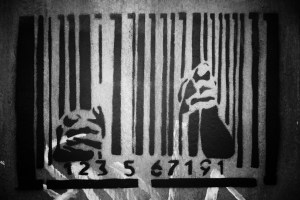
Image by Flickr User lanier67
Foucault’s great metaphor for the disciplinary society—the prison as a template of surveillance and control that has been adapted to all spheres of modern life—becomes punishingly literal behind bars, but that is merely where it is most visible or, often, audible. As I explain to my students, media policymakers claim merely to regulate gadgets, physics, and economic relations, but in fact they are always and inevitably also regulating bodies and ideas. The production of the prison soundscape reveals the relation of policy to conduct, a relation that in everyday life often remains cloaked behind scientific and legal discourses.
A final point: equally punishingly literal is the notion of media effects held by those policymakers in the prisons. Inveterate behaviorists, they imagine–and then attempt to manipulate–a direct causal relationship between media consumption and action, between sound and deeds. Those manipulations, however, are a broken media policy for a broken system. As Marcos put it, speaking of the many entertainment options available to the docile inmate: “Even before I ever could imagine I was going to end up in prison, never in my wild imagination could I expect it to be this easy. Yes I said easy. We have no serious form of rehabilitation. . .Why does the state spend more on activities than education?”
—
Thanks to Genevieve Spinner for invaluable research assistance on this project.
—
Bill Kirkpatrick is Assistant Professor of Media and Cultural Studies in the Communication Department at Denison University. His ongoing research and teaching interests include media history and cultural policy; impacts of popular culture on American public life; theories, practices, and future of citizen-produced media; and media and disability. He is also co-producer of Aca-Media, a monthly podcast that presents an academic perspective on media. You can find out more at www.billkirkpatrick.net.
—
REWIND! . . .If you liked this post, you may also dig:
Prison Music: Containment, Escape, and the Sound of America—Jeb Middlebrook
SO! Reads: Jonathan Sterne’s MP3: The Meaning of a Format–Aaron Trammell
Pushing Play: What Makes the Portable Cassette Recorder Interesting?-Gus Stadler
Share this:


Current Top Posts





April 2021

January 2020

November 2019

October 2019

August 2019

April 2014

November 2017

March 2015

December 2017

October 2015
 Sounding Out!
Recent Comments