
SO! Reads: Jace Clayton’s Uproot

 “Music has always confounded value,” writes interdisciplinary artist and writer Jace Clayton in Uproot: Travels in 21st-Century Music and Digital Culture (FSG Originals, 2016, 22). Recounting his extensive international travels performing as DJ /rupture, Clayton presents a flow of cosmopolitan musical experiences that illustrate complex collisions between music and value around the world. Whether writing about homemade sound-systems in tropical clubs in Brooklyn, or about shellac preservation at the Arab Music Archiving and Research Foundation in Beirut, Clayton considers the technologies by which we make — and place value on — musical sounds in “a world where worth is created in radically different ways from what the market teaches us” (24).
Uproot is a narrative about the ways working musicians experience globalization. “Our music seems to sound the way global capital is — liquid, international, porous, and sped up,” the author writes (16). This homology between sound and economic processes echoes the theories of sociologists like Anthony Giddens and the late Zygmunt Bauman, both of whom argue that modern life is characterized by fluidity and fragmentation: employment is precarious, experience is mediated, and ethical decisions are full of ambiguity. These ideas clearly inspire Clayton’s narrative; that said, Uproot is not an academic publication. As Atossa Araxia Abrahamian writes at the Nation, the book evades genre, “at once travelogue and cultural ethnography, pop philosophy and memoir, a guide to contemporary music and a fanzine.”
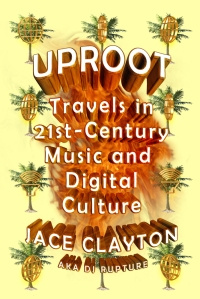 The book begins with a discussion of the history of Auto-Tune. While Clayton’s claim that Auto-Tune was the “first truly new sound effect of the internet era” might be overstated, his distinction between “corrective Auto-Tune” and “cosmetic Auto-Tune” is useful, the first of many moments of clarity in parsing the ways we use and mis-use musical media today. “The robot voice signifies differently everywhere you go,” he writes, an observation that becomes central to the book (49). By refusing to take a deterministic stance toward technology, Clayton empowers the musicians he writes about, acknowledging the ways in which artists mold trends to their own regional and local purposes. Of collaboration with a violinist in Morocco, Clayton writes: “We may have thought similarly, yet our ‘default settings’ were so far apart as to be almost incompatible” (185).
Uproot offers intimate insights into a range of tools and techniques of production, such as compression artifacts, “refixes,” and dozens of music-making interfaces, including Clayton’s own “music software-as-art project,” Sufi Plug Ins.
.
Even language itself is conceived as a form of technological mediation, as when Clayton compares Arabizi — a phonetic spelling of colloquial Arabic — to the hybrid sounds of mahraganat music that the language is used to describe. Of these “wandering genealogies” that emerge from international conversations, Clayton suggests that any hybrid genre we can imagine likely already exists: “Accordions and African techno? It’s called funaná” (102). The book describes at least a dozen other music traditions and microgenres–some very old, some just coalesced–from dabke to zar, each the product of a unique fusion of vocabularies.
Clayton on Mazaher (182): “Umm Sameh, Umm Hassan, and Nour el Sabah: these three women are some of the only people in Egypt keeping zar alive.”
Clayton’s own prose style, replete with metaphor and fluent in informal language, mirrors the ethos of music production he explores in the book: eclectic, energetic, and bursting with detail. What better way to describe Auto-Tune’s effect than as liquification of sound into a “bright neon stream, as if a dial-up modem and a river have fallen in love” (53)? Clayton’s technological travelogue extends beyond aural sensation alone. This is a story of “sidewalk vendors, radios, mosque loudspeakers,” (106) but it is just as much about “jerk chicken, fish tea, goatskin soup” (73). When Clayton describes his surroundings, we can touch the orange blossoms and smell the cigarettes.
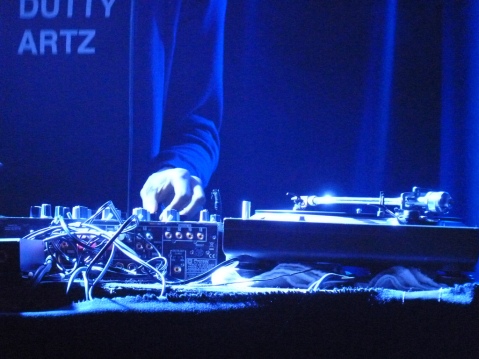
Dj /rupture performs in Minefield UK, 2010, image by Flickr User Paul Narvaez Attribution-NonCommercial 2.0 Generic (CC BY-NC 2.0)
The book’s recurrent question is how DJ practices in different locations are both constrained and inspired by financial flows. In any context, Clayton argues, “[m]oney runs to the people with the least imagination” (24). Early on, he establishes this view that musical experience is priceless, more valuable than any profit derived from rhythms of supply and demand, which reward the wrong people. That said, Clayton isn’t naive about musicians’ inevitable need for income, and throughout the text, readers are asked to inhabit ethical dilemmas that artists encounter throughout the world. At one point, Clayton describes his own moral quandary when asked to perform in front of a giant Red Bull logo, a “glowing lump of techno-fascist DJ furniture.” Later, Clayton critiques the hegemony of “Red Bull patronage” and similar systems of support for artists who are desperate for funding (121). He makes clear his disdain for corporate sponsors, companies that “appear generous as they let us know that our music is literally worthless to them” (123).
A tradeoff emerges between pragmatism and idealism. Clayton pokes holes in the empty rhetoric of “authenticity” that marketers encourage and exploit, even as we sense that he hasn’t yet relinquished his belief in something essentially good about the human spirit. Listening is a powerful social practice that, in Clayton’s view, gives true meaning to music in a global economy that otherwise undervalues it. “The heavier the workaday grind to escape from, the more a party transports us” (73), he writes, suggesting that listeners extract their own surplus value.
At times, Clayton’s observations could benefit from an engagement with ethnographic methods that can help mitigate fieldwork biases. For example, although the book does involve open discussions of gendered inequalities, they are limited in scope. At one point Clayton calls attention to “macho wrangling over propriety and womanhood” among managers and producers in Agadir, Morocco (52); he describes his own futile attempt to acquire a frank interview with female singers amid the patriarchal structure there. But despite Clayton’s awareness of gendered power dynamics, he does not critique the male musicians and producers who propagate such imbalances.
When female figures do appear, they are often treated as side characters. Rihanna, for example, is presented as exemplary of the business model of “singer as mouthpiece” (50), a person for whom others do the work. Clayton isn’t wrong to call attention to the large networks of employees that work behind any celebrity brand, but it is risky to do so at the expense of female workers, especially in the midst of a book that elsewhere describes women as decoration for the musical environments in which men perform what are presumably more important tasks. “Naked girls on pedestals [who] got their bodies painted” (19), “photoshopped young women” (49) and “demure girls” (49) all set scenes for tales of male creativity. This is not to critique how some women may choose to participate in music scenes, but rather to point out that women’s concerns and perspectives are not Clayton’s focus in these passages, nor in much of the book.
On Berber Auto-tune star Saadia Tihihit (49-50): “Like Justin Beiber or any child groomed to be a media star, Saadia Tihihit occupies a place at least initially defined more by the commercial strategies of those around her than by any desire for artistic autonomy.”
Comparably, Clayton’s conception of music and global inequality is sometimes uneven. Drawing stark divisions between the “civilized” and otherwise, he resorts to clichéd language when he writes of “backwater Uzbekistan” (31) and “war-torn Africa” (81). When he describes towns and villages near Casablanca where “ancient rhythms of life still hold sway” (33), he reproduces exoticizing tropes of African music. Elsewhere in the book, Clayton addresses musical accusations of fetishism, stating: “I know that Africans and blacks have been fetishized for centuries now, perhaps millennia. Who cares? You simply exist in all your complexity and let them deal with it. Fetishism is so vague” (84). He also critiques what he calls the “spectacle of a so-called ancient culture” (99) that is often at the heart of “world music” scenes, but then describes Appalachian musical performance as “the old-timey way with banjos and fiddles and washtub percussion” (32), opposing these practices against technological advancement, a false dichotomy that ethnomusicologists work to complicate, if not avoid.
Clayton brings these issues to a head during the book’s extensive discussion of “world music” as a marketing category. His commentary on the conundrums of appropriation surrounding figures such as Paul Simon, M.I.A., and Moby feels familiar, but he surpasses the usual analysis of these common case studies with more personal insights into “world music,” beginning with crate-digging excursions at record shops with deep international selections, such as the now-defunct RRRecords in Lowell, Massachusetts. Clayton contrasts his own on-foot exploration of foreign sounds with what he calls “World Music 2.0,” an internet-driven network of musical discovery based around the commodification of information and attention, in which middlemen reign supreme. His ambivalence is exemplified by this claim: “At its worst, World Music 2.0 offers the clubland equivalent of a package vacation. At its best, it propels some of the most exciting music in the world” (104-105).
The book’s ideas occasionally undermine themselves, but there is no question that the author ultimately intends to advocate for people on the margins. As Max Pearl has noted at the LA Times, Clayton consistently defends lo-fi, lo-tech, and lo-res sonic expression — that which is “distorted, homespun, libidinous” (80) — as valuable in its own right. Further, Sukhdev Sandhu has suggested at the Guardian that the book’s attention to homologies between “the movement of sounds and of migrant bodies” serves to recognize the struggles of global refugees and affirm their humanity.
Among Uproot’s many mentions of transport, readers never receive a clear statement about what, precisely, the relationship between music and motion is, or how exactly value emerges from that pairing. Rather than a weakness of the book, however, maybe such equivocation should be taken as an accurate reflection of the nebulous circumstances in which many of us find ourselves — creators and listeners who are regularly uprooted, usually at the mercy of those whom the money follows. Faced with this precarity, let Clayton’s enthusiasm for all sounds ground you.
Uproot is accompanied by an online Listening Guide that includes audio and visual examples of music from the book: http://www.uprootbook.com.
—
Featured Image: DJ /rupture performing at the Fórum Eletronika de Mídias Expandidas 2005 by Flickr user Brayhan Hawryliszyn (Attribution-NonCommercial 2.0 Generic (CC BY-NC 2.0)
—
Elizabeth Newton is a doctoral candidate in musicology. She has written for The New Inquiry, Tiny Mix Tapes, Real Life Magazine, the Quietus, and Leonardo Music Journal. Her research interests include musico-poetics, fidelity and reproduction, and affective histories of musical media. Her dissertation, in progress, is about “affective fidelity” in audio and print culture of the 1990s.
—
 REWIND!…If you liked this post, you may also dig:
SO! Reads: Dolores Inés Casillas’s ¡Sounds of Belonging!–Monica De La Torre
SO! Reads: Roshanak Khesti’s Modernity’s Ear–Shayna Silverstein
Lokananta: Sounds of Crisis and Recovery from Indonesia’s National Record Company — Ian Coss
Share this:

Riot Grrrl, Punk and the Tyranny of Technique


Image of Alice Bag used with her permission (thank you!)
For full intro and part one of the series click here. For part two, click here.
Our Punk Sound series implicitly argues that sound studies methodologies are better suited to understanding how punk works sonically than existing journalistic and academic conversations about musical genre, chord progressions, and/or genealogies of bands. Alexandra Vasquez’s sound-oriented work on Cuban music, for example, in Listening in Detail (2014) opens up necessary conversations about the “flashes, moments, sounds” in music that bear its meanings and its colonial, raced, classed, and gendered histories in material ways people can hear and feel. While retaining the specificity of Vasquez’s argument and the specific sonic archive bringing it forth, we too insist on “an ethical and intellectual obligation to the question: what do the musicians sound like” (12) and how do folks identifying with and through these musical sounds hear them?
In this series, we invite you to amplify varied historicized “details” of punk sound–its chunk-chunk-chunk skapunk riffs, screams, growls, group chants, driving rhythms, honking saxophones–hearing/feeling/touching these sounds in richly varied locations, times, places, and perspectives: as a pulsing bead of condensation dripping down the wall of The Smell in Downtown LA (#savethesmell), a drummer making her own time on tour, a drunk sitting too near the amp at a backyard party, a queer teenager in their bedroom being yelled at to “turn it down” and “act like a lady[or a man]”. . .and on and on. Today’s essay is by Tamra Lucid. Here, Tamra offers her thoughts on how both technique and expression reinforce a gendered understanding of music. When punk sound plays with extremes, how can artists who feel trapped by these polemics resist?
SOUND!
–Aaron SO! (Sounding Out!) + Jenny SO! (Sounding Out!)
—
“Don’t touch that!” a virtuoso guitarist had once told me when as a kid I reached for his guitar. The same phrase would later be delivered by a punk guitarist at a gig where I offered to replace a string broken during his performance. As noted in the book Girls Rock , women are often told not to touch these sacred instruments (18). I remember thinking that guitar was as complex as a car engine and as dangerous as a circular saw. Technique and theory are meant to liberate musicians (so that their dexterity can follow wherever imagination and inspiration may lead), but when experiencing gender discrimination from instructors and fellow instrumentalists, technique and theory can seem antagonistic. In this essay I show how the elite and virtuoso focus on technique and theory has catalyzed punk musicians to cultivate the raw, expressive, qualities of punk sound. Yet, paradoxically, I point out how movements toward a raw and visceral sound constitute a cage of their own, alienating an equally radical and virtuoso community of women in the punk scene. How do these sonic contours in the 1990s riot grrrl scene tell a story about injustice and community building through sound?

Iconic guitarist Eddie Van Halen, shredding. Technique can be a form of gendered gatekeeping. Image by K. Todd Storch @Flickr CC BY-NC-ND.
Theory and technique become a cage when they are used by sexist cliques, such as the heavy metal scene, which sought to maintain hegemony over local scenes and resources. For the gatekeepers, there are many benefits to this form of discrimination–women are encouraged to act as doting fans rather than joining bands. As a teenager I saw many young women told by male musicians that their only permissible roles were those of sex object or fan. Early in my musical career when I put out an ad searching for band mates some male musicians would call just to laugh at me.
In the late 1980s and early 1990s when canons of punk tone and composition ironically became defined by an athletics-like dedication to speed, precision and endurance, riot grrrl bands were criticized for their primitive skills. However, by removing the barriers to self-expression that this emphasis on technique and theory created, many people, not only female or female identified, were empowered to create music similar to performance art. As Liam S. Ruin of the Columbia, South Carolina hardcore band Shirley Temple of Doom (1993-1996) said in an interview I conducted with them for this essay: “I still think emphasis on technique is gross and ableist and boring and obvious.”
In this time of sonic reform, some scenes came to prize sincerity over skill. Here, a new canon of theory and technique evolved–another cage. Some related to the riot grrrl scene found themselves accepted by their community while receiving praise for abandoning a commitment to simplicity. For example Associated Newspapers News North West previewed a gig by Sleater Kinney in Manchester, UK by describing them as “too musically competent to be a Riot Grrrl band.” Likewise, the female hardcore bands Girl Jesus and Free Verse (though politically aligned with riot grrrl) found little support in a scene that viewed them as a threat. It was as if the language of technique and theory was the language of oppressors, and using it implied submission to the status quo. The directness of purpose which had liberated so many artists, became a new kind of cage for others.

Shot of Girl Jesus from 1995. Image used with permission by the author.
As a roadie for Girl Jesus, I witnessed the immediate dismissal (including groans of disappointment) they suffered when confronting male bands at gigs many times. Despite these jeers I also saw the way their ferocious music and performance, anchored by guitarist Gina Rush’s use of middle eastern scales, Shell Davina’s unique and unusual drumming style, and Grit Maldonado’s flamenco-like bass lines, reduced many male bands to discouraged silence and listless performances. I remember thinking that riot grrrl, or what was left of it in 1993, would welcome such a powerful example of female creativity. The feeling of competence I felt as Girl Jesus approached each gig with confidence in their music and technology helped me to reinvent myself, encouraging me to graduate quickly from roadie to musician.
Gina Rush carefully chose her amps and had them modded by an expert. Shell used a vintage drum-kit that would make any collector drool. But these distinctions were rejected by the riot grrrl audience who found them elitist and classist. Though Girl Jesus was a band of working class lesbians they were treated the same way as male bands in the scene. As Shell reported in an article entitled “Queercore: Ready to Face the Market” by Brent Atwood in the May 6, 1995 issue of Billboard Magazine: “As a female band, we expected a strong network of women in music to stick together. Instead we found a lot of competition.” She also pointed out: “We’ve had more club owners be sexist to us than homophobic.” Despite their embrace of technology and technique, two domains that code as masculine, Girl Jesus nurtured into existence two of the more popular riot grrrl bands in mid-90’s Los Angeles, Patsy and my own band Lucid Nation, which began by rehearsing in Girl Jesus’s garage using their equipment. The name of Girl Jesus’s first cassette demo succinctly captured the problem: “Afraid of Our Own.”

The cover of Free Verse’s “Access Denied” album. Image used with permission by the author.
A similar trajectory was found by the all female hardcore band Free Verse, whose first record “Access Denied” was released by the indie label Brain Floss Records. Free Verse began in Lawrence, Kansas in 1995 and in 1998 relocated to Seattle. Lucid Nation toured nationally with Free Verse in the summer of 1998. The experience was similar to what I observed as a roadie for Girl Jesus. Male bands who looked down upon female musicians with disdain were stunned by their display of skill and ferocity. However, when we played in Olympia, Washington, the riot grrrl community cowered against the back wall, clearly uncomfortable. On the road we smiled ruefully over the irony of masculinist male bands becoming fans while female fans who shared our politics turned their backs. This created a conundrum for Free Verse. Although they were able to deliver a feminist message to scenes and individuals who were hostile to feminism, they could not enjoy the community of like minded women who identified as riot grrrl.
Over time, Free Verse earned enough respect that they were able to open for leading bands from a variety of scenes. From Hardcore bands like The Blood Brothers to indie stars like Sleater Kinney. From queer core bands like The Need and The Butchies to riot grrrl supergroup The Cold Cold Hearts. Though Free Verse were chosen to participate in the Northwest Coalition For Human Dignity’s anti-racism tour October 2002, a tour sponsored by Ms. magazine and featured in ROCKRGRL magazine, the band was never able to achieve the following or recognition of the bands they shared bills with, information about them is hard to find on the internet today.
Liam S. Ruin, now one of the guiding lights of the new Riot Grrrl Intersectional movement, provides a more intimate look at how the pressures of technique and theory influenced Shirley Temple of Doom: “Not really any RG [riot grrrl] activity in Columbia SC. Um, Slant 6 played there once. Our scene was extremely nuclear. We played with our friend’s bands, The Trema, Erector Set, Guyana Punch Line. We were pretty much all in each other’s bands or dating each other or whatever. Making it up as we went along. Jessica saw me in the halls at school wearing a Pearl Jam shirt and told me ‘you’re way too cool to be listening to shitty bands.’ She made me a mix cd that was mostly D.C. Emo and Hardcore but it had Bratmobile, Bikini Kill and L7, too. Then she lent me her bass. I practiced with Joy Division and Heavens To Betsy covers till I could play along. We started a band with her boyfriend. Half of our band were really into Straight Edge H/C and the other half were into Huggy Bear, Fugazi, NOU, etc.”

Donita Sparks of L7. Image by Dena Flows CC BY-NC-ND.
Shirley Temple of Doom, despite reflecting a riot grrrl like platform in their lyrics received little attention from the riot grrrl community. Eventually the band collapsed due to internal tensions regarding technique–as if the rhetoric of extremes around technique and expression had become an expertly baited, misogynist trap. As Liam informed me: “The guys in the band were very technical and pushed me to play more technical bass lines but honestly, I get bored with proficiency. I’ve heard what guitars are supposed to sound like. I wanna hear what they’re not supposed to sound like. We split because of ideological differences. I got really into visceral bass-feels and wanted to sound like a disaster, and they wanted to be on Victory Records.”
How did the cage of technique and expression, evolve in a style of music that advanced freedom as its guiding praxis? Early on, rock musicians were considered unskilled when compared to classical, jazz and country musicians. Later, virtuosity became central to rock music as bands like Yes, Led Zeppelin, and Pink Floyd, sought radical sounds to accommodate an aesthetic cultivated by Cannabis and LSD. As What’s That Sound? An Introduction to Rock and It’s History puts it: “Rock musicians now had a responsibility to create sophisticated music using whatever means were available.” Soon after this turn to virtuosity, guitarists like Eddie Van Halen became the Paganinis of their time, displaying jaw-dropping finger speed and impressive knowledge of scales and musical theory.
Later, punk rock crashed the party. First in the hands of the MC5 and The Stooges, and then the New York Dolls, The Ramones, the Sex Pistols and many other bands, rock music turned again towards primitive and cathartic sincerity. Musical virtuosity was literally spit upon. The Ramones famously told The Clash that they needn’t worry about improving their musicianship before playing live because “as you’ll see tonight, we suck.” Ferocity replaced dexterity. Nihilistic and cathartic lyrics displaced idealistic flights of fancy. Punk quickly developed its own criteria to indicate mastery of the genre. Bands like Fugazi and F.Y.P. typified a performance style that required frenetic motion while preserving the lockstep rhythm and hand speed, if not the musical knowledge and experimentation, of the earlier virtuosos. Then riot grrrl arrived, freeing a generation of punk women who were uncomfortable with the athletic performance style of these bands. For example, one of L.A.’s favorite riot grrrl bands Crown for Athena would perform at times with one member of the band sitting on the stage singing while clinging to the pant leg of another who stood immobile and emotionless. Frenetic performance and blazing chord speed was no longer a requirement for legitimacy on the punk stage.

Flier advertising an International Woman’s Day celebration featuring Lucid Nation. Image used with permission by the author.
Riot grrrl liberated me from the odious trial of confronting sexist music teachers, store clerks, booking agents, and record companies. I learned from the movement that I could get by with simple barre chords. I could use cheap and borrowed gear and I didn’t have to worry about great tone. One of the bands I admired, Foxfire, a band of female high school students from Los Angeles, used an oven pan instead of a snare drum. Riot grrrl bands emphasized community by booking shows with each other and with activist groups like Food Not Bombs. We made our own labels to distribute each other’s records. When Lucid Nation opened for Bikini Kill at Terraza Jamay in Montebello, Kathleen Hanna took tickets at the door.
As my musical skills developed I found myself feeling restricted by the aesthetics of riot grrrl. Beginning with Lucid Nation’s DNA record (2000) we began exploring cliches of what we called “butt rock,” now more popularly known as classic rock. While we attempted to master the techniques of classic rock our intent was to deconstruct them by introducing unexpected twists of sound (like chaotic analog synth and noise pedals) and lyrics containing feminist perspectives. At this point, we had moved on to other scenes, for example, the melange of Peace Punks, Black Panthers, and riot grrrls at Koo’s Cafe in Santa Ana, CA. We played hemp rallies and non-riot grrrl political events like fundraisers for Big Mountain and other Native American causes.

1997 Image of the author with her “surrealist assemblage.” Image used with permission by the author.
Eventually I developed a fascination with improvisation inspired by freestyle rap and augmented by the writing of Gertrude Stein and the recordings of Jack Kerouac. By the time our most successful album was released, the improvised Tacoma Ballet (2002), I prized musicianship and encouraged experienced collaborators, like Patty Schemel of Hole on drums and Greta Brinkman of Moby’s live band on bass, to bring to bear the breadth and depth of their musical knowledge. I was delighted that Rick King of Guitar Maniacs in Tacoma allowed us to use his highly valuable collectible gear such as a 1967 Gibson Flying V and an array of legendary vintage pedals when we recorded the album. I was proud when Patty said in an interview about Tacoma Ballet: “…there are always ideas that I have–interesting beats and such–that I could never incorporate into Hole or any other project. In Lucid Nation I got to incorporate all my weirdness.” Though Tacoma Ballet made it to #1 on the New Music Weekly Chart of College and Secondary Market Radio Stations in December 2002 it received very little attention in riot grrrl circles. I found myself silenced again, not by advocates of technique, but by a community who valued raw expression.
Of course, in 2002 riot grrrl was less popular than it had been a decade before–it mostly consisted of isolated zine writers and bands. Still, those who remained in the scene ignored Tacoma Ballet despite its success. When I asked them why, they explained that although they admired our work and the songs spoke to their experience, our band just wasn’t riot grrrl. I was told that the skills and awareness of musical history displayed on the record were too self conscious, that I had become ambitious, or as more than one zine writer said, I had sold out. Since I made no money on that record despite the attention it got, and we couldn’t tour behind it since the music was improvised, I found it hard to understand how such a purely artistic lark could be viewed as selling out. I didn’t sell out, my increased respect for theory and technique just felt wrong when viewed from the perspective of the riot grrrl canon.

EDM and the new politics of punk sound. Image by Patrick Savalle CC BY-SA.
While new music hardware and software have helped level the field in ways that were not possible in the 90’s, the cage of expression and technique continues to govern a new world of highly individuated scenes. EDM continues to fetishize the drop. Live performers need no longer be concerned about vocal pitch or knowledge of vocal harmony. Hardware like the Digitech VLFX, available on Amazon for under $200, corrects pitch and provides easy and automatic harmony vocals. In this device, music’s ability to create unexpectedly cathartic experiences has been diminished, while the simple mimicry of technique has been elevated.
Perhaps new regimes of data are to blame. Specific canons of theory and technique function as points of data that help define marketing audiences. After all, bands often succeed by conforming to the sonic norms of their given scene. For this reason, there is a tension between conservation and innovation. An artist must conserve as much of their scene’s identity as possible while finding subtle ways to innovate. Today, anyone can share their music on the internet regardless of traditional criteria. Despite this, a desire for acceptance and success continues to pressure musicians into accepting limitations to their creativity like technique and expression.
–
Cover image is of Tamra Lucid and by TheInfinite314 @Wikimedia Commons CC BY-SA.
—
Tamra Lucid is an executive producer of Viva Cuba Libre: Rap is War the award winning documentary about Cuban hip hop legends Los Aldeanos, a producer of Edward James Olmos Presents Exile Nation: The Plastic People, and associate producer of The Gits documentary. Writing from her riot grrrl zines was reprinted in A Girl’s Guide To Taking Over The World: The Zine Revolution by Karen Green and Tristan Taormino,and in Hilary Carlip and Francesca Lia Block’s Zine Scene. Tamra blogs for Exterminating Angel Press and for Reality Sandwich where her most recent project has been a series of interviews with water protectors and filmmakers at Standing Rock. She’s a founding member and primary singer of Lucid Nation.
–
 REWIND! . . .If you liked this post, you may also dig:
Listening to Punk’s Spirit in its Pre-, Proto- and Post- Formations – Yetta Howard
Feeling Through the Keen and Grind: Team Dresch’s Personal Best – Gretchen Jude
SO! Amplifies: Indie Preserves – Norie Guthrie and Scott Carlson
Share this:


Current Top Posts





April 2021

January 2020

November 2019

October 2019

August 2019

April 2014

November 2017

March 2015

December 2017

October 2015
 Sounding Out!
Recent Comments