
Finding Resonance, Finding María Lugones

I am always listening for María: I find her most in the traces of words.
Trained as a literary scholar, I relish in the contours of stories; I savor the nuances found between crevices of language and the shades of implication when those languages are strung together. It is no surprise, then, that since the death of my friend and mentor María Lugones, I have turned to many books, particularly her book, Pilgrimages/Peregrinajes: Theorizing Coalition Against Multiple Oppression, to feel connected to her. I have struggled, though, to write about her, talk about her, even think about her for many years. It wasn’t until I found a passage about spirits and hauntings in Cuban-American writer and artist Ana Menéndez’s novel The Apartment that I found language to describe a way through the grief of the last five years.

Menéndez’s novel follows many characters that all, at some point in time, come to live in apartment 2B in Miami Beach. While each person is seemingly disconnected from the next, they all leaves sonic traces of themselves for the next person’s arrival. Each new tenant leaves behind the creak of a dented floorboard, or the rumbling of the air conditioner, the faint melody of a piano, or the swish of spirits looking for a place to sit down. The climax of the novel revolves around Lenin García, a young Cuban migrant who commits suicide in the Miami apartment shortly after arriving. Anna, a journalist who migrated to the US from the Czech Republic during their communist regime, prepares the apartment for rental after the suicide. When looking through Lenin’s belongings she explains that the “Spirits pressed down on her, and again and again she rejects them. Sends them packing, back to the pre-rational past. Not a haunting, but an echo. The boy’s life a gesture pointing back to her own. A dream of a thousand iterations” (131). These spirits that surround her, that remind her of her own life’s ghosts, provide a particularly sonic connection; the tethers that connect one migration tragedy to another is an echo of commonality that creates a kin experience.
The three years I learned with and from María are overshadowed by the physical distance the pandemic required of me in her final moments. When I try to write about her, my hair stands on end, my eyes water, my nose drips, and I stretch out my hand toward a presence I feel, just out of reach. I know it’s her, I just can’t seem to touch her. I have described María’s death as a haunting—as something that haunts me. I defined this haunting as a physical presence that I could not see, but I could feel, sense. But what if, like Anna, I am feeling, not a haunting, but an echo; or more accurately, the resonances of María that echo around me constantly? What Menéndez’s passage provides is the necessity of reinterpreting my awareness of María from one of general sensing to one of specific aural attunement. If I am listening for her, how, then do I keep her with me?

Lenin, from The Apartment, provides a potential answer: when meeting with a curandera in Cuba, she tells him “The ancestors speak to you from the home of your inner life. When your inner life is spare, there is nowhere for the ghosts to sit. When you furnish your spirit, the ancestors will once again find rest in you” (143). Echoes become an analytic that provide furnishings ‘in the soul’ for sustained company of those who have passed. The reverberation of echoes—reverberations as a prolonged sense of resonance that stretches the meeting of two energies—can, quite literally, allow a reader to connect back to people across space and time. My tether to María is a resonance that simultaneously locates and disperses spatially and temporally. I hear this connection as my harmony to her melody. To further the metaphor, that resonance is the strumming of a guitar, where I am the guitar and she is the musician, and that moment where we both hear for each other, even when we do not know the other exists, is the note.
What happens when I use literary methods of analysis to find people in the interstices of sound? To search for María in what she calls the “enclosures and openings of our praxis” as a reader of her text? Now that I had to search the histories of her echo, I turned to her book, Pilgrimages/Peregrinajes.
When María recommends “to women of color in the United States that we learn to love each other by learning to travel to each other’s ‘worlds’,” (78) I imagine our first few encounters; encounters that were strange, difficult, and lessons in learning to listen to her on her terms. I had been invited to her home in Binghamton, New York for a meeting of a political-intellectual group she hosted, and was nervous to meet the woman I had written my Master’s thesis on, and who was the reason I applied to Binghamton for a PhD program. Her voice rang through the room, slow and clear; her mouth pursed a bit as she thought through her next sentence, her finger pointed as she spoke her next idea. In trying to stay out of her way, I became a barrier when she moved backward; she bumped into me and said simply ‘you must be careful not to trip me’ and moved along. I was mortified.
Our next few encounters were similarly odd, and lead me to think that, maybe, María was not the right choice for my mentoring needs. A few months into this first year in graduate school—where tenured male professors were violent toward me, and I was not sure I should stay in academia—I confessed to a friend in the same political-intellectual group that I was not sure María liked me or that I should work with her. Her response changed everything: this friend, who had worked with María many, many years said: “don’t do that. Don’t make her mother you. It’s not who she is. Travel to her, learn her.” I finally understood that traveling to María’s world meant listening to her from her perspective, not my own. That shift in me “from being one person to being a different person” (89) is how I first found María in the haptic world. I learned to listening to her: I learned the catch in her throat meant she wanted tea; I learned the increase in sighs meant she was in more pain that usual; I learned the shuffling of papers probably meant she was looking for her handkerchief to wipe her forehead as she had a hot flash. Each of these sonic gestures, I could respond to—could show up for her.

But with María’s death, this kind of listening is no longer available to me; I could not listen for hem or hmm or tchps. I had to learn to listen differently. In re-reading Pilgrimages/Peregrinajes I learn that it does not just contain her philosophical interventions for liberatory futures. It is a series of stories; her stories of the echoes that resonate inside of her; stories that she weaves together that happen to name philosophical practices of relationality. It is through the coerced placement of her by her father in an asylum that she finds other woman who teach her to resist; this resistance is sonic: a woman repeating over and over “I am busy, I am busy” as they electroshock her (i). It is through wanting desperately to love her mother that she finds ways her mother taught her to listen differently in order to name the capacity of ‘world’-traveling. What I had felt when I first read her work over a decade ago was a resonance; a sonic reverberation across space and time that connected my to her before our physical meeting, during our time as friends and mentor/mentee, and now after her physical death.
Connecting to María through echoes feels effortless now that I have the language. I hear now María’s warning against the dangers in the primacy of the visual. In “Hablando Cara a Cara/Speaking Face to Face: An Exploration of Ethnocentric Racism,” she explains:
I exercise this playful practice. The appreciation of my playfulness and its meaning may be realized when the possibility of becoming playful in this way has been collectively realized, when it has become realized by us. It is here to be appreciated or missed and both the appreciation and the missing are significant. The more fully this playfulness is appreciated, the less broken I am to you, the more dimensional I am to you. But I want to exercise my multidimensionality even if you do not appreciate it. To do otherwise would be to engage in self-mutilation, to come to be just the person that you see. To play in this way is then an act of resistance as well as an act of self- affirmation (41).
What she taught me here is that being herself meant a practice that was more than being seen. To be what others could only see was an act of mutilation to her multidimensionality. That reminder was crucial to becoming her friend during my time at Binghamton, but even more crucial now that she is gone from this world.

I’ll leave you with the most important story she left behind: she provided a method of learning that was based on the senses and focused primarily on the sonic—what she called “tantear.” This tantear has become instrumental in my own research. It is a fumbling around in the dark, a feeling around tactically that focuses on searching “for meaning, for the limits of possibility; putting our hands to our ears to hear better, to hear the meaning in the enclosures and openings of our praxis” (1). The embodied experience of stumbling, of careful and intense feeling for and with others, requires a capacity of listening deeply. It is listening that undergirds the learning. The language of the sonic provides the understanding of the feelings within the body. Listening becomes a profound practice of relationality; echoes become a mechanism of connection; and resonance becomes the confirmation that I can still be with María.
—
Images courtesy of the author, except where noted.
—
Daimys Ester García is a Latinex writer, artist and educator from Miami. She earned her PhD in Comparative Literature at SUNY Binghamton. She is currently an Assistant Professor in English at the College of Wooster, where her research and teaching is at the intersections of Latinx literatures & studies, Native literatures & studies, women of color feminisms, and decolonial praxis with a focus on coalitional politic. She is working on a book manuscript, tentatively titled Comfort is Colonialism: Coalitional Commitments for Cuban-American Women Writers, which offers a repertoire of practices to re-connect Cuban-Americans with other histories of resistance in the US.
—
Thank you to Wanda Alarcón for care in the form of editorial labor.
—

REWIND!…If you liked this post, you may also dig:
Faithful Listening: Notes Toward a Latinx Listening Methodology–Wanda Alarcón, Inés Casillas, Esther Díaz Martín, Sara Veronica Hinojos, and Cloe Gentile Reyes
Enacting Queer Listening, or When Anzaldúa Laughs–Maria Chaves Daza
“Oh how so East L.A.”: The Sound of 80s Flashbacks in Chicana Literature–Wanda Alarcón
Xicanacimiento, Life-giving Sonics of Critical Consciousness–Esther Díaz Martín and Kristian E. Vasquez
Share this:

Poptimism and Popular Feminism

Almost 20 years ago, 2 Many DJs and Freelance Hellraiser each released too-clever mashups that laid R&B pop diva vocals over indie rock instrumentals, revealing that the paired songs had exactly the same compositional structure. The former’s “Smells Like Booty” put Destiny’s Child together with Nirvana, and the latter’s “A Stroke of Genius” combined Christina Aguilera with The Strokes. The mashups were clever because they flouted supposedly commonsense views that these these pairings shouldn’t work: how could something as superficial, formulaic, and, frankly, girly as Destiny’s Child and Aguilera have anything in common with something as serious and aggressive as Nirvana and The Strokes? Writing in 2009, Dorian Lynskey explained that “A Stroke of Genius came out when many indie fans still believed that manufactured pop stank of evil and death, and the idea of Christina Aguilera and the Strokes in perfect harmony was strange.” Note Lynskey’s use of the past tense: by 2009, the gatekeepers of elite musical taste generally agreed that commercial, chart-oriented music whose fans were at least thought to be mainly teen girls and/or gay men could be just as artistically valuable as rock and hip hop.
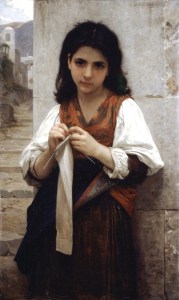
“Tricoteuse” by William-Adolphe Bouguereau (1825-1905), Public Domain
That consensus has a name: poptimism. Poptimism upends the hierarchy between rock (and sometimes hip hop) and pop, which is a contemporary variation on a very old hierarchy that privileged fine art over craft. Back in the 18th century, philosophers like Immanuel Kant invented the idea of “fine art” by distinguishing it from craft: craft is subordinate to utility (you don’t want your coffee mug to leak), but art exists for its own sake (think of how unwearable some high fashion is, or of Rosemarie Trockel’s art sweaters). As many feminist art historians have argued, this art/craft hierarchy conveniently maps onto patriarchal gender hierarchies: art, like men, is autonomous, whereas craft, like women, are subordinate to daily needs; art is productive, craft is reproductive. For example, art historians Roziska Parker and Griselda Pollock have shown that there is an “intersection in the eighteenth and nineteenth centuries of the development of an ideology of femininity…with the emergence of a clearly defined separation of art and craft.” The conceptual and institutional structures that confined women to reproductive labor and craft into the service of life’s reproductive needs were manifestations of the same underlying gender system.

“Jennifer Lopez | Pop Music Festival | 23.06.2012” by Flickr user Ana Carolina Kley Vita, CC BY 2.0. A Google image search of the word “pop music” listed this image as one of the top images.
This same system informs the traditional rock-over-pop hierarchy. In her 2001 article “Feminist Musicology and the Abject Popular,” Susan Cook argues that “‘the popular’…has been so thoroughly feminized” and “carries with it a staggering cultural baggage, a trunk full of social codes that have been historically attached to womankind and underprivileged men.” In the latter half of the twentieth century, the distinction between rock and pop was largely grounded in the same gender system that organized the art/craft hierarchy: rock embodied all the values and characteristics of ideal masculinity, and that’s why it was superior, whereas pop embodied all the values and characteristics of ideal femininity, and that’s why it was inferior. In the early 2000s, poptimism revises this gender script, putting “thoroughly feminized” pop on an equal playing field with rock. However, instead of more-or-less uncritically cheerleading for pop and/or pop stars, we should be thinking about the institutions and conventions that dole out artistic status.

“Rock Hard Open Air 2009” by Flickr user Elena, CC BY-NC-ND 2.0
Kelefa Sanneh’s 2004 article “The Rap Against Rockism” brought the fact of rock-conceived-as-art to the general public’s attention. “Rockism” is the idea that rock music is the only kind of commercial recorded music that has artistic merit. According to Sanneh,
rockism isn’t unrelated to older, more familiar prejudices…The pop star, the disco diva, the lip-syncher, the “awesomely bad” hit maker: could it really be a coincidence that rockist complaints often pit straight white men against the rest of the world? Like the anti-disco backlash of 25 years ago, the current rockist consensus seems to reflect not just an idea of how music should be made but also an idea about who should be making it.
Grounded in the idea that rock is superior because it is both made by and for white dudes and expresses the stereotypical features of elite white masculinity, rockism upgrades the gendered (and raced) logics of the fine art/craft distinction into 20th century terms. Meanwhile, poptimism revalues the aspects of pop music that were traditionally de-valued because of their association with stereotypical (often white) femininity: pop is hugely collaborative and rarely written by lone authors; it prioritizes pleasure over deep meaning, beauty and spectacle over substance; its music and its ideas are supposedly simple rather than complex…you get the idea. (Ethnomusicologist Elizabeth Keenan-Penagos explains the gendered implications of poptimism in more depth in this piece about the role of misogyny in critiques of poptimism.)
Sanneh’s article kicked off this millennial round of poptimism, but poptimism’s basic ideas and values go all the way back to the 19th century (which is much later than Michael Kramer argues here). Friedrich Nietzsche’s critique of German composer Richard Wagner uses the same basic framework we now call poptimism: Wagner, he argued, was too concerned with deep philosophical meaning and not enough with the beauty and pleasure of the sounds. Saying things like “music is a woman” and that Italian opera is superior to German opera because it’s prettier and more fun (see The Gay Science sections 77-80), Nietzsche also recognized the gender and race dynamics of poptimism: by 19th century standards Italians weren’t fully white, so his prioritization of Italian over German opera subordinates white highbrow culture to not-really-white middle-to-lowbrow culture. In Nietzsche Contra Wagner, he makes his preference for light, unserious art over high culture quite clear. There, he contrasts the “hubbub…with which the ‘cultured’ man and the man about town allow themselves to be forced through art, literature, music, and with the help of intoxicating liquor, to ‘intellectual enjoyments’” with the “nimble, volatile, divinely undisturbed, divinely artificial art, which blazes up like pure flame into a cloudless sky” (emphasis mine). This contrast flips fine art/craft hierarchies and argues that things traditionally devalued as feminine, such as superficiality or sensory pleasure, are artistically superior to all the values commonly attributed to fine art, such as intellectual depth. Though he called it “the joyful wisdom” (die frӧliche Wissenschaft, often translated as The Gay Science) instead of “poptimism,” the later Nietzsche’s music aesthetics articulates the same basic theoretical commitments that inform 21st century poptimism.
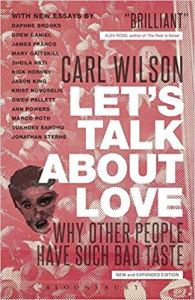 The basic idea of poptimism has been around since the late 1880s, but it took more than a century to really take off. In the decade after Sanneh’s article, there was a poptimism bubble: it rose to huge popularity, especially with the publication of Carl Wilson’s 2007 book on fans of cheesy pop music. That bubble started to burst about 9 or 10 years after that book appeared as critics began to sour on poptimism. Though it was initially understood as a radical upheaval of the powers that be, by 2017 poptimism had been co-opted by those powers. Instead of challenging patriarchal gender systems, poptimism reinforced them. Writing in The Quietus, Michael Hann argues that “Poptimism, in practice, has not meant championing those who do not get the acclaim they are due, so much as celebrating the position of artists who don’t need their genius proclaimed” such as Beyonce or Taylor Swift. The oft-noted death of the negative album review suggests that [p]optimism is now the orthodox practice among music critics. (This also coincides with recent trends in academic literary theory, which prize “reparative” readings over critical ones.) Such concerns have led Rob Harvilla to pose the rhetorical question “Have we reached the end of poptimism?” because what began as a feminist revolt now feels like an expectation or obligation to stan for the already powerful, such as corporations and megastars. Hann and Harvilla observe a change in poptimism, at least as it is practiced in the music media and industry: poptimism feels less like rooting for undervalued and underrepresented women and more like cheerleading for The Man. Harvilla speculates about poptimism’s end because this corporate poptimism betrays the movement’s original ideals and values.
Why did the poptimism bubble happen when it did? There were many contributing factors, such as the rise of what sociologists Richard Peterson and Roger Kern call “omnivorous taste,” which is the idea that elites prefer both traditional highbrow culture and a range of lowbrow forms, a.k.a. “I like everything but [usually country or hip hop].” Evolutions in feminist media and activism are another central cause of the poptimist bubble. Because pop is an inherently gendered category defined by its feminization, poptimism’s evolution is closely tied to feminism’s. The poptimism bubble roughly coincides with the period when feminism broke the mainstream and mutated into popular feminism.
This is more than just a correlation or coincidence. “Pop” is a gendered category, so its evolution is inextricably tied to evolving gender norms and politics. Poptimism emerged at the dawn of a broader “woke” turn in popular media and pop culture. The first decades of the 21st century saw the rise of a proliferation of explicitly feminist web publications (Autostraddle, Broadly, Jezebel, etc.) and the circulation of feminist theory outside the academy on social media sites like tumblr. 2014, the year Beyonce brought the big pink “FEMINIST” sign to the VMAs, was the year that feminism broke the mainstream. As media studies scholar Sarah Banet-Wesier argues, around 2014 a variety of white liberal feminism focused primarily on individual economic (and sexual) empowerment; it “became a sort of product” that circulated both as a corporate and individual brand. “Feminism” sold us Tshirts, Spotify playlists, and a couple of Beyonce albums. Banet-Weiser’s term for this feminism as brand or business strategy is “popular feminism.” In 2018, poptimism works more or less like popular feminism: it turns the revaluation of things traditionally devalued because of their femininity into a way to make money.

Screenshot from Beyoncé’s 2014 VMAs performance.
Both popular feminism and corporate poptimism are the result of the same flawed thinking that believes inequality can be fixed just by empowering individuals and not by restructuring the institutions and conventions that structure our relations with one another. This thinking seeks to put formerly low-status things in high status places without reconfiguring the underlying fact that there is a status differential in the first place.
Banet-Weiser warns that popular feminism is only half of a two-sided coin: “popular misogyny…mimics the operation of popular feminism but flips and distorts the politics.” The incel movement is an example of popular misogyny: arguing that women oppress men by refusing to have sex with them, it takes the language of oppression developed by feminism and uses it to justify the idea of patriarchal sex-right. Similarly, the classical music blog “Slipped Disc” has been described as the “Breitbart of classical music” because its championing of the orthodox Western art music canon is “openly sexist, racist, and LGBT-phobic.” The 2018 Grammy Awards show presented both sides of this coin in stark clarity: as Maura Johnston noted, though the ceremony prominently featured a #MeToo performance from Kesha and other women artists, almost all the awards went exclusively to men.

Screenshot of Kesha’s performance of “Praying” at the 2018 Grammys.
Viewed in Banet-Weiser’s terms, the RIAA seems to be leveraging both sides of this coin to maximize its profits, practicing popular feminism in the streets but popular misogyny on the ballot. Like popular feminism, the RIAA’s poptimism values superficial markers of feminist progress because they obscure patriarchy’s retrenchment. For example, the two most definitive or canonical poptimist texts (the Sanneh article and Wilson book) are authored by cis men, so it may appear that poptimism hasn’t changed those institutions and conventions so much as conformed to them.
I agree with Banet-Weiser that though Feminism™ is certainly limited and insufficient, it can be a helpful gateway for beginners. Poptimism™ is similarly limited and insufficient, but we should think about how we can lead fans brimming with that kind of poptimism to a deeper engagement with the institutions and conventions that continue to value the same kinds of people and the music they make and like above others.
—
Featured image: “Pop” by Flickr user Andreas Andrews, CC BY-NC-ND 2.0
—
Robin James is Associate Professor of Philosophy at UNC Charlotte. She is author of two books: Resilience & Melancholy: pop music, feminism, and neoliberalism, published by Zer0 books last year, and The Conjectural Body: gender, race and the philosophy of music was published by Lexington Books in 2010. Her work on feminism, race, contemporary continental philosophy, pop music, and sound studies has appeared in The New Inquiry, Hypatia, differences, Contemporary Aesthetics, and the Journal of Popular Music Studies. She is also a digital sound artist and musician. She blogs at its-her-factory.com and is a regular contributor to Cyborgology.
—
 REWIND! . . .If you liked this post, you may also dig:
In Search of Politics Itself, or What We Mean When We Say Music (and Music Writing) is “Too Political”–Elizabeth Newton
Music Meant to Make You Move: Considering the Aural Kinesthetic–Imani Kai Johnson
Pushing Play: What Makes the Portable Cassette Recorder Interesting?–Gus Stadler
Share this:


Current Top Posts





April 2021

January 2020

November 2019

October 2019

August 2019

April 2014

November 2017

March 2015

December 2017

October 2015
 Sounding Out!

Recent Comments