From Spanish to English to Spanish: How Shakira’s VMA Performance Showcases the New Moment in Latin Music “Crossover”

***This post is co-written by Petra Rivera-Rideau and Vanessa Díaz
DOI: https://doi.org/10.59350/y5qq4-zt290
On the night of September 12, Colombian pop star Shakira made history as the first predominantly Spanish-language artist to be honored as MTV’s Video Vanguard at the Video Music Awards (VMAs). The award recognizes artists who have had a major and innovative impact on music videos and popular music. Shakira played a 10-minute medley of Spanish and English hits from her three-decades long career. Her performance demonstrated her breadth as an artist as she shifted from pop to rock to reggaetón.
Not only did she demonstrate her impressive musical range, but of her 69 singles, Shakira selected those that represent two significant crossover moments for Latin music. She sang hits like “Wherever, Whenever,” “Hips Don’t Lie,” and “She Wolf” from her English-language crossover in the early 2000s as part of the so-called “Latin Boom.” She sang 2001’s “Objection (Tango)” with the same samba/rock music arrangement she used at her very first VMA performance in 2002.
During this “Latin Boom” of the late 1990s and early 2000s, Shakira and other established Latin stars who had previously performed in Spanish, such as Ricky Martin, Marc Anthony, and the late Selena Quintanilla, dominated the charts with English-language albums. Despite their successful global careers in the Latin market—and the long history and influence of Latinx musicians in U.S. pop music–U.S. media consistently portrayed these artists as exotic newcomers to the scene, praised more for being “Latin lovers” than established musicians. The Latin boom stars were valued as spicy foreigners there to expose Americans to new, exotic Latin sounds – conga beats, flamenco-style guitar riffs, and festive horns – even as many of these songs draw from familiar rock/pop references. Draco Rosa, one Ricky Martin’s co-writers, remembers “channeling [Jim] Morrison” and “elements of big band … a little bit of surf guitar” in the 1999 smash “Livin’ La Vida Loca.”

Despite the Latin Boom’s English-language crossovers, the images and sounds associated with the moment underscored the artists’ foreignness, something that continues today. This year’s Grammys’ botched treatment of superstar Bad Bunny’s performance and acceptance speech, in which, in lieu of translations, the subtitles merely declared that his words were “non-English.” Spanish has long been used to signify Latinxs’ alleged foreignness and inability to assimilate into US life and culture despite the fact that Latinx communities have been part of the fabric of the US for centuries. In the context of increased anti-immigrant sentiment, the popularity of Spanish-speaking artists like Bad Bunny and Shakira takes on even greater significance.
Following the Grammy’s disastrous handling of Bad Bunny’s performance and speech, backlash ensued. A plethora of popular memes and even t-shirts proudly claiming non-English popped up almost overnight. New York Times’ critic and Princeton professor Yarimar Bonilla proclaimed that “Bad Bunny is [Winning in Non-English].” Celebrities from comedian Cristela Alonzo to rapper 50 Cent admonished CBS. Even California Congressman Robert Garcia sent a letter directly to the CBS president and CEO George Cheeks, writing that the incident “display[ed] a lack of sensitivity and foresight. For too many Spanish-speaking Americans, it felt disrespectful of our place in our shared society, and of our contributions to our shared culture.” CBS eventually released a tepid statement saying that their vendor was not adequately equipped to manage Benito’s Spanish-language speech and performance, and Cheeks took “full responsibility” for the incident. Overall, the Grammys snafu reflects the ways in which the American mainstream still is incapable of embracing the status of Latin artists as equal players in the US and global music markets, in any language.
Compared to this year’s Grammys, however, MTV’s VMAs offered a much more inclusive approach, with a historic perspective that demonstrated exactly how we were able to arrive at this new moment in Latin music. When Puerto Rican and Cuban American rapper Fat Joe and Mexican pop star Thalia presented the award for Best Latin video, Thalia reminded the audience that “in the 2000s’ first Latin explosion, we had a song together, and now we’re here celebrating again this new Latin explosion.” This new Latin explosion refers to the numerous Spanish-language artists like Shakira, Bad Bunny, Karol G, and Peso Pluma who have recently broken out in the US mainstream.
But, unlike the previous Latin Boom, these artists have maintained their Spanish and their musical style. Bad Bunny’s Grammy performance included plena, reggaeton, and merengue rather than the kitschy styles of his Latin Boom predecessors. In addition to selling out stadiums around the country, Karol G drew 15,000 fans, the largest crowd in the Today Show’s history, for her reggaetón performance as part of the program’s Summer Concert Series in Rockefeller Center. Just this past September, Eslabon Armado became the first Mexican regional music group to ever perform on Good Morning America with their chart-topping hit “Ella Baila Sola” (the first Mexican regional song to ever hit number one on Billboard’s Global 200 chart). Whether it is the percussive dembow beat of reggaetón or the syncopated horns of corridos tumbados, all of these musicians have maintained the sounds of their respective genres, foregoing the stereotypical “Latin” sonic signifiers historically associated with Latin music.
Shakira herself reflected this moment in her Video Vanguard performance. She performed her new Spanish-language songs as 2022’s “Te Felicito,” and 2023’s “TQG” and “Bzrp Music Sessions: Volume 53” (the latter having broken four Guinness world records, including the most streamed Latin track in 24 hours). All of these songs have been part of this new Latin music movement. In fact, her “TQG” collaborator Karol G also performed her Spanish hits at the show. Mexican regional phenom Peso Pluma sang “Lady Gaga” on a small stage, surrounded only by his band, and called out “¡arriba México!” at the end. Brazilian artist Anitta performed a multilingual medley from her Funk Generation: A Favela Love Story. In addition, Shakira and Karol G won the award for best collaboration for “TQG.” Not only did the women give their acceptance speech in Spanish, shouting out their home country of Colombia, but they also won in a category otherwise populated by mainstream English-language artists like Doja Cat with Post Malone, and Metro Boomin with The Weeknd, 21 Savage, and Diddy. The interchangeable, tropical Latinidad of the earlier Latin boom was replaced with shout outs to specific countries and regions, and the crowd proudly waved Mexican, Puerto Rican, and Colombian flags. At the VMAs, Latin musicians were not isolated in Latin awards categories or depicted as exotic novelties. They were central to the show – nominated for major awards, and celebrated for some of the night’s most memorable performances.
Much like this year’s Coachella, which featured Bad Bunny and K-Pop sensation Black Pink as headliners, this year’s VMAs reflects a more global approach to pop music. Tuesday night’s award show also featured two performances by K-Pop groups, and MTV offered its first ever award in Best Afrobeats. In this context, it makes sense that Latin music would have a significant presence in the program. But the dominance of Latin music right now makes it so that no part of the music industry can leave Latin music out anymore. Not the VMAs, not the Grammys, not Coachella. As Thalia proudly declared on stage, “this last year for the first time in the US Latin music made a billion dollars in streaming.” Bad Bunny has been the most streamed artist on Spotify for three years in a row, has the longest-running Spanish-language album at the top of the Billboard chart, and in 2022 became the only artist in history to stage two separate $100 million-grossing tours in less than 12 months. Karol G became the first woman to have a Spanish-language debut at number one, and came to the VMAs after a string of historic performances at her Mañana Será Bonito stadium tour. Latin music’s global appeal is undeniable and the industry has to respond accordingly.
This is among the most important times in history for Latin music, and honoring artists like Shakira center stage at the VMAs helps underscore the musical evolution we are lucky enough to witness. Twenty years ago, Shakira had to crossover into the US market in English; now she performs in her native Spanish and is more relevant than ever. The global success of stars like Peso Pluma, Karol G, and Bad Bunny means we need to completely reevaluate the concept of the crossover. Latin artists today did not crossover, the market crossed over into them. They are not compromising their language, their identity, or their culture. They do not have to kowtow to industry expectations that they perform the exotic, sexy Latin other. So while the VMA Vanguard Award winner Shakira may have had to crossover into English to make it during the ‘90s Latin boom, she can proudly return to her roots and, this time, the market will follow her.
—
Featured Image: Screen shot by SO! from Shakira’s MTV 2023 Video Vanguard acceptance speech
—
Petra Rivera-Rideau is Associate Professor of American Studies at Wellesley College, and the author of Remixing Reggaetón: The Cultural Politics of Race in Puerto Rico and the forthcoming book Fun, Fitness, Fiesta: Selling Latinx Culture in Zumba Fitness.
Vanessa Díaz is Associate Professor of Chicana/o and Latina/o Studies at Loyola Marymount University, and the author of Manufacturing Celebrity: Latino Paparazzi and Women Reporters in Hollywood. Díaz and Rivera-Rideau are the co-creators of the Bad Bunny Syllabus.
—

REWIND!…If you liked this post, you may also dig:
Ronca Realness: Voices that Sound the Sucia Body—Cloe Gentile Reyes
Contra La Pared: Reggaetón and Dissonance in Naarm, Melbourne—Lucreccia Quintanilla
Unapologetic Paisa Chingona-ness: Listening to Fans’ Sonic Identities–Yessica Garcia Hernandez
SO! Podcast #74: Bonus Track for Spanish Rap & Sound Studies Forum
Listening (Loudly) to Spanish-Language Radio– D. Inés Casillas
—
Share this:

“Caught a Vibe”: TikTok and The Sonic Germ of Viral Success
DOI:https://doi.org/10.59350/x126q-b4h79
“When I wake up, I can’t even stay up/I slept through the day, fuck/I’m not getting younger,” laments Willow Smith of The Anxiety on “Meet Me at Our Spot,” a track released through MSFTSMusic and Roc Nation in March of 2020. Despite the song’s nature as a “sludgy alternative track with emo undertones that hits at the zeitgeist,” “Meet Me at Our Spot” received very little attention after its initial release and did not chart until the summer of 2021, when it went viral on TikTok as part of a dance trend. The short-form video app which exploded in popularity during the COVID-19 pandemic, catalyzed the track’s latent rise to success where it reached no. 21 on the US Billboard Hot 100, becoming Willow’s highest charting song since her 2010 hit, “Whip My Hair”.
The app currently known as TikTok began as Musical.ly, which was shuttered in 2017 and then rebranded in 2018. By March of 2021, the app boasted one billion worldwide monthly users, indicative of a growth rate of about 180%. This explosion was in many ways catalyzed by successive lockdowns during the first waves of the COVID-19 pandemic. Despite the relaxation and subsequent abandonment of COVID mitigation measures, the app has retained a large volume of its users, remaining one of the highest grossing apps in the iOS environment. TikTok’s viral success (both as noun and adjective) has worked to create a kind of vibe economy in which artists are now subject to producing a particular type of sound in order to be rendered legible to the pop charts.
For anyone who has yet to succumb to the TikTok trap, allow me to offer you a brief summary of how it functions. Upon opening it, you are instantly fed content. Devoid of any obvious internal operating logic, it is the media equivalent of drinking from a fire hose. Immersive and fast-paced, users vertically scroll through videos that take up their entire screen. Within five minutes of swiping, you can–if your algorithm is anything like mine–see: cute pet videos, protests against police brutality, HypeHouse dance trends, thirst traps, contemporary music, therapy tips, attractive men chopping wood, attractive women lifting weights, and anything else you can fathom. Since its shift from Musical.ly, the app has also been a staging ground for popular music hits such as Lil Nas X’s’ “Old Town Road”, Lizzo’s “Good As Hell”, and, recently, Harry Styles’ “As It Was.”
The app, which is the perfect–if chaotic–fusion of both radio and video is enmeshed in a wider media ecosystem where social networking and platform capitalism converge, and as a result, it seems that TikTok is changing the music industry in at least three distinct ways:
First, it affects our music consumption habits. After hearing a snippet of a song used for a TikTok, users are more likely to queue it up on their streaming platform of choice for another, more complete listen. Unlike those platforms, where algorithms work to feed a listener more of what they’ve already heard, TikTok feeds a listener new content. As a result, there’s no definitive likelihood that you’ve previously heard the track being used as a sound. Therefore, TikTok works the way that Spotify used to: as a mechanism for discovery.
Second, TikTok is changing the nature of the single. Rather than relying upon a label as the engine behind a song’s success, TikTok disseminates tracks–or sounds as they’re referred to in the app–widely, determining a song’s success or role as a debut within a series of clicks. Particularly during the pandemic, when musicians were unable to tour, TikTok’s relationship to the industry became even more salient. Artists sought new ways to share and promote their music, taking to TikTok to release singles, livestream concerts, and engage with fans. Moreover, Spotify’s increasingly capacious playlist archive began to boast a variety of tracklists with titles such as, “Best TikTok Songs 2019-2022”, “TikTok Songs You Can’t Get Out Of Your Head”, and “TikTok Songs that Are Actually Good” among others. The creation and maintenance of this feedback loop between TikTok and Spotify demonstrates not only the centrality of social media ecosystems as driving current popular music success, but also the way that these technologies work in harmony to promote, sustain, or suppress interest in a particular tune.
Most notoriously, the bridge of Olivia Rodrigo’s “drivers license”, went viral as a sound on TikTok in January 2021 and subsequently almost broke the internet. Critics have praised this 24-second section as the highlight of the song, underscoring Rodrigo’s pleading soprano vocals layered over moody, syncopated digital drums. Shortly after it was released, the song shattered Spotify’s record for single-day streams for a non-holiday song. New York Times writer Joe Coscarelli notes of Rodrigo’s success, “TikTok videos led to social media posts, which led to streams, which led to news articles , and back around again, generating an unbeatable feedback loop.”
And third, where songwriting was once oriented towards the creation of a narrative, TikTok’s influence has led artists to a songwriting practice that centers on producing a mood. For The New Yorker, Kyle Chayka argues that vibes are “a rebuke to the truism that people want narratives,” suggesting that the era of the vibe indicates a shift in online culture. He argues that what brings people online is the search for “moments of audiovisual eloquence,” not narrative. Thus, on the one hand, media have become more immersive in order to take us out of our daily preoccupations. On the other, media have taken on a distinct shape so that they can be engaged while doing something else. In other words, media have adapted to an environment wherein the dominant mode of consumption is keyed toward distraction via atmosphere.

Despite their relatively recent resurgence in contemporary discourse, vibes have a rich conceptual history in the United States. Once a shorthand for “vibration” endemic to West Coast hippie vernacular, “vibes” have now come to mean almost anything. In his work on machine learning and the novel form, Peli Grietzer theorizes the vibe by drawing on musician Ezra Koenig’s early aughts blog, “Internet Vibes.” Koenig writes, “A vibe turns out to be something like “local colour,” with a historical dimension. What gives a vibe “authenticity” is its ability to evoke–using a small number of disparate elements–a certain time, place, and milieu, a certain nexus of historic, geographic, and cultural forces.” In his work for Real Life, software engineer Ludwig Yeetgenstein defines the vibe as “something that’s difficult to pin down precisely in words but that’s evoked by a loose collection of ideas, concepts, and things that can be identified by intuition rather than logic.” Where Mitch Thereiau argues that the vibe might just merely be a vocabulary tick of the present moment, Robin James suggests that vibes are not only here to stay, but have in fact been known by many other names before. Black diasporic cultures, in particular, have long believed sound and its “vibrations had the power to produce new possibilities of social attunement and new modes of living,” as Gayle Wald’s “Soul Vibrations: Black Music and Black Freedom in Sound and Space,” attests (674). We might then consider TikTok a key method of dissemination for a maximalist, digital variant of something like Martin Heidegger’s concept of mood (stimmung), or Karen Tongson’s “remote intimacy.” The vibe is both indeterminate and multiple, a status to be achieved and the mood that produces it; vibes seek to promote and diffuse feelings through time and space.
Much current discourse around vibes insists that they interfere with, or even discourage academic interpretation. While some people are able to experience and identify the vibe—perform a vibe check, if you will—vibes defy traditional forms of academic analysis. As Vanessa Valdés points out, “In a post-Enlightenment world that places emphasis on logic and reason, there exists a demand that everything be explained, be made legible.” That the vibe works with a certain degree of strategic nebulousness might in fact be one of its greatest assets.

Vibes resist tidy classification and can thus be named across a variety of circumstances and conditions. Although we might think of the action of ‘vibing’ as embodied, and the term vibration quite literally refers to the physical properties of sound waves and their travel through various mediums, the vibe through which those actions are produced does not itself have to be material. Sometimes, they name a genre of feeling or energy: cursed vibes or cottagecore vibes. Sometimes, they function as a statement of identification: I vibe with that, or in the case of 2 Chainz’s 2016 hit, “it’s a vibe.” Sometimes, vibes are exchanged: you can give one, you can catch one, you can check one, So, while things like energy and mood—which are often taken as cognates for vibes—work to imagine, name, and evoke emotions, vibes are instead invitations.
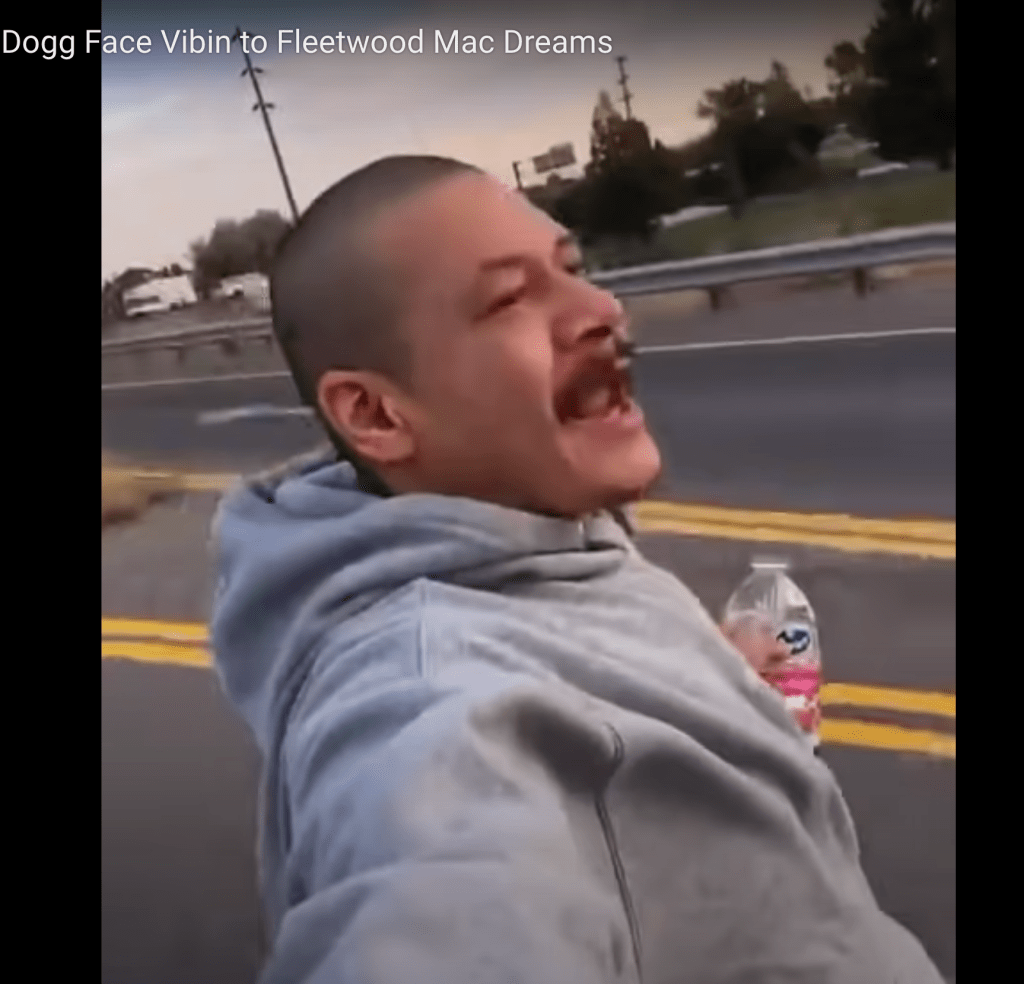
Not only do vibes serve as a prompt for an attempt at articulating experience, they are also invitations to co-presently experience what seems inarticulable. By capturing patterns in media and culture in order to produce a coherent image/sound assemblage, the production of a vibe is predicated upon the ability to draw upon large swathes of visual, aural, and environmental data. Take for example, the story of Nathan Apodaca, known by his TikTok handle as: 420doggface208. After posting a video of himself listening to Fleetwood Mac’s “Dreams” while drinking cranberry juice and riding a longboard, Apodaca went viral, amassing something like 30 million views in mere hours. This subsequently sparked a trend in which TikTok users posted videos of themselves doing the same thing, using “Dreams” as the sound. According to Billboard, this sparked the largest ever streaming week for Fleetwood Mac’s 1977 hit with over 8.47 million streams. Of his overnight success, Apodaca says, “it’s just a video that everyone felt a vibe with.” To invoke a vibe is thus to make a particular atmosphere more comprehensible to someone else, producing a resonant effect that draws people together.
As both an extension and tool of culture, vibes are produced by and imbricated within broader social, political, and economic matrices. Recorded music has always been confined—for better and worse—to the technologies, formats, and mediums through which it has been produced for commercial sale. On a platform like TikTok, wherein the emphasis is on potentially quirky microsections of songs, artists are invited to key their work towards those parameters in order to maximize commercial success. Nowadays, pop songs are produced with an eye towards their ability to go viral, be remixed, re-released with a feature verse, meme’d, or included in a mashup. As such, when an artist ‘blows up’ on TikTok, it does not necessarily mean that the sound of the song is good (whatever that might mean). Rather, it might instead be the case that a hybrid assemblage of sound, performance, narrative, and image has coalesced successfully into an atmosphere or texture – that we recognize as a/the vibe – something that not only resonates but also sells well. As TikTok’s success continues to proliferate, the app is continually being developed in ways that make it an indispensable part of the popular music industry’s ecosystem. Whether by exposing users to new musical content through the circulation of sounds, or capitalizing upon the speed at which the app moves to brand a song a ‘single’ before it’s even released, TikTok leverages the vibe to get users to listen differently.
@jimmyfallon This one’s for you @420doggface208 #cranberrydreams#doggface208#dogfacechallenge♬ original sound – Jimmy Fallon

We might indeed consider vibes to be conceptual, affective algorithms created in the interstice between lived experience and new media. “Meet Me At Our Spot,” the track through which I’ve framed this article, is full of allusions to youth culture: drunk texts, anxiety over aging, and late-night drives on the 405. It is buoyed by a propulsive bass line that thumps with a restless energy and evokes a mood of escapism. Willow Smith’s intriguing timbre and the pleasing harmonies she achieves with Tyler Cole invite listeners to ride shotgun. For the two minutes and twenty-two seconds of the song, we are immersed within their world. In the final measures the pop of the snare recedes into the background and Tyler’s voice fades away. The vibe of the track – both sonically and thematically – is predicated on the experience of a few, fleeting moments. Willow leaves us with a final provocation, one that resonates with popular music’s current mode: “Caught a vibe, baby are you coming for the ride?”
—
Featured Image: Screencap of Nathan Apodaca’s viral TikTok post, courtesy of SO! eds.
—
Jay Jolles is a PhD candidate in American Studies at the College of William and Mary currently at work on a dissertation tentatively titled “Man, Music, and Machine: Audio Culture in a/the Digital Age.” He is an interdisciplinary scholar with interests in a wide range of fields including 20th and 21st century literature and culture, critical theory, comparative media studies, and musicology. Jay’s scholarly work has appeared in or is forthcoming from The Los Angeles Review of Books, U.S. Studies Online, and Comparative American Studies. His essays can be found in Per Contra, The Atticus Review, and Pidgeonholes, among others. Prior to his time at William and Mary, he was an adjunct professor of English at Drexel University and Rutgers University-Camden.
—

REWIND! . . .If you liked this post, you may also dig:
Listen to yourself!: Spotify, Ancestry DNA, and the Fortunes of Race Science in the Twenty-First Century”–Alexander W. Cohen
Evoking the Object: Physicality in the Digital Age of Music–-Primus Luta
“Music is not Bread: A Comment on the Economics of Podcasting”-Andreas Duus Pape
“Pushing Record: Labors of Love, and the iTunes Playlist”–Aaron Trammell
Critical bandwidths: hearing #metoo and the construction of a listening public on the web–Milena Droumeva
TiK ToK: Post-Crash Party Pop, Compulsory Presentism and the 2008 Financial Collapse—Dan DiPiero (The other “TikTok”! The people need to know!)
—
Share this:




Current Top Posts


April 2021
January 2020
November 2019

October 2019

August 2019

April 2014

November 2017
March 2015
December 2017

October 2015


Recent Comments