
“HOW YOU SOUND??”: The Poet’s Voice, Aura, and the Challenge of Listening to Poetry
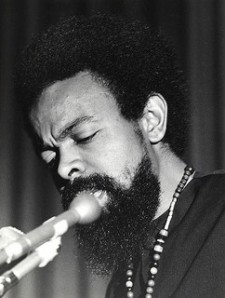
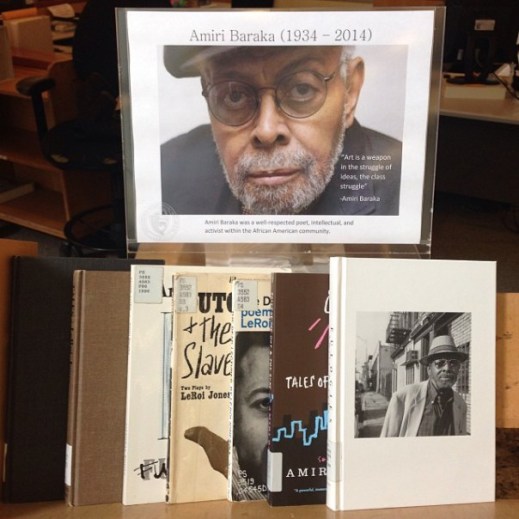
This post is dedicated to the memory of Amiri Baraka, who passed away on January 9, 2014 in Newark, New Jersey.
DOI: https://doi.org/10.59350/89g4m-6zm59
I began writing this post while my wife, Sarah, was at a conference on writing curriculum for high school literature. Over the phone one night she asked how to help students better understand the language of Shakespeare, and at a loss for suggestions (not only because I don’t study early modern drama), I recalled my own adolescent struggles with Macbeth, Hamlet, and Julius Caesar. I recalled well-intentioned teachers who gave me recordings, telling me that they would help me get an “ear” for Shakespeare’s language—yet all I remember, maybe all I learned, while listening to the Caedmon recording of Macbeth on vinyl, was that, to my mid-1990s ear, Shakespeare (anachronistically) sounded like Star Wars (which appeared 15 years after the 1960 Caedmon album).
My high school confusion has not completely faded when it comes to the sound of recorded poetic language, even more so when the notion of the poet’s voice is thrown into the mix. As opposed to verse recited by actors (the Caedmon Macbeth featured Anthony Quayle), or the sound of the syllables when we read a poem silently to ourselves, I find it tough to parse the idea of the sound of the poem in terms of the poet’s voice because “voice” is a slippery category—a constructed one, contingent upon the given historical moment of inscription and reception. It is tough because this idea of the sound of the poem, located in the voice of the poet, gets complicated with sonic technologies where voice is subject to the shifting conditions of fidelity.
The act of listening to recorded poetry thus poses particular analytic challenges, which become more complex when the politics of identity are brought to bear on these questions of voice and poetry. As a site for identity production, the recorded poetry performance projects a mediated voice that is a potential self. The “sound” of this poetic subjectivity is different from recording to recording, even of the same poem. In an effort to work through these complexities, this post takes up three different recordings of Amiri Baraka’s poem “Black Dada Nihilismus,” which offer variations in delivery and performance that each depend upon the social, political, and aesthetic dimensions of the soundscape that each recording is embedded within.
“Black Dada Nihilismus” is an excellent opportunity to consider the overlapping challenges of voice, performance and the politics of identity in recorded poetry. Published in the early 1960s, this poem was written before Baraka’s shift in politics, which was precipitated by the assassination of Malcolm X in 1965, yet the poem anticipates the intersection of aesthetics and politics during the Black Arts Movement in the late 1960s into the 70s. This shift can be tracked in the sonic details of the first two recordings, made in 1964 and 1965. In the third version, a 1993 remix by DJ Spooky, we can hear how this shift reverberates beyond its historical moment.
In a statement of poetics included in Donald Allen’s classic 1959 anthology The New American Poetry, Baraka (then Leroi Jones) asked: “HOW YOU SOUND??” How a poet’s poem sounded mattered most for him: “you have to start and finish there … your own voice … how you sound” (425). Primarily referencing the poem on the page, he wasn’t whistling in the dark: often thought of as a vocal performance of language, poetry has a long history with sound. One thread of this history is the Homeric tradition of an “oral poetics,” a tradition where, as Albert Lord notes in The Singer of Tales, socialized performances of poetry were simultaneously modes of composition. The feel of language in the body remained inseparable from the poetry that relayed the heroic tales of the ancient world. In The Sounds of Poetry, Robert Pinsky offers a similar account of sound and voice, suggesting that the “sound” of language, the sensuous play of speech, is the material for poetic composition. Or as Charles Bernstein has it in Close Listening, “poetry needs to be sounded” because it is a way to understand it better (7).
Poetry is often said to be difficult—but how would a poet’s “sounding” of a poem help a listener better understand it, as Bernstein suggests? How is the recorded voice resonating in air different from inert marks on a page? What is the status of that difference? Why or how would the sound recording signify differently than the poem on the silent page? In short, is listening easier than reading? My answer to the final question is a resounding “no.” For me, the challenge is how to consider the recorded poetry performance in both formal and aural terms so as to remain tuned in to the aesthetic and the poetic as well as the social and historical dimensions of a particular poet’s work. This is not easily done.
“Black Dada Nihilismus” was first published in The Dead Lecturer (1964) and later included in Transbluesency (1995). Written in two parts, it asserts a black aesthetic by critiquing the dominance of (white) light in Western art and suggesting a connection between this light, ethnic violence, and religious ideology. This is how the poem opens:
.Against what light
is false what breath
sucked, for deadness.
Murder, the cleansed
purpose, frail, against
God, if they bring him
Bleeding, I would not
forgive, or even call him
black dada nihilismus.
The protestant love, wide windows,
color blocked to Modrian, and the
ugly silent deaths of jews […]
(Transbluesency 97)
Through critique the poem develops the connections between aesthetics and racial dominance and violence. These connections take on different inflections in each recorded version of the poem, and with each inflection another aspect of them is amplified.
The first version is a bootleg of a reading at the Asilomar Negro Writers Conference that was held in Pacific Grove, California, in early August, 1964.
In addition to the preamble, where Baraka explains some of the poem’s key terms such as Dada, which he describes as a movement in France (rather than Germany or Switzerland), another sonic detail that marks this as “live” is at the 2:59 minute mark when we hear the flap of a turning page, reminding us that Baraka is treating the poem as a script in these recordings. In this version, the opening lines are sharply delivered, the voice fully pausing at the linebreaks and acutely pronouncing the hard vowels (e.g. “sucked”). Against the continuous background hush of the original reel-to-reel recording, Baraka punches his words into the air, as if trying to find a rhythm between these harder vowels and the softer ones that often denote the poem’s object of critique (e.g. “light”).
The next version is off the A side of New York Art Quartet and Imamu Amiri Baraka (ESP Disk 1965), where the poem’s rhythm is immediately established by the musical accompaniment.
Between the first recording and this one a shift began in Baraka’s development as a poet. The assassination of Malcolm X pushed him to think even more about race, politics, and art. In this version the opening lines, delivered with punch and pause in the bootleg, take on a different register when juxtaposed with the smooth coolness of the quartet. Overall, though, the poem is delivered more militantly here. In the first version the opening lines are delivered forcefully, but ultimately this forcefulness subsides over the course of the reading. The opposite is the case in this studio version that slowly builds to the apex of the poem, the point of most force, this stanza:
Black scream
and chant, scream,
and dull, un
earthly
hollering.
(Transbluesency 99)
In the bootleg, the turn of the page—between “earthly” and “hollering”—interrupts this stanza, and Baraka hesitates and slowly finds his way toward the poem’s close, while in the studio version, the musical accompaniment reaches a fevered pitch here, making it feel as if it is at the edge of the scream that it names. This prepares us for the closing litany of names of black figures of “black dada nihilismus,” which goes like this:
For tambo, willie best, dubois, patrice, mantan, the
bronze buckaroos.
For Jack Johnson, asbestos, tonto, buckwheat,
billie holiday.
(Ibid.)
In the final version, which is DJ Spooky’s remix of the second one, included on the CD Offbeat: A Red Hot Soundtrip (TVT Records 1996), this litany feels more like the outro (that is meant as) against Spooky’s beats and moody reverb.
An aspect of the poem amplified in the remix is the stanzas leading up to the apex stanza of the “black scream.” In a series of tercets that open the second section, the speaker addresses the experience of racial oppression and a growing need to strike back:
The razor. Our flail against them, why
you carry knives? Or brutaled lumps of
heart? Why you stay, where they can
reach? Why you sit, or stand, or walk
in this place, a window on a dark
warehouse […]
(Transbluesency 98)
The “why” is significantly amplified in the remix, forcing us to hear the ironic indictment of the oppressive “light,” not as audible in the other two tracks, explicit in Baraka’s tercets.
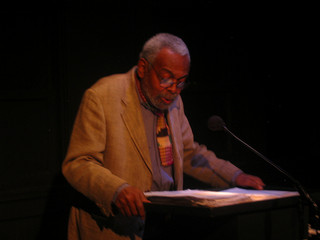
The original recordings of these versions of “Black Dada Nihilismus” are each in a different format: vinyl LP, tape-to-tape reel, and CD. I have been working with digitized versions, so the way I am hearing these recordings—through a smooth digitized MP3 file or Youtube clip—is not the same as the crackle of a needle running an LP’s groove or a nearly noiseless laser tracing a CD. These variations in format mean that the different ways these versions individual signify—their respective “sounds”—are flattened out by compression. Despite this loss of material context, Baraka still sounds different in each of these tracks. Each version of Baraka’s poem offers us another iteration of his “voice,” and the poem, but listening to each of them does not necessarily provide a better understanding of it. We are, though, given different sonic experiences that depend upon the purpose of Baraka’s performance, the listener imagined during the reading, and the voice enunciated through the mediated environment.
Some of the voice details do remain consistent across these recordings. For example, the delivery of one of the poem’s most memorable phrase—“Hermes, the/the blacker art”—that occurs toward the close of the poem’s first section is steadily delivered in a lower register, in the hush of an aside, and might be taken as the motif of each of these variations.
A vast archive of recorded poetry exists. Mid-century recording projects by Caedmon and Folkways made “voices” of well-known poets, such as Robert Frost and Dylan Thomas, available for mainstream consumption. More recent anthologies and series like Poetry Speaks and The Voice of the Poet suggest that the “voice of the poet” still holds appeal. The proliferation of online sound archives such as Penn Sound and From the Fishouse further attest to an ongoing investment in recording, storing, and making available sound files of poets reading their work. And this fascination with the “sound” of poetry is not limited to mainstream cultural spheres or web-based archives. Several scholarly collections on this convergence of sound, voice, and poetry such as Bernstein’s already-mentioned Close Listening, Adelaide Morris’s Sound States, and Marjorie Perloff’s and Craig Dworkin’s The Sound of Poetry/The Poetry of Sound have appeared over the last decade.
The idea of the sound of the poem, located in the mediated voice of the poet, therefore remains relevant today. In many of these instances, however, the poet’s voice falsely takes on an authoritative “aura,” as Walter Benjamin used that word in his (recently re-translated) “The Work of Art in the Age of Its Technological Reproducibility.” Benjamin uses “aura” to talk about authenticity in art and how that is lost when images (or sounds) can be reproduced and widely distributed, and this is not a bad thing: “technological reproducibility emancipates the work of art from its parasitic subservience to ritual. To an ever-increasing degree, the work produced becomes the reproduction of work designed to be reproduced” (24). When Benjamin’s concept is applied to recorded poetry, two key points emerge. First, the “sound” of a poet’s voice is the product of technological conditions. Second, just as a book editor makes aesthetic judgments based on a perceived audience, a listener is imagined when a poetry performance is recorded. Too bad I didn’t know this in high school.
—
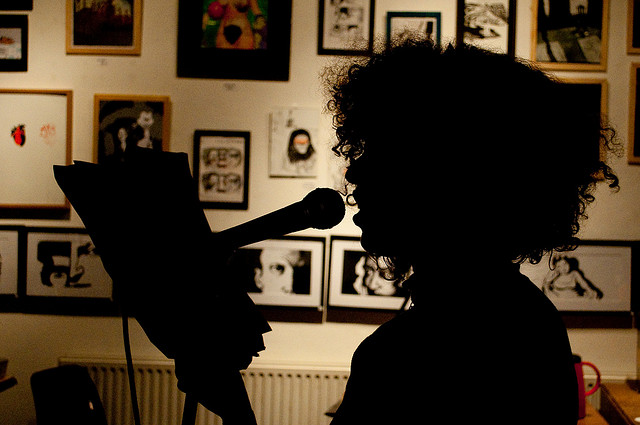
Featured image: “Paula Varjack” by Flickr user Very Quiet, CC-BY-SA-2.0
—
John Hyland recently completed his dissertation on sound, poetics, and the Black diaspora, titled “Atlantic Reverberations: The Sonic Performances of Black Diasporic Poetries,” at the University at Buffalo, SUNY. His poems, essays, and reviews have appeared (or are forthcoming) in a range of journals, such as The Journal of Postcolonial Writing, College Literature, and Borderlands. Recently, he has enjoyed performing with the Buffalo Poets Theater and co-edited a special issue of the poetry journal kadar koli on the relationship between violence and the expressive arts.
—

REWIND! . . .If you liked this post, you may also dig:
Hearing the Tenor of the Vendler/Dove Conversation: Race, Listening, and the “Noise” of Texts-Christina Sharpe
Pretty, Fast, and Loud: The Audible Ali–Tara Betts
The Sounds of Anti-Anti-Essentialism: Listening to Black Consciousness in the Classroom-Carter Mathes
Share this:

Fiddling With Freedom: Solomon Northup’s Musical Trade in 12 Years a Slave

DOI: https://doi.org/10.59350/gn8rg-bat87
Editor’s Note: Sound Studies is often accused of being a presentist enterprise, too fascinated with digital technologies and altogether too wed to the history of sound recording. Sounding Out!‘s last forum of 2013, “Sound in the Nineteenth Century,” addresses this critique by showcasing the cutting edge work of three scholars whose diverse, interdisciplinary research is located soundly in the era just before the advent of sound recording: Mary Caton Lingold (Duke), Caitlin Marshall (Berkeley), and Daniel Cavicchi (Rhode Island School of Design). In examining nineteenth century America’s musical practices, listening habits, and auditory desires through SO!’s digital platform, Lingold, Marshall, and Cavicchi perform the rare task of showcasing how history’s sonics had a striking resonance long past their contemporary vibrations while performing the power of the digital medium as a tool through which to, as Early Modern scholar Bruce R. Smith dubs it, “unair” past auditory phenomena –all the while sharing unique methodologies that neither rely on recording nor bemoan their lack. Today, the series kicks off with Mary Caton Lingold‘s exploration of the materialities of Solomon Northup’s fiddling as represented through sheet music embedded in his 1853 narrative, amplifying a sound that was key to both his freedom and his enslavement.–Jennifer Stoever, Editor-in-Chief
—
Steve McQueen’s recent film Twelve Years a Slave has renewed interest in the original 1853 narrative, which has long been a valued resource for historians of nineteenth-century slavery, literature, and music. Because Solomon Northup was a highly-skilled fiddler and a keen observer of plantation culture, his autobiography is one of the most substantive accounts of musical life during slavery and, to my knowledge, the only slave narrative that includes sheet music in its text. As such, it preserves in audible form a precious record of Northup’s musical artistry and facilitates a sound-based study of nineteenth-century black fiddling, a tradition that was flourishing during Northup’s lifetime.
Uncovering the sounds of vernacular music of the pre-recorded era can be incredibly challenging. For this reason, Northup’s descriptions, when coupled with musical notation, make it possible for us to hear something historically significant. Although “slave music” was all the rage in the 1850s due to the widespread popularity of blackface minstrelsy, print-based compositions by enslaved (or free) musicians are difficult to come by and even more challenging to verify. The tune presented in Northup’s memoir has its own complex relationship to the minstrelsy genre, but it remains a unique sample of African-American music that warrants close-listening.
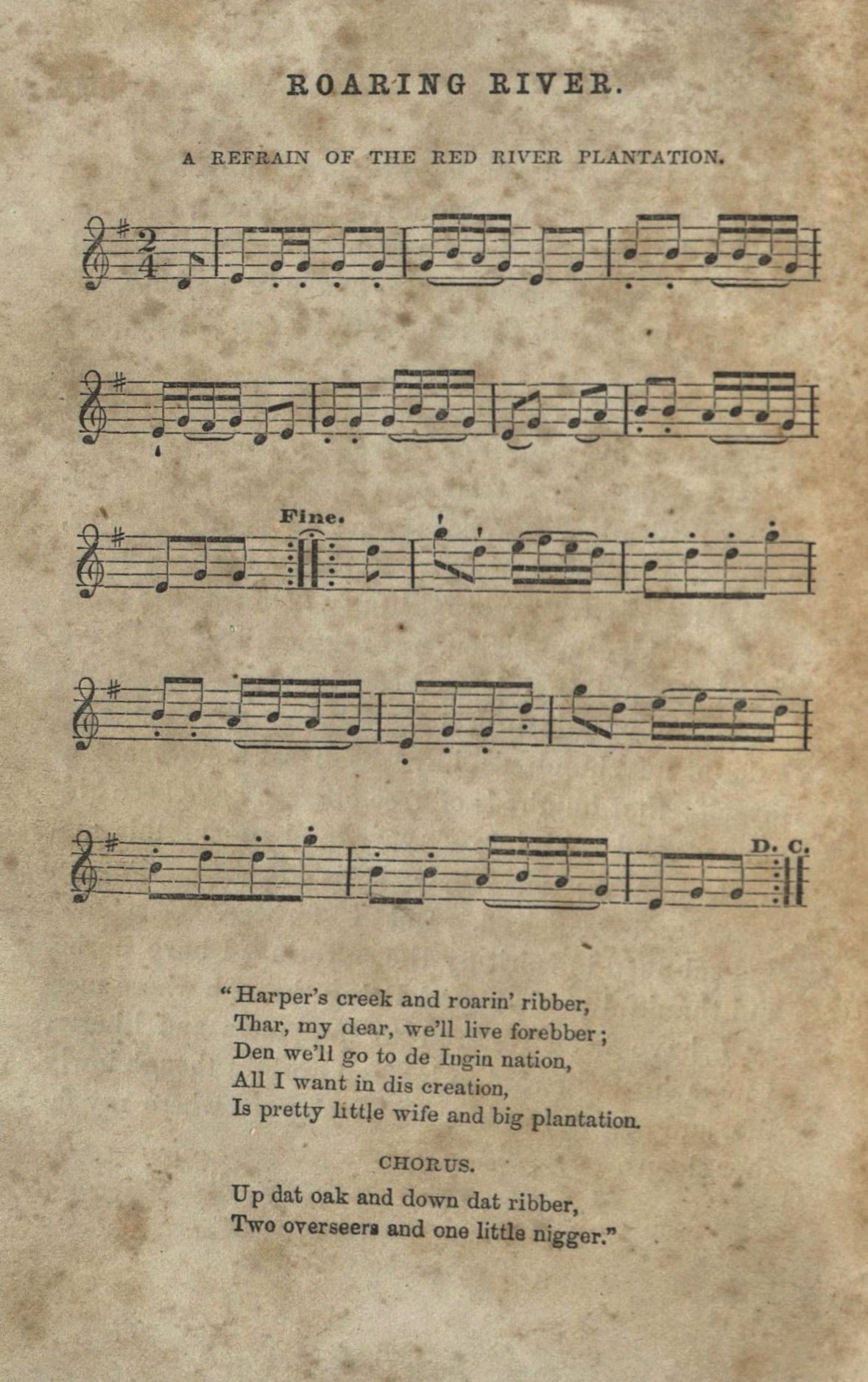
I use performance as a research method for exploring historical vernacular music, offering here my interpretation of “Roaring River: A Refrain of the Red River Plantation.” As I discuss in an essay titled “Listening to the Past,” the process of performance illuminates the subtleties of musical expression. (Do I play it like this or like that? At what tempo?) The aim of such exercises is not historical accuracy, but rather, an attunement to the sonic possibilities of a given piece. These possibilities cannot tell me how Northup would have played the song or what it meant to him, but they allow me to consider the kinds of choices that he would have had to make as a performer, thus illustrating the intellectual and sensorial richness of his music-making. Rather than simply presenting and describing the sheet music, I aim to make it possible for people to hear what would otherwise sit silently on the page.
In the first recording I play Northup’s melody solo to give you a sense of the tune.
In the second, I am joined by guitar.
The use of guitar accompaniment would have been highly unlikely during the period, but it helps to support my amateur playing by providing a livelier, fuller feeling. Northup connected with banjoists, percussionists and dancers as an enslaved and free musician and it’s interesting to imagine how a single song like this would have been transformed according to the talents, desires, and constraints of the performers assembled. It is unclear from the narrative whether or not the tune is an original composition or something Northup learned while living along the Red River, where he was enslaved in Louisiana. One also wonders how many nineteenth-century readers would have plucked the melody at a keyboard or bowed it on a family fiddle. What might their motivations have been?
Though Northup does not discuss the fiddle tune in the text, he does describe the lyrics below it, remarking that they were accompanied by a percussion technique called “patting” among his fellow slaves. He describes this widely documented practice as follows: “The patting is performed by striking the hands on the knees, then striking the hands together, then striking the right shoulder with one hand, the left with the other—all the while keeping time with the feet, and singing” (219). According to Northup, the lyrics that accompanied patting were often nonsensical because they were made to conform to the tonal and rhythmic pattern being patted. He offers “Harper’s Creek” as suitable for the practice but it’s worth noting that the lyrics voice a presumably white man’s desires to own a piece of land and a slave. Though presented below the sheet music at the end of the book, the lyrics are ill-fitting for the fiddle tune provided, which seems more likely to have been played without vocal accompaniment. In light of Northup’s descriptions, the sheet music creates an interesting blend of various performance modes, from popular folksy vocal diddy (with possible origins in minstrelsy), to patting, and fiddling. Here you can see a wonderful example of patting accompanying a nineteenth-century fiddle tune as performed by the Carolina Chocolate Drops and guest Danny Barber (Intricate patting begins at 1:22).
In addition to serving as auditory artifact, the presence of sheet music in the narrative relates to the way Northup’s musicality was commodified within the aesthetic economy of slavery during and after his captivity. After regaining freedom, his talents are presented for sale in the book presumably to appeal to the sort of audiences who would also have coveted the sheet music of minstrelsy, which caricatured and lampooned black performances. Popular appetites for representations of plantation culture left an imprint on Northup’s autobiography as well as other abolitionist publications, like Uncle Tom’s Cabin.
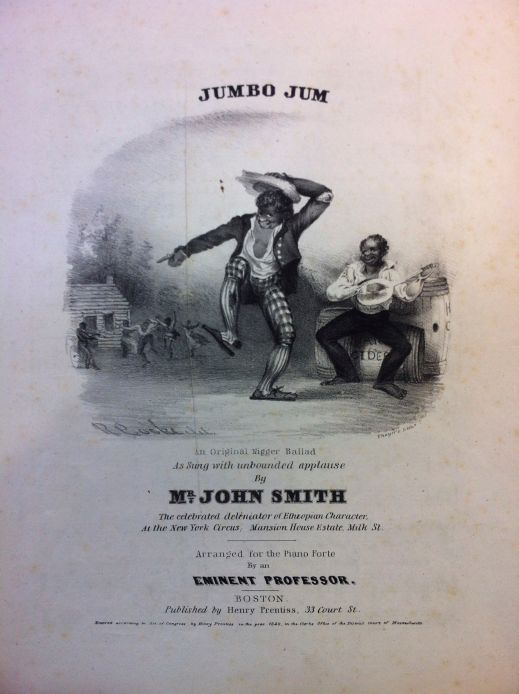
Music-making was both labor and leisure for Solomon Northup and it profoundly influenced his experiences as a slave. His narrative also illuminates the far-reaching impact that he and other black musicians had on their communities as well as nineteenth century music.
Alas! had it not been for my beloved violin, I scarcely can conceive how I could have endured the long years of bondage. It introduced me to great houses —relieved me of many days’ labor in the field—supplied me with conveniences for my cabin—with pipes and tobacco, and extra pairs of shoes, and oftentimes led me away from the presence of a hard master, to witness scenes of jollity and mirth. It was my companion—the friend of my bosom triumphing loudly when I was joyful, and uttering its soft, melodious consolations when I was sad. (217)
Solomon Northup’s biography is highly atypical of slave narratives because he is a free man who is sold into slavery. Some have criticized the popularization of his circumstances, arguing that because he conforms to modes of respectability as a literate, propertied black man, he serves as an ideal hero for white audiences while inadequately representing the experience of slavery. Though many aspects of Northup’s biography are unusual, his status as a highly sought-after musician is emblematic of a legion of black fiddlers who dominated music scenes North and South, from ballrooms to barns, beginning as early as the late seventeenth-century, as Dena Epstein explains in her indispensable study, Sinful Tunes and Spirituals: Black Music to the Civil War (1977).
Prior to enslavement, fiddling, “the passion of [his] youth,” provides Northup with supplemental income that helps to sustain his family during periods of insufficient employment in agriculture and carpentry. Music was an ideal side-career for someone in such circumstances, though, as Northup’s story shows, it did not protect him from the dangers of being black in the United States. He is captured and enslaved while touring as a circus musician. Ferrying South toward the Louisiana plantations that would become his deplorable home, Northup’s freedoms are violently stripped away. But his talent as a first-rate fiddler travels with him, becoming a defining element of his experience of slavery.
Fiddles were extraordinarily popular instruments during the era. Lightweight, portable, and increasing in mass production during the nineteenth-century, a single fiddle could service a large dance if need be. As such, slaves were encouraged (or forced) to take up the instrument and musical ability was considered a highly prized skill. Fiddling granted (primarily male) slaves an unusual degree of mobility as well as opportunities for economic advancement. The fact that numerous runaway slave ads note that the sought-after individuals were fiddlers or had in their possession a violin suggests that the increased mobility and access to income may have facilitated escape for some. For more information about these trends and their eighteenth-century origins, I highly recommend Richard Cullen Rath’s How Early America Sounded (2003), an excellent cultural history of sound.
Just before being sold at market to his first master, Northup encounters an enslaved young man in possession of a fiddle and sizes him up by asking if he could play the “Virginia Reel,” a popular dance. The young man cannot and so Northup takes the instrument from him, boldly showing off his more substantial repertoire and ability, much to the delight of those around him. Though about to be sold into an unknown and terrifying fate, this seemingly mundane interaction underscores how important musicianship is to Northup’s identity and also how significant it was to the societies through which he was forced to move. Whether in New York State, a New Orleans slave market, or a backwoods swamp plantation, fiddling was a thoroughly popular form of entertainment, widely enjoyed by Americans, slave and free, rich and poor, native and immigrant.
Northup expresses pride in the fame he earns in the Red River region, noting that he was known widely as the “Ole Bull of Bayou Boeuf.” Ole Bull was a famous Norwegian violinist, who was one of the first musicians to professionally tour the United States in the 1850s; he became a widely-known celebrity. Because of Northrup’s sought-after talents, his masters hired him out extensively to play at the fashionable balls of nearby plantations as well as the Christmas dances held yearly for slaves. At one ball, he was tipped seventeen dollars, an extraordinary amount that he used to furnish his cabin with bare necessities. In contrast to these more favorable gigs, Northup was also forced to perform during his savage Master Epps’ alcoholic binges. These events were held for hours on end in the middle of the night as Northup’s fellow slaves were commanded to dance. The violent, dreaded affairs interrupted precious sleep and were utterly humiliating for the participants. Depicted memorably in both the memoir and the recent film, the horrifying scenario shows the way slavery degrades Northup’s musicianship and his peers’ dancing, turning these arts into yet one more thing that the master possesses. For Master Epps, Northup is a mere musical device, a kind of proto-phonograph, full of tunes that can be made to play on command. Northup’s “passion” and economic livelihood are thus converted into a mechanized musical labor commodity under slavery.
Through Northup, we can see how before the eras of sound reproduction and broadcast, the circulation of music across North America was greatly facilitated by the forced migration of enslaved people. At the time of Northup’s capture, large numbers of mid-Atlantic slaves were being sold South to the booming plantations along the frontier of Louisiana and Texas. Northup brought a unique repertoire on his journey and he also learned new music that he transported back to the New York publishers of his autobiography. Afro-diasporic musicians began revolutionizing Western music centuries before Northup was born, and as we can see, continued to do so in profoundly significant ways in the Antebellum era both in spite of and due to the harsh conditions of their enslavement.
—
I’d like to thank the students in my course “Sounds of the South” for their lively discussion and excellent essays regarding music in Solomon Northup’s Narrative. I’m also deeply grateful to my musical collaborator, Eric Olsten.
—
Featured Image by Flickr User kubotake
—
Mary Caton Lingold is a doctoral candidate in English at Duke University researching early Afro-Atlantic literature, music, and sound. She leads a collaborative experiment called the Sonic Dictionary at Duke’s Audiovisualities Lab and co-directs Soundbox, a project dedicated to enhancing the practice of using sound in digital scholarship.
—

REWIND! . . .If you liked this post, you may also dig:
“Como Now?: Marketing ‘Authentic’ Black Music,” –J. Stoever
Hearing the Tenor of the Vendler/Dove Conversation: Race, Listening, and the “Noise” of Texts –Christina Sharpe
How Svengali Lost His Jewish Accent––Gayle Wald
—
Share this:




Current Top Posts





April 2021

January 2020

November 2019

October 2019

August 2019

April 2014

November 2017

March 2015

December 2017

October 2015


Recent Comments