
Chicana Soundscapes: Introduction

DOI: https://doi.org/10.59350/z2a3d-2p068
Feminista Music Scholarship understands music production and listening as a collective site of engagement that sometimes produces and sometimes challenges social structures of race, class, gender, sexuality and nation. It is a method and practice that pushes on narrative frameworks that naturalize the absence of women of color and Chicanx subjects in music scholarship. It is always about imagining and practicing life, as the old-saying/ dicho goes says, to the beat of a different drum, to an alternative, more just reality and experience of time, built on the knowledge of buen vivir or sumak kawsay (a kichwe concept and practice that understands the good life cannot be attained without living right with others in convivencia, in mutual respect of marginalized communities, knowledges, cyclical non-linear time, and of La Pachama/mother earth, one that aligns with knowledge practices of many indigenous communities across Las Americas).
This Chicana Soundscapes/Feminista Music Scholarship Forum is inspired by the “Sounds Like Home: Mapping Chicana Mexicana/Indigena Epistemologies in Sonic Spaces” presented at the annual American Studies Association (ASA) Annual Conference, Denver 2017. Thanks to the roundtable organizers Yessica Garcia Hernandez and Iris Viveros Avendaño for inviting me to chair the panel and to ASA Sound Caucus committee for sponsoring the panel and putting a spotlight on this much-needed research. Many have worked tirelessly for over 25 years to make space at the ASA for such a panel–one that is focused on feminista music scholarship, robustly composed of emerging feminista scholars from different localities. It is truly a collective endeavor. That is took this long says much about the way such knowledge has been valued. That is finally happened says much about what’s coming next!
Curtis Marez contextualizes “Chicana Epistemologies/Sonic Spaces” “I’ve been waiting for this panel for my whole academic life” #2016ASA pic.twitter.com/cPTbph1vXb
— Sounding Out! (@soundingoutblog) November 19, 2016
The forum’s inspiring research by scholars/practioners Wanda Alarcón, Yessica Garcia Hernandez, Marlen Rios-Hernandez, Susana Sepulveda, and Iris C. Viveros Avendaño, understands music in its local, translocal and transnational context, and insists upon open new scholarly imaginaries. Not only does each scholar’s research point to the exciting present and future of music studies, it points to the work of feminista scholars and music practicioners who’ve pushed the frames of music studies, from inside and outside of ethnomusicology and musicology, scholars such as: Deborah Wong, Deborah Vargas, Sherrie Tucker, our own mentor Angela Davis, Maureen Mahon, Daphne Brooks, Andreana Clay, Martha Gonzalez, and others. Feminista scholars like Inés Casillas, Jennifer Stoever, Roshanak Kheshti, Monica De La Torre, and others, have made way for for feminista music studies in Sound Studies. And yet, it wasn’t so long ago that Susan McClary shocked the music studies world by insisting that gender mattered in music analysis. We still face constant pushback on that assertion, in particular subfields, especially now. Current times require us to bridge intersectional, decolonial, and gender analysis. Music, and our relationship to it, has much to reveal about how power operates within a context of inequality. And it will teach us how to get through this moment.
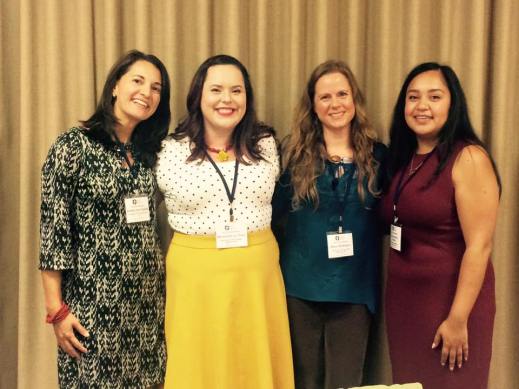
For the last 13 years my research for Chicanxfuturism manuscript has engaged the following question: What practices compose Feminista Music Scholarship? As a practitioner in dialogue with scholars and practitioners, I identify Feminista Music Scholarship as:
- a fluid practice of collective listening and producing music attentive to power relations
- an examination of power-flows through music via epistemologies birthed from feminist of color and indigenista theorizing and practice
- approaching all genres
- troubling the notion of home
- responding to community displacement & social alienation
- networked (through digital archive, social media, etc…; collaborative and collective; and social justice oriented
- recognizing the reciprocal exchange of knowledge and labor between community and scholarly collaborations
- a collective endeavor
- ever-transforming
Feminista Music Scholarship is what the participants of this forum are doing (among their many important interventions)!
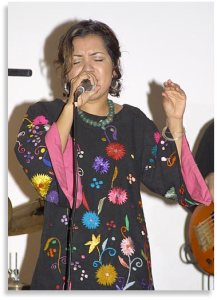
Indeed, Feminist Music Scholarship disrupts what Daphne Brooks describes in “The Write to Rock: Racial Mythologies, Feminist Theory, and the Pleasures of Rock Music Criticism” as “the imagined subaltern sphere of independent rock culture (dubbed “indie-rock”) [that] depends on a narrow discourse of shared knowledge that largely marginalizes (if not altogether erases) the presence of women and particularly women of color in alternative music culture” (61). The conceptualization and development of recent pop music exhibits, scholarship by emerging scholars, and community music dialogues, decidedly influenced by Feminista Music Scholarship is one of many possible answers to Brooks’s serious question, “How do we break outside of these tightly policed spheres?” The scholars/music practitioners in this issue respond to the burning question, “how does Chicana feminist music criticism break out of these spheres and serve as a home for new methods for writing about punk, banda, and new wave, son jarocho and participatory community music production?”
During the ASA roundtable, Alarcón, Garcia Hernandez, Rios-Hernandez, Sepulveda, and Viveros Avendaño presented six-minute flash presentations and then opened the floor to a discussion that is wide-ranging yet grounded in the material practices of sound, music, feminism, and home. They continue that important discussion there. More than ever we need panels, forums, dissertations, articles and other forms scholarship that spotlight the ways vulnerable populations have found ways to disrupt systemic oppression through their raucous listening, producing and community practices. This permits us to remember that this fight is not over, that we are deep in it and we have much strategy to share.
Rock on forum readers, rock on!
—
Michelle Habell-Pallán, associate professor of performance culture of the Americas in the Department of Gender, Women & Sexuality Studies, and adjunct associate professor in the School of Music and Department of Communication, at the University of Washington (UW), is currently the Director of the Certificate for Public Scholarship. For her fifteen years plus of community engagement and the arts, she recently received the Barclay Simpson Prize for Scholarship in Public, which recognizes her efforts to foster the humanities as a public good. Her research examines music, performance, and theater as communal forms of expression that archive alternative histories used to imagine new futures. In tandem, her research also reflects on the way developing media platforms compel new methods of cultural expression, research, archiving and delivery. Her most current research considers dialogues between feminista movements and hip hop feminista musics in Ecuador and its relationship to indigenous social movements rooted in Andean concepts of Sumak Kawsai (Right-living). She is the Co-Director of the UW Honors Quito, Ecuador Study Abroad Program.
Habell-Pallán authored Loca Motion: The Travels of Chicana/Latina Popular Culture (NYU Press). Her most recent book is the bilingual American Sabor: Latinos and Latinas in US Popular Music: Latinos y Latinas en La Música Popular Estadounidense co-authored with Marisol Berrios-Miranda and Shannon Dudley, published by University of Washington Press (Autumn January 2017). Her single-authored book Chicanxfuturism: Punk’s Beat Migration and the Sounds of Buen Vivir is in-progress.
Habell-Pallán guest-curated the award-winning bilingual traveling exhibit American Sabor: Latinos in U.S. Popular Music hosted by Smithsonian Institution’s Traveling Exhibition Service (SITES). As a digital feminista she transforms digital humanities, through community engagement, as co-director of University of Washington Libraries Women Who Rock (WWR): Making Scenes, Building Communities Oral History Archive.
A former UC President’s Postdoctoral Fellow, Habell-Pallán is recipient of a Rockefeller Foundation Humanities Research Award, Woodrow Wilson Foundation Research Award, UW Royal Research Fund Award, and UW Simpson Center Digital Commons Faculty Fellowship (underwritten by the Mellon Foundation).
Habell-Pallán makes community & music with the Seattle Fandango Project, and is a member of the Fembot Collective|Gender, New Media & Technology. She collaborates with a range of local community partners to direct the Women Who Rock: Making Scenes, Building Communities Collective, whose free and family-friendly Seattle unConference/Encuentro takes place annually.
—

REWIND! . . .If you liked this post, you may also dig:
If La Llorona Was a Punk Rocker: Detonguing The Off-Key Caos and Screams of Alice Bag– Marlen Ríos-Hernández
Chicana Radio Activists and the Sounds of Chicana Feminisms–Monica De La Torre
SO! Reads: Deborah R. Vargas’s Dissonant Divas in Chicana Music: The Limits of La Onda–Wanda Alarcon
—
Share this:

SO! Amplifies: Radio Coyote’s #DIASPORADICAL Sound
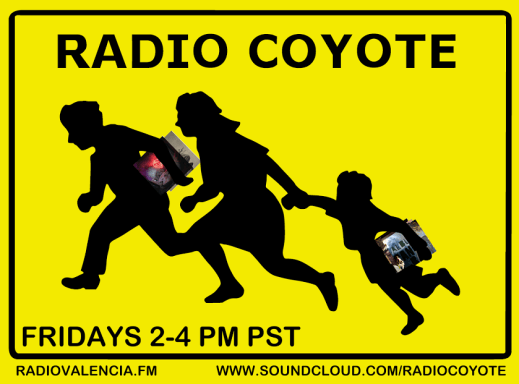

SO! Amplifies. . .a highly-curated, rolling mini-post series by which we editors hip you to cultural makers and organizations doing work we really really dig. You’re welcome!
—
DOI: https://doi.org/10.59350/k2907-nt881
This whole world’s wild at heart and weird on top —Wild at Heart
Por tu amor. . . — Buyepongo
Radio Coyote is a San Francisco-based web radio program & podcast I co-host with my friend Jesus Varela, aka Sweet Jesus. Radio Coyote is our effort at amplifying expression which is #DIASPORADICAL – acknowledging movement and humanity in a world alive with ART; most especially of those on the margins who in the current structure, have become the invisible inspiration for the priviliged, hardly benefiting from the soul they emit.
Recently, Jesus and I recorded with Los Angeles’s own future-rooted band of immigrant brothers – Buyepongo – live from the scrappy but charming Radio Valencia studios in the Mission District. Some topics we talked about included connections between the Bay Area and Los Angeles, the hip-hop influence of Wu-tang Clan & Madlib on the group, and, importantly, the burgeoning yet connected #DIASPORADICAL network building alternatives and manifesting the visceral spirit of our ancestors through drumming.
This particular episode’s conversation is emblematic of how we use sound and voice on Radio Coyote to bring energies together to counter the hegemonic corporate $tandard currently funding the arts and culture industries—live music and entertainment but also tech and media, not to mention the spaces where they intersect—all reflective of a standard which is essentially: THE STRIVE FOR MONETARY SUCCESS MARKED AS WHITE ACHIEVEMENT A/K/A the land of the “Free” where the inspired benefit from those on the margins.
Nahhhhh, FUCK THAT. – emcee Nani Castle in To The People
The type of capitalist cultural extraction we challenge on Radio Coyote can be heard and seen everywhere. Justin Bieber, for example, has a #1 record right now (produced by Skrillex) that is clearly influenced by Caribbean dembow. I’m still waking up from that dream where Macklemore wins a Grammy award over the 2014 jazz griot giant that is Kendrick Lamar. The FADER, like so many media outlets, assigns white writers to cover emerging Latin culture in the US: Exhibit A on contemporary cuban music & Exhibit B on J. Balvin and reggaton. And, I could go on. But because it is so pervasive, we need to keep asking, “Who benefits?”
It don’t make you right cause you majority.- Bree Newsome, South Carolina-based activist & artist who removed the Confederate Flag earlier this past Summer from SC’s capital
Mamacita, pass me a beer-a – Will Smith on Bomba Estereo’s “Fiesta” (Remix) for SONY
Because all around the world – or the worldwild, I like to say, people are waking up and acknowledging themselves, their neighbors, and the stories of their movement, exploring what those moves truly meant and what they will mean for a humanity needing to be increasingly inter-reliant in our crumbling late-Capitalist era. Radio Coyote is a product, a revelation, and a confluence of these worldwild movements, amplifying the true vibration and rhythms of a very specific history and examining how they will mutate in the future.

Our voices and spirits have always been dangerous. During the conquest in what is now Mexico, for example, the Spansh conquistadors killed the ceremonial drummers first. In Chile, when Augosto Pinochet seized power in 1973, he ordered revolutionary singer Victor Jara executed, and his soldiers kidnapped Jara, smashed his hands and wrists and shot him 44 times. But what was once dangerous has been disempowered and I predict, increasingly exploited. Now Canadian DJ A-Trak calls himself “Plantain Papi,” Roots drummer Questlove goes by “Questlove Gomez,” and Kendrick raps in Spanish. Bieber just dropped that dembow-influenced pop record while dembow legacy artists, Los Rakas (via Panama & Oakland) switched to Latin pop.
Cause I just need one more shot at second chances – Justin Bieber in “Sorry“
I get a lot of success because I’m white. – Diplo in YourEDM.com
Radio Coyote is our chance to explore these ideas and who benefits from the global flows of culture . To empower me. To empower us. To get back to the place where this expression was dangerous . We are smuggling these sounds to you over what was once pirate radio – now, online – because the boundaries between u$ are quite pronounced. Radio Coyote is my moment of love in a land$cape of domination and hate. We are powerful. It’s clarity through the confusion. Radio Coyote simply must be. It’s an effort at radically witnessing the expressions all over the world of people who’ve had access to Internet these last 10 – 15 years, but who also seek to honor, understand & feel a past which we are indisputably products of!

Though I am fiercely frightened to get on the mic every Friday from 2 – 4 PM PST, I like to think I’m reversing the common programming Latinas go through, constantly told to shush in this world. I also feel a true duty. We simply need to step up and be ourselves! We need to acknowledge and be proud of our own particular story of being human in a world with the same level of equality as the other, together, with immense respect for the planet we live on and all the resources she provides (another topic I like to think about, but more on #PACHAMAMAISM at another time…).
There is nothing else we should be doing but seeing ourselves in each other and being very adamant about that. So this is my love force to you and I hope you continue to enjoy/share it. Lift your voice in love, too, in any way you feel is important out in the worldwild! And, then, tell me about it so we can have you call in and talk to us on Radio Coyote: radiocoyotesf@gmail.com! 😀
Tune-in to #RadioCoyote: Smuggling #DIASPORADICAL Sounds Across Borders Every Friday From 2 – 4 Pm PST With DJ Nipslip aka Naticonrazon and Jesucio aka Sweet Jesus: www.radiovalencia.fm. Archives:www.soundcloud.com/radiocoyote
—
all images courtesy of the author
—
Nati Linares aka Nati Conrazon is an artist advocate and cultural lobbyist rebalancing the world who was raised in New York City, but is currently living a #Bicoastalidad lifestyle which is rooted in Oakland, California. Her womanagement clients include Brazil-via-Brooklyn’s Vocalista Making Interracial Music Babies, Zuzuka Poderosa & Powerfully Raw Chilean/Irish Emcee, Nani Castle. Check out all her current projects: www.conrazon.me/projects/current-projects and follow her on Twitter: @conrazon, Instagram: naticonrazon and beyond! Embrace the hybrid!
—
—

REWIND!…If you liked this post, you may also dig:
SO! Amplifies: Sounding Board Curated by Leonardo Cardoso–Jay Loomis
SO! Amplifies: Shizu Saldamando’s OUROBOROS–J.L. Stoever
—
Share this:




Current Top Posts





April 2021

January 2020

November 2019

October 2019

August 2019

April 2014

November 2017

March 2015

December 2017

October 2015


Recent Comments