
Radio Ambulante: A Radio that Listens


DOI: https://doi.org/10.59350/r8n3n-3kk04
Welcome back to the final article in our three-part series, Radio de Acción. Special thanks to you, our readers, and to editors Jennifer Stoever and Neil Verma at Sounding Out! for hosting this addition to a burgeoning field of Latin American critics and producers who are changing the way we hear radio as history, as theory, and in practice.
Over the past several weeks we have tried to bring you into the multiple worlds made possible by radio in Latin America. If you missed our previous posts, please find Alejandra Bronfman’s stunning history of radio in the Caribbean here, and Karl Swinehart’s fascinating study of Aymaran-Spanish radio here.
Both of these critical approaches set the stage for Carolina Guerrero’s extraordinary work with radio in the Americas. An executive director and co-founder of Radio Ambulante—a program that fellow co-founder and novelist Daniel Alarcón calls “This American Life, but in Spanish, and transnational”—Guerrero’s post takes us behind the scenes of her show to consider how the sounds on radio come to life for us as listeners, and the significance of hearing someone’s words in her or his own voice and language. For more Radio Ambulante after you finish reading and listening to Carolina’s post, please visit their website and download their podcasts.
–Guest editor Tom McEnaney
—
In late 2007, novelist Daniel Alarcón was hired by the BBC to produce a radio documentary about Andean migration in his native Peru. He spent 10 days traveling around the country, from the highlands to Lima, conducting interviews in both English and Spanish, talking to a wide range of people with very personal stories about migration. But when Daniel received the final mix from London, he was disappointed to find that the editor had privileged the English language voices, and left out many of the most compelling Spanish language storytellers. Daniel was left with a question: what if there was a space for those voices on the radio waves? What would it sound like?
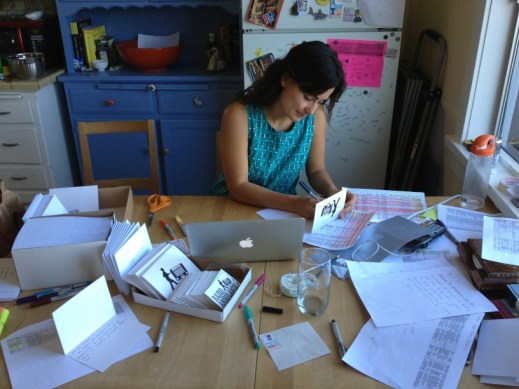
Over coffee in San Francisco in January 2011, Alarcón and I decided to create that space, inspired by US public radio shows like This American Life and Radiolab, which had no Spanish counterpart. We knew that poignant, fun, surprising, unique, sometimes sordid, sometimes romantic, absurd and incredible stories we often heard in Latin America were out there, just waiting to be reported. We knew that they would make great radio. And we knew there was an audience—in Latin America and the US—that wanted to hear it. The result became Radio Ambulante.
.
FIRST STEPS
We began by asking many of our print journalist friends in Latin America to share stories with us. We sent them links to stories from some of our favorite American radio programs, and then contacted a few bilingual independent radio producers here in the US, and asked them for advice on the basics of radio production. Many directed us to Transom.org, which was an absolutely essential resource.
In March of 2012, we launched a Kickstarter campaign. All we had was an idea and a sampler with less than 45 minutes of audio—and still, we managed to raise $46,000 with the support of 600 backers. The success of this campaign was a huge confidence boost, and we knew we were on to something. We used this money to produce our pilot season.
.
Since then, we’ve worked with more than twenty different producers in more than a dozen countries. These are the characters that emerge from Radio Ambulante stories: a transgender Nicaraguan woman living with her Mexican wife in San Francisco’s Mission District; a Peruvian stowaway telling his harrowing tale of coming to New York in 1959, hidden in the hold of a tanker ship; the Chilean soccer player who dared challenge the authority of General Pinochet; a young Argentine immigrant to North Carolina, trying to find his way through the racially charged environment of an American high school. Taken together these voices create a nuanced portrait of Latino and Latin American life:
.
PERSONAL STORIES FOR ALL EARS
Now in our third season, we’ve been working hard to create a group of trusted producers and editors across Latin America; people we can turn to with an idea, people we know we can trust with our limited time and resources; reporters we can send to Cuba, send to Honduras, send to Venezuela, and be certain they’ll come back with usable tape, and a good story. We want these first time producers to become long-term contributors.
That’s the case of Camila Segura, Radio Ambulante’s current Senior Editor. She had no prior experience as a radio producer when she reported her first story for us in 2012. That piece, El otro, el mismo (The Other, The Same) is about two men, one Colombian, one Argentinian, who not only share the same name, but who look almost identical. From this coincidence, the story becomes something much stranger, funnier, more subtle, and ultimately quite moving:
.
We want the listener to be able to relate and identify with the characters, to feel what they feel. A good Radio Ambulante story should be universal and shouldn’t have an expiration date.
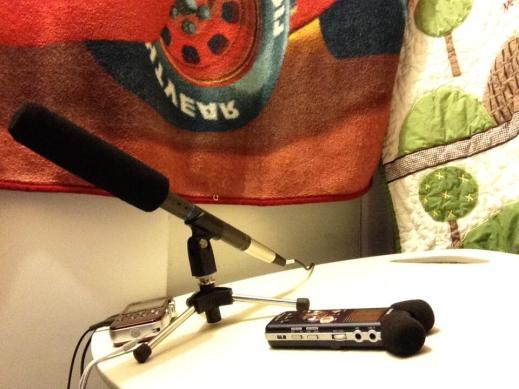
One story from our first season captures this universal quality. In 2011, River Plate, one of the most famous soccer clubs in South America, was relegated to the Argentine Second Division. This event shook the entire nation, and anyone who listens to this story could relate to the sadness and pain that the protagonist is feeling. Two years later, the story still has that raw power:
.
HOW WE SOUND
Martina Castro, Senior Producer, has designed most of Radio Ambulante’s sound, finding the balance between music and sound effects in order to support the voice of the main characters. As she explains,
There are many kinds of pieces that make it to Radio Ambulante. Sometimes the story is focused on one person and their experience: something that happened long ago. Like with Mayer Olórtegui in Polizones (The Stowaways), and the story of how he and his friend Mario jumped aboard a ship headed to the United States. There is no substitute for a dynamic storyteller like Mayer. He not only recreates moments, sometimes even imitating the sounds of what he heard, but he remembers the emotion of what happened, and really feels deeply what he is talking about, like when his voice breaks up at the mention of saying goodbye to his friend Mario.
.
Other, more symphonic, multi-voiced pieces provide a different kind of production challenge. The script must showcase the many characters, while giving the listener enough grounding so as not to get lost. A particularly successful example is our award-winning piece “N.N.”, about Puerto Berrio, Colombia, by reporter Nadja Drost. Nadja gathered recordings of this river town, and conducted interviews with many locals, always focused on the issue of the floating, anonymous dead and the town’s strange relationship with these bodies. The music in a piece like this is only meant to support those real-life sounds and characters, and a repeated melody serves as a ghost-like echo of the dead, those voices we never hear.
We use music carefully to shift the mood, to mark the end of a section, and to alert the listener that something new is coming. The music is also meant to break up chapters of a story, give us a moment to reflect on what we just heard, or to indicate when something is about to change. There are examples in Yuri Herrera’s “Postcard from Juárez,” produced by Daniel Alarcón. It tells the story of Diana la Cazadora, or Diana the Hunter, a vigilante who set about killing bus drivers in one of the world’s most violent cities, allegedly as revenge for years of misogyny and sexism.
.
In this particular story, we were able to do something that the English version (produced for This American Life) could not: read in the original Spanish the letter that the supposed killer sent the local Ciudad Juárez newspaper explaining her actions. We had this read by Lizzy Cantú, a Mexican journalist who’d worked with us before, and then distorted her voice, to give it that dark ambience. The listener is supposed to feel the grim violence in those words: the desperation.

THE STORY IS KEY
In three seasons producing the show, we’ve learned that the craft of radio comes from listening, and that the most challenging aspect of producing radio is not in the technical details of recording those voices or sounds, but in the story itself.
The most basic building block of a good radio story is a good interview. The technical aspects of gathering sound are less important than phrasing the questions to get vivid, almost filmic answers, full of details that set the scene.. As Executive Producer Daniel Alarcón explains,
We ask our reporters to push interviewees to describe scenes in great detail, to unpack moments. Our interviews can last two hours or more, and many are surprised that we go so in depth. We like our reporters to circle back, and then circle back again, so that we’re sure we’re getting the most vivid version possible of a given story’s crucial moments.
We ask our reporters to write colloquially, to imagine they’re telling the story to a friend at a bar. It’s important to have immediacy in the language, an expressive tone that can seem almost improvised, even when it isn’t. The emotional impact of radio is that it feels as though a secret is being shared. The script and the production should always be in service of this intimacy.
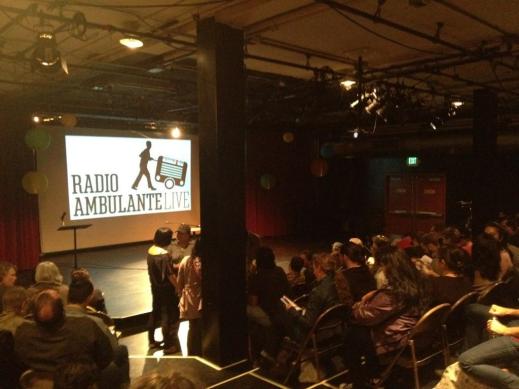
Before a script is final, it’s shared with other editors on the team around the globe (California, Colombia, Puerto Rico, Chile), mixed, edited, soundtracked, and refined through hours of collective work online.
.
ONWARD
While creating our own sound and storytelling style, Radio Ambulante is constantly experiment with different formats and looking for new ways to interact with our listeners. We’ve done three live radio shows, in Los Angeles, San Francisco, and New York. In addition, we’ve produced two English Language specials, and partnered with writers and animators on hybrid multimedia storytelling. With our partners at PRI, we’re developing a new interview series, and are working with Latin American universities and media outlets to teach more journalists to use radio. Our hope is that Radio Ambulante’s success will mean more innovative radio work in Spanish, and more experiments in the possibilities of bilingual radio.
—
Carolina Guerrero is the Executive Director of Radio Ambulante. Before getting into journalism, she was a promoter for cultural and social projects, creating a bridge between organizations in three different continents. She has worked with public and private institutions in several countries, for which she has designed and overseen festivals, art exhibits, teaching workshops and fundraising events. Carolina is a John S. Knight Journalism Fellow at Stanford University 2014-15. She is the proud mother of León and Eliseo. (@nuncaduermo)
All images courtesy @radioambulante on Twitter
—

REWIND!…If you liked this post, you may also dig:
“We wanted to tell stories about sound: Opening Ears Through the Everything Sounds Podcast”-Craig Shank
“Chicana Radio Activists and the Sounds of Chicana Feminisms”-Monica De La Torre
“Óyeme Voz: U.S. Latin@ & Immigrant Communities Re-Sound Citizenship and Belonging”-Nancy Morales
—
Share this:

À qui la rue?: On Mégaphone and Montreal’s Noisy Public Sphere
DOI: https://doi.org/10.59350/axd37-bme35
Editor’s Note: This month Sounding Out! is thrilled to bring you a collection of posts that will change the way you hear cities. The Sounds of the City series will prompt readers to think through ideas about urban space and sound. Are cities as noisy as we think they are? Why are cities described as “loud”? Who makes these decisions about nomenclature and why?
We kicked things off three weeks ago with my critical reading of sound in Lorraine Hansberry’s A Raisin in the Sun, a play about African Americans in Chicago that still rings/stings true today. Two weeks ago, guest writer Linda O’ Keeffe took readers on a soundwalk of Smithfield Square in Dublin, Ireland and specifically of the Smithfield Horse Fair, in order to illustrate how urban renewal disrupts city soundscapes and how sound reclaims those spaces. Last week, regular SO! writer Regina Bradley discussed the dichotomy of urban and suburban in the context of sound (noisy versus quiet) and hip hop.
Today’s post comes from CFP winner Lilian Radovac, who shares with us a critical photoessay on the sound installation Megaphóne in Montreal.–Managing Editor Liana M. Silva
Updated with edits as of 12:28 pm EST
***
October, 2013. I’m waiting for the 80. It’s already dark and bitterly cold for fall, and the bus is predictably late. As the line of people waiting lengthens, traffic rushes past on President-Kennedy and north along Jeanne-Mance, punctuating the larger roar of rush hour in Montreal.
Suddenly, a woman’s voice lifts up out of the din. It’s hard to make out what she’s saying at first, but then a single phrase escapes from the thrum of traffic: “…freedom and democracy…” I look around, trying to place the sound. It’s gone. Several minutes later, the voice rises again: “Tell us again about freedom and democracy!” This time, my ears get a lock on the words and I leave my place in the line to follow them to their source.
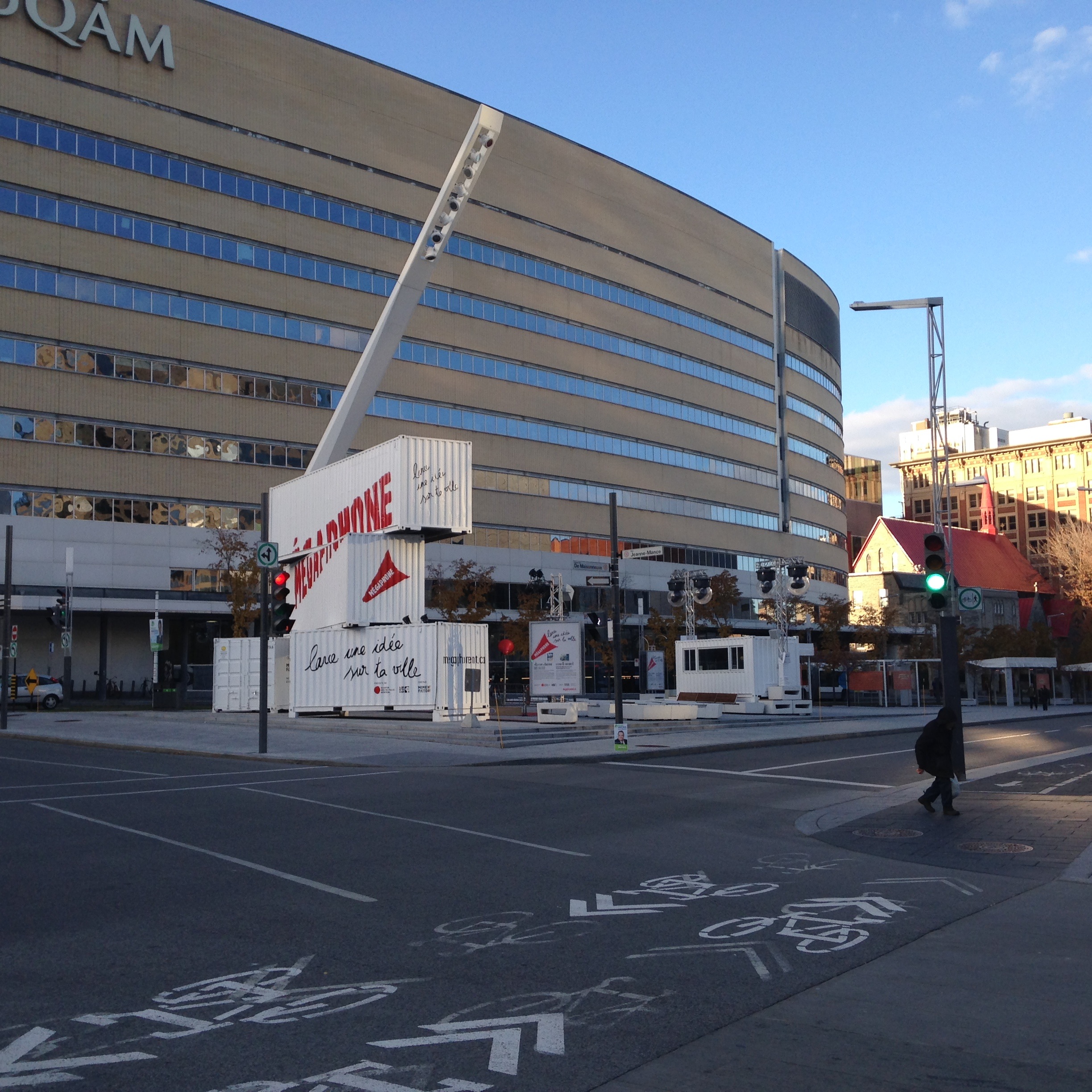
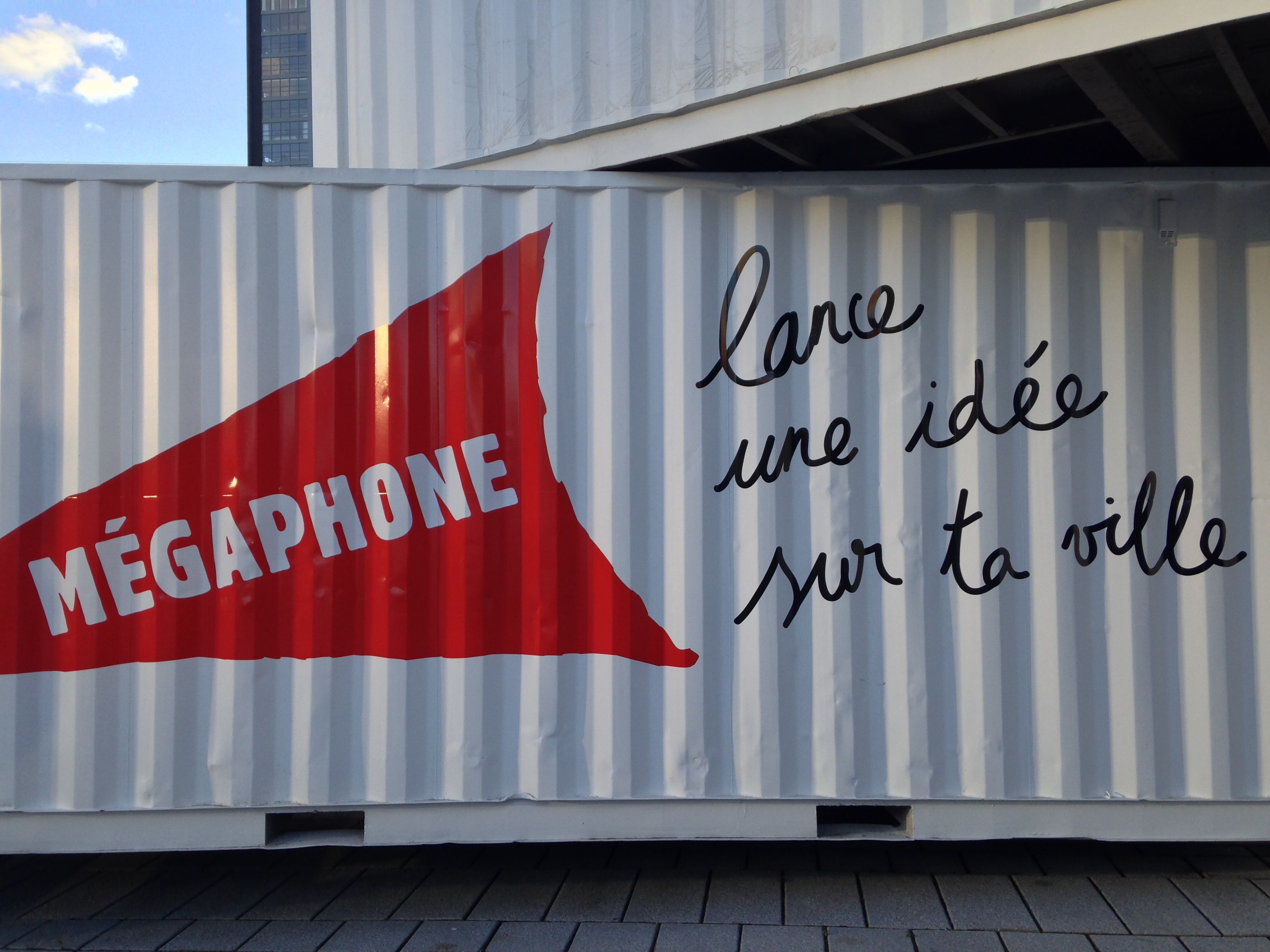
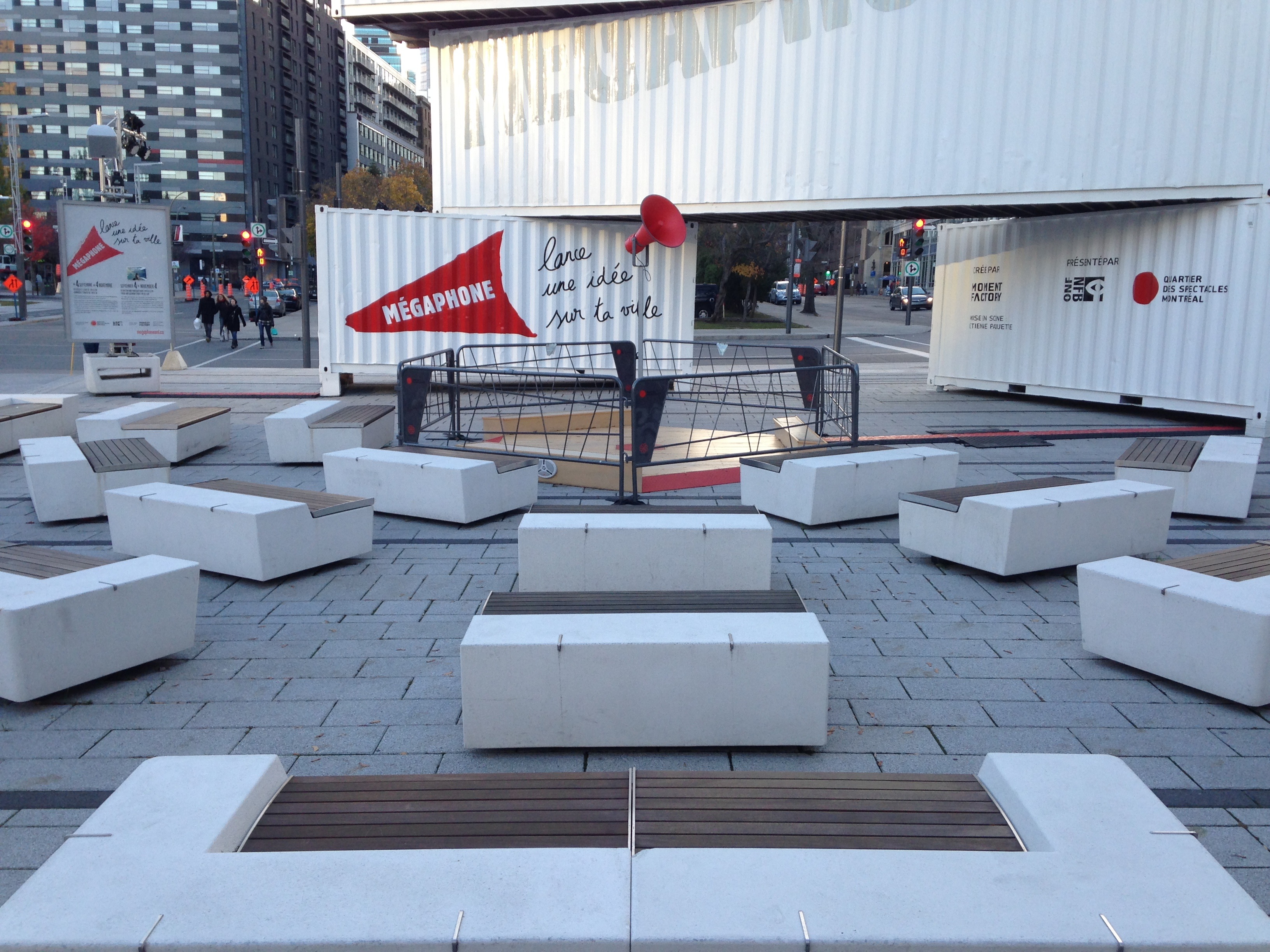
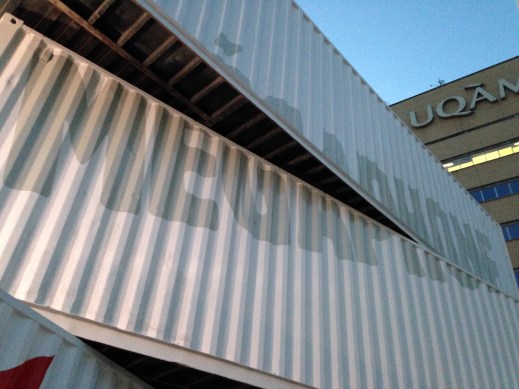
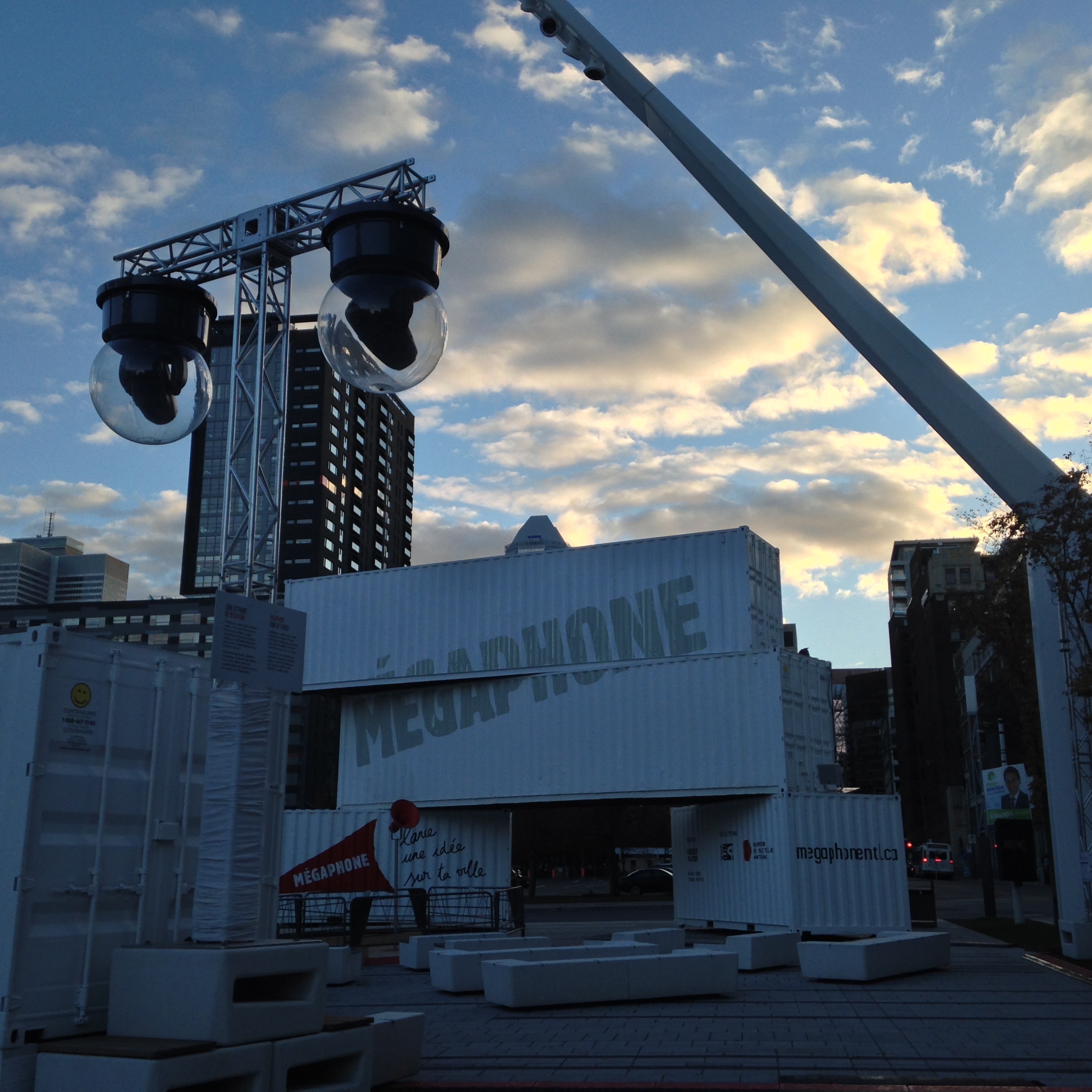
My feet bring me to the Promenade des artistes, a slim triangle of concrete that separates President Kennedy Avenue from De Maisonneuve Boulevard, and the sounds of Mégaphone. The promenade is the temporary home of the audiovisual installation produced by the multimedia studio Moment Factory, co-sponsored by the National Film Board of Canada and the Quartier des spectacles partnership. The installation is composed of three zones: to the west, a small outdoor amphitheater arranged around a large red megaphone; across the street, the University of Quebec at Montreal’s science pavilion, which doubles as a projection screen; and to the east, housed in a series of “event vitrines,” an audio exhibition of recordings by notable Quebec speakers who have “shaped public space in Montreal with their words.”
According to the accompanying press kit, Mégaphone is inspired by London’s Speaker’s Corner and Montreal’s interwar tradition of popular assemblies. Its stated goal is to “bring the art of public speaking back into the city.” It’s designed as an interactive experience, which encourages visitors to take to the stage during designated open mic periods and, by speaking into the megaphone, to “light up the city” with their ideas. Their speeches are first acoustically amplified, then processed by voice recognition software and projected onto the façade of the science building, which becomes a canvas for randomly generated keywords. Mégaphone is also timed to coincide with the run-up to Montreal’s November 4th municipal election, and features a program of scheduled speakers that includes an appearance by the city’s mayoral candidates.
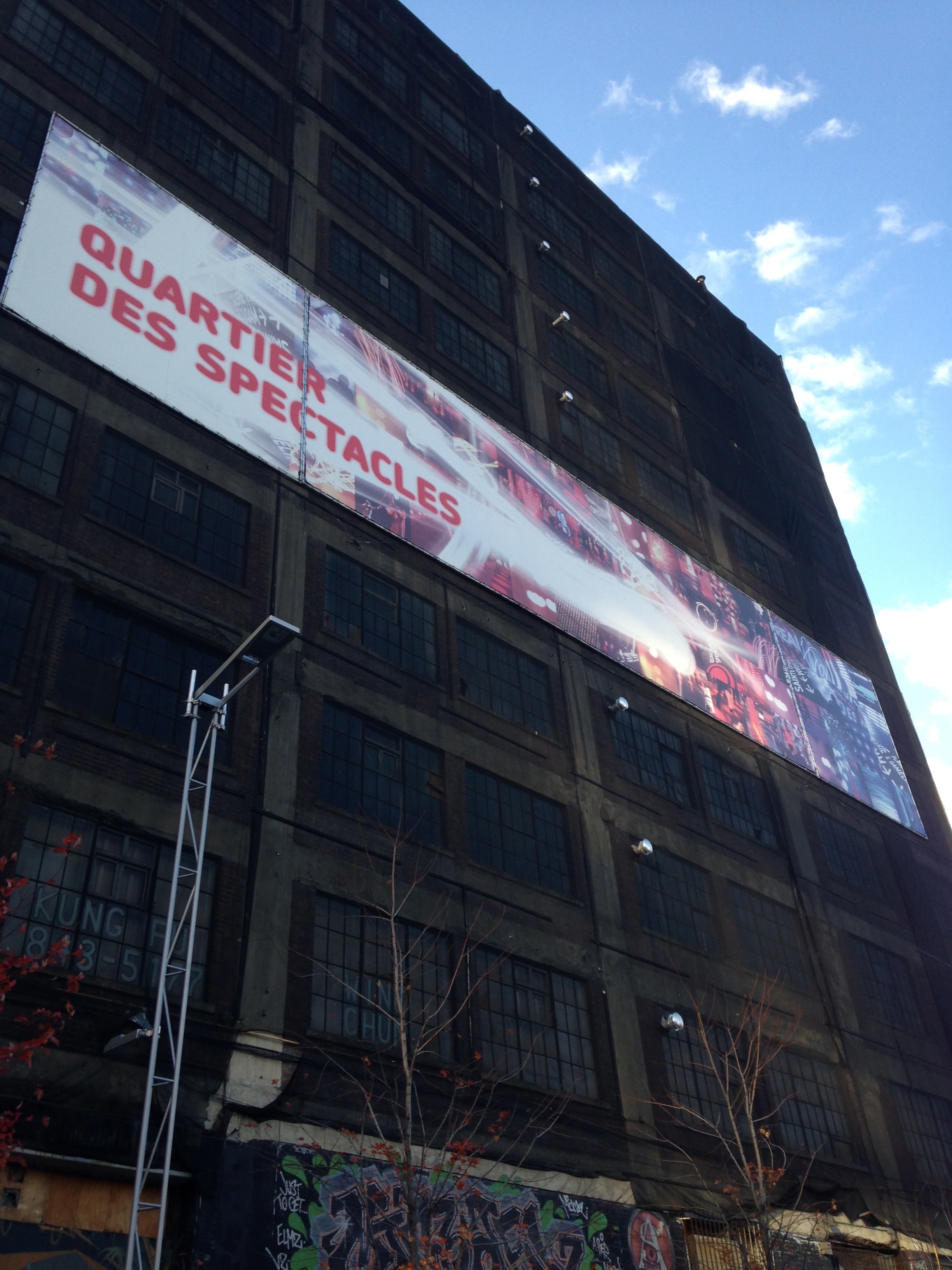
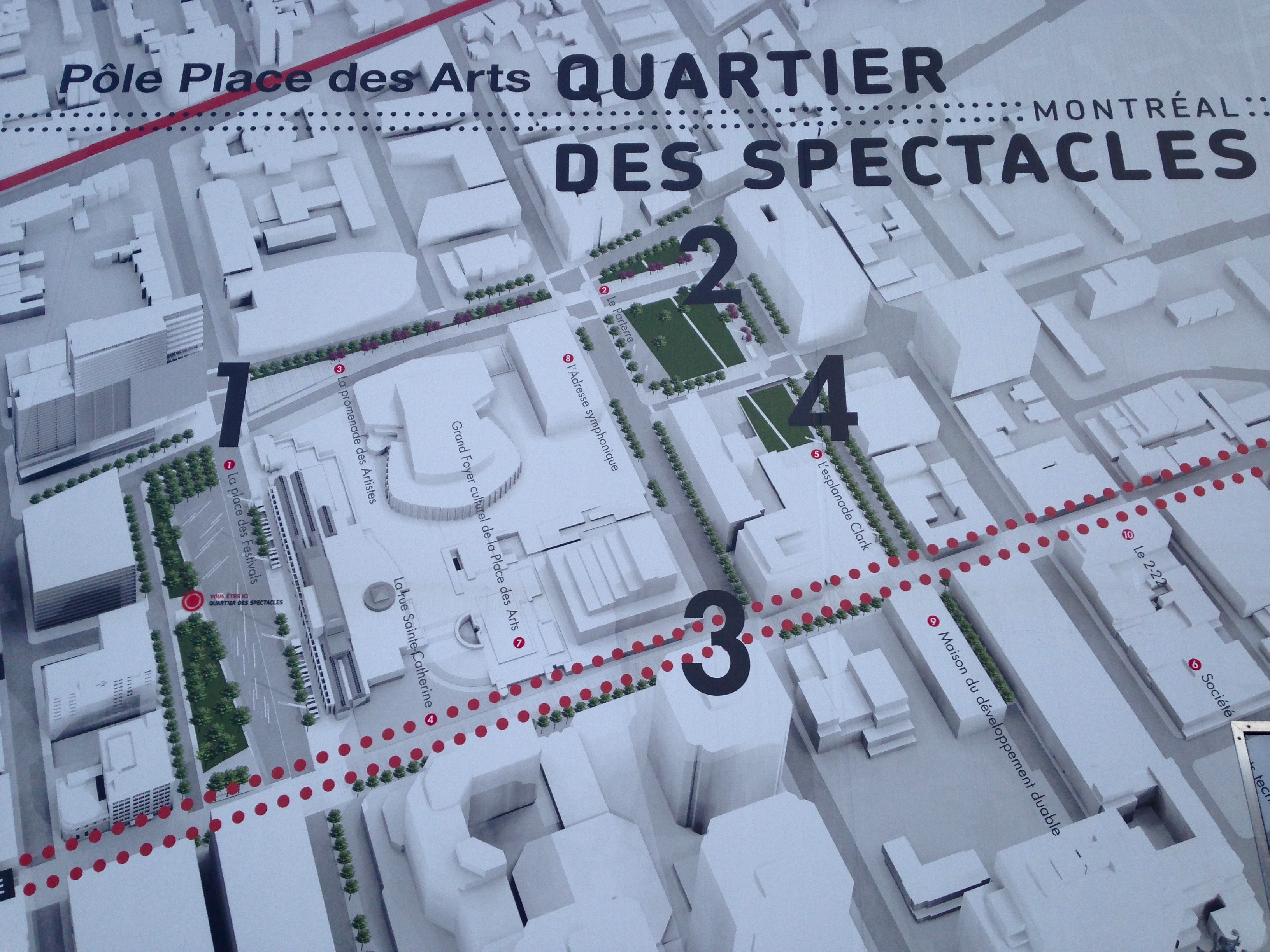
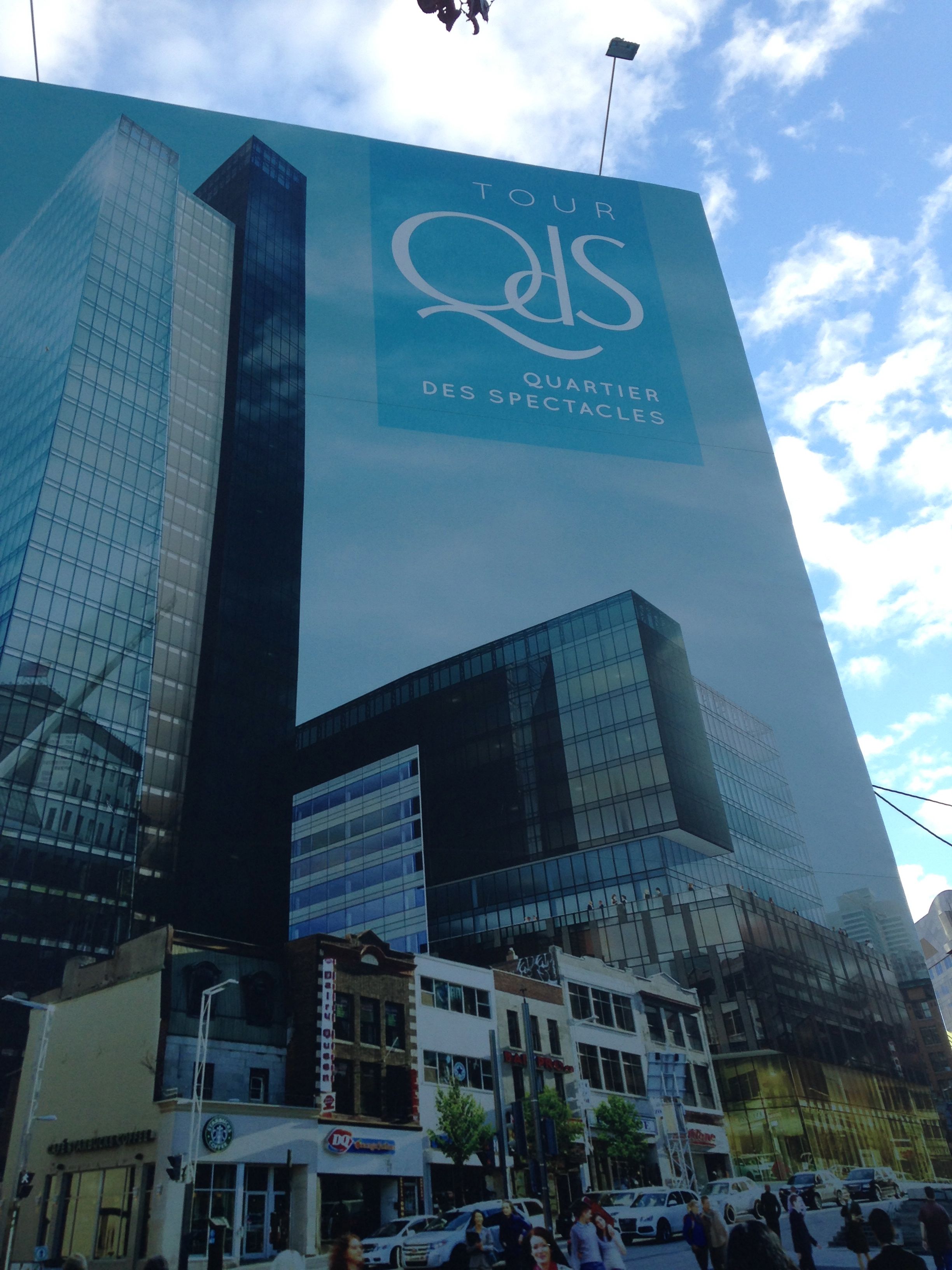
As I wander through the empty amphitheater, I find myself thinking that it’s a strange place for a sound installation. The Promenade des artistes is sandwiched between UQAM’s science campus and the northern border of Place des Arts, a Lincoln Center-style performing arts complex that occupies several city blocks. Jane Jacobs would have called this a “dead place,” lost as it is between a set of bicycle lanes and the science building’s indoor food court, which draws pedestrian traffic away from the open space of the street. On the day of my visit, I’m the only person there. Beyond the Promenade des artistes lies the larger Quartier des spectacles, an ongoing culture-led regeneration project which, in an effort to cement the city’s “brand” as a creative city, has concentrated Montreal’s outdoor cultural activities into a single, sprawling site. Traces of the working-class neighborhood it displaced peek out from behind construction fences, quietly attesting to the area’s industrial past.
Still following the voice, I walk towards the line of event vitrines, where seven audio exhibits map the aural contours of an imagined community made real. The speeches on display tell a story of Quebec’s emergence from its colonial past, when the province’s French-speaking majority was dominated by the Catholic church and a minority Anglophone elite. Each voice, in its way, speaks to a period of enormous social transformation fuelled by the dream of Quebec’s independence: Irving Layton delivers a lecture from an amplified podium; Gilles Vigneault sings “Gen du pays” from a stage at Parc Mont-Royal; Pierre Bourgault gives a firebrand speech at the Third Congress of the Parti Québécois. Only the seventeenth century Wendat Chief Kondiaronk remains eerily mute, his voice buried in the memoirs of his colonial French counterparts.
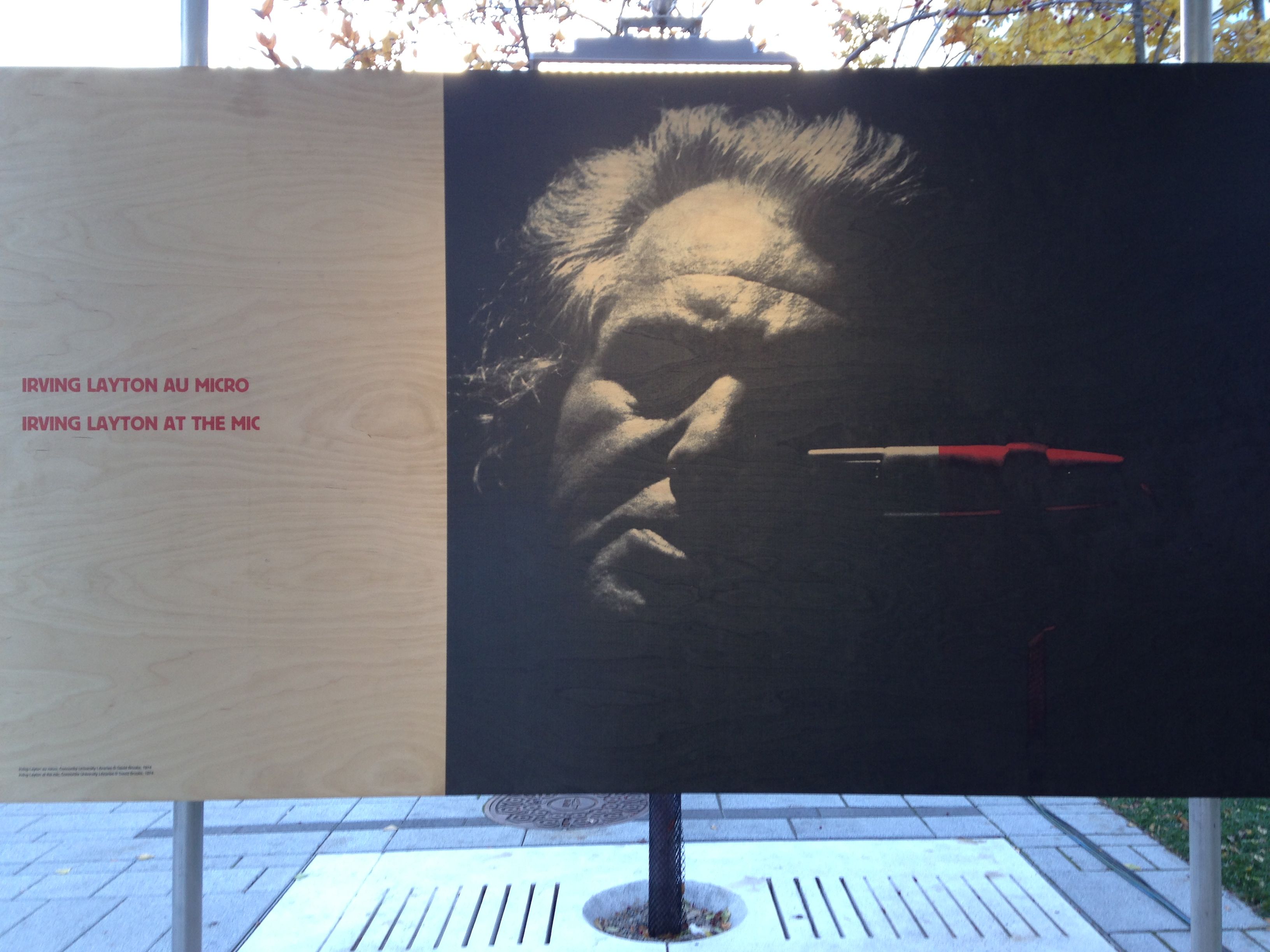
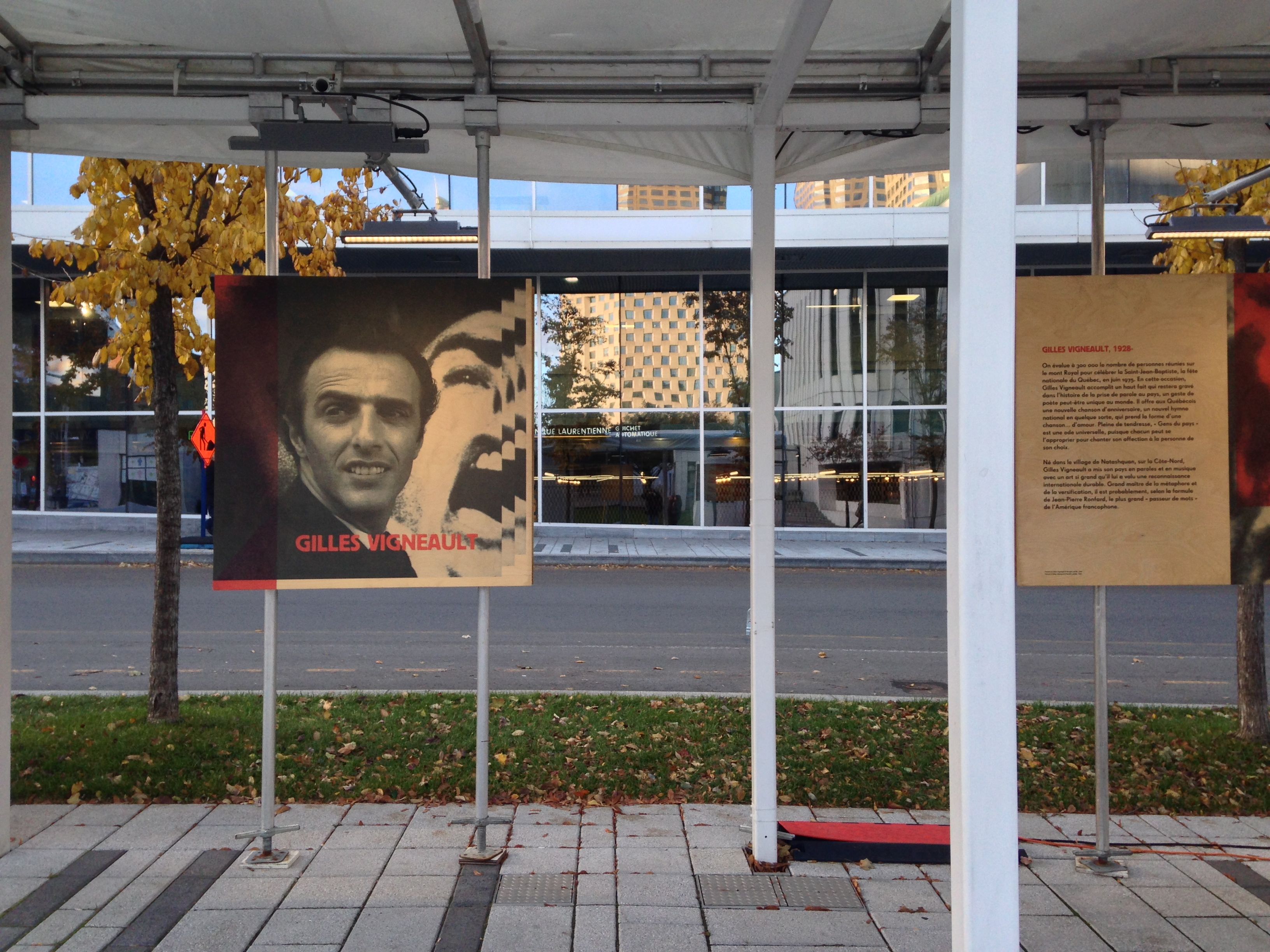
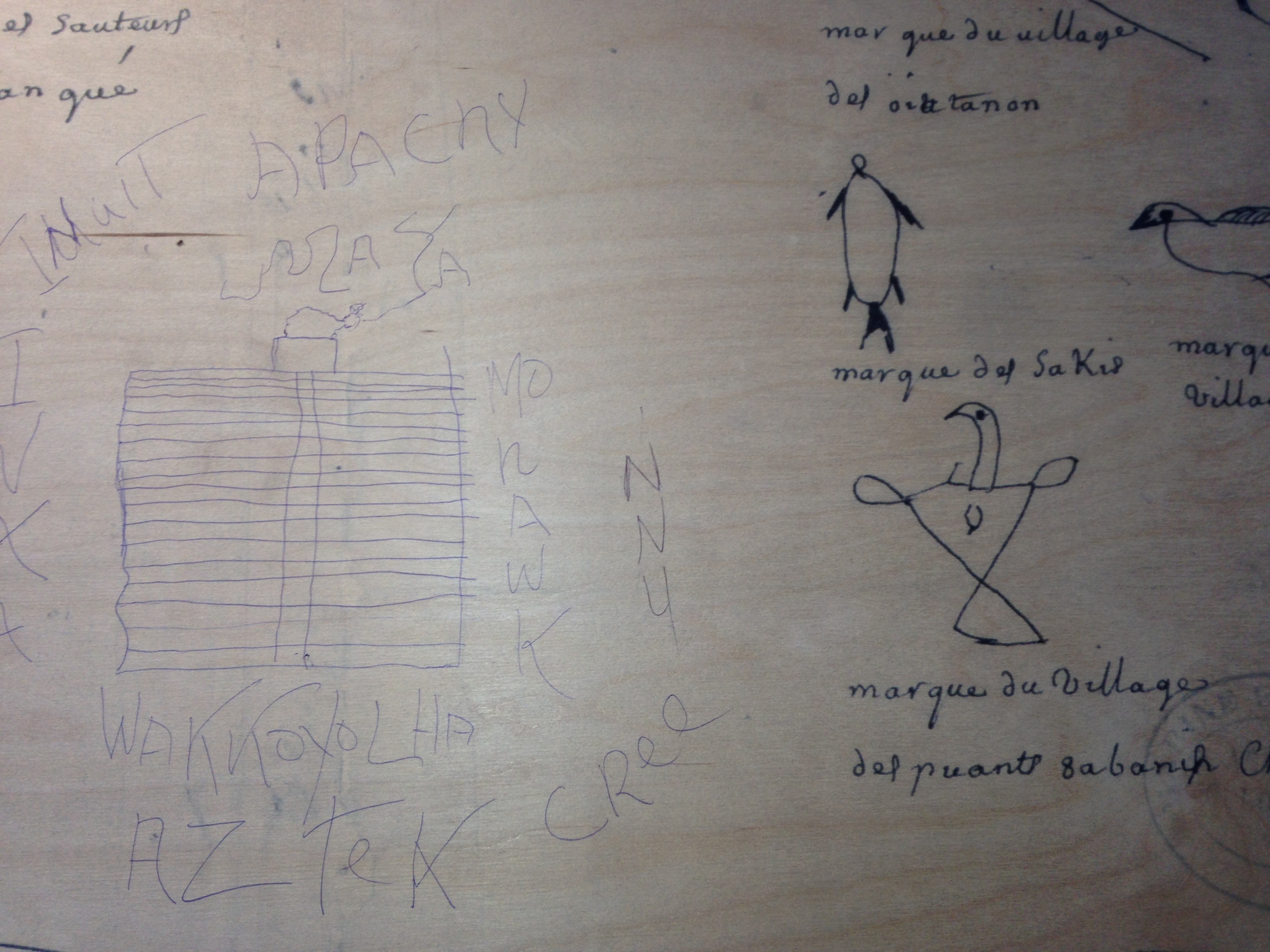
Poet Michèle Lalonde’s voice, however, dominates the space of the exhibit. It’s noticeably higher in pitch than the drone of traffic, and when it rises to meet the words “freedom and democracy” it pierces the low rumble of passing buses and trucks, filling the husk of the surrounding streets. The poem she reads is well known in Quebec, and the version on display here is central to the province’s history and identity as a nation. Recorded at La nuit de la poésie in 1970, the poem was first read at a 1968 benefit performance to support imprisoned members of the Front de libération du Québec, one of whom was Pierre Vallières, the author of Nègres blancs d’Amérique.
Inspired by Vallières’ memoir, “Speak White” is a double appropriation: of the English admonition to Francophones to abandon their mother tongue and, simultaneously, of the revolutionary potential of the Black Power movement of the 1960s, with which the most militant factions of the Quebec independence movement aligned themselves. It is, as Sean Mills has observed, an uncomfortable alliance in a province that struggles to recognize its own racism and status as a settler colony, but in the poetic space of Lalonde’s recitation the words still shudder with subaltern rage.
[Read English translation]
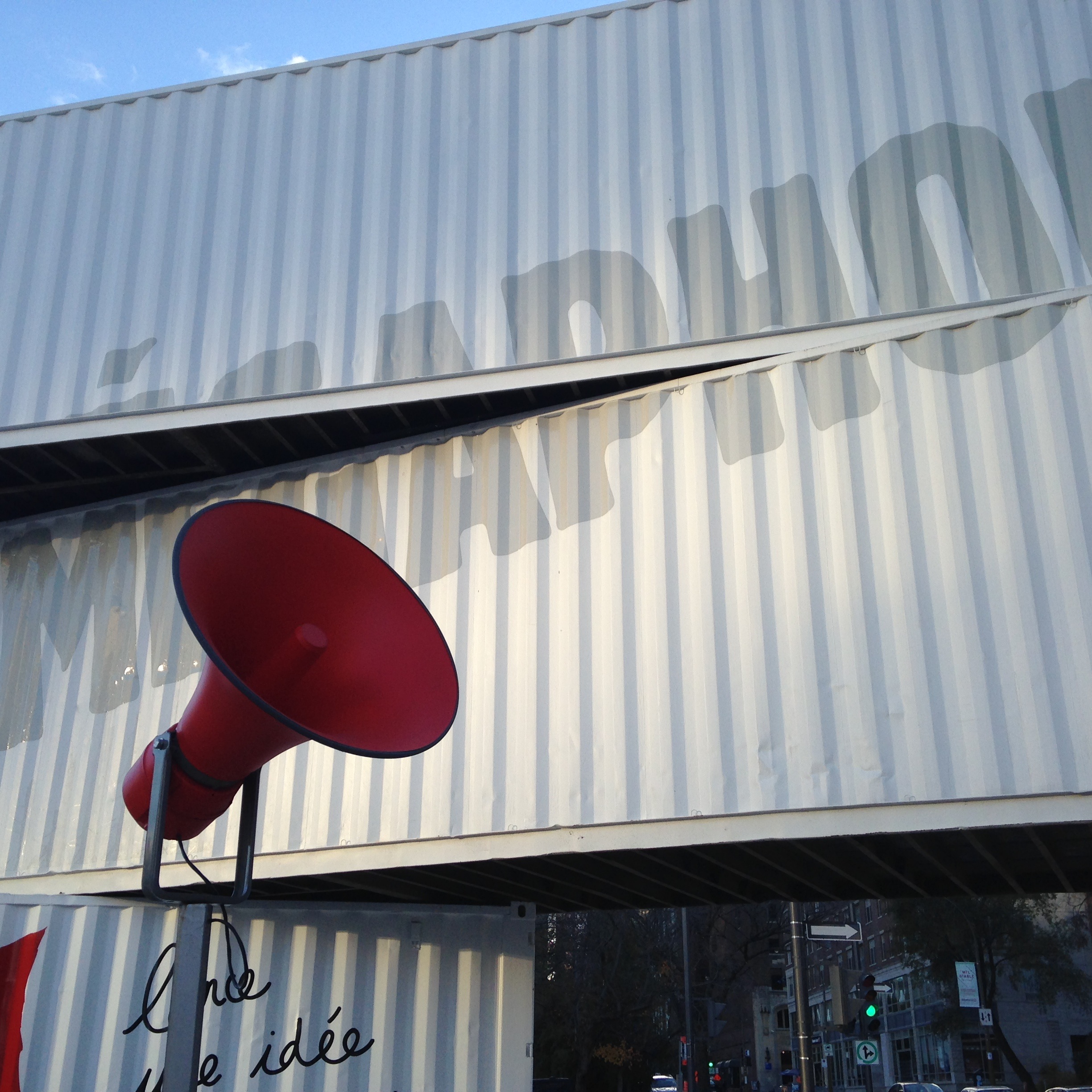
The term “megaphone” is something of a misnomer. The voices of participating speakers are amplified using a hand-held microphone that is connected to a stationary loudspeaker, which actually makes the megaphone more of a rudimentary public address system. It’s an important distinction, since the aural uses of the megaphone are shaped above all by its portability. Megaphones are a mobile audio technology and therefore a nomadic one; like boomboxes and iPods, they’re designed to be easy to carry and to be used while moving from place to place. The public address system, by contrast, is rooted in space: the speaking subject is anchored to the microphone and to the apparatus of amplification, which is composed not only of cables and loudspeakers but also the architectural elements (podium, stage, seating) of the auditorium.
More importantly, the portable megaphone is intended to be used outdoors and in crowds. Thomas Edison’s acoustic megaphone, which he patented in 1878, was soon used at sporting events and to magnify the voices of political leaders at outdoor public events. By 1900, street hawkers began selling makeshift megaphones to the politicians’ audiences, and their wares contributed to a new and noisy public sphere. When the megaphone was married to the transistor and to battery power in the 1950s, the technology was seized by social movements around the world, which used it to appropriate and disperse the power of the individual public speaker. Among them were the student and labor unions that flourished in the wake of Quebec’s Quiet Revolution, which had opened up a space for the province’s democratization.
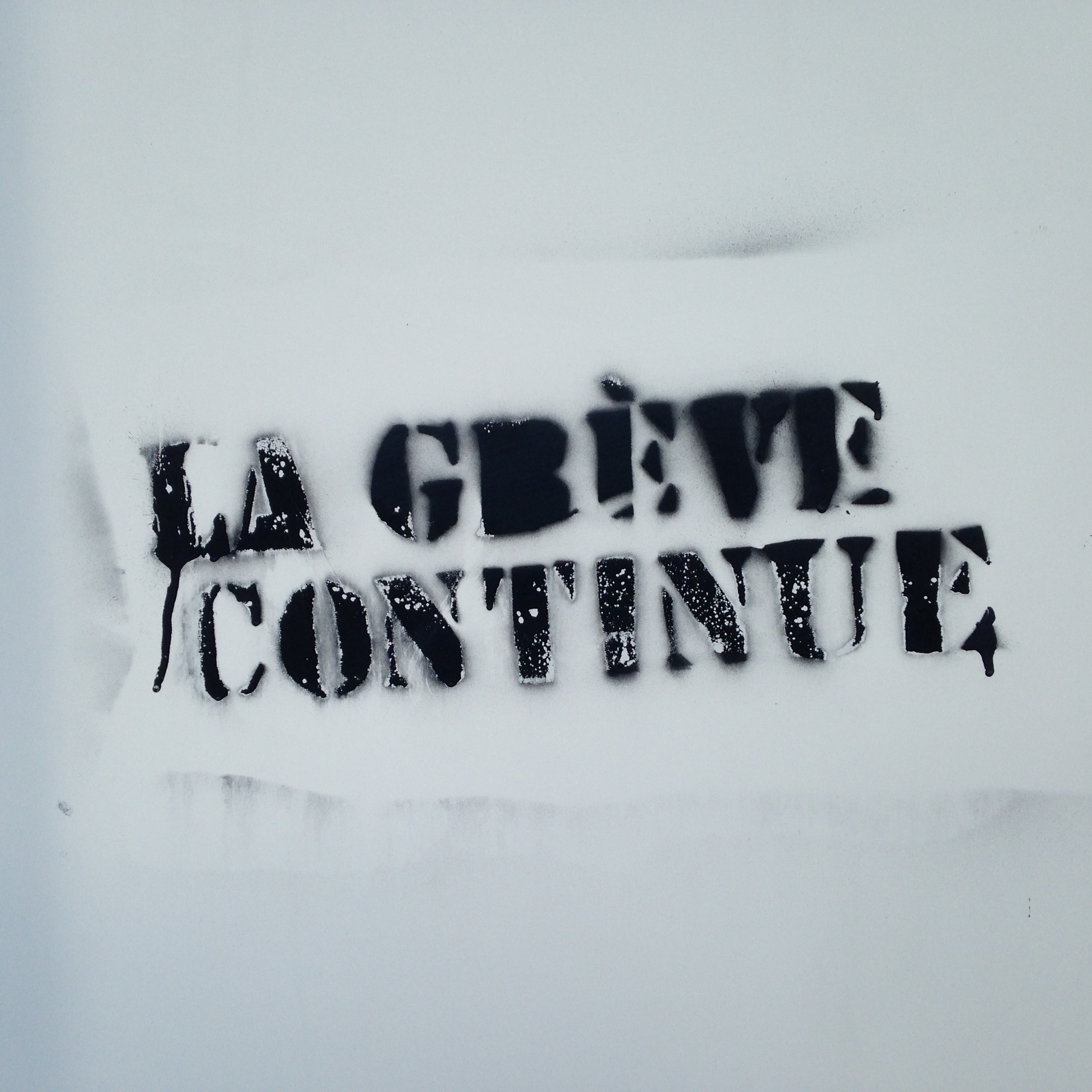
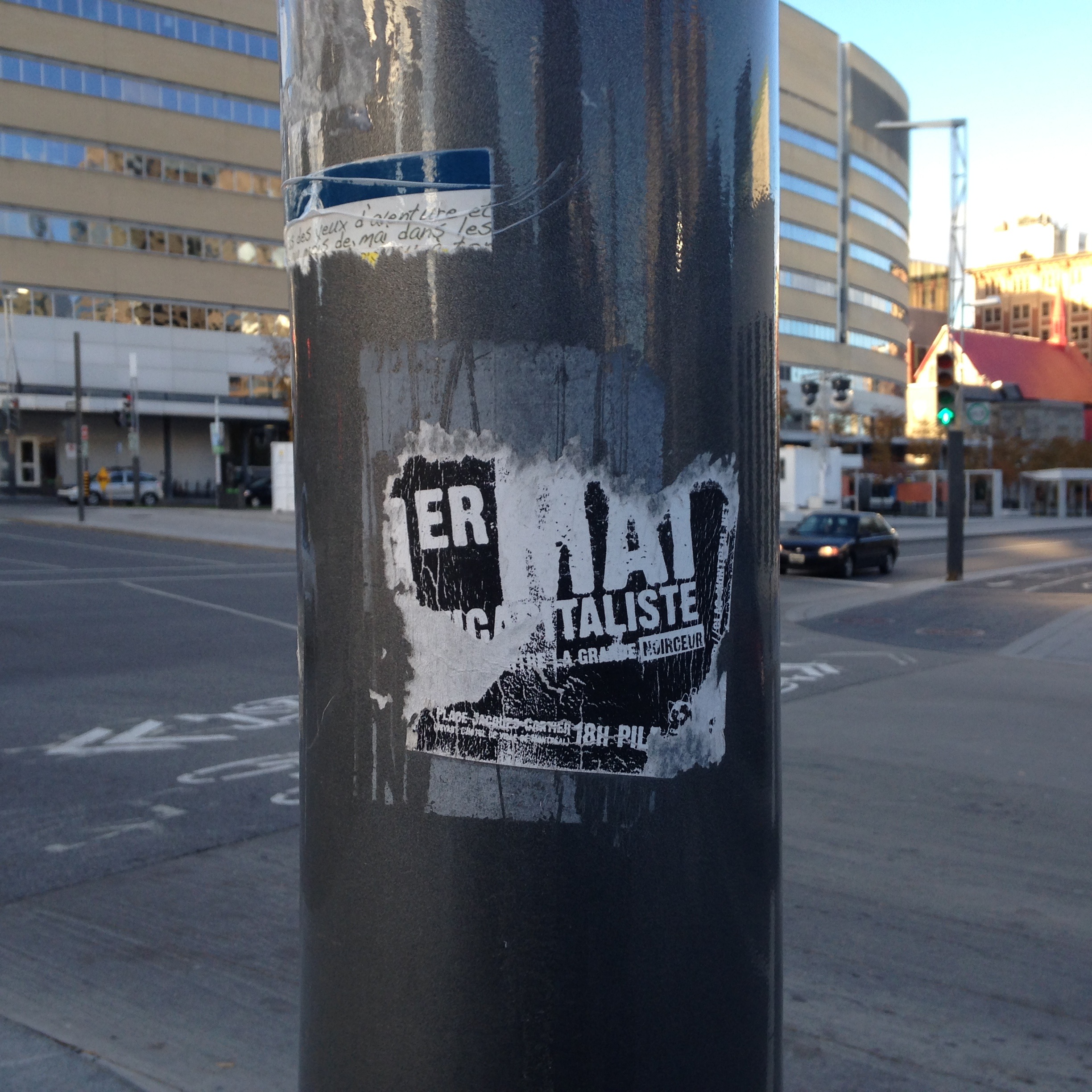
The year before Mégaphone opened, the promenades of the Quartiers des spectacles were crossed by hundreds and sometimes thousands of bodies that spilled out of Parc Émilie-Gamelin, where students and their supporters gathered for the nighttime demonstrations that became a hallmark of the Quebec student strike, or printemps érable. Each night at about 8:30 pm, we set off on marches that had no planned route and no final destination, walking for hours along streets that we claimed with nothing but our voices and the feet that carried them along. If you arrived late you could find the #manifencours on Twitter, or you could listen for the sounds of the crowd’s chants and the police helicopters that hovered constantly overhead, keeping large swaths of the downtown core awake until the early morning hours.
When the Liberal government attempted to break the strike with the reviled Bill 78, which required protest organizers to submit itineraries to the authorities in advance, the night marches dovetailed with a sudden explosion of casserole protests, which coalesced around autonomous popular assemblies organized at the neighborhood level. Within days, demonstrators fanned out across the city as roving bands of casserolières set off from Villeray, Mile End, Hochelaga, St-Henri and even staid, sleepy Outremont, erupting into cacophonous clangs and cheers as we found each other at the borders of our quartiers and merged into ever larger assemblages. If a city can light up with sound, then that is what happened here in Montreal.
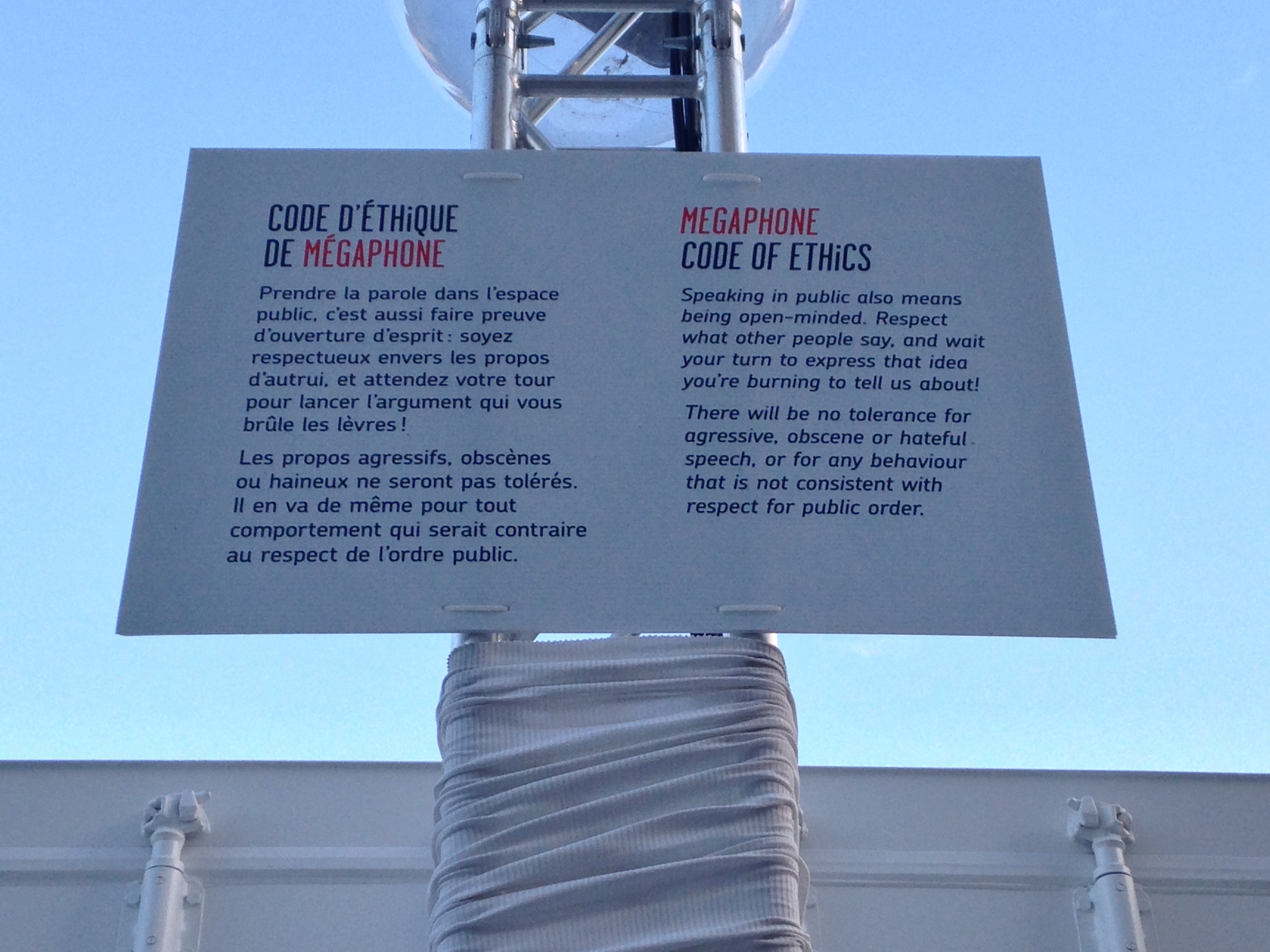
These echoes of the printemp érable form the acoustic backdrop of Mégaphone, and the sounds of the installation are designed to bleed into listeners’ memories of the strike. But Mégaphone is as much about the management of acoustic space as a celebration of its potential. Walking through the Promenade des artistes, I’m struck by a palpable but unintended theme: containment. The voices on display, already tethered to their microphones, are further limited by a series of overlapping spatial and temporal boundaries. The stage is accessible only on certain days and during designated hours, and then only when not reserved for previously scheduled speakers. Like the Quartier des spectacles that surrounds it, the installation is segregated from the lived spaces of the city, out of earshot of most residents and removed from the rhythms of their everyday. As if to belabor the point, speakers are bound by the Mégaphone “code of ethics,” which permits “no tolerance for aggressive, obscene or hateful speech, or for any behavior that is not consistent with respect for public order [emphasis mine].” Presumably, the code does not apply to the Quebeckers whose commitment to radical politics earned them a place in Mégaphone’s pantheon of speakers.
With its endlessly wandering marches and casseroles, the printemps érables was willfully inconsistent with respect for public order and its tactics reflected the anti-authoritarian impulses of the Quebec student movement. Simply by walking together, noisily and spontaneously, we recreated our city as a utopian space in which citizens, not governments, would chart their own course. By contrast, Mégaphone constrains the mobility of political speech, fencing it off in time and space and stripping it of its collective character. In doing so, it subjects the auditory space of the public sphere to what Don Mitchell terms a process of liberalization, drawing it away from the field of autonomous action and back under the stewardship of the state.
Philosophy professor Julien Villeneuve (better known as Anarchopanda) made this connection explicit when he and a group of fellow activists took to the Mégaphone stage to denounce municipal bylaw P-6, which, like Bill 78, requires protesters to inform the police of their activities under threat of arrest and massive fines. While Bill 78 (later Law 12) was repealed after a national outcry, P-6 remains in effect and its enforcement is in large part responsible for ending the strike and for the continuing suppression of public protest in Montreal.
As I walk back towards the bus stop, my fingers numb inside my mittens, I consider how much Mégaphone feels like a memorial to the city’s noisy public sphere, which, for the moment at least, is safely confined to the past.
—
Acknowledgements:
Sincere thanks to Jonathan Sterne, Erika Biddle, Magdalena Olszanowski, Ted Rutland, Liz Miller and the Tapas Gals for the conversations that contributed to this post.
—
Featured image: by Lilian Radovac
—
Lilian Radovac is a writer, organizer and doctoral candidate in communication studies at McGill University. She is currently finishing her dissertation on the cultural history of noise control in New York City, a chapter of which, “The ‘War on Noise’: Sound and Space in La Guardia’s New York,” was published in Sound Clash: Listening to American Studies (John Hopkins, 2012). Her work has also appeared in Times Higher Education, The Chronicle of Higher Education, TOPIA: Canadian Journal of Cultural Studies, and Communication and Critical/Cultural Studies.
—
REWIND!…If you liked this post, you may also dig:
“Quebec’s #casseroles: on participation, percussion and protest”-Jonathan Sterne
“Deejaying her Listening: Learning through Life Stories of Human Rights Violations”-Emmanuelle Sonntag and Bronwen Low
“Listening to the Border: ‘”2487″: Giving Voice in Diaspora’ and the Sound Art of Luz María Sánchez”-D. Ines Casillas
—
Share this:




Current Top Posts





April 2021

January 2020

November 2019

October 2019

August 2019

April 2014

November 2017

March 2015

December 2017

October 2015


Recent Comments