
The Eldritch Voice: H. P. Lovecraft’s Weird Phonography

— Guest Editor Julie Beth Napolin
—
A decade after finding itself downsized to a dwarf planet, Pluto has managed to spark wonder in the summer of 2015 as pictures of its remarkable surface features and those of its moon are delivered to us by NASA’s New Horizons space probe. As scientists begin to tentatively name these features, they have drawn from speculative fiction for what they see on the moon Charon, giving craters names including Spock, Sulu, Uhuru, and—mixing franchises—Skywalker . From Doctor Who there will be a Tardis Chasma and a Gallifrey Macula. Pluto’s features stretch back a bit further, where there will also be a Cthulhu Regio, named after the unspeakable interstellar monster-cum-god invented by H. P. Lovecraft.
We can imagine that Lovecraft would have been thrilled, since back when Pluto was first discovered in early 1930 and was the evocative edge of the solar system, he had turned the planet into the putative home of secretive alien visitors to Earth in his short story “The Whisperer in Darkness.” First published in the pulp magazine Weird Tales in 1931, “The Whisperer in Darkness” features various media of communication—telegraphs, telephones, photographs, and newspapers—as well as the possibilities of their manipulation and misconstruing. The phonograph, however, plays the starring role in this tale about gathering and interpreting the eerie and otherworldly—the eldritch, in a word—signs of possible alien presence in backwoods Vermont.
In the story, Akeley, a farmer with a degree of erudition and curiosity, captures something strange on a record. This something, when played back by the protagonist Wilmarth, a folklorist at Lovecraft’s fictional Miskatonic University, goes like this:
Iä! Shub-Niggurath! The Black Goat of the Woods with a Thousand Young! (219)
The sinister resonance of a racial epithet in what appears to be a foreign or truly alien tongue notwithstanding, this story features none of the more obvious and problematic invocations of race and ethnicity—the primitive rituals in the swamps of Louisiana of “The Call of Cthulhu” or the anti-Catholic immigrant panic of “The Horror at Red Hook”—for which Lovecraft has achieved a degree of infamy. Moreover, the understandable concern with Lovecraft’s social Darwinism and bad biology in some ways tends to miss how for the author—and for us as well—power and otherness are bound up with technology.

The transcription of these exclamations, recorded on a “blasphemous waxen cylinder,” is prefaced with an emphatic remark about their sonic character: “A BUZZING IMITATION OF HUMAN SPEECH” (219-220). The captured voice is further described as an “accursed buzzing which had no likeness to humanity despite the human words which it uttered in good English grammar and a scholarly accent” (218). It is glossed yet again as a “fiendish buzzing… like the drone of some loathsome, gigantic insect ponderously shaped into the articulate speech of an alien species” (220). If such a creature tried to utter our tongue and to do so in our manner—both of which would be alien to it—surely we might expect an indication of the difference in vocal apparatuses: a revelatory buzzing. Lovecraft’s story figures this “eldritch sound” as it is transduced through the corporeal: as the timbral indication of something off when the human voice is embodied in a fundamentally different sort of being. It is the sound that happens when a fungoid creature from Yuggoth—the supposedly native term for Pluto—speaks our tongue with its insectile mouthparts.
Yet, reading historically, we might understand this transduction as the sound of technical mediation itself: the brazen buzz of phonography, overlaying and, in a sense, inhabiting the human voice.
For listeners to early phonographic recordings, metallic sounds—inevitable given the materials used for styluses, tone arms, diaphragms, amplifying horns—were simply part of the experience. Far from capturing “the unimaginable real” or registering “acoustic events as such,” as media theorist Friedrich Kittler once put the case about Edison’s invention, which debuted in 1877, phonography was not only technically incapable of recording anything like an ambient soundscape but also drew attention to the very noise of itself (23).
For the first several decades of the medium’s existence, patent registers and admen’s pitches show that clean capture and reproduction were elusive rather than given. An account in the Literary Digest Advertiser of Valdemar Poulsen’s Telegraphone, explains the problem:
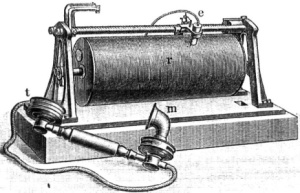
The talking-machine records sound by the action of a steel point upon some yielding substance like wax, and reproduces it by practically reversing the operation. The making of the record itself is accompanied by a necessary but disagreeably mechanical noise—that dominating drone—that ‘b-r-r-r-r’ that is never in the human voice, and always in its mechanical imitations. One hears metallic sounds from a brazen throat—uncanny and inhuman. The brittle cylinder drops on the floor, breaks—and the neighbors rejoice!
The Telegraphone, which recorded sounds “upon imperishable steel through the intangible but potent force of electromagnetism” such that no “foreign or mechanical noise is heard or is possible,” of course promised to make the neighbors happy not by breaking the cylinder but rather by taking the inhuman ‘b-r-r-r-r’ out of the phonographically reproduced voice. Nonetheless, etching sound on steel, the Telegraphone was still a metal machine and unlikely to overcome the buzz entirely.
In his account of “weird stories” and why the genre suited him best, Lovecraft explained that one of his “strongest and most persistent wishes” was “to achieve, momentarily, the illusion of some strange suspension or violation of the galling limitations of time, space, and natural law which forever imprison us and frustrate our curiosity about the infinite cosmic spaces beyond the radius of our sight and analysis.” In “The Whisperer in Darkness,” Lovecraft put to work a technology that was rapidly becoming commonplace to introduce a buzz into the fabric of the everyday. This is the eldritch effect of Lovecraft’s evocation of phonography. While we might wonder whether a photograph has been tampered with, who really sent a telegram, or with whom we are actually speaking over a telephone line—all examples from Lovecraft’s tale—the central, repeated conundrums for the scholar Wilmarth remain not only whose voice is captured on the recorded cylinder but also why it sounds that way.
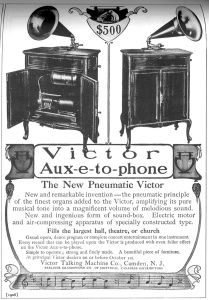
The phonograph transforms the human voice, engineers a cosmic transduction, suggesting that within our quotidian reality something strange might lurk. This juxtaposition and interplay of the increasingly ordinary and the eldritch is also glimpsed in an account of Charles Parson’s invention the Auxetophone, which used a column of pressurized air rather than the usual metallic diaphragm. Here is an account of the voice of the Auxetophone from the “Matters Musical” column of The Bystander Magazine from 1905: “Long ago reconciled to the weird workings of the phonograph, we had come to regard as inevitable the metallic nature of its inhuman voice.” The new invention might well upset our listening habits, for Mr. Parson’s invention “bids fair to modify, if not entirely to remove,” the phonograph’s “somewhat unpleasant timbre.”
What the phonograph does as a medium is to make weird. And what making weird means is that instead of merely reproducing the human voice—let alone rendering acoustic events as such—it transforms the latter into its own: an uncanny approximation, which fails to simulate perfectly with regard to timbre in particular. Phonography reveals that the materials of reproduction are not vocal chords, breath, labial and dental friction—not flesh and spirit, but vibrating metal.
Although we can only speculate in this regard, I would suggest that “The Whisperer in Darkness” was weirder for readers for whom phonographs still spoke with metallic timbre. The rasping whisper of the needle on cylinder created what the Russian Formalist Viktor Shklovsky was formulating at almost exactly the same time as the function of the literary tout court: defamiliarization or, better, estrangement. Nonetheless, leading the reader to infer an alien presence behind this voice was equally necessary for the effect. After all, if we are to take the Auxetophone as our example—an apparatus announced in 1905, a quarter of a decade before Lovecraft composed his tale, and that joined a marketplace burgeoning with metallic-voice reducing cabinets, styluses, dampers, and other devices—phonographic listeners had long since become habituated to the inhumanity of the medium. That inhumanity had to be recalled and reactivated in the context of Lovecraft’s story.
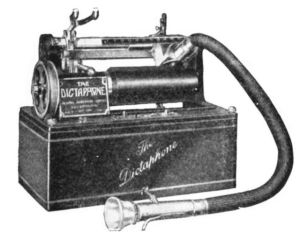
To understand fully the nature of this reactivation, moreover, we need to know precisely what Lovecraft’s evocative phonograph was. When Akeley takes his phonograph into the woods, he adds that he brought “a dictaphone attachment and a wax blank” (209). Further, to play back the recording, Wilmarth must borrow the “commercial machine” from the college administration (217). The device most consistent with Lovecraft’s descriptions and terms is not a record player, as we might imagine, but Columbia Gramophone Company’s Dictaphone. By the time of the story’s setting, Edison Phonograph’s had long since switched to more durable celluloid cylinders (Blue Amberol Records; 1912-1929) in an effort to stave off competition from flat records. Only Dictaphones, aimed at businessmen rather than leisure listeners, still used wax cylinders, since recordings could be scraped off and the cylinder reused. The vinyl Dictabelt, which eventually replaced them, would not arrive until 1947.
Meanwhile, precisely when the events depicted in “The Whisperer in Darkness” are supposed to have taken place, phonography was experiencing a revolutionary transformation: electronic sound technologies developed by radio engineers were hybridizing the acoustic machines, and electro-acoustic phonographs were in fact becoming less metallic in tone. Yet circa 1930, as the buzz slipped toward silence, phonography was still the best means of figuring the sonic uncanny valley. It was a sort of return of the technologically repressed: a reminder of the original eeriness of sound reproduction—recalled from childhood or perhaps parental folklore—at the very moment that new technologies promised to hide such inhumanity from sensory perception. Crucially, in Lovecraft’s tale, estrangement is not merely a literary effect. Rather, the eldritch is what happens when the printed word at a given moment of technological history calls up and calls upon other media of communication, phonography not the least.
I have remarked the apparent absence of race as a concern in “The Whisperer in Darkness,” but something along the lines of class is subtly but insistently at work in the tale. The academic Wilmarth and his erudite interlocutor Akeley are set in contrast with the benighted, uncomprehending agrarians of rural Vermont. Both men also display a horrified fascination with the alien technology that will allow human brains to be fitted into hearing, seeing, and speaking machines for transportation to Yuggoth. These machines are compared to phonographs: cylinders for storing brains much like those for storing the human voice. In this regard, the fungoid creatures resemble not so much bourgeois users or consumers of technology as scientists and engineers. Moreover, they do so just as a discourse of technocracy—rule by a technologically savvy elite—was being articulated in the United States. Here we might see the discovery of Pluto as a pretext for exploring anxieties closer to home: how new technologies were redistributing power, how their improvement—the fading of the telltale buzz—was making it more difficult to determine where humanity stopped and technology began, and whether acquiescence in this changes was laudable or resistance feasible. As usual with Lovecraft, these topics are handled with disconcerting ambivalence.
—
James A. Steintrager is a professor of English, Comparative Literature, and European Languages and Studies at the University of California, Irvine. He writes on a variety of topics, including libertinism, world cinema, and auditory cultures. His translation of and introduction to Michel Chion’s Sound: An Acoulogical Treatise will be published by Duke University Press in fall of 2015.
—
Featured image: Taken from “Global Mosaic of Pluto in True Color” in NASA’s New Horizons Image Gallery, public domain. All other images courtesy of the author.
—

REWIND! . . .If you liked this post, you may also dig:
Sound and Sanity: Rallying Against “The Voice” — Mark Brantner
DIANE… The Personal Voice Recorder in Twin Peaks — Tom McEnaney
Reproducing Traces of War: Listening to Gas Shell Bombardment, 1918 — Brían Hanrahan
—
Share this:

Sculptural Dissonance: Hans Zimmer and the Composer as Engineer
DOI: https://doi.org/10.59350/kx3v2-f6114
Welcome to our new series Sculpting the Film Soundtrack, which brings you new perspectives on sound and filmmaking. As Guest Editor, we’re honored and delighted to have Katherine Spring, Associate Professor of Film Studies at Wilfrid Laurier University. Spring is the author of an exciting and important new book Saying it With Songs: Popular Music and the Coming of Sound to Hollywood Cinema. Read it! You’ll find an impeccably researched work that’s the definition of how the history of film sound and media convergence ought to be written.
But before rushing back to the early days, stick around here on SO! for the first of our three installments in Sculpting the Film Soundtrack.
– NV
—
It’s been 35 years since film editor and sound designer Walter Murch used the sounds of whirring helicopter blades in place of an orchestral string section in Apocalypse Now, in essence blurring the boundary between two core components of the movie soundtrack: music and sound effects. This blog series explores other ways in which filmmakers have treated the soundtrack as a holistic entity, one in which the traditional divisions between music, effects, and speech have been disrupted in the name of sculpting innovative sonic textures.
In three entries, Benjamin Wright, Danijela Kulezic-Wilson, and Randolph Jordan will examine the integrated soundtrack from a variety of perspectives, including technology, labor, aesthetic practice, theoretical frameworks, and suggest that the dissolution of the boundaries between soundtrack categories can prompt us to apprehend film sound in new ways. If, as Murch himself once said, “Listening to interestingly arranged sounds makes you hear differently,” then the time is ripe for considering how and what we might hear across the softening edges of the film soundtrack.
– Guest Editor Katherine Spring
—
Composing a sound world for Man of Steel (2013), Zack Snyder’s recent Superman reboot, had Hans Zimmer thinking about telephone wires stretching across the plains of Clark Kent’s boyhood home in Smallville. “What would that sound like,” he said in an interview last year. “That wind making those telephone wires buzz – how could I write a piece of music out of that?” The answer, as it turned out, was not blowing in the wind, but sliding up and down the scale of a pedal steel guitar, the twangy lap instruments of country music. In recording sessions, Zimmer instructed a group of pedal steel players to experiment with sustains, reverb, and pitches that, when mixed into the final track, accompany Superman leaping over tall buildings at a single bound.
His work on Man of Steel, just one of his most recent films in a long and celebrated career, exemplifies his unique take on composing for cinema. “I would have been just as happy being a recording engineer as a composer,” remarked Zimmer last year in an interview to commemorate the release of a percussion library he created in collaboration with Spitfire Audio, a British sample library developer. “Sometimes it’s very difficult to stop me from mangling sounds, engineering, and doing any of those things, and actually getting me to sit down and write the notes.” Dubbed the “HZ01 London Ensembles,” the library consists of a collection of percussion recordings featuring many of the same musicians who have performed for Zimmer’s film scores, playing everything from tamtams to taikos, buckets to bombos, timpani to anvils. According to Spitfire’s founders, the library recreates Zimmer’s approach to percussion recording by offering a “distillation of a decade’s worth of musical experimentation and innovation.”
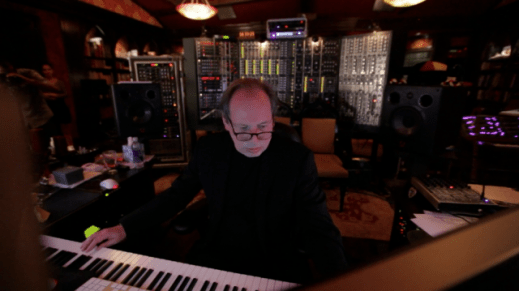
In many ways, the collection is a reminder not just of the influence of Zimmer’s work on contemporary film, television, and video game composers but also of his distinctive approach to film scoring, one that emphasizes sonic experimentation and innovation. Having spent the early part of his career as a synth programmer and keyboardist for new wave bands such as The Buggles and Ultravox, then as a protégé of English film composer Stanley Myers, Zimmer has cultivated a hybrid electronic-orchestral aesthetic that uses a range of analog and digital oscillators, filters, and amplifiers to twist and augment solo instrument samples into a synthesized whole.
http://www.youtube.com/watch?v=Iwuy4hHO3YQ
Zimmer played backup keyboards on “Video Killed the Radio Star.”
In a very short time, Zimmer has become a dominant voice in contemporary film music with a sound that blends melody with dissonance and electronic minimalism with rock and roll percussion. His early Hollywood successes, Driving Miss Daisy (1989) and Days of Thunder (1990), combined catchy themes and electronic passages with propulsive rhythms, while his score for Black Rain (1989), which featured taiko drums, electronic percussion, and driving ostinatos, laid the groundwork for an altogether new kind of action film score, one that Zimmer refined over the next two decades on projects such as The Rock (1996), Gladiator (2000), and The Pirates of the Caribbean series.
What is especially intriguing about Zimmer’s sound is the way in which he combines the traditional role of the composer, who fashions scores around distinct melodies (or “leitmotifs”), with that of the recording engineer, who focuses on sculpting sounds. Zimmer may not be the first person in the film business to experiment with synthesized tones and electronic arrangements – you’d have to credit Bebe and Louis Barron (Forbidden Planet, 1956), Vangelis (Chariots of Fire, 1981), Jerry Goldsmith (Logan’s Run, 1976), and Giorgio Moroder (Midnight Express, 1981) for pushing that envelope – but he has turned modern film composing into an engineering art, something that few other film composers can claim.
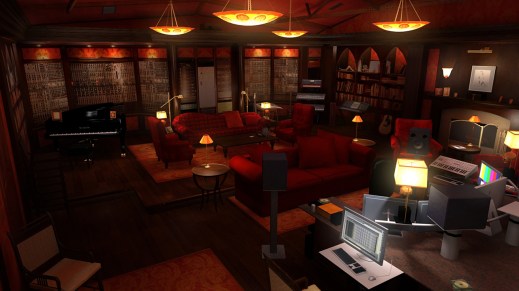
One thing that separates Zimmer’s working method from that of other composers is that he does not confine himself to pen and paper, or even keyboard and computer monitor. Instead, he invites musicians to his studio or a sound stage for an impromptu jam session to find and hone the musical syntax of a project. Afterwards, he returns to his studio and uses the raw samples from the sessions to compose the rest of the score, in much the same way that a recording engineer creates the architecture of a sound mix.
“There is something about that collaborative process that happens in music all the time,” Zimmer told an interviewer in 2010. “That thing that can only happen with eye contact and when people are in the same room and they start making music and they are fiercely dependent on each other. They cannot sound good without the other person’s part.”
Zimmer facilitates the social and aesthetic contours of these off-the-cuff performances and later sculpts the samples into the larger fabric of a score. In most cases, these partnerships have provided the equivalent of a pop hook to much of Zimmer’s output: Lebo M’s opening vocal in The Lion King (1994), Johnny Marr’s reverb-heavy guitar licks in Inception, Lisa Gerrard’s ethereal vocals in Gladiator and Black Hawk Down (2002), and the recent contributions of the so-called “Magnificent Six” musicians to The Amazing Spider Man 2 (2014).
The melodic hooks are simple but infectious – even Zimmer admits he writes “stupidly simple music” that can often be played with one finger on the piano. But what matters most are the colors that frame those notes and the performances that imbue those simple melodies with a personality. Zimmer’s work on Christopher Nolan’s Dark Knight trilogy revolves around a deceptively simple rising two-note motif that often signifies the presence of the caped crusader, but the pounding taiko hits and bleeding brass figures that surround it do as much to conjure up images of Gotham City as cinematographer Wally Pfister’s neo-noir photography. The heroic aspects of the Batman character are muted in Zimmer’s score except for the presence of the expansive brass figures and taiko hits, which reach an operatic crescendo in the finale, where the image of Batman escaping into the blinding light of the city is accompanied by a grand statement of the two-note figure backed by a driving string ostinato. Throughout the series, a string ostinato and taikos set the pace for action sequences and hint at the presence of Batman who lies somewhere in the shadows of Gotham.
Zimmer’s expressive treatment of musical colors also characterizes his engineering practices, which are more commonly used in the recording industry. Music scholar Paul Théberge has noted that the recording engineer’s interest in an aesthetic of recorded musical “sound” led to an increased demand for control over the recording process, especially in the early days of multitrack rock recording where overdubbing created a separate, hierarchical space for solo instruments. Likewise for Zimmer, it’s not just about capturing individual sounds from an orchestra but also layering them into a synthesized product. Zimmer is also interested in experimenting with acoustic performances, pushing musicians to play their instruments in unconventional ways or playing his notes “the wrong way,” as he demonstrates here in the making of the Joker’s theme from The Dark Knight:
The significance of the cooperative aspects of these musical performances and their treatment as musical “colors” to be modulated, tweaked, and polished rests on a paradoxical treatment of sound. While he often finds his sound world among the wrong notes, mistakes, and impromptu performances of world musicians, Zimmer is also often criticized for removing traces of an original performance by obscuring it with synth drones and distortion. In some cases, like in The Peacemaker (1997), the orchestration is mushy and sounds overly processed. But in other cases, the trace of a solo performance can constitute a thematic motif in the same way that a melody serves to identify place, space, or character in classical film music. Compare, for instance, Danny Elfman’s opening title theme for Tim Burton’s Batman (1989) and Zimmer’s opening title music for The Dark Knight. While Elfman creates a suite of themes around a central Batman motif, Zimmer builds a sparse sound world that introduces a sustained note on the electric cello that will eventually be identified with the Joker. It’s the timbre of the cello, not its melody, that carries its identifying features.
To texture the sounds in Man of Steel, Zimmer also commissioned Chas Smith, a Los Angeles-based composer, performer, and exotic instrument designer to construct instruments from “junk” objects Smith found around the city that could be played with a bow or by hand while also functioning as metal art works. The highly abstract designs carry names that give some hint to their origins – “Bertoia 718” named after modern sculptor and furniture designer Harry Bertoia; “Copper Box” named for the copper rods that comprise its design; and “Tin Sheet” that, when prodded, sounds like futuristic thunderclaps.
Smith’s performances of his exotic instruments are woven into the fabric of the score, providing it with a sort of musical sound design. Consider General Zod’s suite of themes and motifs, titled “Arcade” on the 2-disc version of the soundtrack. The motif is built around a call-and-answer ostinato for strings and brass that is interrupted by Smith’s sculptural dissonance. It’s the sound of an otherworldly menace, organic but processed, sculpted into a conventional motif-driven sound world.
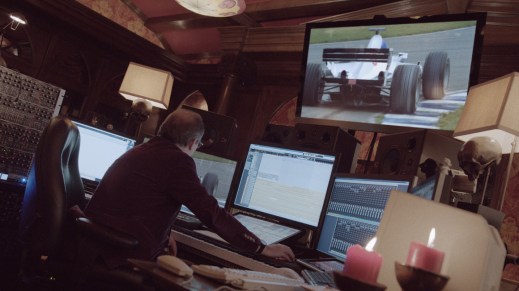
Zimmer remains a fixture in contemporary film music partly because, as music critic Jon Burlingame has pointed out, he has a relentless desire to search for fresh approaches to a film’s musical landscape. This pursuit begins with his extracting of sounds and colors from live performances and electronically engineering them during the scoring process. Such heightened attention to sound texture and color motivated the creation of the Spitfire percussion library, but can only hint at the experimentation and improvisational nature that goes into Zimmer’s work. In each of his film scores, the music tells a story that is tailored to the demands of the narrative, but the sounds reveal Zimmer’s urge to manipulate sound samples until they are, in his own words, “polished like a diamond.”
—
Ben Wright holds a Provost Postdoctoral Fellowship from the University of Southern California in the School of Cinematic Arts. In 2011, he received his Ph.D. in Cultural Studies from the Institute for Comparative Studies in Literature, Art and Culture at Carleton University. His research focuses on the study of production cultures, especially exploring the industrial, social, and technological effects of labor structures within the American film industry. His work on production culture, film sound and music, and screen comedy has appeared in numerous journals and anthologies. He is currently completing a manuscript on the history of contemporary sound production, titled Hearing Hollywood: Art, Industry, and Labor in Hollywood Film Sound.
—
All images creative commons.
—
REWIND! . . .If you liked this post, you may also dig:
Fade to Black, Old Sport: How Hip Hop Amplifies Baz Luhrmann’s The Great Gatsby— Regina Bradley
Quiet on the Set?: The Artist and the Sound of a Silent Resurgence— April Miller
Play It Again (and Again), Sam: The Tape Recorder in Film (Part Two on Walter Murch)— Jennifer Stoever
—
Share this:




Current Top Posts





April 2021

January 2020

November 2019

October 2019

August 2019

April 2014

November 2017

March 2015

December 2017

October 2015


Recent Comments