As I write this, I am sitting on the return flight from Portugal, where I spent an utterly transformational four days at the Invisible Places, Sounding Cities conference (deftly organized and elegantly curated by Raquel Castro), a sensory torrent that still has me buzzing. While there, I was thrilled, provoked, taken, shaken, intrigued, pleased, taught, energized, exhausted, re-energized, puzzled, lifted up. . .all of the things I hope a truly great meeting will do (and then some). What I wasn’t prepared for—and when going to a conference featuring sound artists and performers, I imagine myself ready for anything—was the flood of gratefulness and gratitude that I felt every time I had a conversation about Sounding Out!, every time all of our stickers disappeared off the registration table, every time I introduced myself and there were nods of recognition from people I had never met—people located thousands of miles from my home IP address—and every time my scouting attempts were met with enthusiasm that matched (and often rivaled) my own.
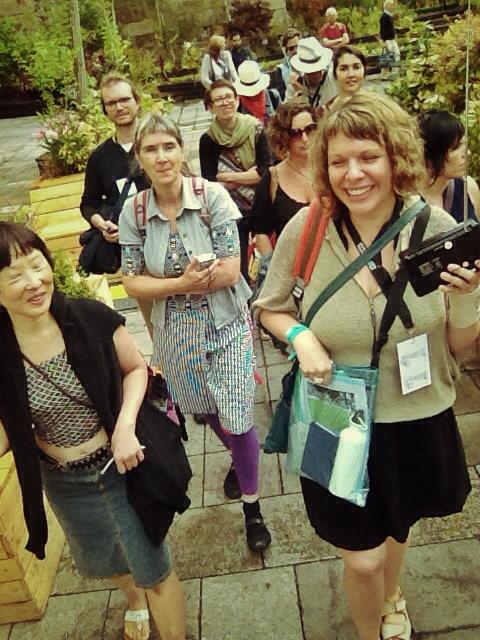
Multimedia artist, SO! Regular Writer, and Portugal resident Maile Colbert leading Invisible Places attendees on the Radio Terramoto soundwalk co-created with her partner Rui Costa (of Binaural/Nodar).
And, while I cannot deny that I my work on Sounding Out! has generated personal pride—speaking honestly, sometimes I go to soundstudiesblog.com just to LOOK at it—but the feeling I enjoyed in Viseu was different from “accomplishment.” I felt grateful for the support of our editors, writers, and podcasters—sharing the best of themselves, tirelessly and without compensation other than mad props and ‘nuff respect—for our readers, ever stretching across the globe, sharing, liking, and ReTweeting, until this endeavor became a networked community, and for our fans—Yes! We have received fan mail!—whose enthusiasm always seems to arrive at the right time, the Hail Mary eleventh hour when the editors are fighting sleep and/or needing another reason to allow Dora the Explorer to play a little longer to steal time to finish a piece. I also felt gratitude for the diverse and full-bodied sound studies community, particularly its rigorous but generous, inviting embrace, which extended to the fledgling Sounding Out! experiment five lightning-quick years ago.
In that time, I hope we have expressed our gratitude in return, by deepening and extending our mutual community, binding us in new and unexpected ways, showcasing our best and giving air to our challenges, and, most importantly, enabling us to greet each other as familiar colleagues—in Viseu, Berlin, Toronto, San Juan, Los Angeles, Copenhagen, New York, Sao Paolo. . .—even if we had never before met “In Real Life.” Know that as we continue to grow and renew the site that the function of community will always remain a prime directive of SO!. I welcome the responsibility we have collectively invested in Sounding Out!; it makes my decisions both more contemplative and surefooted. Thank you, everyone, for the last five years—lets raise a glass of Grão Vasco Dão Tinto toward many more together!
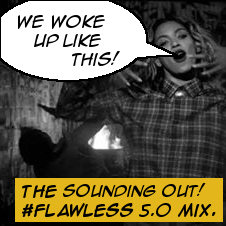
As we sip, let’s also partake in the annual SO! tradition of taking stock of the last action-packed year, with soundtrack supplied by another artist having a #flawless year, Ms. Beyoncé Knowles herself. . .
“Irreplaceable” (Goodbye, Liana): I write this first update completely under protest. I know I am not supposed to admit to affective reactions, especially in cyberspace and especially as a woman with her feet in several male dominated fields, but when Liana Silva-Ford, our stalwart and smoothly bad-ass Managing Editor and Co-Founder, told me she was considering leaving SO!, my eyes welled up instantaneously. Okay, so she very straightforwardly told me she was leaving—even now I still have to sneak in the modifier “considering.” Liana was recently named Editor-in-Chief of the longstanding publication Women in Higher Education(now on Wiley-Blackwell)—read her first “Editor’s End Notes” here—and she is embarking on a book project on her not-so-secret passion, postcards. Liana has, rightly and deservedly, decided to bestow more of her time on these two *amazing ventures. Even though none of us has yet to successfully visualize SO! without her, we know this is right and we wish her all and only the best. Thank you, Liana for your steady hand but light touch, your sharp yet generous editorial eye, and the intelligence, professionalism, and enthusiasm you brought to every meeting, every challenge, and every writer. Working (and SO!-hiveminding) with you has been an exquisite pleasure. And thank you for letting me twist your arm into a permanent “Editor-at-Large” position (whew!).
“Green Light” (Welcome Cara, Neil, Will): On the other hand, I am pleased to announce that the O.G. SO! triumvirate has happily expanded to a sextet. Media scholar Neil Verma (Visiting Assistant Professor in the Department of Radio/Television/Film at Northwestern University) our new ASA/SCMS Special Editor, came on board in late 2013, curating our new Thursday stream that launched in January 2014. Neil has already proved himself to be a skilled editor, an intuitive curator, and a natural at the brand of humor and enthusiastic tomfoolery we thrive on behind the scenes. We initiated our “L.A. Office” in December with the addition of William Stabile, our new Assistant Visual Editor, who is responsible for many of the mighty fine layouts that that you have seen this year. He is flexible, patient, and extremely gifted in the visual arts, with a wit dryer than Riverside, California this time of year. We value his work and presence immensely. And, drum roll please (especially with our crowd), we are pleased to announce right here today, that Cara Lynne Cardinale is our new Managing Editor, coming to us live from the East Bay in Northern California with a soaring collection of great ideas and her feet firmly planted on the ground of spreadsheets, calendars, and deadlines. Cara graduated in 2010 with her Ph.D. in English from the University of California, Riverside, with a brilliant dissertation that I am constantly telling my graduate students to seek out: “‘Through the Eyes’: Reading Deafened Gestures of Look-Listening in Twentieth Century Narratives.” A unanimous selection for her intensity, sharpness, and style-for-miles, Cara will undoubtedly turn this mother out!.
“Upgrade U” (Thursday Stream!): You may have noticed that there has been twice the SO! to love in 2014, thanks to Neil Verma’s work on the Thursday stream, with his cadre of guest editors and an array of media-related subjects that has greatly expanded and deepened the site’s threshold. The year is only a little more than half-over and already we have been treated to forums on Cuban radio history (Tom McEnaney’s “Radio de Acción”), Lou Reed’s voice and sonic influence (NV’s “Start a Band”), and Justin Burton’s rumbling “The Wobble Continuum” of dubstep sounds and scholarship. Jump on the most current series of the stream, “Sculpting the Film Soundtrack” (guest edited by Katherine Spring), a collection of posts that re-frames the cinematic soundtrack to to be heard anew. The media stream + our monthly podcast series + SO!’s monthly pass-the-mic “Sound Off! // Comment Klatsch” = vibrant sounding Thursdays. We like this new math.
“Check on It” (“SO! Amplifies”) b/w “Schoolin’ Life” (Book Reviews): Sounding Out!, by design, is not a clearing house for any-and-all sound-related events [however, you CAN get all that information by following us on Twitter, liking us on Facebook, and Tumbling with us too]. BUT, we realized this year that relationships are built and connections are made through support of one another’s work, and, more often than not, it takes more than 140 characters to properly accomplish this important task. So, in 2014, we launched two new ongoing series, “Sounding Out! Reads,” reviewing the latest monographs of interest to Sound Studies peeps, and a curatorial series called “SO! Amplifies” that enables selected makers, artists, authors, researchers, designers, and other creative/creating folks to introduce their work and tell SO! readers how/why it is important to them (and should be to us). In addition to amplifying the signal sent out by our featured works, we also hope to enable the production of new research, art, and other types of projects and connections through the introduction of these new tools, models, information, and archives. At the very least, we will be hipping your ears and eyes to some seriously cool new ish.
“Satellites” b/w “Rocket” (War of the Worlds collabo extravaganza): Neil Verma came to the SO! team last summer in search of a site to host observations on the occasion of the 75th Anniversary of Orson Welles’ 1938 broadcast of War of the Worlds. Knowing the brilliance and exceptional quality of Neil’s work—please buy and devour his 2012 Theater of the Mind (University of Chicago Press, SCMS First Book Award Winner) ASAP—I automatically said an enthusiastic “YES.” BOOM. Just like that, an international multimedia fandango was born. On the ground, or since we are talking radio, terrestrially, #WOTW75 sounded like a three-hour radio broadcast on Binghamton University’s WHRW 90.5 with 2 hours of original content produced by Team SO! (one of them live!) bookending a re-broadcast of Welles’ original at the precise date and time of its debut, 8:00 PM EST, October 30th [1.5 hours are available via our podcast series: EPISODE XXII: Remixing War of the Worlds presents an original creative sound composition by Monteith McCollum and his Performative Processes class at Binghamton University that re-imagined act three of WOTW and EPISODE XXIII: War of the Worlds Revisited, the new 60-minute audio documentary featuring interviews with top media scholars engineered by our very own Multimedia editor Aaron Trammell]. BUT, out in the aether and Twittersphere, #WOTW75 looked like so much more: simultaneous listening parties dotting the globe—a special shout out to Jake Smith’s event at Northwestern U in Chicago—a months-long supergroup collabo between the Sounding Out! crüe and the University of Wisconsin-Madison’s Antenna—mad props to Andrew Bottomley—a real-time Twitter conversation using the hashtag #WOTW75 that sparked myriad reactions from excitement to snark—NV has curated the best of these for the upcoming sound special issue of Velvet Light Trap—academic panels, radio interviews, podcasts—thank you Aca-Media!—TV interviews, live dramatic radio performances—you rock, Charles Berman and the WHRW drama dept—a live collaging project put on by Toronto’s Collage Collective at the Textile Museum of Canada, martian-themed cupcakes, commemorative T- shirts by artisanal screen printers Muckles Ink, a theme-song (!!) written and performed by Binghamton’s finest ambient surf-noise band The Short Waves, and, we dearly hope, renewed excitement for the experience of “liveness” in the twenty-first century, an experience greatly changed since 1938, but no less vital in importance and thrilling in affect.
We also congratulate our writers on their recent news and updates!
Kaj Ahlsved is working hard on his PhD dissertation “Music and sport: soundscape, identity, context and function.” He published his first article in the 2013 Yearbook for the Finnish society for Ethnomusicology. His second article, “Let’s Play Hockey,” is currently under peer review. He is also part of a research project called Kiekkokansa that will publish a book on Finnish ice hockey culture in April 2015. For this project he and a few other researchers had the opportunity to do ethnography in Minsk during the 2014 World Ice Hockey Championships.
Regina Bradley released her video dialogue series called Outkasted Conversations. She has a chapter titled “Kanye West’s Sonic [Hip Hop] Cosmopolitanism” in the collection The Cultural Impact of Kanye West. She also has an article forthcoming on Edward P. Jones’ The Known World and the Hip Hop Imagination in Southern Literary Journal.
Dolores Inés Casillas was promoted to Associate Professor with tenure at the University of California at Santa Barbara.
Kariann Goldschmitt will be a Visiting Lecturer in the Faculty of Music at the University of Cambridge this upcoming October. Her essay on mobile tactics in the Brazilian independent music industry has been published in The Oxford Handbook of Mobile Music Studies, Volume 1.
Jonathan Sterne is co-organizing, with Nick Mirzoeff and Tamar Tembeck, the first-ever sound studies-meets-visual culture studies conference. Called Sound, Vision, Action, it puts scholars and artists in dialogue across sonic and visual traditions. They are especially interested in how each field addresses questions of power. The lineup is still being confirmed, but it will be hosted by Media@McGill in Montreal, 14-15 November 2014. Sterne is teaching a graduate seminar in conjunction with the conference in the Fall. More details will be available at http://media.mcgill.ca.
Jennifer Stoever was promoted to Associate Professor with tenure at the State University of New York, Binghamton where she was also awarded a 2014 Chancellor’s Award in Teaching.
And now. . .because this is how we do year after year, roll up your rug or roll down your partition, please, it is time to celebrate our #flawless 5.0 blog-o-versary, ‘Yonce-style. –JS, Editor-in-Chief
—
Jennifer Stoever is co-founder and Editor-in-Chief of Sounding Out! She is also Associate Professor of English at Binghamton University.
—
Click here for Sounding Out!‘s Blog-O-Versary #Flawless 5.0 mix with track listing
(Just in case you missed last year’s 4.0 celebration and mix click here; 3.0 click here; for year two, click here; and for our first Blog-O-Versary party mix click here)
This is part two of a three part series on live Electronic music. To review part one, click here.
In the first part of this series,”Toward a Practical Language for Live Electronic Performance,” I established the language of variability as an index for objectively measuring the quality of musical performances. From this we were able to rethink traditional musical instruments as musical objects with variables that could be used to evaluate performer proficiency, both as a universal for the instrument (proficiency on the trumpet) and within genre and style constraints (proficiency as a Shrill C trumpet player). I propose that this language can be used to describe the performance of electronic music, making it easier to parallel with traditional western forms. Having proven useful with traditional instruments we’ll now see if this language can be used to describe the musical objects of electronic performance.
We’ll start with a DJ set. While not necessarily an instrument, a performed DJ set is a live musical object comprised of a number of variables. First would be the hardware. A vinyl DJ rig consists of at least two turntables, a mixer and a selection of vinyl. A CDJ rig uses two CD decks and a mixer. Serato and other vinyl controller software require only one turntable, a mixer and a laptop. Laptop mixing can be done with or without a controller. One could also do a cassette mix, reel to reel mix, or other hardware format mixing. Critical is a means to combine audio from separate sources into one uniform mix. Some of the other variables involved in this include selection, transitions and effects.
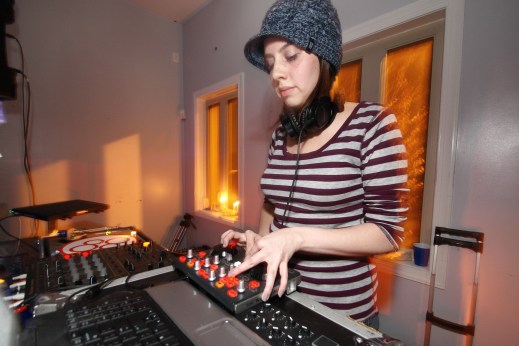
DJ Lush, FORWARD Winter Session 2012, Image by JHG Photography (c)
Because DJ sets are expected to be filled with pre-recorded sounds, the selection of sounds available is as broad as all of the sounds ever recorded. Specific styles of DJ sets, like an ambient DJ set, limit the selection down to a subset of recorded music. The choice of hardware can limit that even more. An all-vinyl DJ set of ambient music presents more of a challenge, in terms of selection, than a laptop set in the same style, because there are fewer ambient records pressed to vinyl than are available in a digital format.
Connected to selections are transitions, which could be said to define a DJ. When thinking of transitions there are two component factors: the playlist and going from one song to another. The playlist is obviously directly tied to the selection; however, even if you select the most popular songs for the style, unless they are put into a logical order, the transitions between them could make the set horrible.
One of the transitional keys to keeping a mix flowing is beat matching. In a turntable DJ set the beat mapping degree of difficulty is high because all of the tempos have to be matched manually by adjusting the speed of the two selections on the spinning turntables. When the tempos are synchronized, transitioning from one to the other is accomplished via a simple crossfade. With digital hardware such as the laptop, Serato and even CDJ setups, there is commonly a way to automatically match beats between selections. This makes the degree of difficulty to beat match in these formats much lower.
Effects, another variable, rely on what’s available through the hardware medium. With the turntable DJ set, the mixer is the primary source of effects and those until recent years have been limited to disc manipulation (e.g. scratching), crossfader, and EQ effects. Many of the non vinyl setups and even some of the vinyl setups now include a variety of digital effects like delay, reverb, sampler, granular effects and more.
With these variables so defined it becomes easier to objectively analyze the expressed variability of a live DJ set. But, while the variables themselves are objective, the value placed on them and even how they are evaluated are not. The language only provides the common ground for analysis and discussion. So the next time you’re at an event and the person next to you says, “this DJ is a hack!” you can say, “well they’ve got a pretty diverse selection with rather seemless transitions, maybe you just don’t like the music,” to which they’ll reply, “yeah, I don’t think I like this music,” which is decent progress in the scheme of things. If we really want to talk about live electronic performance however we will need to move beyond the DJ set to exemplify how this variable language can work to accurately describe the other musical objects which appear at a live electronic performance.
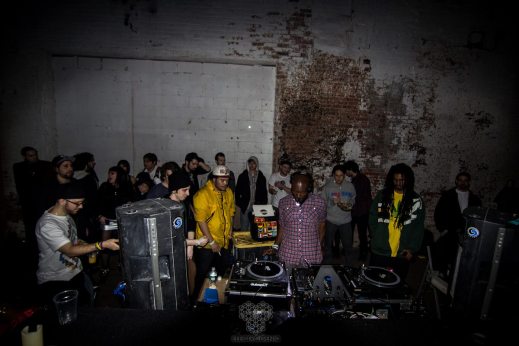
Joe Nice at Reconstrvct in Brooklyn NY on 2-23-2013, Photo by Kyle Rober, Courtesy of Electrogenic
Take for example another electronic instrument: the keyboard. The keyboard itself is a challenging instrument to define; in fact I could argue that the keyboard is itself not actually an instrument but a musical object. It is a component part of a group of instruments commonly referred to as keyboards, but the keyboard itself is not the instrument. What it is is one of the earliest examples of controllerism.
On a piano, typically fingers are used to press keys on the keyboard, which trigger the hammers to hit the strings and produce sound. The range of the instrument travels seven octaves from A0 to C8, and can theoretically have 88 voice polyphony, though in typical that polyphony is limited to the ten fingers. It can play a wide range of dynamics and includes pedals which can be used to modify the sustainabilty of pitches. With a pipe organ, the keyboard controls woodwind instruments with completely different timbre, range, and dynamics; the polyphony increases and the foot pedals can perform radically different functions. The differences from the piano grow even more once we enter the realm where the term “keyboard,” as instrument, is most commonly used: the synthesizer keyboard.
The first glaring difference is that, even if you have an encyclopedia of knowledge about keyboard synthesizers, when you see a performer with one on stage you simply cannot know by seeing what sounds it will produce. Pressing the key on a synthesizer keyboard can produce an infinite number of sounds, which can change not just from song to song, but from second to second and key to key. A performer’s left thumb can produce an entirely different sound than their left index finger. Using a keyboard equipped with a sequencer, the performer’s fingers may not press any keys at all but can still be active in the performance.
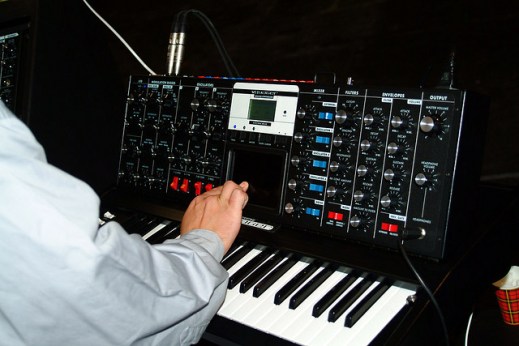
Minimoog Voyager Electric Blue, Image by Flickr User harald walker
When the keyboard synthesizer was first introduced, it was being used by traditional piano players in standard band configurations, like a piano or organ, with timbres being limited to one during a song and the performance aspect being limited to fingers pressing keys. Some keyboardists however used the instrument more as a bank for sound effects and textures. They may have been playing the same keys, but one wouldn’t necessarily expect to hear a I IV V chord progression. Rather than listening for the physical dexterity of the player’s fingers, the key to listening to a keyboard in this context was evaluating the sounds produced first and then how they were played to fit into the surrounding musical context.
Could one of these performers be seen as more competent than the other? Possibly. The first performer could be said to be one of the most amazing keyboard players in the piano player sense, but where they aren’t really maximizing the variability potential of the instrument, it could be said they fall short as a keyboard synthesizer performer. The second performer on the other hand may not even know what a I IV V chord progression is and thus be considered incompetent on the keyboard in the piano player sense, but the ways in which they exploit the variable possibilities shows their mastery of the keyboard synthesizer as an instrument.
Well, almost.
While generally speaking there isn’t a set of variables which define the keyboard synthesizer as an instrument, if we think of the keyboard synthesizer as a group of musical instruments, each of the individual types of keyboard synthesizers come with their own set of fixed variables which can be defined. Many of these variables are consistent across the various keyboards but not always in a standard arrangement.
As such, while the umbrella term “keyboard” persists it is perhaps more practical to define the instruments and their players individually. There are Juno 60 players, ARP Odyessy players, MiniMoog players, Crumar Spirit players and more. Naturally an individual player can be well versed in more than one of these instruments and thusly be thought of as a keyboardist, but their ability as a keyboardist would have to be properly contextualized per instrument in their keyboard repertoire. Using the MiniMoog as an example we can show how its variability as an instrument defines it and plays into how a performance on the instrument can be perceived.
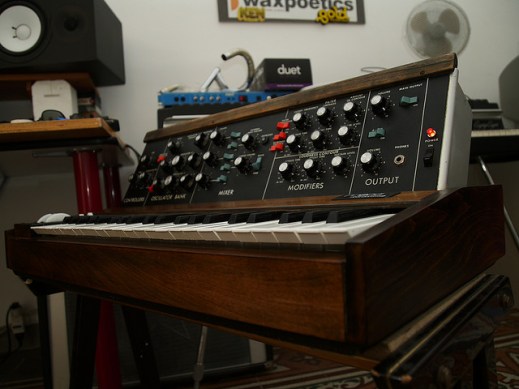
Minimoog, Image by Flickr User Francesco Romito
The first variable worth considering when evaluating the MiniMoog is that it is a monophonic instrument. This is radically different from the piano; despite one’s ability to use ten fingers (or other extremity) only one note will sound at one time. The keyboard section of the instrument is only three and a half octaves long, though the range is itself variable. On the left-hand side there is a pitch wheel and a modulation wheel. The pitch wheel can vary the pitch of the currently playing note, while the modulation wheel can alter the actual sound design.
As a monophonic instrument, one does not need to have both hands on the keyboard, as only one note will ever sound at a time. This frees the hands to modify the sound being triggered by the keyboard exemplified via the pitch and modulation wheels, but also available are all of the exposed controls for the sound design. This means that in performance every aspect of the sound design and the triggering can be variable. Of course these changes are limited to what one can do with their hands, but the MiniMoog also features a common function in analog synths, a Control Voltage input. This means that an external source can control either the aspects of the sound design and/or the triggering for the instrument.
Despite this obvious difference from the piano, playing the MiniMoog does not have to be any less of a physical act. A player using their right hand to play the keyboard while modulating the sound with their left, plays with a different level of dexterity than the piano player. The right and left hand are performing different motions; while the right hand uses fingers to press keys as the arm moves it up and down the keyboard, the left hand can be adjusting the pitch or modulation wheels with a pushing action or alternately adjusting the knobs with a turning action. Like patting your head and rubbing your belly, controlling a well-timed filter sweep while simultaneously playing a melody is nowhere near as easy as it sounds.
At the same time playing the MiniMoog doesn’t have to be very physical at all. A sequencer could be responsible for all of the note triggering leaving both hands free to modulate the sound. Similarly the performer may not touch the MiniMoog at all, instead playing the sequencer itself as an intermediary between them and the sound of the instrument. In this case the MiniMoog is not being used as a keyboard, yet it retains its instrument status as all of the sounds are being generated from it, with the sequencer being used as the controller. Despite not having any physical contact with the instrument itself, the performer can still play it.
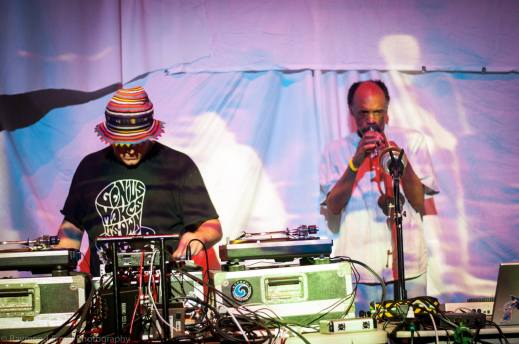
Minimoog in Live DJ Performance, Image by Fluckr Users Huba and Silica
Taking it one step further – if a performer were to only touch a sequencer at the start of the performance to press play and never touch the instrument, could they still be said to be playing the MiniMoog live? There is little doubt that the MiniMoog is indeed still performing because it does not have the mechanism to play by itself, but requires agency to illicit a sonic response. In this example that agency comes from the sequencer, but that does not eliminate the performer. The sequencer itself has to be programmed in order to provide the instrument with the proper control voltages, and the instrument itself has to be set up sonically with a designed sound receptive to the sequencer’s control. If the performer is not physically manipulating either device however, they are not performing live, the machines are.
From this we can establish the first dichotomy of electronic performance; the layers of variability in an electronic performance can be isolated into two specific categories: physical variability and sonic variability. While these two aspects are also present in traditional instrument performance, they are generally thought to not be mutually exclusive without additional devices. The vibrato of an acoustic guitar is only accomplished by physically modulating the strings to produce the effect. With an electronic instrument however, vibrato can be performed by an LFO controlling the amplitude. That LFO can be controlled physically but there does not have to be a physical motion (such as a knob turn) associated with it in order for it to be a live modulation or performance. The benefit of it running without physical aid is that it frees up the body to be able to control other things, increasing the variability of the performance.
In a situation where all of the aspects of the performance are being controlled by electronic functions, the agency in performance shifts from the artist performing live, to the artists establishing the parameters by which the machines perform live. Is the artist calling this a live performance a hack? Absolutely not, but it’s important that the context of the performance is understood for it to be evaluated. Like evaluating the monophonic MiniMoog performer based on the criteria of the polyphonic pianist, evaluating a machine performance based on physical criteria is unfair.
Daniel Carter on horn during Overcast Radio’s set at EPICENTER: 02, Photo courtesy of Raymond Angelo (c)
In the evaluation of a machine performance, just as with a physical one, variability still plays an important role. At the most base level the machine has to actually be performing and this is best measured by the potential variability of the sound. This gets tricky with digital instruments, as, barring outside influences, it is completely possible to repeat the exact same performance in the digital domain, so that there is no variation between each iteration. But even such cases with a digital sequencer controlling a digital instrument, with no physical interaction, are still a machine performances; they just exhibit very little variability. The performance aspect of the machine only disappears when the possibility for variability is completely removed, at which point the machine is no longer a performance instrument but a playback device as is the case with a CD player playing a backing track. The CD player if not being manipulated physically or by an external control is not a performance instrument as all of the sound contained within it can only be heard as one fixed recorded performance, not live. It is only when these fixed performances are manipulated either physically (ie a DJ set) or by other means, that they go from fixed performances to potentially live ones.
From all of this we arrive at four basic distinctions for live electronic performances:
• The electro/mechanical manipulation of fixed sonic performances
• The physical manipulation of electronic instruments
• The mechanized manipulation of electronic instruments
• A hybrid of physical and mechanized manipulation of electronic instruments
These help set up the context for evaluating electronic performances, as before we can determine the quality of a performance we must first be able to distinguish what type of performance we are observing. So far we’ve only dealt with a monophonic instrument, but even with its limitations can see how the potential variability is quite high. As we get into the laptop as a performance instrument that variability increases exponentially.
This is part two of a three part series. In the next part we will begin to exemplify the laptop as performance instrument, using this language to show the breadth of variability available in electronic performance and perhaps show that indeed, where that variability continues to be explored, there is merit to the potential of live electronic music as an extension of jazz.
—
Native Frequencies at the Trocadero 2013, Featured Image Courtesy of Raymond Angelo (C)
—
Primus Luta is a husband and father of three. He is a writer, technologist and an artist exploring the intersection of technology and art, and their philosophical implications. He is a regular guest contributor to the Create Digital Music website, and maintains his own AvantUrb site. Luta is a regular presenter for the Rhythm Incursions Podcast series with his show RIPL. As an artist, he is a founding member of the live electronic music collective Concrète Sound System, which spun off into a record label for the exploratory realms of sound in 2012.
—
REWIND! . . .If you liked this post, you may also dig:






















Recent Comments