
Video Gaming and the Sonic Feedback of Surveillance: Bastion and The Stanley Parable
DOI: https://doi.org/10.59350/2cvkr-nsk53
As the practice of sound design becomes ever more refined as a key factor in the immersive aspects of gameplay, it is essential to develop a conceptual vocabulary of the ways that sound is implemented as a cultural facet. In particular, it is important to recognize the power relations at stake within the implementation of the human voice as an interactive narrative trope. And, while I’ve already discussed the ways in which the voice of GLaDOS in Portal invites players to reflect on how they internalize a set of mediated perspectives about how their body ought to be, it is equally important to consider the other ways that a narrator’s voice invites players to reconsider the intersection of agency and surveillance.
This post compares the use of narration in Bastion and The Stanley Parable in an effort to understand how the voice is used as what Karen Collins would refer to as an “interactive non-diagetic sound,” or, in other words, a sound that is triggered by player actions, but not experienced by the character in the game. Specifically, I argue that the voice in these examples is an essential point in the feedback loop between player and game. And, as part of the cybernetics of gameplay, it produces a dispositif of surveillance, akin to Bentham’s panopticon, which lets the player know their actions are constantly being monitored, calculated, and considered by the game’s algorithms. But, while the original panopticon produced the effect of surveillance through the clever use of light, these games use sound to effect surveillance.
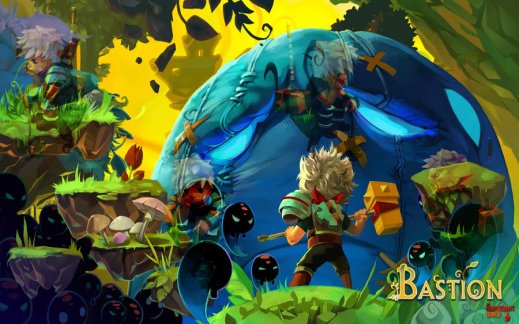
Bastion, was developed by the small indie game company Supergiant Games, but was distributed and released by Warner Bros. Interactive Entertainment, first through Microsoft’s distribution service, XBOX Live Arcade, but has since been released more broadly after receiving much critical acclaim. In Bastion, players take the role of a young boy, referred to only as “The Kid,” and adventure around gradually rebuilding a world that has fallen apart since a cataclysmic sundering referred to only as “the Calamity.” Although the world of Bastion is beautiful and visually stimulating, it is the game’s sound design that has earned it much critical acclaim. The game is narrated by a character named “Rucks,” who speaks in a deep weathered voice, with somewhat of a western twang. And, even though The Kid eventually encounters and is able to interact with Rucks within the game, Rucks still relays dialogue in the third-person.
When The Kid and Rucks meet, Rucks evinces with trademark grit, “Sure enough, he finds another. He finds me.” And, while that is a scripted plot point within the game, at other points Rucks’ narration modulates to best reflect the player’s actions. A player who begins the game slowly, exploring nooks and crannies, might hear “The kid walks slowly down the path, checking everything,” while a player who runs straight ahead could hear, “The kid barrels forward, not looking once behind him.” These quotes force the player to recognize that the game is watching, and actively staging narrative commentary about their in-game decisions. This commentary unfolds in aural space, through narration, discrete from the old text (and controller) triggers of “look” and “examine” which used to prompt text-box commentary about the environment of the game. In short, Bastion’s sound design succeeds because it is balanced in such a precise way: players are being constantly engaged with a narration which confirms that they are, in fact, properly interacting within the game world and story.

The Stanley Parable, on the other hand, works deliberately to turn the paradigm of narration on its head. Where Rucks, in Bastion, frequently alluded to how many secrets he was yet to reveal about himself and the game-world, his character ultimately plays a supportive role, helping The Kid to understand the chaotic environment of the game. The narrator in The Stanley Parable, however, plays the antagonist in many ways, attempting to foreshadow and predetermine the actions of the player, or “Stanley.” On the game’s website, a short sentence contextualizes the endeavor, “The Stanley Parable is a Half Life 2 mod about video games.” The game itself is a mod of the “Source engine,” which runs both Half-Life 2, and Portal, was developed by the very small development team of Davey Wreden and William Pugh, and released for free. It is meta-fiction that stages a critique of the context of narrative within interactive games and fiction. Specifically, the game questions the idea of narrative itself by showcasing the ways that players are able to undermine the scripted plots and spaces of a videogame by exploring and experimenting with exploits and bugs in the game’s code and narrative.
Although the narrator in The Stanley Parable will prescribe several decisions to the player over the course of the game, the player is given the agency to contest the story as told by the narrator, and, therefore, to experiment with the plot. As the player reaches a set of two open doors on the way to the employee lounge the narrator reads, “When Stanley came to a set of two open doors, he entered the door on his left.” If the player chooses to travel through the door on the right instead, the narrator will attempt to steer the player back to the main plot tree by saying, “This was not the correct way to the employee lounge, and Stanley knew it perfectly well.” And, then as an open door is revealed, “So he turned left at the first open door, and walked back in the right direction.” If the player continues to ignore the narrator’s advice, he comes to somewhat of a dead end and the narrator reads, “Stanley was so bad at following directions, it’s incredible that he wasn’t fired years ago. Maybe this was why everyone left. No one wanted to be around someone as bad at listening as him.” The player is given several other opportunities to make decisions and lead the story to completion in achieving one of seven endings; each based the decisions the player has made when interacting with the narrator’s dialogue.
The Stanley Parable allows players the agency to see the limitations of linear storytelling where Bastion does not. Where some paths in The Stanley Parable will lead the player into direct conflict with the narrator, other paths do not. There is never a point where the narrator ceases to comment on the player’s actions and activities. Because the sonic feedback of surveillance remains a constant in both games the player remains engaged, in both cases, with the logic of the game-system. In other words, no matter how many times the player defies the narrator in The Stanley Parable, it never seems like the game is breaking. The game world remains constant because the motif of surveillance holds; players know the game still works because the narrator continues to stage commentary – even if it is commentary about the player’s failure to keep to the plot.
For Marc Andrejevic, author of iSpy (2007)—who has written extensively about the abundance of surveillance techniques implemented in digital spaces–the danger of surveillance lies in the production of an asymmetrical power relationship between media producer and media consumer. And, while this is certainly best argued about instances of dataveillance–how companies like Amazon, for example, track customer clicks on and off their website via web cookies in order to better produce exploitable (and in some cases saleable) consumer profiles–it is important to also consider the ways that the implementation of sound also functions as a technique of control.
At its most positive, the sonic panopticism of Bastion and The Stanley Parable offer players a sense of comfort in knowing that the game is operating properly, and not glitching out. Further, players are invited into a more immersive game, which leverages both visual and audio interactivity to lull players into an environment of almost trancelike feedback and play. Clearly, this is the promise of good sound design; it gently alerts players to the presence of a tightly designed and well-implemented game, and produces affects of brand loyalty and trust within a game’s player contingent.
But, while there are clearly aesthetic and market benefits to the implementation of narration in both games, one cannot help but wonder, in the context of post-feminism and self-surveillance, what implications there are in the implementation of the male voice as surveil-er in both games. Just as it was curious in Portal 2 how GLaDOS acted as a critical female voice constantly judging the player’s body image and intelligence, it is curious how much authority is given to the voice of Rucks in Bastion. And while several good critiques have already been written about how the game features only one (somewhat silent, and certainly helpless) female character, and how the game’s villain is portrayed, concretely, as the racially exotic other, it is sadly fitting that the most comforting and well-acclaimed aspects of the game come from the interactivity produced by the voice of its distinctively white male narrator.
The sound design in The Stanley Parable, of course, is more cutting in the ways it stages a commentary about how the voice of the narrator (this time distinctively British), exacts a form of social coercion through techniques of surveillance, and how these techniques serve, namely, to hamper player agency. But, even its own narrative of resistance fails to compel; in fact, it is the uneasy ending of compliance and conformity that is, perhaps, the happiest. This, ironically, reveals one of the key cultural problems of our era: the reciprocal aspects of surveillance and interactivity. If affective resonances of trust, knowledge, and comfort come bundled with the male voice, is it in the vested economic interests of sound design communities to leverage these to make profit? Even though both games have earned critical praise, it is only Bastion that has won awards for sound design. In other words, are we caught in our own feedback loop of comfort, industry, and design?
–
Aaron Trammell is co-founder and Multimedia Editor of Sounding Out! He is also a Media Studies PhD candidate at Rutgers University. His dissertation explores the fanzines and politics of underground wargame communities in Cold War America. You can learn more about his work at aarontrammell.com.
—

REWIND! . . .If you liked this post, you may also dig:
DIANE… The Personal Voice Recorder in Twin Peaks— Tom McEnaney
The Role of Sound in Video Games: Pong, Limbo, and Interactivity— Aaron Trammell
Orality and Cybernetics in Battleship— Aaron Trammell
—
Share this:

Genre in the Age of Convergence: Mario Paint Composer
DOI: https://doi.org/10.59350/rg065-mge82
It’s no secret that over the course of the twentieth century, aesthetic productions have drawn increasingly on recycled and re-appropriated materials. Perhaps, for this reason, the above video – a rendition of Michael Jackson’s Thriller on the newly minted Mario Paint Composer – sounds absolutely mundane. Nothing new, just another curiosity born out of the collective consciousness we cannily refer to as the Internets, which we understand jokingly as a series of tubes, notably Youtubes. Laffs aside, this phenomena complicates many traditional modes of interpretation.How do we hear the music of a convergence era when within it lies a devious set of connotations, each serving to reorient the listener to its own particular theme? What tactics do listeners take when interpreting this semiotic collision of sound, icon and song? These questions complicate the topic of genre, where a social consensus traditionally guides the collective organization of a medium. What social and sonic forms shape our understanding of Thriller as it was reproduced by Mario Paint Composer on Youtube in 2008?
Before delving too deeply into a discussion of genre, it is important to situate the phenomena of convergence in a pre-digital context. Although the user-centric nature of web 2.0 has certainly helped to accelerate this process, one needs to look no further than Dick Hebdige’s “The Meaning of Mod,” in the anthology Resistance Through Rituals, to sense an earlier precedent to the mash-up culture we observe today. Drawn to the adventure of a dangerous soHo night-life culture, “The mod dealt his blows by inverting and distorting the images (of neatness, of short hair) so cherished by his employers and parents, to create a style, which while being overtly close to the straight world was nonetheless incomprehensible to it.” Although Hebdige is writing in 1974, long before computers would become mainstream, he makes a worthy point here about the appropriation of fashion. Constructing it as an act of distortion,Hebdige argues that early 1960s mods (understood here as a working class youth movement), through their stylistic appropriations were able to undermine the fabric of British society. By acting as criminals, but lauding the style of white collar workers – suits, short hair – mods help to show that semiotic convergence is not something new, instead it can be read as a stance of resistance.
In the case of Thriller, resistance is too strong a word. I prefer distortion, it is value neutral, although it can easily be understood in the context of resistance. Thriller on Mario Paint Composer distorts Thriller by Michael Jackson. By simplifying the song to a series of 16-bit samples, the song’s transcriber geoffnet1, translates it all to the symbolic language of Mario Paint – where mushrooms sound like drums, hearts are bass notes, ships are cymbals, flowers are horns, cars are synth pads and game-boys sound like blips. geoffnet1’s Thriller is a distortion of the Mario Paint Composer sound as well; originally a part of the 1992 Super Nintendo cartridge, Mario Paint, Mario Paint Composer is now a fan-modded update of its original form. Unlike the original Mario Paint Composer has been designed with functionality taking a precedent over accessibility. Originally marketed as an intuitive music scripting software, the following limitations were part and parcel of the platform (These restrictions have been copied from Tombobbuilder’s page, a musician who works with the limits of Mario Paint Composer as it was originally distributed.):
1. Only 24 measures are available.
2. No more than three notes at a time.
3. You can not double notes on the same line or space.
4. Tempo is restricted.
5. There is no fluctuation in dynamics (volume).
6. No sharps or flats are available.
7. Can only compose using the “white keys” from the piano.
8. Only two of each letter name are available (except A, where there is only one).
9. C major and A natural minor are the only keys to compose in.
Of these restrictions, Thriller only conforms to the third: “You can not double notes on the same line or space,” in this regard it distorts what most people understand as the Mario Paint sound as well. By no means am I calling this work inauthentic, instead I am calling attention to the stability of sonic tropes in our cultural memory. The sound of Mario Paint is not remembered for the limitations described above, instead, there is a stable and distinct sonic fingerprint which is derived from the alchemy of icon, sound and song though which genre can be constructed and maintained.
Thriller is 8-bit music, even though there is nothing 8-bit about it. Similar to the way in which mods subverted the British status-quo, Thriller puts the idea of genre into crisis. This is not a crisis that works to undermine the existence of genre as a phenomenon, it is instead a crisis of interpretation, where the traditional means through which a genre can be identified are called into question. No longer can the easy answers be found at Allmusic or Wikipedia, some sounds have become more epistemically ellusive. Ultimately, this is a good thing, as it encourages listeners to take a critical ear to what they are listening to – and how they come to understand it.
Aaron Trammell
—
Share this:




Current Top Posts





April 2021

January 2020

November 2019

October 2019

August 2019

April 2014

November 2017

March 2015

December 2017

October 2015


Recent Comments