
This is Your Body on the Velvet Underground


DOI: https://doi.org/10.59350/w3yhz-e0296
“Everyone who bought one of those 30,000 copies started a band.” Brian Eno’s remark about the Velvet Underground’s brilliant but commercially lackluster 1967 debut album was re-circulated widely last October, when fans and critics mourned the passing of Lou Reed, lead songwriter for the band, and a key cultural figure of the last fifty years, by any metric.
The remark has become trite through overuse, but not the sentiment it captures. A band that has, since even before before Andy Warhol’s Factory, been linked to an aesthetic of menace, hysteria and psychosis didn’t just “inspire” or “provoke” much of the music, art and sensibilities of the post-1960’s. It extruded that era.
At Sounding Out!, we decided that in order to come to grips with Reed’s work in general (and the Velvet Underground in particular) from a Sound Studies perspective we’d have to adopt that spirit of provocation. I asked two prominent writers in the field for articles about how this band changed — and continues to change — the experience and history of sound, in a short series Start A Band: Lou Reed and Sound Studies. I’m thrilled to present the first of our articles from returning author Jacob Smith from Northwestern University, a musician and accomplished author of several distinguished books on sound and media history. Stay tuned next week for a second installment from Tim Anderson from Old Dominion University, an award winning writer and co-chair of the Sound Studies SIG at the Society for Cinema and Media Studies.
–NV
—
Lou Reed’s recent death has inspired many critics to return to his groundbreaking work with the Velvet Underground (VU). Albums such as The Velvet Underground and Nico (1967), White Light/White Heat (1968) and The Velvet Underground (1969) have the reputation of influencing everyone from David Bowie, Iggy Pop and Roxy Music to the Sex Pistols, Talking Heads, REM and Nirvana. Many recent obituaries describe VU in literary terms, citing Reed’s “lyrical honesty,” “rock and roll poetry,” and touting his songs as “serious writing” and even a kind of “Great American Novel.” There is much to be missed by taking such a decidedly literary approach to sound recordings, and there is an alternative approach, thanks to the emergence of Sound Studies as a vibrant academic field. Can what Jonathan Sterne has called the “interdisciplinary ferment” of Sound Studies help us to re-think the work of this seminal rock band (The Sound Studies Reader, 2)? I think it can.
For a start, Sound Studies emboldens us to base our analysis on VU’s records, which have often been oddly upstaged by other aspects of their career: Reed’s street-level lyrics to be sure; but also the group’s role as background music to Andy Warhol’s Factory; or their use of drones and feedback, which makes them a footnote in the history of avant-garde music; or their influence on the glam and punk explosions of the 1970s. Sound Studies encourages us to start with VU’s records, but the next step is not necessarily a formal musicological analysis.

For some of its proponents, including Steven Connor, Sound Studies is best understood as part of a broader investigation of the “fertility of the relations” between the senses, and VU’s albums turn out to be an excellent place to begin an exploration of the multisensory experience of recorded sound (“Edison’s Teeth: Touching Hearing,” in Hearing Cultures, ed. Viet Erlmann, 54). This essay explores the tactile experience of VU’s records, inspired by work on the tactile dimension of the cinema. I borrow the organizational structure of Jennifer M. Barker’s book The Tactile Eye, which moves from a discussion of sensations at the surface of the body, to muscular responses, and lastly, to the “the murky recesses of the body, where heart, lungs, pulsing fluids, and firing synapses receive, respond to, and reenact the rhythms of cinema” (2-3). Think of this essay as a body-scan of the VU listening experience (“this is your body on VU”) that follows a similar path from the skin, to the musculature, and finally, to the viscera.
Downy Sins
Writing about the tactile experience of movies is concerned with modes of looking that resemble touching, a “haptic visuality” that attends to textures and surfaces, and moves over the image like a caress (See Laura U. Marks The Skin of the Film, 183 and Touch, 117). A form of “haptic listening” has also been commonplace in the culture of popular sound recordings. Much of the recorded popular music of the past century has invested meaning in what Theodore Gracyk calls “very specific sound qualities and their textural combination” (Rhythm and Noise, 61). From Bo Diddley to Aphex Twin, pop recordings have tended to stress evocative timbres, idiosyncratic voices, and signature sounds over structural or lyrical complexity.
VU’s records exemplify that tendency because their complexity can be found more on the level of timbre than in musical structure or instrumentation. Moreover, Reed’s lyrics often encourage a blurring of listening and touching. On “Venus in Furs,” listeners are prompted to hear John Cale’s viola stabs as the licks and bites of a mistress’s whip. “Sister Ray” cues haptic listening by chugging resolutely on a single chord for seventeen minutes, while a plasmatic organ performance mutates from elegant bass arpeggios to shimmering waves of icy noise. As with “Venus in Furs,” Reed’s lyrics tie the textural complexity of “Sister Ray” to the surface of the body, through his descriptions of searching the skin of his arm for a “mainline” vein, and a first-person account of receiving oral sex. These examples demonstrate that the poetry of Reed’s lyrics is intimately bound up with the sonic texture of VU’s recordings, and moreover, that he was adept at liberating the erotic potential of haptic listening.
Run Run Run
Films can produce an empathetic muscular response in the viewer’s body, as when we flinch in response to a horror film, or clench our fists while watching a thrilling action movie (Barker, The Tactile Eye 94, 83, 72). Listeners can have similarly empathetic relationships with recorded sound when they move along with the rhythms of a dance record, synchronize their workout or commute to a carefully designed playlist, or embody a recorded performance by miming an air guitar or air drums.
The members of VU had distinctive styles of instrumental performance that made their records evoke powerful muscular responses in listeners. Consider the piano track on “Waiting For the Man,” which loses any semblance of melodic content to become the sheer act of pounding on the keyboard by the end of the song. Reed is usually regarded as a lyricist, but he is just as influential as a muscular rhythm guitar player. “What Goes On” has a minimalist arrangement that eschews structural development to become a showcase for Reed’s vigorous strumming. The second half of the track lacks vocals or a conventional solo instrument, and so feels like a diagram of the human body that reveals the pulsating musculature beneath the skin.
Reed’s jangly rhythm guitar could dominate the mix of VU tracks like “What Goes On” because it occupies a sonic niche that, in a more typical rock arrangement, would be filled by the hi-hat or ride cymbal. In fact, it is Maureen Tucker’s distinctive drumming that is the main source of muscle power on VU’s records. Standing behind a spare kit consisting of little more than a snare and a bass drum turned on its side, Tucker attacked her instrument with relentless intensity, raising her mallet over her head with each bone-cracking snare hit. A review of a live appearance in 1968 observed that Tucker “beats the shit” out of her drums so that the sound “slams into your bowels and crawls out your asshole” (See Clinton Heylin, All Yesterdays’ Parties, 64). Hear (and feel) for yourself, on the VU track “Foggy Notion,” a seven-minute drum and guitar workout.
Tucker was a pioneer female instrumentalist in the male-dominated world of rock. “I didn’t want to be the one to blow it,” she said in an interview. “I wasn’t gonna say, ‘Well, they’ll say she’s a girl, she can’t do it.’ So I was determined, I wasn’t gonna stop” (Albin Zak III, The Velvet Underground Companion, 1965). Ironically, her uncompromising and supremely physical performances were so minimal and precise that she was sometimes compared to a machine. A Verve Records press release from 1968 referred to the fact that Tucker had briefly held a job at IBM, and wrote that “her symphonic simplicity is like that of a human computer.” One trajectory of VU’s influence leads to the electronic austerity of bands like Kraftwerk, but an attention to the tactile dimension of the band’s records prevents Tucker, one of rock’s most muscular drummers, from disappearing into the circuitry.
The Body Lies Bare
A tactile analysis of VU records can go deeper still, to document their relation to the body’s viscera. The experience of the inner body is usually hidden from us, and gains our attention only when organ systems produce an overall effect like nausea (Barker, The Tactile Eye, 125). We lack direct conscious control over most of our visceral responses, but we can stimulate them through the ingestion of drugs, which of course, is the topic of many of VU’s most famous tracks. But where other rock bands of the 1960s associated the drug experience with whimsical flights of the imagination, VU’s drug references are bluntly visceral.
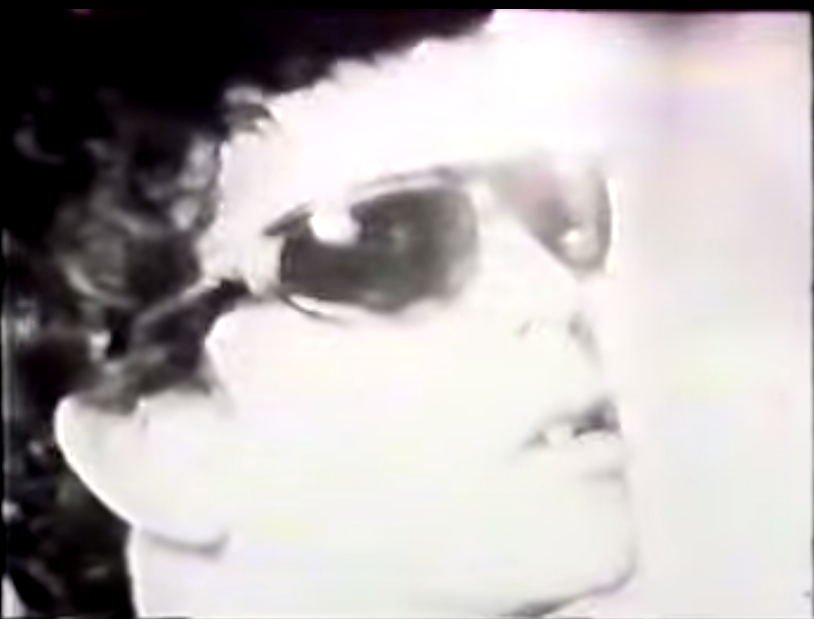
“Heroin” is a sonic re-enactment of the physical effects of the eponymous drug, conveyed not only via Reed’s lyrics, but in the backing track’s fluctuations between dreamy bliss and frantic rush. “White Light/White Heat” fuses two sensory metaphors, one visual and one tactile, in order to point to an embodied experience beyond them both. Listen to how the track ends, with surging cymbals and a distorted bass figure whose spasmodic rhythm suggests the dilation of blood vessels, the firing of synapses, and the tightening and release of internal organs that have been kicked into amphetamine overdrive.
The mysterious visceral body can also emerge into our consciousness in moments when the internal rhythms of the heart or lungs are destabilized, as in a sudden heart palpitation or violent case of the hiccups (Barker, The Tactile Eye, 128-29). “Lady Godiva’s Operation” provides a vivid demonstration. The first half of the track is run-of-the-mill hippy exotica, with John Cale’s lead vocal given the conventional placement in the center of the stereo picture. This calm sonic surface is unsettled when Cale’s voice is decentered, shifting first to the left and then the right speaker. The lead vocal fractures even further when Reed begins to finish each of Cale’s lines:
Cale: ‘Doctor is coming,’ the nurse thinks…
Reed: … sweetly.
Cale: Turning on the machines that…
Reed: … neatly pump air.
Cale: The body lies bare.
By integrating these fragmented lines, we learn that a body is lying on an operating table. Listeners are encouraged to inhabit this body through the placement of voices around and above us, as well as the sounds of heartbeats and breathing that enter the mix but are jarringly out of rhythm with the existing backing track. Reed sings that the doctor is making his first incision into the body, and the backing track vanishes, leaving only the heartbeat, breathing, and an eerie whirring vocalization that sonifies some nameless physical process. The scene ends with a dark twist, suitable as a shock tactic from an exploitation film: the anesthetic has malfunctioned, and the patient has regained consciousness in the midst of the procedure.
The track’s arrhythmic sound effects overwhelm the coherent flow of the standard musical mix, working in tandem with the lyric’s account of the body made manifest in a moment of dysfunction. The fact that VU’s “White Light/White Heat” LP contains “Lady Godiva’s Operation,” as well as the title track and “Sister Ray,” makes it a tour de force of tactile phonography. Reed may have been a rock poet, but he and his collaborators were also acoustic engineers who were adept at sonifying tactile experience, producing music worth feeling with our whole bodies.
—
Featured Image- “A Drop of Warhol” by Flicker User Celeste RC
—
Jacob Smith is Associate Professor in the Radio-Television-Film Department at Northwestern University. He has written several books on sound (Vocal Tracks: Performance and Sound Media [2008], and Spoken Word: Postwar American Phonograph Cultures [2011], both from the University of California Press), and published articles on media history, sound, and performance.
—

REWIND!…If you liked this post, you may also dig:
“Devil’s Symphony: Orson Welles’s “Hell on Ice” as Eco-Sonic Critique”–Jacob Smith
“One Nation Under a Groove?: Music, Sonic Borders, and the Politics of Vibration” -Marcus Boon
“Music Meant to Make You Move: Considering the Aural Kinesthetic“-Imani Kai Johnson
Share this:

DIY Histories: Podcasting the Past

DOI: https://doi.org/10.59350/vgcxg-j7s36
This is article 3.0 in Sounding Out!‘s April Forum on “Sound and Technology.” Every Monday this month, you’ll be hearing new insights on this age-old pairing from the likes of Sounding Out! veteranos Aaron Trammell and Primus Luta along with new voices Andrew Salvati and Owen Marshall. These fast-forward folks will share their thinking about everything from Auto-tune to techie manifestos. Today, Salvati asks if DIY podcasts are allowing ordinary people to remix the historical record. Let’s subscribe and press play. –JS, Editor-in-Chief
—
Was Alexander the Great as bad a person as Adolph Hitler? Will our modern civilization ever fall like civilizations from past eras?
According to Dan Carlin’s website, these are the kind of speculative “outside-the-box” perspectives one might expect from his long-running Hardcore History podcast. In Carlin’s hands, the podcast is a vehicle for presenting dramatic accounts of human history that are clearly meant to entertain, and are quite distinct from what we might recognize as academic history. Carlin, a radio commentator and former journalist, would likely agree with this assessment. As he frequently emphasizes, he is a “fan” of history and not a professional. But while there are particularities of training, perspective, and resources that may distinguish professional and popular historians, an oppositional binary between these kinds of historymakers risks overlooking the plurality of historical interpretation. Instead, we might notice how history podcasters like Carlin utilize this new sonic medium to continue a tradition of oral storytelling that in the West goes back to Herodotus, and has since been the primary means of marginalized and oppressed groups to preserve cultural memory. As a way for hobbyists and amateurs to create and share their own do-it-yourself (DIY) histories, I argue that audio podcasting suggests a democratization of historical inquiry that greatly expands the possibilities for everyone, as Carl Becker once said, to become his or her own historian.

Frequently listed among iTunes’ top society and culture podcasts, and cited by several history podcasters as the inspiration for their own creations, the popularity of Hardcore History stems from Carlin’s unconventional and dramatic recounting of notable (but sometimes obscure) historical topics, in which he will often elaborate historical-structural changes through contemporizing metaphors. Connecting the distant past to more immediate analogies of present life is the core of Carlin’s explanatory method. This form of explanation is quite distinct from the output of academic historians, who assiduously avoid this sort of “presentism.” But as the late Roy Rosenzweig (2000) has suggested, it is precisely this kind of conscious and practical engagement with the past – and not the litany of facts in dry-as-dust textbooks – that appeals to non-historians. Rosenzweig and David Thelen claim have found that most Americans perceive a close connection with the past, especially as it relates to the present, through their personal and family life. Using the medium of podcasting to talk about the past is a new way of making the past vital to the present needs and interests of most people. This is how podcasters make sense of history in their own terms. It is DIY insofar as it is distinct from professional discourse, and less encompassing (and expensive) than video methods.
Podcasts can present an alternative model for making sense of the past – one that underscores the historymaker’s interpretive imprints, and which cultivates a sense of liveness and interactivity. Admittedly, Dan Carlin’s own style can be rambling and melodramatic. But to the extent that he practices history as a kind of storytelling, and acknowledges his own interpretive interventions, Hardcore History, like other independently produced history podcasts (I am thinking about a few of my favorites – Revolutions, The History Chicks, and The British History Podcast) give their listeners the sense that history is not necessarily something that is “out there,” or distant from us in the present, but part of a living conversation in the present. Podcasters construct a dialogue about history which, when combined with the interactivity offered by website forums, draws the listener into a participatory engagement. Rosenzweig and Thelen’s explain, Americans interested in popular history are skeptical of “historical presentations that did not give them credit for their critical abilities – commercialized histories on television or textbook-driven high school classes.” Such analytic skills are precisely what we as historians and teachers aim to develop in our students. Podcasting, when it constructs a collaborative dialogue in which audience and producer explore history together, can both be a valuable supplement to traditional historiography, and a way for people to connect with the past that overcomes the abstraction of textbooks and video.
But is the podcast as intellectually freeing as it might seem? Jonathan Sterne (et. al., 2008) notes that podcasting encompasses a range of technologies and practices that do not necessarily determine the liberation of content production from the dominance of established institutions and economies of scale. Indeed, there are many professional historians and media producers who have utilized audio (and sometimes video) podcasting to reach a wider audience. While the History Channel has not (yet) entered the field, one can surely imagine the implications of corporate-produced history content that homogenizes local and cultural particularities, or which present globalized capitalism as a natural or inevitable historical trajectory.
The kind of podcasts I am concerned with, however, are created by independent producers taking a DIY approach to content production and historical inquiry. While their resources and motivations may differ, podcasts produced on personal computers in the podcaster’s spare time have an intimate, handcrafted feel that I find to be more appealing than, say, a podcasted lecture. Ideally, what results is an intimate and episodic performance in which podcasters can, to use Andreas Duus Pape’s phrasing from an earlier Sounding Out! post, “whisper in the ears” of listeners. This intimacy is heightened by the means of access – when I download a particular podcast, transfer it to my iPhone, and listen on my commute, I am inviting the podcaster into my personal sonic space.
Complimenting this sense of intimacy is a DIY approach to history practiced by podcasters who are neither professional historians nor professional media producers. Relatively cheap and easy to produce (assuming the necessary equipment and leisure time), podcasting presents a low barrier of entry for history fans inspired to use new media technologies to share their passion with other history fans and the general public. Though a few podcasters acknowledge that they have had some university training in history, they are usually proud of their amateur status. The History Chicks, for example, “don’t claim to know it all,” and that any pretense toward a comprehensive history “would be kinda boring.” Podcasting and historical inquiry are hobbies, and their DIY history projects allow the relative freedom to have fun exploring and talking about their favorite subject matter – without having to conform to fussy disciplinary constraints. For Jamie Jeffers, creator of the British History podcast, most people are alienated by the way history gets taught in school. However, “almost everyone loves stories,” he says, and podcasting “allows us to reconnect to that ancient tradition of oral histories.” Others justify the hobby in more bluntly. For the History Chicks, women in history is “a perfect topic to sit down and chat about.” Talking about history, arguing about it, is something that history fans (and I include myself here) enjoy. Podcasting can broaden this conversation.
Despite my optimistic tone in this post, however, I do not want to suggest uncritically that the democratizing, DIY aspects that I have noted (among just a handful of podcasts) comprises the entire potential of the format. Nuancing a common opposition between the bottom-up potential of podcasting with the prevalent top-down (commercial) model of broadcasting for example, Sterne and others have asserted that rather than constituting a disruptive technology – as Richard Berry has suggested – podcasting realizes “an alternate cultural model of broadcasting.” Referring to earlier models of broadcasting – such as those Susan Douglas (1992) described in her classic study of early amateur radio – Sterne and company assert that analyses of podcasting should focus not on the technology itself, but on practice; not on the challenge podcasting poses to corporate dominance in broadcasting, but rather how it might offer a pluralistic model that permits both commercial/elite and DIY/amateur productions.
Adapting these recommendations, I argue that podcasting can help us conceptualize an alternate cultural model of history – one that invites reconsideration of what counts as historical knowledge and interpretation, and about who is empowered to construct and access historical discourse. Rather that privileging the empirical or objective histories of academic/professional historians, such an expanded model would recognize the cultural legitimacy of diverse forms of historiographical expression. In other words, that history is never “just” history, or “just” facts, but is always a contingent and situated form of knowledge, and that, as Keith Jenkins writes, “interpretations at (say) the ‘centre’ of our culture are not there because they are true or methodologically correct … but because they are aligned to the dominant discursive practices: again power/knowledge” (1991/2003, p. 79). But to reiterate Sterne’s (et. al.) caution however, such an alternative model would not necessarily determine a role-reversal between professional and DIY histories. Rather through podcasting, we might discover alternative ways of performing history as a new oral tradition – of becoming each of us our own historian.
—
Andrew J. Salvati is a Media Studies Ph.D. candidate at Rutgers University. His interests include the history of television and media technologies, theory and philosophy of history, and representations of history in media contexts. Additional interests include play, authenticity, the sublime, and the absurd. Andrew has co-authored a book chapter with colleague Jonathan Bullinger titled “Selective Authenticity and the Playable Past” in the recent edited volume Playing With the Past (2013), and has written a recent blog post for Play the Past titled “The Play of History.”
—
Featured image: “Podcasts anywhere anytime” by Flickr user Francois, CC BY 2.0
—
REWIND!…If you liked this post, you may also dig:
“Music is not Bread: A Comment on the Economics of Podcasting”-Andreas Duus Pape
“Pushing Record: Labors of Love, and the iTunes Playlist”-Aaron Trammell
“Only the Sound Itself?: Early Radio, Education, and Archives of ‘No-Sound’”-Amanda Keeler
—
Share this:




Current Top Posts





April 2021

January 2020

November 2019

October 2019

August 2019

April 2014

November 2017

March 2015

December 2017

October 2015


Recent Comments