
Going Hard: Bassweight, Sonic Warfare, & the “Brostep” Aesthetic


DOI: https://doi.org/10.59350/4e3q9-nt214
[Editor’s Note 01/24/14 10:00 am: this post has been corrected. In response to a critique from DJ Rupture, the author has apologized for an initial misquoting of an article by Julianne Escobedo Shepherd, and edited the phrase in question. Please see Comments section for discussion]
Time to ring the bell: this year, Sounding Out! is opening a brand-new stream of content to run on Thursdays. Every few weeks, we’ll be bringing in a new Guest Editor to curate a series of posts on a particular theme that opens up new ground in areas of thought and practice where sound meets media. Most of our writers and editors will be new to the site, and many will be joining us from the ranks of the Sound Studies and Radio Studies Scholarly Interest Groups at the Society for Cinema and Media Studies, as well as from the Sound Studies Caucus from the American Studies Association. I’m overjoyed to come on board as SCMS/ASA Editor to help curate this material, working with my good friends here at SO!
For our first Guest series, let me welcome Justin Burton, Assistant Professor of Music at Rider University, where he teaches in the Popular Music and Culture program. Justin also serves on the executive committee of the International Association for the Study of Popular Music-US Branch. We’re honored to have Justin help us launch this new stream.
His series? He calls it The Wobble Continuum. Let’s follow him down into the low frequencies to learn more …
Neil Verma
—
Things have gotten wobbly. The cross-rhythms of low-frequency oscillations (LFO) pulsate through dance and pop music, bubbling up and dropping low across the radio dial. At its most extreme, the wobble both rends and sutures, tearing at the rhythmic and melodic fabric of a song at the same time that it holds it together on a structural level. In this three-part series, Mike D’Errico, Christina Giacona, and Justin D Burton listen to the wobble from a number of vantage points, from the user plugged into the Virtual Studio Technology (VST) of a Digital Audio Workstation (DAW) to the sounds of the songs themselves to the listeners awash in bass tremolos. In remixing these components—musician, music, audience—we trace the unlikely material activities of sounds and sounders.
In our first post, Mike will consider the ways a producer working with a VST is not simply inputting commands but is collaborating with an entire culture of maximalism, teasing out an ethics of brostep production outside the usual urge for transcendence. In the second post, Christina will listen to the song “Braves” by a Tribe Called Red (ATCR), which, through its play with racist signifiers, remixes performer and audience, placing ATCR and its listeners in an uncanny relationship. In the final post, Justin will work with Karen Barad’s theory of posthuman performativity to consider how the kind of hypermasculinist and racist signifiers discussed in Mike’s and Christina’s pieces embed themselves in listening bodies that become sounding bodies. In each instance, we wade into the wobble listening for the flow of activity among the entanglement of producer, sound, and listener while also keeping our ears peeled for the cross-rhythms of (hyper)masculinist and racist materials that course through and around the musical phenomena.
So hold on tight. It’s about to drop.
Justin Burton
—
As an electronic dance music DJ and producer, an avid video gamer, a cage fighting connoisseur, and a die-hard Dwayne “The Rock” Johnson fan, I’m no stranger to fist pumps, headshots, and what has become a general cultural sensibility of “hardness” associated with “bro” culture. But what broader affect lies behind this culture? Speaking specifically to recent trends in popular music, Simon Reynolds describes a “digital maximalism,” in which cultural practice involves “a hell of a lot of inputs, in terms of influences and sources, and a hell of a lot of outputs, in terms of density, scale, structural convolution, and sheer majesty” (“Maximal Nation”). We could broaden this concept of maximalism, both (1) to describe a wider variety of contemporary media (from film to video games and mobile media), and (2) to theorize it as a tool for transducing affect between various media, and among various industries within global capitalism. The goal of this essay is to tease out the ways in which maximalist techniques of one kind of digital media production—dubstep—become codified as broader social and political practices. Indeed, the proliferation of maximalism suggests that hypermediation and hypermasculinity have already become dominant aesthetic forms of digital entertainment.
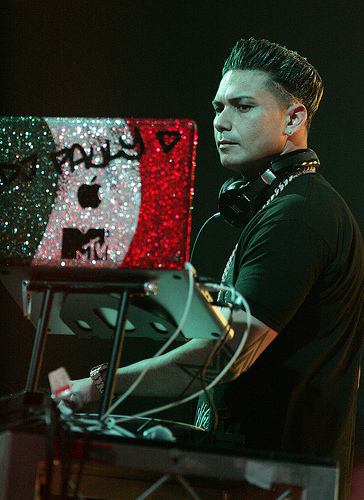
More than any other electronic dance music (EDM) genre, dubstep—and the various hypermasculine cultures in which it has bound itself—has wholeheartedly embraced “digital maximalism” as its core aesthetic form. In recent years, the musical style has emerged as both the dominant idiom within EDM culture, as well as the soundtrack to various hypermasculine forms of entertainment, from sports such as football and professional wrestling to action movies and first-person shooter video games. As a result of the music’s widespread popularity within the specific cultural space of a post-Jersey Shore “bro” culture, the term “brostep” has emerged as an accepted title for the ultra-macho, adrenaline-pumping performances of masculinity that have defined contemporary forms of digital entertainment. This essay posits digital audio production practices in “brostep” as hypermediated forms of masculinity that exist as part of a broader cultural and aesthetic web of media convergence in the digital age.
CONVERGENCE CULTURES
Media theorist Henry Jenkins defines “convergence culture” as “the flow of content across multiple media platforms, the cooperation between multiple media industries, and the migratory behavior of media audiences who will go almost anywhere in search of the kinds of entertainment experiences they want” (Convergence Culture, 2). The most prominent use of “brostep” as a transmedial form comes from video game and movie trailers. From the fast-paced, neo-cyborg and alien action thrillers such as Transformers (2007-present), Cowboys & Aliens (2011), and G.I. Joe (2012), to dystopian first-person shooter video games such as Borderlands (2012), Far Cry 3 (2012), and Call of Duty: Black Ops 2 (2012), modulated oscillator wobbles and bass portamento drops consistently serve as sonic amplifiers of the male action hero at the edge.
Assault rifle barrages are echoed by quick rhythmic bass and percussion chops, while the visceral contact of pistol whips and lobbed grenades marks ruptures in time and space as slow motion frame rates mirror bass “drops” in sonic texture and rhythmic pacing. “Hardness” is the overriding affect here; compressed, gated kick and snare drum samples combine with coagulated, “overproduced” basslines made up of multiple oscillators vibrating at broad frequency ranges, colonizing the soundscape by filling every chasm of the frequency spectrum. The music—and the media forms with which it has become entwined—has served as the affective catalyst and effective backdrop for the emergence of an unabashedly assertive, physically domineering, and adrenaline-addicted “bro” culture.
Film theorist Lorrie Palmer argues for a relational link among gender, technology, and modes of production through hypermasculinity in these types of films and video games. Some definitive features of this convergence of hypermediation and hypermasculinity include an emphasis on “excess and spectacle, the centrality of surface over substance… ADHD cinema… transitory kinetic sensations that decenter spatial legibility… an impact aesthetic, [and] an ear-splitting, frenetic style” (“Cranked Masculinity,” 7). Both Robin James and Steven Shaviro have defined the overall aesthetic of these practices as “post-cinematic”: a regime “centered on computer games” and emphasizing “the logic of control and gamespace, which is the dominant logic of entertainment programming today.” On a sonic level, “brostep” aligns itself with many of these cinematic descriptions. Julianne Escobedo Shepherd describes the style of Borgore, one particular dubstep DJ and producer, as “misogy blow-job beats.” Other commenters have made more obvious semiotic connections between filmic imagery and the music, as Nitsuh Abebe describes brostep basslines as conjuring “obviously cool images like being inside the gleaming metal torso of a planet-sized robot while it punches an even bigger robot.”

MASCULINITY AND DIGITAL AUDIO PRODUCTION
While the sound has developed gradually over at least the past decade, the ubiquity of the distinctive mid-range “brostep” wobble bass can fundamentally be attributed to a single instrument. Massive, a software synthesizer developed by the Berlin and Los Angeles-based Native Instruments, combines the precise timbral shaping capabilities of modular synthesizers with the real-time automation capabilities of digital waveform editors. As a VST (Virtual Studio Technology) plug-in, the device exemplifies the inherently transmedial nature of many digital tools, bridging studio techniques between digital audio workstations and analog synthesis, and acting as just one of many control signals within the multi-windowed world of digital audio production. In this way, Massive may be characterized as an intersonic control network in which sounds are controlled and modulated by other sounds through constantly shifting software algorithms. Through analysis of the intersubjective control network of a program such as Massive we are able to hear the convergence of hypermediation and hypermasculinity as aesthetic forms.

Media theorist Mara Mills details the notion of technical “scripts” embedded both within technological devices as well as user experiences. According to Mills, scripts are best defined as “the representation of users embedded within technology… Designers do not simply ‘project’ users into [technological devices]; these devices are inscribed with the competencies, tolerances, desires, and psychoacoustics of users” (“Do Signals Have Politics?” 338). In short, electroacoustic objects have politics, and in the case of Massive, the politics of the script are quite conventional and historically familiar. The rhythmic and timbral control network of the software aligns itself with what Tara Rodgers describes as a long history of violent masculinist control logics in electronic music, from DJs “battling” to producers “triggering” a sample with a “controller” or “executing” a programming “command” or typing a “bang” to send a signal” (“Towards a Feminist Historiography of Electronic Music,” 476).
In Massive, the primary control mechanism is the LFO (low frequency oscillator), an infrasonic electronic signal whose primary purpose is to modulate various parameters of a synthesizer tone. Dubstep artists most frequently apply the LFO to a low-pass filter, generating a control algorithm in which an LFO filters and masks specific frequencies at a periodic rate (thus creating a “wobbling” frequency effect), which, in turn, modulates the cutoff frequency of up to three oscillating frequencies at a time (maximizing the “wobble”). When this process is applied to multiple oscillators simultaneously—each operating at disparate levels of the frequency spectrum—the effect is akin to a spectral and spatial form of what Julian Henriques calls “sonic dominance.” Massive allows the user to record “automations” on the rhythm, tempo, and quantization level of the bass wobble, effectively turning the physical gestures initially required to create and modulate synthesizer sounds—such as knob-turning and fader-sliding—into digitally-inscribed algorithms.
SONIC WARFARE AND THE ETHICS OF VIRTUALITY
By positing the logic of digital audio production within a broader network of control mechanisms in digital culture, I am not simply presenting a hermeneutic metaphor. Convergence media has not only shaped the content of various multimedia but has redefined digital form, allowing us to witness a clear—and potentially dangerous—virtual politics of viral capitalism. The emergence of a Military Entertainment Complex (MEC) is the most recent instance of this virtual politics of convergence, as it encompasses broad phenomena including the use of music as torture, the design of video games for military training (and increasing collaboration between military personnel and video game designers in general), and drone warfare. The defining characteristic of this political and virtual space is a desire to simultaneously redefine the limits of the physical body and overcome those very limitations. The MEC, as well as broader digital convergence cultures, has molded this desire into a coherent hegemonic aesthetic form.
Following videogame theorist Jane McGonigal, virtual environments push the individual to “work at the very limits of their ability” in a state of infinite self-transition (Reality is Broken, 24). Yet, automation and modular control networks in the virtual environments of digital audio production continue to encourage the historical masculinist trope of “mastery,” thus further solidifying the connection between music and military technologies sounded in the examples above. In detailing hypermediation and hypermasculinity as dominant aesthetic forms of digital entertainment, it is not my goal to simply reiterate the Adornian nightmare of “rhythm as coercion,” or the more recent Congressional fears over the potential for video games and other media to cause violence. The fact that music and video games in the MEC are simultaneously being used to reinscribe the systemic violence of the Military Industrial Complex, as well as to create virtual and actual communities (DJ culture and the proliferation of online music and gaming communities), pinpoints precisely its hegemonic capabilities.
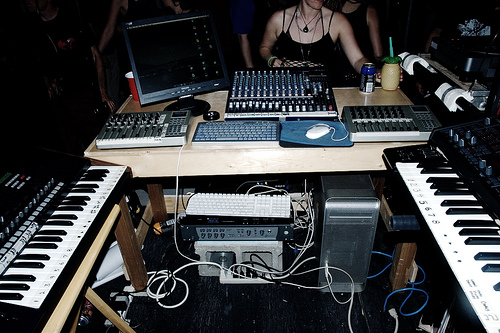
In the face of the perennial “mastery” trope, I propose that we must develop a relational ethics of virtuality. While it seems to offer the virtue of a limitless infinity for the autonomous (often male) individual, technological interfaces form the skin of the ethical subject, establishing the boundaries of a body both corporeal and virtual. In the context of digital audio production, then, the producer is not struggling against the technical limitations of the material interface, but rather emerging from the multiple relationships forming at the interface between one’s actual and virtual self and embracing a contingent and liminal identity; to quote philosopher Adriana Cavarero, “a fragile and unmasterable self” (Relating Narratives, 84).
—
Featured Image: Skrillex – Hovefestivalen 2012 by Flickr User NRK P3
—
Mike D’Errico is a PhD student in the UCLA Department of Musicology and a researcher at the Center for Digital Humanities. His research interests and performance activities include hip-hop, electronic dance music, and sound design for software applications. He is currently working on a dissertation that deals with digital audio production across media, from electronic dance music to video games and mobile media. Mike is the web editor and social media manager for the US branch of the International Association for the Study of Popular Music, as well as two UCLA music journals, Echo: a music-centered journal and Ethnomusicology Review.
—

REWIND! . . .If you liked this post, you may also dig:
Toward a Practical Language for Live Electronic Performance-Primus Luta
Music Meant to Make You Move: Considering the Aural Kinesthetic-Dr. Imani Kai Johnson
Listening to Robots Sing: GarageBand on the iPad-Aaron Trammell
—
Share this:

Heard Any Good Games Recently?: Listening to the Sportscape

DOI: https://doi.org/10.59350/dqt3h-mch65
Sound and music play important roles in shaping our experiences of sports. Every sport has its own characteristic sounds and soundscape; some are very silent while others can be dangerously noisy. Barry Truax, in his engagement with R. Murray Schafer’s concept of soundscape in the book Acoustic Communication, states that the listener is always present in a soundscape, not solely as a listener but also as a producer of sound (10). Both Truax and Schafer use the term hi-fi to describe environments where sounds may be heard clearly, while lo-fi, often urban, environments, have more overlapping sounds. When an audio environment is well balanced (hi-fi), there is a high degree of information exchange between sound, listeners and the environment, and the listener is involved in an interactive relationship with the other two components (Truax 57). Truax’s understanding of the concepts of hi-fi and lo-fi enable a better understanding of the power relations between the key sonic elements of sports: players, the audience and the organizer (usually a game DJ), an increasingly prominent role in today’s team sports events due to permeation of recorded music. Using examples from Finnish soccer, pesäpallo (“Finnish baseball”), and ice hockey, I track how a particular game’s sonic balance can be altered to shape the atmosphere of the event and, even influence the game’s outcome.
In Europe, soccer is overwhelmingly associated with crowd chants, as noted by Les Back in his article “Sounds in the Crowd.” Without the sounds from the audience, the soccer soundscape would be more hi-fi, revealing the keynote sounds of the sport clearly: for example, the thuds from kicking the football, individual shouts from both the players and the spectators. The clear hi-fi signal articulation may be desirable at other times, but from a home team perspective, it does not provide a good soccer atmosphere. However, while playing recorded music to engage the crowd preceding free kicks or corner situations is not prohibited, it breaks the unwritten rules of the game. This means that creating a good atmosphere becomes the crowd’s responsibility; thus, the infamous songs and chants.
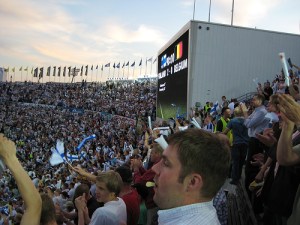
The culture of avoiding electronically reproduced music reveals the potential vulnerability of soccer’s soundscape to silence as much as chants, if not more so. Silence often becomes a way of effecting change at the level of soundscape. A silent, passive, crowd can mirror, for example, the team’s performance on the field or reflect a general lack of interest. Organized supporter groups can also demonstrate their dissatisfaction with something by refusing to sing.
This sound clip demonstrates how keynote sounds of soccer are exposed while approximately 1200 people in the audience seem to be “just watching” a very important home game at the end of the Veikkausliiga season 2012. In the end of the clip the home team, FF Jaro, equalizes and eventually went on to avoid relegation by just 1 point.
In contradiction to soccer, an important part of the pesäpallo experience (Finnish baseball, the national sport of Finland) is actually listening to the continuous communication of the teams. The key to pesäpallo, and the most important difference between pesäpallo and American baseball, is the vertical pitching. Hitting the ball, as well as controlling the power and direction, is much easier. This gives the offensive game much more variety, speed and tactical dimensions than in baseball. The fielding team is forced to counter the batter’s choices with defensive schemes and the game becomes a mental challenge. The continuous communication by the batting team standing in a half circle around the dueling batter and pitcher influences the pesäpallo soundscape. For a better appreciation of the sport, spectators must carefully tune in to the teams’s communiqués.
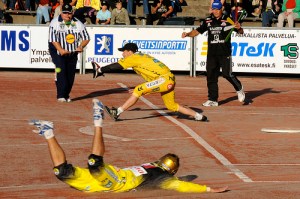
The male pesäpallo team Vimpelin Veto from the small village of Vimpeli in rural Finland has a very active crowd, with a high know-how of the sport. The village has only a little over 3200 inhabitants but had an average of 2087 spectators/game during the 2012 season. In a local newspaper article Veto’s player Mikko Rantalahti reveals that when the crowd is making lots of noise the visiting players’ tactical “wrong”-shouts (“väärä” in finnish), like when a pitched ball is too low, can’t be heard by the fielding players of the visiting team. The audiences’ collective shouting makes the soundscape more lo-fi and the visiting team’s communication difficult.
This tradition of strategic noisemaking has, before the use of headsets, also been heard in American football, when crowds make noise to make the vocal communication difficult for the visiting team. According to Matthew Mihalka’s PhD dissertation “From the Hammond Organ to ‘Sweet Caroline’: The Historical Evolution of Baseball’s Sonic Environment,” crowd noise in baseball is viewed as less influential since directions are sent via hand signals (44). Even though the pesäpallo manager leads the offensive play with a multicolored fan and other visual signals much of the communication is verbal.
(starting point ~16:30)
In this video clip from the 2011 Superpesis final between Vimpelin Veto and Sotkamon Jymy, the audience tries not only to disturb the focus of the hitter, but also the communication of the visiting team standing in the half circle around the batter. Even the commentators are struck by the crowd noise and note its influence.
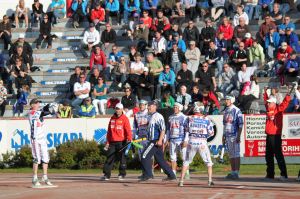
At Vetos games, the audience creates the sonic atmosphere just as in soccer. When the home team is batting, the audience engages in rhythmic hand clapping, deliberately uncoordinated with the organizers’ music. In 2012, I interviewed the managing director J-P Kujala, who is responsible for the music at Vetos games, and he stated that the atmosphere at Veto’s home games is so good that “there is no need for musical reinforcements.” He also doubted that the audience would react positively to music played to activate the audience. At the stadium, music is only heard before the game, during warm-up and intermissions. Kujala refrains from playing music when the visiting team is batting since that can be considered as “disturbing. . .we don’t do that here.” From the organizers’ perspective, the teams are sonically treated equally, but if the home audience creates a sound wall that drains out the visiting teams’ tactical shouts—making the soundscape more “lo-fi”—it is considered as home court advantage. In this context, lo-fi is not related to the use of technology and playing music, but instead to the audience’s sounds.
However, in contrast to the Vetos’ home court sound culture, more teams are beginning to play music inside the actual game, not only when the home team is batting (2:19) but also when the visiting team is batting. DJs often use songs to create funny remarks at the visiting team’s expense. Whatever the implied interpretation of the music might be, the strategy of playing music in this core situation also modifies something very authentic about the pesäpallo experience. In this sound clip from Koskenkorvan Urheilijat’s home game one can hear the visiting team Pattijoen Urheilijat communicating underneath the Finnish hit song Älä tyri nyt (“Don’t mess up now”). Notice that the home crowd, unlike at Vetos games, is not actively making noise—hence the use of music.
As this clip shows, the increasing use of music in pesäpallo calls attention to the need to develop up-to-date rules for the use of recorded music rather than relying on custom or practice.
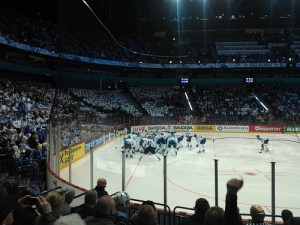
When discussing the soundscape of ice hockey, the most popular sport in Finland, the question is no longer about whether or not to play music but which music suits certain situations best. As in soccer, the most active fans often get cheaper tickets to fill in their own fan sections and sing from the curve behind the goals. Apart from singing along to iconic goal songs or team anthems, the fans very seldom interact with the other music played by the DJ. Moving toward a more mediated sport experience, the ice hockey soundscape is also becoming more lo-fi and the balance of sound making has shifted towards the organizers, with lots of sound events using recoded sound (music, videos, commercials etc.) to entertain the crowd during breaks of play. This shift from hi-fi to lo-fi can, according to Truax, encourage the feeling of being cut off from the environment and may begin to dramatically shift the audience’s experience of the sport (20).
There is no doubt that supporter groups have an important role as creators of meaningful sounds and good atmosphere in Finnish ice halls. In that sense it is a paradox that much of the music played “from record” overlaps their activity. John Bale has written that “fully modernized sport will alter the nature of the soundscape of stadiums and arenas […] and that electronically amplified sound will also increase and hence reduce the spontaneity of the crowd’s songs and chants” (141). The hockey example above with its planned rituals confirms this statement. Discussing and choosing the right songs for the right moment in an attempt to not only entertain but also coordinate the crowd is of course a way to deal with this schizophonic clash of sounds. A more and more common way to integrate the fans in the formation of the soundscape is the possibility of interacting with the DJ through for example Twitter. This is also a way to recognize the power relations in the soundscape.
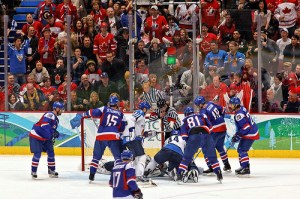
The ice hockey team HC TPS, together with a long time sponsor, recently came up with the idea of “buying silence” and donating the spot to fans. The sponsor also provided the organizers and fans with radiotelephones. That way they could, when prompted by a text on the video screens in the hall, communicate when the spot is being played and make the best out of the situation. This innovative action alters the balance of the soundscape allowing other sounds to be produced and heard more clearly. It makes the ice hockey soundscape hi-fi again; the fans’ interaction with the environment improves and showcases how the balance in the soundscape of hockey is now entangled with the use of technology for sound reproduction.
As highlighted by the examples above, sounds play an important role for experiencing sports. For the audience, making sounds is a way to participate and interact with the event. When the use of music, at least in finnish sports, seems to increase there is also a need to identify the underlying necessity to the play music; it becomes a race to not only find suitable sport music but identify why music is played and which effects it might have on the soundscape as a whole. In soundscape research there has been a certain romanticization for hi-fi soundscapes, but in the cases I have studied there are no clear dichotomies where the one stands for something negative (lo-fi) and the other for something to strive for (hi-fi). Both hi-fi and lo-fi environments reveal power relations in how they connect to the audience’s motivation and ability to contribute with sounds, in addition to the use of technology.
—
Featured image: “Finland vs. Belarus” by Flickr user s. yume, CC-BY-2.0
—
Kaj Ahlsved is a PhD student in musicology at Åbo Akademi University in Turku, Finland. His research focus is on the ubiquitous music of our everyday life and especially how recorded music is used during sport events. He does ethnographic field work in team sports, mainly focusing on Finnish male teams in ice hockey, soccer, pesäpallo (“finnish baseball”), volleyball, floorball and basket. His research is funded by PhD Program in Popular Culture Studies and he is a member of the Nordic Research Network for Sound Studies (Norsound). He holds a master’s degree in musicology and bachelor’s degree in music pedagogy (classical guitar). Kaj is a Finnish-swede living with his wife and three children in the bilingual town of Jakobstad/Pietarsaari. He is, of course, a proud fan of the local soccer team FF Jaro.
—
Share this:




Current Top Posts





April 2021

January 2020

November 2019

October 2019

August 2019

April 2014

November 2017

March 2015

December 2017

October 2015


Recent Comments