
Speaking American
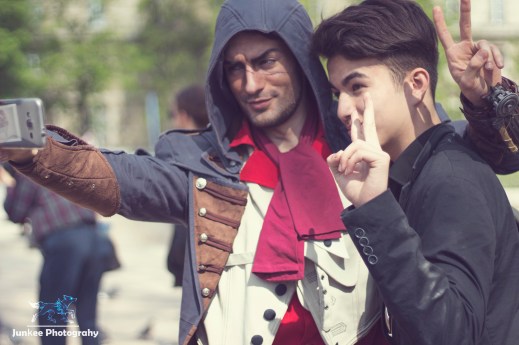
This is something you just don’t hear about in the history books.
–Alex Hutchinson, Creative Director, Assassin’s Creed III
DOI: https://doi.org/10.59350/47qgq-2yc08
What does it mean to speak American? According to Laura Amico, a teacher in the Cliffside Park school district in New Jersey, to speak American is the opposite of speaking Spanish. Students captured her saying this on Snapchat before they walked out in protest: to be American is the same as to speak American. Evidently, to speak American is to speak English, a historical curiosity, given that English was not spoken on the North American continent until the 17th century, preceded by many Native American languages and, ironically, Spanish. In simplest terms, “American English” is not a homogenous dialect either. What kind of “American English” does Laura Amico exalt as acceptable for patriotic conduct? How does an American patriot speak?
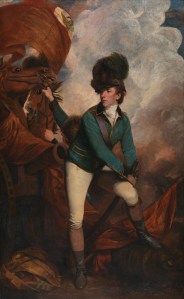
In The Patriot (2000), Mel Gibson plays Benjamin Martin, a hero of the French and Indian War, who is forced out of his South Carolina plantation-managing life to avenge the deaths of his sons at the hands of the British during the American Revolution. The main British villain of that film, the fictional Colonel Tavington,–played in sneering style by Jason Isaacs—is notable for his barbaric conduct (among other things, he traps civilians in a barn and burns them alive). British audiences were noticeably aghast at this characterization, which implicitly compared British command of the time period to Nazi atrocities in World War II. Tavington may in part have been based on Banastre Tarleton, a notorious and brutal, misogynist dragoon whose victory at Monck’s Corner was among the bloodiest battles in the dirty war fought in the south at the end of the Revolution, or Lord Rawdon, a serial rapist and generally unpleasant English officer.
Nevertheless, Tavington’s barn-burning exploits are more likely based on American General John Sullivan’s slash-and-burn campaign against British-allied Mohawks, Senecas, Onondagas, and Cayugas, a subject little discussed in American history. This culminated in a 1782 massacre at Gnadenhutten in Ohio, where white Americans murdered 96 Delawares who had converted to the Moravian faith (pacifists). Evidently, in The Patriot, the conflict was not a civil war, and character was constructed in part through dialect (as detailed below, dialect here refers to all the clues in the way a person speaks, not just his or her accent).
Although Tavington’s conduct in The Patriot manifested visibly onscreen, his dialect said much about him. As noted in a recent Atlantic Monthly article, entertainment—such as Disney cartoons—can “take [bias] and pour concrete over it.” Rosina Lippi-Green, a linguist, notes that such biases are then difficult to remove: “They etch it in.” Another linguist, Chi Luu, suggests that with English RP (see below), the effect is more subtle; such accents go beyond “pure evil” by shading villains as more educated and intelligent—but still bad. Relating these findings to The Patriot, viewers understand Tavington as educated, intelligent, and evil through his English RP dialect; moreover, in black-and-white terms, his dialect makes tangible that he is completely different from the rough-and-ready, courageous Benjamin Martin. An aural line is drawn between American “good guys” and British “bad guys.” The British are fighting just to be sadistic or greedy; the Americans are fighting to defend their way of life.
Compared to media about other American conflicts, there has been little recent dramatic depiction of the American Revolution. Historically, one reason dramatizations of the American Revolution have historically remained rare is the tradition of American reverence for the “Founding Fathers,” causing their depiction as human beings to be circumscribed. Just as visual conventions have been built up regarding the antagonists of the conflict, so, too, have aural conventions in audio-visual representations such as a general use of a Standard North American accent for American (patriot) characters (whether they hail from northern or southern colonies) and English RP for all (villainous) British characters. The effect of this is epitomized by the example from The Patriot above: “good guys” versus “bad guys.”
While the way characters sound is important in most creative works—from the written dialect of Dickens’s characters to the chilling, mask-assisted tones of Darth Vader—it is no more so than in audio drama. Richard J. Hand and Mary Traynor have argued in the The Radio Drama Handbook (2011) that the elements of audio drama are words, music, sound, and silence. Arguably the most important of these to the audio drama are words. Alan Beck’s work on radio acting further argues that to create character through words and sound, refinement of dialect is needed. In this context, dialect refers to more than just a regional pronunciation: it includes details on a character’s geographical region, social class, gender, age, style, and subgroup.
In terms of The Patriot, probably the highest profile pop cultural depiction of the American Revolution until Hamilton, accents mattered. “A well-educated British accent,” in American films at least, “had come to serve as a sufficient shorthand for villainy” as Glancy pointed out, or “British, upper class, and a psychopath, happily burning people alive,” as a 2010 Daily Mail article put it. Whatever his villainy, would a historical Colonel Tavington, have sounded the way he did as depicted in The Patriot? How did those on the North American continent in the 18th century sound?
Richard Cullen Rath has convincingly argued that sound was incredibly important in colonial America, but what role did speech in English have? David Crystal, in discussing the Globe Theatre’s 2004 production of Romeo and Juliet in original pronunciation (OP)/Early Modern English (EME), was most frequently asked one question: how do we know? How do we know what Shakespeare’s English sounded like? For EME, spelling, contemporary accounts of the language, and the use of rhythms, rhymes, and puns illuminate this area. Crystal noted that EME would not sound like any modern accent but would have the pronunciation of “rs” in common with “rural” accents, as in Ireland and the West Country (Somerset).
This is important because the association of Shakespeare with a certain kind of English accent—the RP referred to below—has long had the effect of making his works less accessible than they might have been. If Shakespeare’s actual working dialect had more in common with “rural” accents like Irish and West Country, the latter of which is often still designated as a shorthand for stupidity in common with American southern dialect, this has a liberating effect on Shakespeare in performance. It may sound “strange” at first, but it suggests that Shakespeare can/should be performed in a vernacular, at the very least to make it more accessible to a wide variety of audiences.
Crystal has suggested that, “It is unfortunately all too common to hear accents on stage or film in which—notwithstanding the best efforts of dialect coaches—accuracy and consistency throughout the performance leaves, shall we say, a little to be desired.” Sky 1’s recent big-budget effort in historical drama, Jamestown, set in 1619, is diverse and rich in dialect, with characters speaking with Irish, northern English, southern English, and Scottish accents—nor are they uniform in suggesting that one accent will signify the character’s goodness or badness (though it has to be said most of the southern English-speaking characters are, at the very least, antagonistic). Most of the Native American characters have so far not spoken English rather than racist “Tonto talk,” and white English-speaking characters must speak Powhatan (or use sign language) in order to communicate. As actor Jay Tavare points out, early Hollywood was not concerned with the accurate portrayal of indigenous languages, given that Navajo extras were most often used in Westerns (meaning the Diné language of the southwest was heard regardless of where the film was set). More recently, even such films as Dances with Wolves (1991), which has generally received praise for its accurate portrayal of Sioux/Lakota culture, included Lakota dialogue which was linguistically imprecise. Clearly, there is still a long way to go.
Suppose we decide we cannot ever know how such historical actors sounded, so we decide to depict 18th century English speakers based on other criteria. How do directors, actors, and voice coaches bring the viewer/listener as close to the author’s intent as possible in fictional depictions of the years surrounding the American Revolution? How is the 18th century made accessible through dialect? As Glancy suggests above, British officers in film, television, and radio depictions of the American Revolution are most commonly associated with Received Pronunciation (RP), though the term was not coined until 1869, and, as Crystal points out, the “best speech” heard in the English court of the 16th century was “nothing like” RP. In fact, it was probably influenced by the Devonshire accents of Sir Francis Drake and Sir Walter Raleigh (an English so far in Jamestown associated with servants . . .). As Edda Sharp and Jan Haydn Rowles point out in How to Do Standard English Accents, RP has almost disappeared in England, “now confined to a very small section of society, the older upper and upper middle classes, older actors and broadcasters.”
The officer class of the British Army in the 18th century was in fact largely composed of Scots (as per Stuart Reid and Paul Chappell)—though how much they retained their Scottish identity (including accent) is of course impossible to know. As Kevin Phillips in 1775: A Good Year for a Revolution points out, within England, support for the colonies during the American Revolution was generally strongest in the major cities and in the eastern and southern counties—the same places where during the Civil War, support had been strongest for Parliament and Cromwell. Support in Scotland was limited to a small fringe. By contrast, statistics from Revolutionary America 1763 to 1800: Almanacs of American Life on the ancestral origins of the white population of Virginia in 1790 make Scotch-Irish (11.7%) and Scottish (5.9%), the second-largest groups after English. References to the Scottish officer class are made in Cooper’s The Last of the Mohicans, where Colonel Munro is referred to as “the Scotsman” (played memorably in the Michael Mann film by Maurice Roëves). Beal suggests that guides to “correct” pronunciation in the 18th century were often written by and for Scots—to pass as “British.” The Scottish people have had a long history of wishing to disassociate themselves from rule by the English (as evident in the 2014 Scottish Referendum). The Wars of Scottish Independence in the 13th and 14th centuries were fought between English and Scottish forces, at the conclusion of which Scotland retained its status as an independent state. However, in 1707, the Act of Union unified England and Scotland under one government.
With these many regional British accents potentially to be heard in the British Army in America in the 18th century, and with approximately 92.2% of white colonists in Virginia hailing from the British Isles in 1790 (including England, Scotland, Ireland, and Wales), it is perhaps curious that there has been so little variation in dialect in media depictions such as films, TV, and radio. Traditionally, for example, George Washington has been depicted with a Standard North American accent and not a modern southern American accent. This is also true in the case of Colonial Williamsburg re-enactors.
Besides being generally a very sound depiction of the Revolutionary period, HBO’s John Adams (2008), based on David McCullough’s book, is also unusual as far as accents go. John Adams gives the British King George III, played by Tom Hollander, Standard Neutral English, but it does something very unusual with its American characters. Virginian characters (including Washington and Jefferson) have suspiciously Somerset-sounding accents. John Adams introduces a clear regionalism in Anglo-American accents that goes beyond the singling out of the Boston accent (which is generally personified in John Adams himself). It isn’t clear why this decision is made; the accent does not belong exclusively to Virginian characters, as it is also the accent of Benjamin Franklin, proudly Pennsylvanian, and Alexander Hamilton himself. Is the shorthand present to aurally distinguish between Loyalists, and American rebels? What affinity, one might ask, does the Somerset accent have with a depiction of the American character?
Standard North American speech is rhotic (people who say an ‘R’ whenever it is written), as is the Somerset accent (and, as Ben Zimmer explains, was associated with country speech in England from the 17th century). This contrasts with Neutral Standard English Accent, which is non-rhotic (people who only say an ‘R’ if there is a vowel sound spoken after it). Perhaps the filmmakers had in mind the best guesses about how “proper” Anglophones spoke in the 18th century, as in John Walker’s Critical Pronouncing Dictionary (1791), where he normatively condemns rhotic English. Then again, perhaps it is merely a storytelling expedient; look at the actors assembled to play Founding Fathers:
- Washington – David Morse, American, born in Massachusetts
- Jefferson – Richard Dillane, born in London
- Hamilton – Rufus Sewell, born in southern England of Welsh and Australian parents
- Franklin – Tom Wilkinson, born in Leeds, grew up in Canada
- Sam Adams – Danny Huston, American, born in Rome
Standardization may have made practical sense, but the use of the rhotic sends a subtly different message than North American Standard English, and perhaps hints at the influence of David Crystal’s work on OP/EME.
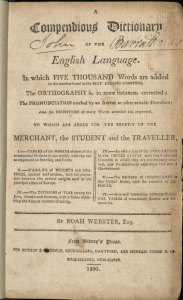
Even among linguists, North American 18th century English has not been examined to the extent that EME has, with Beal going no further than to suggest “the contact between the various regional dialects of the English-speaking colonists and the languages of the Native Americans and of other European colonists” would have influenced pronunciation, but she is not conclusive as to what extent. Noah Webster in 1789 envisioned “a language in North America, as different from the future language of England, as the modern Dutch, Danish and Swedish are from the German or from one another” (cited in Mühleisen). From the beginning, too, American fiction was concerned with pronunciations, with Cooper sensitive to those which “disclosed class or origins,” as Schachterle noted. The word “Americanism,” in fact, was coined by John Witherspoon in 1781. Its entry in Webster’s Compendious Dictionary (1806) is “a love of America and preference of her interest.” As David Crystal points out, this was the first dictionary written in English to include words like butternut, caucus, checkers, chowder, constitutionality, hickory, opossum, skunk and succotash. It was also the first dictionary to give now-familiar American spellings to words like color and defense.
It is probably not a surprise that many of the words above have their origins in Native American languages. Black and Native voices (and use of dialect) are somewhat rare in media depictions of the Revolutionary period, notable exceptions being The Last of the Mohicans, with its heroes (“Hawkeye,” Uncas, and Chingachgook, played by Daniel Day-Lewis, Eric Schweig, and Russell Means, respectively), as part of an extended, multi-racial family unit, speaking with a uniform Standard North American accent:
and Ubisoft’s smash video game, Assassin’s Creed III (2012).
The hero of this Xbox/Playstation game is Connor/Ratohnhaké:ton (Noah Watts), half-British, half-Mohawk, who speaks Mohawk as well as English (again, no Tonto talk here), as taught by the project’s language consultant, Akwiratekha’ Martin. However, again ignoring historical realities like the Sullivan campaign, the villains are British redcoats, echoing the storyline set up by The Patriot (Connor’s village is burned and his parents are killed by a British officer who sneers, “You are a nothing, living in the dirt like animals.”) In a making-of featurette, the creators of Assassin’s Creed III note that it has more than two hours of “cinematics,” a concept that suggests that the game will be a more potent window into history for its users than film, television, radio, or books. While it is positive that the game inaugurates a Native American action hero role model, it is disappointing that it recycles “the British are baddies” dialect trope.
In media like cartoons, video games, and audio drama, dialect supplies us with many clues about characters and what we should think and feel about them. Class is still very much implicit in accents in Britain, and every time we open our mouths we display characteristics about ourselves, whether feigned or not. When mass media-makers produce historical drama, they make choices. Despite the United States’ and the United Kingdom’s “special relationship,” the “British are baddies” trope remains. Its continued use and the future choices made by media-makers have much to say about Anglo-American relations and conventions in fiction today.
If, as suggested by several linguists identified in this article, children very quickly pick up conventions of who is “bad” via what they sound like, it behooves us to pay careful attention to the way mass media uses voices and what norms these establish, for listeners young and old. Also, what accents filmmakers use for past accents may profoundly influence who can hear themselves as “American” in the present moment–one important reason why Lin-Manuel Miranda’s Hamilton resonated with contemporary audiences. If teacher Laura Amico in the Cliffside Park school district in New Jersey has established that her pupils should “speak American,” what does this mean (besides the fact she expects them to speak English not Spanish)? Should they, for example, speak like President Trump, who uses a New York Queens accent which, according to Jeff Guo, connotes “competence, aggressiveness and directness” despite the fact its speaker comes from a privileged background? As Guo suggests, the way we speak is at least as important as what we say. In response to reports that Trump mocked the Indian Prime Minister, Narendra Modi, by imitating his accent, Congressman Raja Krishnamoorthi published a statement saying, “Americans are not defined by their accents, but by their commitment to this nation’s values and ideals.” That, perhaps, is speaking American?
—
Featured Image: Arno Victor Dorian, Assassin’s Creed Unity: Leon Chiro Cosplay Art
—
With thanks to Kenneth Longden and Matthew Kilburn
—
Leslie McMurtry has a PhD in English (radio drama) and an MA in Creative and Media Writing from Swansea University. Her work on audio drama has been published in The Journal of Popular Culture, The Journal of American Studies in Turkey, and Rádio-Leituras. Her radio drama The Mesmerist was produced by Camino Real Productions in 2010, and she writes about audio drama at It’s Great to Be a Radio Maniac.
—

REWIND!…If you liked this post, you may also dig:
The Magical Post-Horn: A Trip to the BBC Archive Centre in Perivale–Leslie McMurtry
Speaking “Mexican” and the use of “Mock Spanish” in Children’s Books (or Do Not Read Skippyjon Jones)–Inés Casillas
Sounding Out! Podcast #40: Linguicide, Indigenous Community and the Search for Lost Sounds
Share this:

Listening to the City of Light: An interview with Sound Recordist Des Coulam

DOI: https://doi.org/10.59350/kp68c-7p206
How should we take account of, question, describe what happens every day and recurs every day: the banal, the quotidian, the obvious, the common, the ordinary, the infra-ordinaire, the background noise, the habitual?
I’m meeting with the British sound recordist Des Coulam at the brasserie La Coupole on the Boulevard de Montparnasse in Paris. “Just imagine…this place opened in 1927. If you installed a microphone in the middle of this room in 1927 and if it was still there today, how many interesting things could you have recorded in this place? It just begs belief, doesn’t it? François Mitterrand, Picasso, Ford Maddox Ford, Beauvoir, Man Ray, they were all here. They all echo in these walls.”
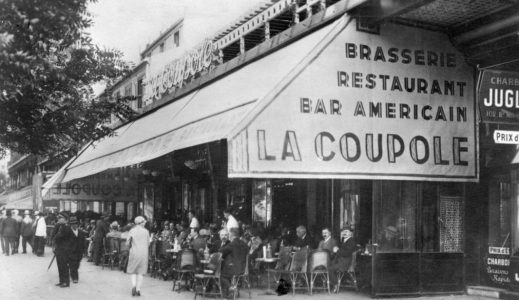
The sound inside La Coupole by Des Coulam
Des Coulam has been capturing the urban soundscape of Paris for almost ten years. Paris is a city full of mirrors, replicating itself through various mediums. A great archive of the city and its streets, boulevards, arcades and cafés has been written, painted, filmed and photographed throughout the 19th and 20th centuries. However, its aural history is less documented.
“All the archival sounds you find of Paris are adjunct to pictures, so you’ve got television pictures, you’ve got film, you’ve got very few actual recordings of Paris, and I wanted to capture the contemporary soundscape of the city and archive it for future generations to explore, study and enjoy,” explains Coulam. “It’s only on the last few seconds on our historical clock that we’ve been able to capture and archive sounds, so most of our sonic heritage is passed by completely unrecorded. We can get an idea of what nineteenth, eighteenth, and seventeenth century sounds were like from literature and from art in some cases. But the fact is we can’t actually listen to them. All the sounds we hear came from somebody’s imagination.”
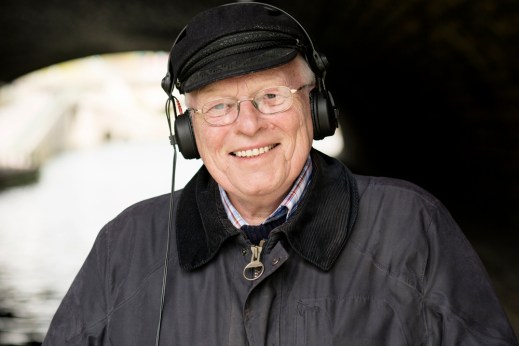
Coulam’s methodical approach and commitment to the task of recording the sounds of Paris, almost on a daily basis, is helping to create the first comprehensive sound archive of the city. These sounds constitute the Paris Soundscapes Collection and are being archived in the British Library of London.
“Memorable recordings are not limited by your equipment, only by your imagination”
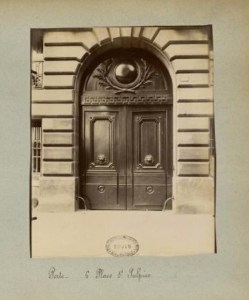
“And people forget that,” laments Coulam. “I mean, listening is an art and it’s an art that must be learned. You have to practice, practice, practice to listen. But once you master the art it opens up an all-new world. Because for me, if you give sounds the opportunity to breathe and to speak, they all have a story to tell. We walk along the street and hear a sound and you think: what is that? And you can create a story the sound is telling you. You might hear one of these big Parisian doors bang. What’s behind that door? How many interesting people have walked through that door? And you start to see or experience the place differently.”
Sounds inside l’Eglise Saint-Gervais-Saint-Protais (w/creaking wooden door) by Des Coulam
Des Coulam is of the opinion that the ability to tune into sounds with an inquisitive and imaginative mind can provide better recordings than the most expensive equipment. It’s a skill that he has been developing for over 50 years. “I can tell you the exact day. It was the 25th of December, 1958 when I woke up on Christmas morning and found a tape recorder. And if you had asked me to write a list of 100 things I wanted for Christmas, the tape recorder would not have featured in it. But there it was and I fell in love with it instantly and stayed in love with it ever since. It turned something on in my head that stayed with me all my life. I was 10 years old and now I’m almost 70 years old…I don’t know what I would do without it. I would probably just curl up and die or something…Because now it consumes all of my life. I work seven days a week, but it never feels like work. It’s just fun.”
An aural flâneur in a changing city
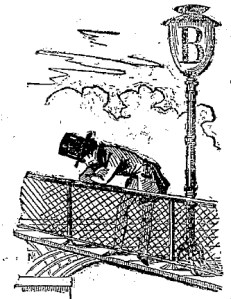
“Some of my best recordings have come serendipitously when they are not planned.” Most of the time Coulam doesn’t adhere to a strict pathway through the streets of Paris. He follows the background city sounds as someone who follows a river stream. He describes himself as an aural flâneur. The term flâneur (stroller, idler, walker) dates back to the 16th century and was made popular by Walter Benjamin in his 1935 essay “Paris, Capital of the Nineteenth Century” in The Arcades Project. “I’m doing exactly what the 19th century flâneurs did. Observing, that’s all I do. But I observe through sound rather than visually,” says Coulam. “The one thing the flâneur had was time. They had the time to stroll around the streets and observe the everyday life. But in my case I observe listening.” According to Aimée Boutin, the author of City of Noise: Sound and Nineteenth-Century Paris, it is in the writings of Balzac, Louis Huart and Victor Fournel that the flâneur emerges as an attentive listener, an eavesdropper and collector of stories who views the city as a musical score and as a cacophonous/harmonious concert.
19th century images of the flâneur predominately evoke a white male figure of means and privilege who observes and listens to the city from a position of detachment towards the crowd. He is invested in his own anonymity and imagines himself cultivating a sense of neutrality and “objectivity.” Coulam’s active listening practices depart from this perspective by challenging his perspectives and owning the subjectivity of the recording and archiving process. “The way you hear sound changes depending on the circumstances and also the way you interpret sound is different. You and I could walk down the same street and hear it differently. I can walk down the same street twice and hear it differently. There are lots of sounds that I will hear and there are lots of sounds that I won’t hear.” In a recent blog entry Coulam writes that while being “aware that sounds don’t exist in a vacuum, I am always thinking about the social, cultural and historical context of the sounds I find and that has taught me how to explore and appreciate the rich history, complexity and diversity that is Paris.”
Besides his own recordings of the Parisian soundscapes, Coulam has been adding new aural narratives of the city in the series “Paris – A Personal View” inviting guests who live in Paris to visit a place in the city that has a special meaning for them. In this series, Coulam often features the city of the contemporary flâneuse, a radically different form of flâneurie through the steps of the walking woman. In the audio bellow, Monique Wells, an expert on African Diaspora in Paris and founder of the non-profit association Les Amis de Beauford Delaney, explores her favorite place in the city – the Jardin du Luxembourg.
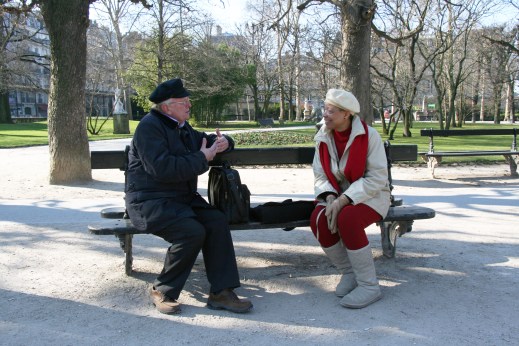
Monique Wells, Jardin du Luxembourg, “Paris – A Personal View” Series by Des Coulam
This is a particular time to be listening to the city as a new plan to expand the metropolis of Paris is on its way. “Paris is on the cusp of a huge change. If we look at the history of Paris, it is a history of circles. So you get start with the Romans who invaded and camped out on the Île de la Cité. What did they do? They built a wall around it. And over the years as Paris expanded more walls have been built around the city until today. Now, you’ve got this wall of traffic – the périphérique – and everything within that is Paris and everything without is the suburbs. Nicolas Sarkozy decided, when he was president, that he was going to demolish this invisible wall between Paris and the suburbs. So he gave birth to the Greater Paris Project which is now going ahead. So over the next 10, 20 or 30 years the visual landscape of the city will change and also its sound landscape. And this is a perfect time to capture that change. I won’t live long enough to see it all but I’m already seeing some of it. And what you have right now is that some sounds of Paris are actually disappearing, some are about to disappear, some have stayed remarkably the same and new sounds have appeared.”
Sounds around the Pont National (near Boulevard Périphérique) by Des Coulam
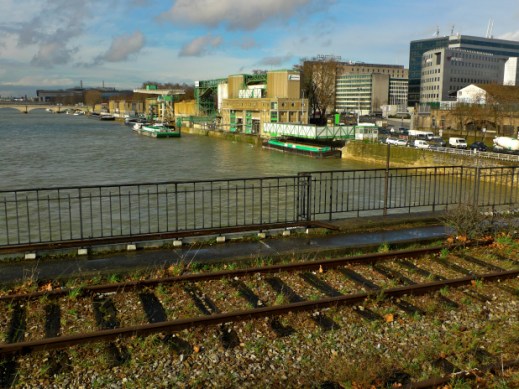
The Vanishing Sounds of Paris
The changes in the visual landscape of Paris and the modernization of its infrastructures will cause a significant change in its soundscape. For instance, Coulam dedicates a lot of his time to recording the changes of the subterranean and aerial soundscape of the Parisian metro lines. “The sounds of the Metro are changing dramatically. If you imagine the sounds of the Paris Metro, you immediately get this picture of the sort of 1950s black and white film, you can hear the sounds of the train rattling over the lines. It’s gone, it’s all completely gone. The last of those trains disappeared in 2012. And I knew this was happening so I recorded a lot of metro line 5 where the old trains were. So I’ve got a stack of recordings of those because nobody else was doing it.”
Sounds of Line 5 at Quai de la Rapée by Des Coulam
“That lovely rattle, these clanking rattling sounds. Just what you imagine it to be!” The old trains on line 5 are now being replaced by modern models with a quieter sound. Also, the trams that covered the city in the 1930s were later substituted by motorized buses. “There are no trams in the center of the city but you’ve got them on the periphery now. There are 8 tram lines. On a lot of the routes they actually go through lot of pains to reduce the amount of noise the tram makes by putting grass down between the tram lines to absorb the sound. So that’s a completely different soundscape than you would have had in this case in the 1930s.”
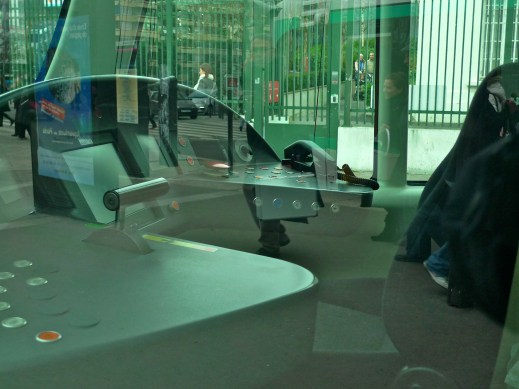
Inside a tram on Line T2 from the station Henri Farman to Porte de Versailles by Des Coulam
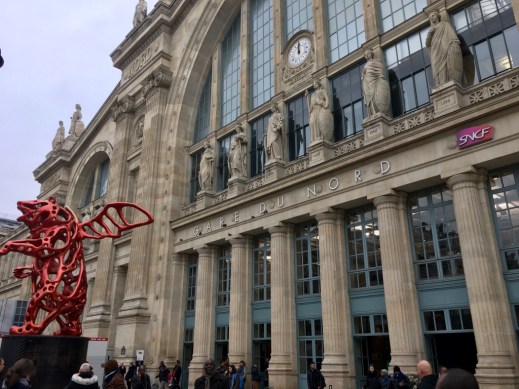
Coulam has been recording the sounds of the Gare du Nord, one of the six main railway stations in Paris, that is going through some transformations right now. A sign outside the station in the construction zone promises “a brighter and more practically designed hall for enlightened travelling”. The distinctive soundscape of the Gare will certainly change. A new type of pavement is enough to alter the echoing sounds made by footsteps and rolling suitcases.
Inside the Gare du Nord; October 2016
“But on a more human level,” says Coulam, “the street criers, the vagabond man, the knife grinders, people like that who used to come around shouting in the street are completing gone. The only thing you find now are the market traders in the market stores, but you don’t find any of these tradesmen in the streets of Paris.”
“An attempt to exhaust a place in Paris” in sound
“The only time you really notice the urban soundscape is when isn’t there,” remarks Coulam. On the day we meet, Montparnasse is eerily quiet. There is little traffic and only a few pedestrians are strolling along the Boulevard. “The soundscape you hear is not the normal Montparnasse because this is August and everybody is away on holiday, so you are immediately struck by the relative quiet around here.” It might be difficult to find places of quiet in a city like Paris during the other eleven months of the year.
But even the noise, the chatter and the rumble are important parts of the urban soundscape. “The biggest challenge I face recording the soundscape of Paris is the sound of traffic, and I long ago decided that you couldn’t ignore it. And in a sense, why should you? Because it’s an integral part of the soundscape, so to ignore it is a sort of cheating, really. So, I decided to embrace it and I started to deliberately record traffic and it was absolutely fascinating!”
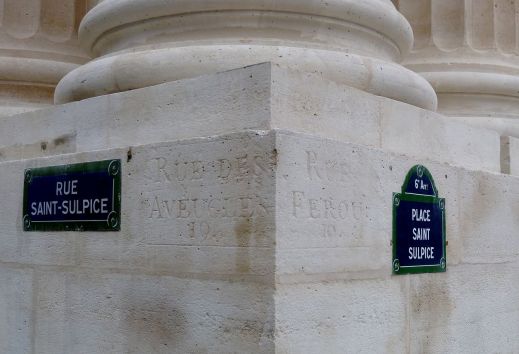
The author and filmmaker George Perec once sat down for three days in Saint-Sulpice Square to write down all the non-events around him. “What happens, when nothing happens other than the weather, people, cars, and clouds?” asked Perec. In the same vein, Coulam continues recording the sounds that constitute the backdrop to everyday life and through attentive listening, he weaves the sound tapestry of the city of Paris. “You sit on a Parisian green bench in a busy narrow pavé street and just let the street walk past you. You will hear fabulous sounds.”
“An attempt to exhaust a place in Paris” in sound (Café de la Mairie, Place Saint-Sulpice) by Des Coulam
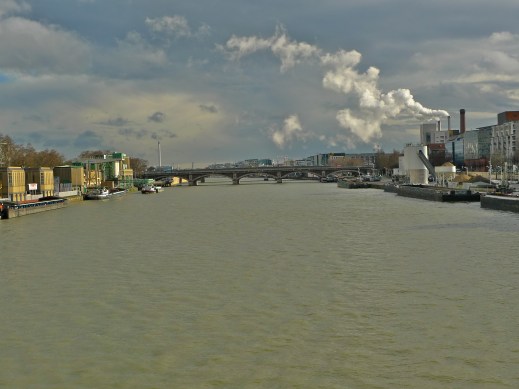
You can hear Des Coulam’s collection of Parisian soundscapes at Soundlandscape or follow him on twitter.
—
Featured Image: Line 5 at Quai de la Rapacca, Image by Des Coulam
—
Carlo Patrão is a Portuguese radio artist and producer of the show Zepelim. His radio work began as a member of the Portuguese freeform station Radio Universidade de Coimbra (RUC). In his pieces, he aims to explore the diverse possibilities of radiophonic space through the medium of sound collage. He has participated in projects like Basic.fm, Radio Boredcast, and his work has been featured in several international sound festivals and has also been commissioned by Radio Arts (UK). He is currently working on a radio show for the Portuguese national public radio station RTP. In addition to his work in radio, he has a master’s in clinical psychology
—

REWIND! . . .If you liked this post, you may also dig:
Playing with Bits, Pieces, and Lightning Bolts: An Interview with Sound Artist Andrea Parkins — Maile Colbert
(Sound)Walking Through Smithfield Square in Dublin— Linda O’Keeffe
Sounding Our Utopia: An Interview With Mileece— Maile Colbert
—
Share this:




Current Top Posts


April 2021
January 2020

November 2019

October 2019

August 2019

April 2014

November 2017
March 2015
December 2017

October 2015


Recent Comments