
(Sound)Walking Through Smithfield Square in Dublin

DOI: https://doi.org/10.59350/pywqa-vdt14
Editor’s Note: This month Sounding Out! is thrilled to bring you a collection of posts that will change the way you hear cities. The Sounds of the City series will prompt readers to think through ideas about urban space and sound. Are cities as noisy as we think they are? Why are cities described as “loud”? Who makes these decisions about nomenclature and why?
We kicked things off last week with my critical reading of sound in Lorraine Hansberry’s A Raisin in the Sun, a play about African Americans in Chicago that still rings/stings true today. Regular writer Regina Bradley will discuss the dichotomy of urban and suburban in the context of sound (noisy versus quiet, respectively), and CFP winner Lilian Radovac will share with us a photoessay on the sound installation Megaphóne in Montreal. Today, guest writer Linda O’ Keeffe takes readers on a soundwalk of Smithfield Square in Dublin, Ireland and specifically of the Smithfield Horse Fair, in order to illustrate how urban renewal disrupts city soundscapes and how sound reclaims those spaces.–Managing Editor Liana M. Silva
—
Since 2010, as part of my PhD research, I have conducted over two dozen sound walks through the Smithfield Square and its environs, in Dublin’s North Inner city; with teenagers, by myself and through organising deep listening group walks as part of World Listening Day. These walks were designed to encourage the participating walkers to listen intently to this space and compare it to other spaces on the north side of Dublin city. The walks were also designed to examine the changing use and design of the Smithfield space over the past four years. This essay is drawn from the findings of this research, which explored the co-production of space and soundscapes with 84 teenagers (43 girls and 41 boys) from Dublin, Ireland. I include some of their observations of Smithfield Square here.
The Smithfield Square’s redesign began in 1996 as part of an urban regeneration project, and was completed in May of 2013. Smithfield is a traditional working class area, historically connected to wholesale markets, and in recent years it has gone through many iterations. In a push towards gentrification, the Smithfield Square space was ripped up, rebuilt, re-imagined and ripped up again because each iteration of its design proved unattractive to potential visitors/users of this space. According to the Royal Institute of the Architects of Ireland (1991), Dublin City Council considered these users were tourists and new middle class urbanites, not the locals.
Large-scale apartment complexes with business premises on the ground floor, tourist facilities, and an art house cinema were situated alongside smaller, older social housing, flat complexes and wholesale markets within the area. This reshaping of architecture impacts the diffusion of sound in space. It changes what Brandon LaBelle (2010) calls the acoustic territories that demarcate space where sound is no longer attributable to specific spaces or communities. Additionally, since the early 1990s, sounds within Smithfield began to change with the removal or downsizing of certain productive practices, such as the fish and fruit markets. This reduced the kind of traffic, both pedestrian and commercial, which would have moved and sounded through the area. The Smithfield Horse Fair disrupts the area’s soundscape and opens up the possibilities of the space of Smithfield Square for the broader community.
The design of the square, its restaurants, boutique shops and cafes, suggest that the soundscape designed for this space was meant to be a quiet and calm, recreating in the square what Karin Bijsterveld has defined in Mechanical Sound (2008) as the quiet of the middle classes. The sounds produced by the fair are then seen as counter to the types of sensory experiences that, Monica Montserrat Degen argues in her book Sensing Cities: Regenerating Public Life in Barcelona and Manchester (2008), are acceptable to the middle classes, who purchase a type of sensory/sonic experience. However, the soundwalks I describe contest what “quiet” means in the context of the square.
Listening to the Square
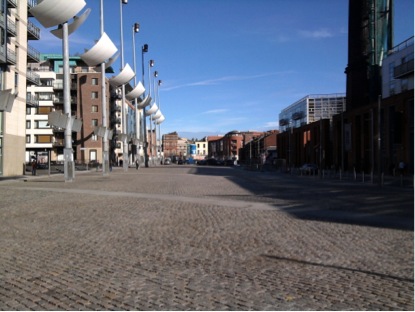

In 2009 the Smithfield Square, which is laid with thousands of cobblestones, had placed around one side twelve 26.5 metre gas lighting masts, at one end of the square two lines of trees were planted with seating placed among them, and at the other end some large concrete plant pots. The seating located within the trees, attracted groups of homeless people and addicts. As a result, the dominant soundscape during the day was the sounds of men and women shouting obscenities at each other, with the susurration of trees rarely heard over this dominant sound. One of my teenage participants noted, “you always hear people screaming in the background” (Participant 2).

Aside from the shouting voices and loud reflections from singular sound sources within the Square such as the clatter of suitcase wheels across the cobblestones, seagulls screeching overhead, the beeping of trucks reversing and even the sounds of people talking at a distance, the teenagers who participated in the soundwalks defined the space as silent. Their use of the word silent did not mean the absence of sound, but rather an absence of activities, life, general sounds of community, consumption and production.
One sound that dominates the soundscape of Smithfield and its surroundings is the sound of the Luas tramline. The Luas line sits at one end of the Square and the sounds produced are distinctive: there is the whoosh as it passes, the ding a ling of its bells and the sounds of the doors opening and closing. The sound of the Luas echoes around the area from 6 in the morning till midnight. The sounds have become synonymous with that part of the city. The teenage participants defined these sounds as rhythmic, musical, “like a ballet.” For the teenager participants, the sounds of the Luas has been the only constant sound within Smithfield.

The sounds of children and teenagers were absent, even with the vast housing areas that surround Smithfield Square—some dating back to the 1940s. Within five minutes of the square are two primary schools and one all-boy’s secondary school. During the day, I would hear the children playing in the school grounds, and in flat complexes close to the Smithfield Square. Each of these spaces were gated and enclosed. Most of the teenage participants lived within such housing areas, and would often refer to the level of noise made by the children within their immediate housing areas. Yet, none of the teenagers, and no young children, used the Smithfield Square for “hanging out” or playing.

The teenagers argued that the Smithfield Square had no point; it was too wide open and too quiet.
Group 11b: Although, there probably was sound for somebody who listened to it but because we were all coming down from the city, the space seemed to be nothing… it just seemed real quiet, empty.
Because of that, the teenagers felt they could not group together to chat. For them, it would be like situating themselves in the middle of a stage. Their sounds were amplified or reverberated, ironically creating a feeling of being surveilled. They felt more comfortable and safer in confined areas, such as street corners, laneways, and the archways of large buildings. Within these smaller spaces, the sounds produced have closer reflections. Teenagers often surround themselves with sounds by shouting, playing music, etc., creating what Barry Blesser and Linda-Ruth Salter in Spaces Speak, Are You Listening? (2009) call a sonic bubble. These “territorial bubbles appear as if by magic around a group of individuals if they begin to interact, and the group quickly acquires rights to the arena” (2009:34) thus creating a temporal space. They did not feel they could do so in such an open area.
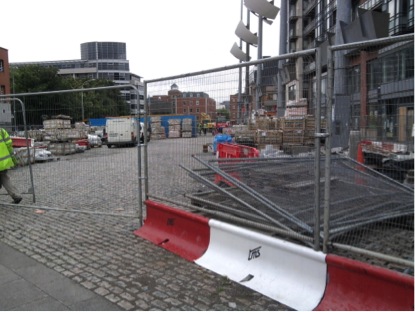

Because of the poor planning and design of the Smithfield area, there are vast empty spaces surrounded by fencing or construction hoarding, numerous derelict buildings, and closed-down shops and restaurants. The Smithfield Square is no different, with numerous buildings left empty as a result of foreclosures or bankruptcy. The silence in this space is indicative of the loss of the social and economic processes. The vast square then takes on another level of silence, the loss of productive meaning, the presence of poverty, homelessness and unemployment.
On one walk with the teenagers I noted that they would group together in the square, even when they were told to walk around and record sounds within the space independently. Later, they said there were no sounds to record, so they just walked towards the closest sound source, a small shopping market in the square. I had noted numerous individual sounds, but they would have required standing in the middle of the square to record them. During focus group sessions after the soundwalks, the teenagers defined positive soundscapes as places with numerous loud sounds, the voices of hundreds within busy shopping streets, music coming from stores and traffic in the distance. These sounds defined a city, and made the teenagers feel safe and enclosed. Smithfield contained none of these kinds of sounds.
Soundwalking the Smithfield Horse Fair

There are a few events held regularly within the square since it re-opened in 2013. Some of these events are part of the Dublin City Council’s efforts to invigorate the space, such as food and art markets, as well as fairs for various seasons and holidays. One of the few public events that take place in Smithfield Square is the Smithfield Horse Fair, which happens on the first Sunday of every month. Having walked through this space repeatedly over a period of 3 years, it was only when I attended the horse fair that the space came alive, it had a purpose.
The horse fair has been a contentious event for both locals and city managers for the past two decades, with the horse dealers arguing that there is either a historical precedence for the horse fair or with the Dublin city councillors arguing that the land was historically used for the selling of cattle for market. The appearance within the Smithfield Square once a month of the horse fair brings with it a vast and lively, and sometimes, as defined by the media and Dublin City Council, a threatening soundscape/environment.
Some sounds defined as threatening are the loud whinnying of horses as they are jostled around the fair. The media has also reported, on several occasions, large-scale fights, which have broken out during the fair, leading to the presence of riot police. This eventually led to the gating of the fair and an extreme police presence as if these measures might reduce such sounds through the threat of arrest. For those living in the new apartment complexes, the sounds produced at the fair are amplified because of the design of the space, and possibly sound more threatening as a result.
During one walk of the Smithfield horse fair that I did in April 2013, some of the audible sounds were horses neighing and whinnying in panic, horse shoes on the cobblestones, traders shouting out their wares of horse paraphernalia, seats, stirrups etc., the voices of old men, which was the dominant background sound, and the sounds of traditional Irish music.
Outside of the gated fair were the sounds of large groups of teenagers, shouting and calling to each other. The space was alive with sound; the voices of teenagers merged with, or were lost within, the chaos of other sounds, becoming part of a larger soundscape. Because the space was busy with people, activities, music and even security there was a reason to use the square, even if you were not actively taking part in the event. The fair created a space for teenagers to engage with, and perhaps feel safe within the boundaries of its soundscape. Suddenly the square was as busy and as loud as the city centre.

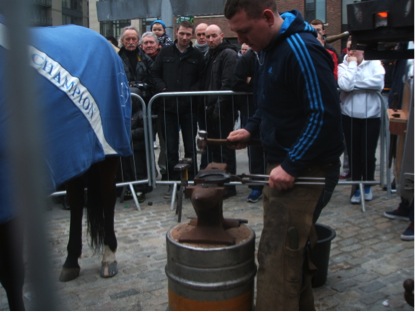
While walking through this soundscape, I encountered different kinds of soundmarks. For example, the banging of horseshoes was quite distinctive because it is, as Schafer would define, an archetypal sound, one that no longer belongs in the city. It felt like hearing a sound from the past. Yet this kind of sound creates a kind of historic continuity with the past (Barry Truax, Acoustic Communication, 2000). When discussing the cobblestones within Smithfield Square, most of the young female participants stated that it was not so much the look of the cobblestones that gave the space a sense of history but rather the sounds made when something moved over them. The lack of people and activities within the square meant that these sounds were rarely activated. The soundscape of the fair on those days transformed Smithfield, lifting it out of its everyday silences, which seemed to invite young people to participate. It was reactivated with life.
What was noticeable about the two fairs I visited was that by the second event in 2013, there were far fewer horses than at previous fairs. There were about 8 or 10 horses being paraded around the space by what looked like homeless people or addicts. There seemed to be no real horse-trading; the soundscape lacked the sounds of horses. Instead, the space had become a gathering space, with groups of tourists wandering around taking pictures of anything and everything.


Conclusion
This fair does not fit within the cultural ethos of regenerated urban spaces like Smithfield, where culture is defined as a consumerist process or part of the arts. However, the space takes on new potentialities as a result of the presence of people, sounds and activities, allowing the teenagers to view the possibilities of spatial use. Sounds can distinguish a space, as identified during the Smithfield horse fair. These sounds also remove focus from teenagers’ voices audible within the space, and transfer it to other sounds. The space was no longer a large fishbowl viewable from any angle; instead it had become a busy vibrant immersive soundscape.
—
Featured Image: “Smithfield Horse Fair, Dublin” by Flickr user Admanchester, CC BY-NC-ND 2.0
—
Linda O Keeffe is secretary to the Irish Sound Science and Technology Association and editor of the Interference Journal. Her practice is concerned with an exploration, both academic and creative, of the ways in which sound alters our experience of different spaces. Her art training was within the sculpture department of IADT under the tutelage of Finola Jones. She completed a Masters in Virtual Reality in NCAD with Kevin Atherton, and just finished a PhD in sociology in NUIM. Her research examined the urban of Dublin city soundscape as socially and technologically co-constructed. She has composed for dance, theatre, quartets, and new instrument performers, installed sound installations for commissions in Ireland, China and Holland, and has had radio works performed both nationally and internationally. In 2008 she mentored under Eric Leonardson in Chicago, a sound artist and performer. More recently, she was commissioned by Resonance FM to create a work for radio for the 2013 Derry city of culture event. Current projects include a solo exhibition in November 2014 for the Limerick Sculpture Centre, which will be a creative realization of her PhD research. You can find her at www.lindaokeeffe.com.
—

REWIND!…If you liked this post, you may also dig:
“Heard Any Good Games Lately?: Listening to the Sportscape”-Kaj Ahlsved
“Park Sounds: A Kansas City Soundwalk for Fall”-Liana Silva
“Sounding Out! Podcast Episode #7: Celebrate World Listening Day with the World Listening Project”
—
Share this:

Playing with Bits, Pieces, and Lightning Bolts: An Interview with Sound Artist Andrea Parkins
DOi: https://doi.org/10.59350/cqf69-fpn94
Editor’s Note: Welcome to Sounding Out!‘s fall series titled “Sound and Play,” where we ask how sound studies, as a discipline, can help us to think through several canonical perspectives on play. While Johan Huizinga had once argued that play is the primeval foundation from which all culture has sprung, it is important to ask where sound fits into this construction of culture; does it too have the potential to liberate or re-entrench our social worlds? SO!’s regular contributor Maile Colbert interviews sound artist Andrea Parkins and gets her to talk about her creative process, and the experience of playing with sound, composition, and instruments.–AT
—
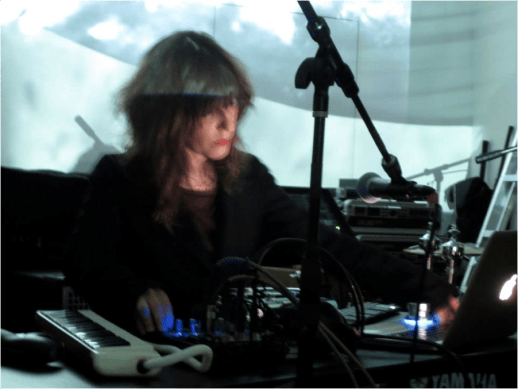
In 2003, working towards my graduate degree in Integrated Media at California Institute for the Arts, I met and worked with a visiting artist by the name of Andrea Parkins, with whom I became a friend and colleague. Although I’ve been familiar with her work for more than a decade, every time I see Andrea perform my mind is blown. And, every time we discuss her practice, her methodology, and her thoughts on art and work, I’m always compelled and inspired in my own practice as a sound artist. In particular, I am impressed by her insights on the relationship between art, play, and the act of improvisation. The interview that follows is both a sampling of the conversations we have been gifted with throughout the years and a rare opportunity to listen in to the creative process of a working sound artist.
1. Hi Andrea, how are you today? What are you in the middle of?
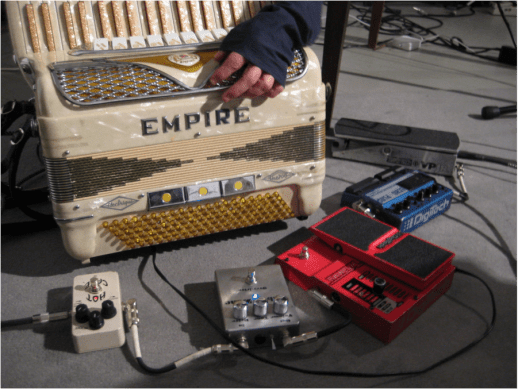
I’m well – working on a number of different projects at the moment, including preparing for a residency at Q-02: workspace for experimental music and sound art, in Brussels, where I’m going to be working on a new multi-diffusion sound piece, addressing the interaction of moving objects with human gesture in idiosyncratic acoustical spaces. I’m also working on some new recordings – one is a catalogue of short pieces, combining electric accordion-generated feedback with processed field recordings; and another incorporates 15 short object-based electronic pieces into a live ensemble work.
2. Can you describe your entrance into the world of sound and music?
I grew up in Western Pennsylvania, acutely aware of the drones and sonic events in the surrounding rural landscape. At the same time my early experience of sound through my teens resided in realm of the “musical” and the social; it connoted family (nearly all of my family members were/are musicians, and music and sound was always present); culture; and musical practice as ritual. Most family members were serious classical musicians, some were rock musicians and singer/songwriters; some were both. I studied classical piano from the age of 6 through my early twenties, and from the beginning had access to and absorbed a wide range of musics– immediately attracted to dissonance, or music with subtle harmonic and timberal changes. After high school, I moved to Boston and studied jazz piano and free improvisation. In my early 20s, I bought an analog synth, and experimented with oscillators and filters, playing synth in punk, free jazz, and new wave bands. Probably most important in my sonic development was that I went to art school and in that context began making experimental films and video, drawings and installation. I believe that my exposure to non-narrative film especially had a profound effect on how I began thinking of compositional possibilities for sound, and about art that happens in time, and also space
3. Speaking of worlds, what is the line experienced, if there is one, between the experimental sound art world and improvisation? How did you find yourself with one foot in each of these worlds, and how do you navigate between them?
While I know that some artists and theorists do draw a line between sound art and improvisational “music” performance, I don’t usually think about it that way, and for the most part that is not how I experience my relationship with sound. Having said this, I recognize that there are communities that identify themselves as one thing or the other, and performance and exhibition spaces that are organized based on one side or the other of this dichotomy, so at times I do have to “navigate between them.” This isn’t necessarily a bad thing: this allows artists to build a common discourse around their particular focus, and can even develop a creative legacy among artists. For myself, I try to think about my intentions regarding a particular installation or performance: especially in consideration of site and audience, and formulate language around this that can speak to the specifics of the situation.
4. And being a woman in these worlds, have you found a difference between when you were starting out and now? Have you found a difference within the generations you work with?
I believe that for younger women, things have changed a lot: peer communities of young artists are more integrated gender-wise, and it seems that there are many more women worldwide are active and visible as experimental musicians and sound artists than when I began. I came “of age” at a different juncture and did not have this experience. To some extent this was because of the class and milieu that I came from, which meant there was no model in front of me. I do think this would have been mitigated if I had learned sooner about some of the female innovators of electronic music, among them: Bebe Barron, Wendy (Walter) Carlos, Eliane Radigue, Maryanne Amacher, Laurie Spiegel, and Pauline Oliveros. This exposure came later.
When I began working as an improvising musician, I found myself on the periphery, and never wholly part of, a group of mostly male colleagues. There were aspects to this experience that I actually now appreciate. It had value because I remained in the position of an outsider, and while I felt some sense of displacement because of this, it allowed me to develop my own critique of whatever prevailing processes and products were happening at that time, and a new assessment of what I wanted to create. I should mention that when working alone or in collaboration in other forms: intermedia, sound and performance installation, I have found that these contexts offer a more inclusive politics and discourse.
5. Something interesting came up in our last conversation that inspired me to change this question around a bit. Instead of asking you to talk about your works, and since our readers can access many different interviews, documents, and articles online, can you talk about how to talk about your work?
This is something I am learning how to do (yet again), as I become more aware that my work engages with multiple practices, multiple voices, multiple processes. It’s about beauty too (that dirty word) – in the sense that beauty (for me) is about viscerality, atmosphere, presence, fragility; this calls my attention to the physical space I am in and to how time is passing: that is to say, to mortality. Most recently I have been seeking different forms of sonic structure that are not based on “history” as forward motion, as a narrative driving through time, but that can allow for stasis, multiplicity, simultaneity, and chaos and acceptance of a potentially forward moving structure to fall totally apart.
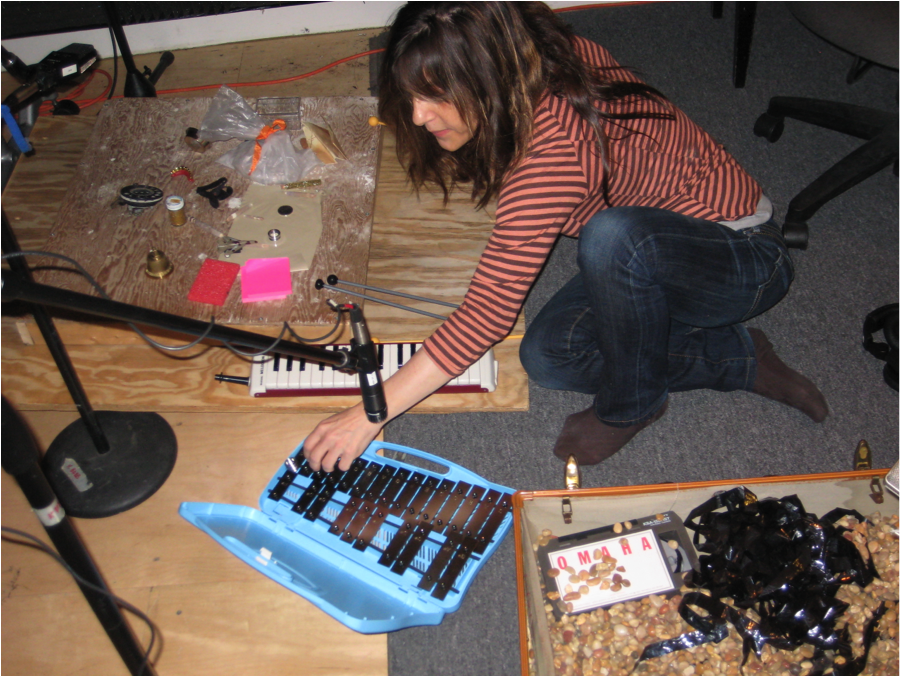
Since 2005, in addition to exploring these modalities as an improviser and composer (for live instruments), I have been working to reintegrate a more interdisciplinary approach to my work – referencing the materiality of objects, and the body in motion, and engaging in wider range of sonic sources and processes, visual elements, and acoustical spaces. This has resulted in my creation of several fixed media works for the gallery/installation setting, as well as some electronic music pieces scored only for objects.
6. The term improvisation confuses a lot of people, and can be hard to articulate. What does it mean to you? And within improv, what does “work” and what does “play” means to you?
Speaking most simply, improvisation is (for me) a series of compositional decisions made in real time that are then immediately acted upon, with acute attention: to self, other, site and context. Being an improviser entails so much listening (to oneself and others, at the same time) and also connecting with others while maintaining one’s own sonic space/language; in a way it’s social and interiorized process at the same time. So it’s work! You are — at times – straining your ears; listening for the clues for what others are “saying,” even if they are not quite saying it. Perhaps this even involves a kind of telepathy. However, at its best moments it can be exhilarating work; there can be lively engagement among fellow performers — or when performing alone when moving among one’s own sonic materials and instruments – that is highly stimulating and fun.

7. Is there a hierarchy of process versus presentation for you?
I often find that my best-laid plans must be jettisoned because I have an idea or epiphany that suddenly strikes me, and it just won’t wait. For me, these “lightening bolts” often quickly resolve into having to face a challenging new work process — challenging perhaps because I have been afraid that somehow it won’t produce a result that I can readily identify as successful. But the old ways will always be there, and in the meantime it is possible that by trying something else, a new discovery will come that transforms everything – including the way I think about what a “successful result” should look like. I now feel that the notion of a “successful result” in itself has become pretty relative, and in some cases, a moot point. This is because what I now define as successful can often have much to do with my assessment of the process I employ in making something, rather than how well I have fulfilled the requirements of a pre-meditated structure: the result. This has made my engagement with my work much more open-ended in a way that I have learned to appreciate over time.
For me, composition mostly happens in the editing: that is where I find (uncover, sculpt) structure from the sound that I collect and/or record, building up a mass of material from which I can “find the piece” through editing, assemblage and layering. I think this is similar to the way some filmmakers might shoot video/film and then from raw footage hone in on or discover a film’s structure via the editing process. I like the idea that instead of filling a pre-ordained structure with content one can move the content around until the structure emerges. Maybe one recognizes the completed structure when one sees it. I like to remember that a structure, even if unusual, asymmetric, messy, seemingly random, or just plain weird – if that is what emerges – is still a structure, howsoever idiosyncratic. And it can be presented.
8. Can you talk about differences between performance vs. play and performance vs. studio to you, and your relationship with the instruments you play?
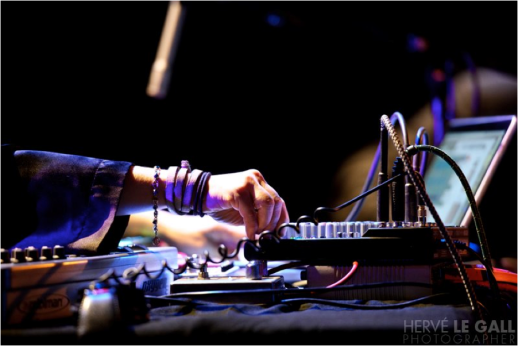
In 2002, I began developing a MAX-based extended processing instrument inspired by Rube Goldberg and his machines. It has built into its programming seemingly “randomized” sonic processing that highlights and/or alters specific frequencies and densities, with emphasis on repetitions, interruptions, stasis and malfunction. When I began working with the instrument, I was exploring processes related to Fluxus in my compositional and improvisational practices. I was also thinking about a kind of poetics that I saw as related to my independent studies in feminist and psychoanalytic theory, and to the body of an improvising performer who is up against the limits of his or her own virtuosity. Once I designed the instrument I realized there really was a connection to these things – and to how approach decision-making as an artist – the importance of chance – but also slippage and failure and moments of physical awkwardness as what I try to accomplish on a technical level comes perilously (and for me, interestingly) close to falling apart – especially when performing with multiple instruments in simultaneity. My virtual instrument is a collaborative partner who doesn’t cooperate. It makes “sense and non-sense,” The slippage and failure relates to meaning, and for me is a metaphor for loss or displacement. For me, this is important … to me this is daily, everyday life.
—
Featured Image Photo Credit: Julia Berg 2010
—
Andrea Parkins is a composer, sound/installation artist and improvising electroacoustic performer who engages with interactive electronics as compositional/performative process, and explores strategies related to Fluxus’ ordered, ephemeral activities. She is a key participant in the New York sound art and experimental music scene, and worldwide she is known for her pioneering gestural/textural approach on her electronically-processed accordion and self-designed virtual sound-processing instruments. Described as a “sound-ist,” of “protean,” talent by The New York Times music critic Steve Smith, Parkins’ laptop electronics and Fender-amped accordion create sonic fields of lush harmonics and sculpted electronic feedback, punctuated by moments of gap and rift. Her work has been presented at the Whitney Museum of American Art, The Kitchen, Diapason, and Experimental Intermedia; and international festivals/venues including Mexico City’s 1st International Sound Art Festival, NEXT in Bratislava, Cyberfest in St. Petersberg, and q-02 in Brussels. Parkins’ recordings have been published by Important Records, Atavistic, and Creative Sources, and her work has received support from American Composers Forum, NYSCA, the French-American Cultural Exchange, Meet the Composer, Harvestworks Digital Media Arts Center, and Frei und Hanseastadt Hamburg Kulturbehoerde. Parkins is on faculty at Goddard College’s MFA in Interdisciplinary Arts program.
—
Maile Colbert is a multi-media artist with a concentration on sound and video who relocated from Los Angeles, US to Lisbon, Portugal. She is a regular writer for Sounding Out!
—

REWIND! . . .If you liked this post, you may also dig:
Wayback Sound Machine: Sound Through Time, Space, and Place— Maile Colbert
Sounding Out! Podcast #15: Listening to the Tuned City of Brussels, The First Night— Felicity Ford and Valeria Merlini
Sounding Out! Podcast #10: Interview with Theremin Master Eric Ross— Aaron Trammell
—
Share this:




Current Top Posts





April 2021

January 2020

November 2019

October 2019

August 2019

April 2014

November 2017

March 2015

December 2017

October 2015


Recent Comments