
From “listening” to “filling in”: where “La Soeur Écoute” Teaches Us to Listen


DOI: https://doi.org/10.59350/70pxh-gfm63
Editor’s Note: Welcome to the second installment in the “DH and Listening” blog series for World Listening Month, our annual forum that prompts readers to reflect on what it means to listen. This year’s forum considers the role of “listening” in the digital humanities (DH, for short). We at Sounding Out! are stoked to hear about (and listen to) all the new projects out there that archive sound, but we wonder whether the digital humanities engage enough with the the notion of listening. After all, what’s a sound without someone to listen to it?
Next week Fabiola Hanna will be reflecting upon what DH means when it talks about participatory practices. Jacqueline Wernimont from the Vibrant Lives team shared with us last week about the ethics of listening to 20th century sterilization victims’ records. Today, Emmanuelle Sonntag introduces us to a figure from a long time ago, “la soeur écoute,” a nun whose was responsible for sitting in and listening when another nun had a visitor. As she reflects on this nun’s job, she senses her notion of listening (especially in the context of the digital) change.
Sit down, fade into the background, and listen closely. Mother Superior will want all the details.–Liana Silva, Managing Editor
—
Who is she?
At the beginning of my doctoral research on listening, while I looked in French dictionaries for the word “écoute” I came upon, almost systematically, the expression “soeur écoute.” For example, this dictionary says “soeur écoute” is a nun who, in a monastery, accompanies in the parlor room another nun who gets visited.
This is how I met this cloistered nun called “la soeur écoute” (literally, “the sister listening”, or “sister listen”, if a literal translation has any sense here). The term is “vieilli” (outdated), as written in the dictionaries, but strangely, they insist on mentioning her again and again, even in 2016 editions. She is a listener, just as you would say, “I’m a librarian”. However I prefer to say “she is listener”, without the “a”, even if it is not proper English. In French, elle est écoute, and believe me, this resonates amazingly. To me, the “soeur écoute” is a fascinating woman because her activity has ceased to exist in monasteries, allowing me to imagine her experience, behavior, life and occupation as a cloistered nun.
Here she is at work. A visitor is knocking on the monastery’s door — can you hear it? The “soeur écoute” welcomes the visitor and leads him/her through the place until they reach the parlor. The room is divided in two spaces by a metal or wooden grille, the sacred one and the secular one. The “soeur écoute” has the visitor sitting in front of the grille, on the secular side of the room. On the other side, the nun who is being visited is already sitting, waiting for the “soeur écoute” to pull aside the curtain that hides the grille. The “soeur écoute” then sits next to the visited nun, slightly in the background. During the conversation, she neither speaks nor moves nor takes any notes. She just listens. When the session is finished, she closes the curtain and leads the visitor to the exit. Later, she promptly reports what she heard to the mother abbess.
The word “écoute” has three moments in its evolution over time (of course with some overlapping). In order: someone, somewhere, something. “Someone” refers to the 12th century (“écoute,” as a person, is attested in France at the beginning of this century), and “somewhere” to the 15th (meaning the place from where you listen). Then, listening considered as “something” (the “thing” you must have to be able to hear attentively) goes back the 19th. In our common comprehension of what listening is, we are now entirely in the “something” part, with no overlapping at all. For my research, the minute I started to look at my “object” as a “person,” my thinking shifted. The “soeur écoute” rung a bell: we are in the “something” timeframe of the notion of listening, and this could blind us in our comprehension of what listening in 2016 really is.
Listening Behind Bars
Firstly, the “soeur écoute” is also called, in some sources, “auscultatrice.” For example, I found a mention (with a missing “t”) of such nuns in a primary source of 1705 concerning the Ursulines de la Congrégration de Paris. The document tells neither how the “auscultatrice” should behave, nor the technical rules to apply, such as the distance between the grille and the visited nun, or the distance between the “auscultatrice” and the visited nun. But it does indicate how the visited nun should behave with her. In the section called “De la manière dont les Religieuses se doivent comporter au Parloir” (How nuns must behave in the parlor), we read:
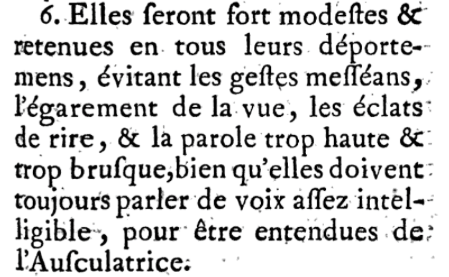
“They will be humble and reserved in their behavior. They will avoid inappropriate gestures, as well as the distraction of sight, bursts of laughing, speaking loudly or impetuously, although they always are expected to speak in an intelligible way, so that the auscultatrice can hear them” (my translation).
The term “auscultatrice” is reminiscent of the very roots of the word “écoute,” the Latin auscultare, a combination of “(…)auris, a word that gives the first part of the verb auscultare,” and “a tension, an intention and an attention, which the second part of the term marks’, as the French philosopher Jean-Luc Nancy explains.
In the case of the Ursulines, it is a paradox, as the word “écoute” had been used since the 12th century, and the expression “soeur écoute” commonly used since the end of the Middle Ages. I suspect a marketing reason here: “auscultatrice” sounds much more strict and in-depth than “soeur écoute,” providing the idea of a pure and original listening, if not conservative.
Second, the “soeur écoute” is part-time. A primary source dating of 1628, in a 1876 book, mentions 25 nuns interviewed about their occupations inside the Sainte-Praxède monastery. Seven among them claim to be or to have been “auscultatrice” (p. 52–54, 193, 198, 212, 234). All of them double it up with another job, such as nurse or organist. Some of them also claim being “auscultatrice de la porte” (auscultatrice of the door) or “auscultatrice du parloir” (auscultatrice in the parlor). The grille, the door and her body (when she strides along the monastery), are her work instruments, her listening prostheses.
Third, the “soeur écoute” appears to have amazing skills. In the Dictionnaire françois, by Pierre Richelet (1680), she is called “tierce”, meaning she is the third element in the triangle of the setting in the parlor, hence, a mediation :

Dictionnaire françois, 1680, p. 448
Also, the plural “ÉCOUTES“ (written in capital, as to demonstrate a precedence on the singular form) : “this word is used to designate people placed to listen and to discover what is happening” (my translation).

Dictionnaire françois, 1680, p. 265
She indeed has an ability to discover what is happening, by watching, observing, monitoring, keeping an eye, but also by aggregating the data she is collecting.
The parlor in motion
As I was writing a few pages devoted to the “soeur écoute” for my dissertation, I stumbled upon an oral history documentary,funded by the Illinois Humanities Council, called Chosen (Custody of the Eyes). As Abbie Reese describes on her website, it is “a collaborative documentary film — a portrait made with and about a young woman transitioning into a cloistered religious community that follows an ancient rule.” Reese explains:
The severity of their lives is striking. During the four visits permitted each year, the nuns and their loved ones are separated by a metal grille and are not supposed to reach through the bars to touch one another.
Today, this order, as others, uses “extern sisters” to provide the link with the outside world.
Intrigued by this grille, reminiscence of the “soeur écoute,” I watched the 8-minute demo and was stricken by two moments. The first one, at 2:20, shows Abbie Reese in the parlor, with a computer, in front of the metal grille. Behind it, one of the cloistered nuns reaches the computer through the bars in order to plug in a cable. At 07:55, this time from the point of view of the Poor Clare nuns, we see the parlor with the grille covered by a green curtain. A nun walks in, pulls aside the curtain. Then, at 08:02, from the secular side again, a nun closes the curtain while saying : “you can turn it off!”.
What did we just witness? A cloistered contemplative nun reached through a metal grille to transfer some video files into a computer. It is here, around this gesture, that I see digital humanities coming into the picture along with listening. Of course I’m not building a case on the cable itself, or on the video files. It is the gesture more than anything else that draws my attention: the exact moment where the nun reaches the computer through the bars.
A surveilled sequence of events
As it comes from the outside world, by definition a visit to the monastery disturbs the extremely scheduled sequence of events and rules giving rythm to the monastery’s life. From this point of view, the “soeur écoute” is the only one, in the enclosure of the monastery, in power of keeping watch (“épier”) on what is around her. In All Ears: The Aesthetics of Espionage (English edition to be released in December 2016), Peter Szendy evokes the “écoute” (as a person) as the one whose job is to practice an auditive surveillance (“celui ou celle qui pratique la surveillance auditive”). Yet here, with this listening nun, we are reaching a listening that is much more than aural.
What does she do as a job? Surveillance? Espionage? I would rather say that her listening is a lookout (“affût”), a sentinel (“sentinelle”) as well as a watch (“guet”) — I have to say here the English language lacks in qualifying precisely those notions. In this regard, Kate Lacey’s explorations around “listening in”, “listening out” and “mediated listening” is, to my understanding, an indication of the difficulty to define “the act of listening.” However, there is another aspect in which the “soeur écoute” appears as unbeatable : her ability to report. I suppose the relevance of the report depended on the visitor, so the nun had to decide whether or not to report to the abbess.
In French, there is a word to designate those who report: “rapporteur/rapporteuse.” When I was a kid, in a French school somewhere in France, being a “rapporteuse” was an insult. As I’m writing this, I suddenly remember the litany that was sung through the school’s playground against the poor one who was accused (I use the feminine here in order to relate with the nun, but it could be a boy of course). It was always “delivered” with the same few music notes and tone, by three, four, five kids, arm in arm, sweeping the playground with this human singing barrier of accusation:
Elle est une rapporteuse ♪ ♫ ♬ Elle est une rapporteuse ♪ ♫ ♬ Elle est une rapporteuse ♪ ♫ ♬ — (She is a tattletale ♪ ♫ ♬ She is a tattletale ♪ ♫ ♬ She is a tattletale ♪ ♫ ♬)
All this to say that the “soeur écoute” reminds us that listening is linked to the act of reporting. In Listen: A History of Our Ears, Peter Szendy underlines listening as being not at all benevolent, the kindly meaning being a very late one in the long evolution of the notion. Quite the contrary, argues the French philosopher and musicologist, listening holds a great amount of perversity. When observing the “soeur écoute”, this is what we see: a woman whose listening is not kind.
She is a tattletale ♪ ♫ ♬ She is a tattletale ♪ ♫ ♬ She is a tattletale ♪ ♫ ♬
Reaching through the bars of the grille
Let us revisit the video at 02:20: observing, again and again, the gesture of the nun with the camera cable. Her body and the grille. Her face and attitude. What she says. How she tries to plug the cable. Her hands and arms. Her fingers. Her way to deal with the grille. The nun is in movement between (and with) those technological objects, digitally ensuring the mediation between both worlds. In Listen, Szendy argues (in an ironic passage of the book, hence difficult to quote) that listening is “a matter of touching.” He stands up for “listening with our fingertips” (in the French edition, slightly different: “l’écoute au bout des doigts”). While doing so, Szendy plays wonderfully with the word “digital.” In French it has two meanings : “digital” refers to the fingers, but also to the digital, like the one of the digital technologies (although more often translated as “numérique”). The “digital” intervention of “sister listener” then takes a new dimension, between fingers and technology.
She is a tattletale ♪ ♫ ♬ She is a tattletale ♪ ♫ ♬ She is a tattletale ♪ ♫ ♬
In All Ears, Szendy highlights listening as a kind of intelligence activity, “activité de renseignement” in French. Yet, “renseignement” also means filling in a metadata, or, if you prefer, a field that describes a digital object. Like the nun trying to plug in the cable. The “soeur écoute” then appears as a figure of a “filling in” processes and practices : while listening, she also informs, and in-forms.
The grille and the grid
I just read the fascinating story around a visit in a cloistered monastery close to my home in Montréal. Again a grille. Again a green curtain. This time though, the nuns reach easily through the bars, shaking hands. Nuns have the internet. They know how to catch the rumor of the world, if they wish to.
My partner told me recently: “it seems you are building a case on someone whose job does not exist anymore to reflect on something very contemporary, the digital.” Yes, it is exactly that. This is what is so liberating with the “soeur écoute.” And no, it is not exactly that, my dear: I’m not sure she does not exist anymore. What if a little bit of a “soeur écoute” would be in all of us? In other other words, what if the way she listens would inform how we listen today, making the connection between listening as person (the “someone”), listening as place (the “somewhere”), and listening as object (the “something”)?
I see the “soeur écoute” as a reading grid, or framework, which forces to rethink listening and its role. Reaching through the bars, she helps expand the study of listening beyond its sonorous contours. She encourages to consider listening in order to include the non-sonorous aspects of “keeping watch” and “sentineling”. Going from one world to another, from one side to another, pulling aside curtains, she urges us, “researchers of listening”, being “tierce” and part-time in our methods and attitudes. Even if it has to go such as far as considering listening as a counterpoint to sound. After all this, maybe, starting to auscultate the relationship between listening and digital humanities.
I have to go. I have put Listening under custody. I have a cable to plug, and a report to write.
I am a tattletale ♪ ♫ ♬ I am a tattletale ♪ ♫ ♬ I am a tattletale ♪ ♫ ♬
Featured image: FreeImages.com/Michael P***
—
Emmanuelle Sonntag defines herself as a “knowledge organizer.” She offers consultancy services in communication, education, curriculum design, information management and knowledge mobilization while pursuing her PhD in Sociology on… Listening at Université du Québec à Montréal. She tweets on listening, sounds, stories and other noises @lvrdg.
—

REWIND!…If you liked this post, you may also dig:
Reflective Sound Gathering via the New England Soundscape Project–Daniel Walzer
“HOW YOU SOUND??”: The Poet’s Voice, Aura, and the Challenge of Listening to Poetry–John Hyland
“An Ear-splitting Cry: Gender, Performance, and Representations of Zaghareet in the U.S.“-Meghan Drury
—
Share this:

(Sound)Walking Through Smithfield Square in Dublin

DOI: https://doi.org/10.59350/pywqa-vdt14
Editor’s Note: This month Sounding Out! is thrilled to bring you a collection of posts that will change the way you hear cities. The Sounds of the City series will prompt readers to think through ideas about urban space and sound. Are cities as noisy as we think they are? Why are cities described as “loud”? Who makes these decisions about nomenclature and why?
We kicked things off last week with my critical reading of sound in Lorraine Hansberry’s A Raisin in the Sun, a play about African Americans in Chicago that still rings/stings true today. Regular writer Regina Bradley will discuss the dichotomy of urban and suburban in the context of sound (noisy versus quiet, respectively), and CFP winner Lilian Radovac will share with us a photoessay on the sound installation Megaphóne in Montreal. Today, guest writer Linda O’ Keeffe takes readers on a soundwalk of Smithfield Square in Dublin, Ireland and specifically of the Smithfield Horse Fair, in order to illustrate how urban renewal disrupts city soundscapes and how sound reclaims those spaces.–Managing Editor Liana M. Silva
—
Since 2010, as part of my PhD research, I have conducted over two dozen sound walks through the Smithfield Square and its environs, in Dublin’s North Inner city; with teenagers, by myself and through organising deep listening group walks as part of World Listening Day. These walks were designed to encourage the participating walkers to listen intently to this space and compare it to other spaces on the north side of Dublin city. The walks were also designed to examine the changing use and design of the Smithfield space over the past four years. This essay is drawn from the findings of this research, which explored the co-production of space and soundscapes with 84 teenagers (43 girls and 41 boys) from Dublin, Ireland. I include some of their observations of Smithfield Square here.
The Smithfield Square’s redesign began in 1996 as part of an urban regeneration project, and was completed in May of 2013. Smithfield is a traditional working class area, historically connected to wholesale markets, and in recent years it has gone through many iterations. In a push towards gentrification, the Smithfield Square space was ripped up, rebuilt, re-imagined and ripped up again because each iteration of its design proved unattractive to potential visitors/users of this space. According to the Royal Institute of the Architects of Ireland (1991), Dublin City Council considered these users were tourists and new middle class urbanites, not the locals.
Large-scale apartment complexes with business premises on the ground floor, tourist facilities, and an art house cinema were situated alongside smaller, older social housing, flat complexes and wholesale markets within the area. This reshaping of architecture impacts the diffusion of sound in space. It changes what Brandon LaBelle (2010) calls the acoustic territories that demarcate space where sound is no longer attributable to specific spaces or communities. Additionally, since the early 1990s, sounds within Smithfield began to change with the removal or downsizing of certain productive practices, such as the fish and fruit markets. This reduced the kind of traffic, both pedestrian and commercial, which would have moved and sounded through the area. The Smithfield Horse Fair disrupts the area’s soundscape and opens up the possibilities of the space of Smithfield Square for the broader community.
The design of the square, its restaurants, boutique shops and cafes, suggest that the soundscape designed for this space was meant to be a quiet and calm, recreating in the square what Karin Bijsterveld has defined in Mechanical Sound (2008) as the quiet of the middle classes. The sounds produced by the fair are then seen as counter to the types of sensory experiences that, Monica Montserrat Degen argues in her book Sensing Cities: Regenerating Public Life in Barcelona and Manchester (2008), are acceptable to the middle classes, who purchase a type of sensory/sonic experience. However, the soundwalks I describe contest what “quiet” means in the context of the square.
Listening to the Square
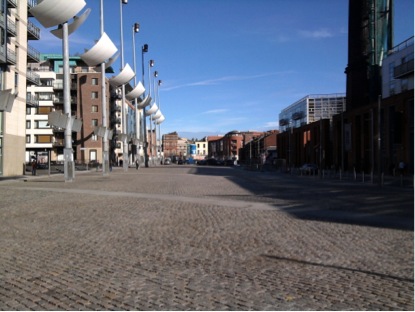

In 2009 the Smithfield Square, which is laid with thousands of cobblestones, had placed around one side twelve 26.5 metre gas lighting masts, at one end of the square two lines of trees were planted with seating placed among them, and at the other end some large concrete plant pots. The seating located within the trees, attracted groups of homeless people and addicts. As a result, the dominant soundscape during the day was the sounds of men and women shouting obscenities at each other, with the susurration of trees rarely heard over this dominant sound. One of my teenage participants noted, “you always hear people screaming in the background” (Participant 2).

Aside from the shouting voices and loud reflections from singular sound sources within the Square such as the clatter of suitcase wheels across the cobblestones, seagulls screeching overhead, the beeping of trucks reversing and even the sounds of people talking at a distance, the teenagers who participated in the soundwalks defined the space as silent. Their use of the word silent did not mean the absence of sound, but rather an absence of activities, life, general sounds of community, consumption and production.
One sound that dominates the soundscape of Smithfield and its surroundings is the sound of the Luas tramline. The Luas line sits at one end of the Square and the sounds produced are distinctive: there is the whoosh as it passes, the ding a ling of its bells and the sounds of the doors opening and closing. The sound of the Luas echoes around the area from 6 in the morning till midnight. The sounds have become synonymous with that part of the city. The teenage participants defined these sounds as rhythmic, musical, “like a ballet.” For the teenager participants, the sounds of the Luas has been the only constant sound within Smithfield.

The sounds of children and teenagers were absent, even with the vast housing areas that surround Smithfield Square—some dating back to the 1940s. Within five minutes of the square are two primary schools and one all-boy’s secondary school. During the day, I would hear the children playing in the school grounds, and in flat complexes close to the Smithfield Square. Each of these spaces were gated and enclosed. Most of the teenage participants lived within such housing areas, and would often refer to the level of noise made by the children within their immediate housing areas. Yet, none of the teenagers, and no young children, used the Smithfield Square for “hanging out” or playing.

The teenagers argued that the Smithfield Square had no point; it was too wide open and too quiet.
Group 11b: Although, there probably was sound for somebody who listened to it but because we were all coming down from the city, the space seemed to be nothing… it just seemed real quiet, empty.
Because of that, the teenagers felt they could not group together to chat. For them, it would be like situating themselves in the middle of a stage. Their sounds were amplified or reverberated, ironically creating a feeling of being surveilled. They felt more comfortable and safer in confined areas, such as street corners, laneways, and the archways of large buildings. Within these smaller spaces, the sounds produced have closer reflections. Teenagers often surround themselves with sounds by shouting, playing music, etc., creating what Barry Blesser and Linda-Ruth Salter in Spaces Speak, Are You Listening? (2009) call a sonic bubble. These “territorial bubbles appear as if by magic around a group of individuals if they begin to interact, and the group quickly acquires rights to the arena” (2009:34) thus creating a temporal space. They did not feel they could do so in such an open area.
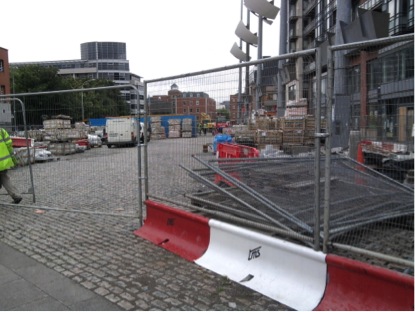

Because of the poor planning and design of the Smithfield area, there are vast empty spaces surrounded by fencing or construction hoarding, numerous derelict buildings, and closed-down shops and restaurants. The Smithfield Square is no different, with numerous buildings left empty as a result of foreclosures or bankruptcy. The silence in this space is indicative of the loss of the social and economic processes. The vast square then takes on another level of silence, the loss of productive meaning, the presence of poverty, homelessness and unemployment.
On one walk with the teenagers I noted that they would group together in the square, even when they were told to walk around and record sounds within the space independently. Later, they said there were no sounds to record, so they just walked towards the closest sound source, a small shopping market in the square. I had noted numerous individual sounds, but they would have required standing in the middle of the square to record them. During focus group sessions after the soundwalks, the teenagers defined positive soundscapes as places with numerous loud sounds, the voices of hundreds within busy shopping streets, music coming from stores and traffic in the distance. These sounds defined a city, and made the teenagers feel safe and enclosed. Smithfield contained none of these kinds of sounds.
Soundwalking the Smithfield Horse Fair

There are a few events held regularly within the square since it re-opened in 2013. Some of these events are part of the Dublin City Council’s efforts to invigorate the space, such as food and art markets, as well as fairs for various seasons and holidays. One of the few public events that take place in Smithfield Square is the Smithfield Horse Fair, which happens on the first Sunday of every month. Having walked through this space repeatedly over a period of 3 years, it was only when I attended the horse fair that the space came alive, it had a purpose.
The horse fair has been a contentious event for both locals and city managers for the past two decades, with the horse dealers arguing that there is either a historical precedence for the horse fair or with the Dublin city councillors arguing that the land was historically used for the selling of cattle for market. The appearance within the Smithfield Square once a month of the horse fair brings with it a vast and lively, and sometimes, as defined by the media and Dublin City Council, a threatening soundscape/environment.
Some sounds defined as threatening are the loud whinnying of horses as they are jostled around the fair. The media has also reported, on several occasions, large-scale fights, which have broken out during the fair, leading to the presence of riot police. This eventually led to the gating of the fair and an extreme police presence as if these measures might reduce such sounds through the threat of arrest. For those living in the new apartment complexes, the sounds produced at the fair are amplified because of the design of the space, and possibly sound more threatening as a result.
During one walk of the Smithfield horse fair that I did in April 2013, some of the audible sounds were horses neighing and whinnying in panic, horse shoes on the cobblestones, traders shouting out their wares of horse paraphernalia, seats, stirrups etc., the voices of old men, which was the dominant background sound, and the sounds of traditional Irish music.
Outside of the gated fair were the sounds of large groups of teenagers, shouting and calling to each other. The space was alive with sound; the voices of teenagers merged with, or were lost within, the chaos of other sounds, becoming part of a larger soundscape. Because the space was busy with people, activities, music and even security there was a reason to use the square, even if you were not actively taking part in the event. The fair created a space for teenagers to engage with, and perhaps feel safe within the boundaries of its soundscape. Suddenly the square was as busy and as loud as the city centre.


While walking through this soundscape, I encountered different kinds of soundmarks. For example, the banging of horseshoes was quite distinctive because it is, as Schafer would define, an archetypal sound, one that no longer belongs in the city. It felt like hearing a sound from the past. Yet this kind of sound creates a kind of historic continuity with the past (Barry Truax, Acoustic Communication, 2000). When discussing the cobblestones within Smithfield Square, most of the young female participants stated that it was not so much the look of the cobblestones that gave the space a sense of history but rather the sounds made when something moved over them. The lack of people and activities within the square meant that these sounds were rarely activated. The soundscape of the fair on those days transformed Smithfield, lifting it out of its everyday silences, which seemed to invite young people to participate. It was reactivated with life.
What was noticeable about the two fairs I visited was that by the second event in 2013, there were far fewer horses than at previous fairs. There were about 8 or 10 horses being paraded around the space by what looked like homeless people or addicts. There seemed to be no real horse-trading; the soundscape lacked the sounds of horses. Instead, the space had become a gathering space, with groups of tourists wandering around taking pictures of anything and everything.


Conclusion
This fair does not fit within the cultural ethos of regenerated urban spaces like Smithfield, where culture is defined as a consumerist process or part of the arts. However, the space takes on new potentialities as a result of the presence of people, sounds and activities, allowing the teenagers to view the possibilities of spatial use. Sounds can distinguish a space, as identified during the Smithfield horse fair. These sounds also remove focus from teenagers’ voices audible within the space, and transfer it to other sounds. The space was no longer a large fishbowl viewable from any angle; instead it had become a busy vibrant immersive soundscape.
—
Featured Image: “Smithfield Horse Fair, Dublin” by Flickr user Admanchester, CC BY-NC-ND 2.0
—
Linda O Keeffe is secretary to the Irish Sound Science and Technology Association and editor of the Interference Journal. Her practice is concerned with an exploration, both academic and creative, of the ways in which sound alters our experience of different spaces. Her art training was within the sculpture department of IADT under the tutelage of Finola Jones. She completed a Masters in Virtual Reality in NCAD with Kevin Atherton, and just finished a PhD in sociology in NUIM. Her research examined the urban of Dublin city soundscape as socially and technologically co-constructed. She has composed for dance, theatre, quartets, and new instrument performers, installed sound installations for commissions in Ireland, China and Holland, and has had radio works performed both nationally and internationally. In 2008 she mentored under Eric Leonardson in Chicago, a sound artist and performer. More recently, she was commissioned by Resonance FM to create a work for radio for the 2013 Derry city of culture event. Current projects include a solo exhibition in November 2014 for the Limerick Sculpture Centre, which will be a creative realization of her PhD research. You can find her at www.lindaokeeffe.com.
—

REWIND!…If you liked this post, you may also dig:
“Heard Any Good Games Lately?: Listening to the Sportscape”-Kaj Ahlsved
“Park Sounds: A Kansas City Soundwalk for Fall”-Liana Silva
“Sounding Out! Podcast Episode #7: Celebrate World Listening Day with the World Listening Project”
—
Share this:




Current Top Posts





April 2021

January 2020

November 2019

October 2019

August 2019

April 2014

November 2017

March 2015

December 2017

October 2015


Recent Comments