
Sounding Out! Podcast #38: Radio Frequencies, Radio Forms LIVE


.
CLICK HERE TO DOWNLOAD: Radio Frequencies, Radio Forms LIVE
SUBSCRIBE TO THE SERIES VIA ITUNES
ADD OUR PODCASTS TO YOUR STITCHER FAVORITES PLAYLIST
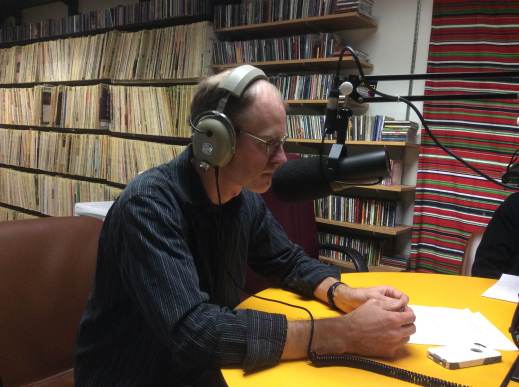
Today’s podcast is an archival recording of “Radio Frequencies, Radio Forms LIVE,” a special program on WHRW, Binghamton University’s free-format radio station, broadcast on December 15, 2014 from 6:00-7:30. Part original radio art broadcast and part “Behind the Artists’ Studio” conversation, “Radio Frequencies” represents the culmination of a semester-long experimental collaboration between Professor Jennifer Stoever (BU English) and Filmmaker, Sound Artist and Professor Monteith McCollum (BU Cinema) and the students of their advanced transdisciplinary seminar “Resonant Frequencies: Exploring Radio Forms.”
Over the course of the Fall 2014 semester, students learned the fundamentals of recording and editing while discussing radio history, sound production, sound art history, and theories of sound and listening to copious (and diverse) radio pieces ranging from Aimee Temple McPherson sermons to Norman Corwin’s We Hold These Truths, the Suspense episode “Sorry, Wrong Number” to Delia Derbyshire’s “The Dreams.” McCollum and Stoever’s students were creative, interested, driven and exceptionally talented; two from the course, Tara Jackson and Aleks Rikterman, went on to have some of their semester’s work featured in the 2014 Mix for Wavefarm’s annual 60 X 60 competition, the only two students alongside seasoned arts professionals, professors, radio producers, and Prix Italia Winners.
The WHRW broadcast features well-crafted recordings of the course’s capstone project—4 collaboratively developed original 8-10 minute radio pieces—alongside fascinating live discussions between Monteith, Jennifer, and their students about radio as medium, broadcast vs. performance aesthetics, the process of recording, manipulating, and editing sounds, the students’ radio influences, the role of the listener, the value of radio’s past and their forecasts about its future. This podcast is a must listen for anyone interested in radio production and history, creative pedagogy, conversations about sound art, or just interesting and unexpected listening!
Credits:
- “Amarilli,” a suspenseful radio drama scripted, performed, recorded, edited, and mixed by Maggie Leung, Hyucksang Sun, and Daniel Hong.
- “The Parlor City,” interwoven radio-verite stories about Binghamton, NY conceived, recorded, edited, and mixed by Yang Gao, Daniel Santos, and Ashley Verbert.
- “Untranslatable” an artistic sono-montage piece about language conceived, recorded, performed, edited, and mixed by Tara Jackson, Anna Li, and Michael Ederer.
- “Pura Vida: Solo Travel” a documentary interview montage conceived, recorded, scored, edited, and mixed by Aleksandr Rikterman and Garrett Bean.
Hosts and Executive Producers: Monteith McCollum and Jennifer Stoever
Opening Interview: Daniel Santos
WHRW Engineer: Tara Jackson
WHRW Program Manager: Daniel Kadyrov
McCollum and Stoever’s course was made possible by a generous transdisciplinary team-teaching grant from the Provost’s Office at Binghamton University, with thanks to Provost Don Neiman and Don Loewen, Vice Provost for Undergraduate Education
–
Monteith McCollum, Assistant Professor of Cinema at Binghamton University, is an inter-media artist working in film, sound, and sculpture. His films have screened at Festivals and Museums including The Museum of Modern Art, Hirshhorn, Wexner Center for the Arts and Festivals including SXSW, Slamdance, Hot Docs, Amsterdam & Osnabruck European Media Arts Festival. His films have garnered dozens of festival awards including an IFP Truer than Fiction Spirit Award. You can learn more about his work at monteithmcollum.com.
Jennifer Stoever is co-founder and Editor-in-Chief of Sounding Out! She is also Associate Professor of English at Binghamton University and a recipient of the 2014 SUNY Chancellor’s Award in Teaching.
—
 REWIND! . . .If you liked this post, you may also dig:
SO! Reads: Susan Schmidt Horning’s Chasing Sound: Technology, Culture, and the Art of Studio Recording From Edison to the LP – Enongo Lumumba-Kasongo
Sounding Out! Podcast #34: Sonia Li’s “Whale” – Sonia Li
Sounding Out! Podcast #10: Interview with Theremin Master Eric Ross – Aaron Trammell
Share this:

Of Sound Machines and Recording, Sharing that Transcends Time and Space

This is the conclusion to a two-part post by SO! regular writer Maile Colbert. Read Part One from Monday, January 12th here.
—
As we are primarily a visual culture, no longer connected to what environments can tell us through sound, we’ve lost aural acuity once central to the dynamic of our lives.
From what we have just begun to see, it appears that ancient human beings had learned well the lessons imparted by natural sounds. Their lives depended as much (if not more) on their ability to hear and understand the audio information imparted by their surroundings as those given by visual cues. –Bernard Krause, Ph.D The Soundscape Newsletter 06, June, 1993
Birth
All newborns emerge with the same cry, it is near impossible to distinguish one from another, even as a mother. This could be for many reasons and serve many purposes. Should something happen to a birth mother, the indistinguishable cry may help draw attention from another. It could be that, considering niche effect (in which animals adapt their calls to a frequency less populated by other environmental sounds), aside from biological reasons, a newborn’s cry is shaped by the wombscape from whence it came, and I speculate that generally speaking one wombscape is similar to another. Primarily what a fetus is hearing is low frequency. So it would serve that they would have an instinct to initially call out in a high frequency range. The baby then develops its cry according to its surrounding, such as a household in the city versus a country, a household with other children or not, a household with constant media sound.
My daughter has the most incredible earsplitting high frequency bark when she wants attention. If this doesn’t work (such as when “Baby, Mama has to wash the garden manure from her hands before she picks you up”), she’ll roll into a gritty horrific low growl that sounds like she’s being strangled. One of these always works, and I often wonder about these sounds’ relationship to the white noise (her specific mix in a more mid-range involving pink noise and a “rain on roof” recording) that has been a constant since her birth, and is still used for naps, some feedings, and bedtime.
Sound Machines and Noise
From my late pregnancy insomnia, to creating a calming environment in the labor room at the hospital, to keeping a consistent calming environment in the recovery room, to using that sound as a signal that it is time to calm, time to sleep…a sound machine has been a constant already in my daughter’s new world. It started with an app in Paris, at a festival during my third trimester, my waddling condition wouldn’t allow me to walk around much nor meet friends for drinks, etc. So I choose to stay in the hotel room and read. The fetal babe wasn’t in the mood to read, kicking and dancing, perhaps excited from the music at the festival. For a little while I played with her, her kicking in response to my pokes and prods. But soon I knew we both needed to both settle down. I was always fascinated by my parents’ sound machine as a child, it seemed something magical. I found and downloaded an app that allowed you to create your own mix, and so it began.
But recent research poses the question of whether a sound machine can actually affect hearing development. Some researchers have questioned if prolonged exposure to consistent sound could affect auditory pathways to the brain. I wonder what then of infants who grow up near, say, the ocean…or like my mother near a stream and small waterfall, a constant sound in her childhood and soundtrack to her memories from then. Or near a busy road or even walkway. Of course I want the babe to grow up to enjoy and focus on a varied soundscape. But at certain points, the noise has been a lifesaver! It’s been especially useful now combatting construction sounds, as babies tend to focus on background sounds, most likely for survival:
.
Of course it is very important to be aware of the strength of the sound a baby is exposed to, all too easy for our very visual culture to ignore. Even a sound machine with the volume too high, or the proximity too close, could reach decibels over 80, a threshold that could cause the tiny hair cells in the ear needed for hearing to die. As we lose these, we start to lose our hearing. The amount of energy in a sound doubles with even just a three decibel climb. If any sound makes it difficult to hold a regular conversation, chances are it’s past this threshold and could be doing damage. Our world is in many ways getting increasingly louder. As our cities grow, its sounds grow, and we are exposed to more constant and louder soundscapes. Will an accidental evolution be for us to adapt to losing our hearing? For me of course, this is a very bleak thought.
Death
Your words are preserved in the tin foil and will come back upon the application of the instrument years after you are dead in exactly the same tone of voice you spoke in then. . . . This tongueless, toothless instrument, without larynx or pharynx, dumb, voiceless matter, nevertheless mimics your tones, speaks with your voice, speaks with your words, and centuries after you have crumbled into dust will repeat again and again, to a generation that could never know you, every idle thought, every fond fancy, every vain word that you chose to whisper against this thin iron diaphragm.
-Edison’s Ars Memoria, concept for the phonograph

Kaua’i `O’o, extinct since 1987
A recorded sound transcends time. It allows a listener to share a space and perspective with the recordist. It allows a future people to hear the songs of people passed, and of their shared past. It allows for an extinct bird to call into the future, for a child to hear that bird and wonder, and question, and to have that question affect her future and therefore perhaps the future of others. I often think about what soundscapes or sound I have experienced that my daughter might not have the opportunity to experience when she’s older. Already since my childhood growing up in part in Hawaii, three birds I knew, I had heard, that my mother grew up with, that her father grew up with, that his parents grew up with (and so on)…are no longer calling in the wild. But what the world and I can share with her and her generation, can give her, can leave her, are recordings.
Kaua’i `O’o: http://macaulaylibrary.org/audio/6031
Po’ouli: http://macaulaylibrary.org/audio/5125
Hawaiian Crow: http://macaulaylibrary.org/audio/13434
The library I am constantly creating, shaped by my choice and perspective…where to hit start, when to stop, where to point the mic, what equipment to use, how to frame this aural moment that captured me and invoked the desire to save and to share.
I think of this very often these days, as a friend and great soundscape ecologist and composer has passed. Steve Miller (www.stevemiller.net ) left a wealth of music, sound, and writing that his daughter and family can share. His daughter will be able to put on headphones and share a space her father formed with his perspective, his choices, his interests. A sharing active with him.
A sharing that transcends time and space.

The artist and her daughter in the studio, Image by JS
.
Future Memory, for Odette
Sound has a hold over my daughter in a way I wasn’t quite expecting. It’s almost a punch line that the daughter of two parents that work with and study sound would have such sensitivity. The smallest sounds can pull her from sleep, can pull her from eating. They can be a character for her, making her laugh, cry, yawn, widen her eyes in amazement.
It was only natural my partner and I decided to make an album as a gift to our daughter. We had wanted to do the same marking our history together years back, and had various sound recordings and unfinished ditties in a library marked “Future Memory.” The idea behind it was an aural coming together of our history and feelings expressed and translated through sound and song. We realized, of course, in many ways this was Odette’s history as well, and she our future.
The album became Future Memory, for Odette, a lullaby album in dedication and celebration to her, and including sounds from her growing in the womb, soundscapes we hope will be a part of her life, and in recording them in some way ensuring that, a score written for her while I was in labor from a friend, songs her father and I began and finished together during the stages of pregnancy, birth, and her first year, and collaborations and contributions in sound and music from family and friends would be her legacy.
This is her first song:
—
Dedicated to Odette Helen, and to the family, daughter, and memory of Steve Miller
“Future Memory, for Odette” to be released in 2015 through Wild Silence (www.wild-silence.com ). A dedication album to a new born daughter…a mix of her parents’ recorded and shared sounds, memories, hopes, and dreams towards a future with her. Sounds of her womb-scape, birth, and first year…music in collaboration with friends and family across oceans and land…an album of lullabies for Odette.
—
Maile Colbert is a multi-media artist with a concentration on sound and video who relocated from Los Angeles, US to Lisbon, Portugal. She is a regular writer for Sounding Out!
—
REWIND! . . .If you liked this post, you may also dig:
On Sound and Pleasure: Meditations on the Human Voice– Yvon Bonenfant
This Is Your Body on the Velvet Underground– Jacob Smith
Sound Designing Motherhood: Irene Lusztig & Maile Colbert Open The Motherhood Archives– Maile Colbert
Share this:


Current Top Posts





April 2021

January 2020

November 2019

October 2019

August 2019

April 2014

November 2017

March 2015

December 2017

October 2015
 Sounding Out!
Recent Comments