
Poptimism and Popular Feminism

Almost 20 years ago, 2 Many DJs and Freelance Hellraiser each released too-clever mashups that laid R&B pop diva vocals over indie rock instrumentals, revealing that the paired songs had exactly the same compositional structure. The former’s “Smells Like Booty” put Destiny’s Child together with Nirvana, and the latter’s “A Stroke of Genius” combined Christina Aguilera with The Strokes. The mashups were clever because they flouted supposedly commonsense views that these these pairings shouldn’t work: how could something as superficial, formulaic, and, frankly, girly as Destiny’s Child and Aguilera have anything in common with something as serious and aggressive as Nirvana and The Strokes? Writing in 2009, Dorian Lynskey explained that “A Stroke of Genius came out when many indie fans still believed that manufactured pop stank of evil and death, and the idea of Christina Aguilera and the Strokes in perfect harmony was strange.” Note Lynskey’s use of the past tense: by 2009, the gatekeepers of elite musical taste generally agreed that commercial, chart-oriented music whose fans were at least thought to be mainly teen girls and/or gay men could be just as artistically valuable as rock and hip hop.
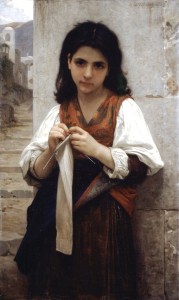
“Tricoteuse” by William-Adolphe Bouguereau (1825-1905), Public Domain
That consensus has a name: poptimism. Poptimism upends the hierarchy between rock (and sometimes hip hop) and pop, which is a contemporary variation on a very old hierarchy that privileged fine art over craft. Back in the 18th century, philosophers like Immanuel Kant invented the idea of “fine art” by distinguishing it from craft: craft is subordinate to utility (you don’t want your coffee mug to leak), but art exists for its own sake (think of how unwearable some high fashion is, or of Rosemarie Trockel’s art sweaters). As many feminist art historians have argued, this art/craft hierarchy conveniently maps onto patriarchal gender hierarchies: art, like men, is autonomous, whereas craft, like women, are subordinate to daily needs; art is productive, craft is reproductive. For example, art historians Roziska Parker and Griselda Pollock have shown that there is an “intersection in the eighteenth and nineteenth centuries of the development of an ideology of femininity…with the emergence of a clearly defined separation of art and craft.” The conceptual and institutional structures that confined women to reproductive labor and craft into the service of life’s reproductive needs were manifestations of the same underlying gender system.

“Jennifer Lopez | Pop Music Festival | 23.06.2012” by Flickr user Ana Carolina Kley Vita, CC BY 2.0. A Google image search of the word “pop music” listed this image as one of the top images.
This same system informs the traditional rock-over-pop hierarchy. In her 2001 article “Feminist Musicology and the Abject Popular,” Susan Cook argues that “‘the popular’…has been so thoroughly feminized” and “carries with it a staggering cultural baggage, a trunk full of social codes that have been historically attached to womankind and underprivileged men.” In the latter half of the twentieth century, the distinction between rock and pop was largely grounded in the same gender system that organized the art/craft hierarchy: rock embodied all the values and characteristics of ideal masculinity, and that’s why it was superior, whereas pop embodied all the values and characteristics of ideal femininity, and that’s why it was inferior. In the early 2000s, poptimism revises this gender script, putting “thoroughly feminized” pop on an equal playing field with rock. However, instead of more-or-less uncritically cheerleading for pop and/or pop stars, we should be thinking about the institutions and conventions that dole out artistic status.
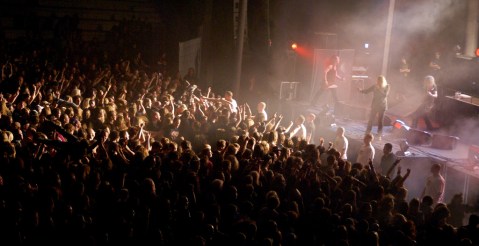
“Rock Hard Open Air 2009” by Flickr user Elena, CC BY-NC-ND 2.0
Kelefa Sanneh’s 2004 article “The Rap Against Rockism” brought the fact of rock-conceived-as-art to the general public’s attention. “Rockism” is the idea that rock music is the only kind of commercial recorded music that has artistic merit. According to Sanneh,
rockism isn’t unrelated to older, more familiar prejudices…The pop star, the disco diva, the lip-syncher, the “awesomely bad” hit maker: could it really be a coincidence that rockist complaints often pit straight white men against the rest of the world? Like the anti-disco backlash of 25 years ago, the current rockist consensus seems to reflect not just an idea of how music should be made but also an idea about who should be making it.
Grounded in the idea that rock is superior because it is both made by and for white dudes and expresses the stereotypical features of elite white masculinity, rockism upgrades the gendered (and raced) logics of the fine art/craft distinction into 20th century terms. Meanwhile, poptimism revalues the aspects of pop music that were traditionally de-valued because of their association with stereotypical (often white) femininity: pop is hugely collaborative and rarely written by lone authors; it prioritizes pleasure over deep meaning, beauty and spectacle over substance; its music and its ideas are supposedly simple rather than complex…you get the idea. (Ethnomusicologist Elizabeth Keenan-Penagos explains the gendered implications of poptimism in more depth in this piece about the role of misogyny in critiques of poptimism.)
Sanneh’s article kicked off this millennial round of poptimism, but poptimism’s basic ideas and values go all the way back to the 19th century (which is much later than Michael Kramer argues here). Friedrich Nietzsche’s critique of German composer Richard Wagner uses the same basic framework we now call poptimism: Wagner, he argued, was too concerned with deep philosophical meaning and not enough with the beauty and pleasure of the sounds. Saying things like “music is a woman” and that Italian opera is superior to German opera because it’s prettier and more fun (see The Gay Science sections 77-80), Nietzsche also recognized the gender and race dynamics of poptimism: by 19th century standards Italians weren’t fully white, so his prioritization of Italian over German opera subordinates white highbrow culture to not-really-white middle-to-lowbrow culture. In Nietzsche Contra Wagner, he makes his preference for light, unserious art over high culture quite clear. There, he contrasts the “hubbub…with which the ‘cultured’ man and the man about town allow themselves to be forced through art, literature, music, and with the help of intoxicating liquor, to ‘intellectual enjoyments’” with the “nimble, volatile, divinely undisturbed, divinely artificial art, which blazes up like pure flame into a cloudless sky” (emphasis mine). This contrast flips fine art/craft hierarchies and argues that things traditionally devalued as feminine, such as superficiality or sensory pleasure, are artistically superior to all the values commonly attributed to fine art, such as intellectual depth. Though he called it “the joyful wisdom” (die frӧliche Wissenschaft, often translated as The Gay Science) instead of “poptimism,” the later Nietzsche’s music aesthetics articulates the same basic theoretical commitments that inform 21st century poptimism.
 The basic idea of poptimism has been around since the late 1880s, but it took more than a century to really take off. In the decade after Sanneh’s article, there was a poptimism bubble: it rose to huge popularity, especially with the publication of Carl Wilson’s 2007 book on fans of cheesy pop music. That bubble started to burst about 9 or 10 years after that book appeared as critics began to sour on poptimism. Though it was initially understood as a radical upheaval of the powers that be, by 2017 poptimism had been co-opted by those powers. Instead of challenging patriarchal gender systems, poptimism reinforced them. Writing in The Quietus, Michael Hann argues that “Poptimism, in practice, has not meant championing those who do not get the acclaim they are due, so much as celebrating the position of artists who don’t need their genius proclaimed” such as Beyonce or Taylor Swift. The oft-noted death of the negative album review suggests that [p]optimism is now the orthodox practice among music critics. (This also coincides with recent trends in academic literary theory, which prize “reparative” readings over critical ones.) Such concerns have led Rob Harvilla to pose the rhetorical question “Have we reached the end of poptimism?” because what began as a feminist revolt now feels like an expectation or obligation to stan for the already powerful, such as corporations and megastars. Hann and Harvilla observe a change in poptimism, at least as it is practiced in the music media and industry: poptimism feels less like rooting for undervalued and underrepresented women and more like cheerleading for The Man. Harvilla speculates about poptimism’s end because this corporate poptimism betrays the movement’s original ideals and values.
Why did the poptimism bubble happen when it did? There were many contributing factors, such as the rise of what sociologists Richard Peterson and Roger Kern call “omnivorous taste,” which is the idea that elites prefer both traditional highbrow culture and a range of lowbrow forms, a.k.a. “I like everything but [usually country or hip hop].” Evolutions in feminist media and activism are another central cause of the poptimist bubble. Because pop is an inherently gendered category defined by its feminization, poptimism’s evolution is closely tied to feminism’s. The poptimism bubble roughly coincides with the period when feminism broke the mainstream and mutated into popular feminism.
This is more than just a correlation or coincidence. “Pop” is a gendered category, so its evolution is inextricably tied to evolving gender norms and politics. Poptimism emerged at the dawn of a broader “woke” turn in popular media and pop culture. The first decades of the 21st century saw the rise of a proliferation of explicitly feminist web publications (Autostraddle, Broadly, Jezebel, etc.) and the circulation of feminist theory outside the academy on social media sites like tumblr. 2014, the year Beyonce brought the big pink “FEMINIST” sign to the VMAs, was the year that feminism broke the mainstream. As media studies scholar Sarah Banet-Wesier argues, around 2014 a variety of white liberal feminism focused primarily on individual economic (and sexual) empowerment; it “became a sort of product” that circulated both as a corporate and individual brand. “Feminism” sold us Tshirts, Spotify playlists, and a couple of Beyonce albums. Banet-Weiser’s term for this feminism as brand or business strategy is “popular feminism.” In 2018, poptimism works more or less like popular feminism: it turns the revaluation of things traditionally devalued because of their femininity into a way to make money.
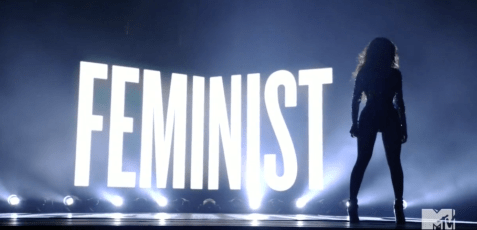
Screenshot from Beyoncé’s 2014 VMAs performance.
Both popular feminism and corporate poptimism are the result of the same flawed thinking that believes inequality can be fixed just by empowering individuals and not by restructuring the institutions and conventions that structure our relations with one another. This thinking seeks to put formerly low-status things in high status places without reconfiguring the underlying fact that there is a status differential in the first place.
Banet-Weiser warns that popular feminism is only half of a two-sided coin: “popular misogyny…mimics the operation of popular feminism but flips and distorts the politics.” The incel movement is an example of popular misogyny: arguing that women oppress men by refusing to have sex with them, it takes the language of oppression developed by feminism and uses it to justify the idea of patriarchal sex-right. Similarly, the classical music blog “Slipped Disc” has been described as the “Breitbart of classical music” because its championing of the orthodox Western art music canon is “openly sexist, racist, and LGBT-phobic.” The 2018 Grammy Awards show presented both sides of this coin in stark clarity: as Maura Johnston noted, though the ceremony prominently featured a #MeToo performance from Kesha and other women artists, almost all the awards went exclusively to men.

Screenshot of Kesha’s performance of “Praying” at the 2018 Grammys.
Viewed in Banet-Weiser’s terms, the RIAA seems to be leveraging both sides of this coin to maximize its profits, practicing popular feminism in the streets but popular misogyny on the ballot. Like popular feminism, the RIAA’s poptimism values superficial markers of feminist progress because they obscure patriarchy’s retrenchment. For example, the two most definitive or canonical poptimist texts (the Sanneh article and Wilson book) are authored by cis men, so it may appear that poptimism hasn’t changed those institutions and conventions so much as conformed to them.
I agree with Banet-Weiser that though Feminism™ is certainly limited and insufficient, it can be a helpful gateway for beginners. Poptimism™ is similarly limited and insufficient, but we should think about how we can lead fans brimming with that kind of poptimism to a deeper engagement with the institutions and conventions that continue to value the same kinds of people and the music they make and like above others.
—
Featured image: “Pop” by Flickr user Andreas Andrews, CC BY-NC-ND 2.0
—
Robin James is Associate Professor of Philosophy at UNC Charlotte. She is author of two books: Resilience & Melancholy: pop music, feminism, and neoliberalism, published by Zer0 books last year, and The Conjectural Body: gender, race and the philosophy of music was published by Lexington Books in 2010. Her work on feminism, race, contemporary continental philosophy, pop music, and sound studies has appeared in The New Inquiry, Hypatia, differences, Contemporary Aesthetics, and the Journal of Popular Music Studies. She is also a digital sound artist and musician. She blogs at its-her-factory.com and is a regular contributor to Cyborgology.
—
 REWIND! . . .If you liked this post, you may also dig:
In Search of Politics Itself, or What We Mean When We Say Music (and Music Writing) is “Too Political”–Elizabeth Newton
Music Meant to Make You Move: Considering the Aural Kinesthetic–Imani Kai Johnson
Pushing Play: What Makes the Portable Cassette Recorder Interesting?–Gus Stadler
Share this:

My Music and My Message is Powerful: It Shouldn’t be Florence Price or “Nothing”
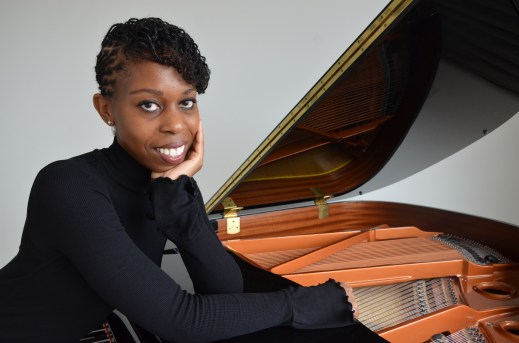
Flashback to the second day of the recent Gender Diversity in Music Making Conference in Melbourne, Australia (6-8 July 2018). In a few hours, I will perform the first movement of the Sonata in E minor for piano by Florence Price (1887–1953). In the lead-up, I wonder whether Price’s music has ever been performed in Australia before, and feel honored to bring her voice to new audiences. I am immersed in the loop of my pre-performance mantra:
My music and message is powerful, my music and message is powerful.
Repeating this phrase helps me to center my purpose on amplifying the voice of a practitioner who, despite being the first African-American woman composer to achieve national and international success, faced discrimination throughout her life, and even posthumously in the recognition of her legacy.
In Price’s time, there were those in positions of privilege and power who listened to her music and gave her a platform. One such instance was Frederick Stock of the Chicago Symphony Orchestra and his 1933 premier of her Symphony in E minor. But there were times when her musical scores were met with silence. For example, when she wrote to Serge Koussevitzky of the Boston Symphony Orchestra requesting that he hear her music, the letter remained unanswered. There was a notable intermittency in how Price was heard, which continues today. It seems most natural for mainstream platforms to amplify her voice in months dedicated to women and Black history; any other time of the year appears to require more justification. And so, as I am repeating this mantra—my music and message is powerful—I am attempting to de-centre my anxieties, and center my service to amplifying Price’s voice through an assured performance.
I applied to the conference a few months ago. I was keen to bring my research to new audiences. Upon seeing that the conference was in Australia, I knew this would be a fantastic opportunity to gain transnational insight into the ongoing work around representation and inclusion in music. Fast-forward to July: here I am, in Australia for the first time. The venue is unfamiliar and I have not met anyone here before this visit. However, this is what I do know: I have fifteen minutes for my performance; hence, I have only prepared the first movement of the sonata. Looking in the program, I noticed there will be a paper taking place at the same time as my performance, given by an academic who identified himself in his printed abstract as “a white, old, straight man with power and privilege.”
The title of his paper? “I Have Nothing to Say.” While gender diversity was the overarching theme of the conference, the goal towards inclusion negated the fact that not all platforms are created equal. The speaker’s proposed topic advertised the ease with which the dominant voice may access a space for its mere presence, regardless of what will be said. Conference logistics then set this voice and its contribution against the radically diverse sounds of our time slot. In addition to my lecture and performance, there are several other events taking place simultaneously. The subjects include: mentoring women composers, creative realizations of parenthood in composition, gender balance in Australian jazz, interpretative approaches to the music of Kaija Saariaho, music as a vehicle for navigating the challenges around non-binary and transgender identity, and a cis-gendered white man’s exploration of ceding power and listening.
I remember a casual conversation the night before in which the joke arose of the speaker being “the token white man.” Of course it was a joke; the very notion is absolutely ridiculous. I remember reflecting on tokenization earlier that day and tweeting to that effect:
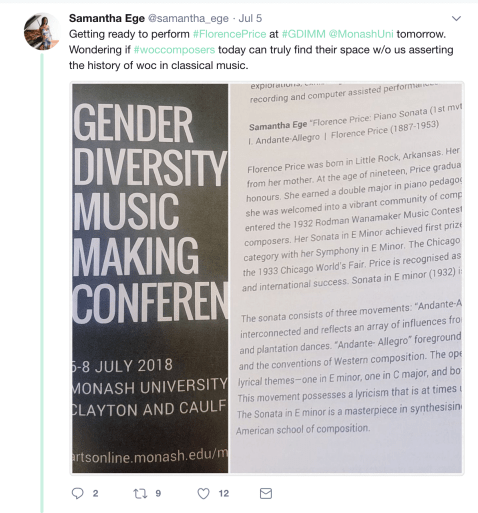
I knew the joke was light-hearted, but there is nothing light-hearted about being a token, nothing light-hearted about knowing your excellence, yet wondering if it will even factor into the decisions around your involvement. Anyway, I did not want to prioritize thoughts about the token white man over my purpose at the conference because that would take up time, space and energy, and in my pre-performance rituals, that time, space and energy belongs exclusively to the women that I seek to honour.
When it is time to perform, I bow, then sit, then sink into the first sound, which is this rich e minor chord that engages almost all of my fingers. I relish the rich tones in the grandeur of the introduction. But as the first theme comes in, conjuring up the soundworld of plantation songs, I calm the mood down to ensure that the lyricism of the top melody really sings.
My music and message is powerful.
The performance is followed by a presentation where I talk more about the sonata, who Price was, and what she achieved. I make sure to highlight her Arkansan roots and her Chicago successes, particularly around the Symphony in E minor. I speak about the influence of the spirituals within the classical frameworks of her compositions. I also speak about the privilege and the incredibly moving significance of being able to present and perform her music for an audience, largely of African descent, at the Chicago Symphony Center.
I play excerpts from the rest of the sonata off my recent album Four Women on Spotify and struggle to find the best time to pause the track because there is so much that I want the audience to hear: from the development of spiritual themes in the second movement, to the virtuosic whirlwind that is the final movement.
A dynamic discussion ensues, weaving in the narratives of Nina Simone, African-American folk tradition and my passion for this repertoire. I elaborate upon the ways in which exploring classical music by women has been an empowering personal journey. I articulate how the perception of men achieving “firsts” renders them gods while women achieving “firsts” are miracles that were never supposed to happen, that may never happen again. I express my role as a musicologist-pianist as demonstrating a long and rich history of women music-makers and, therefore, evidencing precedents—her-stories—for the creative contributions of women now. My time comes to an end and I am left feeling proud to have represented Price’s music and legacy here, today.
After my performance, I tweeted the following thought-through (but clearly not proof-read) thread expressing my disappointment:
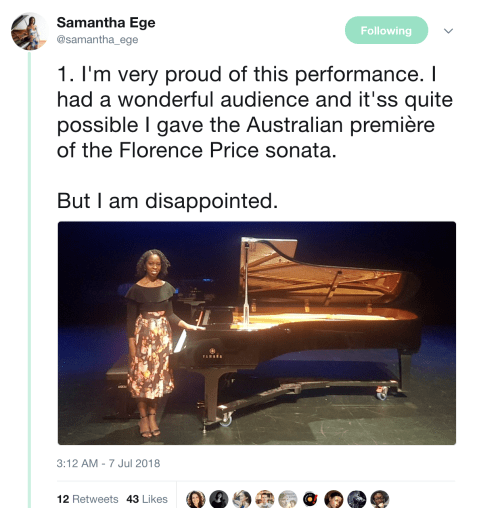
My goal with this post was to juxtapose this paper with Price’s music and career, spotlighting the implications of uneven power and access therein.
3. His talk was called “I have nothing to say.”
Some people therefore chose to listen to a man who has “nothing to say” over the music of an African American woman composer who has historically been silenced and is barely heard in this current day.
Let that sink in.
— Samantha Ege (@samantha_ege) July 7, 2018
Wrapped up in my post was the criticism of the fact that, being a university professor, the speaker of “I Have Nothing to Say,” has access to this kind of platform year-round, while marginalised voices only get amplified in the specific and limited spaces that society has carved out for them.
My critique is not about the individual, but about the systemic and institutionalized undermining of underrepresented voices, even at a conference designed to amplify them. The fact that such a work was placed on such a program evidences the extent to which we are so conditioned to ensuring the most powerful and privileged voice speaks in every single space, even when they acknowledge they have nothing to say.
Since posting that evening to both Twitter and Facebook, I have received a backlash on the latter, one that is, at present, unaffiliated with the organisers of the event. It has, however, attempted to derail the conversation. Apparently I was only upset because my program faced competition from other papers. Maybe I should have looked into the scheduling to make different arrangements. Or I should have found out what the speaker’s talk was about because there is a chance that I would have enjoyed it. Repeatedly, the onus was placed on me to reach out to the “token white man” and better understand his position. I also learned something new: passing judgement on a presentation because of its title is no better than passing judgement on a composer because of their gender. However, I was under the impression that the paper title was a choice and that Price’s identity as a black woman was not.
Anyway, I did not judge by the title. I judged by the abstract:
When one of the organisers of this conference suggested in a Facebook exchange on someone else’s post that I should submit an abstract for a paper, I was surprised. And a little frightened. What could I possibly contribute to such an event? I am the problem. I am a white, old, straight man with power and privilege. Surely my voice could only be heard by others as a violence in this context. Surely, my job is to get out of the way, to shut up, to not be heard. Surely, the only thing I could ethically and honourably bring to this is my listening. But then I felt that this is what needs to be said. I am and old straight white man who says that the job of people like me is to actively get out of the way, actively cede power and authority, actively be told, actively shut the fuck up. So I decided to use the occasion to practice a way of speaking that does those things, gets out of the way, cedes power and authority, gets told, shuts the fuck up. To practice speaking which listens. A listening-speaking. So that’s what I am trying to do in this paper. To enact a listening-speaking that gets out of the way, cedes power and authority, gets told, shuts the fuck up.
The speaker’s participation was invited and his proposal both encouraged and evidently accepted by the organizers. The abstract presents a sense of knowing better. “Surely my voice could only be heard by others as a violence in this context.” Yes. “Surely, my job is to get out of the way, to shut up, to not be heard.” Yes. “Surely, the only thing I could ethically and honourably bring to this is my listening.” Yes! “But…”
Ultimately, what needed to be said, actually needed to be done. The enacting of a listening-listening with neither platform nor audience would have been a powerful statement, quietly powerful, but powerful nonetheless. To reiterate, not all platforms are made equal—could I, realistically, have told him to shut the fuck up? How would that have sounded? How would I have sounded?
The derailing responses I have received pointedly ignore how the very presence of this paper disrupted the multiple and intersectional conversations happening in that moment. It distracted from the rarity of these subjects and their platform, and quite materially, culled an audience who could and should have been doing the very listening the abstract advertises. Scheduling this paper restored the speaker’s position to the center, and re-centered his power and authority to speak about everything and “nothing.” His privilege remained intact. In the midst of the most diverse and pertinent themes was the voice that has, both historically and to this day, spoken over the top of so many others.

“Trocadero Piano Player” by Flickr User Pierre Metivier (CC BY-NC 2.0)
I chose not to reach out directly to the institution nor its organisers because of the emotional labor this would entail. To put the issue forward in a quiet behind-the-scenes way that is sensitive to those who created the issue, is to chip away at my voice and its power. On the otherhand, to project the issue with a loud “shut the fuck up” is to perform a type of power and privilege on a platform that I do not have. I enact a public conversation here via Sounding Out! so that this experience may inform wider work towards diversity and representation. I enact this conversation in order to progress definitions of inclusion to a point where the choice to engage the dominant voice factors in a listening-listening as an exceedingly valuable contribution to the narratives offered by lesser heard voices.
I have since received a written acknowledgement from the organizers of this problematic programming, with a formal apology for the impact. But I must bring to light the important action of two allies, in particular, who recognised the emotional work required of me to bring this forward institutionally. They offered to continue the conversation on my behalf. We talked about the way in which the ensuing discussion must center listening. We shared that the process towards inclusivity may result in mistakes being made along the way. We discussed that while compassion and sensitivity can be important parts of the dialogue, I cannot afford to extend that compassion and sensitivity without becoming emotionally drained. And so, they wrote to the institution with the message of actively learning and making efforts towards change. I am so grateful for that allyship because while I knew that my voice would be heard, I could not guarantee how it would be heard. After all, if there is one take away to be had from this experience, it is that regardless of intention—and regardless of occasion—the dominant voice is very much conditioned to speak up, and speak over. And the dominant ear cannot help but listen.
So, how do I move forward?
My music and my message is powerful.
—
Featured Image: Courtesy of Author
—
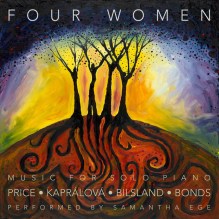 Samantha Ege is a British musicologist, pianist and teacher based in Singapore. She is a Ph.D. candidate in Music at the University of York, UK. Her research focuses on the aesthetics of Florence Price. As a pianist, her focus on women composers has led to performances in Singapore (supported by the British High Commission and International Women’s Day), and lecture-recitals at the University of York, the Chicago Symphony Center and the Women Composers Festival of Hartford, USA. Her album Four Women: Music for Solo Piano by Price, Kaprálová, Bilsland & Bonds reflects her journey into a rich and unrepresented repertoire.
She would like to thank Deborah Torres Patel for the gift of this mantra.
—
 REWIND! . . .If you liked this post, you may also dig:
Spaces of Sounds: The Peoples of the African Diaspora and Protest in the United States–Vanessa Valdes
becoming a sound artist: analytic and creative perspectives–Rajna Swaminathan
Sounding Out Tarima Temporalities: Decolonial Feminista Dance Disruption–Iris C. Viveros Avendaño
Gendered Soundscapes of India, an Introduction –Praseeda Gopinath and Monika Mehta
On Whiteness and Sound Studies–Gustavus Stadler
Share this:


Current Top Posts





April 2021

January 2020

November 2019

October 2019

August 2019

April 2014

November 2017

March 2015

December 2017

October 2015
 Sounding Out!

Recent Comments