
Straight Leanin’: Sounding Black Life at the Intersection of Hip-hop and Big Pharma

 Marginalized bodies produce marginalized sounds to communicate things that escape language. The queer body is the site of sounds that engage pleasure, repression, rage, isolation, always somehow outside of dominant language. Sound Studies tells us that we should trust our ears as much as our eyes, justifying our trust in sound, and of the resonating body. Affect Theory goes further, saying that all senses play into a body that processes input through levels of response, experience, and anticipation. Affect is the vibrational space that is both bodily memory and anticipation. So where do sound and affect meet in queer bodies? How do marginalized peoples use sound and the body to express liberation, objectification, joy, and struggle?
Our writers in Sound and Affect tackle these questions across a spectrum of the marginalized experience. Last week, I opened by offering the concept of the tremble, a sonic form of affect that is necessarily queer in its affective reach. Next week, Maria Chaves explores the connection between voice, listening, and queer Chicana community formation: through space, across time, and with laughter. The series finishes with Justyna Stasiowska bringing the noise in a discussion of the trans body and the performance work of Tara Transitory. Today, Kemi Adeyemi, sloooooooows thingggggggggs doooooooooownnnnn so that we can hear the capitalist connections between the work expected of black bodies and the struggle for escape from this reality through the sonic affects, temporal shifts, and corporeal elsewhere of purple drank. —Guest Editor Airek Beauchamp
—
The first track on Future’s 2015 album Dirty Sprite 2 opens with the gassy sounds of the rapper preparing “lean”: a prescription promethazine and codeine cough syrup mixture that is cut with sweet sodas and candies. He vigorously shakes the syrupy Sprite together before cracking the bottle open and pouring the fizzing drink over ice likely held in two stacked Styrofoam cups, the vessel of choice for hip-hop’s most audible drug. As Future takes his first sips his mouth puckers with the sweetness. He swirls and sips again, sighing with pleasure as he begins boasting “…I just took a piss and I seen Codeine coming out/We got purple Actavis, I thought it was a drought.”
Otherwise known as syrup, sizzurp, purple stuff, drank, Texas Tea, and barre, lean is a highly addictive concoction that is sipped slowly to release a potent blend of euphoria, hallucinations, and motor impairment—especially when consumed in conjunction with alcohol. Lean slows you down, muddies your perception, and makes you physically sway, recline, lean. Future’s album, like much of his oeuvre, pays homage to lean and this particular song, “Thought It Was a Drought,” flies in the face of the pharmaceutical company Actavis that stopped producing the drug in 2014 amidst fears that it was being illegally distributed to and consumed by non-prescription holders. The lack of production has apparently not stopped Future’s consumption, however. On 2014’s “Codeine Crazy” he explains in a lean-fueled cadence that trails into his Southern accent that “I’m an addict and I can’t even hide it.”
Future’s demonstrations of addiction speak to a significant strain of hip-hop’s cache that stems from the genre’s long engagement with the terse intersections of drugs and black life. As Touré succinctly described in a 2012 piece in the Washington Post, early hip-hop often charted the realities of the drug-addled inner city that arose in the 1970s and ‘80s. “If you’re wondering why hip-hop has often been angry, sneering, nihilistic and dystopic,” he explains, “you can blame the war on drugs, and how it feels to be on the wrong side of it.” Rappers such as Future continue to bolster their legitimacy by narrating their functional (if fabricated) knowledge of selling drugs and thus being on the “wrong side” of this so-called war. But where the crack/trap rap genre documents the rapper’s mastery of the war by espousing the maxim that you never snort what you sell, the acceptance of prescription drugs as a product the rapper can hustle and consume has become commonplace.

Spotted at SXSW 2008, Image by Jazzbeezy
The hardest working people in hip-hop are at the forefront of their craft, and they are seemingly wasted every step of the way. In this, the mainstreaming of lean within contemporary hip-hop tells a familiar story of how embedded prescription drugs are within and across USAmerican societies. This essay offers a cursory glance at the sonic, physical, and affective terrain of lean in mainstream hip-hop, however, to query how prescription drugs are seen to generate productively intoxicated states that counter the violent realities of a particularly black everyday life. Contemporary soundscapes of lean have taken hold at a point when the intersections of neoliberalism and Big Pharma circumscribe particularly black ways of being. Beginning the work of understanding the discursive entanglements of race, labor, and drugs that are sounded by lean reveals larger questions about the subtle and covert ways that black consciousness itself is produced and policed in the neoliberal state.
As has been well documented by popular news outlets such as The Guardian and scholars such as Mac McCann, the sounds of lean were developed in the 1990s by Houston’s DJ Screw, who worked to record the loosened, detached body-feeling accessed through lean with his “chopped and screwed” productions. He slowed the tempo of whole songs to around 60 bpm, which elongated the vocals to an underwater slur, and chopped the rhythm up with strategic pattern interruptions that created even more goopy space between beats. Swishahouse Records took this droning Houston sound mainstream in the early 2000s with Top 40 radio hits by artists such as Mike Jones, whose song “Back Then” paired slow and guttural choruses that maintained the core elements of the chopped and screwed sound with bouncy lyrics about girls, cars, and money that trended toward mainstream pop rap.
By 2011, gesturing to the sounds of lean become a virtual guarantor of mainstream hip-hop success. This was evidenced in part by Harlem’s A$AP Rocky, who compiled the essential audio components of lean for his debut mixtape Live.Love.ASAP—which sampled Mike Jones on the ode to lean,“Purple Swag”—and immediately nabbed a $3 million dollar deal with RCA.
While the chopped and screwed aesthetic fell a bit by the wayside in ensuing years, recording the literal sounds of lean being poured, swirled, and sipped became increasingly common in hip-hop recordings—as did capturing the swooning effects the drug has on rappers’ flow. Lil Wayne’s public addiction to lean took center stage on his prolific and sometimes-erractic mixtapes such as Dedication 5 that feature many interludes where his words bleed into one another or trail off altogether following the droopy intoxication promethazine was having on his body. The devastating effects of the controlled substance became starkly clear when Wayne suffered multiple seizures, and when Rocky’s manager, A$AP Yams, passed away following complications with drugs—a fate Houston’s own DJ Screw and the beloved Pimp C had already met.

Lil Wayne
Despite the physical risks of consuming lean, the drug appears to be a stalwart coping mechanism for artists whose work ethic has led to extravagant excesses that are balanced by the increasingly visible violence done onto black bodies. Future himself repeatedly strikes a balance between his addiction to lean and the conditions of his particularly black stardom. His video for “Codeine Crazy” is a swirling, purple-inflected picture of the artist in various states of repose: the video opens with him in a club attempting to hold his head up straight, taking his first wobbling steps after lying down in a field once populated by purple horses, and being shaken awake on an Atlanta porch while holding Styrofoam cups full of lean.
The production, lyrics, and imagery underscore his apparent struggles balancing celebrity life with the realities of his difficult upbringing, encapsulated in the admittance that he is “Drowning in Actavis suicide.” The sentiment is exacerbated in the video for “March Madness,” where iconic clips of Civil Rights Movement protesters being beaten by the police provide visual background while Future intersperses dedications to lean and exaltations of the good life with lamentations of the loss of black civil rights: “Ballin’ like the March Madness/All these cops shooting niggas, tragic/I’m the one that’s living lavish.” In these works, Future paints a picture whereby the entire spectrum of black life from extraordinary celebrity to mundane tragedy can only be understood in and through drug-induced states.

Schoolboy Q show at The Door in Dallas 6/30/12, Image by Flickr User Mikel Galicia
Future’s balancing act is common among artists for whom prescription drug abuse is both a status symbol and a requirement of black everyday life where maintaining success requires that you work nonstop. When Hot 97s Angie Martinez queried the relationships between lean and seizures, the self-confessed functional addict Schoolboy Q responded with incredulity: “Man that shit ain’t from no lean, man…Bro, we are rappers; we don’t sleep. People don’t understand.” His story of churning out features, mixtapes, albums, and tours for Interscope Records reflects our larger neoliberal economy that places a premium on the individual’s maximum, efficient output. As Q suggests in his interview, prescription drug use has blossomed under these conditions whereby the individual is made to feel perpetually behind, as Joanna Moncreiff writes in the essay “Psychiatric Drug Promotion and the Politics of Neoliberalism.” Prescriptions are marketed to stabilize, enhance, and/or find relief in one’s productivity in an age where individual entrepreneurship and competition are rewarded. Set against a larger national reliance on prescriptions to remain physically and mentally “stable” enough to remain efficient under this intensity, the black coping strategies heard through lean are innately USAmerican coping strategies.
At the same time, the slowed pace of lean is also attuned to the national epidemic whereby black people are routinely killed whether they are working or not. The racialized politics of productivity required by neoliberalism are thrown into relief as black people such as Eric Garner are killed because of their entrepreneurial efforts. As a result, attending to the sounds of lean must necessarily reflect gaps in our understanding of how particular patterns in drug use do and do not render black people intelligible as functional citizens worthy of life. Rappers like A$AP Rocky, Schoolboy Q, Future and others create musical odes to and demonstrations of the slowed pace of lean as it provides them a break from norms of physical and affective comportment. The drug incurs simultaneous sensory overload and the critical detachment from their bodies that allows them to experience (and potentially control) this overload at a slower pace—a physical and affective space that several rappers discuss in the Vice article “Lean on Me.” Lean radically grounds them, in other words, in an alternative body-space-time continuum that converses with the demands the neoliberal state places on the black body.
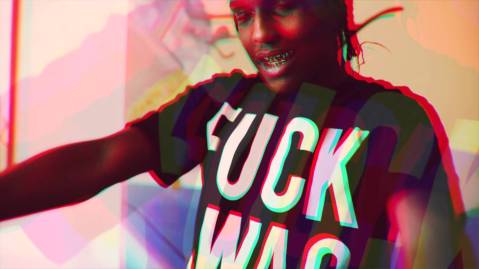
A$AP Rocky, Still from “Purple Swag Bootleg” (Director’s Cut)
The dissociative pleasures controlled substances offer to black people have been historically criminalized, and radically different sentencing guidelines continue to be handed down for the perceived consumers of “crack” (black people) versus “cocaine” (white people). In this milieu, black reliance on prescription drugs for pleasure, physical ailments, mood stabilization, or otherwise has proven to be dangerously unintelligible. Sandra Bland and Ralkina Jones died while their requirements and requests for the proper prescription meds they took to remain alive were ignored if not refused outright by the police. The question of whether or not black people experiencing alternate states of reality are more or less deserving of death is further triggered by the murders of people who may have been knocked into “discombobulated” states following car accidents, such as Renisha McBride and Jonathan Ferrell. The many deaths of black transpeople killed in the midst of various stages of medical reassignment further underscores a need for larger awareness of the ways that alternative conceptions of reality and consciousness map onto black life.
A critical history of hip-hop’s pharmaceutical undercurrent is not just an exercise in examining aesthetics. We can examine how lean is Auto-Tuned, chopped and screwed, and lyricized until we’re blue in the face. Sitting in the muck of lean-addled songs—theorizing how it feels to lean back and let our heads roll off our necks while we watch our surroundings fade and sway to purple—reveals a critically important rubric of black bodies, sounds, and affects that are wholly circumscribed by the entanglements of race, political economy, and the medical industrial complex. Reading black life against the sounds of lean subsequently makes the intersections of black labor, joy, and depression audible. This reading will not only take prescription drugs and hip-hop seriously within the canon of music and sound studies, but will also raise questions about intoxication—in its most expansive definition—as a critical component of black labor and survival from slavery to the neoliberal moment.
—
Featured Image: A$AP Rocky, Image by Flickr User Mira Shemeikka, Extra-swagged by SO!
—
Kemi Adeyemi is about to complete her PhD in Performance Studies at Northwestern University. Her dissertation examines how blackness is produced as an aural, visual, and embodied economy in the white nightlife scenes of Chicago’s gentrifying neighborhoods; the work illuminates how a small community of queer women of color that circulates through these scenes mobilize black sound as a theory and method taking pleasure therein.
—
 REWIND!…If you liked this post, check out:
“This is Your Body on the Velvet Underground“-Jacob Smith
“The (Magic) Upper Room: Sonic Pleasure Politics in Southern Hip Hop“–Regina Bradley
“Tomahawk Chopped and Screwed: The Indeterminacy of Listening“–Justin Burton
Share this:

Straight Outta Compton . . .Via New York

Sounding Race in Rap Songs explores the production of musical identity in hip hop’s first two decades as a commercial genre. Although I don’t ignore lyrics or visual imagery, my main purpose is to analyze rap music as music, to understand how specific artistic decisions contribute to racial meaning in particular songs. My methods revolve around the study of how producers manipulate breakbeats, also commonly known as “breaks.” Initially understood as short, percussion-heavy passages that appear in many songs recorded in the 1960s and 1970s, breaks have been central to hip hop from the music’s earliest days in the South Bronx when DJs began isolating and looping them on their turntables to the delight of dancers. Since then, producers have tried out new approaches to working with breakbeats: hiring studio musicians to re-record them; programming drum machines to imitate them; and using sampling-sequencing technology to capture and rearrange them.
 Throughout the book, I describe how producers use breaks and give rise to musical-racial codes that can be manipulated to project a variety of identities and attitudes. The following excerpt from the third chapter of Sounding Race, explains how the style of beat making popularized by the New York-based Bomb Squad (Public Enemy’s production team) provided a blueprint for pioneering west coast gangsta rap group N.W.A’s depiction of Compton, California. By layering multiple loops into a dense, cacophonous mix, N.W.A transposed Public Enemy’s “too black, too strong” sound onto the world of Los Angeles’s postindustrial streets.
N.W.A and its former members have been in the news recently thanks to the biopic Straight Outta Compton. Yet one aspect of the group’s development downplayed in the film is the way that its members formulated their identities in relation to east coast rap. In the mid-1980s, New York was the undisputed center of the industry, and its influence on L.A.-based acts is easy to see and hear. Ice Cube’s first group C.I.A. ( Cru’ In Action) used a nasal, hocket style approach to rapping cribbed directly from the Beastie Boys 1986 album License to Ill. And the cover of N.W.A’s first album N.W.A and the Posse, features numerous group members posing with the giant clock necklaces made famous by Public Enemy’s Flavor Flav. In similar fashion, the beat Dr. Dre produced for “Straight Outta Compton” (the title track to their breakout 1988 album) followed the Bomb Squad’s potent formula for signifying militant blackness. —Loren Kajikawa
—
The following is an excerpt from Chapter Three “‘Let Me Ride’: Gangsta Rap’s Drive Into The Popular Mainstream,” of Loren’s Kajikawa’s Sounding Race in Rap Songs, with thanks to The University of California Press. Any notes have been included in the text to conform to Sounding Out!‘s style sheet.
We [Public Enemy] were in Vegas and they [N.W.A.] were on tour with us, and I had just got the vinyl in. That’s what this is all about. Because Run-DMC and LL Cool J gave me energy. And if our energy happened to be transferred to N.W.A., then that’s what this whole thing is for.” Chuck D as quoted in Brian Coleman, Check The Technique: Liner Notes For Hip-Hop Junkies (New York: Villard Books, 2007), 354.
According to Chuck D, Public Enemy’s musical style directly influenced Dre, and he recalls giving the first two copies of It Takes a Nation of Millions To Hold Us Back to Dr. Dre and Eazy-E prior to the album’s official release. The recorded evidence supports Chuck D’s recollection. For many of the tracks on Straight Outta Compton, Dr. Dre seems to have borrowed from the “loops on top of loops” style of Public Enemy’s Bomb Squad.
In fact, when Ice Cube left N.W.A. in 1989, he hoped that Dre would continue to make beats for his solo project. When this proved impossible due to Dre’s contractual obligations to N.W.A., Ice Cube began collaborating with the Public Enemy’s Bomb Squad, which served as the production unit for his album Amerikkka’s Most Wanted (1990). N.W.A.’s breakthrough was finding a way to put a distinctive spin on these influences, and the artistic strategy that they arrived at for their first Ruthless Records release was designed to put themselves on the map—both literally and figuratively.
Rather than shout out the multiplicity of neighborhoods where their members were actually from (as they had done in “Panic Zone”), N.W.A. chose to center their identity around Dr. Dre and Eazy-E’s hometown of Compton, California. The sound of Compton as Dr. Dre imagined it, however, drew on musical practices and artistic decisions similar to those found in Public Enemy’s “Rebel Without a Pause.” To construct the rhythmic foundation of “Straight Outta Compton,” Dre looped the breakbeat from The Winstons’ “Amen Brother” (1969), one of the most sampled beats in hip hop, that also served as the foundation for dozens of songs in the UK’s “jungle” (aka “drum and bass”) genre.

Like other heavily sampled breaks from this era, the one-measure loop features a syncopated interlocking of snare and bass hits that is reminiscent of James Brown’s “Funky Drummer (featuring Clyde Stubblefield’s famous beat). As if he were following the Bomb Squad’s exact formula, Dr. Dre layered a drum machine (Roland TR-808) over this break.

The 808 was programmed to add its characteristic bass boom to the first two drum kicks of the “Amen” loop, and to tick off a 16-count hi-hat pulse with a closing hi-hat clasp on the downbeat of every other measure. The “Amen” break and the two hi-hat parts, provide the rhythmic foundation around which Dr. Dre places numerous other repeating sounds. Two other ingredients stand out in this beat: a guitar ostinato and a low drone on what sounds like a baritone sax or trombone (or perhaps a downwardly pitched sample of another instrument). The guitar ostinato, which plays straight eighth-notes on E-flat except for a one step descent to D-flat on the “and” of every fourth beat, churns out tight 1-measure units of sound.

The horn drone (also on E-flat) has a raw, muddled quality, and casts an ominous cloud over the track.
By combining these layers with the dense percussion track, Dre created a tightly packed funk groove with many sonic similarities to Public Enemy’s Bomb Squad. Like “Rebel Without a Pause,” the track to “Straight Outta Compton” features tight 1-measure loops stacked on top of one another to create a thick and intense groove.

Comparison of layers of looped sound in Public Enemy’s “Rebel Without a Pause” and N.W.A.’s “Straight Outta Compton”
Except for the drone, most of the elements in the track have a punchy feel, full of rhythmic stabs and staccato attacks, including the automatic gunfire that Dre samples to follow Ice Cube’s reference to an AK-47 assault rifle. Due to the “noisiness” of the beat, the way sonic space seems filled to maximum capacity, the members of N.W.A.—similar to Public Enemy’s Chuck D and Flavor Flav—practically yell their verses, as if they must raise their voices in order to be heard over the cacophony. Even before the actual words to “Straight Outta Compton” are digested, the sound of the track and the group’s vocals evoke the palpable tension of imminent conflict, which reinforces the theme of violent confrontation in the song’s lyrics. For the chorus of “Straight Outta Compton,” Dr. Dre strings together a series of samples with rapid-fire precision. The sound of screeching car tires from Davy DMX’s “One for the Treble” is followed by turntable scratching; the scratching leads directly to a choppy sample of the words “City of Compton” from Ronnie Hudson’s “Westcoast Poplock,” which is then followed by more scratching. The whole chain of musical events is deployed over the breakbeat from Funkadelic’s “You’ll Like It Too,” which Dr. Dre splices into the beat just for the chorus. The rapid cutting from one sample to the next exemplifies the “rupture” Tricia Rose identifies as fundamental to hip hop’s post-industrial aesthetic in Black Noise: Rap Music and Black Culture in Contemporary America (39).
Thus, the music and lyrics for “Straight Outta Compton” depict the city as a place of extremes, where things happen fast and change is sudden and complete. It is a place where one is either equipped to deal or left behind. In this way, Dr. Dre exploited the spatial characteristics encoded in Public Enemy’s music to depict Compton as place. The sonic characteristics that animated Public Enemy’s militant blackness were rerouted and effectively transposed onto N.W.A.’s depiction of Los Angeles gangstas.
—
Loren Kajikawa has served on the faculty at the University of Oregon’s School of Music and Dance since 2009. His main area of research and teaching is American music of the twentieth and twenty-first centuries, and he offers a variety of courses in music history, ethnomusicology, and musicology. Kajikawa’s writings have appeared in American Music, Black Music Research Journal, ECHO: a music-centered journal, Journal of the Society for American Music,and Popular Music and Society, among others. His recent book Sounding Race in Rap Songs (University of California, 2015) explores the relationship between rap music’s backing tracks and racial representation.
—
 REWIND! . . .If you liked this post, you may also dig:
“‘I’m on my New York s**t’: Jean Grae’s Sonic Claims on the City”––Liana Silva
Love and Hip Hop: (Re)Gendering The Debate Over Hip Hop Studies–Travis Gosa
Caterpillars and Concrete Roses in a Mad City: Kendrick Lamar’s “Mortal Man” Interview with Tupac Shakur–Regina Bradley
Share this:


Current Top Posts





April 2021

January 2020

November 2019

October 2019

August 2019

April 2014

November 2017

March 2015

December 2017

October 2015
 Sounding Out!
Recent Comments