
The (Magic) Upper Room: Sonic Pleasure Politics in Southern Hip Hop

 After a rockin’ (and seriously informative) series of podcasts from Leonard J. Paul–a three part “Inside the Game Sound Designer’s Studio”– our summer Sound and Pleasure series keeps giving you the good stuff, this week with SO! Regular Regina Bradley, making it rain. . . with some serious knowledge. What is the connection between sound and enjoyment, and how might black women’s sexual freedom be manifested via sound? –-JS, Editor-in-Chief
—
At fifteen, while in church service, I learned how to clutch pearls after hearing a woman moan during the altar call.
It was not a “Jesus done found and saved me” moan, either. A friend forgot to turn his cell phone off for church. As the church prayed, his phone started to ring. It was not the usual digital beeping or quick calypso ring tone. His phone calls were annotated by a woman’s moan during sex. She moaned from his cell phone to pick up the call. Each ring the woman moaned louder and adamant until she hollered like she was just saved. The kids in the back snickered as the ushers – including my grandmother – silently and angrily screened each pew to see who would pick up the phone. Quaking church ladies and my grandmother’s wide-eyed glare and heaving chest suggested they were about to pass out from embarrassment. Wringing their white gloved hands and grabbing at their pearl necklaces in angst, they looked everywhere but at each other: the back of a man’s head, the cross at the front of the church, the stain glass windows. A flush of warmth entered my cheeks and neck as I tried to contain my laughter and creeping embarrassment. I was embarrassed for my grandmother and the ladies of the church because I was aware of the unspoken rule that women – especially middle-class black women – don’t do sex. Being embarrassed of sex is proper and “ladylike.”
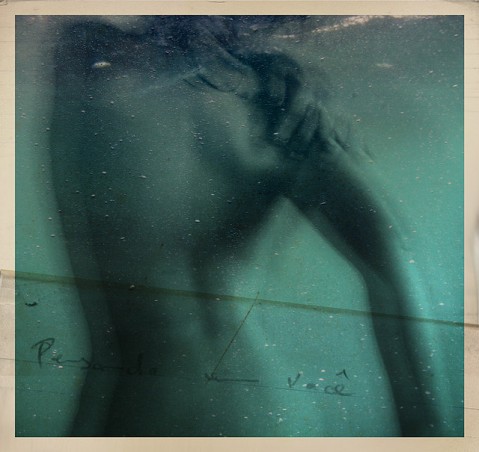
“Dancing underwater II” by Flickr user Miss Cartier, CC BY-NC-SA 2.0
Ashon Crawley’s contextualization of the praise and worship in Black Pentecostal church as a sonic public zone is useful for using sound to complicate the church as an erotic space. Crawley’s suggestion of sound as a “vessel. . .for the exchange of ecstasy and ecstatics” collapses the more tangible notions of gender and respectability via physical displays –i.e. the quaking church ladies and clutching pearls – to recognize the overlap of moaning as a marker of sexual joy, moaning as a form of praise and worship, and moaning as an indicator of shame. Crawley’s observations bring to mind Helga Crane’s run in with the storefront church in Nella Larsen’s Quicksand. It is not the physical aspect of the church and its embodiment of respectability that draws Helga into the space. Rather, it is the singing, weeping, and moaning – the sonic elements of praise and worship–that parallel her own suppressed sexual frustrations. Her weeping is not necessarily a “come to Jesus moment” but rather a sonic release acknowledging her sexual agency.
Looking back at when this dude’s phone went off in church, I realize the bulk of discomfort in acknowledging sexual pleasure exists in how it sounds. The woman’s moan highlighted an alarming reality for the women at my church: pleasure was being presented outside of its respectable physical and sonic boundaries. I wish to identify what I call sonic pleasure politics to address new developments in 21st century southern gender identity politics. Sonic manifestations of pleasure point to a younger generation’s rearticulation of sexuality as a site of agency and self-definition in an otherwise suppressed southern experience.
![Purity-Rings.jpg by Wikimedia user Bibleknowledge, CC-BY-SA-3.0 (http://creativecommons.org/licenses/by-sa/3.0)], via Wikimedia Commons](http://commons.wikimedia.org/wiki/File:Purity-Rings.jpg)
Purity-Rings.jpg by Wikimedia user Bibleknowledge, CC-BY-SA-3.0, via Wikimedia Commons
As a southern black woman, I’ve always been struck by the anxiety sex and pleasure invoked in the women in my life. Sex and pleasure were never articulated in the same breath, as sex was a wifely duty and responsibility for procreation. Pleasure was never synonymous with sexual joy, even when I snatched whispers of conversation about sex from my elders. Moreover, I was taught that sex (or even an interest in it) would plummet my stock as a good girl and put me in the ranks of “fast-tailed” girls who used sex as a desperate plea for attention. Nope, sex – pleasurable sex – was always for men’s gratification. Aside from the abstinence manifesto – “just don’t do it, chile” – for women, enjoying sex was the devil’s work. Respectable sex was quiet, for marriage, and never discussed outside of the house.
Sound as a signifier of sexual pleasure is considered by many to be counterintuitive because of the history of sexual trauma associated with black women’s bodies in the south. Reading sex as a genesis point of southern black women’s pleasure and empowerment is a difficult undertaking. The forced silence of slave women’s rapes and other physical violence that took place on southern soil parallels the silence that is deemed to be necessary for survival in a racist society. Further, the far-reaching residual effects of black women’s inferred lacking virtue lurk in how black folks navigate their southern experience and identities. Conservative attitudes towards sex in the southern black community are no doubt associated with the constructed attempts to humanize and validate blacks outside of hypersexual scripted blackness.
However, the sonic dimension of sex and pleasure in the south goes largely without analysis even though sound is a primary space in which recognition of sexual and nonsexual pleasure takes place. Consider blues women and, more recently, women in [southern] hip hop culture. The sounds of women’s giggles and moans as representative of sexual pleasure in bass music and the heavy use of moaning in the work of Trina, Jacki-O, Khia, Erykah Badu, Beyoncé, and Missy Elliott points to a need to recognize sound as a reservoir of pleasure, raunchiness, and sexual work—what I call “sonic pleasure politics.”
Studies of sonic pleasure including those of Robin James contextualize pleasure via the technical production of sound to induce a particular set of cultural and visceral responses. However, I ground my theorization of sonic pleasure politics in the growing body of scholarship offered by the “Pleasure Ninjas” collective consisting of Joan Morgan, Brittney Cooper, Treva Lindsey, Kaila Story, Yaba Blay, and Esther Armah. They utilize pleasure as a site of healing and reclamation of black women’s identities. Morgan’s interrogation of pleasure as a form of survival, for example, is especially useful in thinking about how southern women’s sexuality stems from the trauma of the transatlantic slave trade. She suggests pleasure’s palpability as an alternative space to reclaim slaves’ humanity. The Pleasure Ninjas’ construction of pleasure lends credence to my theorization sonic pleasure politics as a space for mediating the historical implications of abusive sexual power and the use of sexual pleasure as a form of resistance in the south.

“Atlanta – Poncey-Highland: Clermont Lounge” by Flickr user Wally Gobetz, CC BY-NC-ND 2.0
Situating women’s pleasure in southern hip hop is messy as it reflects both men’s investment in women as objects of pleasure – i.e. bass music – and women’s subversion of this expectation of their sexuality a way to express themselves. For example, Lil Wayne’s lyrical affirmation of his sexual prowess via cunnilingus in songs like “Pussy Monster,” “She Will,” and “Lollipop” parallels singer Joi’s demonstration of pleasure as a form of sexual consent via the use of (presumably her) moans and sounds of cunnilingus on her popular song “Lick.” Sonic pleasure politics become a workspace for bridging the south’s historical construction of [black] women’s sexuality-as-respectability and the recent, more fluid form of younger women’s embrace of sex-as-empowerment heard in southern popular culture.
Sonic Pleasure Politics and Strip Club Culture
A primary space for teasing out the multi-layered significance of sounds and sexuality in southern hip hop is the strip club. The production of sonic and visual representations of strip clubs are inextricably linked: bass heavy musical tracks keep time with the “clapping cheeks” of exotic dancers. Further, the loudness of the strip club denotes patrons’ attempts to drown out the world while pivoting off of the fantasy of sexy women dancing, moaning, and sexually gesturing for their entertainment. The dominance of strip clubs in southern hip hop contribute to the erotic map(s) of a younger generation of southern black women. My contextualization of strip clubs as a cartographic point of interest pivots off of Kaila Story’s description of erotic maps as an entry point for recognizing black women’s sexual agency. Erotic maps are the touchstones through which people address sexual pleasure. Story uses black women’s social-historical narratives to map out black women’s use of sexuality as a measure of self-definition. These maps are complex as they are intertwined with historical-cultural biases and cultural preferences frequently outside of black women’s experiences.

“IMG_0478” by Flickr user Ferrum College, CC BY-NC-SA 2.0
Strip club anthems, like Memphis rapper Juicy J’s “Bandz a Make Her Dance,” riff on the sonic and physical components of strip club culture. The bass kicks complement what sounds like clapping hands, a signifier of strippers’ clapping butts. Juicy J talks at length about his love of the strip club, distinguishing between “real” and fake strip clubs by the amount of nakedness and strippers wrangling for high-paying patrons’ bands of money. The snapping sound of rubber bands holding wads of cash together authenticates the duality of the women’s sexual posturing as physically pleasurable for men and profitable – economically pleasurable – for women. “Bandz a Make Her Dance” is grounded in the appeal of strip clubs as spaces of empowerment for black men. From this perspective, the clapping heard across the track could also signify the snapping of rubber bands against money to sonically signify men’s power as a strip club patron. Yet the physical and sonic presence of black women’s bodies – i.e. grunting as they maneuver and climb the dancing pole – also makes strip club culture a useful space to pivot southernness and sonic pleasure.
An example of establishing black women’s sonic pleasure narratives in strip clubs is singer Rihanna’s panning of “Bandz a Make Her Dance” titled “Pour It Up.” Although Rihanna is a pop singer from the “Global” South, she sonically signifies if not subverts southern hip hop gender politics via sampling the instrumental from Juicy J’s record. The majority of “Pour It Up’s” instrumental accompaniment is a subdued if not washed out sample of “Bandz a Maker Dance” that helps highlight Rihanna’s voice. The clarity of Rihanna’s voice “garbles” the accompaniment in the sense it is background noise to her narrative of enjoying herself and taking pleasure in the bodies of other women present in the club. The accompaniment serves as a brief nod to Juicy J’s initial intentions of crafting the strip club as a sexual space but ultimately uses the track as a testament to her own pleasure narrative.
In particular, Rihanna’s sing-song holler before the chorus “All I see is signs…all I see is dollar signs,” points to a subversion of the hypermasculinity in strip club culture to establish her own pleasure in a similar space. Parallel to Juicy J’s indulging of exotic dancers via throwing bands of money, Rihanna enjoys herself at the strip club using other people’s money:
Strip clubs and dolla’ bills (Still got mo’ money)
Patron shots can I get a refill (Still got mo’ money)
Strippers going up and down that pole (Still got mo’ money)
4 o’clock and we ain’t going home (Still got mo’ money)
Bands make your girl go down (Still got mo’ money)
Lot more where that came from (Still got mo’ money)

“Rihanna – Oslo 2013” by Flickr user NRK P3, CC BY-NC-SA 2.0
In particular, Rihanna’s verse not only demonstrates an alternative viewpoint of black women’s bodies in the strip club but destabilizes the idea of the strip club – and intercedes on the understanding of southern hip hop – as a heternormative hypermasculine space. The line “bands make your girl go down” alludes to not only a possible sexual encounter by Rihanna or for the girl in question but doubly signifies upon the potential for pleasure via the strip club culture for women and the hypersexuality of Juicy J’s track. “Pour it Up” reflects the messiness of [southern] hip hop gender politics because it builds upon the reputation of the strip club as a site for men’s pleasure to excavate women’s dancing as pleasurable for their own purposes. In addition to Rihanna’s sonic signifying of strip club culture, the “Pour It Up” reveres pole dancing as an art form rather than an exploitative practice. Rihanna’s pleasure in watching the dancers perform parallels the exertion of joy – and consent – that the dancers exhibit in their movement.
Trekking back to the sexy moaning phone in church, the sonic cue of sexual pleasure and joy conflicted with the gender norms associated with southern black women’s identities. Consideration of sonic pleasure narratives stirs discussion of the unarticulated experiences of southern black womanhood that may be overlooked in favor or a larger, more conservative, and familiar narrative of sex as tool of victimization. Sonic pleasure politics makes room to remap the contemporary southern social-cultural landscape as a complex yet living space of cultural production and sexual freedom.
–
Featured Image: “RIHANNA EM BELO HORIZONTE” by Flickr user http://www.rihannafentyforum.com, CC BY-NC-SA 2.0
–
Regina Bradley recently completed her PhD at Florida State University in African American Literature. Her dissertation is titled “Race to Post: White Hegemonic Capitalism and Black Empowerment in 21st Century Black Popular Culture and Literature.” She is a regular writer for Sounding Out!
–
 REWIND!…If you liked this post, you may also dig:
Thrills, Chills, and Safe Sexuality: The Sounds of Michael Jackson’s “Thriller” – Osvaldo Oyola
“I Love to Praise His Name”: Shouting as Feminine Disruption, Public Ecstasy, and Audio-Visual Pleasure – Shakira Holt
I Like the Way You Rhyme, Boy: Hip Hop Sensibility and Racial Trauma in Django Unchained – Regina Bradley
Share this:

A Brief History of Auto-Tune

 This is the final article in Sounding Out!‘s April Forum on “Sound and Technology.” Every Monday this month, you’ve heard new insights on this age-old pairing from the likes of Sounding Out! veteranos Aaron Trammell and Primus Luta along with new voices Andrew Salvati and Owen Marshall. These fast-forward folks have shared their thinking about everything from Auto-tune to techie manifestos. Today, Marshall helps us understand just why we want to shift pitch-time so darn bad. Wait, let me clean that up a little bit. . .so darn badly. . .no wait, run that back one more time. . .jjuuuuust a little bit more. . .so damn badly. Whew! There! Perfect!–JS, Editor-in-Chief
—
A recording engineer once told me a story about a time when he was tasked with “tuning” the lead vocals from a recording session (identifying details have been changed to protect the innocent). Polishing-up vocals is an increasingly common job in the recording business, with some dedicated vocal producers even making it their specialty. Being able to comp, tune, and repair the timing of a vocal take is now a standard skill set among engineers, but in this case things were not going smoothly. Whereas singers usually tend towards being either consistently sharp or flat (“men go flat, women go sharp” as another engineer explained), in this case the vocalist was all over the map, making it difficult to always know exactly what note they were even trying to hit. Complicating matters further was the fact that this band had a decidedly lo-fi, garage-y reputation, making your standard-issue, Glee-grade tuning job decidedly inappropriate.
Undaunted, our engineer pulled up the Auto-Tune plugin inside Pro-Tools and set to work tuning the vocal, to use his words, “artistically” – that is, not perfectly, but enough to keep it from being annoyingly off-key. When the band heard the result, however, they were incensed – “this sounds way too good! Do it again!” The engineer went back to work, this time tuning “even more artistically,” going so far as to pull the singer’s original performance out of tune here and there to compensate for necessary macro-level tuning changes elsewhere.

“Melodyne screencap” by Flickr user Ethan Hein, CC BY-NC-SA 2.0
The product of the tortuous process of tuning and re-tuning apparently satisfied the band, but the story left me puzzled… Why tune the track at all? If the band was so committed to not sounding overproduced, why go to such great lengths to make it sound like you didn’t mess with it? This, I was told, simply wasn’t an option. The engineer couldn’t in good conscience let the performance go un-tuned. Digital pitch correction, it seems, has become the rule, not the exception, so much so that the accepted solution for too much pitch correction is more pitch correction.
Since 1997, recording engineers have used Auto-Tune (or, more accurately, the growing pantheon of digital pitch correction plugins for which Auto-Tune, Kleenex-like, has become the household name) to fix pitchy vocal takes, lend T-Pain his signature vocal sound, and reveal the hidden vocal talents of political pundits. It’s the technology that can make the tone-deaf sing in key, make skilled singers perform more consistently, and make MLK sound like Akon. And at 17 years of age, “The Gerbil,” as some like to call Auto-Tune, is getting a little long in the tooth (certainly by meme standards.) The next U.S. presidential election will include a contingent of voters who have never drawn air that wasn’t once rippled by Cher’s electronically warbling voice in the pre-chorus of “Believe.” A couple of years after that, the Auto-Tune patent will expire and its proprietary status will dissolve into to the collective ownership of the public domain.
.
Growing pains aside, digital vocal tuning doesn’t seem to be leaving any time soon. Exact numbers are hard to come by, but it’s safe to say that the vast majority of commercial music produced in the last decade or so has most likely been digitally tuned. Future Music editor Daniel Griffiths has ballpark-estimated that, as early as 2010, pitch correction was used in about 99% of recorded music. Reports of its death are thus premature at best. If pitch correction is seems banal it doesn’t mean it’s on the decline; rather, it’s a sign that we are increasingly accepting its underlying assumptions and internalizing the habits of thought and listening that go along with them.
Headlines in tech journalism are typically reserved for the newest, most groundbreaking gadgets. Often, though, the really interesting stuff only happens once a technology begins to lose its novelty, recede into the background, and quietly incorporate itself into fundamental ways we think about, perceive, and act in the world. Think, for example, about all the ways your embodied perceptual being has been shaped by and tuned-in to, say, the very computer or mobile device you’re reading this on. Setting value judgments aside for a moment, then, it’s worth thinking about where pitch correction technology came from, what assumptions underlie the way it works and how we work with it, and what it means that it feels like “old news.”

“Anti-Tune symbol”
As is often the case with new musical technologies, digital pitch correction has been the target for no small amount of controversy and even hate. The list of indictments typically includes the homogenization of music, the devaluation of “actual talent,” and the destruction of emotional authenticity. Suffice to say, the technological possibility of ostensibly producing technically “pitch-perfect” performances has wreaked a fair amount of havoc on conventional ways of performing and evaluating music. As Primus Luta reminded us in his SO! piece on the powerful-yet-untranscribable “blue notes” that emerged from the idiosyncrasies of early hardware samplers, musical creativity is at least as much about digging-into and interrogating the apparent limits of a technology as it is about the successful removal of all obstacles to total control of the end result.
Paradoxically, it’s exactly in this spirit that others have come to the technology’s defense: Brian Eno, ever open to the unexpected creative agency of perplexing objects, credits the quantized sound of an overtaxed pitch corrector with renewing his interest in vocal performances. SO!’s own Osvaldo Oyola, channeling Walter Benjamin, has similarly offered a defense of Auto-Tune as a democratizing technology, one that both destabilizes conventional ideas about musical ability and allows everyone to sing in-tune, free from the “tyranny of talent and its proscriptive aesthetics.”

“Audiodatenkompression: Manowar, The Power of Thy Sword” by Wikimedia user Moehre1992, CC BY-SA 3.0
Jonathan Sterne, in his book MP3, offers an alternative to normative accounts of media technology (in this case, narratives either of the decline or rise of expressive technological potential) in the form of “compression histories” – accounts of how media technologies and practices directed towards increasing their efficiency, economy, and mobility can take on unintended cultural lives that reshape the very realities they were supposed to capture in the first place. The algorithms behind the MP3 format, for example, were based in part on psychoacoustic research into the nature of human hearing, framed primarily around the question of how many human voices the telephone company could fit into a limited bandwidth electrical cable while preserving signal intelligibility. The way compressed music files sound to us today, along with the way in which we typically acquire (illegally) and listen to them (distractedly), is deeply conditioned by the practical problems of early telephony. The model listener extracted from psychoacoustic research was created in an effort to learn about the way people listen. Over time, however, through our use of media technologies that have a simulated psychoacoustic subject built-in, we’ve actually learned collectively to listen like a psychoacoustic subject.
Pitch-time manipulation runs largely in parallel to Sterne’s bandwidth compression story. The ability to change a recorded sound’s pitch independently of its playback rate had its origins not in the realm of music technology, but in efforts to time-compress signals for faster communication. Instead of reducing a signal’s bandwidth, pitch manipulation technologies were pioneered to reduce the time required to push the message through the listener’s ears and into their brain. As early as the 1920s, the mechanism of the rotating playback head was being used to manipulate pitch and time interchangeably. By spinning a continuous playback head relative to the motion of the magnetic tape, researchers in electrical engineering, educational psychology, and pedagogy of the blind found that they could increase playback rate of recorded voices without turning the speakers into chipmunks. Alternatively, they could rotate the head against a static piece of tape and allow a single moment of recorded sound to unfold continuously in time – a phenomenon that influenced the development of a quantum theory of information.
In the early days of recorded sound some people had found a metaphor for human thought in the path of a phonograph’s needle. When the needle became a head and that head began to spin, ideas about how we think, listen, and communicate followed suit: In 1954 Grant Fairbanks, the director of the University of Illinois’ Speech Research Laboratory, put forth an influential model of the speech-hearing mechanism as a system where the speaker’s conscious intention of what to say next is analogized to a tape recorder full of instructions, its drive “alternately started and stopped, and when the tape is stationary a given unit of instruction is reproduced by a moving scanning head”(136). Pitch time changing was more a model for thinking than it was for singing, and its imagined applications were thus primarily non-musical.
Take for example the Eltro Information Rate Changer. The first commercially available dedicated pitch-time changer, the Eltro advertised its uses as including “pitch correction of helium speech as found in deep sea; Dictation speed testing for typing and steno; Transcribing of material directly to typewriter by adjusting speed of speech to typing ability; medical teaching of heart sounds, breathing sounds etc.by slow playback of these rapid occurrences.” (It was also, incidentally, used by Kubrick to produce the eerily deliberate vocal pacing of HAL 9000). In short, for the earliest “pitch-time correction” technologies, the pitch itself was largely a secondary concern, of interest primarily because it was desirable for the sake of intelligibility to pitch-change time-altered sounds into a more normal-sounding frequency range.
.
This coupling of time compression with pitch changing continued well into the era of digital processing. The Eventide Harmonizer, one of the first digital hardware pitch shifters, was initially used to pitch-correct episodes of “I Love Lucy” which had been time-compressed to free-up broadcast time for advertising. Similar broadcast time compression techniques have proliferated and become common in radio and television (see, for example, Davis Foster Wallace’s account of the “cashbox” compressor in his essay on an LA talk radio station.) Speed listening technology initially developed for the visually impaired has similarly become a way of producing the audio “fine print” at the end of radio advertisements.

“H910 Harmonizer” by Wikimedia user Nalzatron, CC BY-SA 3.0
Though the popular conversation about Auto-Tune often leaves this part out, it’s hardly a secret that pitch-time correction is as much about saving time as it is about hitting the right note. As Auto-Tune inventor Andy Hildebrand put it,
[Auto-Tune’s] largest effect in the community is it’s changed the economics of sound studios…Before Auto-Tune, sound studios would spend a lot of time with singers, getting them on pitch and getting a good emotional performance. Now they just do the emotional performance, they don’t worry about the pitch, the singer goes home, and they fix it in the mix.
Whereas early pitch-shifters aimed to speed-up our consumption of recorded voices, the ones now used in recording are meant to reduce the actual time spent tracking musicians in studio. One of the implications of this framing is that emotion, pitch, and the performer take on a very particular relationship, one we can find sketched out in the Auto-Tune patent language:
Voices or instruments are out of tune when their pitch is not sufficiently close to standard pitches expected by the listener, given the harmonic fabric and genre of the ensemble. When voices or instruments are out of tune, the emotional qualities of the performance are lost. Correcting intonation, that is, measuring the actual pitch of a note and changing the measured pitch to a standard, solves this problem and restores the performance. (Emphasis mine. Similar passages can be found in Auto-Tune’s technical documentation.)
In the world according to Auto-Tune, the engineer is in the business of getting emotional signals from place to place. Emotion is the message, and pitch is the medium. Incorrect (i.e. unexpected) pitch therefore causes the emotion to be “lost.” While this formulation may strike some people as strange (for example, does it mean that we are unable to register the emotional qualities of a performance from singers who can’t hit notes reliably? Is there no emotionally expressive role for pitched performances that defy their genre’s expectations?), it makes perfect sense within the current affective economy and division of labor and affective economy of the recording studio. It’s a framing that makes it possible, intelligible, and at least somewhat compulsory to have singers “express emotion” as a quality distinct from the notes they hit and have vocal producers fix up the actual pitches after the fact. Both this emotional model of the voice and the model of the psychoacoustic subject are useful frameworks for the particular purposes they serve. The trick is to pay attention to the ways we might find ourselves bending to fit them.
.
—
Owen Marshall is a PhD candidate in Science and Technology Studies at Cornell University. His dissertation research focuses on the articulation of embodied perceptual skills, technological systems, and economies of affect in the recording studio. He is particularly interested in the history and politics of pitch-time correction, cybernetics, and ideas and practices about sensory-technological attunement in general.
—
Featured image: “Epic iPhone Auto-Tune App” by Flickr user Photo Giddy, CC BY-NC 2.0
—
REWIND!…If you liked this post, you may also dig:
“From the Archive #1: It is art?”-Jennifer Stoever
“Garageland! Authenticity and Musical Taste”-Aaron Trammell
“Evoking the Object: Physicality in the Digital Age of Music”-Primus Luta
Share this:


Current Top Posts





April 2021

January 2020

November 2019

October 2019

August 2019

April 2014

November 2017

March 2015

December 2017

October 2015
 Sounding Out!
Recent Comments