
The Blue Notes of Sampling

 This is article 2.0 in Sounding Out!‘s April Forum on “Sound and Technology.” Every Monday this month, you’ll be hearing new insights on this age-old pairing from the likes of Sounding Out! veterano Aaron Trammell along with new voices Andrew Salvati and Owen Marshall. These fast-forward folks will share their thinking about everything from Auto-tune to techie manifestos. So, turn on your quantizing for Sounding Out! and enjoy today’s supersonic in-depth look at sampling from from SO! Regular Writer Primus Luta. –JS, Editor-in-Chief
—
My favorite sample-based composition? No question about it: “Stroke of Death” by Ghostface and produced by The RZA.
.
Supposedly the story goes, RZA was playing records in the studio when he put on the Harlem Underground Band’s album. It is a go-to album in a sample-based composer collection, because of the open drum breaks. One such break appears in the cover of Bill Wither’s “Ain’t No Sunshine”, notably used by A Tribe Called Quest on “Everything is Fair.”
.
RZA, a known break beat head, listened as the song approached the open drums, when the unthinkable happened: a scratch in his copy of the record. Suddenly, right before the open drums dropped, the vinyl created its own loop, one that caught RZA’s ear. He recorded it right there and started crafting the beat.
This sample is the only source material for the track. RZA throws a slight turntable backspin in for emphasis, adding to the jarring feel that drives the beat. That backspin provides a pitch shift for the horn that dominates the sample, changing it from a single sound into a three-note melody. RZA also captures some of the open drums so that the track can breathe a bit before coming back to the jarring loop. As accidental as the discovery may have been, it is a very precisely arranged track, tailor-made for the attacking vocals of Ghostface, Solomon Childs, and the RZA himself.

“How to: fix a scratched record” by Flickr user Fred Scharmen, CC BY-NC-SA 2.0
“Stroke of Death” exemplifies how transformative sample-based composition can be. Other than by knowing the source material, the sample is hard to identify. You cannot figure out that the original composition is Wither’s “Ain’t No Sunshine” from the one note RZA sampled, especially considering the note has been manipulated into a three-note melody that appears nowhere in either rendition of the composition. It is sample based, yes, but also completely original.
Classifying a composition like this as a ‘happy accident’ downplays just how important the ear is in sample-based composition, particularly on the transformative end of the spectrum. J Dilla once said finding the mistakes in a record excited him and that it was often those mistakes he would try to capture in his production style. Working with vinyl as a source went a long way in that regard, as each piece of vinyl had the potential to have its own physical characteristics that affected what one heard. It’s hard to imagine “Stroke of Death” being inspired from a digital source. While digital files can have their own glitches, one that would create an internal loop on playback would be rare.
*****

“Unpacking of the Proteus 2000” by Flickr user Anders Dahnielson, CC BY-NC-SA 2.0
There has been a change in the sound of sampling over the past few decades. It is subtle but still perceptible; one can hear it even if a person does not know what it is they are hearing. It is akin to the difference between hearing a blues man play and hearing a music student play the blues. They technically are both still the blues, but the music student misses all of the blue notes.
The ‘blue notes’ of the blues were those aspects of the music that could not be transcribed yet were directly related to how the song conveyed emotion. It might be the fact that the instrument was not fully in tune, or the way certain notes were bent but others were not, it could even be the way a finger hit the body of a guitar right after the string was strummed. It goes back farther than the blues and ultimately is not exclusive to the African American tradition from which the phrase derives; most folk music traditions around the world have parallels. “The Rite of Spring” can be understood as Stravinsky ‘sampling’ the blue notes of Transylvanian folk music. In many regards sample-based composing is a modern folk tradition, so it should come as no surprise that it has its own blue notes.
The sample-based composition work of today is still sampling, but much of it lacks the blue notes that helped define the golden era of the art. I attribute this discrepancy to the evolution of technology over the last two decades. Many of the things that could be understood as the blue notes of sampling were merely ways around the limits of the technology. In the same way, the blue notes of most folk music happened when the emotion went beyond the standards of the instrument (or alternately the limits imposed upon it by the literal analysis of western theory). By looking at how the technology has evolved we can see how blue notes of sampling are being lost as key limitations are being overcome by “advances.”
 First, let’s consider the E-Mu SP-1200, which is still thought to be the most definitive sounding sampler for hip-hop styled sample-based compositions, particularly related to drums. The primary reason for this is its low-resolution sampling and conversion rates. For the SP-1200 the Analog to Digital (A/D) and Digital to Analog (D/A) converters were 12-bit at a sample rate of 26.04 kHz (CD quality is 16-bit 44.1 kHz). No matter what quality the source material, there would be a loss in quality once it was sampled into and played out of the SP-1200. This loss proved desirable for drum sounds particularly when combined with the analog filtering available in the unit, giving them a grit that reflected the environments from which the music was emerging.
 On top of this, individual samples could only be 2.5 seconds long, with a total available sample time of only 10 seconds. While the sample and conversion rates directly affected the sound of the samples, the time limits drove the way that composers sampled. Instead of finding loops, beatmakers focused on individual sounds or phrases, using the sequencer to arrange those elements into loops. There were workarounds for the sample time constraints; for example, playing a 33-rpm record at 45 rpm to sample, then pitching it back down post sampling was a quick way to increase the sample time. Doing this would further reduce the sample rate, but again, that could be sonically appealing.
An under appreciated limitation of the SP-1200 however, was the visual feedback for editing samples. The display of the SP-1200 was completely alpha numeric; there were no visual representations of the sample other than numbers that were controlled by the faders on the interface. The composer had to find the start and end points of the sample solely by ear. Two producers might edit the exact same kick drum with start times 100 samples (a fraction of a millisecond) apart. Were one of the composers to have recorded the kick at 45 rpm and pitched it down, the actual resolution for the start and end times would be different. When played in a sequence, these 100 samples affect the groove, contributing directly to the feel of the composition. The timing of when the sample starts playback is combined with the quantization setting and the swing percentage of the sequencer. That difference of 100 samples in the edit further offsets the trigger times, which even with quantization turned off fit into the 24 parts per quarter grid limitations of the machine.
 Akai’s MPC-60 was the next evolution in sampling technology. It raised the sample and conversion rates to 16-bit and 40 kHz. Sample time increased to a total of 13.1 seconds (upgradable to 26.2). Sequencing resolution increased to 96 parts per quarter. Gone was the crunch of the SP-1200, but the precision went up both in sampling and in sequencing. The main trademark of the MPC series was the swing and groove that came to Akai from Roger Linn’s Linn Drum. For years shrouded in mystery and considered a myth by many, in truth there was a timing difference that Linn says was achieved by delaying certain notes by samples. Combined with the greater PPQ resolution in unquantized mode, even with more precision than the SP-1200, the MPC lent itself to capturing user variation.
Despite these technological advances, sample time and editing limitations, combined with the fact that the higher resolution sampling lacked the character of the SP-1200, kept the MPC from being the complete package sample composers desired. For this reason it was often paired with Akai’s S-950 rack sampler. The S-950 was a 12-bit sampler but had a variable sample rate between 7.5 kHz and 40 kHz. The stock memory could hold 750 KB of samples which at the lowest sample rate could garner upwards of 60 seconds of sampling and at the higher sample rates around 10 seconds. This was expandable to up to 2.5 MB of sample memory.
 .
.
The editing capabilities made the S-950 such a powerful sampler. Being able to create internal sample loops, key map samples to a keyboard, modify envelopes for playback, and take advantage of early time stretching (which would come of age with the S-1000)—not to mention the filter on the unit—helped take sampling deeper into the sound design territory. This again increased the variable possibilities from composer to composer even when working from the same source material. Often combined with the MPC for sequencing, composers had the ultimate sample-based composition workstation.
Today, there are literally no limitations for sampling. Perhaps the subtlest advances have developed the precision with which samples can be edited. With these advances, the biggest shift has been the reduction of the reliance on ears. Recycle was an early software program that started to replace the ears in the editing process. With Recycle an audio file could be loaded, and the software would chop the sample into component parts by searching for the transients. Utilizing Recycle on the same source, it was more likely two different composers could arrive at a kick sample that was truncated identically.
 Another factor has been the waveform visualization of samples for editing. Some earlier hardware samplers featured the waveform display for truncating samples, but the graphic resolution within the computer made this even more precise. By looking at the waveform you are able to edit samples at the point where a waveform crosses the middle point between the negative and positive side of the signal, known as the zero-crossing. The advantage of zero-crossing sampling is that it prevents errors that happen when playback goes from either side of the zero point to another point in one sample, which can make the edit point audible because of the break in the waveform. The end result of zero-crossing edited samples is a seamlessness that makes samples sound like they naturally fit into a sequence without audible errors. In many audio applications snap-to settings mean that edits automatically snap to zero-crossing—no ears needed to get a “perfect” sounding sample.
It is interesting to note that with digital files it’s not about recording the sample, but editing it out of the original file. It is much different from having to put the turntable on 45 rpm to fit a sample into 2.5 seconds. Another differentiation between digital sample sources is the quality of the files, whether original digital files (CD quality or higher), lossless compression (FLAC), lossy compressed (MP3, AAC) or the least desirable though most accessible, transcoded (lossy compression recompressed such as YouTube rips). These all result in a different degradation of quality than the SP-1200. Where the SP-1200’s downsampling often led to fatter sounds, these forms of compression trend toward thinner-sounding samples.
 .
.
Some producers have created their own sound using thinned out samples with the same level of sonic intent as The RZA’s on “Stroke of Death.” The lo-fi aesthetic is often an attempt to capture a sound to parallel the golden era of hardware-based sampling. Some software-based samplers by example will have an SP-1200 emulation button that reduces bit rates to 12-bit. Most of software sequencers have groove templates that allow for the sequencers to emulate grooves like the MPC timing.
Perhaps the most important part of the sample-based composition process however, cannot be emulated: the ear. The ear in this case is not so much about the identification of the hot sample. Decades of history should tell us that the hot sample is truly a dime a dozen. It takes a keen composer’s ear to hear how to manipulate those sounds into something uniquely theirs. Being able to listen for that and then create that unique sound—utilizing whatever tools— that is the blue note of sampling. And there is simply no way to automate that process.
—
Featured image: “Blue note inverted” by Flickr user Tim, CC BY-ND 2.0
—
Primus Luta is a husband and father of three. He is a writer and an artist exploring the intersection of technology and art, and their philosophical implications. He maintains his own AvantUrb site. Luta was a regular presenter for Rhythm Incursions. As an artist, he is a founding member of the collective Concrète Sound System, which spun off into a record label for the exploratory realms of sound in 2012. Recently Concréte released the second part of their Ultimate Break Beats series for Shocklee.
—
 REWIND!…If you liked this post, you may also dig:
“SO! Reads: Jonathan Sterne’s MP3: The Meaning of a Format”-Aaron Trammell
“Remixing Girl Talk: The Poetics and Aesthetics of Mashups”-Aram Sinnreich
“Sound as Art as Anti-environment”-Steven Hammer
Share this:

Sound at IASPM-US 2014

For the second weekend in March, the U.S. chapter of the International Association for the Study of Popular Music (IASPM-US) will be holding its annual meeting at the University of North Carolina, Chapel Hill. Like sound studies, popular music studies is fueled by an interdisciplinary spirit, and many of the questions that currently occupy the popular culture corner of sound studies have much in common with those of us who take the study of music seriously. This year’s conference offers a unique theme, “Music Flows,” that centers around questions of water, flows, and liquidity. The conference theme also offers more expansive ideas to flows, including mobility, embodiment, sonic materialities, and ecology. While the theme may strike some as unconventional, it ends up being an excellent metaphor for those of us who study musical flows in fields that prefer static works and communities over transient ones.

The James Taylor Bridge over Morgan Creek in his native city of Chapel Hill, North Carolina
Since this is a popular music conference, many of the papers at this meeting take musical texts as their focus (including mine); however, there are still many panels and individual papers that might interest scholars from a sound studies perspective. After all, sound travels better in water than in air, and following that logic, water and sound both feature waves. Indeed, there are papers that take the water waves and sound waves as their inspiration. Compare, for example, SO! guest writer Mack Hagood’s discussion of an early popular recording of water waves against Robin James’s philosophical theorizing about sound waves and Neo-Liberalism in the music of Ludacris. Similarly, many papers take their inspiration from the sounds that come from water or are performed in it: Peter Schultz specifically tackles the sound-design of watery environments in video games, while SO! guest writer Josh Ottum investigates the sounds from the floating garbage island in the middle of the ocean. These papers offer attendees the opportunity to consider the large theoretical consequences of changes to the water and waves in recordings.
Some papers approach water from a perspective focused on materiality and mediation. Craig Eley’s paper offers a historically grounded study of the hydrophone and underwater recording. Peter McMurray’s paper analyzes the problem of making music for watery environments and the challenges of water’s sonic conduciveness. For an athletic perspective on hearing music in the water, Niko Higgins talks about the music that swimmers use in their athletic training. These perspectives on liquid mediation offer a tremendous opportunity to expand sound studies beyond its general dependence on sounds that happen in the open air.
Beyond the more literal takes on the water in music flows, a large portion of the papers have taken their inspiration from the metaphor of social mobility, liquidity, and trade. There are panels and papers that emphasize transnational sonic flows, such as the panel “In and Out of Africa,” and Jason Robinson’s work on recording challenges in a transatlantic jazz collaboration. Two papers in particular deal with the role of African Americans in U.S. diplomatic relations: Darren Mueller’s paper on Dizzy Gillespie as a jazz ambassador, and Kendra Salois’s work on hip-hop diplomacy. Along a similar vein, Yvonne Liao specifically considers ports and their relationship to musical trade in Shanghai’s jazz scene. There is also a paper on the role of music as a social lubricant by Luis-Manuel Garcia that promises to be a real treat.
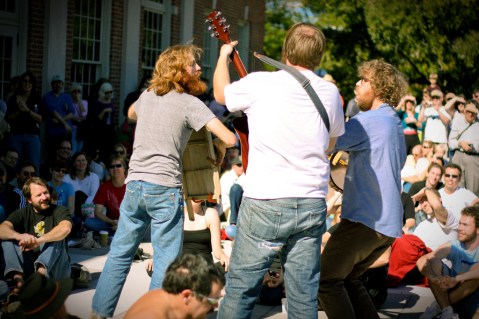
Megafaun serenades a Chapel Hill, North Carolina crowd, Image by Flickr user abbyladybug
Finally, it is worth mentioning how many papers address sound studies’ long-standing relationship with soundscapes, ecomusicology, and the environment. There is a panel called “Ecologies of Place” with papers on ecologically-minded music from places as far flung as India, Iceland, Appalachian Ohio, and Canadian parks. There is also a panel on “Urban Soundscapes,” including Robert Fry’s paper on sound, music, and branding at a hot spring resort and Mathew Robert Swiatlowski’s paper on the boom box and the Walkman in urban space.
Many in sound studies cite Jonathan Sterne’s critiques of ocularcentrism in cultural criticism. This conference encourages us to think beyond the air and stasis and shift our focus to the possibilities of liquid metaphors in cultural change.
—
Featured Image: One of Chapel Hill’s many ponds, at the Outdoor Education Center, Image by Flickr User Kat St Kat
—
Kariann Goldschmitt is an Adjunct Assistant Professor at New College of Florida and Ringling College of Art and Design. She holds a Ph.D. in Musicology from UCLA (2009) and was the 2009-2011 Mellon Fellow of Non-Western Music at Colby College in Maine. Her scholarly work focuses on Brazilian music, modes of listening, and sonic branding in the global cultural industries. She has published in The Journal of Popular Music Studies, American Music, Yearbook for Traditional Music, and Luso-Brazilian Review and contributes to the South American cultural magazine, Sounds and Colours.
—
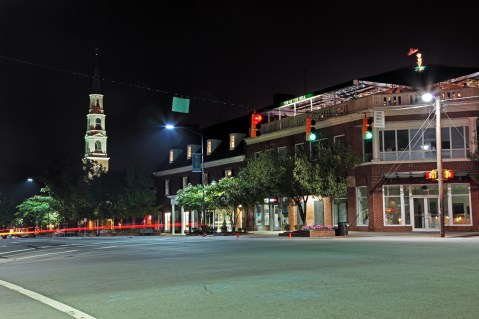
“Franklin Street, Chapel Hill” by Wikimedia user Caroline Culler, CC BY 3.0
Friday, March 14

So nice we put it twice, The James Taylor Bridge, Public Domain
.
Saturday, March 15

“Cheerleaders, UNC, 1989” by Flickr user North Carolina Digital Heritage Center, CC BY-NC-ND 2.0
.
Sunday, March 16
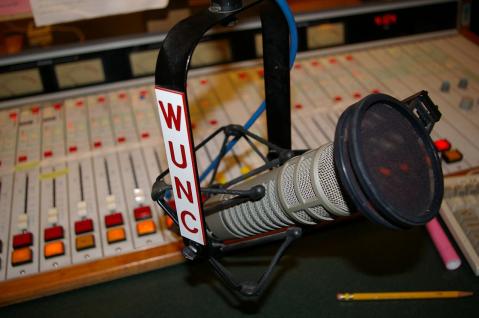
Chapel Hill’s finest, WUNC, image by Flickr user Keith Weston
Share this:


Current Top Posts





April 2021

January 2020

November 2019

October 2019

August 2019

April 2014

November 2017

March 2015

December 2017

October 2015
 Sounding Out!
Recent Comments