
Music Video as Process: “Revitalize” by T-Rhyme

What is a music video, anyway? Historically dismissed by film theorists as cinematically flawed or by the public as mere promotional snippets, music videos didn’t used to get the credit they deserve as a serious artistic medium. In the 1990s, Carol Vernallis challenged both notions, suggesting that they are actually a unique genre where music and visuals aren’t just paired—they communicate deeply with each other. Since then, scholars have taken diverse approaches to try to make sense of how film theory is applicable to these delicious nuggets of musical storytelling. For example, Phoebe Macrossan argues that Beyoncé’s Lemonade is a signal example of “film worlding,” indicating how the artist uses video to create her own intimate and all-encompassing environment. Additionally, Olu Jenzen and colleagues have found that political remix videos use recombinations of existing sounds and images to make rhetorical points that can challenge mainstream media reporting in real time. According to Stan Hawkins and Tore Størvold, from the perspectives of musicology or music theory, perhaps it is the video that amplifies the song’s harmonic structure or musical form, as suggested by their analysis of Justin Timberlake’s “Man of the Woods.”
Through skillful harmonic analysis or rhetorical analysis or cataloging of film techniques, scholars and critics now take music videos seriously. Yet, across interdisciplinary research approaches to music videos, what is largely taken for granted is that the music video is an object, a work to which various theories can be applied. What if we extend these approaches further and consider the music video not just as an object of analysis to be dissected, but as a representation of a creative process that entwines sound and vision in innovative ways to connect people and forge relationships? Such an analysis is especially possible when listening to independent creators who take an active role in conceptualizing, shooting, and editing their videos. By shifting our perspective to view the music video as documenting an ongoing creative and relational journey rather than solely as an object for analysis, we open up new possibilities for understanding the deeper significance of these works. Music videos can serve not just as vehicles for artistic expression, but as catalysts for strengthening bonds, preserving cultural knowledge, and fostering a sense of pride and resilience within communities.
Music Video as Process
In 2023, I co-organized a series of performances for Native Jam Night at UC Riverside, an annual music showcase featuring Indigenous artists from California and across Turtle Island. One way my colleagues and I honed in on guest artists was by asking students to listen to several playlists and recommend the music that spoke to them. The song “Revitalize” by T-Rhyme came up as a favorite. T-Rhyme has released music that tells personal stories and responds to contemporary social realities. At times, this music responds to her lived experience as a woman with Nehiyaw and Denesuline roots.
The music video for “Revitalize” is not only a popular extension of the song’s appeal, but an audiovisual series of connections and interactions. Paying attention to it in this way shows what can emerge from one kind of nontraditional listening posture, this one inspired by my conversations with T-Rhyme and also grounded in the way I have been opening my ears to her music. I first got to know T-Rhyme in-person when I invited her and MC Eekwol to perform as part of the Show & Prove hip hop event in 2018. We stayed in touch over the next several years.

As part of T-Rhyme’s return visit to California in 2023, we got to drive around and talk music business, have dinner with Native directors and actors as part of an Indigenous Storytelling event, go shopping, and get tacos at one of my favorite hole-in-the-wall spots. When it came time to make plans around the release for my book Sonic Sovereignty: Hip Hop, Indigeneity, and Shifting Popular Music Mainstreams, I knew it made sense to keep building on dialogues with musicians. Instead of just talking about myself, or even ideas that were already published, I wanted to keep the conversation going, continue listening, and find ways to share what I was hearing with more audiences. When I talked with T-Rhyme in the winter and spring of this year, then, it was to hear more about her creative process beyond any single project, to talk about what I was hearing and how I was listening, and to make space for that meaning making that almost approaches a musical flow that can bubble up out of a good dialogue.
Revitalization
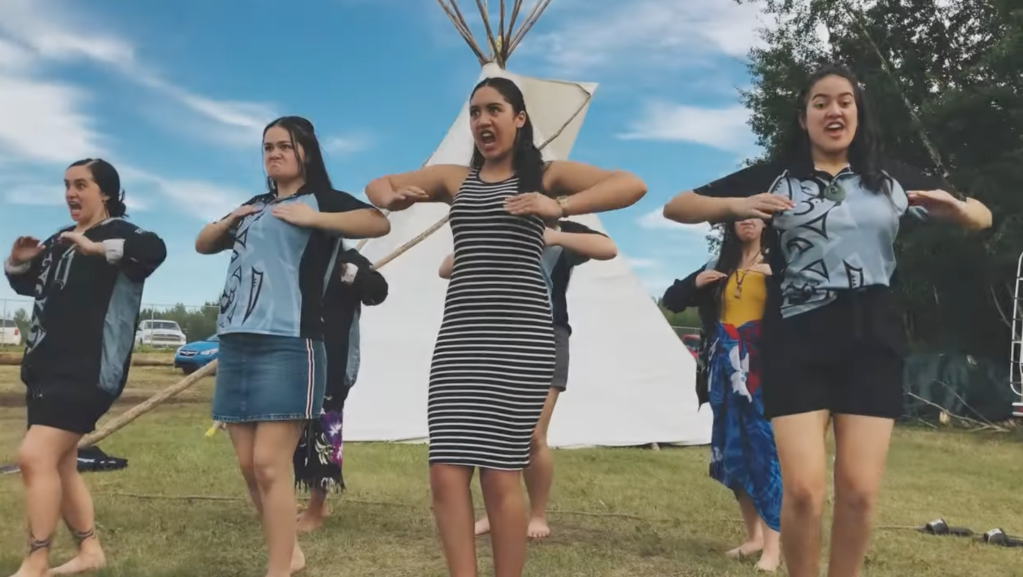
A years-long process led up to “Revitalize,” T-Rhyme told me, and there are goals for the song that stretch beyond the moment of recording. To make the video, T-Rhyme went out to ceremonial grounds with her family and her photographer cousin Tennille Campbell’s family, spending time out with buffalo so Campbell could record. Looking back, she went through over a year and a half of her recordings of family and friends to select moments of daily life to interweave with special moments of celebration.
To convey the importance of land with viewers, the rapper worked with her brother, who shared his drone landscape footage that he recorded where he lives in northern Saskatchewan. She filmed other pieces at a powwow in Treaty Six territory in Alberta, finding inspiration from old friends she reconnected with for the occasion, as well as other Indigenous musicians and dancers she met while looking to connect there. T-Rhyme delivers the chorus and rapped verses over a beat by Doc Blaze, while collaborators in the music video mouth key words, notably “revitalize,” to her audio. Each aspect of the video was made with family or friends, and together they encompass years of work and hopes for the future.

From her past work, T-Rhyme recalled that shooting a music video can be stressful and involve intense time pressure. Instead, she told me, “I wanted none of those vibes to be involved with this project. I wanted the whole entire thing to be good vibes. And positive because part of our healing is through laughter and joking and being together as family.”
So, what is “revitalization” in the context of making music with family and friends? For T-Rhyme, “These are people I trust, I grew with, I evolved with, I changed with. All these people make me feel good and that I’m proud of, that I want to show off.” Paying attention to how musicians choose to tell their stories and further relationships with others is part of recognizing their sovereignty through sound. Sonic sovereignty is an active process.
The notion of “sonic sovereignty” builds from Jolene Rickard’s determination in “Diversifying Sovereignty and the Reception of Indigenous Art,” that “the idea of our art serving Indigenous communities reinforced my understanding that sovereignty is more than a legal concept”(82), and Tewa and Dine scholar-filmmaker Beverly Singer’s working through what she refers to as “cultural sovereignty,” in Wiping the War Paint off the Lens: Native American Film and Video, “which involves trusting in the older ways and adapting them to our lives in the present”(2). It’s meaningful to move into celebration together, as T-Rhyme explains: “Part of revitalization, especially when it comes to our healing as Native people, is we need to remember love. We don’t need to be in survival mode all the time.”
Intergenerational Teaching
Generations of T-Rhyme’s family stretch throughout the video for “Revitalize”. In the first verse, the musician’s mother stands in a bright red ribbon skirt at the edge of the river, near a photo frame.Then this photo of the rapper’s grandparents smiles out from the rocky shores of a river. A kid in sneakers runs nimbly over these same rocks, generations converging at the water. When T-Rhyme raps in the chorus, “raise your fists high in the air right now,” viewers see her mother raising her fist, the river greenery behind her, then proudly holding the picture of her own parents.

Music videos are often associated with youth culture, especially in a North American context. Yet in process and in content, this music video showcases intergenerational teaching and learning, with the involvement of elders, parents, children, and friends, connecting embodied knowledge across generations. Men and boys teaching intergenerationally feature onscreen, notably a father and son in regalia and an entrepreneur who runs Cree Coffee Company. Community leaders and scholars across Turtle Island share stories of diverse Indigenous masculinities, highlighting the kinds of teaching, leadership, and care that men, boys, and masculine people share from the present into the future. T-Rhyme reflected, “we have men out here who are trying to be warriors still, in their own way, whether they’re dancing powwow, whether they’re running their own business, and just being present fathers.”

T-Rhyme described that over the years, her relationship with her mother has changed. And yet, they have an ongoing push and pull between being serious and being playful together. With her mom, she says, “laughter and joking is our medicine.” She laughed as she recalled that for filming, “we’d be trying to have a serious moment and I’d say ‘okay mom, stand in the water’ and she’d say, ‘okay, like this.’ ‘Yeah, that looks good. Rest your face. You look real Kookum right now.’ Just cracking jokes at her.” T-Rhyme uses a word for grandmother to kid with her mom.
The process of writing the lyrics, too, involved reflecting on the relationship she has had with her mom across the past, present, and future. T-Rhyme raps, “My mother is sacred, she’s a survivor for real, though it’s taken her and I so many decades to heal.” This comes from what the rapper describes as a way to highlight how her mom is a “survivor and somebody that I respect and ultimately, enabled and motivated me to do my own healing too.”
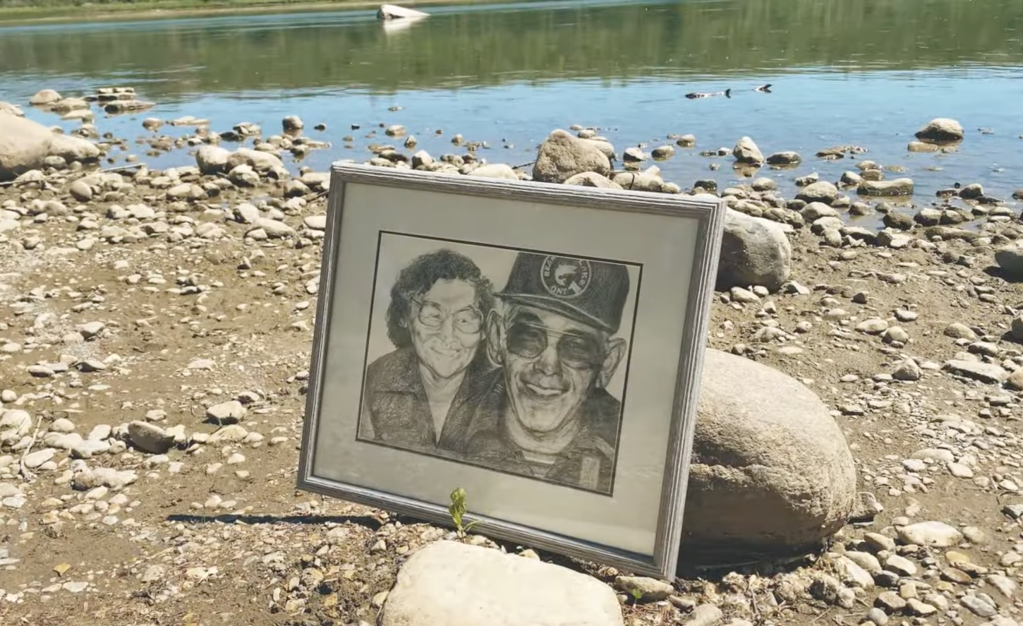
In the context of intergenerational healing, T-Rhyme’s music video, which involves multiple generations of her family, embodies Indigenous survivance –the active transition from mere survival to resilience—in the face of historical and ongoing colonial violence. T-Rhyme brought her grandparents into the filming through their photograph, and their living memory. She explained, “Without them, I wouldn’t be here, my kids wouldn’t be here and my mom wouldn’t be here. Speaking of revitalization, they were the ones that were the front lines of maintaining our culture through a literal, cultural genocide in our communities.” Since “they really had to do their part in maintaining our culture enough to survive through residential school,” she recalls, “It was important to me to acknowledge them as survivors.”
T-Rhyme included her daughter in ‘Revitalize,” as well as in other music videos, notably the title track on “For Women By Women.” She explains, “I always want to feature her because she’s such a powerhouse.” T-Rhyme’s visual narrative brings in a photo of her daughter dancing at one of her shows, and the rapper has made music videos with her son as well.
When they were all getting stir-crazy from COVID shutdowns, T-Rhyme and her kids made the video “Trap’d,” for which the rapper helped then-12-year-old Joaquem act as videographer. Teaching her son and daughter and giving them space to make their own art, she calls her kids her “heroes,” explaining, “I just love including them where I can.”
The Story Beyond the Video
Watching and listening to the work of independent artists, such as T-Rhyme, complements existing writing on music video that comments on mainstream names like Madonna and Beyoncé. Furthermore, approaching music videos as processes through which relationships are built and furthered rather than solely as objects for analysis invites other forms of listening, especially modes that acknowledge the network of people whose interactions create the sounds that vibrate audience members’ eardrums.

The people who click play on the finished music video make up what is traditionally understood as its audience. By witnessing relationships behind musical choices, we can recognize that there is another group, too, that the video is for: media professionals, family members, and community participants who work together to create it. Making a piece as complicated as a music video can become an occasion for all of these actors to further and strengthen relationships: filming may offer the excuse everyone needed to visit an important location together, or storyboarding brings people in the room together who hadn’t been able to find the time, or the song provides a vehicle for talking about a topic that would otherwise be repeatedly put on the shelf for another day. Listening for process in this way can encourage audience members who view the video, too, to use this communally crafted artistic labor as an invitation for connection.
“Revitalize” particularly serves as an example of how making a music video can involve collaboration with family and friends over an extended period, encompassing years of documentation and strengthening relationships. In addition to sharing a past and inspiring interaction for the making of the video, the song carries hopes for a future. As T-Rhyme says, “I want “Revitalize” to be a catalyst for healing and pride.” Paying attention to how musicians tell their stories and build relationships through music videos is part of recognizing their sovereignty and cultural continuity through sound and visuals.
—
Featured Image: Still from music video for “Revitalize” by T-Rhyme (2021)
—
Dr. Liz Przybylski (pronunciation) is an ethnomusicologist and pop music scholar working in hip hop and electronic music in the US and Canada. Dr. Przybylski is an Associate Professor of Ethnomusicology at the University of California, Riverside. A graduate of Bard College (BA) and Northwestern University (MA, PhD), Liz’s research appears in Ethnomusicology, Journal of Borderlands Studies, and IASPM Journal, among others. Dr. Przybylski has presented research nationally and internationally, including at the Society for Ethnomusicology, Native American and Indigenous Studies Association, Feminist Theory and Music, International Association for the Study of Popular Music, and International Council for Traditional Music World Conferences. Recent and forthcoming publications analyze how the sampling of heritage music in Indigenous hip hop contributes to dialogues about cultural change in urban areas. Dr. Przybylski has also published on popular music pedagogy. Liz was awarded a National Endowment for the Humanities Faculty Fellowship and a Fulbright Fellowship. Liz’s most recent book Sonic Sovereignty: Hip Hop, Indigeneity, and Shifting Popular Music Mainstreams was published in July 2023 (NYU Press). This follows Liz’s first book, Hybrid Ethnography: Online, Offline, and In Between (SAGE Publications, 2020) which develops an innovative model of hybrid on- and off-line ethnography for the analysis of expressive culture. In addition to university teaching, Liz has taught adult and pre-college learners at the American Indian Center in Chicago and the Concordia Language Villages program of Concordia College in Bemidji. On the radio, Liz hosted the world music show “Continental Drift” on WNUR in Chicago and has conducted interviews with musicians for programs including “At The Edge of Canada: Indigenous Research” on CJUM in Winnipeg. Dr. Przybylski served as the Media Reviews Editor for the journal American Music, the President of the Society for Ethnomusicology, Southern California and Hawaii Chapter, and on the Society for Ethnomusicology Council.
—

—
REWIND! . . .If you liked this post, you may also dig:
Sounding Out! Podcast #40: Linguicide, Indigenous Community and the Search for Lost Sounds–Marcella Ernest
The “Tribal Drum” of Radio: Gathering Together the Archive of American Indian Radio–Josh Garrett Davis
Sonic Connections: Listening for Indigenous Landscapes in Kent Mackenzie’s The Exiles–Laura Sachiko Fugikawa
Unsettling the World Soundscape Project: Soundscapes of Canada and the Politics of Self-Recognition–Mitchell Akiyama
Becoming Sound: Tubitsinakukuru from Mt. Scott to Standing Rock–Dustin Tahmahkera
EPISODE 60: Standing Rock, Protest, Sound and Power–Marcella Ernest
A Tribe Called Red Remixes Sonic Stereotypes–Christina Giancona
I’m on my New York s**t”: Jean Grae’s Sonic Claims on the City––Liana Silva
How not to listen to Lemonade: music criticism and epistemic violence–Robin James
Share this:

SO! Reads: Todd Craig’s “K for the Way”: DJ Rhetoric and Literacy for 21st Century Writing Studies

or, Last Summer a DJ Saved My Life
“Hip Hop does work that a lot of other things don’t do” Young Guru (viii).
The way that we imagine English Studies, specifically Composition and Rhetoric (Comp/Rhet), today needs a radical shift. Specifically, we need new techniques for Writing Studies pedagogy to reach students in a more meaningful and contemporary fashion. Todd Craig’s “K for the Way:” DJ Rhetoric and Literacy for 21st Century Writing Studies (Utah State University Press, 2023) both documents the need for this shift and enacts it. Craig’s work enables us to recognize the pedagogical impact on writing that Hip Hop has had over the last 50 years—specifically how the DJ/deejay as twenty-first century new media reader and writer teaches students not just to think about sound, but to compose with it, too.
An Associate Professor of English at CUNY Graduate Center, Craig has little desire to shake the foundations of English Studies, but instead do what Hip Hop has always done—make a way where there is none. The point is to (re)imagine new ways of doing old things; in this case, of teaching and reaching students who arrive in First-Year Writing courses. “K for the Way” does more than demonstrate the ways in which the DJ is a twenty-first century pedagogical savant; it also teaches readers, using DJ Rhetoric and DJ Literacy, about the culture that makes them possible.
This summer, a DJ really did save my life: as someone who feels consistently overwhelmed by the vast nature of scholarly discourse, “K for the Way” gave me a chance to breathe, to identify with something that has been a part of me for the better part of my life, and to see myself in a conversation about a topic I am more than passionate about. For Craig, community, history, and culture are the core of his mission as a scholar, educator, and DJ.
Craig defines several new terms that bridge the worlds of Hip Hop and Composition and Rhetoric. First, we have DJ Rhetoric, which can be understood as the modes, methodologies, and discursive elements of the DJ. For Craig, it “encompasses the quality of oral, written, and sonic language that displays and expresses sociocultural, historical, and musical meanings, attitudes, and sentiments” (23). Next, there is DJ Literacy, which is the “sonic and auditory practices of reading, writing, critically thinking, speaking, and communicating through and with the rhetoric of Hip Hop DJ culture” (23). These two definitions, operating in conjunction, situate the DJ as a kind of griot, a figure that Adam Banks invokes as a carrier of tradition, stories, and histories in Digital Griots: African American Rhetoric in a Multimedia Age (Studies in Writing and Rhetoric) (2011). The mission of the griot is to carry stories and translate them to various audiences while adhering to the rhetorical conventions and modes of whichever audience they find themselves before; similarly, the DJ is responsible for “communicating the pulse and the evolution of a culture that once sat as ‘underground’ but now has dramatically evolved to ‘mainstream’” (25). These definitions serve as guides for the reader as they are tethered to all of the concepts and (re)imagining happening throughout the book.
Craig is intimately close to the work he is doing. He lives and breathes Hip Hop; and what should a book about the Hip Hop DJ be if not written by someone who embodies the role, culture, and practice of DJing? Craig uses a a research methodology known as hiphopography in which Hip Hop ways of being are central to studying it. Coined by James G. Spady, this term is defined as “a shared discourse with equanimity, not the usual hierarchical distancing techniques usually found in published and non-published (visual-TV) interviewers with rappers” (27). Craig states that hiphopography “allowed me to engage a variety of Hip Hop DJs while also maintaining my own shared values and sentiments around my love of Hip Hop culture and DJ practices” (28). Hiphopography constructs a conversational, intimate space—touched by history, culture, and music—wherein the interviewer and interviewee can engage and produce meaningful data. This methodology—and Craig’s many interviews with DJs about their craft—becomes part of the text’s core as we begin to see how Craig’s two-pronged argument connects DJ Rhetoric and DJ Literacy to bring both life throughout the book.
If one understands the DJ as a twenty-first century rhetorician and compositionist and considers the ways in which the DJ is a cultural meaning-maker, sponsor, and master sampler, then one can clearly see the connections between the DJ, DJ culture, and Writing Studies in the contemporary moment. In the first part of his argument supporting the significance of DJ Rhetoric and Literacy in writing pedagogy Craig asserts that, “it is essential that the academy at large works to strengthen students’ undergraduate experiences by reinforcing their racial, ethnic, and cultural ties” (14). This perspective provides the foundation for the second part of his argument that “the DJ (and thus, Hip Hop DJ culture) is the epicenter of Hip Hop culture’s creation” (23). Taken together, these dynamic arguments make the claim that the DJ offers a powerful model of a new media reader, writer, and critic. Today, our students come to writing classrooms with a “vast array of cultural capital. . .in their philosophical and cultural backpacks” (107). If we, as writing teachers, want to honor that cultural capital and build with it, we should follow Craig’s lead and look toward the DJ for some pointers on how to expand students’ access to a language that represents them.
Readers will also see a developing research agenda in “K for the Way” that thinks toward changing the culture beyond the present, while acknowledging the groundwork laid for the current moment and building genealogically upon that foundation, just as DJs do with sampling. Craig best exemplifies this when he writes, “in order to fully engage in a conversation—whether intellectual, pedestrian or otherwise—that discusses what DJ Rhetoric might look like, one has to think about the cultural and textual lineage of sponsors and mentors” (51). This notion of textual lineage is borrowed from Alfred W. Tatum who explains the term as “Similar to lineages in genealogical studies” and continues to note that textual lineage is “made up of texts (both literary and nonliterary) that are instrumental in one’s human development because of the meaning and significance one has garnered from them” (Tatum, qtd. in Craig, 51). Craig builds upon Tatum’s idea by introducing sonic lineage, which follows the same logic as Tatum’s term, but through sound (51). What becomes apparent, is that the DJ, as a cultural sponsor, can deploy sonic lineage as a way of communicating history and culture to members within and outside of the Hip Hop community and, more specifically, DJ culture.
Chapter three, especially, works at the interdisciplinary junction of Sound Studies, Writing Studies, and Hip Hop studies to convey a clear critique of the dominant discourse surrounding plagiarism. Craig is unsatisfied with the black-and-white conception of plagiarism as it presents itself in the academy. As a result, he moves to inquire “how we as practitioners [of teaching composition] approach citation methods and strategies within a twenty-first century landscape” (75). Craig promptly turns us toward the DJ’s conceptualization of sampling as a citation practice. Sampling in Hip Hop, as defined by Andrew Bartlett, “is not collaboration in any familiar sense of the term. It is a high-tech and highly selective archiving, bringing into dialogue by virtue of even the most slight representation” (77). The highly selective archiving, a.k.a crate diggin’, builds upon the idea of sonic lineage.
For the DJ, the process of diggin’ through crates to find that right sound, that one joint that going to get the party jumpin’, is a key element in the practice of “text constructing” (79). The Hip Hop sample functions alongside an understanding, offered by Alasdair Pennycook, of “transgressive-versus-nontransgressive intertextuality,” which, for an academic audience, complicates the idea of plagiarism.. The DJ becomes a figure through which we can understand intertextuality, sampling becomes the practice through which we can see parallels to citation through text construction, and the mix is where we begin, with the help of Pennycook, to complicate notions of plagiarism. In this chapter, readers are able to understand through sound.
Subsequently, Craig explores the concept of revision as it relates to the DJ’s ability to engage with an emcee on the point of “remix as revision” (107). Building from on Nancy Sommers’ article, “Revision Strategies of Student Writers and Experienced Adult Writers,” Craig lifts and examines four strategies of revision through the lens of the Hip Hop DJ: deletion, substitution, addition, and reordering (Sommers, qtd. in Craig, 107). These practices not only identify the Hip Hop DJ as a master of revision but also center the DJ, in the context of the writing classroom, as a key figure for understanding editorial practice. As teachers of writing—and especially for those of us who are deeply connected to Hip Hop culture—we have traditional scholars, such as Sommers, but we also have the DJ as cultural scholar, which offer new models with communicating and practicing the craft of writing in the twenty-first century.

Chapter Five, which is co-written by Craig and Carmen Kynard, centers on six women DJs: DJs Spinderella, Pam the Funkstress, Kuttin Kandi, Shorty Wop, Reborn, and Natasha Diggs to work toward developing a “Hip Hop Feminist Deejay Methodology” that positions women in Hip Hop culture as a key source of key knowledge production–as meaning-makers, theoreticians, storytellers–and as tastemakers in twenty-first century discourse about education, technologies, race, and gender. This chapter is also apt representation of hiphopography at work, as both Craig and Kynard ground their position in the interviews of these six women deejays, “deliberately situating their stories first… as opposed to the usual academic expectation that a tedious delineation of methods and an extant literature review come before a discussion of the actual subjects” (123).
In part, this chapter focuses on the affordances and limitations—political, social, and economic—present in DJ culture, and the effects it has on these women DJs to make it do what it does. For example, the introduction of the digital software Serato has simultaneously made access to music easier, and complicated access to the cultural archive that made the music possible in the first place. Natasha Diggs, states, “While she values the ability to access mp3 files so readily, she argues a deejay’s research and craft suffer, because many times the mp3 files do not include information about an artist’s name, history, or band” (129). Pam the Funkstress ties this sentiment up nicely when she argues, “There’s nothing like vinyl” (129).
The final chapter is fashioned like a Hip-Hop outro, with Craig leaving with a few parting ideas. Most important among them is his vision of “Comp 3.0,” a version of Comp/Rhet wherein “we have to push the scope of writing and rhetoric—with or without the field’s permission or acknowledgement” (171). For scholars of composition and rhetoric and writing teachers who ground part of their understanding of the field in Black Studies, Hip Hop, and the DJ, we gotta make it do what it do, regardless of who says what! Comp 3.0 does not seek approval or recognition from the powers that be; instead, it focuses on the new ways of thinking and writing, and of teaching, that we are able to conjure—with history, culture, and practice propelling us—when we invoke that which got us to the academy in the first place.
What is at stake, for those of us who engage Black Studies, Sonic Studies, Comp/Rhet, and Hip Hop Studies as critical points of departure for the teaching of writing, is that our presence—our being, methods, and our teaching—is crucial for developing a genealogy of scholars and world citizens who are aware of the myriad possibilities present in the twenty-first century.
—
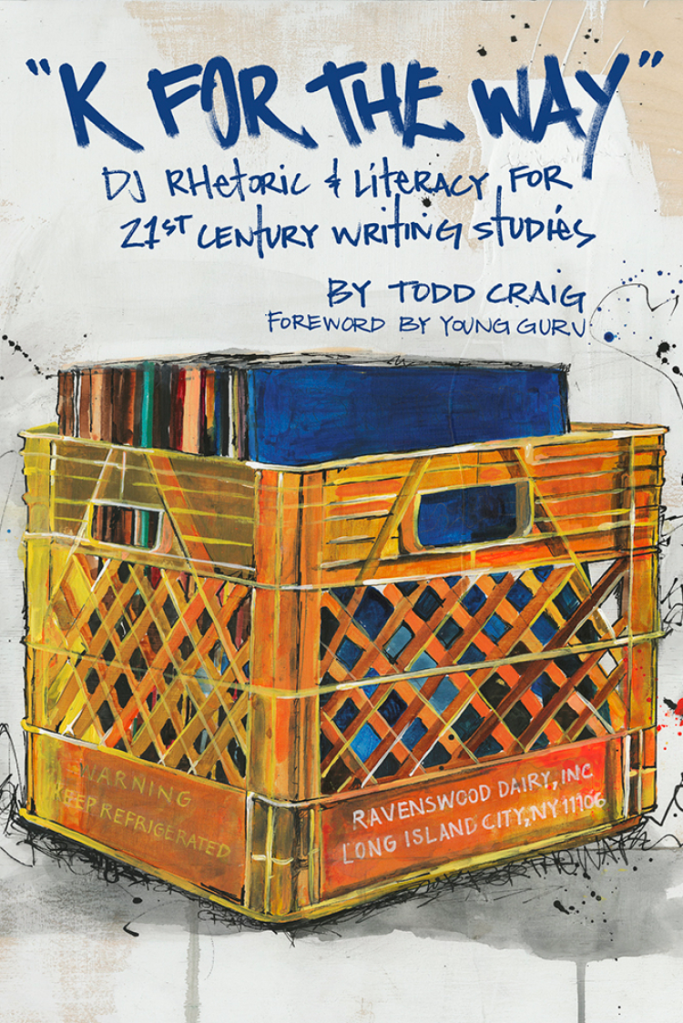
Featured Image: Cover Art for “K for the Way”: DJ Rhetoric and Literacy for 21st Century Writing Studies by Cathey White
—
DeVaughn (Dev) Harris is a PhD student studying composition and rhetoric in NYC. His academic interests are mainly in writing studies and pedagogy, but those are often supported by other sub-interests in music, creative writing, African American studies, and philosophy. When not reading or writing, Dev enjoys making music wherever and however possible. He has published music before under the collective AbstraktFlowz.
—

REWIND! . . .If you liked this post, you may also dig:
“Heavy Airplay, All Day with No Chorus”: Classroom Sonic Consciousness in the Playlist Project—Todd Craig
Deep Listening as Philogynoir: Playlists, Black Girl Idiom, and Love–Shakira Holt
SO! Reads: Steph Ceraso’s Sounding Composition: Multimodal Pedagogies for Embodied Listening--Airek Beauchamp
The Sounds of Anti-Anti-Essentialism: Listening to Black Consciousness in the Classroom- Carter Mathes
Contra La Pared: Reggaetón and Dissonance in Naarm, Melbourne–Lucreccia Quintanilla
Ill Communication: Hip Hop and Sound Studies–Jennifer Stoever
SO! Amplifies: Regina Bradley’s Outkasted Conversations
A Listening Mind: Sound Learning in a Literature Classroom–Nicole Brittingham Furlonge
Share this:


Current Top Posts





April 2021

January 2020

November 2019

October 2019

August 2019

April 2014

November 2017

March 2015

December 2017

October 2015
 Sounding Out!
Recent Comments