
Making His Story Their Story: Teaching Hamilton at a Minority-serving Institution
In the summer of 2016, optimistic about a full-time teaching position at a minority-serving institution, yet unsure about what the U.S. election would mean for immigrants’ rights, I played the Hamilton soundtrack daily. Lin Manuel Miranda wrote the Pulitzer-prize winning musical inspired by Ron Chernow’s biography on the United States’ founding father because, he believed, Alexander Hamilton’s life embodied hip hop. My repeated listenings urged me to assign the musical as homework in my courses.
Colleagues with whom I engage on Twitter provided resources with which to begin. A public historian, Lyra Monteiro, wrote an important review for Public History,“Race-Conscious Casting and the Erasure of the Black Past in Lin-Manuel Miranda’s Hamilton,” which provide one key angle of critique. Latinx Theater scholar and SO! writer Trevor Boffone created an online syllabus, #Syllabus4Ham, that provided important critiques of the musical, news coverage of its growing popularity, and initial scholarly analyses of the cultural historical significance of the musical’s popularity. Pedagogically, Miranda’s archival research in addition to his belief that Hamilton’s life embodied hip hop sparked an interest to bring the production to my gender and interdisciplinary studies classrooms. While colleagues works’ inspired ways to discuss the musical in class, post-election coverage and the release of the Hamilton Mixtape provided more material to discuss. Teaching children of hip hop whose lives embody the struggle that Miranda made the central force behind his re-writing of Hamilton’s contribution to United States’ history, I wanted to develop lessons drawing on those relations.
By the spring 2017, I had done preliminary reading on the syllabus Boffone provided and replaced the musical with the Mixtape as my car ride soundtrack. When organizing my syllabus, I assigned tracks from the mixtape against the musical’s soundtrack with the intent of assigning students excerpts in both both my introductory Gender Studies course and Interdisciplinary Research Methods courses, but with a unique twist for each class. Gender Studies engaged with the content contextualized by discussions of immigration and citizenship. I assigned my Research Methods course Monteiro’s critique of race-consciousness of the musical against the mixtape and the musical. While students were in solidarity with Montiero’s argument, I invited them to consider Miranda’s original intent, the mixtape, which may have informed the themes Miranda prioritized.
Few of them had heard of the musical before my class and less had heard of the mixtape. Their limited exposure necessitated historicizing both Miranda’s career and the evolution Hamilton’s, which begins with 2009 Miranda’s White House performance. Miranda, invited by President Obama to perform a song from his previous hit In the Heights, instead decided to introduce his new project, a mixtape based on Alexander Hamilton.
Through discussion, I proposed that the students consider that the production, in 2009 envisioned as an album, served as a strategic catalyst to bring attention to his forthcoming mixtape. That attention evolved into encouraging Miranda to produce the musical; it would take a few more years till the intended mixtape was produced. Even though produced later, I speculated that the mixtape thematically benefited from the popularity of the musical because the musical’s focus on Alexander Hamilton rewrites the context of the mixtape.
Teaching Hamilton the musical and the mixtape felt politically necessary at a minority serving institution in this historical moment of anti-immigrant, and anti-black sentiment. Having, in the past, worked with other youth to mobilize youth empowerment through hip hop, Hamilton provided an avenue in which I could discuss its political potential because of its popularity not only in spite of it. In breaking down Miranda’s cultural and political significance, I summarized the evolution of awards he and the musical’s cast had won as well as the preliminary cast’s reflections on participating in Hamilton, along with what it means to have the success of the musical produce a wider audience for the mixtape.
After more than a semester working with students who grow frustrated with the traditional research paper and because of my own work producing research-based fiction and poetry, teaching the musical and mixtape provided an important example of research-based art. Because some students approach interdisciplinary research methods not understanding the possibilities of the relationship between art and research and some students are unsure of how to connect learning outcomes to their aspiring performance careers, I find teaching Miranda’s work remains necessary. Further, Miranda provides an avenue through which I could relate to students because of our shared interest in music as well as our conflicted relationship with consuming hip hop.
Teaching a student population that is 25% Latinx and who are either directly or indirectly affected by immigration policies, my students related, often quite deeply and intimately, to the message of the song. I watched their faces as they listened, particularly to “Immigrants (We Get the Job Done),” and their kinesthetic responses showcased what many of us ache for our students to experience: wonder, appreciation, and the illumination of insight.
I then guided them to hone in specifically on Puerto Rican rapper Residente rapping about the Mexican immigrant struggle in Spanish, emphasizing how he sonically and rhetorically urges a Latin pan-ethnicity while using his U.S. citizenship privilege to historicize border crossing Mexicans. Residente’s lyrics create an opportunity to discuss Puerto Ricans’ cultural reality of being perceived as immigrants while being legally defined as citizens, all the while calling back to the lyrical connection to the “Battle of Yorktown” from the musical.
I highlighted Miranda’s rhetorical strategy in building a song around one line that contexts changes across either song. The “Battle of Yorktown” centers on the contributions of immigrants to gaining freedom. During the lecture, I drew connections between the lyric that would become a song and the lyric subtly referencing the lack of freedoms for black people who were enslaved in the U.S. I asked about the parallels before explaining them, using the intentionality behind creating and compelling a racially diverse cast to script a narrative about who could and who had built the United States. What does it mean to hear these voices emanating from this cast, telling this story?
Pedagogically, teaching music in either course served the intent of reimagining the purpose and potential of sound, whether from a musical or a mixtape, as a site of critical thinking. Popular musicians’ cultural authority slowly decenters the white fragility I have come to expect from difficult conversations such as the ones Hamilton and The Hamilton Mixtape allow me to have. Furthermore, the call-and-response between the mixtape and the musical work address the silence of the unrecognized, exploited, and/or enslaved labor that continues to build this country. For my students, hearing musicians they like or who perform in their favorite genre, speaking truth to power about poverty, struggle, and not being thought of as good enough shifted not only our classroom energy, but many students’ perspectives.
Teaching the Hamiltons helped my student population make sense of their “invisible” status in the U.S. and want more than what’s expected. They gained something in being able to hear their stories in the classroom—not just read them on the page—but hear them from people who look and sound like them. Hungry for more material that speaks to their disenfranchisement, my students wondered why more songs that sound the complex beauty of our resilience and struggle are not on the radio. They wanted to know how they can ask for more.
—
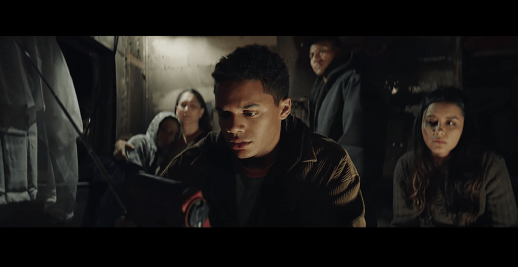
Featured Image: Screen capture from “Immigrants (We Get the Job Done)” remix video
—
Erika Gisela Abad, Ph.D, is a Queer Latina poet, born and raised in Chicago. She received her PhD in American Studies in 2012. Since completing her degree, she has worked as: a customer service associate and a scheduler at a phone interpreter call center, head counselor for a caddy program affiliated with a high school scholarship fund, field director for an education policy campaign, an oral historian and ethnographer. Since August 2016, she has been a full time assistant professor teaching gender studies. Twitter: @lionwanderer531; @prof_eabad
—
 REWIND!…If you liked this post, you may also dig:
“Don’t Be Self-Conchas”: Listening to Mexican Styled Phonetics in Popular Culture*–Sara V. Hinojos and Dolores Inés Casillas
“Ich kann nicht”: Hearing Racialized Language in Josh Inocéncio’s Purple Eyes (Ojos Violetas)–Trevor Boffone
Moonlight’s Orchestral Manoeuvers: A duet by Shakira Holt and Christopher Chien
The Sounds of Anti-Anti-Essentialism: Listening to Black Consciousness in the Classroom- Carter Mathes
Share this:

The Queer Sound of the Dandiya Queen, Falguni Pathak


co-edited by Praseeda Gopinath and Monika Mehta
Our listening practices are discursively constructed. In the sonic landscape of India, in particular, the way in which we listen and what we hear are often normative, produced within hegemonic discourses of gender, class, caste, region, and sexuality. . . This forum, Gendered Soundscapes of India, offers snapshots of sound at sites of trans/national production, marketing, filmic and musical texts. Complementing these posts, the accompanying photographs offer glimpses of gendered community formation, homosociality, the pervasiveness of sound technology in India, and the discordant stratified soundscapes of the city. This series opens up for us the question of other contexts in India where sound, gender, and technology might intersect, but, more broadly, it demands that we consider how sound exists differently in Pakistan, Sri Lanka, the Maldives, Bangladesh, Bhutan, Nepal, and Afghanistan. How might we imagine a sonic framework and South Asia from these locations? —Guest Editors Praseeda Gopinath and Monika Mehta
For the full introduction to the forum, click here.
To read all of the posts in the forum, click here.
—
The late 1990s was a pivotal time for activism around queerness in India. The violent response of the Hindu right to Deepa Mehta’s Fire (1998), a film portraying a romantic and sexual relationship between two women, prompted widespread debate on the question of censorship generally and of sexual-minority rights in particular. By rendering homosexuality explicit in its visuals and dialogues, and charting a linear trajectory of queerness—the protagonists move from unhappiness to happiness, denial to acceptance—Fire valorizes “coming out.” In the film, as in liberal strands of LGBT activism, it matters not only that one is out, but that one is seen as such. The premium placed on visibility in this formulation is undercut by the “queer” figure of Falguni Pathak. A tomboyish singer with a high-pitched voice, Pathak shot to fame with her debut album Yaad Piya Ki Aane Lage in the same year that Fire was released in India. Her performances mobilize disparate, even contradictory, signs of gender and sexuality at once, inviting us to examine the relationship between visuality and aurality in constructing queerness.
Falguni Pathak’s stardom is typically understood in the context of economic liberalization and the reconfiguration of Indian public culture that followed. The 1990s boom in the music industry was facilitated by the spread of satellite television, which gave non-film singers a new platform and a new set of audiences. Pathak’s “cute” and catchy love songs circulated endlessly on television countdown shows, turning her into an unlikely sensation. I say “unlikely” because Pathak’s apparent tomboyishness seemed at odds with the hyper-femininity and heteronormativity of the narratives in her music videos. Romantic quests, schoolgirls giddy with love, feminine bonding over make-up and men—these are standard features of Pathak’s videos, as is her own smiling presence as the singer-narrator. Through her gestures and lyrics, she comments on the lovesick teen’s plight and steps in occasionally to comfort or help the young girl, as in her first hit, “Chudi.”
For instance, in “Maine payal hai chhankai” (“The tinkling of my anklets,” 1999) she cheers on a group putting on a dance and puppet show for a school function. In songs like “Chudi/Yaad piya ki aane lagi” (“Bangles/I remember my lover,” 1998), “O piya” (“O beloved,” 2001), and “Rut ne jo bansi bajai” (“The music of the weather,” 2012) she is portrayed as a pop star.
The singer-as-pop-star was a common trope in early Indipop music videos (Kvetko). But Pathak dressed very differently than other pop stars. Whether on or off screen, she was (and is) always in men’s clothing, with a short, unfussy haircut and little make-up. Pathak’s style was mirrored on occasion by a minor character in her music videos. (“Chudi” includes a tomboyish school girl who struggles with the dance moves her friends choreograph.) Thus, Pathak’s visible presence in her videos brushed against the pitch, timbre, and style of her singing, which together articulated a hyper-feminine pop sensibility.
This sense of a “mismatch” (Fleeger) continues in Pathak’s contemporary performances. She is the most sought-after vocalist for Navratri festivities in Mumbai each year. On each night of this nine-day long Hindu festival, the “Queen of Dandiya” appears on stage dressed in a brightly colored kurta, vest, and trousers, and sings traditional Gujarati songs and hymns. The women in her audience dress more conventionally and more elaborately, in saris, salwaar kameez, and ghaghra-cholis. They dance in circles, performing recognizable garba moves. Meanwhile, Falguni Pathak saunters around the stage, engaging cheerfully with her fellow musicians and fans. Neither Pathak’s clothes nor her unfeminine dance moves bother the revelers as they dance the night away. For example, note how Pathak sways and rocks to the beat 34 seconds into this lively 2012 stage performance of Suneeta Rao’s hit song “Pari hun mein.”
Falguni Pathak’s temple performances at other times of the year are similar. They draw huge crowds unconcerned with the apparent mismatch between sound and image in her star persona. She tends to be as immersed in the devotional songs she sings as her audience. But her movements, plain clothes, and floppy hair-style make her look more like the male percussionists who accompany her, rocking and whipping their heads from side to side as they keep the beat, than the middle-class women clapping and singing along.
Performative traditions of mimicry and cross-dressing abound in India. But Pathak’s gender performance does not align with those religious, folk, and filmic traditions (and tropes) because it never registers as masquerade. The very casualness of her look, the fact that she dresses in t-shirt and trousers in all of her public appearances, suggests that this is not a temporary or theatrical adoption of a gender role. When asked in interviews why she eschews traditionally feminine clothing, Pathak always responds that she never has worn anything other than pants and t-shirts and is comfortable as she is. There were certainly other pop stars in the 1990s whose musical performances had masculine elements to them. Recall, for instance, Shweta Shettty’s suited look in “Johnny Joker” (1993). But none of Pathak’s peers sported a butch look as consistently and nonchalantly as she did—and none of them sang in as saccharine a voice. After six decades of Lata Mangeshkar’s vocal hegemony in Hindi cinema, such a “sweet,” contained, and unadorned voice has come to represent ideal Indian femininity. Pathak sounds charming and benign in her songs and interviews, but she does not dress the part.
 Pathak’s challenging of conventional gender norms through her appearance and through the fact that she has never been married raises the specter of queerness in public discourse. But even that is difficult to pin down. Popular commentators and fans sometimes suggest that she looks like Kiran Bedi, a high-ranking (retired) police officer who enjoys celebrity status, making it hard to read the masculine details of Pathak’s persona as “gay.” Even as she is a queer icon (Giani), Pathak never comments on her sexuality or love life. She either evades questions about relationships or simply states that she is single. Where some celebrities come out publicly or keep alive innuendoes about their sexuality (Singh), she treats it as a non-issue. All in all, what we get in Falguni Pathak’s music videos and star persona is a queerly gendered performance that seems both utterly “natural” (because it seems comfortable and casual) and profoundly mismatched.
To be clear, my argument is not so much that Falguni Pathak looks or sounds queer. The latter point is as hard to prove as the former is easy. If, for just a second, we manage to shut out of our mind’s eye the image of Pathak singing, her voice sounds thoroughly conventional. She sings in a traditional idiom, of traditional themes. No matter how intently I listen, no “queer timbre” (Bonenfant, Chaves Dasa), no “butch throat” (Glasberg) reaches out to touch me. Thus on the one hand, Pathak, like the other “mismatched women” Jennifer Fleeger writes about, confounds heteronormative expectations about gender and sexuality. On the other, her voice eludes “queer listening” (Bonenfant). What do we do with a queer figure who doesn’t sound queer? How might we understand her voice vis-à-vis queerness in Indian public culture? How do her live performances today continue to disrupt the emphasis on visibility in queer studies and politics—that is, the fixation on visual representations and “coming out” of the closet? Finally, how might Pathak’s “vocalic body” (Connor) help us conceive of the intersection of aurality and queerness in South Asian public culture?
Falguni Pathak intervened in a cultural field that was just beginning to deal with LGBT visibility. This becomes apparent when we remember that the 1990s was a period not just of economic liberalization but of vibrant queer activism as well. Pathak’s non-feminine image was startling for a pop star, but her voice was familiar and “good.” Her safe sound allowed her to push the boundaries of desire in televisual representations of the time. But it did more than that, too. The disjuncture between her feminine voice and butch look was critical to the complex landscape of desire her music videos evoked. It created space for ambiguity and incongruity amid charged debates about alternative sexual identities.
In “Main teri prem diwani/Indhana winva” (“I am madly in love with you,” 2001), Pathak stars as the neighbor to whom the protagonist turns for advice in matters of love. In an amazingly campy move, Pathak urges the young woman to seduce her lover by donning outfits inspired by Moulin Rouge (2001), specifically the song “Lady Marmalade” (00:36-00:55), and The Mummy Returns (2001) (1:59-2:03). Queerness is also writ large in “Meri chunnar udd udd jaye” (My scarf flies away, 2000), where Pathak appears as the beloved friend of a young girl in exile. The girl misses her friend intensely and attempts to recreate the dance moves and games she played with her older friend, this time with another mysterious woman who steps out of a painting.
Men’s roles in this and other Falguni Pathak music videos are ambiguous at best (Giani). Thus, despite the happy ending to the teen love stories, what lingers is Pathak’s simultaneous disruption and enabling of straight romance. This is why she is remembered fondly as a queer icon, even as the music scene in India has moved on from the “cuteness” of the 1990s. She offered LGBT audiences a way to read and revel in non-normative desires (Giani), without completely unseating “traditional” ways of living and loving.
The broader lesson in Falguni Pathak’s performances is that we cannot think of visuality apart from aurality, and vice versa. No matter how hard NBC’s “The Voice” tries to convince us (Tongson), we cannot in fact understand the sound of a singer’s voice as separate from the image of her as a performer and the contexts in which she emerges on the scene. It is not Pathak’s tomboyish appearance so much as the apparent disjuncture between that look and her voice that is key. What is queer about her voice is the look of it.
—
Featured Image: Falguni Pathak’s classic pose.
—
Pavitra Sundar is Assistant Professor of Literature at Hamilton College, where she teaches courses on global film and literature. Her scholarly interests span the fields of cinema studies, sound studies, postcolonial literary and cultural studies, and gender-sexuality studies. She is currently completing a book manuscript on the politics of Bollywood film sound and music. Her work has been published in journals such as Meridians, Jump Cut, South Asian Popular Culture, and Communication, Culture, and Critique, as well as in anthologies on South Asian and other cinematic traditions.
—
REWIND!…If you liked this post, you may also dig:
Ritual, Noise, and the Cut-up: The Art of Tara Transitory—Justyna Stasiowska
Moonlight’s Orchestral Manoeuvers: A duet by Shakira Holt and Christopher Chien
If La Llorona Was a Punk Rocker: Detonguing The Off-Key Caos and Screams of Alice Bag–Marlen Rios-Hernández
Share this:


Current Top Posts





April 2021

January 2020

November 2019

October 2019

August 2019

April 2014

November 2017

March 2015

December 2017

October 2015
 Sounding Out!
Recent Comments