
This is What It Sounds Like . . . . . . . . On Prince (1958-2016) and Interpretive Freedom
Can you imagine what would happen if young people were free to create whatever they wanted? Can you imagine what that would sound like?–Prince, in a 2015 interview by Smokey D. Fontaine
Prince leaves an invitingly “messy” catalog—a musical cosmos, really—just as rich for those who knew it well as for those encountering it with fresh ears. He avoided interviews like he avoided conventions. He made few claims. Read him as you will.
We are free to interpret Prince, but not too free. Yes, art is open, and perhaps Prince’s art especially. And yet many eulogies have described him as indescribable, as if he were untethered by the politics of his world; he wasn’t. Some remembrances assume (or imagine) that Prince was so inventive that he could escape stultifying codes and achieve liberation, both as musician and human being. For example, Prince has often been called “transcendent”—of race, of musical genre, even of humanity itself. This is overstated; he was rooted in all of these. Better to say, maybe, that he was a laureate of many poetics, some musical and some not. He responded to race, genre, and humanity, all things that he and we are stuck with. He was a living artwork, and these, by way of sound, were his media.
Prince was not transcendent. He was just too much for some to assimilate.

Since Prince’s passing last month, I’ve been struck by the idea that his career might have been, deliberately or not, an elaborate quotation of the career of Little Richard, who anachronistically has outlived him. Or, a sonic version of what Henry Louis Gates Jr. calls “signifyin(g)” in the African American artistic tradition in The Signifying Monkey: repetition with a difference, a re-vision—and, especially appropriate here—a riffing (66). Both Prince and Richard in their way defined rock music, even as rock—as a canonized form—held them at a distance. They were simultaneously rock’s inventive engine and its outer margins, but never, seemingly, its core—at least from the perspective of its self-appointed gatekeepers.

Rock and race have, to put it mildly, an awkward history. African-American rock artists rarely get their due from labels and taste-making outlets, in money or posterity, a phenomenon not at all limited to the well-known pinching of Elvis and Pat Boone. One might consider, for example, Maureen Mahon’s anthropology of the Black Rock Coalition, a group home to Greg Tate, Living Colour, and others dwelling on rock’s periphery. Canons are one way to understand how this denial works.
To be sure, some black artists have been canonized in rock, but always with a handicap, as Jack Hamilton has explained lucidly. In, for example, best-of lists (which I have browsed obsessively since Prince died, as if enshrinement there might confirm something about him; he is usually #40 or #50), there are only so many slots of color: Hendrix is the black guitar god; Little Richard the sexual sentinel rising in a repressed era; James Brown the lifeline to funk; Big Mama Thornton the grandmaternal footnote. Best-of lists published by major magazines and websites such as Rolling Stone and VH1, tend to name about 70% white artists, as well as 90-95% male ones. These lists have become just a smidgen more inclusive in the past decade or so. Still, only the Beatles and Rolling Stones are regular contenders to be named history’s greatest rock band.
We are free to interpret greatness, but not too free.
For those who care about lists enough to comment on them, much of the point is in the arguing, the freedom to declare an opinion that cannot be challenged on logical grounds. I certainly wouldn’t argue for more “correct” best-of lists, either for aesthetics or inclusivity. Lists have every right to be subjective. But they are also fascinatingly unmoored by any explicit standard for judgment. As a result, the debates that surround their ordering are full of unvarnished pronouncements of truth (and falsity), even for those who acknowledge the subjectivity of lists, which I observed first hand as I joined and posted on a Beatles forum and an Eagles forum to research this article (“…putting the Police and the Doors ahead of the Eagles is absurd, IMHO”). But why would anyone declare certainty about a question such as the best rock artist of all time, when it is so plainly open to personal interpretation?
Yes, lists are subjective. But who are the subjects that invest in them?
Prince’s career began in the late 1970s, a musical moment deeply reflective of what Robin DiAngelo calls “white fragility.” The Beatles were gone after the 1960s and guitar music stood under their long shadow. Led Zeppelin were bloated and breaking up. Disco was in ascent. Rock had somehow convinced itself that it was neither rooted in nor anchored by queer, female, and racially marked bodies, as it indeed was and in fact had always been. White male rock critics and fans were busily constructing the “rock canon” as a citadel—impenetrable to “four on the floor beats” and diva-styled vocals—and there was nothing in its blueprint to suggest that there would be a door for someone like Prince.
Just one month after Prince finished recording his breakthrough, self-titled album in July 1979—the record gave us “I Wanna Be Your Lover” and “I Feel For You,” which Chaka Khan would take to chart topping heights in 1984—Chicago “shock jock” Steve Dahl staged an infamous event at Comiskey Park called Disco Demolition Night. The fascistic spectacle, which took place between games of a White Sox doubleheader, asked fans to bring disco records, which would be demolished in an explosion and ensuing bonfire on the field.
It was a release of pent-up frustration and a wild-eyed effort to rid the world of the scourge of disco, which many listeners felt had displaced rock with plastic rhythms, as Osvaldo Oyola discussed in a 2010 SO! post “Ain’t Got the Same Soul,” a discussion of Bob Seger, who famously sang in 1979, “Don’t try to take me to a disco/you’ll never even get me out on the floor.” Excited, drunk defenders of the “rock canon” rioted around the fire. The nightcap was cancelled.
These are the subjects who invest in lists.
Many who witnessed the event, both in person and on television, experienced its personal, racially charged, and violent implications. Aspiring DJ Vince Lawrence, who worked as an usher at the Disco Demolition Night game, was later interviewed for a BBC documentary entitled Pump Up the Volume: The History of House Music: [see 9:00-10:15 of the clip below]:
It was more about blowing up all this ‘nigger music’ than, um, you know, destroying disco. Strangely enough, I was an usher, working his way towards his first synthesizer at the time, what I noticed at the gates was people were bringing records and some of those were disco records and I thought those records were kinda good, but some of them were just black records, they weren’t disco, they were just black records, R&B records. I should have taken that as a tone for what the attitudes of these people were. I know that nobody was bringing Metallica records by mistake. They might have brought a Marvin Gaye record which wasn’t a disco record, and that got accepted and blown up along with Donna Summer and Anita Ward, so it felt very racial to me.
Lawrence notes that blackness was, for rock’s canonizers, part of a mostly inseparable bundle of otherness that also included queer people, among others. Although the disco backlash is often regarded as mainly homophobic, in fact it points to even deeper reservoirs of resentment and privilege.
When music companies decided to mass-market the black, queer sound of disco, they first called it “disco-rock”; two words that American audiences eventually ripped apart, or demolished, perhaps. Black and queer people—and women too, of all races and sexualities—represented the hordes outside of rock’s new citadel, whose walls were made from the Beatles’ cheeky jokes, Mick’s rooster-strut, Robert Plant’s cucumber cock, and Elvis’s hayseed hubris.
Little Richard, for example, was black and queer like disco; what to do with him? His drummer invented the straight eight rhythm, perhaps the genre’s most enduring motif. Here’s Little Richard was rock incarnate, total frenetic energy; Richard’s brilliant, singular approach to the piano would launch a thousand rock tropes in imitation. But in canonization he could only be the nutrient-rich soil of rock—say, #36 on a best-of list—never its epitome, somehow.
I don’t know if Prince—a lifelong resident of Minneapolis, who came of age in the volatile Midwestern American milieu of white disco demolitions AND underground black electronic music culture—cared to consider this history, but he floated in it. He effectively signified on Little Richard not so much by quoting his music (though he owed a debt to him just like everyone who played rock), but by reproducing his position in the music industry. He was a queer noncomformist, never in the business of explaining himself, obsessed with control, whose blackness became a way of not flinching in the face of an industry that would never embrace him, anyway.

I interpret Prince’s musical personae as queer, not in the sense of inversion, as the anti-disco folks had it, but as a forever-exploration of sexual life. Prince’s queerness was not, strictly speaking, like Little Richard’s, but Prince took it on as an artistic possibility nonetheless. If Richard dwelled on this particular fringe as a consequence of his body, his desires, and the limits of social acceptance and religious conviction, Prince chose it as his identity. But Prince also lived and worked within limits of morality and, also like Little Richard, religion.
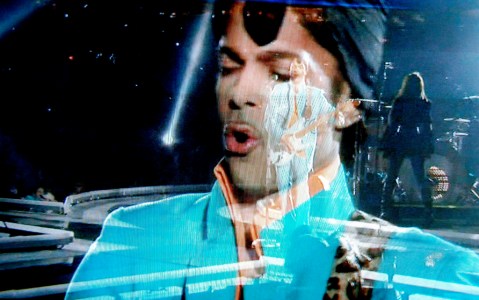
Image by Flickr User Ann Althouse, 2007
Touré writes in a New York Times obit of Prince’s “holy lust,” the “commingling” of sexuality and spirituality. Jack Hamilton writes of the doubt and moral uncertainty that coursed through songs like “Little Red Corvette.” Holy lust is arguably the central pursuit of rock; the term “rock and roll” is etymologically linked either to intercourse or worship, appropriately, emerging in both cases from African-American vernacular. Prince’s queer play with sex, sexuality identity, and religion is as rock and roll as it gets.
As punk sputtered, Simon Reynolds writes in Rip it Up and Start Again, funk appeared to rock fans as a racially tinged, politically and sexually charged savior. Bass, the heart of funk, was key to punk becoming post-punk around 1980. The instrument was suddenly charged with new symbolic and structural importance. During the same period, it is remarkable how many of Prince’s songs either have no bass, or rework bass’s role entirely. “When Doves Cry,” from Purple Rain (1984), Prince’s 6th studio album, is the best-known example of an ultra-funky track that withholds bass entirely, but “Kiss” lacks it, too, as well as “Darling Nikki.”
Earlier on Purple Rain, the bass on “Take Me with U” plays almost as a drone, buzzing like a minimalist’s organ.“Kiss,”from 1986’s Parade and Prince’s second-biggest hit —yet only #464 on the Rolling Stone list of the 500 Greatest Songs of All Time—is so tight, so locked in, so populated by alluring timbres that suggest an alien plane of instrumentation, that you forget it’s even supposed to have bass by rock top 40 convention. On much of 1980’s Dirty Mind, it is difficult to know which carefully tweaked synthesizer tone is supposed to index the bass, if any. Prince’s funk was even funkier for being counterintuitive, as Questlove notes. This gesture wasn’t rejection, of course, it didn’t “transcend” funk. Prince was still playing inarguably funky music, and the lack of bass is so unusual that it’s almost even more apparent in its absence. Free, but not too free.
Prince approached rock iconicity much as he approached bass, which is to say that he embraced clichés, but performed them inside-out, calling attention to them as both limits and possibilities, as constraint and freedom. “Raspberry Beret,” from 1985’s Around the World in a Day, is a boppy “girl group” song with sly allusions to anal sex, that uses exotic instruments and is written in an obscure mode. The virtuosic riff on “When Doves Cry,” instead of going where guitar solos go, comes right at the beginning of the track, before the drums, both seemingly isolated from the rest of the song and yet heralding it, too.
All of this worked very well, of course. His songs are just idiomatic enough to give listeners a foothold, but brave enough to evoke a world well beyond idiom. In retrospect, this is precisely what Little Richard had done. This is also what Hendrix and George Clinton and Tina Turner and OutKast have done, from where they rock out—way beyond the citadel, mastering many idioms, then extending them, at once codifying and floating away from genre.

Andre 3000 of OutKast rocking outside the box at Lollapalooza 2014, Image by Flickr User Daniel Patlán
Prince’s career calls back to the personal and artistic concerns, as well as the innovations, of Little Richard and other artists’ sonic expressions of blackness that both built rock’s house and sounded out the tall, white walls of the citadel that would exclude them. All of these artists, I suspect, find little point to hanging out near the citadel’s gates; there are other, funkier places to live. Prince himself was perfectly comfortable working athwart Warner Brothers, the press, stardom. He did more than fine.
We are free to interpret Prince, but not too free. Creative as he was, he lived in his time; he was no alien. The greatest testament to his genius is not that he escaped the world, nor that he rendered a new musical landscape from scratch, but rather that he worked in part with rock’s sclerotic structural materials to create such beautiful and fluid work.
—
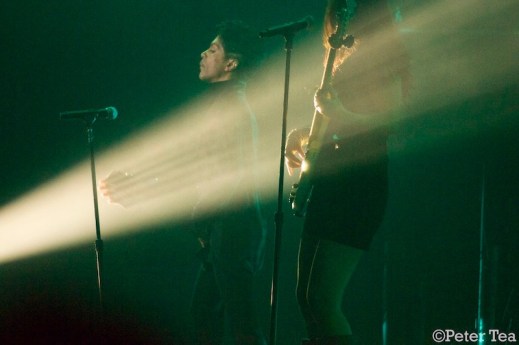
Featured Image by Peter Tea, July 12, 2011, under Creative Commons license No Derivatives 4.0 International (CC BY-ND 4.0)
—
Benjamin Tausig is assistant professor of ethnomusicology at Stony Brook University, where he works on sound studies, music, and protest in Bangkok and other urban spaces. He is on Twitter @datageneral
—
 REWIND!…If you liked this post, you may also dig:
Enacting Queer Listening, or When Anzaldúa Laughs–Maria Chaves
Learning to Listen: The Velvet Underground’s “Once Lost” LPs–-Tim Anderson
Music Meant to Make You Move: Considering the Aural Kinesthetic-Imani Kai Johnson
Black Mourning, Black Movement(s): Savion Glover’s Dance for Amiri Baraka–Kristin Moriah
Share this:

The Amplification of Muted Voices: Notes on a Recitation of the Adhan

Where do we begin?
On Tuesday January 13th, 2015, my first-year students and I gathered for the second meeting of our seminar, “Soundscapes: Artistic, Social, and Biological Approaches to Acoustic Environments.” We were just a few steps away from the iconic Duke chapel, almost in its shadow.
The chapel is an example of a revivalist architectural style known as “Collegiate Gothic.” Its steps were constructed with soft stone, intended to wear down quickly and provide an accelerated impression of age and prestige. The chapel’s cruciform blueprint is an unambiguous symbol of its Methodist Christian roots, as is the university’s motto: “eruditio et religio” (“erudition and religion”). In true Gothic revivalist style, the phrase is a Latin translation of a line from an 18th-century, English-language Methodist hymn titled “Sanctified Knowledge.”
.


On Tuesday, January 13th—the second day of my Soundscapes seminar—Duke’s Office of Communications announced that the Islamic call to prayer, the adhan, would sound from a bell tower of its iconic chapel in Durham, North Carolina. According to a press release, Duke’s chapel administrators and Muslim Students Association felt the three-minute long, “moderately amplified” recitation “represents a larger commitment to religious pluralism” on campus and that the sound of the adhan “connects the university to national trends in religious accommodation.”
The story was picked up by WRAL, the television news outlet based in nearby Raleigh. The web-based stories included a photo of the student slated to be the muezzin, the person appointed to recite the call to prayer. In the photo, the student was shown rehearsing from the bell tower. I read the announcement just before walking to class and thought the event would be a historic opportunity for my students and I to make field recordings of their university soundscape.
Where do we begin?
The adhan was scheduled to take place on the afternoon of Friday, January 16th. On Wednesday, January 7th—a week before the announcement of the adhan at Duke—twelve people were murdered during an attack on the Paris offices of the satirical newspaper Charlie Hebdo. Ostensibly, the murders were committed on behalf of Al-Qaeda in the Arabian Peninsula as a retaliation for the newspaper’s cartoon depiction of the prophet Mohammed.

Image of “Je Suis Charlie” solidarity demonstrations in Hamburg, Germany, by Flickr user Konrad Lembcke
Where do we begin?
Islamic theology posits that the adhan is not music. It is recited, not sung. Likewise, the text of the Qu’ran is not poetry. These sacred texts are certainly musical and poetic, but they are neither music nor poetry. These theoretical distinctions have complex and profound implications: more than soundscapes or sound art or acoustemology, the Islamic premise underlying recitations of the adhan and Qu’ran provoked my students to reconsider entire constellations of historical, cultural, linguistic, political, and—indeed—spiritual phenomena.
My students and I conducted a survey in which they asked classmates to identify a recording of the adhan. Only 2 out of 48 students recognized it as a recitation of the Islamic call to prayer; most guessed it was “Arab” or “Middle Eastern” music, but it seemed universally familiar as a “soundtrack” for a film sequence. One student who had lived in Morocco recognized the adhan immediately; another recognized it as the sound of his Lebanese grandmother’s alarm clock, automated to remind her to pray. We became acquainted with Cairo in One Breath, a documentary film project about post-revolutionary Egypt’s 2010 Adhan Unification Project, an effort to “replace individual muezzins with a single voice, broadcast to Cairo’s [thousands of] mosques from a radio station.”
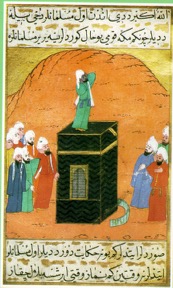 We also became familiar with the mythology of the first muezzin: Bilal, who was born in Mecca to Abyssinian slaves—in other words, a black man who was freed from slavery.
Where do we begin?
On Wednesday January 14th, the Reverend Franklin Graham posted a reaction to Duke’s announcement on his Facebook account. Franklin is the son of evangelical Baptist preacher Billy Graham, close friend and advisor to American presidents from Dwight D. Eisenhower to George W. Bush and known as “America’s pastor.” Franklin Graham is a resident of High Point, North Carolina (an hour’s drive from Duke) whose salary from tax-exempt, non-profit religious organizations is reported to be $880,000 per year.

Graham’s post “went viral,” and his threat of financial sanctions—aimed squarely at donors and alumni—seemed to land on its mark. Within hours, Duke’s proposed adhan recitation became the subject of a flood of media coverage, and the university received “credible threats” of violence; public relations and financial concerns were quickly compounded by “safety concerns.” My students and I—whose safety was being threatened—wondered whether the phrase “safety concerns” was a euphemism for terrorism, or vice versa.
On Thursday January 15, the university’s administration announced that they were canceling the planned recitation from the chapel bell tower. Instead, the adhan would be recited just outside the chapel, at the top of the steps leading to the chapel’s front doors. Franklin Graham celebrated the decision—again, on Facebook.

Later in the day, Richard Hays, the dean of the Duke Divinity School, released a letter outlining his objections to the proposed recitation. Hays’ letter revealed a somewhat obscure but significant division between the Divinity School and the chapel administration, each of which see themselves—in their own ways—as custodians of Duke’s Christian image. For the Divinity School administration, the chapel is a symbol of the university’s Christian identity. For the chapel administration, its Christian heritage is an aspect of a fundamentally pluralistic identity.
It is worth pausing here to emphasize that the controversy—now national in scope—was provoked by the mere prospect of sound. More specifically, a sound amplified at “moderate volume.”
By this point, the student muezzin and his family requested that his photo and name be removed; like the university, the young man and his family expressed “safety concerns.” Duke removed his image and name from the official online version of the announcement immediately. WRAL, the Raleigh television station, have still not removed the student’s image or name from their website.

Screen Capture of WRAL’s website by author
Where do we begin?
On the morning of Friday, January 16th?
The adhan was scheduled to take place at 1PM. At 12:30, I met two of my students—Tanner Waters and Jee Yoon—near the chapel. A large crowd was already gathering. Tanner, Jee, and I equipped ourselves with identical digital audio recorders so we could make a trio of stereo recordings, each from a distinct position; later, we would synchronize the recordings, mixing them in different ways to experiment with sonic “versions” of the event.
A half-dozen news vans were parked around the circular driveway leading to the chapel, their satellite antennas projecting into the clear blue sky. This was news. The news’ cameras were arranged on tripods in a straight line at the rear of the crowd; university security were maintaining a perimeter around the chapel that kept broadcast media at a distance. As I approached with my headphones on and my audio recorder in my hand, a chapel staff member asked mildly, “Excuse me, sir. Are you with the media?” I smiled and shook my head. No.
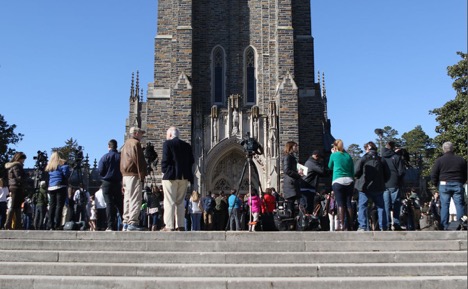
Photo by Elysia Su, The Duke Chronicle
A small PA sat at the top of the steps. Very small. There were no cables attached to it, and a small radio antenna extended from the top. It took me a few minutes to realize that this was the amplification, the moderate “loudspeaker” for the adhan. It took me another moment to realize the student muezzin would not appear: instead, he would transmit his recitation remotely. I was told later that he was just behind the closed doors of the chapel. Like so many recitations of the adhan, the transmission, amplification, and conceptual layers of it seemed uncannily like a sound art installation.
We all faced the loudspeaker, waiting for sounds to happen. The crowd went from murmurs to whispers, then silent. After a few seconds, the voices of members of the Muslim Students Association began to broadcast from the loudspeaker.
A young man’s voice introduced the adhan—a brief, prosaic context for what we would hear. Then a woman’s voice (also young) offered a literal English translation of the the adhan’s Arabic text. She spoke plainly, without the melodic contours of a recitation.
Now, before sharing recording of the Duke student muezzin’s recitation, I offer a bit of context—not an explanation or translation, but a comparative musical example. First, let’s listen to an iconic recitation style—albeit with a bit of YouTube-style hyperbole—recorded in Medina, Saudi Arabia. This recitation lasts four minutes—a fairly typical length of time for a complete recitation.
Now, let’s listen to the entire recitation of the adhan at the Duke chapel.
.
The prevailing quality of the Duke recitation is extraordinarily subdued. It is a vocal expression of the “moderate” sound and Muslim identity at the center of the controversy. At one minute and thirty seconds, it is less than half as long as most recitations.
Where do we begin?
Perhaps we might analyze this adhan as a peculiar instance of acousmatic sound: the student muezzin, like Pythagoras or the Wizard of Oz behind a curtain, was separated or dissociated from a discernible source by a curious bit of technology. When I asked Omid Safi, the director of Duke’s Islamic Studies Center, about this aspect of the story—the unseen and moderate voice of the student—he responded that for Muslims at Duke, the entire episode was about “safety and inclusion.”

Author’s screencapture of comments underneath a CBS.com broadcast about the Duke adhan.
Safi is a Duke alum. He studied there as undergraduate, co-founding the Muslim Students Association as a freshman, and went on to earn his Masters and PhD degrees at Duke. Since returning as director of the Islamic Studies Center two and a half years ago, he has been vocal and visible in the mass media. Safi himself has been labeled a “radical Muslim professor” by white conservatives and subjected to online “takedown articles,” particularly surrounding this event. Safi told me,
Part of the reason why … there was amplification but no person in sight [was] that people were scared. And it sounds hysterical … In retrospect, knowing what took place in Chapel Hill a few weeks later, [it was] not so unreasonable.
On Tuesday February 10, 2015, three Muslim college students—Deah Barakat, Yusor Abu-Salha, and Razan Abu-Salah—were murdered in their Chapel Hill home, just a twenty-minute drive from Duke. Less than a year earlier, Yusor Abu-Salha had been interviewed by her third-grade teacher for the StoryCorps oral history project.

Click on image to hear Story Corps interview
.
At horrifying moments like these, I think to myself, “This is why people pray.”
I was deeply ambivalent about discussing the murders with my students. After speaking to a handful of students individually and discreetly, I found most of them were completely unaware of the murders. I wondered—mostly silently, to myself—what impact the news might have on them, then decided to share the story obliquely: I discussed StoryCorps (“listening is an act of love”) in class, an important resource for those of us interested in oral history and I concluded by mentioning the recording of Yusor Abu-Salha. I never asked if they listened to Yusor’s voice, and I cannot know how they might have been affected. I simply did not know what to ask, nor what to say.
Less than one year later, in September, I surveyed my next cohort of incoming freshman. Less than half of them knew anything about the adhan controversy. Among the few who had heard something about it, the event had already acquired dubious mythological qualities: in one account, Muslim students were forced to move their call to prayer from the chapel tower to the nearby Sara Duke Gardens.
Analyses of the event varied considerably. In an op-ed for Duke’s student newspaper titled “Deconstructing the National Fear of Duke’s Adhan,” freshman Eidan Jacob—an Israeli Jew—offered a brilliant context and synthesis, expressing “surprise and disappointment” that the adhan was “so poorly received.” He observed that in his hometown of Haifa, “recitations of the adhan are simply part of the soundscape.”
A broad cultural and political context reveals that xenophobia and—more specifically—Islamophobia, remain cultural common sense in the post-9/11 United States. Both supporters and opponents of the adhan at Duke were disappointed by the controversy, and I do not discern a tidy moral to the story.
The sounds and discourse of the adhan at Duke suggest a narrative preoccupied with “decibels and debate,” but the subtle dynamics and textures of thoughtful, moderate conversation suggest an audible alternative to the loudness and noise of mass media discourse. The diverse qualities of the voices in this story—musical and otherwise—are more than poetic metaphors: the “voices of moderates” and “moderate-sounding voices” deserve close attention; regardless of the causes or motives underlying their subdued tones, their very quietness demands nuanced, high-fidelity listening. The literal and metaphorical amplification of voices might be a distraction from more important matters of range and intimacy.
Where do we begin?
—
In May 2015, the Duke chapel was closed for restoration. It is scheduled to reopen in May 2016.
Plans for a weekly adhan recitation elsewhere on the Duke campus are under consideration.
—
Featured Image by Elysia Su, The Duke Chronicle
—
David Font-Navarrete is an artist, musician, and ethnomusicologist. He is currently a Lecturing Fellow at Duke University’s Thompson Writing Program.
—
 REWIND!…If you liked this post, check out:
“Beat-ification: British Muslim Hip Hop and Ethical Listening Practices” –Jeanette Jouili
“Rallying Cries as Suffering Sounds: “Allah-O-Akbar” and the Aurality of Feminized Iranian Suffering–Roshanak Kheshti
“An Ear-splitting Cry: Gender, Performance, and Representations of Zaghareet in the U.S.“-Meghan Drury
Share this:


Current Top Posts





April 2021

January 2020

November 2019

October 2019

August 2019

April 2014

November 2017

March 2015

December 2017

October 2015
 Sounding Out!
Recent Comments