
SO! Podcast #79: Behind the Podcast: deconstructing scenes from AFRI0550, African American Health Activism

 Welcome to Next Gen sound studies! In the month of November, you will be treated to the future. . . today! In this series, we will share excellent work from undergraduates, along with the pedagogy that inspired them. You’ll read voice biographies (Kaitlyn Liu’s “My Voice, or On Not Staying Quiet,”) check out blog assignments (David Lee’s “Mukbang Cooks, Chews, and Heals”), listen to podcasts, and read detailed histories that will inspire and invigorate. Bet. –JS
We are thrilled to bring you today’s utter gift from Dr. Nic John Ramos (Drexel University) and Laura Garbes (Brown University) who team taught this tremendous course in the Department of Africana Studies at Brown University called African American Health Activism from Colonialism to AIDS that used podcasting as a critical venue of knowledge production and a pedagogical tool. The introductory paragraph of their syllabus explains the class as follows:
Welcome to Next Gen sound studies! In the month of November, you will be treated to the future. . . today! In this series, we will share excellent work from undergraduates, along with the pedagogy that inspired them. You’ll read voice biographies (Kaitlyn Liu’s “My Voice, or On Not Staying Quiet,”) check out blog assignments (David Lee’s “Mukbang Cooks, Chews, and Heals”), listen to podcasts, and read detailed histories that will inspire and invigorate. Bet. –JS
We are thrilled to bring you today’s utter gift from Dr. Nic John Ramos (Drexel University) and Laura Garbes (Brown University) who team taught this tremendous course in the Department of Africana Studies at Brown University called African American Health Activism from Colonialism to AIDS that used podcasting as a critical venue of knowledge production and a pedagogical tool. The introductory paragraph of their syllabus explains the class as follows:
In other words– theirs wasn’t a radio or a podcasting themed course, but instead, Professors Ramos and Garbes introduced podcasting to students as a mode of critical thought and expression. As they reflect:This historical survey course examines African American activism and social movements from Colonialism and Emancipation to the contemporary period through the lens of African American access to health resources. The course also explores how marginalized peoples and communities are using new digital technologies, such as podcasting, to represent and intervene on historical inequalities. Thus, the course aims to produce public historians who are well versed in the history of medicine from the perspective of African descended peoples AND can produce social justice-oriented digital content based on their knowledge of history and marginalized communities.
Like many educators, we see podcasting as an opportunity to enter students on the ground floor of an increasingly popular social medium that many conceive of as a potentially more democratic sound space. We firmly believe spaces of sound, such as podcasting, however, cannot truly be democratic unless more people have the knowledge and know-how to enter their voices and the voices of their communities into the fray. In these troubling times, we especially see podcasting as an opportunity to share and tell stories often misheard, untold, and unheard in history and on the radio. It was important to us that our students recognize that the voices of the communities they come from and/or the histories rarely hear elsewhere have a legitimate place in the academy and on the airwaves.Today, via the form of a podcast, Ramos and Garbes go fantastically meta- on us, introducing one of the final projects from their course–an audio story entitled “Shadows in Harriet’s Dawn” by Brown Undergraduates Mali Dandridge, Sterling Stiger, and Amber Parson— giving us rare insight and commentary on the process. The student work understands Harriet Jacobs (activist and author of Incidents in the Life of a Slave Girl) in the context of enslavement and childhood trauma. The full transcript of their “Behind the Podcast” podcast follows this introduction. Here’s the students’ podcast description:
Through the re-telling of American author and former slave Harriet Jacobs’s girlhood from her autobiography Incidents in the Life of a Slave Girl there is an opportunity to learn about the adverse childhood experiences (ACEs) of children of American slavery. Harriet’s 19th-century trials of navigating complicated family dynamics, emotional abuse, and sexual harassment at a young age are analyzed in the lens of the modern science supporting the clinical ACEs questionnaire tool. This podcast will hopefully mark the beginning of creating more discussions that uncover the social determinants of well-being and trauma in a way that could be helpful even for the struggles of modern day youth.You may also download the syllabus for their course (African American Health Activism Syllabus 1.25.2018 ), along with their Podcast Pitching Assignment (AFRI 0550 Pitching Assignment for Webpage), a process assignment they named the “fieldwork summary prompt” (AFRI0550 Fieldwork Summary Prompt), and the grading rubric for this assignment (AFRI0550 Podcast Grading Rubric). In addition, Ramos and Garbes have also generously documented this experience via their collaborative website: Case Study: Afri 0550, A PEDAGOGICAL APPROACH TO STORYTELLING AND TECHNOLOGY that you absolutely MUST check out. We all have so much to learn! CLICK HERE TO DOWNLOAD: SO! Podcast 79: Behind the Podcast: deconstructing scenes from AFRI0550, African American Health Activism SUBSCRIBE TO THE SERIES VIA APPLE PODCASTS FOR TRANSCRIPT: SCROLL BELOW or ACCESS EPISODE THROUGH APPLE PODCASTS , locate the episode and click on the three dots to the far right. Click on “view transcript.”
Behind the Podcast: deconstructing scenes from AFRI0550, African American Health Activism In this podcast, Dr. Nic John Ramos and Laura Garbes introduce Shadows in Harriet’s Dawn, a final audio project by Mali Dandridge, Sterling Stiger, and Amber Parson. They analyze the project in the context of the course, African American Health Activism, taught at Brown University in spring 2019. The two reflect on how beginner technical and ethical training come together within in the audio story. Resources mentioned within this podcast provided at the end of this transcript. Listeners are highly encouraged to listen to this as a piece of the larger course blog, written by Laura and Nic, and developed as a webpage by Leo Selvaggio, Instructional Media Specialist at the Brown MML. Nic Ramos: Hi, this is Nic John Ramos. Laura Garbes: Hi, this is Laura Garbes, NR: and this is, Behind the Podcast… LG: …deconstructing scenes from African American Health Activism. NR: Laura, what are we doing in this podcast? LG: Right, So first of all, we’re trying to display a really awesome audio story that our students made. That’s first and foremost. But we’re also using it as a teaching tool, right? NR: Yeah, that’s right. For our class called African American Health Activism from Colonialism to AIDS, which is taught in the Department of Africana Studies here at Brown University. This historical survey course examines African American activism and social movements from colonialism and emancipation to the contemporary period, through the lens of African American access to health resources. The course also explores how marginalized people and communities are using new digital technologies such as podcasting to represent and intervene on historical inequalities. The course aims to produce public historians who are well versed in the history of medicine from the perspective of African-descended peoples and can produce social justice oriented digital content based on their knowledge of history and marginalized communities. LG: Yeah. So part of this is really giving space to show the great work on this audio story on Harriet Jacobs and childhood trauma. Through doing so, we want to touch on a few things behind the process that will be good for educators looking to implement similar projects in their own classrooms. NR: If you’re interested in learning more about podcasting as a pedagogical tool, check out our webpage. LG: Well, check out our webpage, which will put it in the show notes later. Always with the show notes.. [laughs] Right, because there were going to put in a bunch of sound clips of this and sort of a step by step guide of how to replicate the process assigning a podcast. And, you know, there are other sources out there and we linked them at the end of that guide. But what we really wanted to emphasize was like… Okay, cool there is a lot of stuff on the technical recording and the technical interviewing pieces. And then there’s some scholarship, notably Dr. Jenny Lynn Stoever on the sonic color line, and the cultural politics of listening and how our listening ear has been conditioned. We weren’t really finding something that kind of weaves those two together, and we really think it’s important that when we’re teaching the technique, it not be divorced from that theory. NR: The podcast we’re showcasing today is called Shadows in Harriet’s Dawn, on the childhood trauma of American slavery, through the retelling of American author and former slave Harriet Jacobs’ girlhood from her autobiography, Incidents in the Life of a Slave Girl. There’s this opportunity that our students saw to learn about the adverse childhood experiences of children of American slavery. This podcast will hopefully mark the beginning of creating more discussions that uncover the social determinants of well-being and trauma in a way that could be helpful even for the struggles of modern-day youth. LG: Yes, okay, so this podcast was created by three students in your class. Amber, Sterling and Molly. So, let’s take a listen. Upbeat, childlike music Incidents in the Life of a Slave Girl Archive #1: I was born a slave; but I never knew it till six years of happy childhood had passed away. (Chapter I) Children’s music box mixed in with the sound of children laughing Archive #1: My father was a carpenter, and considered so intelligent and skilful in his trade, that, when buildings out of the common line were to be erected, he was sent for from long distances, to be head workman. On condition of paying his mistress two hundred dollars a year, and supporting himself, he was allowed to work at his trade, and manage his own affairs. His strongest wish was to purchase his children; but, though he several times offered his hard earnings for that purpose, he never succeeded. In complexion my parents were a light shade of brownish yellow, and were termed mulattoes. They lived together in a comfortable home; and, though we were all slaves, I was so fondly shielded that I never dreamed I was a piece of merchandise, trusted to them for safe keeping, and liable to be demanded of them at any moment. (Chapter I) Loud thump Silence Mali: But, almost inevitably, the fond shielding around Harriet would cease to exist, profoundly changing her life for the worse. Sterling: For Harriet, the context in which that happy childhood took place would be revealed to be one filled with abuse and trauma. Amber: Trauma works to stay hidden and unexposed. It knows how and when to enter into the crawl space, and it is always on the run to move from generation to generation. Amber: My name is Amber and I am here alongside my other fellow classmates Pauses Sterling: Hello, I’m Sterling. Pauses Mali: Hi, I’m Mali. Amber: And we’re here today to explore Harriet Jacobs’ story in relation to childhood trauma. LG: Ok Nic. I’m going to stop this right here, just to say two and a half minutes have passed. That’s it. And there’s already a collection here of kind of really rich sound clips. You hear from the archive an approximation of Harriet Jacobs’s voice straight from the very beginning. You hear different types of music. You hear their own voices that have to be cut out of different sound clips. It’s already getting pretty complex. And as we’ll kind of see as we go into it, they’ll go on to cut in all of the interviewees’ voices and introductions so that you’ve got a sort of sense of where we’re going. NR: Yeah, what I really love about this is that they’ve really set the tone and mood, but also have given us a clue about where they want to take this podcast, what direction they want to take this podcast. What I really love about this is that we get already a very historical context, that they’re drawing out how they want to connect it to really present-day issues. LG: And I think two things really made those possible. So first is the fact that we have trainings at the MML at Brown, which in that digital resource guide we mentioned there’s the stuff that is going to be available on arranging tracks. When you specifically focus on arranging tracks, it makes it possible for first-time podcasters to think a little bit more creatively instead of saying: we’re going to put the entire chunk of what we recorded from person A, the entire chunk from person B, and we’ll do our analysis in the end. You can see that they’re being creative. They’re interspersing these things like quotes in an academic essay or a historical essay. NR: Yeah. What I love is that we’re going to hear in the next couple minutes all the people that they’re going to interview as experts to craft an argument and perspective on Harriet Jacobs. LG: Let’s listen. Sterling: Through the re-telling of this American author and former slave’s girlhood from her autobiography Incidents in the Life of a Slave Girl, there is an opportunity to learn about the adverse childhood experiences, or ACEs, of children in American slavery. Mali: Harriet’s 19th-century trials of navigating slavery, complicated family dynamics, emotional abuse, and sexual harassment at a young age have a lot to reveal about trauma and the different ways it is able to manifest itself. We hope to offer both a lens of social and scientific understanding of these complexities using knowledge from the following expert sources, starting with our guest Anna Thomas. Cheeky, academic music Enter: Montage of guest speakers Anna: I am a PhD candidate in the English Department at Brown. I am graduating this year, and I work on African American literature alongside Caribbean literature. I study the relationship between ethics and form in nineteenth and twentieth century African and Caribbean literature. Ramos: I’m Nic John Ramos I’m the Mellon postdoctoral fellow in Race and Science and Medicine at Brown University. Dima: My name is Dima Amso, and I am a professor in the Cognitive Linguistic and Psychological Sciences Department. I study brain and cognitive development. Kevin: My name is Kevin Bath. I am a professor in Cognitive Linguistic and Psychological Sciences. My research focuses on using animal models to understand how real life adversity, especially during early post-neonatal, impact the development of the brain and may drive risk for negative outcomes. Amber: Through the collective perspectives of us, our guests, and several archival sources, we now present to you the story of Harriet…that is a story that beautifully and remarkably demonstrates resilience towards the mobility of trauma. 19th century music Archive #1: When I was six years old, my mother died; and then, for the first time, I learned, by the talk around me, that I was a slave. My mother’s mistress was the daughter of my grandmother’s mistress. She was the foster sister of my mother; they were both nourished at my grandmother’s breast. In fact, my mother had been weaned at three months old, that the babe of the mistress might obtain sufficient food. They played together as children; and, when they became women, my mother was a most faithful servant to her whiter foster sister. On her death-bed her mistress promised that her children should never suffer for anything; and during her lifetime she kept her word. They all spoke kindly of my dead mother, who had been a slave merely in name, but in nature was noble and womanly. I grieved for her, and my young mind was troubled with the thought who would now take care of me and my little brother. I was told that my home was now to be with her mistress; and I found it a happy one. No toilsome or disagreeable duties were imposed upon me. My mistress was so kind to me that I was always glad to do her bidding, and proud to labor for her as much as my young years would permit. (Chapter I) I would sit by her side for hours, sewing diligently, with a heart as free from care as that of any free-born white child. When she thought I was tired, she would send me out to run and jump; and away I bounded, to gather berries or flowers to decorate her room. Those were happy days—too happy to last. (Chapter I) The slave child had no thought for the morrow; but there came that blight, which too surely waits on every human being born to be a chattel. (Chapter I) Science music Dima: So, in general, some basic principles of brain development are that there’s tremendous amounts of change that happens very early on in postnatal life. So after like about three or four, the brain is sort of fine-tuning rather than showing huge amounts of organization. Even still, the way that the brain develops is that continually tries to adapt to its environment so both positive experiences are highly shaping and negative experiences are highly shaping, um and stress in particular has received a lot of attention in the developmental science community, both with respect to human stressors and animal models that try to recapitulate those and try to understand what’s under the hood so to speak and the idea is that what’s happening with stress and trauma especially early on in postnatal life is that it’s um shaping the system and ways that then get sort of set that sort of set up their brains to have long-term consequences of that stressor. NR: So that was Dima Amso, one of the interviewees of this podcast. And what I like what the students are doing here is that they’re setting up an expert voice to provide context to what we just heard and we’re going to hear in the future. But as you can tell, they’re going to set up these experts in a way in which they’re able to speak for themselves, and the listener is going to be able to hopefully differentiate the different positions that some experts say without them having to directly say the differences between these experts… if that makes sense. LG: Yeah, this was a conversation we had in that Q&A discussion. We went in and we talked through techniques with the students. But then we moved on to OK, actually, you’ll have to do a little field work log and then we’ll talk again, because there’s only so much you can do before you actually go out there and interview. So I think what was great was building in time to actually discuss the interviews, because there were a few instances and a few groups were saying, OK, there some discrepancies here between either different interviewees’ perspectives. Or there were discrepancies between the interviewees’ perspectives and perhaps the main argument trying to be made. Allowing for those differences to kind of breathe, while weaving a cohesive narrative that’s fit for a podcast, is an art, and they sort of have to walk this tightrope. And that was definitely one of the skills of argumentation that could definitely be transferred over for them when they’re writing essays in the future. NR: You know, the students had to edit, and they had to figure out what story they wanted to tell You can tell that some of these experts are giving a story that conflate animal studies with human behavior in a way that’s really popular in making comparisons today within science. But the students also had to make a decision about whether or not they wanted to go down the road of talking about the history of scientific racism and the conflation of some humans as animals. And while there’s room here is that I know that they had a lot of work to do around just talking about Harriet’s story alone. You’ll find later that they’ve just left some of these opportunities to delve deeper, where it’s on the listener to think about, make their own conclusions about that. Let me say a note on ethical interviewing is that when we say ethical interviewing, we’re allowing the experts to speak on their terms. And allowing them, allowing their positions and their thoughts to manifest through the other voices that you’re going to hear right? In the contrast of the comparisons that listeners are going to be able to hear in the different voices and positions they take. LG: Right and coming up next, as we’ll see, they definitely contextualize all of the different interviewees’ comments, like Sterling here. Sterling: According to Harriet from her narrative, she had an early childhood with “unusually fortunate circumstances” in comparison to other children of American slavery. Mali: This understanding of her background is important to truly capture understanding of how events that would impact her later in life would vastly change herself perception regarding her quality of life. In particular, these events would occur after the death of her described “kind mistress” when the mistress’s sister and new husband Dr. Flint claimed ownership of Harriet. Dima: You know, childhood development isn’t happening in a vacuum, it’s happening in a broader context and a good part of early child development is about the caregiving, no matter how. It’s really interesting to think about the animal models. I do these examples, so we study socioeconomic status in a lab and what they try to do is recapitulate what happens when a great parent gets their resources taken away, so for animals and the mouse studies, you can take away the bedding and make it really hard for them to keep their babies warm and they are just like working so hard to replace that to take care of that and that then stresses them out, which turns out to have consequences on the growing pup later, and then if you add an additional stressor you kind of see how this sort of balloons into multiple now stressors and formative times. Loud thump Archive #1: During the first years of my service in Dr. Flint’s family, I was accustomed to share some indulgences with the children of my mistress. Though this seemed to me no more than right, I was grateful for it, and tried to merit the kindness by the faithful discharge of my duties. (Chapter V) Sound: opening of door…. assertive, domineering footsteps… heartbeat But I now entered on my fifteenth year—a sad epoch in the life of a slave girl. My master began to whisper foul words in my ear. (Chapter V) Enter old, southern man whispering LG: So something I’m hearing here that is fantastic are the sound effects: something to keep our interest, that loud thump you hear before you hear Harriet Jacobs’s voice again. NR: Just this science music they used… LG: It’s so on point, right? NR: Yeah, the science music, the loud thump, opening the door, footsteps, heartbeat, they’re really layering a lot of stuff to keep the listener interested, and many people wouldn’t think about doing that. You could imagine that if they didn’t have these elements in here, you would just be hearing one long monologue, that quite frankly you’d be just bored.

Figure 1: Final Audition Software File for “Shadows in Harriet’s Dawn”
- “P-Pops And Other Plosives.” Transom, April 27, 2016. https://transom.org/2016/p-pops-plosives/.
- Workshop I: Intro to Audio Editing Multimedia Lab at Brown. https://docs.google.com/presentation/d/1xNoz4xO50AYJyEahLLuAOXx_TfPWdP_iBke7j7jTXcI/edit?usp=sharing
- AFRI0550: Hearing a Story Structure https://drive.google.com/file/d/10F0EcgIApO1Nw0W3ZB4edFliWroR31bA/view?usp=sharing
Nic John Ramos is an Assistant Professor in the Department of History at Drexel University and held a Mellon Postdoctoral Fellowship of Race in Medicine and Science at Brown University from 2017-2019. His article “Poor Influences and Criminal Locations: Los Angeles’s Skid Row, Multicultural Identities, and Normal Homosexuality” was recently published in American Quarterly.
Laura Garbes is a PhD student in sociology at Brown University, where she studies racism, whiteness, and cultural organizations. Her research explores the racialization of sound in public broadcasting. She is also a fellow at Brown University’s Swearer Center for Public Service, and a member of the Du Boisian Scholar Network. — REWIND! . . .If you liked this post, you may also dig:
SO! Podcast #78: Ethical Storytelling in Podcasting
A Manifesto, or Sounding Out!’s 51st Podcast!!! – Aaron Trammell
Deep Listening as Philogynoir: Playlists, Black Girl Idiom, and Love–Shakira Holt
REWIND! . . .If you liked this post, you may also dig:
SO! Podcast #78: Ethical Storytelling in Podcasting
A Manifesto, or Sounding Out!’s 51st Podcast!!! – Aaron Trammell
Deep Listening as Philogynoir: Playlists, Black Girl Idiom, and Love–Shakira HoltShare this:

SO! Amplifies: The Electric Golem (Trevor Pinch and James Spitznagel)
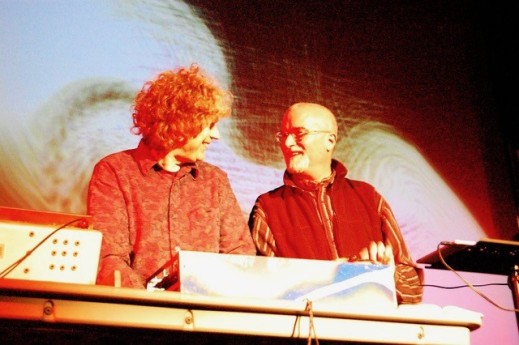

—
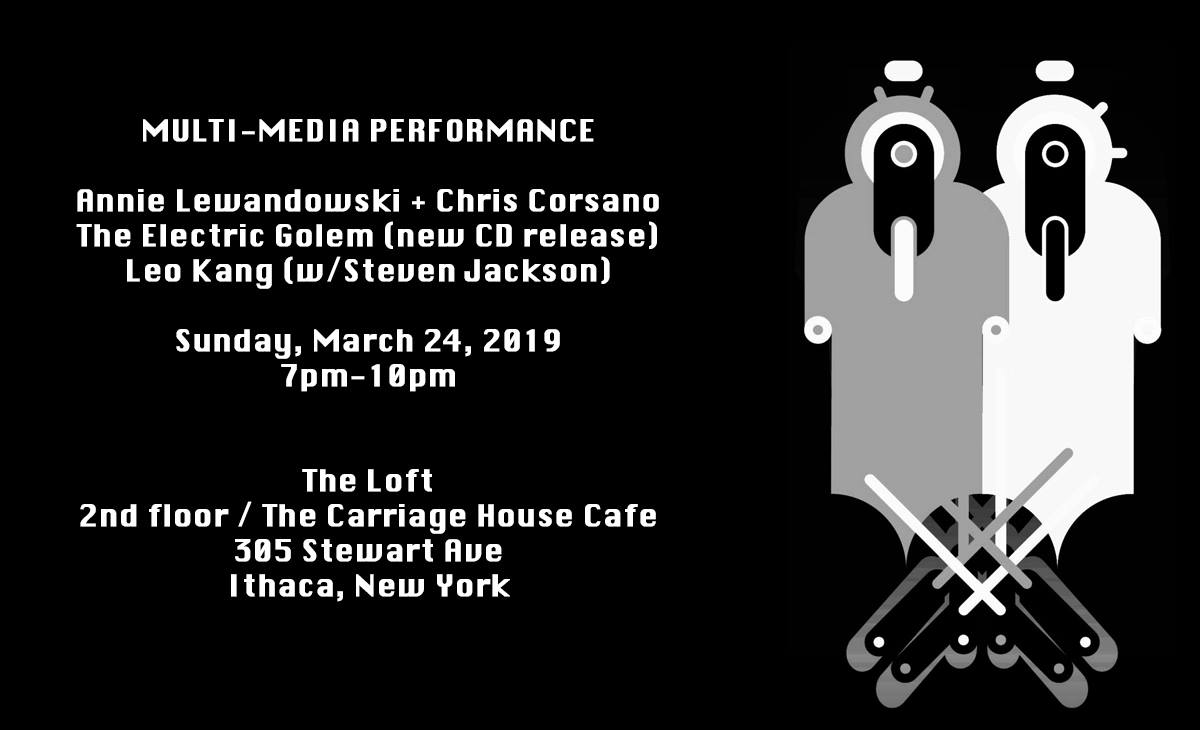
On March 24th, 2019 the record release party for The Electric Golem’s 6th CD Golemology was held at the Loft in Ithaca, New York. The Electric Golem is an avant-garde synthesizer duo featuring Trevor Pinch and James Spitznagel, that has been in existence for about ten years.
Trevor Pinch is a local sound artist and professor at Cornell University. He is an STS (Science and Technology Studies) and Sound Studies scholar. As a key thinker of STS, Trevor is the coproducer of theories about Sociology of Scientific Knowledge, Social Construction of Technology (SCOT), and the role of users in technological history and innovation. However, Trevor’s interest in dates back much farther; he built his first modular synthesizer when he was a physics student in London in the 1970s.
The other half of The Electric Golem, James Spitznagel, is a multi-media artist who uses the iPad as a musical instrument and to create digital paintings. While he has played many roles in the music and culture industries—guitarist in a rock band, record store owner, art gallery and guitar shop investor, and even business manager for the Andy Warhol Museum—he moved to Ithaca to focus on producing abstract art: digital paintings and experimental, improvisational music. Being an energetic and enthusiastic person who has unrestrained fantasies, James finds that everything around him can be his inspiration.
Pinch and Spitznagel formed the group after Spitznagel read Analog Days: The Invention and Impact of the Moog Synthesizer (by Trevor Pinch and Frank Trocco) and realized Pinch also lived in Ithaca. Spitznagel simply looked his name up in the phone book and called him up: “I go, ‘is this Trevor Pinch?’ He said, ‘yes.’ I said, ‘well, you don’t know me, but I just read your book and I love it.’” And then they got together for a beer and have been best friends and collaborators ever since. Once Spitznagel heard about Pinch’s homemade synthesizer, he asked Trevor to try to make something together and it turned out to be a fascinating mixture of analog–Trevor’s synth, Moog Prodigy, and a Minimoog–and James’s digital instruments.
Building from this first moment of discovery, The Electric Golem’s music is electronic, experimental, and totally improvised. Typically, the pieces of music last twenty minutes to half an hour and expresses their interaction with the machines and with each other in the studio. James is much more controlling of the tone and rhythm, and patches the sound as he goes along, whereas Trevor is much more about making spontaneous weird sounds. They complement each other and the creation process is usually by random and spontaneous, as Spitznagel describes: “I didn’t tell Trevor what to do or what to play, but I said, here’s the piece of music I’ve written. He just instinctively knew what add to it.” Reciprocally, “he might just play something that I go, oh, I can weave in and out of the ambient sound he’s putting there.”
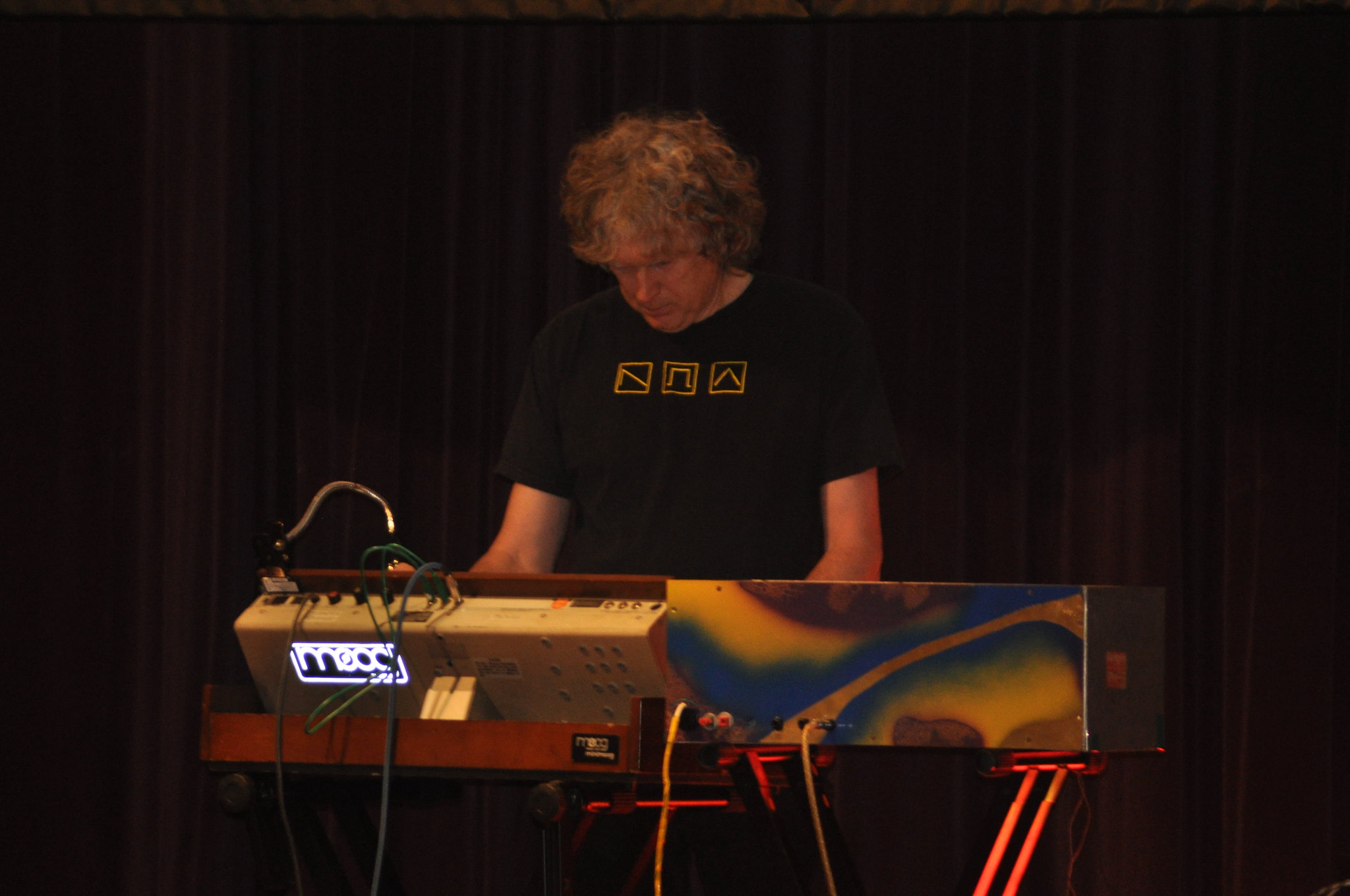
Trevor Pinch, Electric Golem at Elmira College, 2012
For the duo, the process of producing music becomes a shared experience with their listeners. The music is ever changing and evolving. In addition, unexpected drama adds vitality to the palette. “The iPad might freeze up or synthesizer might break somehow,” Spitznagel notes, “that’s happened to us, but we carry on. Like Trevor looks at me and says, it’s not working there. Or, I look at him and go, I have to reboot my computer, it’s not working. But, those times actually inspire us to try new things and go beyond what we are doing.” James explained. Their inspiration comes from the unknown, which just emerges from their practice. “Generally, this sort of music is completely unique to Electric Golem.” Trevor concluded.
The name “Electric Golem” comes from a series of books with Golem in the titles that Trevor collaborated on with his mentor Harry Collins. “The golem is a creature of Jewish mythology,” Pinch and Collins wrote in The Golem, What You Should Know about Science, “it is a humanoid made by man with clay and water, with incantations and spells. It is powerful, it grows a little more powerful every day. It will follow orders, do your work, and protect you from the ever threatening enemy. But it is clumsy and dangerous. Without control, a golem may destroy its masters with its flailing vigour” (1). Noting Trevor’s association with the concept of the Golem, Spitznagel added the “Electric” twist not just as a metaphor for their sound but also because “it’s kind of like a retro name.” The Electric Golem mushroomed from there, and in the past decade they have had many invitations and bookings to play out, receiving the first recording contract from the Ricochet Dream label, and have played with a bunch of notable musicians, such as Malcolm Cecil of Tonto’s Expanding Head Band, Simeon of Silver Apples, and “Future Man” (aka Roy Wooten), and they haven’t stopped there.
According to Pinch, the key feature of The Electric Golem’s music is its ability to encompass different moods. “I think Electric Golem has become good at one thing: its changing and transitioning from one sort of mood of music to another. And we have become quite good at those transitions. I think people would say that’s what they kind of like about us.” These sorts of slow transitions construct a unique texture of sound that can be quite cinematic, so much so that in 2012, the Electric Golem performed the accompaniment to the silent movie A Trip to the Moon, a special Cornell cinema event. Overall, as improvised experimental music, it is sometimes challenging to listen to, with no regular rhythm or reliable melody. Trevor produces warm, rich drones from the analog side that contrast with the sharper digital rhythms that James programs. In short, the Electric Golem varies between these two affects but the music goes far beyond the representation of emotional states; sometimes it conjures up the feeling of the vastness of space and time.
Experimental music, is a collaboration and negotiation process between instruments and their users. No matter if analog or digital, instruments have autonomy; they are non-human actors with their own agency to some extent. As Trevor Pinch intimates, “I understand the general sort of sound that can be produced, but the particular details of how it will work out, you don’t really know, that’s much more spontaneous, you have to react to that.” Instruments can often be uncontrollable–making their own sounds—so that Electric Golem must respond in kind. “So, it’s sort of like higher level meta-control versus actually doing what you’re doing in response to the instrument that combines together,” Trevor describes, “which I think is the secret to controlling these sorts of instruments.” It is incredible that Pinch and Spitznagel know each other so well—and each know their instruments so well–that they can improvise for long periods with no trouble. Trevor says: “Follow the use of these instruments! Follow the instruments! They are not essentialized. They are just stabilized temporarily.”
On the whole, The Electric Golem shows an artistic form which breaks the traditional paradigm, deconstructs and then reconstructs it, seeking to free sound from the instruments. Their music is beyond pure melody and rhythm, beyond the expression of existence, expressing more of an aesthetic state of transcendence. They challenge what music is, and what musical instruments are; they challenge divisions between the identities of engineer and musician. Electric Golem’s music co-constructs art and technology and binds them together; art, for them, is a mode of presenting technology, and vice versa, technology is a pathway through which art can flourish.
My favorite Electric Golem piece is called “Heart of the Golem.” What is the heart of the Golem? According to Pinch, “It is a mystery, a process of unfolding and discovery. It is somewhere where analog and digital sound meet, and an improvisation.” What the magic is remains unknown and unlimited, just like the future of the Electric Golem.
—
Featured Image: Courtesy of The Electric Golem
—
Qiushi Xu is a PhD candidate in the subject of Philosophy of Science and Technology in Tsinghua University, Beijing and in a joint PhD program in the Department of Science and Technology Studies in Cornell University, working with Prof. Trevor Pinch. Her research areas are Sound Studies, STS, Cultural Studies and Gender Studies. Her current research focuses on the sociology of piano sound and the negotiation and construction of piano sound in the recording studio (PhD dissertation), gender issues in recording industry, experimental music, auscultation and sound therapy. She holds an MA in Cultural and Creative Industries from King’s College London; a BA in Recording Arts and a BA in Journalism and Communication from the University of China, Beijing. She is also an amateur pianist, writer, and traditional Chinese painter. As a multiculturalist, she is am fascinated by different forms of art and culture in different cultural contexts.
Share this:


Current Top Posts





April 2021

January 2020

November 2019

October 2019

August 2019

April 2014

November 2017

March 2015

December 2017

October 2015
 Sounding Out!
Recent Comments