
Hearing “Media-Capitalism” in Egypt

As I began researching my first book Ordinary Egyptians, a study of Egyptian culture from the 1870s until the eve of the 1919 revolution, sounds and early sound media were the last thing on my mind. However, When I dug more deeply into the historical sources, I realized the importance of music and the comedic theater in the urban culture of turn of the century Egypt. This made me expand the scope of my research to incorporate the vernacular culture of Egypt as an entire media-system, which as I showed in my book, was instrumental in constructing a modern Egyptian national identity. Music, songs, plays, chants, speeches, conversations and chatter, were very influential in forming an Egyptian national culture at the end of the nineteenth century, especially in a society with low literacy rates. By incorporating performance and sound media–especially the rising record industry–my book strives to expand the historical study of this period beyond just the visual and the printed to include sound, and aural/oral expressions of culture.
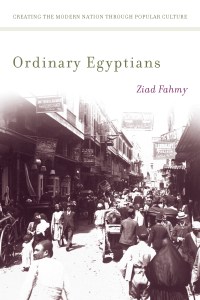
“Muski Street, Cairo, 1903.” Source: William Herman Rau. From Library of Congress Prints and Photograph Division.
Ordinary Egyptians also engages with some of the theories of nationalism and tests their applicability to Egypt and the Arab world. It introduces the concept of “media-capitalism,” which expands the historical analysis of Egyptian nationalism beyond just print and silent reading, through the incorporation of audiovisual, sound, and performance media. By integrating these new media, especially the burgeoning record industry, my book attempts to make room for both the “ear” and the “eye”—for the aural and oral alongside the visual—and in the process provides a more comprehensive explanation for how individuals and communities digest and embody cultural information. As this excerpt explains, cultural productions, in any form, are not socially relevant unless they are communally and socially activated; they must be discussed, breathed, and animated in the routine of everyday life.
The following is an excerpt from Ordinary Egyptians, with thanks to Stanford University Press. Notes have been included in the text to conform to Sounding Out!‘s style sheet.
—
Mundane Nationalism
Egypt’s new mass media reflected on relevant everyday political, economic, and cultural concerns, and amplified them on the national stage in a comprehensible, locally pertinent and entertaining form. The repeated themes of many of these media included: bemoaning the lack of economic opportunities for native Egyptians, portraying the economic exploitation of Egyptians by foreigners, warning of perceived declines in national “morality,” satirizing and at times insulting British and native officials, and rousing patriotism and a sense of collective national solidarity.
However, the most effective way that national identity and a sense of nationhood was ‘absorbed’ was not only through these overstated themes and methods, but through the mundane media portrayals and representations of everyday “national” life and the internalization of these modes in actual practice. As Michael Billig describes in Banal Nationalism, nationalist ideology “might appear banal, routine, almost invisible,” however, these “subconscious” matter-of-fact representations create a common sense “naturalness of belonging to a nation” (15-16). Billig explains that often there is “continual ‘flagging’, or reminding, of nationhood,” as on a daily basis, citizens are reminded of their national identity. This reminding however, is “so familiar, so continual, that it is not consciously registered as reminding” (8). Mundane and unstated representations of Egyptian-ness abounded in most forms of mass culture, where “Egyptians” distinctively spoke and acted and were clearly, though tacitly, differentiated from non-Egyptians. Most of the media examined in this study implicitly addressed their listeners, viewers and readers as members of an Egyptian “nation.” To be sure, the most influential aspect of vaudeville and the satirical press were not necessarily the outwardly nationalistic messages of many of their articles, cartoons, and dialogues, but the recurring and mundane representations of colloquial Cairene as the de-facto dialect of all Egyptians, and the implicit understanding that flawlessly speaking and understanding it was the basic marker of a “modern” Egyptian national identity. Only an “authentic” ibn or bint al-balad (son or daughter of the country) would employ Egyptian Arabic and grasp its multiple meanings and nuances and hence participate in this new mass-produced colloquial culture. In fact, many of the comedic dialogues depicted in political cartoons and vaudeville repeatedly contrasted the mispronunciations of foreigners—who often played unsympathetic or villainous roles—with the “correct” pronunciation of affable Egyptian characters. This repeated portrayal of Cairene as the only “authentic” Egyptian accent reified it as an unofficial dialect of all Egyptians, even if back in the villages and towns of the Sa‛id more localized modes of expression were employed. By way of media-capitalism, Cairo’s dialect and culture was overwhelming—colonizing, if you will— the multitude of other localized dialects and cultures in Egypt. Thus, paradoxically, Cairene Arabic was the primary tool for nationalist, anti-imperialist discourse, and simultaneously, through internal-colonialism, it imposed its own culture on the “nation” [Note: This is very similar to what was happening in France during roughly the same time period. See Eugen Weber’s Peasants Into Frenchmen: The Modernization of Rural France, 1870-1914, 486-88].

“Egyptian crowds with Italian flag during 1919 Revolution.” Source: From L’Illustration (Paris), May 3, 1919.
The Sensorium and the Public Sphere
The efficacy of the new mass media and its potential for mass mobilization was best demonstrated during times of national crisis. The 1906 Dinshaway Incident and the 1919 Revolution in particular reveal how all forms of mass media functioned together to effectively document, memorialize, celebrate, and mobilize on a national scale. The growth of popular Egyptian mass culture, articulated almost exclusively in colloquial Egyptian, was the pivotal factor in the popularization and dissemination of an Egyptian national identity. The evolution and universalization of a colloquial Egyptian middle culture, made possible especially through the utilization of sound and audiovisual media, allowed for a shared and “uniquely” Egyptian cultural landscape. It is primarily within this non-official web of colloquial Egyptian mass culture, driven in large part by media-capitalism, that Egyptian national identity was widely disseminated and popularized.
One crucial aspect of this study was the critical role coffee shops played as cultural hubs, where differing mass media from newspapers to recorded music were publicly merged, negotiated, and digested. Many of the songs initially written for musical and comedic plays were recorded and played, or performed by street musicians at coffee shops and even in the streets and sidewalks. The role of the thousands of urban cafés and other public meeting areas in the broadcasting and reception of these new cultural productions is central to understanding the potency and effectiveness of this developing nationwide culture. Indeed, coffeehouses, as Peter Burke has remarked in A Social History of the Media, “inspired the creation of imagined communities of oral communication” (30).
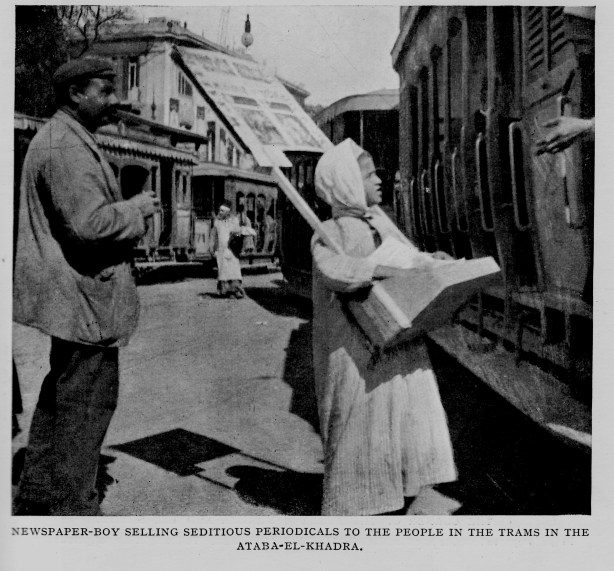
“Egyptian newspaper boy yelling out the latest headlines, Cairo, 1907.” Source: From Douglas Sladen, Oriental Cairo (London: 1911), 64.
However, as discussed in previous chapters, this was never a one way conversation, as writers of these vernacular media were plugged into the streets and public squares through these very same cafés. As we have observed in this study, it can be said that the entire vaudeville theater industry arose out of the cafés on ‘Imad al-Din Street, where most of the vaudeville theaters were housed [Note: See Ibrahim Ramzi, Masrahuna ’Ayyam Zaman wa Tarikh al-Fananin al-Qudama’ (Cairo: Matba‘at al-Salam (1984), 25. There were at least three major cafés in Imad al-Din Street that were frequented by actors, singers, writers, and musicians— Qahwat al-Fan (The Arts Café), Qahwat Barun (The Baron Cafés), and Qahwat Misr (The Egypt Café)]. It was through these dialogical “physical” interactions with the people in the streets, market places, and cafés that the writers, musicians and performers of these media (re)calibrated with the subtleties, textures, and flavors of everyday Egyptian life. As Mikhail Bakhtin cautions in The Dialogic Imagination, we must not ignore the “social life of discourse outside the artist’s study, discourse in the open spaces of public squares, streets, cities and villages;” for it is in these public spheres that Egyptian mass culture is embodied into everyday life, acquiring its socio-economic, political relevance, and more importantly perhaps, its perceived authenticity, and contemporaneity (259). Indeed, access to any form of knowledge— be it visual, aural, tactile, gustatory or olfactory—is corporally mediated and is acquired through a living dialogical engagement. Or as Bakhtin elaborates in Problems of Dostoevsky’s Poetics, “the single adequate form to verbally expressing authentic human life is the open ended dialogue . . . In this dialogue a person participates wholly and throughout his whole life, with his eyes, lips, hands, soul, spirit, within his whole body and deeds” (293). In other words texts alone are meaningless when viewed in isolation of the socially embodied realities of their production, and more importantly perhaps, their reception on the street. It is in their interrelationship with social life that texts become meaningfully activated and authenticated as genuinely reflecting popular concerns and realities. As we have seen throughout this book, colloquial Egyptian culture is better equipped in engaging in this dialogue with the everyday, and hence guaranteeing its circulation and popularity.
(Ordinary Egyptians, p. 170-172)
—
Featured Image: View 042: Egypt – Street in Native Quarter, Cairo., n.d., T. H. McAllister, Manufacturing Optician. 49 Nassau Street, New York. Brooklyn Museum Archives (S10|08 General Views_People, image 9785).
—
Ziad Fahmy is an Assistant Professor of Modern Middle East History at the department of Near Eastern Studies. Professor Fahmy received his History Ph.D. in 2007 from the University of Arizona, where his dissertation “Popularizing Egyptian Nationalism” was awarded the Malcolm H. Kerr Dissertation Award (2008) from the Middle East Studies Association. His first book, Ordinary Egyptians: Creating the Modern Nation through Popular Culture (Stanford University Press, 2011), examines how, from the 1870s until the eve of the 1919 revolution, popular media and culture provided ordinary Egyptians with a framework to construct and negotiate a modern national identity. His articles have appeared in the International Journal of Middle East Studies and in Comparative Studies of South Asia, Africa and the Middle East. Professor Fahmy is currently beginning another book project tentatively titled, Listening to the Nation: Sounds, Soundscapes, and Mass Culture in Interwar Egypt. In 2011-2012, he was a Faculty Fellow at the Society for the Humanities at Cornell University, where the focal theme was “Sound: Culture, Theory, Practice, and Politics.”
Share this:

Rallying Cries as Suffering Sounds: “Allah-O-Akbar” and the Aurality of Feminized Iranian Suffering
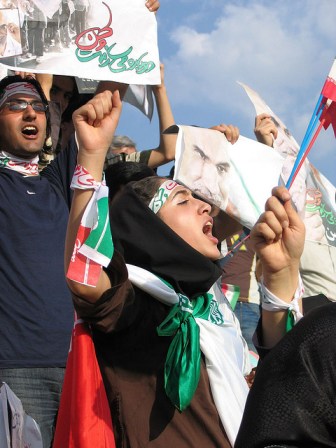
By July of 2009 dozens of pitch-black videos began to appear on YouTube. Documenting ambient noise, in some cases narration and, most prominent of all, impromptu collective outcries of “Allah-o-Akbar,” these videos resonate with an urgent gusto, punctuated with an eerie sense of desperation through faint echoic reverberations. By the level of desperation audible in every voice, at once dulcet and melancholic in tone, there is a distinct sense that Allah very well may be called forth. While most of these videos received scant attention, one entitled “Inja Kojast”](translated as “Where is this Place”) received over 174,000 hits (as of writing).
It was dubbed with English, Spanish, and Japanese subtitles, was sampled by a music producer (“Tehran’s Roof Tops _Remix”) and also played a prominent role in the 2010 French film Fleur du Mal. What is enabled, invoked, and signified by the layering of these multiple and disparate incantations? What is affectively evoked in the widespread circulation of these chants by YouTube and in Fleur du Mal? Why was this video circulated so widely and deemed so affectively resonant by disparate audiences?
Due to the fact that the Iranian government had barred entry to representatives of foreign media and systematically jailed Iranian journalists accused of being hostile to the regime, the disputed 2009 Iranian elections and ensuing protests were largely reported on by a new breed of “citizen journalists”. Filling in the information vacuum, citizen journalists tweeted and uploaded to the Internet raw video footage of protest marches and confrontations with Basiji militiamen by day – and the voices of dissent performed on Iran’s many rooftops by night. Donning the cloak of darkness, residents of Iran’s major cities climbed to the rooftops of their buildings to chant “Allah-o-Akbar” in numbers – a brief reprieve from the violent suppression of their street protests by Basiji militiamen.

“Women Smash the Shah’s Crown,” Poster from the Iranian Revolution, Courtesy of Flickr User Voyou Reserve
As Negar Mottahedeh has written in her online essay “Allah-o-Akhbar”: “The cry of “Allah-o-Akbar” was the defining sound of the 1978 protests against the Shah of Iran, during a revolution that toppled the Pahlavi monarchy and established the Islamic Republic of Iran.” This earlier revolutionary context is represented in the video for “Allah o Akbar, Khomeini Rahbar”, which hailed a politically diverse citizenry to stand behind this “rahbar” or new “leader.” The chanting of “Allah-o-Akbar” was further exploited as a nationalistic call-to-arms during the Iran-Iraq war in the music video for the anthemic “Allahu Akbar Iran, Iran.” The chant’s versatility and instrumentality in this immediate post-revolutionary period is due not only to its capacity to appeal to the pious and patriotic backers of the newly formed Islamic Republic but also because of its power as a performative political rallying cry. Mottahedeh’s essay title employs a pun: the addition of ‘h’ to the word “Akbar” in transliteration changes the word to “Akhbar” or news. Although she does not elaborate on this, her title suggests that this chant is itself a form of citizen journalism, a broadcast calling forth the revolutionary spirit that Iranians pride themselves for always having at the ready. But what kind of journal is “Allah-o-Akbar”? Is it a call to arms, a rallying cry, a collective sound of suffering or all of the above?
Despite its pious provenance and deployment as the paradigmatic cry of the revolutionary uprising against the Shah, the Islamic Republic currently led by Ali Khamenei and Mahmood Ahmadinejad–which was inaugurated by these earlier revolutionary calls–has interpreted the post-2009 chanting of “Allah-o-Akbar” as blasphemous and an affront to their authority. Journalist Jalal Hosseini argues that this is due in part to the fact that opposition candidate Mir Hossein Mousavi called upon his supporters to remember the revolutionary history of this performative chant in an open letter, stating “Let’s not abandon the green colour which is a symbol of spirituality, freedom and religious mentality and moderateness and the Allah O Akbar slogan that tells us of revolutionary roots.”
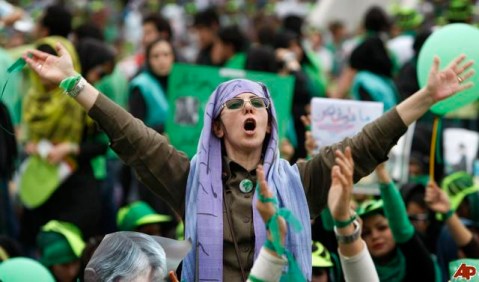
Women at the Front, 2009, Image by Flickr User Raymond Morrison
As Hosseini has written, “In a religious state, where religion is present in every aspect of life, Iran’s protestors have managed to turn religion against their government…Allah-o Akbar is perhaps the single most symbolic phrase in the Muslim world, yet Iran’s current rulers, who themselves employed this slogan in their struggle against the Pahlavi regime in the 1979 Revolution, did not tolerate the protesters’ cries of Allah-o-Akbar after the 2009 presidential election. Allah-o Akbar has essentially become a forbidden phrase.” Hosseini goes on to quote numerous Tehranis who testify to their disparate intentions behind the chanting, highlighting the ambivalence inherent to the slogan, which makes it available to Iranians of many stripes, and, as he argues, allows the calls to resonate even beyond the nation by appealing to other Muslims globally. But the widespread circulation of these videos and their popular impact on global YouTube audiences also suggests that the chanting has had an impact on non-Muslims as well.
Susan Moeller, who penned a Huffington Post piece right around the time of “Inja Kojast’s” semi-viral circulation, argues that this most recent phase of the chant’s resignification has helped to win Americans over to the protesting Iranian’s cause, writing, “watching Americans are learning to reframe the meaning of ‘Allah O Akbar’ and re-imagine the people of Iran. The pictures from Tehran are showing that Iranians are not monolithic in their beliefs.” Moeller suggests that this collective chanting has somehow cut through the status quo Islamophobic representations of a fundamentalist Iran to create an affective and empathetic pathway through which Americans can “re-imagine the people.” Moeller’s argument echoes the sentiment of the comments written on the YouTube page for “Inja Kojast,” comments like “This breaks my heart!” left by Annabanana23663 or “I have listened to this so many times already that you would think I would have moved on BUT I continue to listen and will continue to listen for there is truth in that voice of pain. And only by embracing pain can we love truth. And truth not only will set us free but without truth we cannot be free. Go you beautiful Persians. The people of the USA love you for your defiance” (by YouTube viewer HulkSmashPunyHumans).
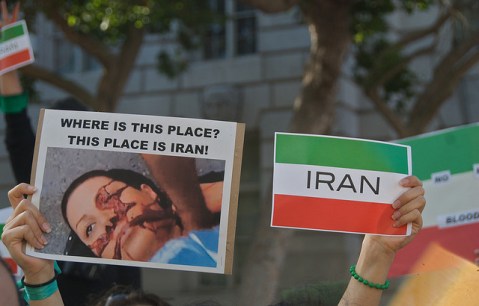
“Where is this Place?” San Francisco, CA, 20 June 2009, Image by Flickr User Steve Rhodes
Not only were YouTube users impacted by “Inja Kojast” but the video’s representation of Iran’s rooftop chants inspired the narrative arc of French filmmaker David Dusa’s Fleur du Mal (Flowers of Evil, 2010), a film that explores the precarity and instability of Iran after the 2009 elections. Through a chanting scene in which the two main characters, Gecko (Rachid Youcef) and Anahita (Alice Belaïdi), vociferously call out “Allah-o-Akbar” on the edge of a rooftop in the avowedly anti-Islamic nation of France, they thumb their noses at both nation-states at once while also sealing their romantic bond. Perhaps in an ironic play on Khomeini’s exile in the same city, the beautiful, educated and upwardly mobile Anahita is incubated in Paris for a time while the political instability following the 2009 elections settles down. Completely obsessed with the post-election struggles that she and her friends were actively engaging in on the streets of Tehran, she daily follows every new tweet and YouTube video. She bides her time in Paris by convincing Gecko, the bellhop at her swanky hotel, to give her a tour of the city and the two soon become lovers.
Despite the somber context of the film’s main narrative preoccupations with Iran’s botched 2009 elections, this plot point, I argue, enables the cathexis of an Orientalist drive that is shared by Western audiences: a drive to consummate the desire for the feminized Muslim woman seen to have suffered under the despotic rule of Muslim masculinity. It is this same desire that gets sublimated in a consumption of feminized Muslim suffering which has led to a reductive popular reading of “Inja Kojast” that eclipses the ambivalence of and disparate intentions behind the chanting it documents. In particular, it is through the cries of the narrator’s own female sounding voice that “watching Americans are learning to…re-imagine the people of Iran” as finally available to and eligible for their empathy, attention and yearning.
Fleur du Mal weaves narrative scenes with YouTube footage of Iranian post-election street protests and, in one scene, an image of Neda Agha Soltan’s assassination. Viewed over 1,200,000 times (as of this writing), there has been a wide-scale promotion through documentary films, video diaries, songs and various other imagery of what has been called Neda’s martyrdom for Iran’s “green revolution”. This representation of a feminized Iranian suffering at the hands of an Islamic fundamentalist Iranian masculinity has become a privileged symbol for Iran’s Green Movement outside of Iran. This has enabled an affective attachment to be made which has, quoting Moeller yet again, enabled Americans to “re-imagine the people of Iran.” This time, somewhat counter to Moeller’s claim, it is not only “pictures” that are functioning to transform perceptions of Iranians; sound operates as a critical conduit to an interiority characterized by pain and suffering that has particular appeal.

Image by Shahin Edlata, San Francisco
I argue that the suffering sounds of “Inja Kojast” resonate within what I have elsewhere termed an “aural imaginary” through which Americans and the West “re-imagine[s] the people of Iran.” Through the suffering sounds of an anonymous feminine-sounding voice–reflecting upon and poetically translating the suffering sounds of a nation’s nightly chanting of “Allah-O-Akbar”– a direct link has been made to the feminized victim of Islam.
As US-backed Israeli war-drums are beaten, and as conspiracy theories regarding Iran’s hand in the recent spike in oil prices resuscitate decades-long antagonisms, we must be mindful of the multi-sensorial cooptations of empathetic and affective attachment that have constructed feminized suffering as justification for military intervention and the instrumentalization of sound in support of this. The old Orientalist desire for a feminized opening through which to re-imagine and know the radical other that is Iran has been found through a new gateway: aurality.
—
Featured Image: “Iran 06” courtesy of Flickr User Chong Head
—
Roshanak Kheshti is Assistant Professor of Ethnic Studies and affiliate faculty in the Critical Gender Studies Program at the University of California, San Diego. She is currently completing a manuscript entitled “Modernity’s Ear: The Aural Imaginary and the World Music Culture Industry,” which theorizeshow an other to the listening self is racialized and gendered within the world music listening event. She has published in American Quarterly, Feminist Studies, Hypatia and Parallax.
Share this:


Current Top Posts





April 2021

January 2020

November 2019

October 2019

August 2019

April 2014

November 2017

March 2015

December 2017

October 2015
 Sounding Out!
Recent Comments