
Beat-ification: British Muslim Hip Hop and Ethical Listening Practices


As the beat drops for our latest Live from the SHC post, Cornell’s Society for the Humanities Fellow Jeanette Jouili hits us with some (social) science, sharing her ethnographic research on Muslim Hip Hop in pious communities in Britain. To give earlier installments by Damien Keane, Tom McEnaney, Jonathan Skinner, and Eric Lott another spin, click here. Next week, the needle comes to the end of the groove for the “Sound: Culture, Theory, Practice, Politics” crew as Society Director Tim Murray takes us on home. Good thing Sounding Out! can’t stop, won’t stop. . . –JSA, Editor in Chief (and 2011-2012 SHC Fellow)
—
Can Hip Hop sound Islamic? And conversely, can one listen to Hip Hop in a Muslim way? What is at stake when a contemporary musical form like Hip hop (or rock or punk) is introduced into the catalogue of recognized Islamic music genres? What impact do these genres have on longstanding Islamic traditions of ethical listening? In the process of creating new genres of Islamic music, which have not been previously connected to Muslim music traditions, norms are negotiated, border zones are walked upon, limits explored. At the same time, these Islamic music practitioners, even those who push established artistic limits within the Islamic movement, nevertheless intend to uphold the initial ethical project.
Considering music as producing sensual pleasure or extreme emotional excitement, Muslim scholars throughout the ages have been concerned with its capacity to hinder the exercise of reason and self-mastery as well as with its promises for spiritual benefit. Roughly, one can say that those who have opposed the practice of listening to music feared that music’s force arouses worldly passions which distract from the remembrance of God, whereas those who were favourable toward this practice – generally speaking these voices came from thinkers and practitioners of the Islamic mystical traditions –highlighted music’s capacity to impel the believer to seek the spiritual world while simultaneously being attentive to its potential dangers. Among these two sides, there is a wide range of theological opinions, from those that prohibit any kind of musical singing (considering Qu’ran recitation and poetry recitation not in terms of the category music) as well as all musical instruments, to those that allow for singing and certain musical instruments (i.e. drums permitted, stroke instruments not), and those who allow for all the array of musical expressions (given that specific moral conditions are fulfilled).
If the evolution of Islamic music toward the incorporation of modern music traditions has already been controversial within many Islamic revival contexts, it is not exaggerated to claim that Hip hop, at least in the UK, is probably the most contested and is until now the most marginalized of the different music genres within the Islamic popular culture scene. Today’s British Muslim Hip Hop is an occasion to think about the struggles of young Muslims to incorporate a music tradition that epitomizes black music culture like no other contemporary genre into the larger frame of Islamic music in Britain, which has been largely associated with South Asian and Middle Eastern music traditions.
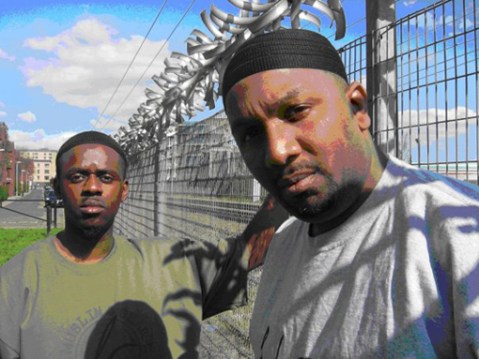
Rakin and Ismael of Hip Hop Duo Mecca 2 Medina, Image Courtesy of M2M
Muslim Hip Hop takes many different sonic and stylistic directions in the UK. Some artists advance their Muslim identity in the context of religion and others take a more political standpoint; many blend both to varying degrees. What connects these diverse orientations is the critique of contemporary mainstream commercial Hip Hop. Many Muslim Hip Hop fans and artists see this music as little more than a glorification of materialism and sexism. The thriving Muslim Hip Hop scene in the UK, which is deeply influenced by Afro-Caribbean converts to Islam, clearly situates itself in continuity with early Hip Hop, as defined by black awareness, political messages, and an underlying Islamic identity. Their own engagement in Islamic Hip hop is thus seen as holding true to the ‘authentic’ Hip hop traditions by purifying a corrupted Hip hop and renewing and reconnecting it to its Islamic identity.
While Aki Nawaz’ FUN-DA-MENTAL were Muslim Hip Hop pioneers in early nineties British hip hop, it was notably Mecca 2 Medina which opened the doors for Muslim rappers in the reticent U.K. Muslim community. Currently, the Mozambique-born rapper Mohammed Yahya, the female rap duo Poetic Pilgrimage, the sisters from Pearls of Islam, Muslim Belal, and Rakin Niass (formerly of Mecca 2 Medina) headline many urban Muslim cultural events in Britain. Lowkey and Jaja Soze are two well-established names in the UK Hip hop scene who are also present within the more subcultural Muslim scene.

Lowkey, Image by Flickr User The Girl 78
The Islamic Hip hop scene in Great Britain struggles to find a way to bring the tradition of Hip Hop in line with Islamic traditions, molding it to conform to Islam’s ethics of listening and sonic practices. Hip Hop can be especially problematic (from a certain Islamic point of view) because danceability is usually one of its prime objectives. The sensual dance style instigated by Hip Hop is notably achieved through amplified bass and repetitive beats that often drown the vocals. British Muslim Hip hop artists emphasize, however, that it is not so much the beats, but the spoken word art that connects Hip Hop to the sonic-linguistic practices of Islam’s pronounced oral tradition. A minority of rappers (for instance, Muslim Belal) adhere to a specific Islamic interpretation according to which music instruments are forbidden, and therefore use no instrumentals, only human voices as background music. But the large majority of Muslim artists, including those who are outspokenly religious, do use instrumentation. Yet, a fine line seems to exist where beats begin transmuting into “nightclub” sounds. While neither clearly defined, nor necessarily articulated by the artists themselves, Muslim artists nonetheless avoid this musical point of no return so as not to marginalize the spoken word. Jaja Soze’s “Just Like Me” is a good example of such sonic practice. Soze plans to do exclusively spoken word in the future.
.
Notably, according many Muslim Hip Hop artists in the UK, Hip Hop invokes important similarities with forms of recited or sung poetry, practices which were so cherished in the early Islamic community. For all these artists, reconciling Islam with Hip hop means recentering the spoken art form by sonically emphasizing the voice and the words. Thus, Islamic Hip hop is stylistically related to spoken word poetry, which frequently critiques the camouflaging of Hip hop lyrics behind beats. The lyrical content is also reflective of an Islamic ethic, often weaving explicitly pious Islamic themes with politically and socially conscious lyrics. Racism, Islamophobia, Neo-Liberalism and Imperialism in the age of the Global War on Terror are constant themes, as are critiques of the gang violence faced by minority communities in England’s major cities and cultural practices connected to the countries of origins of Muslim immigrants. “Silence is Consent,” from Poetic Pilgrimage, a female Hip Hop and Spoken Word duo and one of the few Muslim female Hip Hop artists in the UK highlights such socially conscious lyrics.
.
Lowkey’s lyrics in “Terrorist?” are an especially strident critique of the War on Terror:
.
Far from constituting a vital unit with the lyrics (as is otherwise commonly assumed for Hip hop), beats and musical instrumentation are often treated as dispensable in Muslim Hip Hop. Even the artists who use instrumentation regularly perform their pieces a cappella on events that do not allow music instruments; many artists even offer their CDs in two versions: one with and one without instrumentation. Also, many artists switch easily from spoken poetry to Hip hop (the same lyrics can be performed, depending on the demands, as a spoken word or a Hip hop/rap piece), as they consider spoken poetry to be an intrinsic part of the broader Hip hop culture.
Such considerations are in line with Islamic traditions of listening, with their strong concern for listening to the voice and to the word. Listening to voices and words that carry spiritual and sacred contents or disseminate more broadly positive messages is reasoned through the paradigmatic experience of Qur’an recitation. The invocation of “beautification” (translated literally from the Arabic term tajweed, which refers to Qur’an recitation) has become a common trope among the British Muslim Hip Hop artists I have interviewed in order to defend their artistic activity (whether pertaining to voice and instruments or only to their vocal skills). As in Quran recitation, “beautification” is employed here as a tool to facilitate the reception and to reinforce the affective impact of the word. “Clarity” by Rakin Niass, who started rapping with the British rap group Cash Crew and is one of the founding members of Mecca 2 Medina, clearly promotes a moral life style.
.
Hip hop, if it wants to be considered legitimate within an Islamic context, must enable an ethical listening. Charles Hirschkind’s The Ethical Soundscape (2006) argues that listening in Islamic traditions, is “not a spontaneous and passive receptivity but a particular kind of action itself, a listening that is a doing” (34). It represents a form of active listening that involves both the intellect and the senses, promoting a specific way of being in the world. Consequently, I consider contemporary genres like Muslim Hip Hop, however modernized it might sound, does still bear the imprint of earlier da’wa traditions, encouraging an virtuous life for listeners, and cultivating necessary ethical and political sensibilities through the ear.
These new musical styles are not only reflective of new sensibilities and subjectivities, they are, as notes Jean-Luc Nancy in Listening (2007), productive of subjectivity. It is for this reasoning that one should not underestimate the significance of the evolving music genres within the Islamic revival movement. Listening carefully to them will therefore provide crucial keys for understanding the possibilities for the development of specific ethical projects within a global mass culture.
__
Featured Image Credit: Poetic Pilgrimage, B Supreme 2011 © 2011 Paul Hampartsoumian
__
Jeanette S. Jouili is a 2011-2012 fellow at Cornell’s Society for the Humanities. She has also held a Postdoctoral position at the Amsterdam Institute for Social Science Research at Amsterdam University where she did research on the (pious) Islamic cultural and artistic scene in France and the UK. In 2007, she received her PhD jointly from the Ecole des Hautes Etudes en Sciences Sociales in Paris (France) and the European University Viadrina in Frankfurt/Oder (Germany). Jeanette has published in various journals including Feminist Review, Social Anthropology, and Muslim World. She is currently completing a book manuscript based on the material of her PhD dissertation provisionally titled Pious Practice and Secular Constraints: Women in the Islamic Revival in France and Germany. Jeanette’s research and teaching interests include Islam in Europe, Islamic revivalism, secularism, pluralism, popular culture, moral and aesthetic practices, and gender.
Share this:

Can You Hear Me Now?

The New York Times' Brian Stelter posted this tweet earlier this week. It serves as an example of the importance of sound to the media coverage of the protests in Egypt.
And Gil-Scott Heron thought the revolution would not be televised.
The past few weeks the world has been watching the protests in Egypt. We have not just watched, but we have also tuned in. This is history in the making, especially considering that many of the information we are getting of this protest movement come from the ground, from the protesters themselves, and their requests have gone viral on Youtube and Twitter.
Earlier this week, I was watching CNN and its coverage of the protesters at Tahrir Square after Mubarak’s statement that he would not step down. On several occasions the broadcasters on CNN asked viewers to listen to protesters. The grainy images of the mobile crowds had been playing in the background all afternoon, a reminder of what was going on while the broadcasters offered information and analysis. But at times the broadcasters stopped speaking so viewers could listen to the crowds. The grainy images emitted a dull roar, the combination of all of the cries and statements from the protesters. The cameras followed people down streets, but the roar was constant. It struck me how often the plea to listen came up during the broadcast. On Friday, when Mubarak resigned, I tuned in online (from work) to CNN, MSNBC, and BBC America. The broadcasters made the same requests: let’s tune in to the crowds at Tahrir Square. See early in this MSNBC video where Brian Williams encourages viewers to listen to the protesters:
The newsmedia seemed to offer the sounds to its viewers, but what is at stake when that happens? How are the sounds being coded? Mark Branter’s post on sound and sanity in the context of the Rally to Restore Sanity (which took place on October 30th 2010), reminds us that oftentimes noise and screaming is connected to “irrationality and fear.” He points out, “Public noise is senseless sound, while rational debate is meaningful sound.” In this context, the constant plea from newscasters for the American public to “listen in” to the crowds at Tahrir Square takes a different spin. Are we insiders looking at the Other scream and shout? When the newscasters ask us to tune in to the pleas and screams coming from the Egyptian crowds I wonder if the newscasts frame them as senseless crowds because of the way that they present these sounds. In any instance, this presentation of sound is not innocent. Some may argue that it is just a request from Western media to pay attention to what the crowds are saying, but I believe that we cannot truly listen to their cries on Tahrir Square when we still hold in place this analogy of “sound/noise::rationality/irrationality.” Many agreed that Mubarak should listen to the pleas of the crowds, but are we listening to them as well?
The coverage of the Egyptian protests shows us how complicated listening is. The protesters are not just seen but heard (only when the network wants the viewers to listen, mind you) by viewers. The sonic aspect of this movement is reinforced when we think of the “Speak-to-Tweet” service, set up to allow Egyptian protesters to tweet when the Egyptian government turned off all internet communication. We could read AND hear what the protesters were saying.
When media outlets choose to tune in to the protests in Egypt, this is an example of how important sound is to narratives. Visuals are not the only story, is what I get from the protest coverage. (And letting the world hear the protesters is a step in the right direction.) The coverage and its inclination toward the audio of the protesters tells me that it’s not just a matter of shock value but it’s also a statement of the role of audio in the news. It’s supposed to be a reflection of what is going on at the moment, like taking the temperature of the crowds. As others have said on this blog (for example, Priscilla Peña Ovalle) sound is usually linked to the visual, and the hierarchy of senses in our society always has the visual as the most important. Listening is important, but we must also think about how we listen, and what filters the sounds we listen to.


Share this:


Current Top Posts





April 2021

January 2020

November 2019

October 2019

August 2019

April 2014

November 2017

March 2015

December 2017

October 2015
 Sounding Out!
Recent Comments