
LMGM’s “Lost: Choirboy” & El Jefe’s “Muñoz & La Mission: A Sermon. . .” (in memoriam José Esteban Muñoz)

 Come, let us sing of great men. Well, just one man, not men—and masculine gender is not essential for our purposes. Come to think of it, his greatness isn’t nearly as important as his fierceness, his queer significance, his brown sensibility. But we’re still committed to singing—or at least to music—well, to sound and noise, in any case. José Esteban Muñoz often wrote about queer scenes where music and sound were central to participants’ world-making activities. His archives buzzed with the sounds of West Coast punk, vogue-ball house, cruisy toilets, genderqueer burlesque, and salsa echoing down the barrio streets. And so, for this Round Circle of Resonance, we at La Mission are here to make some noise about a badass thinker who deeply impacted the way we dance/sing/talk/write/sweat about dance music, identity, and politics.
And this is just the beginning of our cacophonous, four-part response to Muñoz’s intellectual holler. The first installment, written by La Mission’s resident essayist / deranged propagandist LMGM (Luis-Manuel Garcia) provides a brief introduction to our collective, some reflections on Muñoz’s relevance to our activities, and a frame for the next three missives from our fellow cultists. It is backed with a rousing sermon-cum-manifesto from our charismatic cult-leader/prophet, El Jefe (Pablo Roman-Alcalá). In the coming weeks, our Naked Mennonite/randy dramaturge (Mandie O’Connell) will prepare and film a urinary performance piece; and our saucy Choir Boy/Linguist (Johannes Brandis) will compose a dirge to our dearly departed José (August 9, 1967- December, 4, 2013).
LMGM a.k.a. Luis-Manuel Garcia
—
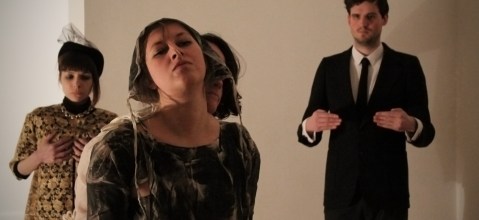
La Mission’s “(p/A)001: A non-Aristotelian Drama in Five Acts,” 2013, Image by Julien Barret
Lost: Choirboy (in memoriam José Esteban Muñoz)
La Mission
Named after San Francisco’s Latino barrio, La Mission is a satirical utopian doomsday cult, a music label, a queer situationist art-gang, a magazine, and a group of dancers with a very dirty sense of humor. We release music on vinyl, publish DIY ‘zines, and make performance art, aiming to re-politicize genres of dance music that have been important to queer people of color. La Mission’s identity is perhaps best summed up by cult-leader El Jefe’s manifesto-sermon, “The Sermon for the Steps of the Ziggurat in our Hearts,” published in our first La Mission magazine:
La Mission is a Community. La Mission is a Collective. La Mission is a Cult. La Mission is a Situationist Art Gang. La Mission is a Anarcho-Syndicalist terror cell. La Mission is a Family. La Mission is You. La Mission is Us. La Mission is gonna strip you butt nekkid, gonna check all your body cavities, gonna give you a shower, gonna give you a goodie bag, gonna give you a clean sheet and a towel. You at home with us now children, you understand me? You home with us now.

Founders Luis-Manuel, Pablo, and Mandie, caught on film at the performance for LM002, ‘a slow mutiny.'”
La Mission was first formed in 2012, in a small café in the Neukölln district of Berlin. The collective initially began with just three of us—Pablo Roman-Alcalá, Mandie O’Connell and Luis-Manuel Garcia—but like any good charismatic doomsday cult, it quickly expanded to include a broad network of lovers and collaborators, led by a core of four instigators (Johannes Brandis joined us later in the year). After a fundraising run in the fall of 2012 (witness our surrealist fundraising video here), we held our first two performances in the winter and spring of 2013, which involved experimental performance art pieces held in unusual spaces. The performances incorporated music and text from our vinyl EPs and their corresponding ‘zines, which were released at around the same time. These multi-channel productions were also conceptually coherent, with (kunst/WORK)001 introducing La Mission’s “mission” and (kunst/WORK)002 focusing on the relevance of utopianism to dance music. After a “quiet spell” where we released an out-of-series vinyl record of “lost remixes,” 2014 has been dedicated to preparing the next volume in the series (due in February 2015), which examines the depredations of capitalism, forced austerity, and false scarcity on music.
Hearing José
La Mission has no idols, but we do have influences—and José Esteban Muñoz is foremost among them. We share with Muñoz a focus on queer nightlife-worlds, a non-classical take on utopianism, a commitment to intellectual interventions outside of academic channels, and a certain brassy tone of voice. His revival of Ernst Bloch’s notion of a utopia based in real-life struggles was crucial in helping us reconcile revolutionary politics with dancefloor utopianism; or, put differently, Muñoz helped us find the critical politics latent in the queer, brown, sweaty gatherings that form the core of our scene of commitment. As “EDM” continues to blow up into a primarily white, hetero, cis, mainstream phenomenon, his insights have helped us maintain clarity and critical focus.
From the outset, we have also been profoundly influenced by Muñoz’s lifelong theorizations of brownness, affect, and (dis)identification. Since three of our four core members are Latina/os in varying states of stripped identity, we have been especially interested in Muñoz’s notion of the “brown commons,” as he was developing the concept in the last years of his life. In promotional texts that circulated ahead of his speaking engagements on the topic, he described brownness as “an expansive sense of the world, a feeling and being in common that surpasses the limits of the individual and the subject.” Notably, he understands brownness and the brown commons as being shaped not only by suffering and struggle, but also by thriving, providing a pool of resources for a better, more vibrant kind of life.
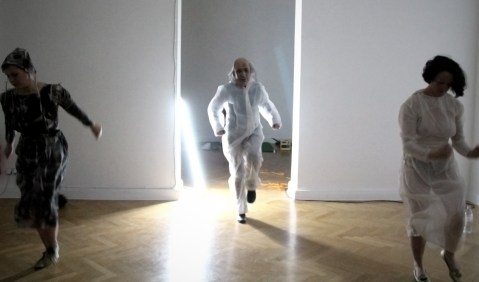
La Mission, (p/A)001: A non-Aristotelian Drama in Five Acts, 2013, Image by Julien Barret
The significance for La Mission’s project in dance music culture should be clear already, but we also take great inspiration in how Muñoz developed an expansive view of brownness and the brown commons, using Latina/o experience as an entry-point for “a vaster consideration of the ways in which people and things suffer and experience harm under the duress of local and global forces that attempt to diminish their vitality and degrade their value.” We here at La Mission are committed to exploring brownness for its potentials for lateral solidarities among people of color, who may have diverse cultural backgrounds but nonetheless share post-migrant experiences of struggle, devaluation, displacement, and inauthenticity. In fact, Muñoz’s work was a direct inspiration for the “Brown Corner” in our La Mission ‘zine (a parody of the “ladies’ corner” and “kid’s corner” of American mid-century lifestyle magazines). Published bilingually and featuring post-migrant authors, the Brown Corner reflects on aspects of brownness, as both specific to their contexts and generalizable to a wider “commons” of brown experience. In the process, we hope to highlight shared feelings, narratives, and resources for brown survival in a world of white supremacy.

A hand-drawn re-working of Frieda Kahlo’s own self-portrait, part of the Brown Corner for issue 001 of the La Mission ‘zine.
Singing into the Horizon
Brother Muñoz, what are we supposed to do with the vinyl records, the zines, the performance videos we had been accumulating for you? We’re trying to sing our way into a queer utopian horizon, and we had been counting on your voice. We know you’re not coming back. As a radical lefty utopian doomsday cult, we’re not so invested in the afterlife, anyway. But it still sucks for us and everyone else you left behind, left in the “here and now” that we struggle to turn into something less suffocating. The party was just getting started, dammit. Besides, we had such a kickass choirboy outfit picked out for you.
—
LUIS-MANUEL GARCIA aka “LMGM”: LMGM/Luis-ManuelLMGM/Luis-Manuel is a Canadian of Peruvian-Colombian origins, currently an Assistant Professor in Popular Music at the University of Groningen (NL), after migrating between Toronto, Berlin, Chicago, and Paris. He has managed to turn his love of electronic dance music into a PhD in Ethnomusicology at the University of Chicago, and into post-doctoral fellowships at the Max Planck Institute for Human Development and the Freie Universität Berlin. On the side, he writes about food and dances every chance he gets.
—

“Portrait of La Mission” by Ben Hammond, who has not seen any of its members naked
Muñoz & La Mission: A Sermon for the Imagined Sanctuary We Built Together
Welcome. La Mission is a family. A family of chosen comrades, chosen brethren, chosen hermanos, chosen сестры, chosen lovers, chosen students, chosen teachers, and chosen arms. Arms, linked and brandished through common thought, common feeling, common goals. It is with a heavy heart that we find ourselves here, remembering one of our family who (though never officially an acolyte or collaborator) was one who contributed to the ecstasy that we have felt and will feel for many years. José Esteban Muñoz was said to be a believer. Ernst Bloch and the New Revolutionary Epoch. Our utopias were described and imagined and realized and experienced. Rise up, my brown brethren, and let us celebrate Brother Muñoz’s legacy!

La Mission’s “(p/A)001: A non-Aristotelian Drama in Five Acts,” 2013, Image by Julien Barnet
The words and deeds of this fellow freedom-fighter, who infiltrated the bourgeois güero academy and infected it with a polylateral program for de- and reprogramming, has been our parallel and our inspiration. Colleague and comrade. A representative of our struggle. Not quite a patron saint—that honor we’ve reserved for communarde Louise Michel—but no less a visionary. As queers, as minorities stripped of identity, as angry and happy children in revolt for something better, we must all learn from each other as equals.
Brother Muñoz made utopia political again and located that utopianism in performance. La Mission’s performances bring forth utopias from our queer future through fleeting mindfuck happenings in the present. Through the work of Sister O’Connell and her band of terrorizing miscreants, we present a non-narrative and non-paternalistic path towards redemption, one of our own making. Can I get a “Fuck, yeah!”?

La Mission at Import Projects, 2013
Brother Muñoz loved music and dancing and life-worlds connected by the beat and said, “Take Ecstasy with Me.” He revealed to us the connections between collective dancing and feeling utopian. In his spirit, La Mission’s music strives to bring forth utopia through that ever-lasting beat. Through disassociation and reassociation, through transcendental repetition, and through getting the fuck down! Can I get a “Fuck, yeah!”?
Brother Muñoz believed in learning and critical thinking. Analysis and the great revolutionary trek through the jungle of our critically thinking minds. La Mission’s tracts enact utopia through a constant vomiting out of our recently digested learnings into the baby-bird mouths of those who read them. The brother was also a hilarious motherfucker, and from this we realize that it is not through the shrill screams of egoism disguised as activism that we will prevail. It is through the joy of laughter combined with thought that we will win our bread. Can I get a “Fuck, yeah!”?
Brother Muñoz loved fucking. La Mission’s fucking creates utopias through the ecstatic act in and of itself. If you aint fucking to make yourself a Temporary Autonomous Zone of happiness, then you aint doing it right. Can I get a copulatory “Fuck, yeah!”?
It is not all loss, though. The ideas live on. Caminamos juntos. On the dancefloor. In the reclaimed Torre David skyscraper and the Taller Tupac Amaru collective; in the informal classrooms and the sweaty bedrooms. Our hearts must burst after sagging, our heads must fill after hanging low, and our linked arms will raise! Oh honey, please don’t give your heart to a world system based on exploitation of the luckless, give your heart to US!
—

La Mission at Import Projects, Common Revilings Project, 2013, Image by Julien Barrat
—
All images courtesy of La Mission
—
PABLO ROMAN-ALCALA: Yo. I am Pablo aka “Beaner” aka “Skirtchaser” aka “El Frijolero” etc. I am an internationally working musician and dj who has enjoyed a modicum of success, but who doesn’t like what has happened to the musical landscape vis-a-vis “conservatism” in respect to both Money and Art. I mean the relationship of the two, okay? It sucks. And I want to change it.
—
 REWIND!…If you liked this post, check out:
Karaoke and Ventriloquism: Echoes and Divergences–Karen Tongson and Sarah Kessler
Freedom Back: Sounding Black Feminist History, Courtesy the Artists– Tavia Nyong’o
“New Wave Saved My Life*”-Wanda Alarcon
Share this:

Look Who’s Talking, Y’all: Dr. Phil, Vocal Accent and the Politics of Sounding White

From the first time Phillip C. McGraw, Ph.D.—better known as “Dr. Phil”—appeared on the Oprah Winfrey Show in 1998, dropping lines like, “My dad used to say, boy, don’t let yer alligator mouth overload yer hummin’ bird ass,” I was hooked. That accent! That no-nonsense, Southern sauce! From what fount of otherworldly knowledge did Phil drink? An insecure teen, gnawing and thrashing my way through high school’s convoluted social milieu (not to mention the murky waters of multiraciality), Dr. Phil’s frank, accented approach to life’s difficulties appeared as a god-send. It didn’t matter much what Dr. Phil was actually saying or whether his words when strung together formed logical thoughts, it was more the way he said things that affected me so. His deep, sing-songy lilt—preachy and avuncular—brought to mind a grandpappy smoking a pipe, whose wisdom was drawn from a hard day’s farmin’, not a god-forsaken textbook.
With Oprah’s endorsement, the Cult of Phil grew fast and strong. Dr. Phil became a national figure–the corporate media’s version of a public intellectual and my own personal hero. His daytime talk show provided him with a regular platform from which to dispense more of that golden, “Texan-dipped” advice, as The New York Times put it. Selling over 2 million copies, his 2003 classic Self Matters began the onslaught of McGraw-family oeuvre, including several by his wife, Robin, and son, Jay–the face of Phil’s teen self-help brand. Not just a sage, Dr. Phil’s commitment to the McGraw family brand let us know he walked the walk. As evidenced by Dr. Phil’s opening credits, which feature behind-the-scenes glimpses of Mr. and Mrs. McGraw canoodling and his smiley next of kin, this family was for real. They loved and laughed together while cross-promoting each other’s book projects. Teenage Me wondered, did white people get better than this?

Screen capture from the opening credits to Dr Phil
Today, Dr. Phil’s star, and my admiration for him, have faded significantly, but one thing remains the same. Ever since I can remember, my older sister and I have communicated almost exclusively via over-the-top, celebrity impersonations and Dr. Phil became a particular mainstay; even now, we religiously observe the maintenance of the Phil “voice.” Pre-Phil, I can recall my sister addressing me in a raspy, befuddled tone startlingly akin to the Keanu Reeves of yesteryear. Not soon after Bill and Ted’s Excellent Adventure became a permanent piece of our home VHS library, Reeves’ trademark method of delivering lines amidst staggered, nonsensical pauses became an obsessive, sisterly tick. “Dude, shut the door when you pee” she might say, staring blankly at me and cocking her head abruptly to the side.
The use of certain impersonations shifted with the ebb and flow of popular culture’s somewhat predictable tide, depending on whose video was “TRL’s” most requested or whose face most frequently graced the cover of TV Guide. I rehearsed George Herbert Walker Bush’s famous “thousand points of light” campaign ad in front of the stained glass mirror adjacent to the family room television; after that, it was all about Phil Hartman’s witty and endearing impersonation of Bill Clinton.
https://screen.yahoo.com/clinton-mcdonalds-000000491.html
It went on that way until Dr. Phil’s shit blew up, and everything became solidified–as if, finally, my sister and I had found our one true voice. With age, I came to understand that Phil wasn’t the prophetic genius I’d hoped he was and that our compulsive Phil-talk was an oddity, to say the least. I began to wonder why, even as adults, we continued to embarrass ourselves in public and take such pains to text each other in mock-“Texan” (thank goodness for smart phones’ “add word” function).
It’s actually quite common for people to adopt alternate voices or speech patterns. Take, for example, child-directed speech (“babytalk”) or pet-directed speech. Both are customized forms of vocal communication or “prosodic modification,” which, while differing dramatically from normative adult speech in their intonation and grammatical structure, are considered customary forms of address. In fact, cross-linguistic studies show that babytalk and pet-directed speech are common across other European languages, Japanese and Mandarin Chinese. As such, parents and pet owners can rest well knowing that prosodic modification of the child and dog varieties are nearly universal human ticks. Unfortunately, research into child- and pet-directed speech didn’t provide much insight into the unique phenomenon of “Phil-talk.” I had hoped to find other accounts in the literature, a history of similar episodes that might lift the shroud of tomfoolery, explain it away as all too common or evidence of psychological disorder x, y or z, something treatable with an esoteric name.
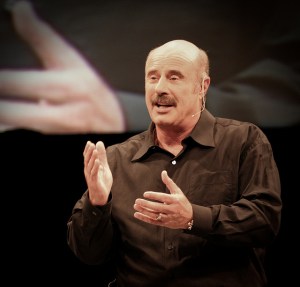
“Dr. Phil in Jacksonville” by Flickr user Craig ONeal, CC BY-NC-ND 2.0
While at this point in my life Phil-talk is more or less an asinine charade, it continues to function as a key component of our familiar vernacular. Interestingly, when re-visiting the many impersonations that have come to define our adolescent years (the Keanu years, the Bush Sr. years, the Phil years), one thing becomes clear: all the voices we’ve adopted have been those of white, male, cultural standard-bearers (Ironically, Keanu Reeves also happens to be Hapa, though I never knew as much. His breakout role as “Ted” helped to popularize the “California dude” archetype). Additionally, I should note, that at no time did any female impersonations enter my repertoire. If you’re going to gain a voice, better make it a male one, no? The racial and gender dissonance that Phil-talk begets drives the urge to perform it.

The author’s mother, with the author’s sister and the author. Picture is property of the author.
From an early age, my mother would tell me tales of her sacrifice—how hard she worked when she came to this country and how difficult life could be in 1960s post-war South Korea—all in a voice with barely a shred of mispronunciation or foreign intonation. My father, a second-generation Swiss-Italian American, scrupulously corrected her syntactical missteps and any other vocal nuances that sounded un-American. It was important to my mother to succeed as an American, and most importantly, that her children succeed too. The pressure I felt to make her content was borderline unbearable. When I started doing the voices, it made my mother happy. She sometimes tried joining in, attempting to mimic key Phil phrases like, “You have gawt to get reee-al,” but to no avail. “You do it better than me,” she’d say, “…my accent.”
When I was young, people looked at me and asked, “what are you?” OR “where are you from?” “America,” I would say. “I’m an American.” These questions were provoked by the racial ambiguity of my mixed-race heritage–the hint of Asianness that marked me as something else. I could not change the shape of my eyes, the contour of my cheeks or the fact that my mother was Korean. But, I could try my hardest to act and sound like an American. Phil-talk became a way to obscure the Asianness, to prove beyond a shadow of a doubt that I did, in fact, belong.
Rather than being merely a childhood performance of celebrity impersonations, I have come to think these various chapters were actually an attempt to perform sonic whiteness. Whether it was Keanu’s California dude cadence, George Bush Senior’s waspy nasality, or Phil’s prolonged Texan twang, I tried to perform in what Aja Martinez defines as “white voice” in her article “‘The American Way’: Resisting the Empire of Force and Color-Blind Racism” (593). She talks about Latino/a students using a “white voice” at school because they equate it with the voice of higher education, but I am really using it here as an explicit racial performance. As a a half Korean, half Euro-American teen girl (now woman) who decides to very literally adopt the voice of a White, 50-something, Texan, TV psychologist, “white voice” was the name of the game, and people loved it–especially my Korean immigrant mother.
For Asian Americans in particular, a people whose national belonging has been culturally questioned and legally denied, accents substantiate and make audible what the eye sees as un-American. In Shilpa Dave’s recently published Indian Accents: Brown Voice and Racial Performance in American Television and Film, she explores accents as they relate to cultural citizenship, national belonging and “the allocation of power.” Someone with an accent is “designated as an outsider to the dominant culture,” writes Dave. In contradistinction to “foreign” sounding accents, Southern accents are a classic symbol of American cultural belonging, like apple pie for the ears.
Would Phil’s wisdom sound as powerful or palatable without the accent? His appeal stems not only from his sometimes entertaining “Phil-isms” (e.g. “You can’t hide the sunrise from a rooster”), but from all that he and his voice signify. A white, male doctor giving advice on TV is hardly noteworthy, but Phil’s recognizably Southern accent separates him from the pack and softens the blow of his often severe advice.
![Angela George [CC-BY-SA-3.0 (http://creativecommons.org/licenses/by-sa/3.0)], via Wikimedia Commons](https://soundstudiesblog.com/wp-content/uploads/2014/11/philmcgrawhwofmay2013.jpg?w=300&h=243)
Angela George [CC-BY-SA-3.0 (http://creativecommons.org/licenses/by-sa/3.0)%5D, via Wikimedia Commons
Constantly searching for ways to be seen, heard, and accepted within an American system of racial binarism that privileges whiteness, denigrates blackness, and locates yellowness somewhere in a No Man’s Land of racial categorization, sound’s flexibility has always seemed to me like a means to belonging. Furthermore, as a multiracial, Korean/White woman, even no man’s land can seem out of reach. As Michael Omi notes in the Introduction to The Sum of Our Parts: Mixed-Heritage Asian Americans, within the historical and political context of the United States, (the “one-drop rule,” eugenic fears of racial intermixing, anti-miscegenation laws, etc.) multiracial identities have consistently been “contained, disregarded, [and] denied.” Multiraciality disorients and confuses insofar as it can discredit entrenched signifiers which make race perceptible to the eye and ear.
Previously on Sounding Out!, I discussed my identification with Nas and the rap world as both a move towards color and the formation of an authentic, multiracial self. A move in the opposite direction, experimenting with “white voice,” functions as another attempt to navigate America’s system of racial identification, albeit in a much more problematic vein. After years of Phil-talk and vocal impersonations of the white male variety, I am finally putting a stop to the charade. However earnest (or subconscious) an attempt to belong, the loss of time spent mimicking Phil represents an era of racial silencing that is somewhat difficult to stomach. Despite the amusement it has brought to friends and family, I am putting the voice to rest in service of getting real.
—
Featured image: “Dr. Phil” by Flickr user House Committee on Education and the Workforce Democrats, CC BY-NC-ND 2.0.
—
Christie Zwahlen is the Assistant Director at Binghamton University’s Center for Civic Engagement, where she has worked for four years to develop, expand and promote community engagement opportunities for students, faculty and staff. Previously, Christie worked for two years as an AmeriCorps VISTA, designing Service-Learning courses in conjunction with faculty at Thiel College and as the Coordinator of the Bridging the Digital Divide Program at Binghamton University. Christie earned her Master’s Degree in English and a Graduate Certificate in Asian & Asian American Studies from Binghamton University in 2009. She is currently enrolled in the English PhD program at Binghamton University.
Share this:


Current Top Posts





April 2021

January 2020

November 2019

October 2019

August 2019

April 2014

November 2017

March 2015

December 2017

October 2015
 Sounding Out!
Recent Comments