
SO! L.A.: Sounding the California Story
 Editor’s Note: Welcome to the second installment in our month-long exploration of listening in observation of World Listening Day on July 18, 2012. For the full introduction to the series click here. To peep the previous post, click here. Otherwise, whip out your most oversized sunglasses, kick back, and listen to Bridget Hoida’s California. –JSA
—-
STOP.
Do not read along with me “in your book.”
Resist the temptation to follow along with your eyes.
Click play. Listen.

Sunset in the San Joaquin Valley
If I had things my way, I would whisper these stories to you as we sat in mesh folding chairs on the poured concrete porch of my Central Valley childhood home. If I had things my way, I would refill your glass with lemons and gin, and we would breathe in the sweet, summer smell of rotting blackberry brambles. If I had things my way, we would wait until the sun set against a Tokay harvest, taking with it the harsh triple digit temperature and leaving us nothing but the quiet of a delta breeze and moonlight. If I had it my way, I would ask you to lean in close as I whisper with canonical voices:
“This is a story about love and death in the golden land, …”
“I remember that moment exactly, those exact words registering in my mind like the notes of a solo…”
“Bobby Gene was a tattletale he told everything he heard…”
“You must not tell anyone what I am about to tell you…”
“My history is murky, and I wanted it [ …] that way so I could be free to tell whatever I wanted. ”
“I’ll tell you what I suppose from your silences and few words and you can tell me if I’m mistaken. You’ll have to speak up with the real stories if I’ve got you wrong…”
“And so they talked and told tales of their region, and I listened. Long into the night I listened until I dropped off to sleep and my father would pick me up onto his lap as he continued to talk about the Revolution…. And every camp was different, none existing for more than six or seven weeks, then off we would go to the next harvest, where new people would gather and there would be new tales to be told and heard. I knew when I was six years old that the one thing I most wanted from life was to be a storyteller.
The storied sound of California
-All Voices
Shush…. Listen.
Linger with me on the drawn-out drawl of the stories I was raised on. Of the stories I was raised upon. For this is the sound of the California story: A myriad of voices sounding out narratives onto the page. Conflicting, concurring, spoken-over and rewrote…no one lasts longer than the next harvest, the next filmic “Action!” This is the sound of the storied terrain of interwoven melodies spoken upon the California soil that I call home.
1.
In or around 1995, I fell madly in love with Joan Didion. It’s not so much Didion the woman but rather the sound of Didion’s words that have me so hung up. My obsession began in the stacks of the Bancroft Library at UC Berkeley. I was assistant to the assistant librarian there and during my lunch hour I would take the dumb waiter up to the roof, eat a Kaiser roll with apricot jam, and read dime store copies of classic novels. I chose the roof because I like to read aloud, and in libraries at the time, reading aloud, especially to yourself, was expressly forbidden.

So there I was on the roof of Bancroft, with my roll, my jam, and my dime store copy of Play It As It Lays. I opened the page and read something about snakes and Iago. A mother died, the town of Silver Wells was won, and then lost, in much the same way a marriage slips into divorce. And then it happened. I stumbled across a line that changed the way I thought about words. Page 7, the first full sentence of the top paragraph, on the right: I might as well lay it on the line, I have trouble with as it was.
And after that line a whole lot of white space.
Beautiful, brilliant, blank white space.
As though in the silence of the rooftop, of the view, Didion was screaming to the reader, to me, something louder than words. In that white space there was sound and it was deafening.

2.
Later, when I decided to get a Ph.D. in creative writing, and although I couldn’t say as much on paper, examine, among other things, the commonality of language in California writers and the sonic devices of oral storytelling, I came across a quote from Didion, in interview, that said:
I had the technical intention to write a novel so elliptical and fast […] it would scarcely exist on the page at all…white space. Empty space. […] A white book to which the reader would have to bring his or her own bad dreams…
And although I adore everything about her I almost wished she hadn’t said it. Or that I hadn’t read it, because the thing about Didion is that statement… the part about the blank space… and the nightmare… it was already there. On the roof of the Bancroft library with my Kaiser roll and apricot jam, when the air tasted like September, I brought my own bad dreams because in that brilliant bit of white space I heard the scream.
3.
I like the white page. I prefer stories to plots. Plot for me is how the narrative moves from one space in time (from one line on the page) to the next. Story is how the narrative sounds. Story is voice. Plots are where girls meet boys and girls lose boys and girls get boys back. Stories are the shuffle and stop of scuffed shoes walking railroad levees, old men clearing phlegm, the surprise of an elastic bikini band as it snaps against the freshly burnt back of a burgeoning starlet. And the sounds of words as they smack unbridled against the page.

a traditional page by John Steinbeck

a white page by Joan Didion
4.
When I read Didion we are on my porch and I hear her voice. When we think of writing, when we imagine reading, we think of quiet moments that exist alone with fixed type on a printed page. But as a reader, and more importantly as a writer, I have never felt this way.
5.
Voice, to paraphrase Emily Dickinson, is the “slant” you bring to your version of “the truth.” Plots are recyclable. Hell, you can buy one on eBay, to be sure. But a writer’s voice is different. I don’t read a book to figure out what happens next. I read to hear the whisper of the author’s voice. If they whisper well, I turn the page.
6.
From John Steinbeck to Gertrude Stein, John Fante to Susan Straight, Larry Levis and Mary Hunter Austin to William Saroyan and Shawna Yang Ryan, there is commonality of sound and language that I’m willing to claim composes an aural palimpsest of sorts. A voicing over, both literally and figuratively of native daughters and native sons held up on the tongue of the golden state.
The cadence, the rhythm, the obsession with things past. The aching nostalgic longing. The reflection. The fear. The reclamation. The imagination. The witness of an agrarian undoing. Sleepy Hollow moments reborn—again and again on western soil. The feeling of home. The feeling of home slipping away. The feeling of self, self-made in the image of home, slipping away alongside it. There’s a certain Californianess to it.
7.
What if we found a way to consider the sound these “fixed texts” emote? What if we broke with conventional narrative structure and embraced a written technique that more adeptly mirrored the sound and cadence of spoken story telling? Then might it be possible that the very aurality that is “written over” on the read palimpsest is in fact the sound that also remains?
As a writer, a writer who believes in voice, who rejoices in sounds as the strike-like syllables against a now forgotten Olivetti key, my pursuit in writing not only a novel, but in writing a novel about California was how I could possibly enter into this conversation. How I might be able to raise my voice loud enough to embrace the crowd of such a respectable page. How I could construct my text in such a way that it would not only read, but also sound Californian.

a “docu-page” by Raymond Barrio
8.
In my struggle to voice not only my novel, So L.A., but also my protagonist Magdalena de la Cruz, I relied heavily on the patterns, soundscapes and literary devices of the collective California canon comprised of authors such as the ones I spoke of above. In So L.A. I was looking for a way to tell the story out loud while still operating within the conventional structure of a “type and text” book.
 9.
9.
My novel opens with Magdalena falling off a boat and then moves both forward and backward in time. This is how most people tell stories orally. They begin in the middle and then jump around, forgetting, amending, and calling attention to the most important parts, while the listener rarely ever exclusively listens but instead interjects and provides his or her own connections, observations and experiences. Eliminating quotations allowed me to access some of this interplay. It allowed me to question the reliability of spoken language. Spoken utterance does NOT always translate to precise hearing of the said words uttered. There is always interference—be it emotional (memory-sound triggers), psychological (felt meaning as opposed to said meaning), physical (honking cars, loud birds, eye rolls and sneezing) or linguistic (signifiers and unspoken gestures). Just because words are utter does not mean they are the same words that are heard. And not only did I want this, but I needed it on my page. Although I considered the docunovel (in the vein of Raymond Barrio), autho-interview collage (like Anna Deavere Smith) and autofictive exploration (ala Salvador Plascencia) I ultimately decided to abandon quotation marks.


a “sounded” page from The People of Paper
10.
This (“) says open. It says start.
This (”) says closed. It says stop.
But (“) and (”) also sound.
For me they sound like a particularly rough clearing of the throat. They sound like standing on a library rooftop, trying to confess your love with the passion of a librarian “with hiccups.”
“They” interrupt the eye. “They” provide visual cues for accessing character and I didn’t want Magdalena “to be seen.” I wanted her to sound.
Her voice required a fluidity and unreliability not attainable “in quotes.” Without conventional quotes I was free to wander inside the head and voice of my protagonist as I pushed the blur between what she was saying, what the listener perceived she was saying, and what other characters were voicing without visual interruption.
11.
Also important in my authorial access to sound (and the absence of sound) on the fixed and written page was the use of filmic microchapters (some only as long as a single sentence). A sentence that reads as a chapter, surrounded by all that stark and lovely white space, not only looks different from a classical bookish chapter, but it also sounds different. Read out loud, or quietly inside the reader’s head, it sounds out a particular meaning and resonated differently within the mind’s eye and ear.
12.
With so much of the present world turning virtual, author and storyteller Barry Sanders concludes, “We demand less from the historical accuracy of our stories. We even demand less of a truth. We are content with images and feelings. If it feels closer to the truth then it might as well be.” However I’d like to extend Sander’s assessment beyond image and feeling to include sound. In this newly constructed world of virtual storytelling we are again experiencing a shift (not unlike the shift from oral to written storytelling) that is also sound dependent and sonically informed. From the staccato sounds of Twitter as compared to the unconstricted and leisurely expanse of Tumblr, it is important to acknowledge that the twenty-second sound bite can be (and historically has been) used (and utilized) in fiction to make noise and call attention to lasting moments of profound revelation. Although Didion’s Maria may “have trouble with how it was” I find a certain sense of comfort in how it is provided we are all able to lean in close and listen. Listen past the interference of type, text and YouTube to the sound of words both on and upon the page as,
“These are tales told in darkness in the quiet at the end of the day’s heat…”
—
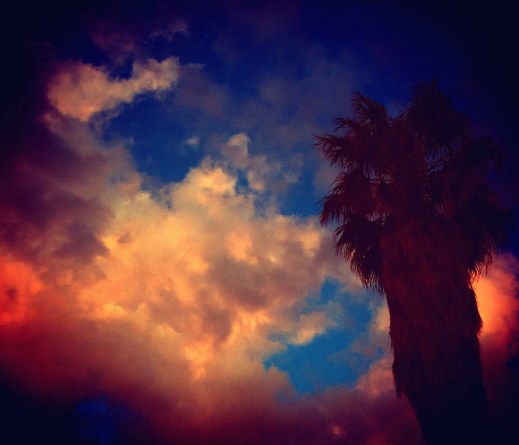
Opening Image Credit: “L.A. Sky at Sunset” by Flickr User David Vienna
Audio note: Voices used, with the exception of Bridget Hoida, are not the actual voices of the authors listed, nor are they meant to be representative of said authors.
—
Bridget Hoida is the author of So L.A. (2012). In a past life she was a librarian, a DJ, a high school teacher, and a barista. In this life she experiments with words and has taught writing at UC Irvine, the University of Southern California and is currently a professor at Saddleback College. Hoida is the recipient of an Anna Bing Arnold Fellowship and the Edward Moses prize for fiction. She was a finalist in the Joseph Henry Jackson/San Francisco Intersection for the Arts Award for a first novel and the William Faulkner Pirate’s Alley first novel contest. Her short stories have appeared in the Berkeley Fiction Review, Mary, and Faultline Journal, among others, and she was a finalist in the Iowa Review Fiction Prize and the Glimmer Train New Writer’s Short Story Contest. Her poetry has been recognized as an Academy of American Poets Prize finalist and she was a Future Professoriate Scholar at USC.
She has a BA from UC Berkeley, a MA in fiction from San Francisco State University, and a Ph.D. in Literature and Creative Writing from the University of Southern California. So L.A. is her first novel.
Share this:

Listening to the A. D. White House: Cornell’s Society for the Humanities’ Year in Review
Today, Society for the Humanities Director Timothy Murray sings us back home with a meditation on the soundscapes of study at the A.D. White House this year, closing out our spring “Live from the SHC” series covering new research on “Sound: Culture, Theory, Practice, Politics.” The 2011-2012 Fellows have got to say goodbye for the summer–and sadly beyond–but we all hope that next years’ Fellows (2012-2013 Theme: Risk @ Humanities) enjoy all the good vibrations we will leave behind, and that you, Dear SO! readers, have enjoyed our broadcast! Our summer series, “Tuning In the Past,” on radio and legacy of broadcaster Norman Corwin, featuring Neil Verma, Shawn VanCour, and Alex Russo begins at the end of June. And, of course, every Monday in between and beyond, we’ll keep giving you something you can feel. –JSA, Editor in Chief (and 2011-2012 SHC Fellow)
—
Many thanks to Jennifer Stoever-Ackerman for hosting “Live from the SHC” on Sounding Out! What a fantastic experience it’s been to have Jennifer screening and tweaking Sounding Out! from her garret office overlooking the gardens behind the A.D. White House, the Cornell home of the Cornell’s Society for the Humanities. Readers of “Live from the SHC” have read various strains of this year’s focal theme, “Sound: Culture, Theory, Practice, Politics.” The aim of this year’s residential research project was to contemplate and analyze the resonance of historical and contemporary representations, movements, ideas, and negations of sound.
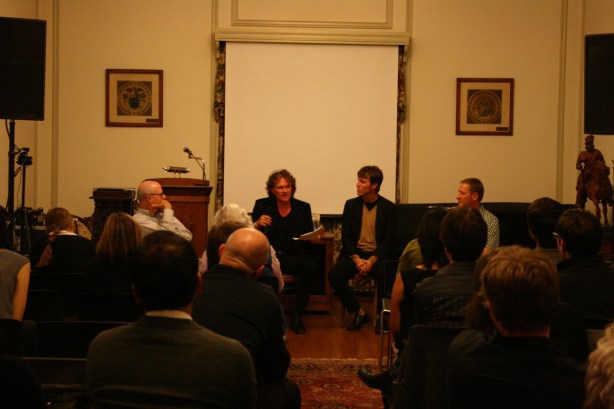
From Left: Tim Murray, Eric Lott, Tom McEnaney, and Marcus Boon, Image by Renate Ferro
Open to study of the broadest cross-cultural range of contexts and media that cross the boundaries of time and space–from East and West/South and North–the Fellows’ research delved into the complex ways that sound abounds in visual, textual, and aural realms. From “voicing” to “listening,” sound shaped the framework of our critical and philosophical analyses of the body, affect, and social publics. Sound came to be appreciated for its shaping of the parameters of psycho-cultural imaginaries, social practice, religious ritual, and political regulation throughout history and across the globe. Just as sound differs in the global context of capitalism and cosmopolitanism, not to mention the specificities of ethnic difference and cultural diversity, “voice,” “hearing,” and “listening” frame the humanities disciplines in relation to their aesthetic properties and political ramifications.

From Left: Eric Lott and Jennifer Stoever-Ackerman, Image by Jeanette Jouili
The Fellows found themselves reflecting on several key issues. Which criteria differentiates natural from artificial sounds? Does sound challenge disciplinary distinctions between the visual and the oral/aural/tactile? Can the loud noises of industrial culture be distinguished from the synthetic sounds of electronic music, the stammerings of performance and the vibrations of philosophical manifestos? It should come as no surprise to followers of Sounding Out! that sound marks the passage of time, the correlation of the aural to the movement of the body in dance and performance, the sonic promise of cartographic projects of social movements and migrations, and the cultural and ethnic specificities of acoustic fields and rhythms in the age of sampling and mixing, not to mention the gender, racial, and ethnic import of voice and spoken narrative.
Adding vibrant texture to our year-long discussions were the three weeks spent in extended dialogue with the Society’s Senior Invited Fellows. Emily Thompson (The Soundscape of Modernity) charted the histories of the architectonic sounds of cinema houses as well as the untraceable wealth of the historical sounds of New York City as its peripheries morphed from country estate to urban zone. Brandon LaBelle came from Norway to take us on a journey of artistic imagination and phenomenological hopefulness as he cruised his writings on Acoustic Territories and Site Specific Sound while sampling the background noises of his multimedia installations. Then Norie Neumark, fresh off the release of VOICE: Vocal Aesthetics in Digital Arts and Media (co-edited with Ross Gibson and Theo Van Leewen), arrived from Australia to follow up on our 2003 online seminar on Sound Cultures. She reminded us of the deep history of sound studies down under, while focusing our attention on voicings and her own multimedia art practice that blends spoken narrative, synthetic noise, mouthed breath, and shocks in the ear. [The “Live From the SHC” logo is a piece from Neumark and Maria Miranda’s “Shock in the Ear”–ED].
.
Various other visitors throughout the year included multimedia artists Mendi and Keith Obadike whose “not” Afrofuturism walked us through their exciting series of performance works,“Four Electric Ghosts,” Caitlin Marshall from Berkeley who brought cyborg speech to life with her prosthetic soundings, and renowned choreographer William Forsythe, whose four-hour choreography piece “Nowhere and Everywhere at the Same Time“–performed amidst amidst over 150 hanging pendulums–combined dance and environment as a means of physically manifesting the process of thought. Marjorie Garber from Harvard rode our acoustic wave to reflect on the future of the humanities while Norma Coates came down from Western Ontario to sensitize us to the mixes of pop sound and culture.

Brock Labrenz performs William Forsythe’s “Nowhere and Everywhere at the Same Time” at Cornell University’s Rand Hall on March 3, 2012. Image by William Staffeld / AAP
In listening back to the echoes of the year past, rather than here retracing the specific projects of our Fellows (you can consult the critical tales already Sound[ed] Out! by Damien Keane, Tom McEnaney, Nina Sun Eidsheim, Jonathan Skinner, Eric Lott, Jennifer Stoever-Ackerman, and Jeanette Jouili), I find myself sampling the sounds, noises, and glitches that provided unexpected reverbs for the academic writing happening behind closed office doors throughout the A. D. White House.
Nina Sun Eidsheim, Image by Renate Ferro
Sounds of glee, delight, and play first arrived on the scene at the end of August with gaggles of laughing and screaming kids running wild and climbing trees in the gardens, surrounded by bemused adults and envious dogs. Accompanying partners brought to the mix the diverse soundings of African film, suspicious packages, software beats, performance art, critical geography, and real estate hawking. No wonder the assembled Fellows strayed so readily, if not unconventionally, from the promised strictures of already exceptional research projects that brought to our weekly seminar table the street sounds of Egypt, Turkey, Korea, early modern Germany, contemporary Islam, American hip hop, contemporary art, circuit bending, gaming, German, Irish, U.S. and Latin American radio, voices of performers, animals, and posthumans, urban soundscapes, and, here making a loud call out to one Stoever-Ackerman, sonic color-lines.

Marcus Boon Rocks the Spring Workshop After Party–Image by JSA
Resounding throughout the year to give cadence and timbre to our serious ponderings were the spontaneous soundings that seemed always to give ample depth to the provocative interstices of intellectual life. There were the noises of glitch, circuit-bending, and Guitar Hero that stretched and extended the purpose of music and machinics. There were spontaneous voice lessons that turned anxious performers into wild choreographic objects. Singing above in the hidden alcoves–when not streaming through the high Victorian ceilings of the A. D. White House–were our flying mammal friends whose echolocation extended beyond the reach of our mere human ears. Then were the sudden noisy reminders of the vulnerability of our corporeal organs. Who could forget the reported imaginary of the crunch of human leg against car as two of our Fellows found themselves under assault from a crazed pizza delivery guy – luckily no lasting damage?
Our fellows will carry away the subliminal lacings of the lighter sounds of improvisation and camaraderie. There were the poundings of feet and slappings of bodies dancing late into the night after hours of laborious conferencing to the beats of DJs Marcus Boon, Art Jones, and Earmuffs.
.
At the end of the year, Fellows grooved to the beat of Tom McEnaney playing bass with The Vix Krater out at the Rongo in Trumansburg, NY (down the road from the home of Moog), before retreating to the bowels of the A. D. White House basement for another dusty, late night jam session with drums, synthesizer, guitars, bass, and various acoustics, led by the ultimate sound blogger herself, the guitar heroesse, Jenny S-A. [Well, I’m learning. So far I know E-Minor. It was Trevor that really broke my strings in! –ED].
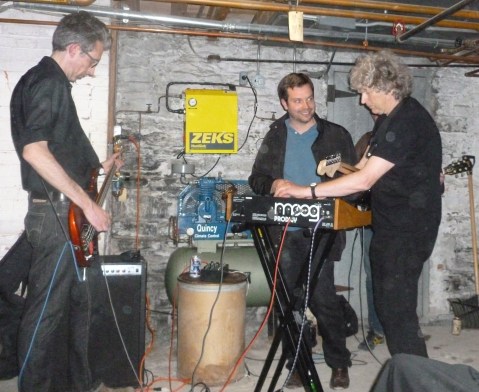
(From left) Damien Keane on bass, Michael Jonik, Trevor Pinch on Guitar and Moog, Image by JSA
And, yes, there was always the accompaniment of the clinks of glasses and bottles bearing the liquid life blood of any noisy crew.
The French philososopher, Jean-Luc Nancy, reminds us in Listening (2007) that the shared space of noise and sound entails “a totality of referrals: from a sign to a thing, from a state of things to a quality, from a subject to another subject or to itself, all simultaneously. Sound is also made of referrals: it spreads in space, where it resounds while still resounding ‘in me'” (7). What resounded and referred this year at the Society for the Humanities was the very immaterial and inchoate touch of sound, which is a-live in intensity and force. But who would have imagined the intensity of the noise of referral that remained so constant throughout the year to envelop the solid academic work of our Fellows in the wilding vibrations of jouissance? Indeed, perhaps the best lesson of the year, at a moment when the humanities finds itself threatened and in transition by the supposed certainty of metric and assessment, is that the Society’s scholarship in sound was driven by the relentless noise of referral and the unpredictable delight of the commune.

From Left: Renate Ferro, Ladi Dell’aira, Sarah Ensor, Jeanette Jouili, Nina Sun Eidsheim, Brian Hanrahan, and Norie Neumark, Image by JSA
—
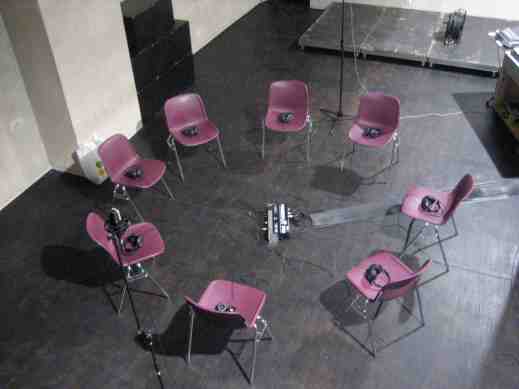
Featured Image Credit: Brandon La Belle, Duck Duck Goose Installation, Ausland, Berlin
—
Timothy Murray is Professor of Comparative Literature and English and Curator of the Rose Goldsen Archive of New Media Art. He is the Cornell Principal Investigator of the Central Humanities Corridor, generously supported by a grant from the Andrew W. Mellon Foundation, and he sits on the International Advisory Board of the Consortium of the Humanities Centers and Institutes (CHCI) and the Steering Committee of the Humanities, Arts, Science, and Technology Advanced Collaboratory (HASTAC). He is Co-Moderator of the –empyre- new media listserv and the author of Digital Baroque: New Media Art and Cinematic Folds (Minnesota 2008); Zonas de Contacto: el arte en CD-ROM (Centro de la imagen, 1999); Drama Trauma: Specters of Race and Sexuality in Performance, Video, Art (Routledge, 1997); Like a Film: Ideological Fantasy on Screen, Camera, and Canvas (Routledge, 1993); Theatrical Legitimation: Allegories of Genius in XVIIth-Century England and France (Oxford, 1987). He is editor of Mimesis, Masochism & Mime: The Politics of Theatricality in Contemporary French Thought (Michigan, 1997) and, with Alan Smith, Repossessions: Psychoanalysis and the Phantasms of Early-Modern Culture (Minnesota, 1997). His curatorial projects include CTHEORY MULTIMEDIA and Contact Zones: The Art of the CD-Rom.
Share this:


Current Top Posts





April 2021

January 2020

November 2019

October 2019

August 2019

April 2014

November 2017

March 2015

December 2017

October 2015
 Sounding Out!
Recent Comments