
On the Poetics of Balloon Music: Sound Artist Judy Dunaway (Part Two)

Last week, Carlo Patrão published “On the Poetics of Balloon Music: Sounding Air, Body, and Latex (Part One),” which examined the history of the association between balloon travel and experimentation and the idea of silence, along with a round up of conceptual artists who have used balloons in their work. Today’s post continues this exploration with an in-depth conversation between the author, producer Marina Koslock and sound artist Judy Dunaway.
We look at alien grace,
unfettered
by any determined form,
and we say: balloon, flower,
heart, condom, opera,
lampshade, parasol, ballet.
Hear how the mouth,
so full
of longing for the world,
changes its shape?
Excerpt from Difference, by Mark Doty
PLAY //
Against Levity: Experimental Music and the Latex Balloon
The term balloon music gained some virality in 2011 after Finn, the protagonist of the animated series Adventure Time, rubbed a toy balloon and improvised a rap over its squeaky sounds. “Balloon music is the future,” says the character. This few second-long scene became an instant meme, inspiring many to share their own versions of the “futuristic sound of balloon music.”
Balloons themselves are viral objects. Designed to infect our moods, they are part of social rituals ranging from the deeply personal to collective (political) euphoria. They are cheap, amusing and awe-inducing. As resonant chambers, balloon membranes are sonically responsive to touch while, at the same time, highly tuned to the vibrations of the environment. To start playing a balloon, no prior experience is required. In this sense, the balloon is a democratic instrument whose sonic textures circumvent expensive music equipment.
The Jazz composer Anthony Braxton was once asked why he used balloons in his Composition 25 (1972). Braxton replied: “I didn’t have enough money for the electronic equipment that could make those kinds of sounds. I’m interested in the expanded reality of sound opened up by the post-Webern continuum, but I’m restricted to using cheap materials. So, you know, I was walking down the street one night and I thought, Hey! I gotta have balloons!”
Anthony Braxton, B-Xo/N-0-1-47a or Composition 6G, w/ Leroy Jenkins, Leo Smith and Steve McCall, with balloon sounds, 1969
“For me, that piece (Composition 25) really best demonstrates the full symbolic meaning of the balloon in the early avant-garde,” says balloon music composer Judy Dunaway. “I’ve discussed this with Braxton himself – the balloon replicated electronic equipment that he couldn’t afford at the time, but he also saw it as a way to open up the minds of the performers to get them to think differently about how they were improvising and how they were interacting in the piece.” Braxton’s Composition 25 is scored for 250 balloons and musicians are required to produce sound by squeezing, rubbing and popping balloons. “I like the idea that he breaks down the hierarchy,” adds Dunaway, “black musicians were discriminated against and they didn’t have the financial means that the white musicians had… and he was using this as a way to get beyond that and say: Here, I’m going to do electronic sounds without any electronics, I don’t need to go buy a Buchla or be associated with an academic institution that can give me access to equipment, right?”

Judy Dunaway, Mother of Balloon Music, Innova Recordings, 2006
Producer Marina Koslock and I met Judy Dunaway at MassArt in Boston to talk about her balloon-based sculptural sonic performances and the ready-made latex balloon as a sound producing instrument. For the past 25 years, Dunaway has been developing a singular specialization in the balloon as a medium for sound and music. You can keep just broadening out and do more things with a concept; or you can work in a particular parameter as an artist and keep digging deeper and deeper and deeper, and that for me as been more interesting, is to pursue that line”, explains Dunaway.
As a consequence, her balloon work has spanned out through several records (e.g. Balloon Music and Mother of Balloon Music), scores, sound sculptures, solo performances, ensembles, and numerous installations. The poetics of the latex balloon as a sound producing instrument contrast with the atmospheric balloon explored in part one of this article. The balloon, no longer buoyant, stays in close proximity to the body of the performer. The surface of the balloon is vibrated through rubbing, stroking, squeezing, pulling, popping and through the control of air releases. These sonic tactile acts bring forth dialogues between the performer’s body and the latex body of the balloon. “I limited my playing techniques to the balloons and my body,” says Judy Dunaway, “it was essential to be able to feel everything that was happening with the balloon in order to be able to fully explore all the sonic possibilities.”
The Balloon Music, DF#, by Tina Touli, 2013-2015
The balloon functions as an external sensory organ, like a skin, that vibrates when sound passes through. In Deaf culture, balloons have a long history of being used as resonating chambers that amplify vibration and facilitate hearing. Deaf people use them at concerts, musicals, clubs and raves to hear the music through the vibration of the balloon’s membrane. David Toop writes about Alexander Bell in the 1870s encouraging students from a Boston school for deaf children to hold balloons in their hands while walking on the street as a safety measure in order to hear the vibrations from the cobblestones as fast horse-drawn wagons passed by. Vibrational information is processed in the same way as sound information. As the scholar Steph Ceraso proposes, the common definition of listening needs to be expanded to include the sensory, contextual, and material aspects of a sonic event. Dunaway’s sound installation Manual Eardrums invites participants to a different mode of listening through the vibration of the balloon. “You are given earplugs at the door and an inflated balloon, and you hold it between your hands as you walk around the space. There’s a low tone playing that sweeps between 100Hz and 150Hz and it causes different vibrational patterns in the room that you can feel and map them out,” explains Dunaway. “Your eardrum is the balloon that you’re holding.”
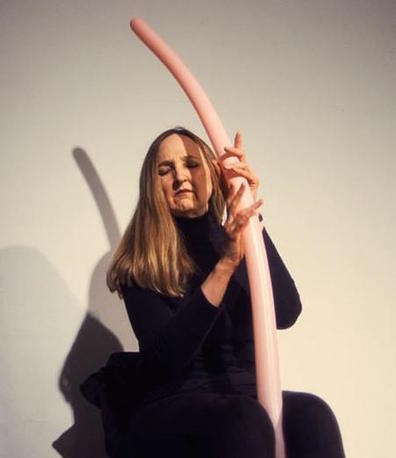
Judy Dunaway performing Amplified Twister Balloon, Photo by Mizuki Nakeshu
Judy Dunaway started to play balloon music in the late 1980s, first as a preparation for guitar string and soon after as a solo instrument. It was in the midst of the AIDS Crisis and Dunaway was part of the downtown improv scene in NYC. “Many of my friends were dying,” she recalls. “Everybody was saying what caused this? Nobody knew how the disease was being spread,” adds Dunaway. “Then, of course, there was this discovery that it was sexually transmitted and you could prevent transmission with latex condoms. Suddenly, they had this power,” she says, “latex had this power to save people’s lives, and I say that that is when balloons really began to speak to me. They were something beyond a mere mechanism to make sound.” Within the envelope of the balloon Dunaway found space for memory, life, and sensuality.
From the beginning, her balloon work has articulated tensions between explicit and implicit meaning around issues relating to social activism, environmentalism, and feminism. “In an era, which continues to be that a woman’s control of her own body is restricted or attempts are being made to restrict our bodies, I coupled myself to this instrument that expresses sensuality, sexuality, and humanity,” says Dunaway. The balloon, as a resonating chamber, bypasses western musical traditions that mechanize the body and gender stereotype musical expression. For Dunaway, the balloon generates a “non-judgmental somatic relationship.”
“Seeing my connection to the body of the balloon, that to me served as an unspoken rebellion against the patriarchy, against the power structures that have oppressed women and, ultimately, all humankind by severing the psyche and the body,” says Dunaway. Following the scholar Robin James, the patriarchy is not just a “relation among people” but is also a “relation among sounds” that are coded in a gender system of masculine absolute/feminine other. “The way I approach the balloon is not nailed or fixed or part of this history,” clarifies Dunaway. The balloon as an instrument has allowed Dunaway to develop a musical lexicon outside of a male-dominated classical heritage.
Judy Dunaway performing Piece for Tenor Balloon, written notation with improvisational passages, 2002
For example, this is her description of the round balloon as a sounding instrument:
Imagine a string, a string on a violin or guitar, and this string is held taut on either end by a the tuning pegs and the bridge now imagine that string suddenly melted and spun out into an orb and it’s all held tight by a column of air. . .this is the palette that I have to access when I play the Tenor Balloon, I have all these harmonics on this curved shape, and I control it partially with my knees.
The Tenor Balloon is placed between both knees and Dunaway applies and releases pressure on the balloon producing microtonal changes on its surface. “And I also use water,” she adds, “copious amounts of water, warm water on the balloon and on my hands because that’s the way I get this stick and slip mechanism to work.” The hands gliding on the balloon’s surface act similar to a bow on a string reaching different nodes and moving through harmonic series.
Judy Dunaway performing “Hommage à Kenneth Noland”, for amplified giant balloon, vibrators, synthesized tones, and projected video, with Max/MSP/Jitter interface, 2017
Each balloon requires its own specific touch or sounding technique. On the piece Amplified Giant Balloon, vibrators are used to resonate the surface of a giant balloon creating a low drone sound. “It’s like vibrating a giant bass string”, says Dunaway, ”I tune my vibrators, I go to the sex shop and I listen to vibrators, and I tune the vibrators to each other so there’s a little beating pattern between them that I can control.”
Around 2015, Dunaway added a new balloon to her solo performances, the Amplified Twister Balloon. The twister balloon is equivalent to the long balloons used to make balloon-animals. Due to its string-like shape, the sounds produced through rubbing or gliding differ from the sounds of a round balloon. “The harmonic series isn’t so predictable,” she continues, “the tension is highest close to the navel of the balloon and that makes it microtonal different from one end to the other like an out-of-tune bugle.” Visually, the Amplified Twister Balloon performance delivers a feminist affirming statement. Defying the tradition of the male guitarist stroking the female form of the guitar, Dunaway finds musical material in a phallic-shaped balloon. “I sort of invert this”, she says, “now I have the penis form that I’m stroking and caressing and I’m taking this phallic power for myself in the Amplified Twister Balloon.”
“My work doesn’t come out of a void,” states Dunaway. In the article My Beautiful Balloon, Dunaway maps out a detailed history of the balloon in experimental and avant-garde music. Many Fluxus artists used the balloon in events, concerts and instructional scores. The sounds of the balloon embodied Fluxus’ humorous/satirical attitude towards art and the collapse of hierarchies of experience by reframing everyday life objects. Balloons are used by DIY artists that re-invent, hack and create new music instruments (Jean Francois Laporte, Thierry Madiot, Aaron Wendell, Tom Nunn, Javier Bustos). Balloon sounds are explored by many artists with backgrounds ranging from improvised music, rock, electronic or electro-acoustic and sound installation (Ricardo Arias, David Bedford, Mauricio Kagel, Alvin Lucier, Terry Day, Tod Dockstader, Christine Sun Kim, Davide Tidoni, Sharon Gal, Eugene Chadbourne, Matmos, EVOL, Alan Nakagawa, to name a few).
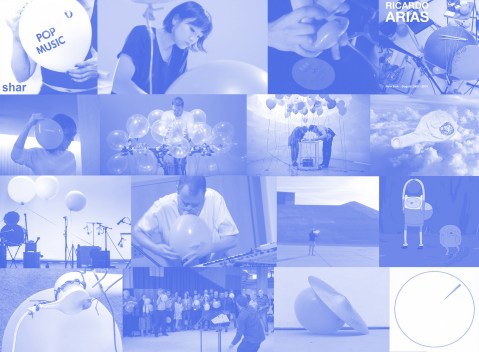
Balloon Music Compilation
To develop a practice around the accessibility of latex is to engage with politics of mass-production and exploitation of resources and labor. Dunaway mentions the connection between the air and breath that fills the balloon and the mass-extraction of latex from the lungs of the Earth. “[Balloons] are literally the blood from a tree in the Amazon,” says Dunaway, “and there’s a whole history of how the indigenous people there were and still are persecuted. Now, they are mostly farmed in Malaysia,” she adds.

Latex being collected from a tapped rubber tree, Wikimedia Commons
Between 1890 and 1920, a rubber fever led to a boom of extraction and exploitation of rubber-bearing plants in the Amazonian countries and to the forced displacement, slavery and mass killing of its indigenous people. The same happened in many African countries. As John Tully writes in his book The Devil’s Milk, “it is still true that where there is rubber there is often human suffering.” Ricardo Arias, a Columbian composer working with balloons (balloon kit) since 1987, has acknowledged this suffering through his balloon work. In Musica Global, Arias composed a series of 20 short balloon pieces called Caouchu: The Weeping Tree/El Árbol Que Llora in memory of the native Americans tortured and killed by the North American and European hunger for natural rubber latex.
These ontological relations between the balloon’s materiality and the environment inform Dunaway’s work. “I’m writing a piece for a large 30 to 35 person balloon ensemble. This piece is called Wind Ensemble and is all about the air going out of the balloon, and the sound of the mouthpiece being vibrated as the air comes out.” Dunaway shares a video recording of this work and the room is filled with high pitched sounds changing at different speeds. The experience is immersive; a meditation on air and vibration. “It’s rather minimal in the concept because I really want you to notice the small changes and nuances over time.” The performative element of the piece has balloon players squeezing the balloon’s mouthpiece and bending over large balloons to make them vibrate until the balloon’s last breath. “Ideally, I would like 60 balloon players, that would be great!” she exclaims. The embodied relationship that Dunaway has developed with the balloon over the past decades resulted in an artistic practice extremely tuned to the sonic proprieties of every inch of the latex balloon.

Still from Le Ballon Rouge by Albert Lamorisse, 1956
The poetics of balloon music bring forth alternative narratives that challenge dominant hierarchies of music production, bypassing expensive technology and expectations of gendered musical expression. The balloon as an object of childhood and of playfulness is charged with emotional resonance and invites the construction of meaning while offering an opportunity to build upon subversive themes. In this two-part article, the balloon was analyzed as an object that is able to generate a vertical dimension of self and the construction of a sense of Place within the silence of the upper air regions that informed the “listening ear” to perceive difference. As a Probe, the balloon navigates the irreversibly altered constitution of the airspace, sonifying masses of air and weather data. Filled with breath or air, in Play, the latex balloon is an extra ear attached to our bodies that vibrate in sympathy with the terrestrial agitations of the Earth. Maybe Finn from Adventure Time is on to something. “Balloon music is the future.”
—
Thanks to Judy Dunaway for the interview and records; Marina Koslock for co-producing the interview with Judy Dunaway; and Jennifer Stoever for your help and excellent editing.
—
Featured Image: Judy Dunaway, photo by Alice Bellati
—
Carlo Patrão is a Portuguese radio producer and independent researcher based in New York city.
—
 REWIND! . . .If you liked this post, you may also dig:
Queer Timbres, Queered Elegy: Diamanda Galás’s The Plague Mass and the First Wave of the AIDS Crisis– Airek Beauchamp
Botanical Rhythms: A Field Guide to Plant Music -Carlo Patrão
Sounding Our Utopia: An Interview With Mileece–Maile Colbert
Share this:

Won’t Back Down: Tom Petty, Jason Aldean and Masculine Vulnerability

October 2017: a week after a Las Vegas gunman killed 58 people at an outdoor festival during a Jason Aldean set, Aldean squared up to the Saturday Night Live mic and soldiered through then-recently deceased Tom Petty’s “I Won’t Back Down.” In a short statement before the song, Aldean mentioned that he was “strugglin to understand what happened that night,” and he reiterated this general sense of confusion about what to make of everything in ensuing interviews. It’s unsurprising that Aldean struggled to make sense of the shooting; traumatic experiences like the one he and his audience endured often don’t fit into any ready-made understanding we have about the world. But Aldean, who seemed uncomfortable publicly displaying the kind of emotional vulnerability the trauma produced in him, was eager to resolve the dissonance: with platitudes like “be louder than the bad guys,” with assurances that “when America is at its best, our bond and our spirit – it’s unbreakable,” with an admission of his own hurt only as an empathic response to others’ rather than as his own, and with a cover song borrowed from one of his idols. Here, I’m listening to the compensatory work the cover of “I Won’t Back Down” performs in the face of the kind of vulnerability Aldean wrestles with in the wake of violence. To hear this as clearly as possible, I’ll contextualize Aldean’s performance by comparing it to a similar use of the song by Tom Petty 16 years earlier, then contrast it with Ariana Grande’s performance of “One More Time” at her One Love Manchester benefit a few months before the Las Vegas shooting.

Screen capture from Cal Vid’s youtube video “Jason Aldean SNL Tom Petty I Won’t Back Down Live Tribute”
Though the song’s titular line, “I won’t back down,” is a fairly direct lyrical idea about maintaining one’s resolve, the rest of the song still manages to paint a rather vague picture. The singer isn’t backing down, sure, but beyond “a world that keeps on pushin [him] around,” there aren’t many specifics about what he’s not backing down from. This is a kind of pop genius: capture a core sentiment that registers with a large audience, then present it in ambiguous enough terms that listeners can fill in the blanks with their own very personal experiences. So, despite Petty’s own analysis that he “laid [the song] out, you know, with no ambiguity at all,” “I Won’t Back Down”’s lyrics are incredibly broad, leaving space for practically anyone to insert themselves into the role of protagonist. Your boss might be a jerk, but you won’t back down. Your employee might think you’re a jerk, but you won’t back down.
Moreover, the sound of the song undermines even its most resolute lyrics. When Petty sings “I won’t back down,” which he does often in the verses and the hook, he scoops all around the pitches of “won’t,” “back,” and “down” so that they sound more interrogative than declarative. Rhythmically, these words sit on weak beats and upbeats in the verses, and in the chorus, the final word, “down,” comes just before – not on – a strong downbeat (see figure below). The effect of the syncopation is similar to the effect of Petty’s pitch bends; lyrical resolve becomes musical uncertainty. Finally, George Harrison’s guitar solo – as George Harrison guitar solos tend to do – plays pensively with the song’s forward momentum, again reining in the lyrics’ more direct message. In all, “I Won’t Back Down” works in a good deal of uncertainty that makes it unclear exactly what the threat is and whether the singer really is as resolute as he’d like us to believe.
| + | 1 | + | 2 | + | 3 | + | 4 | + | |
| verse | I | won’t | back | down | |||||
| hook | I | won’t | back | down |
What a song means or how it works changes with the times, though, and the defiance lurking in the lyrics of “I Won’t Back Down” crystallized after the destruction of the Twin Towers on September 11, 2001. When Petty performed “I Won’t Back Down” at the benefit concert America: A Tribute to Heroes on September 21, the context of a nation rallying around itself to defeat some yet-unknown foreign enemy overwhelmed any of the sonic signifiers that might otherwise temper the song’s resolve. This concert, which was aired virtually on every channel to a country still reeling from a collective trauma, subsumed Petty’s vocal scoops, the lyrics’ offbeat kilter, and the guitar’s sanguine solo under the clarity of a lyrical sentiment that aligned neatly with the politics of the moment: the US won’t back down. The shift in focus in “I Won’t Back Down” just after September 11 is similar to a dolly zoom effect: the threat referenced by the song’s lyrics feels as if it comes nearer and into sharper focus even as the protagonist broadens from an individual to a collective identity.
This sort of shift in the song’s narrative tracks with Christine Muller’s account of the overarching changes in cultural narratives that happened in the wake of the Twin Towers’ destruction. In September 11, 2001 as Cultural Trauma (2017), Muller argues that the broad perception of the fracture of the “American Dream” – “good things happen to good people, and bad things happen to bad people…come to the United States, and you will have opportunity; work hard, and you will succeed; follow the rules, and you will be rewarded” – harkened the rise of cultural media focused on “no-win scenarios…a fascination with anti-heroes who do the wrong things for the right reasons” (9-10). In the case of “I Won’t Back Down,” a song that was once broadly resolute and unfocused on any particular foe, sung by an artist who sent a “Cease and Desist” letter to George W. Bush when the then-candidate used the song for his presidential campaign morphed into an anthem that became narrowly resolute in the face of a named threat (“terror”), woven into a larger political tapestry that aided in the demonization of Muslims and the Islamic countries targeted by the “global war on terror” – an interminable war fought for vaguely defined reasons started at multiple sites by the same Bush Petty had previously defied.
Aldean’s Saturday Night Live performance 16 years later would emulate Petty’s, as faithful a cover as Aldean and his band could do. Though his vocals lack Petty’s high-end nasal clarity, Aldean dutifully hits all the scoops, honors the syncopations, and even yields to a guitar solo that follows George Harrison’s lead from decades previous. For Aldean, who was 40 at the time, and many millennials, the SNL performance would likely resonate with Petty’s iconic Tribute performance. And in the space of those 16 years, another frequently repeated line in the song would take on a political life of its own, recognizable to younger listeners who may not have immediately registered the post-9/11 context of “I Won’t Back Down.” While “I’ll stand my ground” would’ve been as broadly meaningful as “I won’t back down” when Petty released the song in 1989, the 2012 murder of Trayvon Martin pushed the idea of Stand Your Ground laws into public consciousness. These laws nullify one’s “duty to retreat,” to avoid violence if a safe passage away from a threat is reasonably available, instead allowing a person who feels threatened to use violence against their perceived threat. Research shows that Stand Your Ground laws tend to protect white people and endanger Black people, holding up long-standing social norms that cast Blacks as always already violent. So by the time Aldean sang “I’ll stand my ground, and I won’t back down” in 2017, the song had passed through social and political filters that gave its lyrics an anti-Muslim and anti-Black edge.

“Stand Your Ground” By Flickr User Seattle.roamer, CC BY-NC-ND 2.0
At first blush, all this context makes “I Won’t Back Down” a bizarre choice for Aldean to sing in response to the Las Vegas shooting. The identity of the gunman – a white man around retirement age – made him only a bit older than the demographic most responsible for mass shootings in the US. Instead of addressing the fact that mass shootings are a distinctly USAmerican problem, or that country music fosters a close and financial relationship with the NRA (which lobbies against the sorts of regulations that would curb mass shootings), Aldean remained unwilling to offer any thoughts on guns and gun control, even after experiencing the shooting firsthand. While we might reasonably excuse the singer’s lack of reflection on social and political problems in recognition that Aldean was surely traumatized himself, the singer’s performance of “I Won’t Back Down” still performs a specific kind of rhetorical work that relies on Petty’s performance at America: A Tribute to Heroes 16 years earlier. Specifically, Aldean’s rendition of “I Won’t Back Down” places the Vegas shooting in the same political arena used to demonize Muslims after September 11 and to criminalize Black people in political discourse surrounding Stand Your Ground laws. As I mentioned at the top of the essay, Aldean admitted and demonstrated his discomfort with the emotional vulnerability the shooting provoked in him, and I hear his performance of “I Won’t Back Down” as an effort to compensate for that public vulnerability by providing a retreat to a more familiar masculine pose: protective, resolute, stoic.
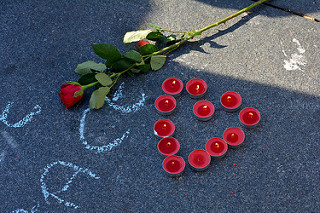
“Liverpool vigil for victims and families of MEN Manchester” by Flickr User James O’hanlon, CC BY-NC-ND 2.0
I published a piece that revolves around the idea of self-care with Sounding Out! in 2017, and one of the two central musical examples I consider there is Ariana Grande’s performance of “One More Time” at the One Love Manchester benefit concert just after the Manchester bombing. Grande’s circumstances run parallel to what Aldean would face a few months later: a traumatic act of violence that disrupted, injured, and killed the artist’s fans as the terror of the event rippled through the community. The two performances are gendered completely differently, however. Grande sings “One Last Time” surrounded by other musicians she invited to participate in the benefit concert. She frequently chokes up and relies on her fans to carry the song forward. She offers no answers or solutions beyond sentiments of love and the need to hold one another close in times of crisis. Grande’s is a performance of feminized care that contrasts sharply with Aldean’s masculinized resolve. Unwilling to publicly grapple with the emotional vulnerability created by the Vegas shooting, Aldean retreats from any public displays of grief and settles into an expression of care rooted in aggressive defense. His performance of “I Won’t Back Down” compensates for the feminized vulnerability triggered by the gunman and provides a masculine space for defiance that shifts attention away from white criminality and toward the US’s usual suspects: Black people and Muslims.

“#Ferguson protest in Memphis” by Flickr User Chris Wieland, CC BY-NC 2.0
Saturday Night Live has scrubbed the internet of any full videos of the performance (the single is available on Spotify), but we can see and hear Aldean running through the same rendition a couple weeks later at the Louisville Yum! Center. It’s worth noting how Aldean embodies the resolve of the song’s lyrics. While Petty always approached a microphone like he was going to whisper something in its ear, his shoulders slouched and knees bobbing to the beat, Aldean squares his shoulders, plants his feet to form a broad base, and confronts the mic straight on. Some of this boils down to style. Jason Aldean’s stage presence is different from Tom Petty’s. But it also captures the distance “I Won’t Back Down” has traveled since the late 1980s, from a largely empty signifier that listeners could fill with their own meaning to an anthem used for rallying listeners in the wake of mass violence. Here, feminized vulnerability and trauma are recast as masculinized aggression and resolve until the song fills with the politics of the moment: the US’s anti-Black, anti-Muslim refusal to back down from standing its ground.
_
Featured Image: “Tom Petty & The Heartbreakers, Oracle Appreciate Event “Legendary”, JavaOne 2011 San Francisco” by Flickr user Yuichi Sakuraba, CC BY-NC 2.0
_
Justin Adams Burton is Assistant Professor of Music at Rider University. His research revolves around critical race and gender theory in hip hop and pop, and his book, Posthuman Rap, is available now. He is also co-editing the forthcoming (2018) Oxford Handbook of Hip Hop Music Studies. You can catch him at justindburton.com and on Twitter @j_adams_burton. His favorite rapper is one or two of the Fat Boys.
_
 REWIND! . . .If you liked this post, you may also dig:
SO! Reads: Hiromu Nagahara’s Tokyo Boogie-Woogie: Japan’s Pop Era and Its Discontents – Shawn Higgins
Spaces of Sound: The Peoples of the African Diaspora and Protest in the United States – Vanessa K. Valdés
SO! Reads: Shana Redmond’s Anthem: Social Movements and the Sound of Solidarity in the African Diaspora – Ashon Crawley
Share this:


Current Top Posts





April 2021

January 2020

November 2019

October 2019

August 2019

April 2014

November 2017

March 2015

December 2017

October 2015
 Sounding Out!
Recent Comments