
Spaces of Sounds: The Peoples of the African Diaspora and Protest in the United States

The slaves who were ourselves had known terror intimately, confused sunrise with pain, & accepted indifference as kindness. – Ntozake Shange, Sassafrass, Cypress & Indigo
Sanford. Baltimore. Chicago. Staten Island. Charlotte. Cleveland. Oakland. Austin. Los Angeles. The Bronx.
Despair in the United States is nothing new. It is neither an emotion confined to the neatly-drawn borders of this land nor is it experienced more acutely by any one group of people. The vast discrepancy between the results of the popular vote and the electoral college’s selection of Donald Trump as forty-fifth president of the United States amply reveals despair to be an sentiment viscerally experienced by a wide swath of people in this country, irrespective of race, ethnicity, gender, class, or sexuality.
Such despair has been ignored, however, by those who have caused and who continue causing the suffering of peoples of both indigenous and, later, African descent. We are taught that men from what we now recognize as Europe arrived in this hemisphere in the late fifteenth century, settling initially on a strip of earth in the Caribbean Sea that would become the first site of massacre and genocide, acts which unleashed, if one lends credence to the narrator of Junot Díaz’s The Brief Wondrous Life of Oscar Wao, the fukú, the “Curse and the Doom of the New World.” The narrating voice himself characterizes the curse not in the actions of death, but in the “screams of the enslaved, [..] the death bane of the Tainos, uttered just as one world perished and another began […]” (1). The fukú resonated through the sounds that these human beings made.

Image of the People’s History of Telegraph Avenue mural, designed by Osha Neumann, painted in 1976, restored and enlarged in 1999, at the corner of Haste and Telegraph in Berkeley. Image by Flickr user nursenicole329 (CC BY-NC-ND 2.0).
.
Not a house in the country ain’t packed to its rafters with some dead Negro’s grief. – Toni Morrison, Beloved
The State’s unwillingness to hold George Zimmerman responsible for the murder of Trayvon Martin–and its subsequent refusal to hold any police officer accountable for the hundreds of deaths they have caused–has galvanized the United States in the last four years. Hundreds of thousands of men, women, and children alike have taken to the streets, as #BlackLivesMatter, a true and succinct sentence, has roused ghosts of the past who have never left us, who have always been present, accompanying us on this journey.
This post is not a reflection of the music that has served as a soundtrack to these protests, though there are articles that have done so, such as this one, this one, and this one. These pieces do not include the extensive list of articles that address perhaps the most widely-viewed piece of protest music thus far, Beyoncé’s “Formation” video, a scarce offering of which can be found here, here, and here. Instead, it is an essay inspired by the sounds of the protesters themselves, the noises made by the minds, bodies, and spirits of the men, women and children who have taken to public spaces and sometimes commercial zones in order to confront and object to the protections applied to those who kill men, women, and children, often of African descent.
Listen to Los Angeles in 2013. . .
. . .to Houston in 2014. . .
. . .to New York City in 2014. . .
. . .and to Charleston in 2015. . .
. . .
 In his pivotal Cities of the Dead: Circum-Atlantic Performance (1996), Joseph Roach characterized New Orleans and London as urban centers marked by two simultaneous, consistent acts: appropriation by white people and white power structures of the cultures of the peoples they have violently marginalized, and then, at the same time, a clear distancing from those very cultures and peoples. Although now in its twentieth year of publication, Roach’s theorization of the circum-Atlantic world remains vastly underutilized in scholarly circles—particularly in sound studies, where it should have special resonance– and has become increasingly critical to our understanding of this historical moment, as it “insists on the centrality of the diasporic and genocidal histories of Africa and the Americas, North and South, in the creation of the culture of modernity” (4). With this configuration, Roach accomplishes two feats simultaneously: first, he decentralizes the United States as the focal point of studies about the so-called New World, instead, placing on equal footing all of the histories and cultures of the Americas. For this scholar of the literatures of the Americas, particularly those written by men and women of African descent, Roach’s is a critical gesture that facilitates comparative work across national boundaries.
Second, and most importantly, Roach emphasizes the role of murder, rape and the destruction of whole cultures indigenous to the American and African continents in the foundation of the nations of this hemisphere. Ta-Nehisi Coates is perhaps the most recent writer to remind us that the most potent legacy of such modernity, racism, “is a visceral experience, that is dislodges brains, blocks airways, rips muscle, extracts organs, cracks bones, breaks teeth” (Between the World and Me, 10). That which we know as “modernity,” itself a deeply flawed construct that remains in need of serious revision, was born of broken backs, mutilated limbs, hushed middle-of-the-night tears of indigenous and African peoples. Moans and sighs, whispers and wails, cries and screams, they are the musical score of this hemisphere’s American experiment.
The slaves who were ourselves aided Indigo’s mission, connecting soul & song, experience & unremembered rhythms –Ntozake Shange

Harriet Tubman Memorial Monument, Harlem, Image by Flickr User John Mannion (CC BY-NC-ND 2.0).
In the face of a populace accustomed to ignoring the wailing of mothers who have buried their children, who have disregarded their dignity and the weight and shape and taste of their loss, men, women, and children have mobilized. They have made manifest that which communities of peoples of African descent have spoken of and have documented since the founding of this nation. As Roach has utilized the term performance, the literal rituals of mourning by communities of African heritage not only commemorate those who have recently passed but they also invoke the spirits of those who have long borne witness to such violence. Throughout his study, Roach distinguishes between a European heritage that begins to segregate the living from the dead during the Enlightenment (50), and more traditional cultures, particularly African ones, where spirits mingle with their human counterparts. While written texts may not, and often do not, adequately commemorate the loss of lives deemed marginal to the larger society, performance itself – chants, wails, songs – serve not only to memorialize but also as gestures of restoration.
Protesters and activists are no longer satisfied with the well-established decree that we should wait for a distant moment for a more perfect realization of the United States’s many promises. No, instead, they have identified this as the historical moment in which those oaths are to be fulfilled. They have walked, marched, and stomped through streets, on sidewalks, parks, churches, filling malls and transportation hubs with their bodies as testimony. They have repossessed and redefined spaces once thought of as simply neutral, transparent space as Katherine McKittrick refers to it in Demonic Grounds, revealing the fault-lines of difference based on class, race, gender, and sexuality in this society (xv). They have done so manipulating sound, both recycling chants used through the decades to protest injustice and, at times, simply occupying space, without a word uttered.
The silence waged in the 2014 protest in Grand Central Terminal after the non-indictment of Daniel Pantaleo in the murder of Eric Garner does not represent erasure, but rather a purposeful demonstration of the willful humanity of those unwilling to forget.
They quiet themselves. They replace the sounds of unfettered pain and grief with its absence, until all that you hear is the mechanized announcement of train schedules. The contrast is stark: the moment highlights what Claudia Rankine has identified as the condition of black life in Citizen, that of mourning (145), against a backdrop of technological advancement, that which has been built on the backs of and through the physical, emotional, and intellectual labor of black life. Here, the members of this community enact what has been called a “die-in”: simulating the physical positioning of bodies in caskets, they force onlookers to confront an uncomfortable truth about the history of this country and of the nations of this hemisphere.
All of us walk on land soaked in the blood of those who have made our lives easier and more convenient. The men and women at Grand Central make manifest what Roach terms surrogation: in the chasm left by death, they offer a replacement, one that both evokes those who have died and disturbs the complacency of survivors themselves (2). The performance serves to confront those who dare say that the violence of genocide and enslavement of past generations should remain in the past; no, these men and women and the spirits they invoke respond. Time is not linear, as we have been taught. For past, present, and future are temporal constructs used to service oppression and domination; this will no longer do.

From Kara Walker’s 2014 exhibit, “A Subtlety,” at the Domino Sugar Factory in Brooklyn (CC BY-NC 2.0)
Here, in this here place, we flesh; flesh that weeps, laughs; flesh that dances on bare feet in grass. Love it. Love it hard. – Toni Morrison
We bear witness to the reclamation of grief, of lives cut short at the hand of a government charged with protecting those human beings who inhabit its borders, at least theoretically. While, as Roach surmises, “memory [may be] a process that depends crucially on forgetting” (2), we hold space to those dedicated to not forget, to instead excavate the silences, breathe life into those histories, remembering that the stories we have heard, the pages we have read, were once human beings. We create “counter-memories” as challenge and testimony, as a sacred pledge to those who are no longer present physically in this realm (Roach 26). We recall the cultures and practices of those who lived before the written form was a tool of exclusion, when remembrance was a practice of community.
American culture, in the hemispheric sense, incorporates all such rituals, across generations; as Roach notes, it is performance that “works on behalf of living memory, by bringing the parties together as often as necessary” (138). No longer consigned to the past, the spirits of those killed by the state are revived, their existences in the human plain celebrated. They are not defined by how they died but instead by how they lived. While literacy of the written form can separate, sound and gesture more effectively bypass the fictions of difference based on race, ethnicity, gender, class, and sexuality. Cities of the Dead amplifies how “performance can articulate what otherwise may not be properly communicated” (161).
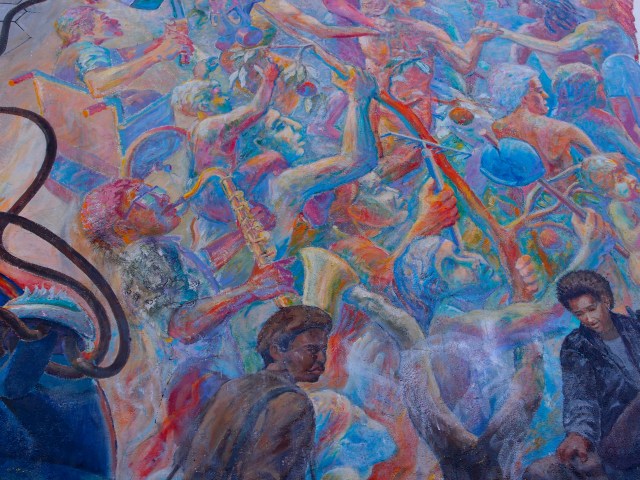
Image of the People’s History of Telegraph Avenue mural, designed by Osha Neumann, painted in 1976, restored and enlarged in 1999, at the corner of Haste and Telegraph in Berkeley. Image by Flickr user nursenicole329 (CC BY-NC-ND 2.0).
It’s so magic folks feel their own ancestors coming up out of the earth to be in the realms of their descendants – Ntozake Shange
We say their names. We say their names: Eleanor Bumpers. Anthony Báez. Sean Bell. Aiyana Stanley-Jones. Tyisha Miller. Oscar Grant. Rekia Boyd. Trayvon Martin. Tanisha Anderson. Renisha McBride. Eric Garner. Yvette Smith. Tamir Rice. Sandra Bland. Freddie Gray. Korryn Gaines. Akia Gurley. Alton Sterling. Philando Castile. Micah Jester. Deborah Danner. Walter Scott. Michelle Lee Shirley.
The list, tragically, grows, and still we say their names. We do so as an act of remembrance. As an offering. As peoples of African descent around the world do in times of ceremony, in the name of ritual. We remember those who have come before us, who have birthed this current historical moment of awakening here in the United States. We say their names.
And, as the sounds of their names said aloud echoes, we pray. Ashé.
—
Vanessa K. Valdés is associate professor of Spanish and Portuguese at The City College of New York; she is the editor of Let Spirit Speak! Cultural Journeys through the African Diaspora (2012) and The Future Is Now: A New Look at African Diaspora Studies (2012) and the book review editor of sx salon. She is the author of Oshun’s Daughters: The Search for Womanhood in the Americas (2014). The title of this essay is inspired by Josh Kun’s Audiotopia: Music, Race, and America, where he writes that his book is “focusing on the spaces of music, the spaces of songs, and the spaces of sounds” (25).
—
Featured Image “Freedom Marchers” by Flickr User Keoni Cabral, Photoshop processed digital image from the Martin Luther King Center in Atlanta, Georgia (CC BY 2.0).
—
 REWIND! . . .If you liked this post, you may also dig:
SO! Reads: Shana Redmond’s Anthem: Social Movements and the Sound of Solidarity in the African Diaspora—Ashon Crawley
Music Meant to Make You Move: Considering the Aural Kinesthetic–Imani Kai Johnson
Black Mourning, Black Movement(s): Savion Glover’s Dance for Amiri Baraka–Kristin Moriah
Something’s Got a Hold on Me: ‘Lingering Whispers’ of the Atlantic Slave Trade in Ghana–Sionne Neely
Share this:

Listening to Punk’s Spirit in its Pre-, Proto- and Post- Formations

Image of Alice Bag used with her permission (thank you!)
“Genres, styles form around places of cohesion, of transport, of passage. Not an instrumental mathematics (though it can be that too), but a speculative one that seeks out locations of collective affect, of resonance between micro and macro spheres.” –Marcus Boon, “One Nation Under a Groove”
Yes. Punk, is a way of living, being, thinking, and relating to the world. Yes, it is bigger than borders. . .greater than the sum of than any number of bands or even the label of “musical genre” altogether. Its dynamic style visually signifies; its DIY mode-of-operations can empower, even as its more capitalist-oriented versions can frustrate and exploit.
YES YES YES.
But also, NO!
Punk sounds!
Even if punk’s sound intentionally evades classification and clichéd high-fidelity top-ten lists like Keanu Reeves dodges bullets in the Matrix, it nonetheless exists. and means. and incites. and motivates. and creates powerful structures of feeling that resonate through entire lifetimes, reverberations of that one all-ages basement show.
How do we know? Because, at the absolute very least, both of us have heard it with–and through–our bodies. It has moved us, and not just symbolically, intellectually, politically, and metaphorically. It has quite literally vibrationally, kinesthetically, heart-throbbingly, finger bleedingly, head-bangingly, body-smashing-up-against-others-bodily, in the pit of our stomachs-y, angry tear cryingly, skin tinglingly moved us.
Without universalizing our respective experiences in the Jersey and Inland Empire/SoCal punk scenes of the 1990s/early 2000s–and our wide listenings and local involvements since then–we want to say simply that punk sound is not an abstract and negative entity. Punk sounds–and punk’d sounds–form distinct sonic calls to some of us out there in the world that our bodies yearn to answer.
And its listeners’ understanding of and relationship to punk’s sound(s) matters. In her essay “On Not Playing Dead,” Bikini Kill, Le Tigre, and (the) Julie Ruin lead singer Kathleen Hanna described one of the key powers of punk’s live sound as creating a threshold of physical exchange, a vibration drawing folks into “one of the only spaces where we give and receive pleasure publicly” to friends and strangers alike, which she argues “seems radical for a myriad of reasons, especially because it challenges the idea that sexuality/pleasure is only for people in straight/monogamous relationships and not something we as a community can have through music.” Punk sound constructs, enables, and sometimes downright demands a variety of participatory responses, both individual and social.
In short, just ask a punk about what punk sounds like! They know! And they will tell you about it! It’s up to us to figure out how to listen. And what better space to try in the audiovisual ‘zine that is Sounding Out!, started by folks whose scenes taught them how to forge and sustain community with and through sound.
This series (and its follow up in Spring 2017) calls bullshit on the related notions that punk sound is either simple presence–ye olde “three chords,” a misnomer that is always already more geographically and historically specific than popular discourse allows–or overdetermined absence, a too-open, too-inclusive sound that, to riff on Green Day, is simultaneously “nothing and everything all at once.” And we very deliberately use “sound” rather than “music” as our guiding framework to think through punk’s sonic pull, not because punk “isn’t music” (a stale but ever present dis on the genre), but because punk itself sounds out the limitations of musical study ( in addition to Alice Bag’s musical manifesto below, see Leandro Donozo’s “MANIFIESTO POR UNA MUSICOLOGÍA PUNK” suggested to us by Alejandro Madrid).
Our Punk Sound series implicitly argues that sound studies methodologies are better suited to understanding how punk works sonically than existing journalistic and academic conversations about musical genre, chord progressions, and/or genealogies of bands. Alexandra Vasquez’s sound-oriented work on Cuban music, for example, in Listening in Detail (2014) opens up necessary conversations about the “flashes, moments, sounds” in music that bear its meanings and its colonial, raced, classed, and gendered histories in material ways people can hear and feel. While retaining the specificity of Vasquez’s argument and the specific sonic archive bringing it forth, we too insist on “an ethical and intellectual obligation to the question: what do the musicians sound like” (12) and how do folks identifying with and through these musical sounds hear them?
In this series, we invite you to amplify varied historicized “details” of punk sound–its chunk-chunk-chunk skapunk riffs, screams, growls, group chants, driving rhythms, honking saxophones–hearing/feeling/touching these sounds in richly varied locations, times, places, and perspectives: as a pulsing bead of condensation dripping down the wall of The Smell in Downtown LA (#savethesmell), a drummer making her own time on tour, a drunk sitting too near the amp at a backyard party, a queer teenager in their bedroom being yelled at to “turn it down” and “act like a lady[or a man]”. . .and on and on. Today’s essay is by Yetta Howard. Yetta discusses the pre-, post- and proto- punk movements that resisted the hegemony of a dominant punk sound from within. How is resistance be productive of a radical identity?
SOUND!
–Aaron SO! (Sounding Out!) + Jenny SO! (Sounding Out!)
–
The radical impulses of punk sound are generally thought to encompass noisiness, inaccessibly, and inconsistency. Beyond the three chords, anti-virtuosity, and “fuck you” to dominant culture that came to define punk is its spirit of provocation. Punk’s ability to be categorized as a type of identifiable chaos is both what allows it to be readily commodified (in the case of pop-punk), and paradoxically what allows it to coalesce as identity (insofar as punk is the sound of marginal experience). Perhaps, in punk, we can listen for a sense of cultural libertinism, in line with what José Muñoz discusses as “the desire, indeed the demand, for ‘something else’ that is not the holding pattern of a devastated present, with its limits and impasses” (98). Where we hear musical norms challenged in terms of non-heteronormative erotics, like in Bad Brains’ “Pay to Cum,” or as reflecting authoritarian violence, as in the Dead Kennedys’ “Police Truck,” is equally where we may locate punk’s fluidity and refusal to maintain a uniformity of sound.
While punk’s sonic offense to authority and legitimacy was initially cast as a mode of rejecting mainstream politesse and a reflection of a class-specific youth revolt, I want to suggest that these offenses can be made palpable as non-visually-inclined gendered and sexual incitements–inhabitations of sound that are physically felt as anti-normative auditory expression. We hear these expressions today in Xiu Xiu’s “Stupid in the Dark” (2014), set to an uncontrollable pulse “in the moonlight,” the non-normative embrace of violence and the erotic are tangible within the texture of this sinister sound. By listening here to punk’s fringes, I aim to highlight how it actively distorts normativity, disrupts readability, and refuses consistency. I propose that when disobedience is cast as a sexual or gendered event, punk incoherence moves closest toward sounding like a stiff middle finger to dominant uptake–an incoherence that signifies radical identity formation outside the dominant.
While punk became and continues to be legible as one of the most significant cultural upheavals of late-twentieth-century music, its anti-establishment ethos is most pronounced when it reflects gender and sexual transgression. This is most clear in a handful of punk’s first wave and, counterintuitively, in contexts that would not necessarily be called punk. Indeed, its proto-punk predecessors and postpunk experimenters become compelling places to listen to punk’s sonic spirit.
Embodying sexual and ethnic difference as audible protest, Alice Bag of the Bags and the Alice Bag Band, cultivated punk anger as both a menacing scream and a revision of white masculinist rage. As documented in Penelope Spheeris’s The Decline of Western Civilization (1981), while performing “Gluttony,” Bag aggressively meshes with the crowd and, wearing a pink mod dress, pushes slam-dancers out of her way. Uttering “watch the calories,” she fiercely shifts from a reproachable timbre to strident shrieks. In her Violence Girl: East L.A. Rage to Hollywood Stage: A Chicana Punk Story (2011) memoir, Bag includes stories about witnessing her father abuse her mother as well as her struggles with dieting and abortion, all of which obliquely and explicitly informed the female bodily revolt we hear in her raw, counter-melodic vocalizations. As gendered, these forceful contestations of conformity extend to the rejection of homogenizing punk style heard on “We Don’t Need the English” (1979).
Also moving against social-sexual normativity, The Cramps’ version of Hasil Adkin’s psychobilly “She Said” on their Smell of Female (1983) live album—featuring a sex theater on its cover—conspicuously emerges as a sonic resistance to the status quo of mid-eighties sexuality. Alongside the frenzied vibrations of Poison Ivy’s and Kid Congo Powers’s sharp guitar plucking, Lux Interior narrates the hungover morning after a one-night stand using explosively orgasmic, hysterical repetitions of “wooo, eeee, ah, ah!” What we hear in these oppositionally tuned shrieks, grunts and cries is punk loudly throwing its disregard for accessibly and popularity into the ears of general decorum.

The DVD cover of Losier’s documentary. Image used with permission by the author.
The lo-fi and brutish contours of punk have existed for decades along the margins of the genre. Before punk was called punk, before industrial became recognizable as its own genre within postpunk, Throbbing Gristle, which included members Genesis P-Orridge, Peter “Sleazy’ Christopherson, Cosey Fanni Tutti, and Chris Carter, crafted their sound with a broken bass, a homemade modular synthesizer, and a set of cassette-players fed through a keyboard. Using “industrial” to describe their noise pieces and eventually to name their label, the group had a creative friendship with Brion Gysin and William Burroughs. Burroughs employed Gysin’s cut-up technique in/as his writing, which he described/subsequently cut-up: “Images shift sense under the scissors smell images to sound sight to sound sound to kinesthetic” (RE/Search #4/5, 36). If the literary extremes of Burroughs’s words operate in the same scope as their synesthetic ambiguity, then the anti-music provocations that they suggest become something heard in Throbbing Gristle as gender non-normativity, bodily lawlessness, and erotically minoritarian practices.
In an early performance art show and exhibition titled “Prostitution” (1976), members of Throbbing Gristle (who began in 1970 as COUM Transmissions) made full use of accoutrements associated with the abject body: the exhibition featured images from the Playbirds series, pornographic magazine layouts of Tutti, and P-Orridge’s TAMPAX ROMANA, a mixed-media installation that included used tampons. The volume of these images is disruptive, their performative effects straddling the sonic-visual extremes of artistic practice. Appearing in Marie Losier’s The Ballad of Genesis and Lady Jaye (2011), the more recent bodily equivalent is P-Orridge and the late Jaye’s “Pandrogeny” project, a corporeal cut-up: both underwent plastic surgery to look like each other—the physical reference points, like Throbbing Gristle’s sounds’ connections with its sources, became lost as they became one, with P-Orridge getting tattoos of Jaye’s beauty marks, for instance. This is the anti-legibility that characterizes punk’s visionary sonic limits. In their modification of flesh, they embody the material alteration of what is heard in heavily processed tape, ruthless loops, and use of non-musical objects as modes of radical resignification.
Contemporaneous with Throbbing Gristle, Chrome’s formation in 1975 firmly placed its industrial experiments in anticipation of punk with their sonic legacy continuing as postpunk sound. In what is a typical two-ish minute duration of a punk song—say, the Germs’ “Manimal”—Chrome’s “Animal” from Red Exposure (1980) sounds as if it were made of chrome. Tinny, metallic tape manipulations and synthesized guitar make each note sound as if it were sinking in deep, murky water. It is a groove emerging from a bath of acid. For the less-vanilla-inclined ear, this combination of sounds is also immensely erotic. Listening to these multiple sonic elements against the logic of normative arrangement means listening to queer forms of relationally. Here, aural encounters are defined by misalignment rather than complementarity.
The equally confrontational sounds of proto-punk duo Suicide, consisting of the late Alan Vega’s often-terrifying vocals and alarming sparseness of Martin Rev’s keyboard work, ushered in what became No Wave. No Wave, New York’s downtown art-film-performance underground of the 1970s, was a cultural anti-movement that contested the increasing popularity of New Wave as subcultural sound. Visually documented in Kris Needs’s Dream Baby Dream: Suicide: A New York Story (2015), Suicide was one of the first to put “punk music” on fliers for their early 1970s gigs at avant-jazz venues and underground art spaces. We hear punk in Suicide when listening for deviations from punk’s dominant formulae of masculine, churning guitar-rock.
While Suicide’s shows were notoriously destruction-inviting as performances, the antagonism of their sound was established through the use of drum machines instead of drums, incorporation of shadowy forms of disco’s repetition, and, at times, a crooning gone awry. Accordingly, “Girl” on their self-titled 1977 album chill-drips sex as Rev’s opening sequence of full-bodied, low tones undulate at angles for its listeners. Less expected as an accompaniment is Vega’s quivery “turn me on,” murmured “yeahs,” and carnal utters of “oh girl,” which reassign any sense of typically gendered desire. He pleads “touch me soft” before fully offering himself up: these tortured requests morph into submissive orgasmic expressions of desire. Here we might call up the temporally correct yet misplaced mixture of black female sexual agency as disco rhythm and vocal moan-cries in Donna Summer mixed with Iggy Pop’s gravelly appeal on The Stooges’ “Penetration.” Punk’s transgressions are not merely sexual in this case, rather, they embody auditory forms of a sexual avant-garde.
Coming out of New York’s No Wave milieu, Sonic Youth, whose “The Good and the Bad” from their self-titled EP Sonic Youth (1982) defines punk in the negative, by forcing us to revel in dissonance. Thurston Moore plays heavy bass as Kim Gordon and Lee Ranaldo continuously build endless dissonance. The song collapses onto itself until it becomes a rebellious pleasure, an oppositionally melodic omen. The song ends with the heavy bass that initially introduced the song. In opposition to the three-minute Ramones single, it is eight minutes of exhilaratingly wrong notes and inconsistent drumming. The song doesn’t champion “bad,” it breaks down the binary: it refuses to be read as good or bad. Similarly, a live version of this song featuring some vocal work by Moore and Gordon is named “Loud and Soft”—a key description functioning all at once to signal the refusal to be named or the need for classificatory stability—sonic, social, or otherwise.
The musical analogue to Jamie Reid’s Nowhere Buses (1972) image, used for The Sex Pistols’ “Pretty Vacant” (1977) single, is the vocalization of “no future.” Perhaps there was no future for punk’s initial impact if comprehensibility implied watering it down for dull masses. At stake in the politics of punk sound are the identities negotiated at its incomprehensible fringes–they productively and spiritually account for marginal experience. In Xiu Xiu’s “Stupid in the Dark”, we can detect a dark renewal of The Pistols’ not wanting a “holiday in the sun.” Like the others I have pointed to in this essay, Xiu Xiu recognizes how the prurient dangers of night are necessary for non-normativity and discordant strangeness to flourish. In Dirty Beaches’ distanced echoing we can listen for a bloody smirk in the muffled vocal of “Night Walk” (2013) and, rather than necessarily take that bus to nowhere, go somewhere by taking that walk on the other sides of the conventional.
–
Cover image is “Cramps-3” by Chad Johnson CC BY-NC-ND.
—
Yetta Howard is Assistant Professor of English and Comparative Literature at San Diego State University. She specializes in gender and sexuality studies, queer studies, and feminist theories of race and ethnicity. Emphasizing visual and auditory texts, her research and teaching focuses on 20th- and 21st-century American cultural studies with an investment in unpopular, experimental, and underground cultural production. Some of Howard’s work appears in TSQ: Transgender Studies Quarterly, The Journal of Popular Culture, and Women & Performance: A Journal of Feminist Theory. Her book manuscript, Ugly Differences: Queer Female Sexuality in the Underground, is under contract with the University of Illinois Press.
–
REWIND! . . .If you liked this post, you may also dig:
Enacting Queer Listening, or When Anzaldúa Laughs – Maria P. Chaves Daza
Feeling Through the Keen and Grind: Team Dresch’s Personal Best – Gretchen Jude
Live Through This: Sonic Affect, Queerness, and the Trembling Body – Airek Beauchamp
Share this:


Current Top Posts





April 2021

January 2020

November 2019

October 2019

August 2019

April 2014

November 2017

March 2015

December 2017

October 2015
 Sounding Out!
Recent Comments