
“This Liquid Dream”: An Interview with Aquaphoneia Composer Navid Navab
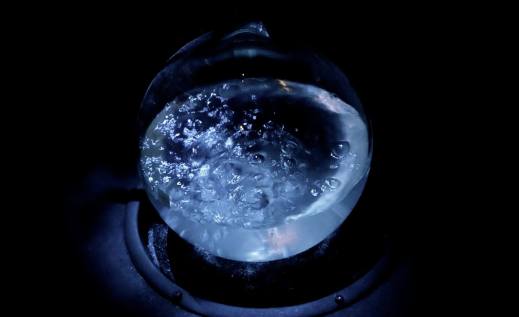
Multidisciplinary composer and media alchemist Navid Navab and his team at the Topological Media Lab based at Concordia University (Montreal) presented Aquaphoneia, a sound installation which transmutes voice into water and water into air at Biennale Nemo in Paris in December 2017 (and will run until March 2018). I conducted this interview in the context of the first presentation of Aquaphoneia originally conceptualized for Ars Electronica 2016: RADICAL ATOMS and the alchemists of our time. This version of the piece looked at technology through the lens of the living materiality. As Prof. Hiroshi Ishii, of the MIT Media Lab’s Tangible Media Group, stated, artists “suggest completely new ways of looking at the role of science in our society and the interplay of technology and nature.”
***
EB [Esther Bourdages]: The theme of the 2016 Ars Electronica Festival, RADICAL ATOMS – and the alchemists of our time, is very close to the Topological Media Lab’s mission: transmutation and alchemy on the philosophical and phenomenological level. For Aquaphoneia, can you expand on alchemy and specifically on how this art piece stands out from your past work? How did alchemical thought process and production techniques come up in the process of the piece?
NN [Navid Navad]: When the 2016 theme for Ars Electronica Festival was announced I was happily surprised and thought: finally, things are coming to light at a much larger scale. Yes, please can we reverse the still prominent European Modernism’s separations—between the conceptual and the material, the precise and the messy, the sciences and the arts—and go back to the holistic richness of alchemical matter? This transition that we are currently experiencing calls for a shift away from representational technologies: from interfaces to stuff, from objects to fields of matter-in-process, from fixed concepts to processes that enact concepts. For over a decade, we as alchemists have been engaging with “bodies and materials that are always suffused with ethical, vital and material power.”
The Topological Media Lab [TML] is occupied by people who are living to fuse and confuse, ready to unlearn the apparent practicality of isolated disciplines, while playfully improvising new pathways to understanding potential futures. The TML hosts an array of projects for thinking-feeling through poetry-infused-matter and breathing life into static forms—which to me is an effortlessly artistic process, and all the while inseparable from a rigorously philosophical or scientific one. Even though it might take decades for the kinds of computational-materials that we are envisioning today to be engineered from ground up at an atomic level, with what is possible today, we explore how the messy stuff of the world could become computationally charged with the potential for play: sounding, dancing, and co-performing new ways of living with or without us.
Aquaphoneia comes out of this rich ecology of experiments. In Aquaphoneia, voice and water become irreversibly fused. The installation listens to the visitors, and transmutes their utterances into aqueous voice, which then is further enriched and purified through alchemical processes.
.
To fully realize this liquid dream, we went to great lengths in order to fuse the messy behaviour of matter flowing throughout the installation with meticulously correlated and localized sonic behaviour. For example, the temporal texture of boiling liquid in one chamber is perceptually inseparable from the spectral entropy of simmering voices which then evaporate into a cloud of spectral mist. All of this dynamic activity is finely localized: the sounds acoustically emit exactly from where the action occurs, rather than spatially schizophying loudspeakers elsewhere.
On another hand, our material-computational-centric approach lead to a tough yet rewarding meditation on control and process. As a composer, I had to let go of all desires for immediate control over sounds and surrender important rhythmical and compositional decisions to messy material processes. In Alchemical Mercury (2009), Karen Pinkus quotes Marcel Duchamp: “alchemy is a kind of philosophy: a kind of thinking that leads to a way of understanding” (159). For us, in the process of creating Aquaphoneia, essentially what had to be understood and then given up was our attachment to our far-too-human notions of time and tempo. Instead we embraced and worked within the infinitely rich and pluri-textural tempi of matter. Technically and compositionally this meant that most of our focus had to be placed on merging the continuous richness of material processes with our computational processes through an array of techniques: temporal pattern following, audio-mosaicing, continuous tracking of fields of activity using computer vision and acoustic sensing techniques in order to synthesize highly correlated sonic morphologies, careful integration of structure-born-sound, etc. We were able to co-articulate compositions by constraining material processes sculpturally, and then letting the liquid voice and the laws of thermodynamics do their thing.
[EB]: One of the first elements that we notice in the installation is the brass horn connected to an old Edison sound recording machine, that now turns into liquid instead of wax cylinders. In fact, it came from an Edison talking machine. You repurpose an authentic artifact, but you do not fall into the trap of nostalgia, and neither into the role of collector, but you embrace innovation with a dynamic approach which excavates past media technologies in order to understand or surpass contemporary audio technologies. Where does the use of the Edison horn come from and how does it speak to your relationship with the superposition of history?
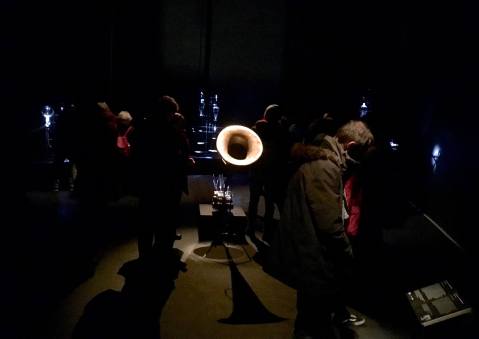
Paris, Biennale Némo, 17 October 2017 – 18 March 2018 Credit: Navid Navad, 2017
[NN]: The history of sound reproduction involves transforming audible pressure patterns or sound energy into solid matter and vice versa. The historic Edison recording machines gathered sound energy to etch pressure patterns onto tinfoil wrapped around a cylindrical drum. Sound waves, focussed at the narrow end of the horn, caused a small diaphragm to vibrate, which in turn caused a miniature steel-blade stylus to move and emboss grooves in the cylinder. The tin foil would later on be replaced by wax cylinders, vinyl disks and eventually digital encoding.
Aquaphoneia engages the intimately recursive relationship between sounding technologies and material transmutations. Our digital audio workstations are an in fact an inclusive part of this history, this endless chain of analog transmutation between energy and matter. Under the fiction of the digital there is always the murmur of electrons and of matter-energy fields in physical transmutation. As J. Fargier writes on an early book on Nam June Paik (1989) “The digital is the analog correspondence of the alchemists’ formula for gold” (translation by NN). Well, yes. The digital revolution has allowed us to shape, compute, purify, and sculpt sounds like never before… but then often at the hefty cost of a disembodying process, with interfaces that are linked to sounds only through layers upon layers of representation, far detached from resonating bodies and the sexy flux of sounding matter.
Aquaphoneia playfully juxtaposes material-computational histories of talking machines within an imaginary assemblage: sounds are fully materialized and messed with tangibly within an immediate medium very much like clay or water or perhaps more like a yet to be realized alchemico-sonic-matter. This odd assemblage orchestrates liquid sounds leveraging intuitive worldly notions—such as freezing, melting, dripping, swishing, boiling, splashing, whirling, vaporizing—and in the process borrows alchemical tactics expanding across material sciences, applied phenomenology, metaphysics, expanded materiology, and the arts. Aquaphoneia’s alchemical chambers set these materials, metaphors, and forces into play against one another. After the initial ritual of offering one’s voice to the assemblage, the aqueous voice starts performing for and with itself, and human visitors have the opportunity to watch and participate as they would when encountering the unpredictable order of an enchanted forest river.
It is also noteworthy that the horn resembles a black hole. The edge of the horn acts like an event horizon, separating sounds from their source-context. Sounds, once having passed the acousmatic event horizon, cannot return to the world that they once knew. Voices leaving the body of their human or non-human speaker, fall into the narrow depths of the horn, and are squeezed into spatio-temporal infinity. Disembodied voices, are immediately reborn again with a new liquid body that flows though alchemical chambers for sonic and metaphysical purification.
Much of my work deals with the poetics of schizophonia (separation of sound from their sources). Sound reproduction (technologies), from Edison’s talking machines to our current systems, transcode back and forth between the concrete and acousmatic, situated and abstract, materialized and dematerialized, analogue and digital. Often sounds are encoded into a stiff medium which then may be processed with an interface, eventually decoded, and re-manifested again as sound. Aquaphoneia ends this nervous cycle of separation anxiety and re-attachment by synthesizing a sounding medium capable of contemporary computational powers such as memory, and adaptive spectro-temporal modulation and morphing. To adapt Marshall McLuhan, instead of encoding and decoding a presumed message with representational technologies, it enchants the medium.
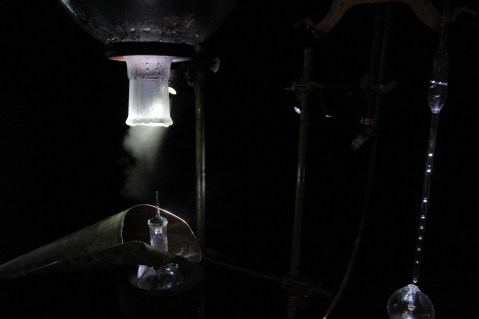
Image Credit: Topological Media Lab, 2016
[EB]: There is the tendency to think that artwork from Media Labs are stable and high tech. Aquaphoneia uses analog and digital technologies with a Do-It-Yourself (DIY) touch in the aesthetic. Since your lab is multidisciplinary oriented and influenced by diverse fields of knowledge, can you develop on the DIY dimension in Aquaphoneia under the gaze of Clint Enns—cinematographer in the experimental field of cinema—: “Adopting a DIY methodology means choosing freedom over convenience”?
[NN]: Aquaphoneia is a truly eclectic assemblage lost in time. Aquaphoneia’s mixed form reflects its extremely fluid, collaborative and playful creative process. Instead of coming up with a definitive design and executing it industrially, Aquaphoneia’s realization involved a much more playful process, where every little aspect of the installation—materials, sounds, software, electronics, etc.—was playfully investigated and messed with. Every little detail matters and every process, undulating back and forth between conception to execution, is an artistic process. The research-creation process leading to the works that come out of our lab are as critical to us as the final and fully produced art works. This was also true for the alchemists who, through their process, were seeking to develop new approaches for understanding the world, relating to matter, and surpassing nature.
Our research-creation activities concern experimenting with ethico-aesthetics of collective thinking-making: humans, non-humans, machines, and materials enacting and co-articulating the ever-changing material-social networks of relations which shape them. This DIY art-all-the-way approach, while providing a healthy dose of aesthetic freedom, is also an ethical one: we live with and within our designs and grow with them. That being said, we are not attached to a DIY process in the same way that some maker cultures might be. Sometimes we blindly find and repurpose something that does something cool, complicated, and mysterious and that is fantastic, sort of like philosophy of media meets cyber dumpster diving meets DIY hacker space meets cutting edge tech research meets miniMax (minimum engineering with maximum impact) meets speculative whatever…
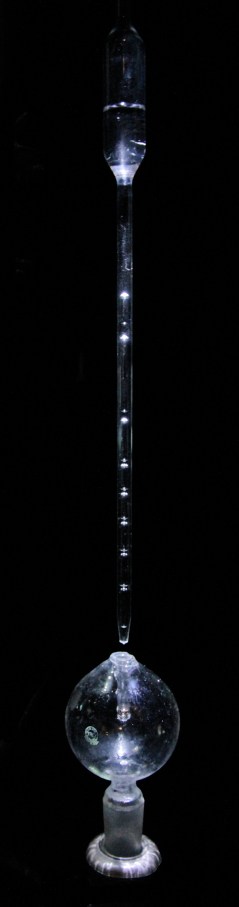
Image Credit: Topological Media Lab, 2016
For example, at some point we decided to gather sonic vapour in a glass dome and condense it back into drops, which were then guided to fall into the bottom of the installation. The purified drop of voice—sonic “lapis philosophorum”—was to fall into the depths of the earth beneath and shine upward like sonic gold, connecting heaven and earth. We had to execute this opus magnum inside a very small hole in the base of the installation. The water drop needed to be immediately sensed and sonified, leading to sounds coming out of the same hole, along with synchronized light. You can imagine that if we were relying on “black-boxed” technologies and ready-made techniques then this task would have seemed like a nightmare to design and fabricate. The water drop was to fall all the way to the bottom of the hole where it would be acoustically sensed by a small apparatus that had to be acoustically isolated from everything else. Then the result of the sonification had to be pushed through the very same hole with a high degree of intelligibility and in a way that it would be seamlessly localized. Meanwhile, light had to shine through this hole in sync with the sounds but the source of light had to remain hidden.
The solution to this technical puzzle came to us effortlessly when playing around with random stuff. We found a hipster product—a little plastic horn—that was made for turning your iPod into a gramophone. Then a speaker was mounted inside of this plastic horn in order to focus sounds towards the end tip of the horn. The back of the speaker was fully covered with foam and duct tape to stop any sound from escaping anywhere except for where we wanted it to appear. A small hole was drilled into the brass pipe in the base of the installation. Our advanced hipster horn-tip-sound-laser-thing was then inserted, allowing crisp sounds to enter the brass hole and emit from it without any visible clues for the perceiver as to where the speaker was hidden. Meanwhile, a similar lighting solution was created so that in a very small footprint we can focus, direct, and bounce enough directional light in the brass pipe without ever getting in the way of the water drops.
We had to engage with this sort of detailed fabrication/composition process throughout the whole installation in order to come up with solutions to sense the behaviour of the materials and liquids locally and to manifest them sonically and visually so that there would be no separation from local material behaviours and their computational enchantment. In trying to do so we discovered that more often than not, there was no ready-made solution or technique to rely on, and at the same time we didn’t have months ahead of us to engage in an abstract design and fabrication process. We had limited hours of collective play time to leverage and to come up with innovative techniques that we didn’t even know could exist and that was really fun.
**
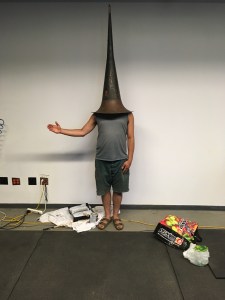
Image Credit: Topological Media Lab, 2016**
Aquaphoneia is a rich sound art piece – a manifesto by itself about innovation and inventiveness. The sound installation demonstrates that the main crafters Navid Navad and his partner Michael Montanaro, in collaboration with other members of the Topological Media Lab, swim easily into the multidisciplinary art. They are are not afraid to experiment and engage with the material, which results in an interlacing of forms, a mixture of historic references, and an interesting fusion of “low” and “high” technology. I was able to catch some of the build up of the art piece, and it was fantastic to witness the lab as a playful messy artistic field with a little team of scholars fusing their different backgrounds in convergence on the marriage of art and science.
Aquaphoneia, a sound installation which transmutes voice into water and water into air at Biennale Nemo in Paris runs until March 2018.
—
-
- NAVID NAVAB art direction, sound/installation concept and design, audiovisual composition, programming, behaviour design
- MICHAEL MONTANARO art direction, visual/installation concept, design and fabrication
- PETER VAN HAAFTEN electronics, sound, programming
- consulting assistants: Nima Navab (embedded lighting design) Joseph Thibodeau (electronics)
- research collaboration: Topological Media Lab
Featured Image: Aquaphoneia, Paris, Biennale Némo, 17 October 2017 – 18 March 2018, Credit: Navid Navad, 2017
—
Esther Bourdages works in the visual arts and technology art field as a writer, independent curator and scholar. Her curatorial research explores art forms such as site-specific art, installation and sculpture, often in conjunction with sound. She has authored many articles and critical commentaries on contemporary art. As a musician, she performs under the name of Esther B – she plays turntables, handles vinyl records, and records soundscapes. She works and lives in Montreal.
Navid Navab is a Montreal based media alchemist, multidisciplinary composer, audiovisual sculptor, phono-menologist, and gestureBender. Interested in the poetics of gesture, materiality, and embodiment, his work investigates the transmutation of matter and the enrichment of its inherent performative quali- ties. Navid uses gestures, rhythms and vibration from everyday life as basis for realtime compositions, resulting in augmented acoustical poetry and painterly light that enchants improvisational and pedestrian movements.
Navad currently co-directs the Topological Media Lab, where he leverages phenomenological studies to inform the the creation of computationally-augmented performance environments. His works, which which take on the form of gestural sound compositions, responsive architecture, site specific interven- tions, theatrical interactive installations, kinetic sound sculptures and multimodal comprovisational per- formances, have been presented internationally at diverse venues such as Canadian Center for Architec- ture, Festival du Nouveau Cinema, Ars Electronica Festival Linz, HKW Berlin, WesternFront Vancouver, McCord Museum, Musée d’art Contemporain de Montréal, Contemporary Arts Museum Houston, Inter- national Digital Arts Biennial, Musiikin Aika Finland, and Festival International Montréal/Nouvelles Mu- siques, among others. www.navidnavab.net
—
 REWIND! . . .If you liked this post, you may also dig:
Playing with Bits, Pieces, and Lightning Bolts: An Interview with Sound Artist Andrea Parkins — Maile Colbert
Sounding Our Utopia: An Interview With Mileece— Maile Colbert
Optophones and Musical Print–Mara Mills
Share this:

Vocal Deformance and Performative Speech, or In Different Voices!

**This post was co-authored by Marit J. MacArthur and Lee M. Miller
Like it or not, we are now accustomed to contemporary pop vocalists manipulating their voices using Autotune and other tools or effects for pitch correction. We may exult in it, and congratulate ourselves on our sophisticated appreciation of the options available to the contemporary vocalist. In another mood, we may scream for low-fi and acoustic music, feel cynical about the possibility that we might ever hear an unmediated voice, live or recorded (if we ever did), and/or laugh off the notion of authenticity in performance entirely. Of course, rather than tricking the audience or trying to sound somehow “better” than they are, many performers manipulate their voices to pose questions about the nature of performance—Reggie Watts and Anna Deavere Smith come readily to mind—and to test essentialist assumptions about and perceptions of voice and sound.
Watts, in an exemplary 2012 TED Talk, plays with the different sorts of authority and affect conveyed by, among other voices: upper-class-British-absurd-explanatory, affectively-meaningful-nonsense-foreign-language, and caz-hip-hop-introducing-a-song-chat. Inhabiting and playing with different voices, he amuses listeners into recognizing how much intonation—the rise and fall of pitch—and other acoustic features affect our perception of a speaker’s voice, and how much we expect people to speak in ways that match our assumptions about their identities.
 We cannot all be so talented at vocal imitation, however. And in sound, voice and performance studies concerned with speech, machine-assisted manipulation of vocal recordings—which we term “vocal deformance”—is much less common than in the creative industries. A playful approach to vocal deformance, as a critical and creative practice, has much to teach us about our perceptions of speech in general, and performative speech in particular. Too often, when we use archival poetry recordings in our teaching, they may reify an idea that students are often loathe to relinquish: a poem is a finished art object, weighted with authorial intention and biographical significance, with one possible interpretation (the instructor’s). When we play a single canonical recording of T.S. Eliot reading The Waste Land in 1946, for instance, his particular intonation, together with assumptions that he was a stuffy, overeducated, repressed snob, can foreclose the possibility of a fresh encounter with the many voices of the poem and a multitude of interpretations.
Using vocal deformance in the classroom and in our own research and scholarship, we can unsettle overdetermined readings of poems, essentialist assumptions about the poets who speak them and questions of poetic authority, and recover the crucial oral components of poetry. Below we offer some examples of vocal deformance of poetry readings, and consider the potential and limits of this technique for teaching and research with recordings of performative speech. As John Hyland wrote in Sounding Out! in 2014, “The act of listening to recorded poetry … poses particular analytic challenges, which become more complex when the politics of identity are brought to bear on … questions of voice and poetry.” Among these challenges are essentialist assumptions, both about identity and recording medium, which are difficult to avoid when we listen. Hyland concludes that, when we listen to recordings, “the poet’s voice falsely takes on an authoritative ‘aura,’ as Walter Benjamin used that word”; one way to counter to this is to listen to the same poem read by the poet at different points in their career, in different contexts, as Hyland does with three recordings of Amiri Baraka’s “Black Dada Nihilismus.” Another approach is to play with recordings.
***
“Glitch” by Ray Weitzenberg, Attribution 2.0 Generic (CC BY 2.0)
***
The concept of deformance dates to a 1999 essay by Jerome McGann and Lisa Samuels. They take inspiration from Emily Dickinson, who sometimes liked to read poems backward, for the potential insights of reading against the form, scrambling the original sequence, and so on. According to McGann and Samuels, Dickinson’s
critical model is performative, not intellectual [. . . ]. it is anti-theoretical: not because it is opposed to theory (i.e., speculative thought), but because it places theory in a subordinated relation to practice. Deformative moves reinvestigate the terms … [of] critical commentary [, with] dramatic exposure of subjectivity as a live and highly informative option of interpretive commentary, if not indeed one of its essential features. [our italics]
Too often in the literature class room, the subjectivity of interpretation is something of a problem. While we might initially encourage a somewhat fluffy reader-response discussion of a poem, eventually we might also worry that students are simply wandering too far from it, following their own random associations with a phrase or metaphor, without learning to parse the rich intricacy of the whole poem. One effect of vocal deformance is that it makes space for the playful response, and also keeps bringing students back to the telling phrase, to the words of the poem, imagining what difference it makes if they are said in different ways, trying on different interpretations, as it were.
While vocal deformance can be applied to any performative speech, it particularly lends itself to poetry recordings. Poetry is, of course, an oral form with a fraught relationship between text and performance, and poetry reading styles are often perceived to be highly conventional, so that we feel we are listening to a Poem rather than a particular poem. From a literary and performance studies perspective, what could be more tiredly familiar than a canonical recording of a canonical poem by a canonical poet in a conventional style of poetry reading that deadens the audience to the charms and nuances of that poem? And how can we do something productive and interesting with the (sometimes extremely) idiosyncratic subjectivity of student responses to canonical texts?
As an interpretive practice, vocal deformance opens up new possibilities for testing assumptions about performance, poetic authority and gender, and, potentially, about race, class, education, region, and canonicity. Is The Waste Land (1922) the deadly serious poem that many readers often take it to be, partly because it is presented to them as an immensely influential Modernist monolith? How does T.S. Eliot’s seemingly grim reading of it, and our perception of his style, contribute to such an interpretation of the poem? After all, the working title of the poem was “He Do the Police in Different Voices,” from Charles Dickens’s Our Mutual Friend (1864-65), and it includes many different voices or speakers, from the clairvoyant Madame Sosistris to Tiresias. What better way to defamiliarize and exploit the authority of the poem than to deform Eliot’s authoritative reading voice?
How do we respond to the now-canonical voice of Eliot reading the opening lines of The Waste Land, “April is the cruellest month, breeding / lilacs out of the dead land”?
.
Okay. Now what if we raise his pitch? Is he suddenly his own great-aunt? What does the same lament mean, spoken by a voice that sounds like an elderly woman?
.
And if we leave his pitch alone, but speed up his speaking rate, does he suddenly sound like an old-school radio announcer, the poem a deranged weather forecast?
.

Glitch Decoration GIF, Licensed under CC-BY-SA 3.
In terms of digital humanities research, a refreshing aspect of vocal deformance is that it avoids some of the easy and misleading reassurances of the empirical move. It’s not that it only clarifies what we thought we were hearing (as visualizing intonation through pitch contours can), but that it encourages multiplicity in listening.
Vocal deformance is essentially a playful strategy for defamiliarization that reminds us, in many ways, of the subjective, creative, even arbitrary nature of interpretation. In this, it has clear affinities with the OULIPO movement (which Dickinson’s practice of reading backwards presages). It may help us imagine, create and respond to alternative sequences and versions of recorded canonical texts—and to any apparently stable, singular performance of a text. The art of the glitch is one deformative practice, with the goal countering screen essentialism, the unreflective assumption that a digital artefact is immutable, stable and coherent. For an example of glitching photographs, see Trevor Owens’s “Glitching Files for Understanding: Avoiding Screen Essentialism in Three Easy Steps,” and Michael Kramer’s blog post about using audio deformance in a digital folk music history seminar at Northwestern University, “Distorting History to Make It More Accurate,” which demonstrates some potential insights gained by glitching newspaper images, photographs and music (Bob Dylan’s “Tangled Up in Blue”). John Melillo and Johanna Skibsrud’s “Two Sides for Wallace Stevens,” on Harvard’s Woodberry Poetry Room site, also offers a beguiling example of audio deformance.
Most deformative practices work with text and image, however, and the few that manipulate recordings introduce noise, skipped phrases, repetition, etc., usually without changing the acoustic features of the voice. It is well worth applying deformance more often to speech, not only in linguistics and the neurobiology of speech perception, but in humanistic study of performative speech because our perception of speech is nothing if not subjective, not to say mysterious, for two reasons.
First, our expectations of what we will hear influence what we do hear, from simple sounds to complex language comprehension. Often these expectations, which can be visual, auditory, cultural, etc., have been naturalized by the listener over time as unconscious reactions. Though many have anecdotal experience of this phenomenon (see an example about a black student, a white teacher, and a black student-teacher disagreeing on what the student said in a 2012 Sounding Out! piece by Christina Sharpe), it is has been demonstrated in many experiments as well. For instance, our perception of foreign-accented speech changes rapidly as we hear a few sentences and calibrate our internal expectations, as shown by Clarke and Garret’s 2004 study “Rapid Adaptation to Foreign-accented English.” And, according to Richard Warren’s “Perceptural Restoration of Missing Speech Sounds” (1970), “when natural speech is interrupted by noisy gaps like a cough or a slammed door, we unknowingly “fill in” the noise, vividly hearing speech sounds that do not exist acoustically. This phenomenon arises both from linguistic expectations as well as our deep familiarity with basic speech acoustics, as shown in Shahin, Bishop, and Miller’s “Neural mechanisms for illusory filling-in of degraded speech.” Similarly, in an illusion called the McGurk effect—noted by Harry McGurk and John MacDonald in 1976—just seeing a talker’s lip movements changes the perception of speech sounds categorically, say from “buck” to “duck.”
Though much of this reshaping of our acoustic perception happens unconsciously, we can also profoundly alter what we hear through selective attention. Particularly in everyday acoustic environments, we hear speech better when we expect it, and when it matches our specific expectations: from a given location, from a certain talker or type of talker, at a certain pitch, and so on (See “Speech Recognition in Adverse Conditions: A Review” by Mattys, Davis, et al. 2012). Perceptual filters fundamentally constrain our experience: if we attend to a talker in one ear, we may not even realize when a second talker in the other ear switches from English to German, as Cherry concluded in “Some Experiments on the Recognition of Speech” in 1953. Social and cultural knowledge also changes what we hear. Listening to someone whom a listener visually perceives as a “non-native speaker” can make speech sound not only more “accented” (see Donald Rubin’s “Nonlanguage Factors Affecting S Judgments of Nonnative English-Speaking Teaching Assistants” from 1992)—what we might call a subjective quality—but, as Molly Babel and Jamie Russell found in 2015’s “Expectations and Speech Intelligibility,” it can also trigger speech processing reactions that make the speech less intelligible to the listener making visual judgments regarding accented speech.

Waveform from a sine wave composition, “Wave Hello to Outsiders.” Rendered in Adobe Audition by Matthew Potter. Attribution 2.0 Generic (CC BY 2.0)
Given what we know about the brain, the fact that expectations affect perception—of recorded voices reading poems, in this case—should not come as a surprise. A growing consensus holds that the brain’s job is not merely to represent the world; rather it strives to predict the world, make inferences about it, and correct those expectations whenever a mismatch is detected (see Knill and Pouget’s “The Bayesian brain: the role of uncertainty in neural coding and computation” [2004] and Karl Friston’s 2010 “The free-energy principle: a unified brain theory?”) In somewhat familiar environments and situations (pretty much everything after infancy), predictive inference is far more efficient than continually rendering the perceptual world de novo. This means that vocal deformance—particularly when it manipulates a known voice, as with canonical poets, or a familiar way of speaking, as with conventional poetry reading styles—waves a red flag at the brain. Change wakes up the quiescent, habitual brain to something new and potentially informative, because the voice does not fit our expectations for what the person would or should sound like. Listen to Reggie Watts!
This effect can also operate inversely; that is, if we do not expect someone to have a particular voice, we may adjust the stories we tell ourselves about our perceptions, to better match our expectations. In musicology, we might think of Nina Eidsheim’s article on the racialized reception of opera singer Marian Anderson, the first African American to sing at New York’s Metropolitan Opera:
the timbre of her voice has routinely (if often admiringly) been characterized as ‘black,’ … [despite] classical music’s minimal indulgence of individual style … this distinction [has] to be based on an assumption that the black body is intrinsically different from the white body and that even when emitting a timbre recognized as classical, the resonance of a singer’s black body is evident (3, 4).
Certainly, as Jennifer Stoever writes, “listening [is] an interpretive site where racial difference is coded, produced, and policed” (62). The same is true of gender difference and many other identity markers and cultural factors related to authority and authenticity. As Shai Burstyn notes in the article “In Quest of the Period Ear,” about attempts to imagine how contemporary audiences experienced medieval music, “culture plays a highly significant—though not exclusive—role in shaping the cognitive skills of its members” (695). If it is remarkably difficult to escape our stereotypical expectations and perceptions of what a person’s voice “should” sound like, that is partly because our brain uses such expectations to make predictions about our sonic experience. We cannot overcome our expectations through good will alone, and engaging with these issues in the classroom, which can be challenging, also provides an opportunity to help students think critically about essentialism and voice, for those moments when a student in the back of the room mutters in surprise that Langston Hughes “doesn’t sound black,” or exclaims that Walt Whitman “doesn’t sound gay.” Though it is not designed to assess stereotyping in speech perception, the Harvard implicit bias test is a good way to engage students in questions of cultural bias and perception [also, see “So You Flunked a Racism Test. Now What?”].
Furthermore, our affective responses to acoustic, non-verbal qualities of speech matter tremendously to our interpretation of verbal semantics, of the meaning of the words spoken. According to voice perception research in Foundations of Voice Studies: An Interdisciplinary Approach to Voice Production and Perception by Jody Kreiman and Diana Sidtis, when we listen to speech, “[s]ome authors … have claimed that normal adults usually believe the tone of voice rather than the words…. For example, the contrast in ‘I feel just fine’ spoken in a tense, tentative tone might be politely ignored, while, ‘I’m not angry’ spoken in hot anger would not” (304). The teacher’s boring tone of voice on the Peanuts cartoon makes the point.
In other words, we pick up on the affective meaning of a speaker’s tone of voice, and weigh it against the semantic meaning of the words spoken. While Kreiman and Sidtis argue that tone cannot be reduced to intonation patterns, “the fundamental frequency of the human voice [pitch] … heads the list of important cues for emotional meanings” (311). Pitch manipulation, then, changes the affective meaning of speech. Tone of voice is also influenced by other acoustic features, including speaking rate or tempo, and rhythm. In poetry recordings, the poet’s tone of voice influences the listener’s interpretation of a poem.
Two fundamental intonation patterns are rising or falling pitch. In American English, relatively high or relatively low pitch at the end of an utterance, compared to the beginning and middle, seems to carry distinct meanings, as demonstrated by Janet Pierrehumbert and Julia Hirschberg. They developed the ToBI (Tones and Break Indices) system for marking the prosody or intonation of speech. Rising intonation can make any utterance sound like a question, whether it is one or not. A relatively high pitch at the end of an utterance—called a high boundary tone—can make the speaker sound less confident or assertive, and more open to other’s opinions. Rising intonation implies that more is to come, that the utterance is not conclusive or concluded, that it should be understood in connection to the next utterance, and sometimes, that the speaker seeks the listener’s agreement before proceeding.
Uptalk, notably practiced among Generation Xers and now millennials, sounds conciliatory, agreeable and open, on the one hand, and lacking in confidence and authority, on the other—depending on the listener and the context. Marybeth Seitz-Brown argues that criticizing uptalk “implies that if women just spoke like men, our ideas would be valuable … [and] sexist listeners would magically understand us, and we would be taken seriously. But the problem is not with feminized qualities, of speech or otherwise, the problem is that our culture pathologizes feminine traits as something to be ashamed of or apologize for.”
Conversely, women can be criticized when they sound too much like men; see “Why Do So Many People Hate the Sound of Hillary Clinton’s Voice?” Falling intonation—and ending an utterance on a relatively low pitch, or a low boundary tone, implies conclusion, closure and confidence. The utterance, such intonation implies, finishes the argument (if there is one), does not seek the listener’s agreement or opinion, and suggests that this utterance can be understood on its own, without connection to subsequent utterances. Donald Trump, for example, is fond of falling intonation and low boundary tones (for a parody of masculine confident declarative intonation, have a listen at Troy McClure from The Simpsons.)
Of course, not all women use uptalk, and not all men use falling intonation with low boundary tones. In American culture, for better or worse, low boundary tones do seem to carry a tone of authority. And in poetry reading as well. Eliot’s original, and now canonical, reading of the opening line of The Waste Land, “April is the cruellest month,” uses falling intonation, so that it sounds like a confident assertion, with a low boundary tone on “month.”

Click on the image to enlarge the pitch contour graph showing Eliot’s low boundary tone.
.
“[B]reeding / lilacs out of the dead land” sounds like a steady, inevitable process, ending on a slightly higher relative pitch, implying that there is more to come, and that the phrase should be understood in connection to the next line, “mixing / Memory and desire, stirring / Dull roots with spring rain.”
What is so compelling and seemingly authoritative about Eliot’s reading style? In some basic sense, the falling intonation of the first phrase does it. Why does it strike many contemporary listeners as pompous? How might we undercut the seeming authority of the Eliotic voice? Make him do uptalk. Here we have simply inverted his intonation.
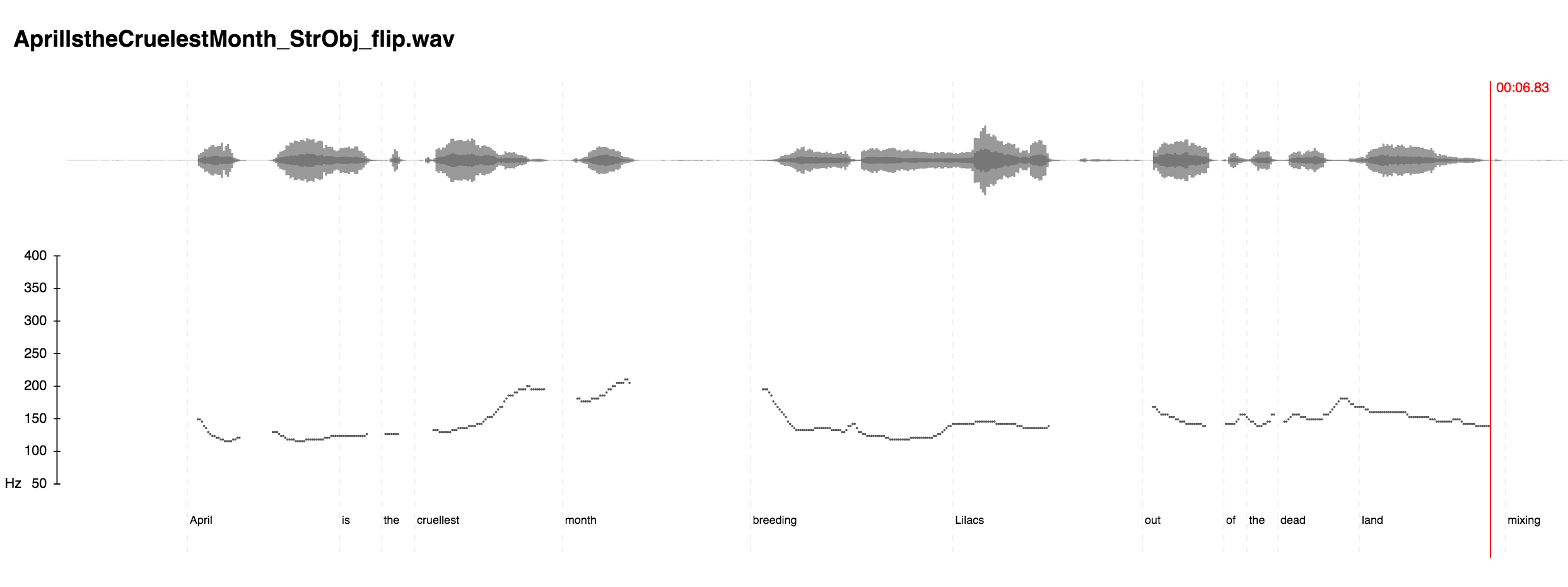
Click on the image to enlarge the pitch contour graph of Eliot’s voice “flipped.”
.
Suddenly he sounds doubtful. The opening line becomes a question—“April is the cruellest month[?]”—instead of a confident statement. Suddenly, Eliot himself expresses the skepticism or confusion many an undergraduate has felt—before we encountered this poem, did we not assume that spring, the return of life and fertility, is a cheerful escape from winter? And his deformed recital of “breeding / Lilacs out the dead land” suddenly sounds more like an agonized complaint, expressing the painful, reluctant awakening of desire in one who had found the dull sleep of winter comforting. Inverting the typical poetic authority of falling intonation into uptalk may embolden readers to entertain very different readings of the poem’s opening.
The editors of Poetry Archive had hopes of stimulating listeners of The Waste Land when they made available a 1935 recording of the poem, claiming: “Whilst the sound quality is understandably not so good, the recording is fascinating for Eliot’s faster, more energetic rendition. Listening to this urgent interpretation blows the dust of this iconic poem and helps us encounter it afresh.” However, if the fundamental falling intonation pattern of Eliot’s reading style doesn’t change—and overall, it doesn’t, between the 1935 and 1946 recordings—his voice may remain, for listeners, an aloof poetic authority.
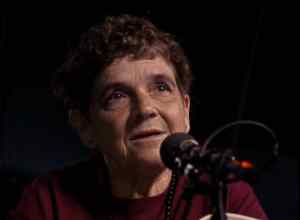
Adrienne Rich reading her poetry
Falling intonation with low boundary tones, then, is a fundental tone of poetic authority. Listen to Adrienne Rich reading from her poem, “What Kind of Times Are These” (1995), which leads the reader to a place “between two stands of trees … near … [where] the persecuted / … disappeared into the shadows.” She insists, “this isn’t a Russian poem, this is not somewhere else but here,” and concludes, “to have you listen at all it’s necessary / to talk about trees.”

Click here to enlarge the pitch contour graph of Rich’s “original” reading
.
She sounds like she means it. Rich has to write poems about nature, her tone implies, to wake people up to the political horrors of the American past and present. Poetry as a form, in pastoral guise, allows her to sneak in political content, potentially grabbing the attention of people who might only listen to poetry if they think it is safely, simply about nature. (Click here to hear the entire poem, starting at 4:01.)
When we invert her intonation, turning it into uptalk, she sounds as if she is questioning the wisdom of this approach, and/or chiding her listeners for making her take it. In this case, uptalk exerts a different kind of authority, the challenging question.

Click image to enlarge the pitch contour graph of Rich’s voice “flipped.”
.
Is it ethical to manipulate the intonation and other vocal qualities on poetry recordings, for the purposes of teaching and research? Obviously it would not be, if we were to present the manipulated recordings as the authentic voice of a poet. And all peoples have the right to protect culturally sensitive recordings, such as sacred songs, music, dances and prayers; see “Native American Intellectual Property Issues.” Otherwise, potential conflicts are similar to those with sampling in the music industry (See Kembrew McLeod and Peter DiCola’s Creative License: The Law and Culture of Digital Sampling [2011]). Vocal deformance, however, can help remind us that no single reading of a poem, by the poet or someone else, is the ultimately authoritative one.
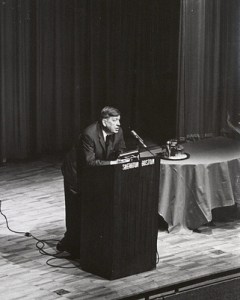
Photograph of Auden speaking at the Boston Sheraton Hotel, February 23, 1966, Box 60, Folder 9, Francis W. Sweeney, SJ, Humanities Series Director’s Records, MS2002-37, John J. Burns Library, Boston College. Attribution-NonCommercial-NoDerivs 2.0 Generic (CC BY-NC-ND 2.0)
In teaching writing, we (the authors) sometimes ask our students to explore alternative methods of presenting the same material. This can be as simple as writing the same sentence, the thesis for instance, in three different ways, or it can involve a different format. Write a poem, record oneself reading it, then try to represent it with a collage of images. Turn a 2,000-word essay into a 250-word presentation with verbal and sonic components. An instructive trick with the opening line of W.H. Auden’s “Musée des Beaux Arts” (1940): “About suffering they were never wrong, the Old Masters.” They were never wrong, the Old Masters, about suffering. The Old Masters were never wrong about suffering. Each version of the opening creates a subtly different emphasis, on suffering versus the wisdom of the Old Masters.
Too often, we lock ourselves into one approach, and cannot imagine an alternative. Locked into one approach, too often we cannot imagine an alternative. Alternatives we cannot imagine, if we lock into one approach too quickly. Writing three different opening paragraphs to the same essay, or rearranging the lines of the poem, stimulates our imagination and our critical faculties because it dramatizes different possibilities, possibilities that offer a different emphasis. And when we play with the pitch, intonation and speaking rate of a poem, this can change the tone as dramatically, from a challenge to confession, or an assertion into doubt.
In the classroom, poet Harryette Mullen is often popular with students, both for her poems on the page and for her expressive reading style, while students can sometimes resist recordings by Adrienne Rich (saying that she sounds lecture-y) and Louise Glück (saying that she sounds bored by her own poems), even as they are engaged by the poems on the page.
When Mullen reads “Present Tense” (2002)—a beguiling comical poem, loosely about the grammatical present and the speaker’s and the world’s present circumstances —what is it about her contrastive intonation that sounds expressive? She ends her opening phrases, “Now that my ears are connected to a random answer machine” with rising intonation and high boundary tones. This draws the reader on: keep listening, the statement’s not finished.

Click image to enlarge the pitch contour graph of Mullen’s reading
.
When we flip the intonation pattern, so that each utterance ends on a relatively low pitch, she sounds more conventional, a poetic authority declaring observations, confident and closed off.

Click image to enlarge the pitch contour graph of Mullen’s reading “flipped”
.
Another tone of poetic authority approaches pure monotony. It was practiced by Alfred Lord Tennyson, Irish modernist poet W.B. Yeats and, perhaps through Yeats’s influence, by American poets such as Yvor Winters. Note how similar they sound here. Winters reads the opening of his poem “The Journey” (1931), moving into a Yeatsian monotone after the title and location of Snake River Country, “I now remembered slowly how I came[.]”

Click here to enlarge the pitch contour graph of Winters reading “The Journey.”
.
Here is Yeats reading the opening of “The Lake Isle of Innisfree”: “I will arise and go now, and go to Innisfree[.]”

Click image to enlarge the pitch contour graph of Yeats reading “The Isle of Innisfree”
.
All we have to do to turn Winters into Yeats is raise his pitch a bit:

Click image to enlarge the pitch contour graph of “Winters as Yeats.”
.
Monotone performance is—at least acoustically—quite uninformative for the brain. Early parts of the auditory brain rapidly adapt or habituate to a wide array of regularities such as pitch and temporal pattern, and they only signal when the pattern changes, as noted in “Early selective-attention effect on evoked potential reinterpreted” (Näätänen, Gaillard et al., 1978). But expectations can work differently across speech’s descriptive dimensions. When speech is usually vivid, as in a direct quotation (“He said ‘I’m leaving now”), higher-level voice-processing areas in the right temporal lobe actually work harder to process (unexpectedly) monotone quotes, according to Yao, Belin, et al.’s “Brain ‘talks over’ boring quotes: top-down activation of voice-selective areas while listening to monotonous direct speech quotations” (2012). In other words, sameness of pitch often means the brain must work harder to grasp meaning.
Interestingly, David Hadbawnik relates in Sounding Out! his disappointment with the productions of three audio recordings of three poetic specimens from Middle English created with SPARSAR, because “they produced monotone outputs that fail to account for prosody.” Vocal deformance might allow him to try to approximate Middle English prosody with the specimens.
MacArthur has written elsewhere about “poet voice,” which she also calls “monotonous incantation.” But how close are contemporary canonical poets to actual monotone, compared to Tennyson and Yeats? Here is Glück, whose reading style is often mentioned as an example of Poet Voice, reading the third stanza of “The Wild Iris” (1992): “It is terrible to survive / as consciousness / buried in the dark earth”:

Click image to enlarge the pitch contour graph of Glück reading “The Wild Iris.”
.
Not much manipulation is required to make it purely monotone, which may account for some students saying she sounds bored by her own poems—though they do not say that about Yeats. They say Yeats’s voice makes them feel like they are in church.
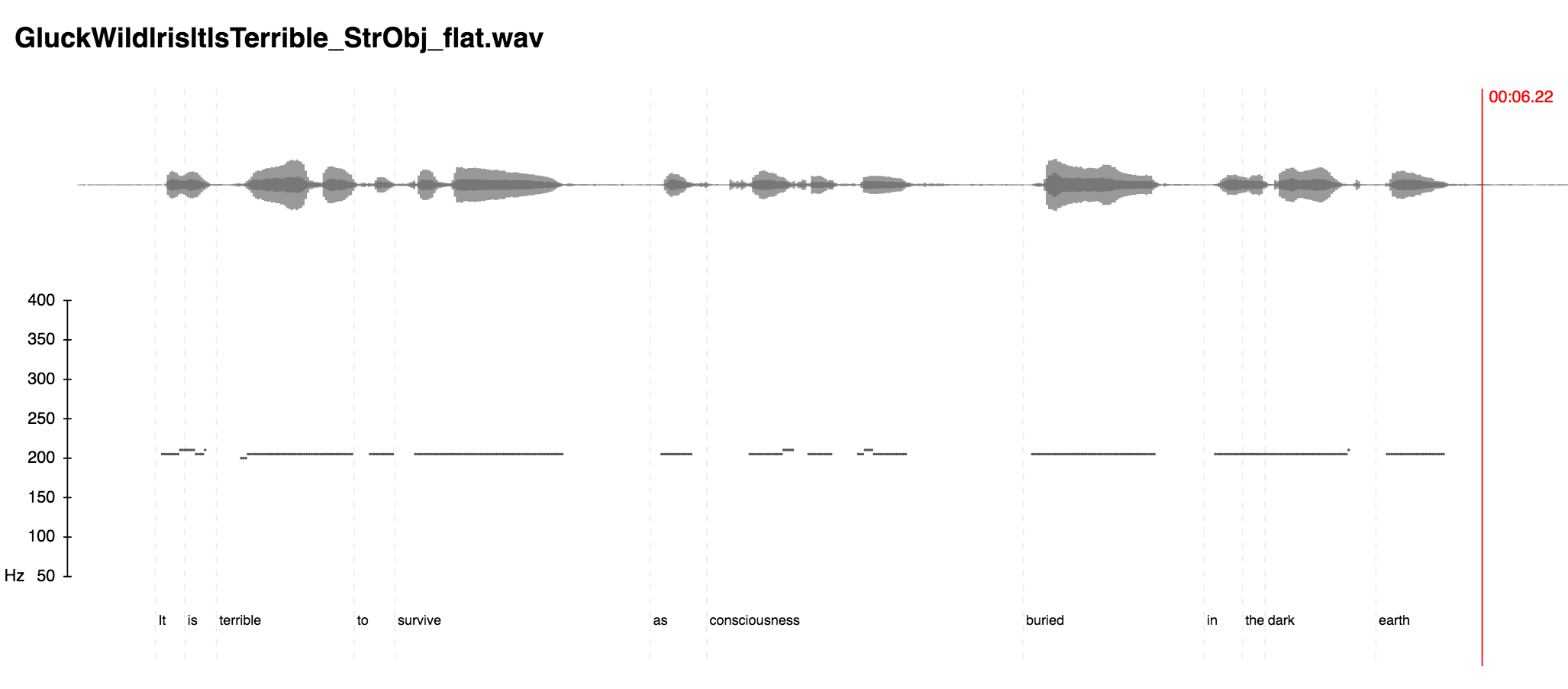
Click image to enlarge the pitch contour graph of Glück “flattened.”
.
Ideally, Glück’s manner of reading her poem should not prevent students from appreciating it. While in other contexts we may defend women’s use of uptalk, it also seems fair to raise the point that academic poetry reading can seem to discourage the expression of affect. (See Donald Hall’s well-known polemic, “The Poetry Reading: Public Performance / Private Art” (1985) and David Groff’s “The Peril of the Poetry Reading: Page Versus Performance” [2005].) Vocal deformance, among other strategies, might help students perceive as much drama in Glück’s poems as they do in Mullen’s—and find as much as poetic authority in both poets’ voices as they do in Yeats’s churchy one. Here, we’ve manipulated Glück’s voice to sound more like Mullen’s style of reading, with a wider pitch range and rising intonation and high boundary tones.

Click image to enlarge the pitch contour graph of Glück reading “expressively.”
.
If we want to explore alternatives to conventional modes of reading poetry, as many do, directly deforming the acoustic qualities of canonical recordings is an excellent way to defamiliarize performance conventions. Ideally, it can help us listen to alternate versions of the history of poetic performance and to different, unimagined possibilities in the present. Given the extraordinary vitality of spoken word and slam poetry outside the academy, it would be a missed opportunity to suppress varied reading styles in the classroom. At the same time, it would be a great shame to leave behind canonical American poetry when the poets’ reading styles fail to appeal to students.
Finally, if we want to liberate students from the anti-performative tendencies of academic culture, resist essentialist readings of poems according to our assumptions about the identities of the poets who wrote them, and dramatize the idea that there are many ways to read a poem, vocal deformance can help, alongside other strategies. As Yvon Bonenfant wrote in a 2014 Sounding Out! piece, “we are mostly neurotic, or otherwise hung up on, what kinds of sounds we make, where and when.”
Instead, let’s play in different voices.
—
NOTE: To illustrate vocal deformance, we used Straight, a state-of-the-art open-source voice synthesis program developed by Hideki Kawahara at Wakayama University in Japan, with the Advanced Telecommunications Research Institute and the Auditory Brain Project. We also used Drift, an open-source pitch-tracking tool that uses an algorithm developed by Byung Suk Lee and Dan Ellis, implemented by Robert Ochshorn and Max Hawkins with support from MacArthur’s ACLS Digital Innovations Fellowship in 2015-16, to visualize intonation with pitch contours.
—
Marit J. MacArthur is associate professor of English at California State University, Bakersfield, and a research associate in Cinema and Digital Media at the University of California, Davis.
Lee M. Miller is associate professor of Neurobiology, Physiology, & Behavior at the University of California, Davis, and technical director of the Center for Mind and Brain.
—
Featured Image: Cropped and Enlarged version of Bill Smith’s “Voice Glitch,” Attribution 2.0 Generic (CC BY 2.0)
—
 REWIND! . . .If you liked this post, you may also dig:
A Listening Mind: Sound Learning in a Literature Classroom–Nicole Furlonge
Audio Culture Studies: Scaffolding a Sequence of Assignments–Jentery Sayers
“HOW YOU SOUND??”: The Poet’s Voice, Aura, and the Challenge of Listening to Poetry–John Hyland
Hearing the Tenor of the Vendler/Dove Conversation: Race, Listening, and the “Noise” of Texts–Christina Sharpe
Share this:


Current Top Posts





April 2021

January 2020

November 2019

October 2019

August 2019

April 2014

November 2017

March 2015

December 2017

October 2015
 Sounding Out!
Recent Comments