
Listening to Interiors, Silo #5
 Early in Jonathan Sterne’s (2003) book The Audible Past he writes, “hearing is concerned with interiors, vision is concerned with surfaces” (p. 15). This binary is in many ways gospel in sound studies. Martin Jay (1993) has established in his work, Downcast Eyes, a similar division between observations, the ocular, and listening, the speculative (p. 85). Most other literature takes a similar perspective – the sonic interior is a main methodological praxis of sound studies. When deciphering the speculative, listening is still the first, best tool, for interpreting an interior. I wonder, what it means to extend this metaphor into space. What does it mean, interpretively, for a sound wave to ricochet through a reverb spring, to yell in a claustrophobic hallway, or to listen with headphones instead of speakers. What is the culture of the interior, and how is it heard?
One place to look is the fantastic but infrequently publicized (although it has gotten some notable press) Silophone. An abandoned grain silo in Montréal, Silophone has been wired to serve as a medium of anonymous communication, and reverberation since November 2000. It’s easy to reach too, just call 514-844-5555. After the second ring, you are patched in to Silo #5, where your words are broadcast to ricochet around the abandoned building. Contributing to a participatory soundscape where several voices contribute to an ever changing, echoing interior. Silophone is definitely art, it is intrinsically technological, certainly audible, and it is almost social.
One striking question about Silophone is what exactly it means, what are the cultural stakes of an anonymous and collective interior? Can it be read as a critique of the ambiguity of network society, the futility of translation in an increasingly global culture? As the sounds refract against the walls of the silo and compete against one another, it is hard to decipher a clear signal, let alone consider a dialect or source. Conversely, Silophone also represents the possibilities of a network commons. Even though one sound rarely emerges as dominant, this relates to the counter-hegemonic aspects of the interior. Inside, hearing privileges proximity, and quiet. The less participants, and the closer your receiver is to a speaker, the more likely you are to hear a sound. Though this is a similar to the listening politics of everyday life, it should be noted that the silo is an experiment of space; the dynamics of its audible space emulates a virtualization of voices unprecedented in non-abstract spaces.

Listening to an interior is an important way to consider the politics of specific objects and architectural configurations. It is a way to render and think through the spatial configurations of space-less phenomenon: sounds, ideology, opinions and ephemera all belong to the interior, and it is important to develop tools for discussing them in a way which is not degraded to mere speculation. Silo #5, once a hub of cacophonous conversation, is now silent, somewhat forgotten and out of vogue. Does this reflect a social shift away from telephone-mediated relations, a societal shift in the practice of hearing? Although the interior of the silo models an anonymous and semi-random collective, other interiors may model other things. What do the interiors of computers, subways or classrooms model? Further, with listening as a method, can we begin proximate our interior selves?
AT


Share this:

President Obama: All Over But the Shouting?
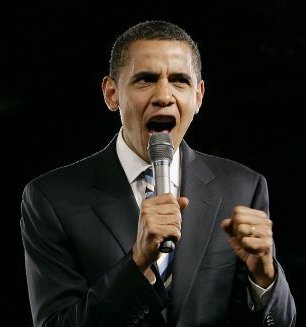
Ishmael Reed’s 12/12/2010 op-ed for the New York Times, “What Progressives Don’t Understand About Obama,” certainly struck a nerve amongst the Left. In the piece, Reed calls out far-Lefters for their misplaced–and dangerous–desire for President Obama to essentially “bust a can of whup ass” out on the Republicans over the tax cut debacle. Citing a lifetime of being labeled rhetorically “rowdy” by white teachers and peers, Reed calls attention to a deeply embedded and racialized double standard for the public expression of anger in the United States. Beyond turning a deaf ear their own pleas for a “sane” national debate back in October–see Mark Brantner‘s Sounding Out! analysis of the rhetorical logic of John Stewart’s Rally to Restore Sanity here–Reed argues that white liberals are also disregarding the racialized difference between white perceptions of their own anger (represented as righteous and authoritative) and their characterizarions of black anger (as a loud, dangerous “whup ass”–or as Reed phrases it “paranoid,” “bitter,” “rowdy,” “angry,” [and] “bull[ying]”). In other words, behind the cries in Reed’s comments for Obama to regain his “drama and passion” and to “stand up and tell these idiots to stuff it” lies a flirtation with and fear of “black anger,” which has a long history in the United States. As Reed mentions, black intellectuals have “been accused of tirades and diatribes for more than 100 years.”
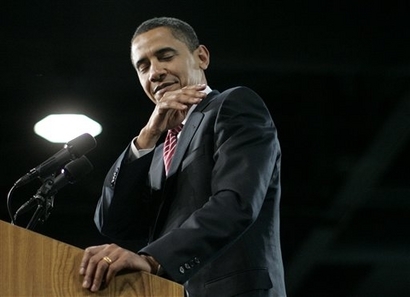
As someone who researches the racialization of sound and listening, I have been tracking Obama’s struggle with sonic stereotypes for quite some time now, and I think it is important to connect Reed’s recent thoughts with the utterance of another man named Reid almost a year ago. Woven into comments supposedly intended as praise of President Obama’s political prowess, Former Senate Majority Leader Harry Reid (D-Nevada) told two political journalists that he had known Obama would be elected president in 2008 because he was “light skinned” and had “no Negro dialect, unless he wanted to have one.” In this brief sound bite, the other Reid acknowledged the increased role that vocal grain and diction would play in a “post-racial” or “colorblind” world, linking the racialization of skin pigmentation with its less acknowledged yet perhaps more insidious counterpart, the racialization of sounds, voices and speech. Unfortunately, incendiary media coverage focused bluntly on Reid’s alleged racism for using the antiquated term “Negro” rather than sparking a more nuanced conversation about the role that race plays in perception and the multifaceted ways in which this racialized perception affects American politics and culture, down to the very level of the senses.
What was most disturbing about Reid’s comments (and the least talked about) was how they showed aural markers of race aligning with—and even superseding—visual codes of race, exposing the seeming comfort Americans have developed with this “sonic color-line,” as I have termed it. Inspired by and indebted to W. E. B. Du Bois’s concept of the visual color-line in The Souls of Black Folk (1903) and his later reimagining of that color-line as a suffocating plate-glass enclosure in Dusk of Dawn (1940), my notion of the sonic color-line posits listening as an interpretive site where racial difference is coded, produced, and policed. In short, we hear race in addition to (and sometimes even before) seeing it. As I have argued elsewhere, the socially constructed division between “sound/noise” marks one border of the sonic color-line; the hierarchies pointed out by Reed (quiet/loud) and exacerbated by Reid (proper/improper) mark still others. The sonic markers of whiteness (“sound”/”quiet”/”proper”) are culturally associated with both intellect and full citizenship privileges; the sonic markers representing blackness (“noise”/”loud”/”improper”) are repeatedly trotted out as signs of deviance, danger, and deserved abjection.
Though I very rarely find myself agreeing with Conservative linguist John McWhorter, I couldn’t help concede to the sentiment expressed in his January 9, 2010, blog for the The New Republic, “Reid’s Three Little Words; The Log in Our Own Eye”: “And who among us—including black people—thinks someone with what I call a ‘black-cent’ who occasionally popped up with double negatives and things like aks could be elected President, whether it’s fair or not?” Both Reid’s statement and McWhorter’s embellishment imply an unspoken sonic color-line, a racial “common sense” that African Americans are not only identifiable by a particular type of sound—the so-called “Negro dialect” or “black-cent” and its attendant loudness—but are aberrant and unelectable because of it, a sonic standard that does not appear to apply to white people. After all, the preceding two white presidents were known for their distinctive dialects and the ways in which they used them to mobilize their respective electorates; Bill Clinton’s soft-spoken Southern drawl was often read as smooth, intimate, and reassuring during the 1990s and George Bush’s folksy Texas-by-way-of-Andover twang attempted to sonically bridge the gaping class divides in the Republican coalition. But even before the recent debates that have pitted Obama’s “coolness”–itself a racialized jazz form of “quiet revolution” a la Miles Davis–against the imagined explosive heat of his anger, contemporary pundits heard the sound of Obama’s crisp, cosmopolitan voice with anxious and divisive ears, leading some to question his “blackness” and his political commitment to black people (Salon,“Colorblind,” 1.22.07)while still others called his baritone “magic” and immediately connected its resonant qualities with Martin Luther King Jr.’s, despite clear differences of tone, cadence, and regional inflection (Salon,“Does Obama’s Baritone Give Him an Edge?”2.28.2008).
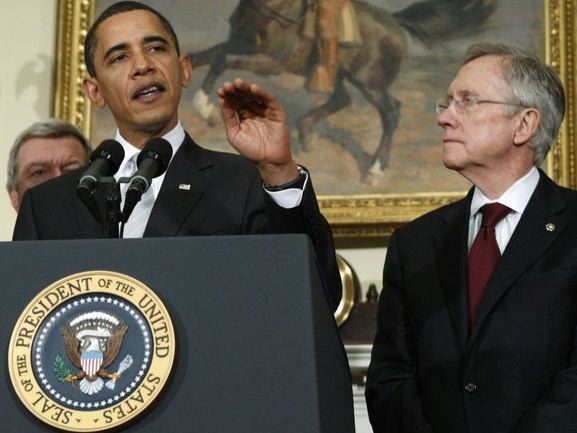
Senator Harry Reid (D-Nevada) Listens to Obama Speak
In other words, Americans continue to hear Obama’s voice through the historical filter of “loudness” and the so-called “Negro dialect” whether or not Obama wants them to and whether or not he “wanted to have one.” While Reid’s prompt and profuse apologies to Obama may have pulled the story from the news cycle—the President called the remarks “unfortunate”—the phenomenon Reid’s clumsy words exposed remains an invisible yet palpable cultural force in the U.S., one whose longer historical genealogy has yet to be reckoned with. Sure to be labeled “rowdy” for beginning to do so, Reed’s recent commentary suggests that Obama’s social and historical knowledge has led him to an astute awareness of “when not to shout” that white Liberals need to recognize. I offer a perhaps less consoling conclusion, that we need to concentrate less on the sound of Obama’s voice and more on the racialized listening practices that can radically distort public discourse in this country. Unless we understand (and eventually dismantle) the relationship between the dominant American “listening ear” and the sonic color-line that shapes it for many (white) liberals and conservatives alike, we will continue to shout into the wind.


Share this:


Current Top Posts





April 2021

January 2020

November 2019

October 2019

August 2019

April 2014

November 2017

March 2015

December 2017

October 2015
 Sounding Out!
Recent Comments