
The (Magic) Upper Room: Sonic Pleasure Politics in Southern Hip Hop

 After a rockin’ (and seriously informative) series of podcasts from Leonard J. Paul–a three part “Inside the Game Sound Designer’s Studio”– our summer Sound and Pleasure series keeps giving you the good stuff, this week with SO! Regular Regina Bradley, making it rain. . . with some serious knowledge. What is the connection between sound and enjoyment, and how might black women’s sexual freedom be manifested via sound? –-JS, Editor-in-Chief
—
At fifteen, while in church service, I learned how to clutch pearls after hearing a woman moan during the altar call.
It was not a “Jesus done found and saved me” moan, either. A friend forgot to turn his cell phone off for church. As the church prayed, his phone started to ring. It was not the usual digital beeping or quick calypso ring tone. His phone calls were annotated by a woman’s moan during sex. She moaned from his cell phone to pick up the call. Each ring the woman moaned louder and adamant until she hollered like she was just saved. The kids in the back snickered as the ushers – including my grandmother – silently and angrily screened each pew to see who would pick up the phone. Quaking church ladies and my grandmother’s wide-eyed glare and heaving chest suggested they were about to pass out from embarrassment. Wringing their white gloved hands and grabbing at their pearl necklaces in angst, they looked everywhere but at each other: the back of a man’s head, the cross at the front of the church, the stain glass windows. A flush of warmth entered my cheeks and neck as I tried to contain my laughter and creeping embarrassment. I was embarrassed for my grandmother and the ladies of the church because I was aware of the unspoken rule that women – especially middle-class black women – don’t do sex. Being embarrassed of sex is proper and “ladylike.”
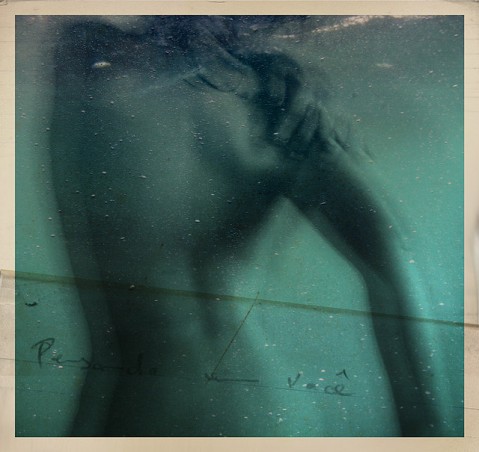
“Dancing underwater II” by Flickr user Miss Cartier, CC BY-NC-SA 2.0
Ashon Crawley’s contextualization of the praise and worship in Black Pentecostal church as a sonic public zone is useful for using sound to complicate the church as an erotic space. Crawley’s suggestion of sound as a “vessel. . .for the exchange of ecstasy and ecstatics” collapses the more tangible notions of gender and respectability via physical displays –i.e. the quaking church ladies and clutching pearls – to recognize the overlap of moaning as a marker of sexual joy, moaning as a form of praise and worship, and moaning as an indicator of shame. Crawley’s observations bring to mind Helga Crane’s run in with the storefront church in Nella Larsen’s Quicksand. It is not the physical aspect of the church and its embodiment of respectability that draws Helga into the space. Rather, it is the singing, weeping, and moaning – the sonic elements of praise and worship–that parallel her own suppressed sexual frustrations. Her weeping is not necessarily a “come to Jesus moment” but rather a sonic release acknowledging her sexual agency.
Looking back at when this dude’s phone went off in church, I realize the bulk of discomfort in acknowledging sexual pleasure exists in how it sounds. The woman’s moan highlighted an alarming reality for the women at my church: pleasure was being presented outside of its respectable physical and sonic boundaries. I wish to identify what I call sonic pleasure politics to address new developments in 21st century southern gender identity politics. Sonic manifestations of pleasure point to a younger generation’s rearticulation of sexuality as a site of agency and self-definition in an otherwise suppressed southern experience.
![Purity-Rings.jpg by Wikimedia user Bibleknowledge, CC-BY-SA-3.0 (http://creativecommons.org/licenses/by-sa/3.0)], via Wikimedia Commons](http://commons.wikimedia.org/wiki/File:Purity-Rings.jpg)
Purity-Rings.jpg by Wikimedia user Bibleknowledge, CC-BY-SA-3.0, via Wikimedia Commons
As a southern black woman, I’ve always been struck by the anxiety sex and pleasure invoked in the women in my life. Sex and pleasure were never articulated in the same breath, as sex was a wifely duty and responsibility for procreation. Pleasure was never synonymous with sexual joy, even when I snatched whispers of conversation about sex from my elders. Moreover, I was taught that sex (or even an interest in it) would plummet my stock as a good girl and put me in the ranks of “fast-tailed” girls who used sex as a desperate plea for attention. Nope, sex – pleasurable sex – was always for men’s gratification. Aside from the abstinence manifesto – “just don’t do it, chile” – for women, enjoying sex was the devil’s work. Respectable sex was quiet, for marriage, and never discussed outside of the house.
Sound as a signifier of sexual pleasure is considered by many to be counterintuitive because of the history of sexual trauma associated with black women’s bodies in the south. Reading sex as a genesis point of southern black women’s pleasure and empowerment is a difficult undertaking. The forced silence of slave women’s rapes and other physical violence that took place on southern soil parallels the silence that is deemed to be necessary for survival in a racist society. Further, the far-reaching residual effects of black women’s inferred lacking virtue lurk in how black folks navigate their southern experience and identities. Conservative attitudes towards sex in the southern black community are no doubt associated with the constructed attempts to humanize and validate blacks outside of hypersexual scripted blackness.
However, the sonic dimension of sex and pleasure in the south goes largely without analysis even though sound is a primary space in which recognition of sexual and nonsexual pleasure takes place. Consider blues women and, more recently, women in [southern] hip hop culture. The sounds of women’s giggles and moans as representative of sexual pleasure in bass music and the heavy use of moaning in the work of Trina, Jacki-O, Khia, Erykah Badu, Beyoncé, and Missy Elliott points to a need to recognize sound as a reservoir of pleasure, raunchiness, and sexual work—what I call “sonic pleasure politics.”
Studies of sonic pleasure including those of Robin James contextualize pleasure via the technical production of sound to induce a particular set of cultural and visceral responses. However, I ground my theorization of sonic pleasure politics in the growing body of scholarship offered by the “Pleasure Ninjas” collective consisting of Joan Morgan, Brittney Cooper, Treva Lindsey, Kaila Story, Yaba Blay, and Esther Armah. They utilize pleasure as a site of healing and reclamation of black women’s identities. Morgan’s interrogation of pleasure as a form of survival, for example, is especially useful in thinking about how southern women’s sexuality stems from the trauma of the transatlantic slave trade. She suggests pleasure’s palpability as an alternative space to reclaim slaves’ humanity. The Pleasure Ninjas’ construction of pleasure lends credence to my theorization sonic pleasure politics as a space for mediating the historical implications of abusive sexual power and the use of sexual pleasure as a form of resistance in the south.
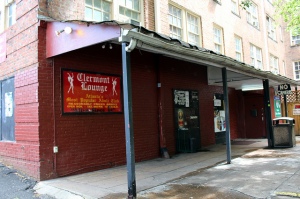
“Atlanta – Poncey-Highland: Clermont Lounge” by Flickr user Wally Gobetz, CC BY-NC-ND 2.0
Situating women’s pleasure in southern hip hop is messy as it reflects both men’s investment in women as objects of pleasure – i.e. bass music – and women’s subversion of this expectation of their sexuality a way to express themselves. For example, Lil Wayne’s lyrical affirmation of his sexual prowess via cunnilingus in songs like “Pussy Monster,” “She Will,” and “Lollipop” parallels singer Joi’s demonstration of pleasure as a form of sexual consent via the use of (presumably her) moans and sounds of cunnilingus on her popular song “Lick.” Sonic pleasure politics become a workspace for bridging the south’s historical construction of [black] women’s sexuality-as-respectability and the recent, more fluid form of younger women’s embrace of sex-as-empowerment heard in southern popular culture.
Sonic Pleasure Politics and Strip Club Culture
A primary space for teasing out the multi-layered significance of sounds and sexuality in southern hip hop is the strip club. The production of sonic and visual representations of strip clubs are inextricably linked: bass heavy musical tracks keep time with the “clapping cheeks” of exotic dancers. Further, the loudness of the strip club denotes patrons’ attempts to drown out the world while pivoting off of the fantasy of sexy women dancing, moaning, and sexually gesturing for their entertainment. The dominance of strip clubs in southern hip hop contribute to the erotic map(s) of a younger generation of southern black women. My contextualization of strip clubs as a cartographic point of interest pivots off of Kaila Story’s description of erotic maps as an entry point for recognizing black women’s sexual agency. Erotic maps are the touchstones through which people address sexual pleasure. Story uses black women’s social-historical narratives to map out black women’s use of sexuality as a measure of self-definition. These maps are complex as they are intertwined with historical-cultural biases and cultural preferences frequently outside of black women’s experiences.

“IMG_0478” by Flickr user Ferrum College, CC BY-NC-SA 2.0
Strip club anthems, like Memphis rapper Juicy J’s “Bandz a Make Her Dance,” riff on the sonic and physical components of strip club culture. The bass kicks complement what sounds like clapping hands, a signifier of strippers’ clapping butts. Juicy J talks at length about his love of the strip club, distinguishing between “real” and fake strip clubs by the amount of nakedness and strippers wrangling for high-paying patrons’ bands of money. The snapping sound of rubber bands holding wads of cash together authenticates the duality of the women’s sexual posturing as physically pleasurable for men and profitable – economically pleasurable – for women. “Bandz a Make Her Dance” is grounded in the appeal of strip clubs as spaces of empowerment for black men. From this perspective, the clapping heard across the track could also signify the snapping of rubber bands against money to sonically signify men’s power as a strip club patron. Yet the physical and sonic presence of black women’s bodies – i.e. grunting as they maneuver and climb the dancing pole – also makes strip club culture a useful space to pivot southernness and sonic pleasure.
An example of establishing black women’s sonic pleasure narratives in strip clubs is singer Rihanna’s panning of “Bandz a Make Her Dance” titled “Pour It Up.” Although Rihanna is a pop singer from the “Global” South, she sonically signifies if not subverts southern hip hop gender politics via sampling the instrumental from Juicy J’s record. The majority of “Pour It Up’s” instrumental accompaniment is a subdued if not washed out sample of “Bandz a Maker Dance” that helps highlight Rihanna’s voice. The clarity of Rihanna’s voice “garbles” the accompaniment in the sense it is background noise to her narrative of enjoying herself and taking pleasure in the bodies of other women present in the club. The accompaniment serves as a brief nod to Juicy J’s initial intentions of crafting the strip club as a sexual space but ultimately uses the track as a testament to her own pleasure narrative.
In particular, Rihanna’s sing-song holler before the chorus “All I see is signs…all I see is dollar signs,” points to a subversion of the hypermasculinity in strip club culture to establish her own pleasure in a similar space. Parallel to Juicy J’s indulging of exotic dancers via throwing bands of money, Rihanna enjoys herself at the strip club using other people’s money:
Strip clubs and dolla’ bills (Still got mo’ money)
Patron shots can I get a refill (Still got mo’ money)
Strippers going up and down that pole (Still got mo’ money)
4 o’clock and we ain’t going home (Still got mo’ money)
Bands make your girl go down (Still got mo’ money)
Lot more where that came from (Still got mo’ money)

“Rihanna – Oslo 2013” by Flickr user NRK P3, CC BY-NC-SA 2.0
In particular, Rihanna’s verse not only demonstrates an alternative viewpoint of black women’s bodies in the strip club but destabilizes the idea of the strip club – and intercedes on the understanding of southern hip hop – as a heternormative hypermasculine space. The line “bands make your girl go down” alludes to not only a possible sexual encounter by Rihanna or for the girl in question but doubly signifies upon the potential for pleasure via the strip club culture for women and the hypersexuality of Juicy J’s track. “Pour it Up” reflects the messiness of [southern] hip hop gender politics because it builds upon the reputation of the strip club as a site for men’s pleasure to excavate women’s dancing as pleasurable for their own purposes. In addition to Rihanna’s sonic signifying of strip club culture, the “Pour It Up” reveres pole dancing as an art form rather than an exploitative practice. Rihanna’s pleasure in watching the dancers perform parallels the exertion of joy – and consent – that the dancers exhibit in their movement.
Trekking back to the sexy moaning phone in church, the sonic cue of sexual pleasure and joy conflicted with the gender norms associated with southern black women’s identities. Consideration of sonic pleasure narratives stirs discussion of the unarticulated experiences of southern black womanhood that may be overlooked in favor or a larger, more conservative, and familiar narrative of sex as tool of victimization. Sonic pleasure politics makes room to remap the contemporary southern social-cultural landscape as a complex yet living space of cultural production and sexual freedom.
–
Featured Image: “RIHANNA EM BELO HORIZONTE” by Flickr user http://www.rihannafentyforum.com, CC BY-NC-SA 2.0
–
Regina Bradley recently completed her PhD at Florida State University in African American Literature. Her dissertation is titled “Race to Post: White Hegemonic Capitalism and Black Empowerment in 21st Century Black Popular Culture and Literature.” She is a regular writer for Sounding Out!
–
 REWIND!…If you liked this post, you may also dig:
Thrills, Chills, and Safe Sexuality: The Sounds of Michael Jackson’s “Thriller” – Osvaldo Oyola
“I Love to Praise His Name”: Shouting as Feminine Disruption, Public Ecstasy, and Audio-Visual Pleasure – Shakira Holt
I Like the Way You Rhyme, Boy: Hip Hop Sensibility and Racial Trauma in Django Unchained – Regina Bradley
Share this:

This is Your Body on the Velvet Underground


“Everyone who bought one of those 30,000 copies started a band.” Brian Eno’s remark about the Velvet Underground’s brilliant but commercially lackluster 1967 debut album was re-circulated widely last October, when fans and critics mourned the passing of Lou Reed, lead songwriter for the band, and a key cultural figure of the last fifty years, by any metric.
The remark has become trite through overuse, but not the sentiment it captures. A band that has, since even before before Andy Warhol’s Factory, been linked to an aesthetic of menace, hysteria and psychosis didn’t just “inspire” or “provoke” much of the music, art and sensibilities of the post-1960’s. It extruded that era.
At Sounding Out!, we decided that in order to come to grips with Reed’s work in general (and the Velvet Underground in particular) from a Sound Studies perspective we’d have to adopt that spirit of provocation. I asked two prominent writers in the field for articles about how this band changed — and continues to change — the experience and history of sound, in a short series Start A Band: Lou Reed and Sound Studies. I’m thrilled to present the first of our articles from returning author Jacob Smith from Northwestern University, a musician and accomplished author of several distinguished books on sound and media history. Stay tuned next week for a second installment from Tim Anderson from Old Dominion University, an award winning writer and co-chair of the Sound Studies SIG at the Society for Cinema and Media Studies.
–NV
—
Lou Reed’s recent death has inspired many critics to return to his groundbreaking work with the Velvet Underground (VU). Albums such as “The Velvet Underground and Nico” (1967), “White Light/White Heat” (1968) and “The Velvet Underground” (1969) have the reputation of influencing everyone from David Bowie, Iggy Pop and Roxy Music to the Sex Pistols, Talking Heads, REM and Nirvana. Many recent obituaries describe VU in literary terms, citing Reed’s “lyrical honesty,” “rock and roll poetry,” and touting his songs as “serious writing” and even a kind of “Great American Novel.” There is much to be missed by taking such a decidedly literary approach to sound recordings, and there is an alternative approach, thanks to the emergence of Sound Studies as a vibrant academic field. Can what Jonathan Sterne has called the “interdisciplinary ferment” of Sound Studies help us to re-think the work of this seminal rock band (The Sound Studies Reader, 2)? I think it can.
For a start, Sound Studies emboldens us to base our analysis on VU’s records, which have often been oddly upstaged by other aspects of their career: Reed’s street-level lyrics to be sure; but also the group’s role as background music to Andy Warhol’s Factory; or their use of drones and feedback, which makes them a footnote in the history of avant-garde music; or their influence on the glam and punk explosions of the 1970s. Sound Studies encourages us to start with VU’s records, but the next step is not necessarily a formal musicological analysis.
 For some of its proponents, including Steven Connor, Sound Studies is best understood as part of a broader investigation of the “fertility of the relations” between the senses, and VU’s albums turn out to be an excellent place to begin an exploration of the multisensory experience of recorded sound (“Edison’s Teeth: Touching Hearing,” in Hearing Cultures, ed. Viet Erlmann, 54). This essay explores the tactile experience of VU’s records, inspired by work on the tactile dimension of the cinema. I borrow the organizational structure of Jennifer M. Barker’s book The Tactile Eye, which moves from a discussion of sensations at the surface of the body, to muscular responses, and lastly, to the “the murky recesses of the body, where heart, lungs, pulsing fluids, and firing synapses receive, respond to, and reenact the rhythms of cinema” (2-3). Think of this essay as a body-scan of the VU listening experience (“this is your body on VU”) that follows a similar path from the skin, to the musculature, and finally, to the viscera.
Downy Sins
Writing about the tactile experience of movies is concerned with modes of looking that resemble touching, a “haptic visuality” that attends to textures and surfaces, and moves over the image like a caress (See Laura U. Marks The Skin of the Film, 183 and Touch, 117). A form of “haptic listening” has also been commonplace in the culture of popular sound recordings. Much of the recorded popular music of the past century has invested meaning in what Theodore Gracyk calls “very specific sound qualities and their textural combination” (Rhythm and Noise, 61). From Bo Diddley to Aphex Twin, pop recordings have tended to stress evocative timbres, idiosyncratic voices, and signature sounds over structural or lyrical complexity.
VU’s records exemplify that tendency because their complexity can be found more on the level of timbre than in musical structure or instrumentation. Moreover, Reed’s lyrics often encourage a blurring of listening and touching. On “Venus in Furs,” listeners are prompted to hear John Cale’s viola stabs as the licks and bites of a mistress’s whip. “Sister Ray” cues haptic listening by chugging resolutely on a single chord for seventeen minutes, while a plasmatic organ performance mutates from elegant bass arpeggios to shimmering waves of icy noise. As with “Venus in Furs,” Reed’s lyrics tie the textural complexity of “Sister Ray” to the surface of the body, through his descriptions of searching the skin of his arm for a “mainline” vein, and a first-person account of receiving oral sex. These examples demonstrate that the poetry of Reed’s lyrics is intimately bound up with the sonic texture of VU’s recordings, and moreover, that he was adept at liberating the erotic potential of haptic listening.
Run Run Run
Films can produce an empathetic muscular response in the viewer’s body, as when we flinch in response to a horror film, or clench our fists while watching a thrilling action movie (Barker, The Tactile Eye 94, 83, 72). Listeners can have similarly empathetic relationships with recorded sound when they move along with the rhythms of a dance record, synchronize their workout or commute to a carefully designed playlist, or embody a recorded performance by miming an air guitar or air drums.
The members of VU had distinctive styles of instrumental performance that made their records evoke powerful muscular responses in listeners. Consider the piano track on “Waiting For the Man,” which loses any semblance of melodic content to become the sheer act of pounding on the keyboard by the end of the song. Reed is usually regarded as a lyricist, but he is just as influential as a muscular rhythm guitar player. “What Goes On” has a minimalist arrangement that eschews structural development to become a showcase for Reed’s vigorous strumming. The second half of the track lacks vocals or a conventional solo instrument, and so feels like a diagram of the human body that reveals the pulsating musculature beneath the skin.
Reed’s jangly rhythm guitar could dominate the mix of VU tracks like “What Goes On” because it occupies a sonic niche that, in a more typical rock arrangement, would be filled by the hi-hat or ride cymbal. In fact, it is Maureen Tucker’s distinctive drumming that is the main source of muscle power on VU’s records. Standing behind a spare kit consisting of little more than a snare and a bass drum turned on its side, Tucker attacked her instrument with relentless intensity, raising her mallet over her head with each bone-cracking snare hit. A review of a live appearance in 1968 observed that Tucker “beats the shit” out of her drums so that the sound “slams into your bowels and crawls out your asshole” (See Clinton Heylin, All Yesterdays’ Parties, 64). Hear (and feel) for yourself, on the VU track “Foggy Notion,” a seven-minute drum and guitar workout.
Tucker was a pioneer female instrumentalist in the male-dominated world of rock. “I didn’t want to be the one to blow it,” she said in an interview. “I wasn’t gonna say, ‘Well, they’ll say she’s a girl, she can’t do it.’ So I was determined, I wasn’t gonna stop” (Albin Zak III, The Velvet Underground Companion, 1965). Ironically, her uncompromising and supremely physical performances were so minimal and precise that she was sometimes compared to a machine. A Verve Records press release from 1968 referred to the fact that Tucker had briefly held a job at IBM, and wrote that “her symphonic simplicity is like that of a human computer.” One trajectory of VU’s influence leads to the electronic austerity of bands like Kraftwerk, but an attention to the tactile dimension of the band’s records prevents Tucker, one of rock’s most muscular drummers, from disappearing into the circuitry.
The Body Lies Bare
A tactile analysis of VU records can go deeper still, to document their relation to the body’s viscera. The experience of the inner body is usually hidden from us, and gains our attention only when organ systems produce an overall effect like nausea (Barker, The Tactile Eye, 125). We lack direct conscious control over most of our visceral responses, but we can stimulate them through the ingestion of drugs, which of course, is the topic of many of VU’s most famous tracks. But where other rock bands of the 1960s associated the drug experience with whimsical flights of the imagination, VU’s drug references are bluntly visceral.
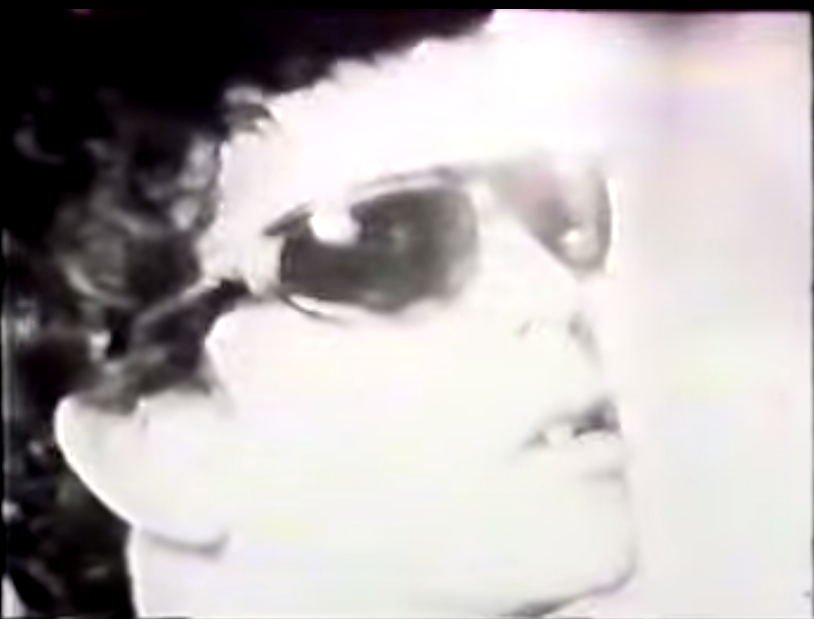
A still from a 1966 film of the Velvet Underground rehearsing by Rosalind Stevenson
“Heroin” is a sonic re-enactment of the physical effects of the eponymous drug, conveyed not only via Reed’s lyrics, but in the backing track’s fluctuations between dreamy bliss and frantic rush. “White Light/White Heat” fuses two sensory metaphors, one visual and one tactile, in order to point to an embodied experience beyond them both. Listen to how the track ends, with surging cymbals and a distorted bass figure whose spasmodic rhythm suggests the dilation of blood vessels, the firing of synapses, and the tightening and release of internal organs that have been kicked into amphetamine overdrive.
The mysterious visceral body can also emerge into our consciousness in moments when the internal rhythms of the heart or lungs are destabilized, as in a sudden heart palpitation or violent case of the hiccups (Barker, The Tactile Eye, 128-29). “Lady Godiva’s Operation” provides a vivid demonstration. The first half of the track is run-of-the-mill hippy exotica, with John Cale’s lead vocal given the conventional placement in the center of the stereo picture. This calm sonic surface is unsettled when Cale’s voice is decentered, shifting first to the left and then the right speaker. The lead vocal fractures even further when Reed begins to finish each of Cale’s lines:
Cale: ‘Doctor is coming,’ the nurse thinks…
Reed: … sweetly.
Cale: Turning on the machines that…
Reed: … neatly pump air.
Cale: The body lies bare.
By integrating these fragmented lines, we learn that a body is lying on an operating table. Listeners are encouraged to inhabit this body through the placement of voices around and above us, as well as the sounds of heartbeats and breathing that enter the mix but are jarringly out of rhythm with the existing backing track. Reed sings that the doctor is making his first incision into the body, and the backing track vanishes, leaving only the heartbeat, breathing, and an eerie whirring vocalization that sonifies some nameless physical process. The scene ends with a dark twist, suitable as a shock tactic from an exploitation film: the anesthetic has malfunctioned, and the patient has regained consciousness in the midst of the procedure.
The track’s arrhythmic sound effects overwhelm the coherent flow of the standard musical mix, working in tandem with the lyric’s account of the body made manifest in a moment of dysfunction. The fact that VU’s “White Light/White Heat” LP contains “Lady Godiva’s Operation,” as well as the title track and “Sister Ray,” makes it a tour de force of tactile phonography. Reed may have been a rock poet, but he and his collaborators were also acoustic engineers who were adept at sonifying tactile experience, producing music worth feeling with our whole bodies.
—
Featured Image- “A Drop of Warhol” by Flicker User Celeste RC
—
Jacob Smith is Associate Professor in the Radio-Television-Film Department at Northwestern University. He has written several books on sound (Vocal Tracks: Performance and Sound Media [2008], and Spoken Word: Postwar American Phonograph Cultures [2011], both from the University of California Press), and published articles on media history, sound, and performance.
—
REWIND!…If you liked this post, you may also dig:
“Devil’s Symphony: Orson Welles’s “Hell on Ice” as Eco-Sonic Critique”–Jacob Smith
“One Nation Under a Groove?: Music, Sonic Borders, and the Politics of Vibration” -Marcus Boon
“Music Meant to Make You Move: Considering the Aural Kinesthetic“-Imani Kai Johnson
Share this:


Current Top Posts





April 2021

January 2020

November 2019

October 2019

August 2019

April 2014

November 2017

March 2015

December 2017

October 2015
 Sounding Out!
Recent Comments