
Blinded By the Sound: Marvel’s Dazzler – Light & Sound in Comics


Trying to reproduce the popularity of KISS-themed comics: Marvel Super Special #5 (1978)
I recently got my hands on a complete set of Marvel Comics’ Dazzler, a comic from the early to mid-80s that featured Alison Blaire, a mutant with the power to transform sound into light. She was the result of an attempted collaboration between Marvel and Casablanca Records. The idea was that rather than publish a comic based on a pre-existing musical act (as they had in 1977 with KISS), Marvel would create a character and Casablanca would, in the words of one of the co-creators, “create someone to take on the persona,” with the potential for a movie tie-in. Casablanca dropped the project before the first issue of the comic, but Marvel re-tooled the character and went ahead with the Dazzler—a talented, yet struggling singer stuck playing at cheesy discos and small clubs while dreaming of wider success.
The last time I wrote about sound in comics, I mentioned how despite (or because of) sound’s transparency, it is an unobstrusive tool in providing the cues needed by readers to provide the closure through which comic literacy functions. The Dazzler series is not a great comic, it is often schmaltzy, repetitive and rife with errors, and just when it started to fulfill a bit of its promise, its creative team and the comic’s direction were changed and it was canceled soon after, but despite this, it is the perfect subject for looking at the representation of sound in comics. Dazzler’s power literally shines a light on how pervasive imagined sound is in this visual/textual form. It also makes room for even more sounds to be woven into the title’s narrative. Since Alison Blaire is an aspiring singer the most prevalent sound present in this title—less common in other popular super heroes titles—is music. Dan Fingeroth and Jacob Springer (who wrote the majority of Dazzler’s brief run) had many opportunities to depict a visual representation of singing.

from Dazzler #21 (Nov 1982). By Fingeroth & Springer
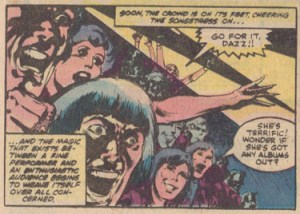
The fans react to Dazzler’s singing – from Dazzler #7 (August 1981), by DeFalco, Fingeroth & Springer
As a singer, Dazzler is a maker of sounds in addition to a user of the sound already present throughout the medium. As a result, in addition to the visual representation of sound through Dazzler’s glowing light show, the writers were in a position of having to use text to describe the quality of sound more often than usual for their genre. As Tom DeFalco (a co-creator and sometimes writer on the series) said in a 1980 interview with Comics Feature, “I have to put in a lot of sounds in the captions and that I hope that kids who very rarely read captions will read these so they’ll know where the sound is coming from. But the good thing about sound is that you are always surrounded by sound.” DeFalco’s answer illustrates the contradiction at the heart of comic sound—it may be ever-present, but because of this is taken for granted to such a degree that he worries that its source will not be self-evident on the comics page. He adds that one way around this, because of Dazzler‘s focus on music, is through descriptions of the audience’s reactions to it—how it makes them feel is a way to clue the readers into the source and quality of sound present in the panels.
It is the affective relationship to sound that marks Dazzler as very different from other superhero comics. All the super-villain battles and fear of the revelation of her mutant powers are merely the narrative obstacles to her primary goal and obsession—singing. In order for that work, the emotions that emerge from her performance (both for Alison and those listening) needs to be evoked (something that the comics unevenly succeeds at). The colorful lights that are often part of a stage show are, in her case, a direct result of her relationship to not only hearing/absorbing sound, but making sound. She repeatedly explains that rhythmic nature of popular music makes her powers easier to use, because she can feel its pulse. For Alison Blaire, hearing, making and using sounds are conflated by means of the visual and textual, allowing the reader to see what he cannot hear or feel. In other words, Dazzler’s conceit is most successful when it evokes an empathic connection between the reader and the imagined sounds.

Black Bolt’s scream converted into light – From Dazzler #19 (Sept 1982), by Fingeroth & Springer
The feeling around sound can also be evoked through its absence. A common practice in mainstream superhero comics is the guest appearance by a popular hero in a new or poorly-selling comic in order to boost sales, and Dazzler seemed to have cameo by some better known character almost every issue. This practice allowed for writers and artists to depict what had for decades been undepictable. When Dazzler teams up with Black Bolt, King of the Inhumans (a Fantastic Four character from back in the Kirby days) he is finally allowed an opportunity to use his greatest and most feared power, his voice. Black Bolt is forever silent. His voice is so powerful a weapon that even his whisper can inadvertently kill all those around him. Thus, despite being an iconic Silver Age character, the voice of Black Bolt is one that can never be “heard” by comic readers. His silence is part of his identity and grants him a tragic and noble-bearing. As such, when he is teamed up with Dazzler, her power becomes the perfect vehicle for representing the unrepresentable sound—Dazzler absorbs the sound of his voice to emit the energy needed to defeat the super-villain. In having the characters work together, the writer was able to use one character’s power to finally represent the other’s. In this moment there is a sense of relief and emotional release, along with a sense of peril that bound to Black Bolt’s voice gives the unheard sound resonance.

Allison turns up the muzak to power her ability. From Dazzler #8 (Oct 1981) by DeFalco, Fingeroth, Springer & Coletta
As the title continued (and after its cancellation, when Dazzler became a member of the X-Men), Alison Blaire’s powers developed in different ways, the most fascinating was the development of her hearing. While early in the character’s career she was dependent on passive hearing, often carrying a portable radio with her in order to insure she had sufficient sound with which to use her light powers, later she developed acute active listening skills. As this aspect of her power developed, it became clear that it was not necessarily the force of sounds themselves that determined the extent of her power (though clearly loud sounds could be more easily transformed into more powerful forms of light, like ultra-focused lasers), but her attentive listening. The more attention she could pay to sounds and could discern even faint sounds, the more she could absorb and transform—later she is even able to use the sounds of digging insects and worms to save herself when she is accidentally buried alive.

From Dazzler #1 (March 1981) by DeFalco & Romita, Jr.
By the end of her original series, Dazzler‘s new writing team had her mostly abandon her musical ambitions and take the more common (and dare I say, more boring) comic book route of getting a costume and joining a team of liked-minded super-beings. Because of this, the character’s special relationship to sound is lost in the shuffle of convoluted continuities and cosmic crises present in the various X-titles. There is less time and attention paid to song and sound as power and its emotional weight. The abandonment of her career goals also abandons the opportunity to explore a unique representation of sound and identity in a medium where identity is writ large. However, if there is a take-away from the strange, mostly failed, collaborative experiment between comics company and records company, it is that like Alison Blaire, if the comics reader “listens” carefully to the sounds present in the text and pictures there is a potential for a lot more depth and appreciation of how sound’s depiction is crucial to comics’ formal success.
—
Osvaldo Oyola is a regular contributor to Sounding Out! and ABD in English at Binghamton University.
Share this:

Hearing “Media-Capitalism” in Egypt

As I began researching my first book Ordinary Egyptians, a study of Egyptian culture from the 1870s until the eve of the 1919 revolution, sounds and early sound media were the last thing on my mind. However, When I dug more deeply into the historical sources, I realized the importance of music and the comedic theater in the urban culture of turn of the century Egypt. This made me expand the scope of my research to incorporate the vernacular culture of Egypt as an entire media-system, which as I showed in my book, was instrumental in constructing a modern Egyptian national identity. Music, songs, plays, chants, speeches, conversations and chatter, were very influential in forming an Egyptian national culture at the end of the nineteenth century, especially in a society with low literacy rates. By incorporating performance and sound media–especially the rising record industry–my book strives to expand the historical study of this period beyond just the visual and the printed to include sound, and aural/oral expressions of culture.
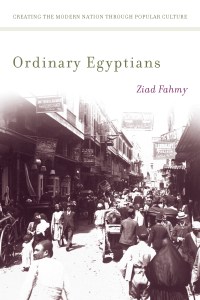
“Muski Street, Cairo, 1903.” Source: William Herman Rau. From Library of Congress Prints and Photograph Division.
Ordinary Egyptians also engages with some of the theories of nationalism and tests their applicability to Egypt and the Arab world. It introduces the concept of “media-capitalism,” which expands the historical analysis of Egyptian nationalism beyond just print and silent reading, through the incorporation of audiovisual, sound, and performance media. By integrating these new media, especially the burgeoning record industry, my book attempts to make room for both the “ear” and the “eye”—for the aural and oral alongside the visual—and in the process provides a more comprehensive explanation for how individuals and communities digest and embody cultural information. As this excerpt explains, cultural productions, in any form, are not socially relevant unless they are communally and socially activated; they must be discussed, breathed, and animated in the routine of everyday life.
The following is an excerpt from Ordinary Egyptians, with thanks to Stanford University Press. Notes have been included in the text to conform to Sounding Out!‘s style sheet.
—
Mundane Nationalism
Egypt’s new mass media reflected on relevant everyday political, economic, and cultural concerns, and amplified them on the national stage in a comprehensible, locally pertinent and entertaining form. The repeated themes of many of these media included: bemoaning the lack of economic opportunities for native Egyptians, portraying the economic exploitation of Egyptians by foreigners, warning of perceived declines in national “morality,” satirizing and at times insulting British and native officials, and rousing patriotism and a sense of collective national solidarity.
However, the most effective way that national identity and a sense of nationhood was ‘absorbed’ was not only through these overstated themes and methods, but through the mundane media portrayals and representations of everyday “national” life and the internalization of these modes in actual practice. As Michael Billig describes in Banal Nationalism, nationalist ideology “might appear banal, routine, almost invisible,” however, these “subconscious” matter-of-fact representations create a common sense “naturalness of belonging to a nation” (15-16). Billig explains that often there is “continual ‘flagging’, or reminding, of nationhood,” as on a daily basis, citizens are reminded of their national identity. This reminding however, is “so familiar, so continual, that it is not consciously registered as reminding” (8). Mundane and unstated representations of Egyptian-ness abounded in most forms of mass culture, where “Egyptians” distinctively spoke and acted and were clearly, though tacitly, differentiated from non-Egyptians. Most of the media examined in this study implicitly addressed their listeners, viewers and readers as members of an Egyptian “nation.” To be sure, the most influential aspect of vaudeville and the satirical press were not necessarily the outwardly nationalistic messages of many of their articles, cartoons, and dialogues, but the recurring and mundane representations of colloquial Cairene as the de-facto dialect of all Egyptians, and the implicit understanding that flawlessly speaking and understanding it was the basic marker of a “modern” Egyptian national identity. Only an “authentic” ibn or bint al-balad (son or daughter of the country) would employ Egyptian Arabic and grasp its multiple meanings and nuances and hence participate in this new mass-produced colloquial culture. In fact, many of the comedic dialogues depicted in political cartoons and vaudeville repeatedly contrasted the mispronunciations of foreigners—who often played unsympathetic or villainous roles—with the “correct” pronunciation of affable Egyptian characters. This repeated portrayal of Cairene as the only “authentic” Egyptian accent reified it as an unofficial dialect of all Egyptians, even if back in the villages and towns of the Sa‛id more localized modes of expression were employed. By way of media-capitalism, Cairo’s dialect and culture was overwhelming—colonizing, if you will— the multitude of other localized dialects and cultures in Egypt. Thus, paradoxically, Cairene Arabic was the primary tool for nationalist, anti-imperialist discourse, and simultaneously, through internal-colonialism, it imposed its own culture on the “nation” [Note: This is very similar to what was happening in France during roughly the same time period. See Eugen Weber’s Peasants Into Frenchmen: The Modernization of Rural France, 1870-1914, 486-88].

“Egyptian crowds with Italian flag during 1919 Revolution.” Source: From L’Illustration (Paris), May 3, 1919.
The Sensorium and the Public Sphere
The efficacy of the new mass media and its potential for mass mobilization was best demonstrated during times of national crisis. The 1906 Dinshaway Incident and the 1919 Revolution in particular reveal how all forms of mass media functioned together to effectively document, memorialize, celebrate, and mobilize on a national scale. The growth of popular Egyptian mass culture, articulated almost exclusively in colloquial Egyptian, was the pivotal factor in the popularization and dissemination of an Egyptian national identity. The evolution and universalization of a colloquial Egyptian middle culture, made possible especially through the utilization of sound and audiovisual media, allowed for a shared and “uniquely” Egyptian cultural landscape. It is primarily within this non-official web of colloquial Egyptian mass culture, driven in large part by media-capitalism, that Egyptian national identity was widely disseminated and popularized.
One crucial aspect of this study was the critical role coffee shops played as cultural hubs, where differing mass media from newspapers to recorded music were publicly merged, negotiated, and digested. Many of the songs initially written for musical and comedic plays were recorded and played, or performed by street musicians at coffee shops and even in the streets and sidewalks. The role of the thousands of urban cafés and other public meeting areas in the broadcasting and reception of these new cultural productions is central to understanding the potency and effectiveness of this developing nationwide culture. Indeed, coffeehouses, as Peter Burke has remarked in A Social History of the Media, “inspired the creation of imagined communities of oral communication” (30).
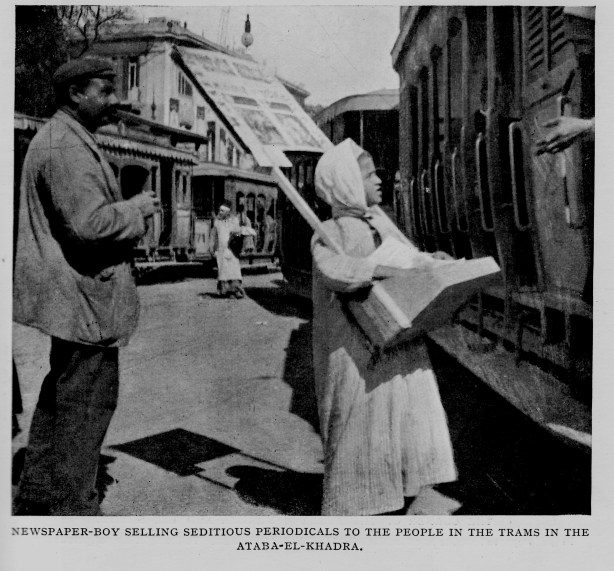
“Egyptian newspaper boy yelling out the latest headlines, Cairo, 1907.” Source: From Douglas Sladen, Oriental Cairo (London: 1911), 64.
However, as discussed in previous chapters, this was never a one way conversation, as writers of these vernacular media were plugged into the streets and public squares through these very same cafés. As we have observed in this study, it can be said that the entire vaudeville theater industry arose out of the cafés on ‘Imad al-Din Street, where most of the vaudeville theaters were housed [Note: See Ibrahim Ramzi, Masrahuna ’Ayyam Zaman wa Tarikh al-Fananin al-Qudama’ (Cairo: Matba‘at al-Salam (1984), 25. There were at least three major cafés in Imad al-Din Street that were frequented by actors, singers, writers, and musicians— Qahwat al-Fan (The Arts Café), Qahwat Barun (The Baron Cafés), and Qahwat Misr (The Egypt Café)]. It was through these dialogical “physical” interactions with the people in the streets, market places, and cafés that the writers, musicians and performers of these media (re)calibrated with the subtleties, textures, and flavors of everyday Egyptian life. As Mikhail Bakhtin cautions in The Dialogic Imagination, we must not ignore the “social life of discourse outside the artist’s study, discourse in the open spaces of public squares, streets, cities and villages;” for it is in these public spheres that Egyptian mass culture is embodied into everyday life, acquiring its socio-economic, political relevance, and more importantly perhaps, its perceived authenticity, and contemporaneity (259). Indeed, access to any form of knowledge— be it visual, aural, tactile, gustatory or olfactory—is corporally mediated and is acquired through a living dialogical engagement. Or as Bakhtin elaborates in Problems of Dostoevsky’s Poetics, “the single adequate form to verbally expressing authentic human life is the open ended dialogue . . . In this dialogue a person participates wholly and throughout his whole life, with his eyes, lips, hands, soul, spirit, within his whole body and deeds” (293). In other words texts alone are meaningless when viewed in isolation of the socially embodied realities of their production, and more importantly perhaps, their reception on the street. It is in their interrelationship with social life that texts become meaningfully activated and authenticated as genuinely reflecting popular concerns and realities. As we have seen throughout this book, colloquial Egyptian culture is better equipped in engaging in this dialogue with the everyday, and hence guaranteeing its circulation and popularity.
(Ordinary Egyptians, p. 170-172)
—
Featured Image: View 042: Egypt – Street in Native Quarter, Cairo., n.d., T. H. McAllister, Manufacturing Optician. 49 Nassau Street, New York. Brooklyn Museum Archives (S10|08 General Views_People, image 9785).
—
Ziad Fahmy is an Assistant Professor of Modern Middle East History at the department of Near Eastern Studies. Professor Fahmy received his History Ph.D. in 2007 from the University of Arizona, where his dissertation “Popularizing Egyptian Nationalism” was awarded the Malcolm H. Kerr Dissertation Award (2008) from the Middle East Studies Association. His first book, Ordinary Egyptians: Creating the Modern Nation through Popular Culture (Stanford University Press, 2011), examines how, from the 1870s until the eve of the 1919 revolution, popular media and culture provided ordinary Egyptians with a framework to construct and negotiate a modern national identity. His articles have appeared in the International Journal of Middle East Studies and in Comparative Studies of South Asia, Africa and the Middle East. Professor Fahmy is currently beginning another book project tentatively titled, Listening to the Nation: Sounds, Soundscapes, and Mass Culture in Interwar Egypt. In 2011-2012, he was a Faculty Fellow at the Society for the Humanities at Cornell University, where the focal theme was “Sound: Culture, Theory, Practice, and Politics.”
Share this:


Current Top Posts





April 2021

January 2020

November 2019

October 2019

August 2019

April 2014

November 2017

March 2015

December 2017

October 2015
 Sounding Out!
Recent Comments