
The Sounds of Selling Out?: Tom Zé, Coca-Cola, and the Soundtrack to FIFA Brazil 2014
 Welcome back to our summer series on “Sound and Sport.” In today’s post, Kariann Goldschmitt discusses the gamechanging controversy over Brazilian musician Tom Ze’s commercial for Coca-Cola’s FIFA 2014. For an instant replay of July’s post click Josh Ottum‘s “Sounding Boards and Sonic Styles: The Music of the Skatepark” or of June’s post, click Tara Betts‘s “Pretty, Fast, and Loud: The Audible Ali.” For May’s post, click Melissa Helquist‘s “Goalball: Sport, Silence, and Spectatorship.” This Thursday’s grand finale will continue our discussion of Brazil, with a podcast by Andrea Medrado entitled “The Sounds of Rio’s Favelas: Echoes of Social Inequality in an Olympic City” AND keep you on the edge of your seat with a bonus Olympic doubleheader post excerpted from David Hendy‘s recent Noise broadcasts for BBC Radio 4 on the sounds of Olympic crowds. And now. . .the sounds of FIFA’s sponsors. —J. Stoever-Ackerman, Editor-in-Chief
—
Tensions in Brazil have been running high as the the country ramps up preparations for next year’s FIFA World Cup. Brazil’s economy is one of the world’s strongest, but its middle class has suffered as economic growth has stagnated amid rapidly rising costs of living. Yet, FIFA demands that Brazil’s government spend large amounts of money to renovate stadiums and further bolster tourism-based services at the expense of everything else. This last June, news of another hike in transit fees was the final straw for many citizens and they took to the streets to protest corruption and the routing of public funds to tournament preparations while basic services suffered. Protesters argue that the country is burnishing its international brand on the backs of its citizens. It is thus no surprise that much of the Brazilian public is fed up with FIFA and its multinational partners. As a consequence, musicians who participate in World Cup-related ad campaigns risk damaging their relationship with the public.
In Spring 2013, the Facebook page of one of Brazil’s most eccentric musical iconoclasts, Tom Zé, was bombarded by negative comments. Unforgivably to some of his most ardent fans, Zé had lent his vocal talents to a Coca-Cola commercial that sought to connect Brazil’s oft-mythologized cultural diversity to the universals of the World Cup and Coca-Cola’s alleged populism. Zé inflected his delivery of the ad copy with an especially musical speaking cadence and rhythm. It was a peculiar take that drew on his signature vocal eclecticism.
The ad opens with Zé stating,
Muita gente se pergunta como vai ser a copa
A coca-cola vai falar como ela não vai ser
[Many people are asking themselves what this cup will be like
Coca-Cola is going to tell you what it won’t be like]
as the shot features a group of people smoothing out a giant kite with the Brazilian flag. There is a strong syncopated rhythm to Zé’s voice that matches the carnival samba drums (especially the caixa) that accompany the ad throughout. As it continues, the imagery matches what Zé describes, in either stills or brief shots, often recalling the frenzy surrounding world cups of the past. In a rapid cadence, he says:
não vai ser só a copa de vuvuzela, do vidente, da celebridade
da menina bonita, do jogadores com cabelo da moda…”
[it won’t be the Cup of the vuvuzela, the psychic, nor of celebrity
of beautiful women, nor of players with fashionable hair]
The synchronization of Zé’s rapidly rhythmic delivery over archetypal images of Brazil’s tournament excitement is crucial to the ad’s message. This passage mentions two icons of the 2010 tournament, the vuvuzela and the psychic (vidente) octopus, with accompanying images. In under four seconds, the camera jumps from a man holding a celebrity magazine (celebridade), a woman cheering (menina bonita), some player figurines (jogadores) and a boy with an elaborate buzz cut. By aligning himself with an official sponsor of the upcoming tournament through ad copy that valorizes Brazil’s present, Zé also lent the sound of his voice to the sports-industrial complex, thereby opening himself up to accusations that he was a “sell-out” (vendido).
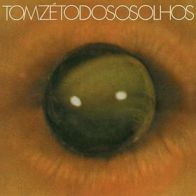
Tom Zé – Todos os Olhos (1973)
Zé is famous for taking part in the tropicália of the late 1960s – a cultural movement that was most effective through popular music. Tropicália musicians bucked Brazilian musical conventions by blending imported rock ‘n’ roll with national music protest songs during a period when musical taste often indicated one’s support or disapproval of the military dictatorship. While most involved in tropicália eventually became Brazilian musical mega-stars (Caetano Veloso, Gilberto Gil, Gal Costa, Os Mutantes, and Mara Bethânia), Zé drifted to obscurity by rejecting many of the machinations of the record industry. He only found an international audience when David Byrne’s Luaka Bop Records released some of his music in the 1990s, the most successful of which was Fabrication Defect [Com Defeito de Fabricação] (1998). Due to his peculiar status, Zé disrupted fan expectations and threatened his brand when he embraced a corporate power so intricately connected to an increasingly unpopular athletic tournament.
The controversy surrounding the Coca-Cola ad took a turn towards farce when, on April 22nd, 2013, Zé released a free 5-song EP on his website titled Tribunal do Feicebuque – a clear play on the way that Brazilians tend to pronounce “Facebook.” Accompanying the songs was a parody of tribunal orders listing the performing and collaboration credits along with lyrics to the songs. Zé’s actions exposed how the incident was a different kind of sonically-driven sports spectacle – this time it was played out over social media, in Brazil’s most influential newspaper, in Tribunal references and fights with fans during his shows at Rio’s famed Circo Voador, and in the ensuing blog reviews of his shows.
The chaotic structure of the EP’s title track, while typical of Zé catalog, disrupts his fans’ claims of “selling out.” He employs a variety of sonically disjunct approaches, opening with the startup sound for Microsoft’s Vista OS before jumping into a psychedelic samba-rock tune with a staccato guitar and a brass section. Zé recorded his vocals over multiple tracks, at times simultaneously sung/spoken at a low pitch and sung at a high pitch. The first half is familiar – the voices trade between Zé and a female companion in something sounding like a duet over a samba-rock beat. The lyrics directly reference infamous moments when Brazilian audiences have turned on their musical icons thought to be too involved in international business influences.
Vendido, vendido, vendido!
A preço de banana
Já não olha mais pro samba
Tá estudando propaganda
[Sell-out, sell-out, sell-out!
The price of a banana
He no longer looks to samba
He’s studying advertising]
At the mid-point, rock gives way to a serious march and more voices enter (including famed São Paulo hip-hop artist Emicida) making the song’s structure more like a trial, complete with competing arguments, before returning to samba-rock under Emicida’s rapping. The song is creative and fun, but it is far from Brazil’s top-40 fare which often favors smoother genre blends and urban pop hits.
Given all of the attention paid to musicians’ efforts to supplement their meager income from digital sales and streaming royalties by forging partnerships with a variety of multinational corporations, it is a little surprising that Tom Zé’s participation in a Coca-Cola commercial would be this controversial. It is difficult to find a musician in Brazil that hasn’t benefitted from some kind of corporate sponsorship. Most artists accept funding from a granting arm of a national corporation (oil company Petrobras, major bank Itaú), license music to national ad campaigns, or embark on a more direct co-branding effort from the likes of mobile phone providers and skin care companies.

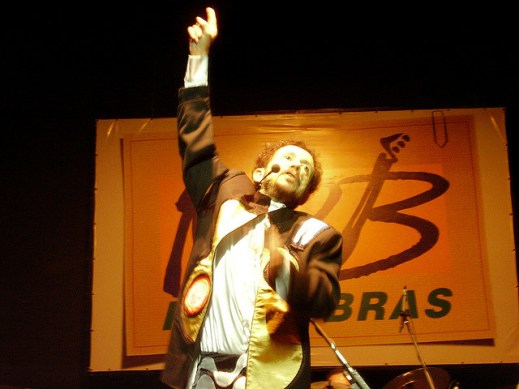
Tom Zé in 2008 performing in front of a Petrobras sign, photo used by CC license, Neto Silveira
One of the hallmarks of the recent changes that have affected the music industry is that musicians rarely refuse opportunities for their music to be used as the soundtrack for mainstream audio/visual entertainment and advertisements. The practice is so common that one of the best-regarded music industry survival books explains possible changes to a musician’s brand when they participate in the advertising of other products. Instead of “don’t license your music,” musicians should license their music in a way that will benefit their brand. It is rare for a song’s success among World Cup spectators to harm musicians; anthems that reflect well on the host nation(s) and express the energy of cheering crowds are a central feature of the tournament. Shakira’s “Waka Waka” actually bolstered her credibility among music fans across the African continent because it sampled Golden Sounds’ hit “Zamina Mina,” a popular song among hip-hop artists in Camaroon and Senegal. In Zé’s case, he misjudged how the tournament and its corporate sponsors were being read by the Brazilian public just weeks before tensions exploded in protest. Indeed, as compared to other Brazilian artists who have recorded potential 2014 World Cup anthems, the reaction to Zé is unique.
As others have noted, television advertising played an important role in the June protest soundtrack. Protesters appropriated the song from a Fiat commercial (released just weeks after Zé’s Facebook episode) that explicitly connects cheering soccer crowds in the street to a new car.
The meaning of “torcer,” a common expression for “cheer” in both advertisements’ copy, is transformed back to its original meaning to wrench or twist thereby exposing the conflicts that have been exacerbated by Brazil’s preparations for the tournament and the sports industrial complex.
These crowds twisted an ad’s soundtrack to challenge the role of multinational agencies and corporations in Brazil’s skewed socio-economic priorities. Indeed, as Leo Cardoso wrote in Sounding Out! a year ago, some of these priorities include regulating sound in Brazil’s largest cities.
For both of these cases involving sonic responses to advertisements that explicitly seek to capitalize on excitement for the soccer tournament, their original intended meaning was twisted and wrenched, forcing musicians to re-evaluate their publics. In the current political climate, Zé found that musical sounds can be aligned with the FIFA World Cup, so long as they are about celebrating sport rather than its multinational sponsors.
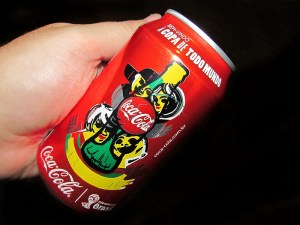
Promotional FIFA 2014 Can, Photo used by CC license, José Roitberg
—
Featured Image: Tom Zé in 2008 performing in front of a Petrobras sign, photo used by CC license, Neto Silveira
—
Kariann Goldschmitt is an Adjunct Assistant Professor at New College of Florida and Ringling College of Art and Design. She holds a Ph.D. in Musicology from UCLA (2009) and was the 2009-2011 Mellon Fellow of Non-Western Music at Colby College in Maine. Her scholarly work focuses on Brazilian music, modes of listening, and sonic branding in the global cultural industries. She has published in The Journal of Popular Music Studies, American Music, Yearbook for Traditional Music, and Luso-Brazilian Review and contributes to the South American cultural magazine, Sounds and Colours.
—

REWIND! . . .If you liked this post, you may also dig:
“Sound-politics in São Paulo, Brazil”–Leonardo Cardoso
Quebec’s #casseroles: on participation, percussion and protest–Jonathan Sterne
Hello, Americans: Orson Welles, Latin America, and the Sounds of the “Good Neighbor”–Tom McEnaney
Share this:

Soundscapes of Narco Silence
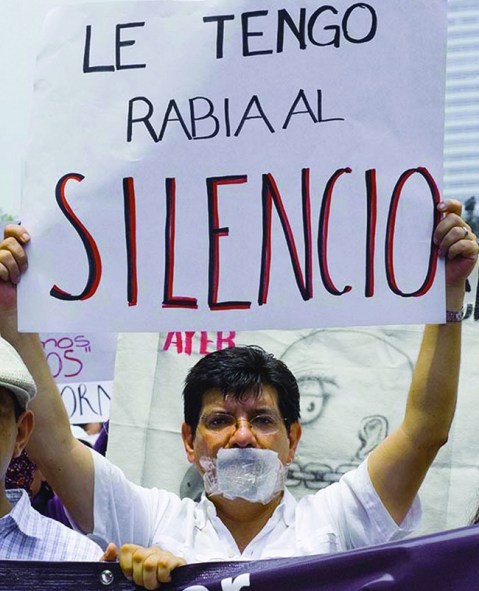
Journalists protest in silent march in Mexico City, Courtesy of the Knight Foundation
Since the drug war began, the lives of approximately 95,000 people have been claimed, with an estimated total of 26,000 disappearances (“Continued Humanitarian Crisis at the Border” June 2013 Report). At the University of Texas, Pan American – an institution located 25 miles north of Reynosa, Mexico (a Mexican city that has been hard hit by drug violence in recent years) – I teach students who have been dramatically impacted by drug war violence. Many have close relatives affected or hear horrific stories of those who have been kidnapped by the cartels; many fear traveling to Mexico to visit loved ones as a result and, in some cases, they report having relatives involved in the drug cartel business. Dinorah Guerra, psychotherapist and head of the Red Cross in Reynosa, describes the devastating psychological and physical toll: “There is a huge risk for people’s self esteem. They cannot speak about what they have seen or what they have heard. [They] lose [themselves] and lose [their] identity” (qtd. in Pehhaul 2010).
I name the space of the drug war and its resulting terror in the U.S.-Mexico border the “soundscape of narco silence.” This soundscape includes death and intimidation, from the brutal killings of news reporters by cartel members to the decapitation of citizen-activists who use online media to alert communities of narco checkpoints. It also consists of those powerful acts that call attention to silence as a tactic of terror. The Movement for Peace with Justice and Dignity, for instance, brought together tens of thousands of people in Mexico to speak out against drug violence through silent marches. Cultural productions, such as narcocorridos, or contemporary drug ballads that document the cross-border drug economy, also become part of the soundscape. The narcocorridos function as a powerful critical response to silence and fear because they enable those in Mexican society, as Jorge Castañeda, author of El Narco: La Guerra Falllida, explains, “to come to terms with the world around them, and drug violence is a big part of that world. The songs are born out of a traditional Mexican cynicism: This is our reality, we’ve gotten used to it” (Qtd. in Josh Kun 2010).
In this blog post, I focus on the role of U.S. Latina/o theater produced in the South Texas border region as it responds to the soundscape of narco silence. Building on David W. Samuels, Louis Meintjes, Ana Maria Ochoa, and Thomas Porcello’s definition of “soundscapes” in “Soundscapes: Towards a Sounded Anthropology” as “the material spaces of performance and ceremony that are used or constructed for the purpose of propagating sound” (330), I suggest that soundscapes of silence in theater function as material spaces of performance that focus the public’s attention on silence – with the intent of intervening in acts that propagate silence and fear. Soundscapes of narco silence are characterized not only by violence and terror, but by cultural productions that function as forms of critical resistance – those works that focus the publics’ attention on the economy of silence and fear that fuels the drug war, and in the process, enable communities to cope with narco violence.
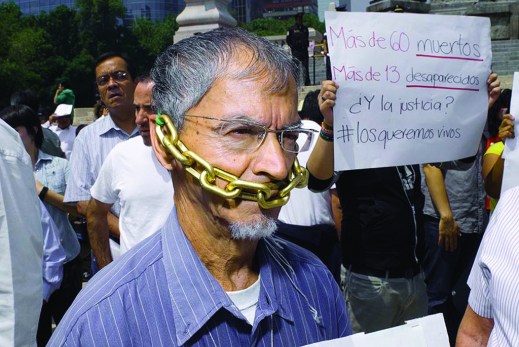
Journalists protest in silent march in Mexico City, Courtesy of the Knight Foundation
To closely listen to the soundscape of narco silence, I engage with the play script and production of Tanya Saracho’s play El Nogalar at South Texas College Theatre (STC) under the direction of Joel Jason Rodriguez in McAllen, Texas in June 2013. The play was first produced at the Goodman Theater in Chicago in April 2011, with a West Coast premiere at the Fountain Theater in Los Angeles in January 2012. I critically analyze the STC Theatre production’s incorporation of a multi-genre soundtrack that included narcocorridos, rancheras, and nortec (norteño + techno). I argue that this soundtrack focused audiences’ attention not only on the devastating effects of silence, but also the function of silence as a form of capital for those most excluded in society. I also offer a brief critical listening of the script’s rendering of silence through character dialogue and stage directions.
El Nogalar tells the story of an upper-class Mexican family comprised of three generations of women (Maité, Valeria, and Anita) whose land and home in the fictionalized estate of Los Nogales in Nuevo Leon, Mexico, and its adjacent nogalar (pecan orchard), are under threat by the maña (drug cartels) moving into the region. The play focuses on the women’s responses to the drug war economy as a result of their different relationships to home (both their estate and the space of Mexico). It also centers the experiences of Dunia, their maid, and López, a former field worker who now works for the maña.

STC Theater Production of El Nogalar. Photo Credit: Miguel Salazar
Cecilia Ballí, in her article “Calderón’s War: The Gruesome Legacy of Mexico’s Antidrug Campaign,” explains the particular circumstances of marginalized men in this society: “The worst casualties of this ‘civil war’ were the estimated 7 million young men to whom society had closed all doors, leaving them the options of joining a drug gang or of enlisting in the military, both of which assured imprisonment of death” (January 2012, 48). With the characters López and Dunia, the play asks audiences then to listen to the impact of the drug war on the most vulnerable populations in Mexico and the US-Mexico border region.
The play script conveys how “narco silence” can be used by those who either seek to preserve traditional class hierarchies (the story of the matriarch Maité) or to survive and profit in the new drug economy (the story of López). “Narco silence,” a term coined by reporter Jonathan Gibler in his book To Die in Mexico, refers to “not the mere absence of talking, but rather the practice of not saying anything. You may talk as much as you like, as long as you avoid the facts. Newspaper headlines announce the daily death toll, but the articles will not tell you anything about who the dead were, who might have killed them or why. No detailed descriptions based on witness testimony. No investigation” (2011, 23). In an early exchange between López and Dunia, López defends “narco silence” as a strategy of survival:

STC Theater Production of El Nogalar. Photo Credit: Miguel Salazar
DUNIA: Why are you the only one they leave alone, Memo?
LÓPEZ:….
DUNIA: All the men your age. Killed. Why Memo? (Beat).
LÓPEZ: Because I know when to keep my mouth shut which is not something I can say for you….
DUNIA: So that’s all it takes to be best of friends with the Maña? That doesn’t seem so hard to do? (American Theatre Magazine July/August 2011, 74).
Later in the play, Dunia, heeding López’s advice, offers a powerful observation of how “narco silence” enables her community to cope with death: “We all just walk around like we’re a movie on mute. You can see people’s mouths moving but all you hear is the static (my italics)” (American Theatre Magazine July/August 2011, 73-74).
The STC Theatre production enhanced the script’s soundscape of narco silence through its sound design, with a soundtrack that included rancheras, narcocorridos, norteño and nortec. This music provided audiences with a connection to the world of Los Nogales and captured each character’s process of coping with narco violence. For example, Maité’s soundtrack consists of several rancheras, such as Lola Beltran singing “Los Laureles” and Chavela Vargas’s powerful rendition of “Que te vaya Bonito.” Beltran’s “Los Laureles” – a cancion ranchera that includes Beltran’s powerful female vocals and mariachi orchestra instrumentation – invites audiences to hear Maité’s nostalgia and desire for an idealized Mexican society and her wish to preserve traditional class hierarchies.
.
Vargas’s powerful rendition of “Que te vaya Bonito” captures Maite’s pain and suffering as she loses her home to the cartels. In Vargas’s version of “Que te Vaya Bonito” – a song about love and abandonment – audiences hear Vargas’s choking and sobbing voice, accompanied by a single guitar.
.
Vargas’s voice conveys, what Lorena Alvarado powerfully argues, is “the body’s dilemma between the hysteria of sobbing and the intelligibility of words, between resignation and retribution” (2010, 4). Vargas’s powerful singing also conveys, as Alvarado further describes, “un nudo en la garganta,” a common expression in Spanish that describes “the knot in the throat, when one cannot speak because words will not come out, but the desperate, or quiet, breath of tears” (Alvarado 2010, 5).
To sonically register the drug cartel economy and lifestyle underlying the “new” Los Nogales, the soundtrack also included narcocorridos. The first sounds we hear in the play are from the narcocorrido “El Carril Número Tres” – which includes two acoustic guitars and an electric bass – by Los Cuates de Sinaloa.
.
“El Carril Número Tres” – tells the story of a secret “lane number three” that allows a Mexican drug lord to freely go back and forth between the US and Mexico because he makes a deal with the CIA and DEA. With this focus on the US government’s involvement in the drug trade, the song centers how silences north of the US-Mexico border have perpetuated drug violence.
The music also included nortec, with songs by the Mexican Institute of Sound, particularly the track “Mexico,” which is a critique of the Mexican government’s complicity with the narcos.
.
With “Mexico,” audiences hear a fusion of norteño, electronic, and hip-hop with lyrics that use the symbols of Mexican national identity and culture to focus the public’s attention on violence and terror. With the lyrics “green like weed, white like cocaine, red your blood” (referencing the Mexican flag) and “at the sound of the roar of the cannon” (alluding to the national anthem), the song powerfully invokes the visual and sonic soundscape of violence that terrorize Mexican residents. With this charged critique of government corruption, “Mexico” momentarily interrupts the soundscape of narco silence rendered in the play script and rest of the soundtrack.
Ultimately, the production’s combination of rancheras, narcocorridos, and nortec captured the class tensions in Mexican society and emphasized the play’s critique of class structures that have enabled drug war violence to persist. With this range of music, the director explains he wanted to “maneuver between the [various] aspects of [the story]: the nostalgia, the corridos, the narcocorridos, and also this fusion of saying ‘we want something more,’ and so that was the whole aspect of it; the blending of the old, the new, and what the present is” (Interview with author July 2013).
The production also deliberately incorporated the sound of silence, particularly in the final scene. By the end, López buys the Los Nogales estate, thereby increasing his class status and social power. Saracho’s stage directions in this final moment indicate “an interpretive sound of trees falling. Now don’t go cueing chainsaws because it’s not literal. Just make me feel trees are falling. Along with the upper class” (87). The play’s reference to the staging of “an interpretive sound of trees falling” brings to mind the philosophical question: “If a tree falls in a forest and no one is around to hear it, does it make a sound?” We might then interpret the final sounds of El Nogalar as inviting audiences to listen attentively to the soundscape of narco silence, implicating audiences as social actors in the politics of the drug war that continue to devastate Mexican society.
—
Featured Image: Journalists Protest against rising violence during march in Mexico, Courtesy of the Knight Foundation
—
Marci R. McMahon received her Ph.D. from the University of Southern California with affiliations in the Department of American Studies and Ethnicity. She is an assistant professor at the University of Texas, Pan American, where she teaches Chicana/o literature and cultural studies, gender studies, and theater and performance in the Departments of English and Mexican American Studies. She is the author of Domestic Negotiations: Gender, Nation, and Self-Fashioning in US Mexicana and Chicana Literature and Art published by Rutgers University Press’ Series Latinidad: Transnational Cultures in the United States (May 2013). Her essays on Chicana literature and cultural studies have been published in Aztlán: A Journal of Chicano Studies; Chicana/Latina Studies: The Journal of MALCS; and Frontiers: A Journal of Women’s Studies. Her second book project, Sounding Latina/o Studies: Staging Listening in US Latina/o Theater explores how contemporary Latina/o drama uses vocal bodies and sound to engage audiences with recurring debates about nationhood, immigration, and gender.
—
REWIND! . . .If you liked this post, you may also dig:
Listening to the Border: “’2487’: Giving Voice in Diaspora” and the Sound Art of Luz María Sánchez–D. Ines Casillas
Quebec’s #casseroles: on participation, percussion and protest–Jonathan Sterne
Deejaying her Listening: Learning through Life Stories of Human Rights Violations— Emmanuelle Sonntag and Bronwen Low
Share this:


Current Top Posts





April 2021

January 2020

November 2019

October 2019

August 2019

April 2014

November 2017

March 2015

December 2017

October 2015
 Sounding Out!
Recent Comments